Buying interior panels without knowing SOLAS rules risks severe project delays and rejected inspections. It is frustrating and costly. I will show you exactly which vessels need these certified panels.
SOLAS-compliant marine wall and ceiling panels are strictly required for passenger ships carrying over 12 passengers, cargo ships of 500 gross tonnage (GT) and above on international voyages, and Special Purpose Ships, while generally exempting domestic vessels, fishing boats, and specific workboats.
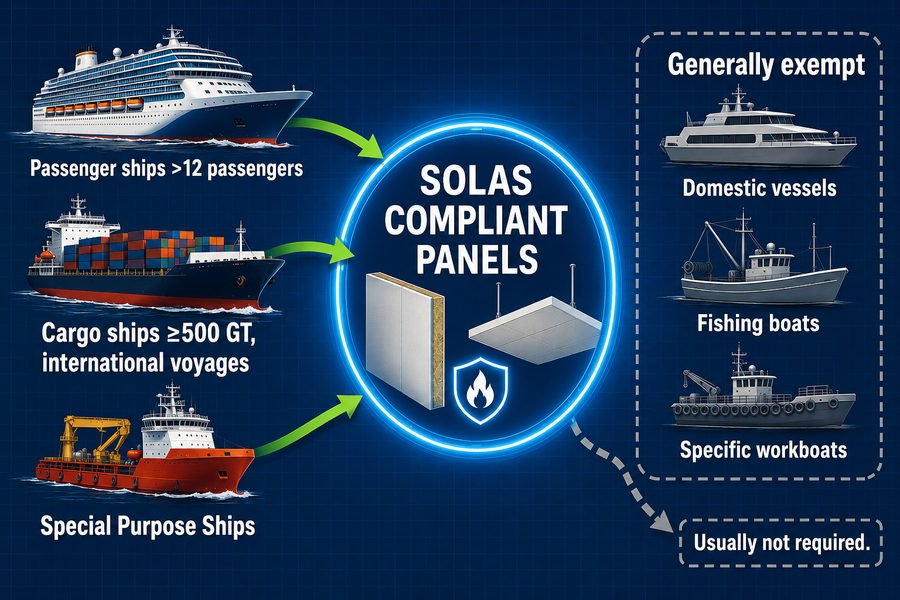
Let's look at the specific ship types to help you buy the right panels for your next shipyard project.
Does SOLAS Cover Cargo Ships Under 500 GT for Marine Panel Selection?
Selecting marine panels for small cargo ships can be confusing. Buying over-spec panels wastes your budget, while under-spec panels risk safety. Here is the clear rule.
No, SOLAS regulations do not mandate SOLAS-compliant marine wall and ceiling panels for cargo ships under 500 Gross Tonnage (GT) on international voyages. These smaller vessels follow local national regulations or specific classification society rules instead of the mandatory international SOLAS fire safety frameworks.
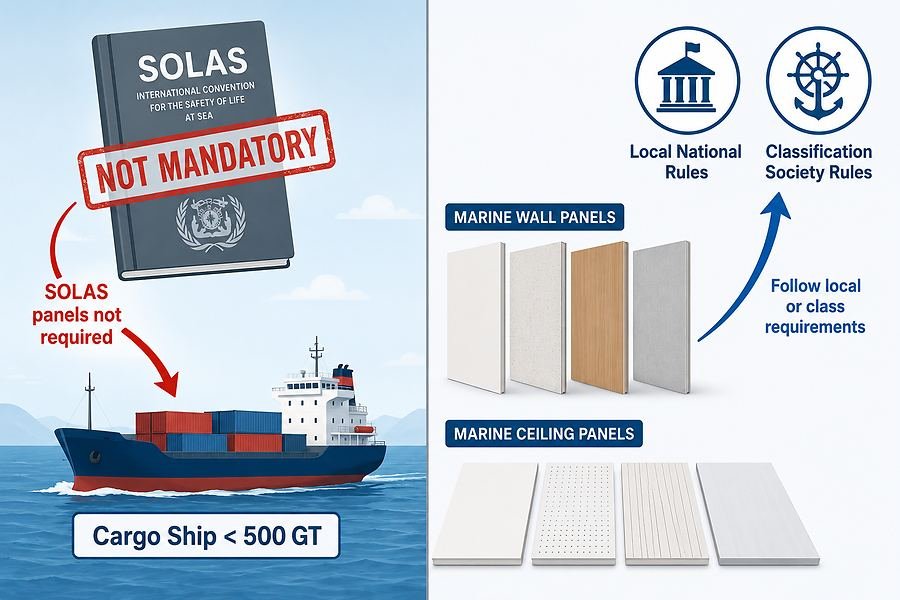
I often see buyers waste money by ordering fully certified SOLAS panels for small coastal freighters. You do not always need them. According to SOLAS Chapter I, Regulation 3, the international convention does not apply to cargo ships under 500 GT1. Instead, you must look at local national regulations and classification society rules.
Local National Regulations for Small Cargo Ships
When a cargo ship is under 500 GT, the flag state's local national regulations take over. For example, in the United States, the US Coast Guard (USCG) uses Subchapter I for cargo vessels2. These local rules often require non-combustible materials, but they might not demand the strict 15-minute fire insulation tests required by SOLAS3. I have helped clients save up to 40% on material costs by sourcing simple aluminum honeycomb panels instead of heavy B-15 rock wool panels when local rules allowed it. You must read the specific national code for the country where the ship is registered.
Classification Society Rules for Unregulated Vessels
Even if SOLAS does not apply, the ship's classification society still has rules. Societies like DNV, ABS, or Lloyd's Register have their own guidelines for small vessels4. They focus heavily on basic structural fire protection. A classification surveyor might approve high-quality marine plywood treated with fire retardants for a small 300 GT cargo ship. A standard SOLAS B-15 panel from China or Vietnam costs around $45 to $65 per square meter. In contrast, an uncertified but class-approved fire-retardant board might only cost $20 to $30 per square meter. Knowing this difference helps you control your project budget and win more decoration contracts.
Panel Requirements vs. Vessel Tonnage
| Vessel Type | Tonnage | Governing Rule | Typical Panel Requirement | Estimated Cost (per sqm) |
|---|---|---|---|---|
| International Cargo Ship | Over 500 GT | SOLAS Chapter II-2 | B-15 or C-Class Certified | $45 - $65 |
| International Cargo Ship | Under 500 GT | Classification Society Rules | Class-Approved Fire Retardant | $20 - $35 |
| Domestic Cargo Ship | Under 500 GT | Local National Regulations | Basic Non-Combustible | $15 - $30 |
Must International Passenger Ships Use SOLAS-Compliant Marine Wall and Ceiling Panels?
Passenger ship fires are catastrophic. Using the wrong interior panels can lead to deadly smoke and rapid fire spread. You must follow these strict rules.
Yes, international passenger ships carrying more than 12 passengers must strictly use SOLAS-compliant marine wall and ceiling panels. The regulations require specific fire-rated divisions, typically B-15 class, to ensure safe evacuation routes, limit fire spread, and rigorously control toxic smoke emissions during emergencies.
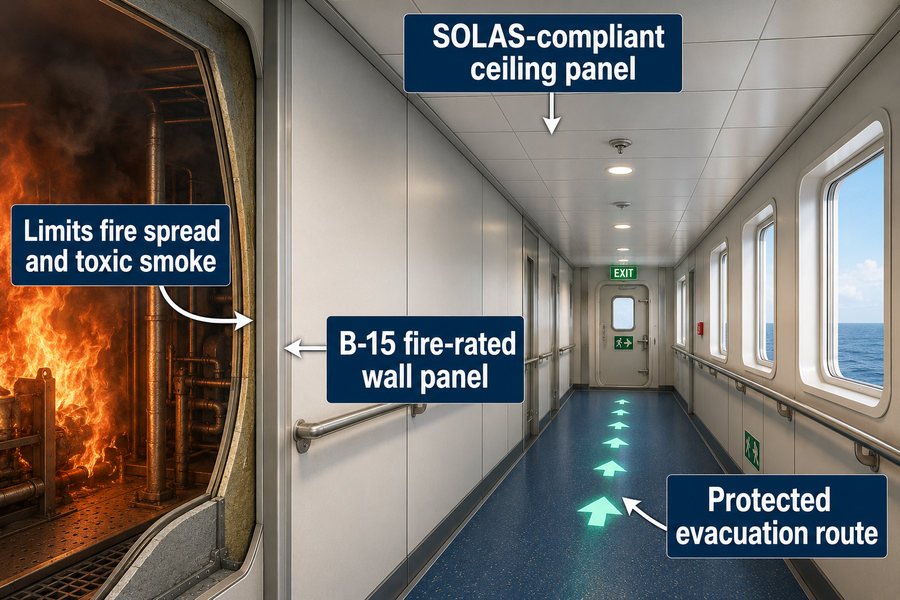
If you buy materials for a passenger ship, you have no room for mistakes. SOLAS Chapter II-2 dictates every detail of fire protection for these vessels. An international passenger ship is defined as any ship carrying more than 12 passengers on an international voyage5. For these ships, you must buy panels with strict fire ratings and low smoke emissions.
Specific Fire-Rated Divisions for Safe Evacuation
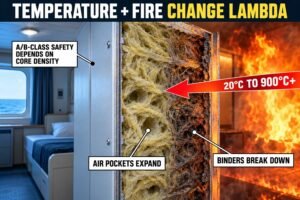
SOLAS requires passenger ships to use specific fire-rated divisions to divide the ship into main vertical zones6. The most common panel you will buy is the B-15 class panel. A B-15 panel means it can stop a fire for 15 minutes. It also keeps the temperature on the unexposed side from rising more than 139°C on average7. To achieve this, high-quality panels use rock wool cores with a density of at least 120 kg/m³ to 150 kg/m³. You must ensure your Asian suppliers provide valid Marine Equipment Directive (MED) Wheelmark certificates. Without these certificates, European and US shipyards will reject your materials immediately.
Limiting Fire Spread and Toxic Smoke Emissions
Limiting fire spread and smoke is just as important as the fire rating. The surface materials on your wall and ceiling panels must comply with the IMO Fire Test Procedures (FTP) Code. Specifically, they must pass Part 2 (Smoke and Toxicity Test) and Part 5 (Test for Surface Flammability)8. Many cheap PVC films create deadly toxic smoke when they burn. You must only buy panels covered with PVC films or painted surfaces that have passed these specific FTP Code tests. A high-quality B-15 panel with certified low-flame spread PVC finish will cost around $50 to $70 per square meter, depending on the thickness and acoustic ratings.
SOLAS Fire Ratings for Passenger Ship Bulkheads
| Fire Rating Class | Insulation Time | Integrity Time | Core Material Requirement | Common Application Area |
|---|---|---|---|---|
| A-60 Class | 60 Minutes | 60 Minutes | High-Density Rockwool + Steel | Machinery space boundaries |
| B-15 Class | 15 Minutes | 30 Minutes | Rockwool (120-150 kg/m³) | Passenger cabin partitions |
| B-0 Class | 0 Minutes | 30 Minutes | Non-combustible materials | Corridor ceilings |
| C Class | None | None | Non-combustible materials | Internal cabin division |
Do Domestic-Only Vessels Need SOLAS-Certified Marine Wall Panels?
Buying expensive certified panels for domestic ships eats into your profits. But ignoring local safety rules is equally dangerous. Let us clarify the exact requirements.
Domestic-only vessels are not strictly required by international law to use SOLAS-certified marine wall panels. Instead, they must comply with their specific national maritime authority regulations, which often adopt modified, less stringent versions of SOLAS standards to balance basic fire safety with lower construction costs.
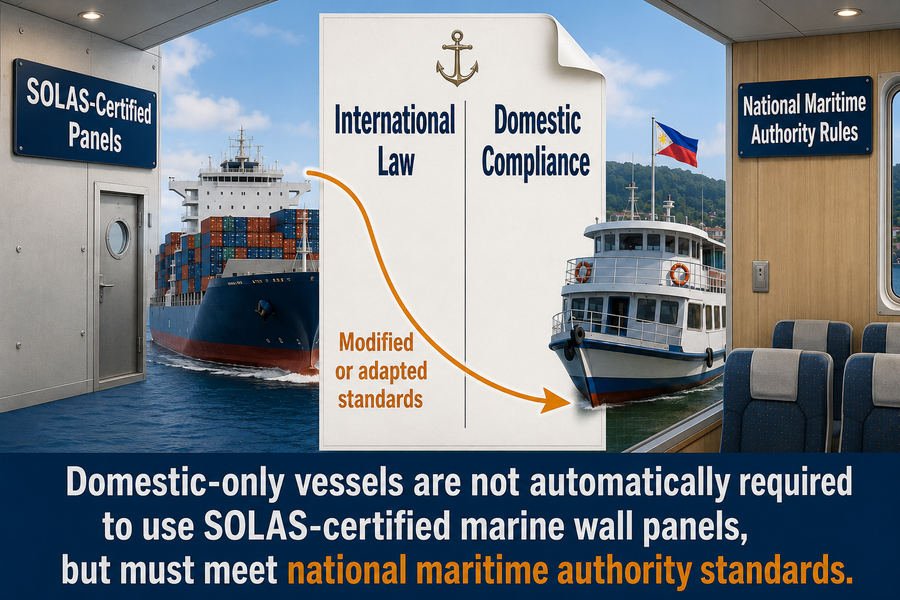
When you undertake a project for a domestic vessel, you operate under different rules. These ships never leave their home country's waters. Because of this, the strict international SOLAS treaties do not automatically apply to them9. You must look at the specific national maritime authority regulations and understand how they modify international standards to lower construction costs.
Specific National Maritime Authority Regulations
Every country has a national maritime authority. In China, it is the Maritime Safety Administration (MSA). In the United States, it is the Coast Guard (USCG).10 These authorities write their own rules for domestic ships. They usually look at SOLAS but remove the most expensive requirements. For example, a local authority might say a river cruise boat only needs "non-combustible" panels, rather than fully certified B-15 panels. A standard non-combustible marine panel without a full MED Wheelmark certificate can be sourced in Asia for about $25 to $35 per square meter. This is a massive cost reduction for your interior decoration company.
Balancing Fire Safety with Lower Construction Costs
National rules aim to balance basic fire safety with lower construction costs. Domestic ships are usually closer to shore, so rescue teams can reach them faster.11 Therefore, they do not always need panels that contain a fire for 60 minutes. However, you cannot just buy regular construction materials. You still need marine-grade products. The panels must resist moisture, vibration, and basic fire threats. I advise my clients to buy high-quality panels from reputable factories in China or Vietnam, but ask the factory for their "Class Approved" line rather than their "MED Certified" line. The physical quality is often the same, but you do not pay the premium for the European certification testing.
Comparison of International vs. Domestic Panel Compliance
| Feature | International SOLAS Vessel | Domestic-Only Vessel | Impact on Procurement |
|---|---|---|---|
| Governing Body | IMO (International Maritime Organization) | National Maritime Authority (e.g., USCG, MSA) | Determines which certificates to request. |
| Certification | MED Wheelmark / USCG Full Approval | Local Authority Approval / Basic Class Approval | Domestic materials are easier to source. |
| Fire Test Standard | IMO FTP Code Part 3, 5, and 212 | Local adapted standards | Reduces testing costs for manufacturers. |
| Material Cost | High ($50 - $80+ per sqm) | Moderate ($25 - $45 per sqm) | Higher profit margins on domestic projects. |
Which Flag Registries Exempt Vessels From SOLAS Marine Panel Rules?
Flag state rules can completely change your procurement strategy. Misunderstanding these exemptions means you might buy expensive certifications you do not actually need.
No recognized international flag registry completely exempts SOLAS-applicable vessels from marine panel rules. However, registries may grant specific exemptions for sheltered water vessels, non-propelled barges, or historical ships based on individual risk assessments and local equivalence rules.
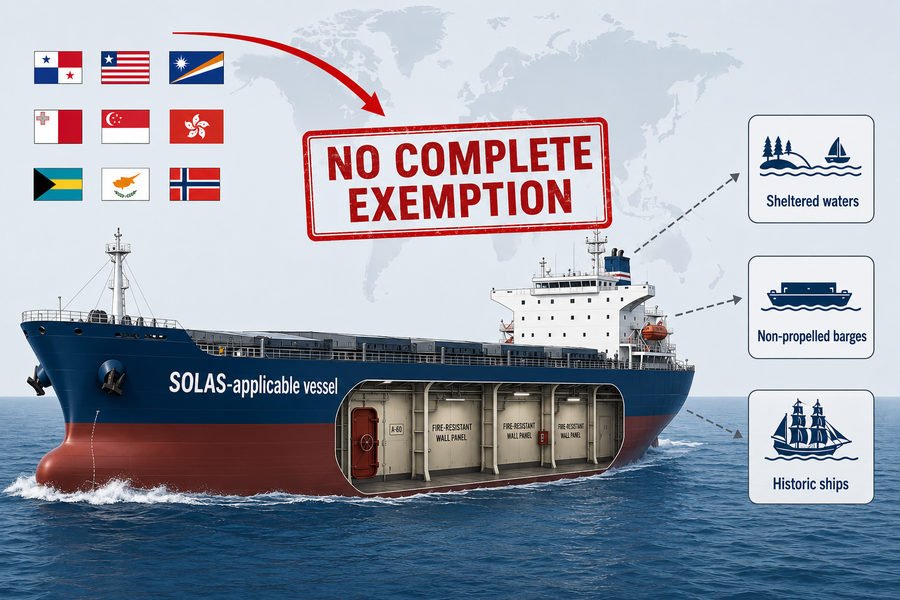
Many buyers hope that registering a ship in a specific country will let them use cheaper, uncertified panels. This is a myth. Major international flag registries like Panama, Liberia, and the Marshall Islands strictly enforce SOLAS rules for standard cargo and passenger ships.13 However, there are very narrow exceptions for sheltered water vessels, non-propelled barges, and historical ships based on specific equivalence rules.14
Exemptions for Sheltered Water Vessels and Non-Propelled Barges
Flag registries have the power to grant exemptions for ships that operate in very low-risk environments. A sheltered water vessel, like a ferry that only crosses a calm bay, might get an exemption. Non-propelled barges, such as floating accommodation platforms moored permanently in a harbor, also frequently get exemptions. Because these vessels do not face the same risks as deep-sea ships, the flag state might allow you to use standard industrial fire-rated panels instead of strict marine B-15 panels. Standard industrial fire panels are much cheaper. However, you can never assume this. You must always get written confirmation from the flag state surveyor before you issue a purchase order.
Individual Risk Assessments and Local Equivalence Rules
Under SOLAS Chapter I, Regulation 5, there is an "Equivalents" clause. This allows a flag registry to accept alternative materials if they are just as safe as the required ones. For historical ships, installing modern thick rockwool panels might destroy the ship's design. The shipyard can submit an individual risk assessment. They might propose using a fire-retardant coating over the original wood instead of installing new SOLAS marine wall panels. The flag registry will review this assessment and apply local equivalence rules.15 If approved, they issue an Exemption Certificate.16 As a procurement officer, you must demand a copy of this Exemption Certificate from the shipyard before you buy non-standard materials.
Common Flag State Exemption Categories for Marine Panels
| Vessel Category | Operating Environment | Typical Flag State Action | Panel Purchasing Strategy |
|---|---|---|---|
| Deep-Sea Cargo > 500 GT | International Oceans | No Exemption | Buy strict SOLAS MED certified panels. |
| Sheltered Water Ferry | Bays, Harbors, Rivers | May grant partial exemption | Seek written approval for lower-rated panels. |
| Non-Propelled Barge | Permanently Moored | Often granted equivalency | Buy industrial fire-rated panels if approved. |
| Historical Ship | Coastal / Exhibition | Individual Risk Assessment | Supply specialized fire-retardant treatments. |
Do Fishing Vessels and Workboats Fall Under SOLAS Marine Panel Requirements?
Outfitting fishing vessels and workboats with the wrong materials wastes money. These boats have unique operating conditions and different safety frameworks entirely.
Fishing vessels and general workboats do not fall under standard SOLAS marine panel requirements. Instead, international fishing vessels follow the Cape Town Agreement or the Torremolinos International Convention, while workboats adhere to specific national codes that dictate their distinct fire protection and interior panel standards.
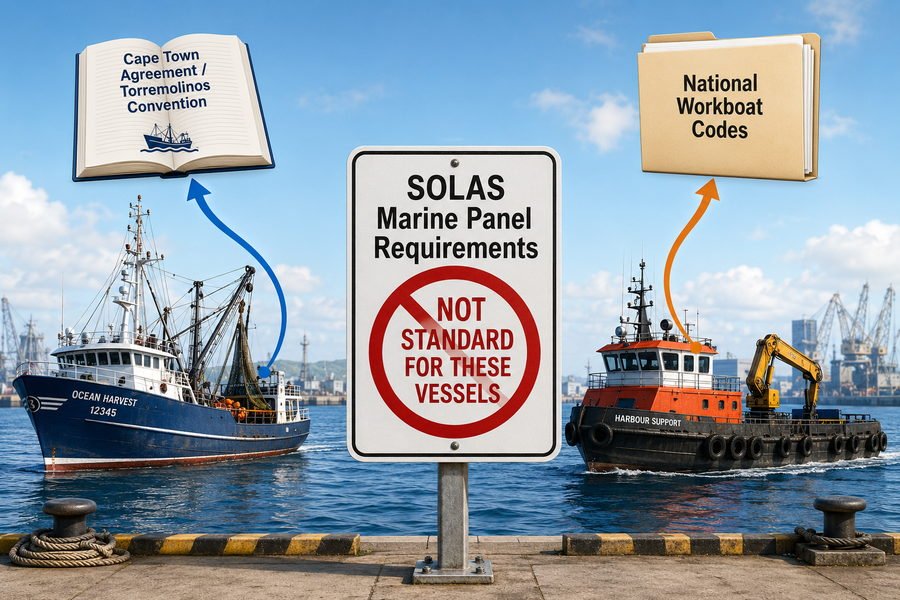
Fishing vessels and workboats are built differently than standard cargo ships. They endure rough handling, constant moisture, and heavy vibrations. Standard SOLAS rules do not fit their operations well. Therefore, you must follow the Cape Town Agreement for fishing vessels and specific national codes for workboats to select the right interior panels.
The Cape Town Agreement for Fishing Vessel Safety
For fishing vessels that are 24 meters in length and over17, safety is guided by the Cape Town Agreement of 2012. This agreement replaces the older Torremolinos International Convention18. The Cape Town Agreement includes rules for structural fire protection, but they are generally less rigid than SOLAS Chapter II-219. For example, the rules focus heavily on preventing fire in the machinery spaces and fish processing areas. For crew cabins, you often need materials with low flame-spread characteristics, but you may not need the heavy 50mm thick B-15 panels used on passenger ships. This allows you to buy thinner, lighter panels. I recommend sourcing 25mm thick aluminum honeycomb panels with a fire-retardant finish. They cost around $30 to $45 per square meter, save weight, and resist the constant dampness found on fishing boats.
Adhering to Specific National Codes for Workboats
Workboats, such as tugboats, pilot boats, and crew transfer vessels, follow specific national codes. In the US, tugboats follow USCG Subchapter M20. These codes dictate their distinct fire protection and interior panel standards. Because workboats are small, heavy rockwool panels take up too much space. National codes often allow the use of lightweight composite panels or fire-treated marine plywood. When sourcing for workboats in Asia, you must focus on durability and moisture resistance over strict fire insulation times. The communication with local Asian sales teams can be difficult, so I always provide them with the exact local standard number (like USCG CFR 46) rather than just saying "marine panel".
Fire Safety Standard Comparison for Fishing Vessels and Workboats
| Vessel Type | Primary Regulatory Framework | Focus of Fire Protection | Ideal Panel Characteristic |
|---|---|---|---|
| Large Fishing Vessel (>= 24m) | Cape Town Agreement | Fish processing and engine rooms | Moisture resistant, low flame-spread finish |
| Small Fishing Vessel (< 24m) | Local National Fishing Codes | Basic crew safety | Lightweight, durable, economical |
| Tugboat / Workboat | Specific National Codes (e.g., USCG Subchapter M) | Space-saving fire boundaries | Thin composite panels, high durability |
Do Special Purpose Ships (SPS) Require SOLAS-Compliant Marine Wall Panels?
Special Purpose Ships blend cargo and passenger rules. Guessing the interior panel requirements here will certainly lead to failed inspections and costly rework.
Yes, Special Purpose Ships (SPS) must use SOLAS-compliant marine wall panels. Under the IMO SPS Code, ships carrying more than 12 special personnel must meet fire protection standards equivalent to passenger ships, demanding strictly certified A-Class and B-Class fire divisions for all accommodation and service spaces.
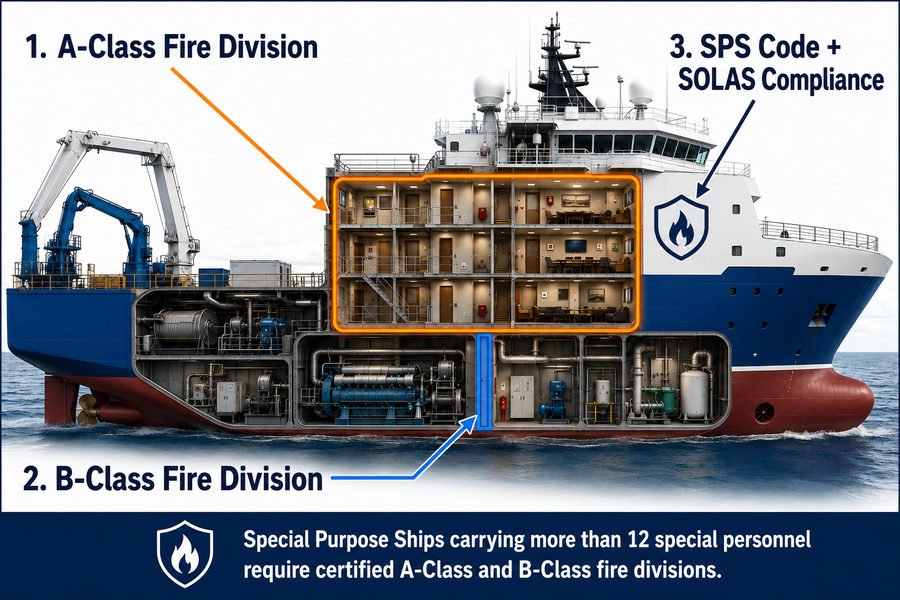
Special Purpose Ships (SPS) are unique. They include cable laying ships, offshore construction vessels, and scientific research ships. They carry "special personnel"—people who are not regular crew members but are not exactly passengers either, like scientists or offshore engineers. Because of this, the rules are very strict. You must treat them exactly like passenger ships when buying interior outfitting products.
The IMO SPS Code and Passenger Ship Equivalency
The guiding document here is the 2008 IMO SPS Code (Resolution MSC.266(84))21. The rule is simple: if the ship carries more than 12 special personnel22, it must meet fire protection standards equivalent to a passenger ship. This means you must buy fully certified A-Class and B-Class fire divisions. You cannot use the cheaper cargo ship standards. The accommodation spaces, corridors, and service spaces must be built with B-15 marine wall panels and B-0 marine ceiling panels. I have seen procurement officers try to save money by buying C-Class panels for an SPS project, only to have the classification surveyor force them to tear down the entire interior. Do not make this mistake.
Sourcing Certified A-Class and B-Class Fire Divisions
When sourcing panels for an SPS project, your focus must be on strict certification and quality control. You must demand B-15 panels with valid MED Wheelmark or USCG approvals. These panels typically use a 50mm thick galvanized steel casing filled with high-density rockwool (120 kg/m³). They will cost you between $45 and $70 per square meter from a reputable Asian supplier. Since lead times can be hard to control, especially for specialized certified panels, you should place your orders at least 45 to 60 days before the shipyard needs them. Always request the test reports alongside the certificates to prove the panels passed the IMO FTP Code tests23.
SPS Code Panel Requirements Based on Personnel Count
| Number of Special Personnel | Regulatory Treatment | Required Panel Certification | Panel Type for Corridors |
|---|---|---|---|
| 12 or fewer | Treated as a Cargo Ship | Standard Cargo Rules | C-Class or B-0 (varies by design) |
| 13 to 240 | Treated as a Passenger Ship | Strict SOLAS / MED Certification | B-15 Class |
| More than 240 | Treated as a Large Passenger Ship | Strictest SOLAS / MED Certification | B-15 Class (with enhanced smoke extraction) |
Conclusion
Understanding SOLAS rules ensures you buy the correct marine panels for every vessel type. This saves money, prevents delays, and guarantees compliance for your critical shipyard interior projects.
-
"solas", https://wwwcdn.imo.org/localresources/en/publications/Documents/Supplements/English/QH110E_supplement_January2026.pdf. SOLAS Chapter I, Regulation 3 lists classes of ships to which the Convention does not apply, including cargo ships of less than 500 gross tonnage, supporting the article’s threshold statement. Evidence role: definition; source type: institution. Supports: SOLAS Chapter I, Regulation 3 excludes cargo ships under 500 GT from the Convention’s application.. ↩
-
"46 CFR Chapter I Subchapter I -- Cargo and Miscellaneous Vessels", https://www.ecfr.gov/current/title-46/chapter-I/subchapter-I. The U.S. Coast Guard’s inspected-vessel regulations in 46 CFR Subchapter I cover cargo and miscellaneous vessels, providing contextual support that U.S.-flag cargo vessels may be governed by this domestic regulatory framework when SOLAS does not apply. Evidence role: case_reference; source type: government. Supports: In the United States, USCG Subchapter I is a relevant domestic regulatory framework for cargo vessels.. Scope note: The applicability of Subchapter I depends on vessel characteristics, route, inspection status, and statutory exceptions; it is not a universal rule for every U.S. cargo vessel. ↩
-
"How Does the IMO FTP Code Connect with Other Marine Fire Safety ...", https://magellanmarinetech.com/how-imo-ftp-code-connect-with-other-marine-fire-safety-frameworks/. SOLAS fire-safety rules and the IMO Fire Test Procedures Code define fire-resisting divisions such as B-class divisions, with B-15 indicating an insulation performance criterion of 15 minutes under the standard fire test, supporting the technical meaning of the 15-minute requirement. Evidence role: definition; source type: institution. Supports: B-15/SOLAS-type panel requirements involve a 15-minute fire insulation performance test.. Scope note: This supports the meaning of B-15 fire-test performance; whether a specific small vessel must use B-15 panels depends on the vessel’s applicable flag-state and class rules. ↩
-
"[PDF] Rules and Regulations for the Classification of Special Service Crafts", https://upcommons.upc.edu/bitstreams/5587205f-9199-4ee7-825a-a65ad6e2e590/download. Classification-society rule sets, such as ABS, DNV, and Lloyd’s Register rules for smaller or special-service vessels, include requirements for materials, structural fire protection, and survey approval, supporting the general claim that class rules may govern vessels outside SOLAS scope. Evidence role: general_support; source type: institution. Supports: Classification societies maintain their own rules or guidelines that can apply to small vessels even when SOLAS does not apply.. Scope note: The exact requirements vary by classification society, notation, flag administration, vessel service, and the edition of the applicable rules. ↩
-
"Passenger ships - International Maritime Organization", https://www.imo.org/en/OurWork/Safety/Pages/PassengerShips.aspx. SOLAS defines a passenger ship as a ship carrying more than twelve passengers and applies its convention framework to ships engaged on international voyages, supporting the definitional basis used here. Evidence role: definition; source type: institution. Supports: An international passenger ship is defined as any ship carrying more than 12 passengers on an international voyage.. Scope note: The source establishes the legal definition; application can vary with flag-state implementation and vessel-specific exemptions. ↩
-
"Passenger ships - International Maritime Organization", https://www.imo.org/en/OurWork/Safety/Pages/PassengerShips.aspx. SOLAS Chapter II-2 requires structural fire protection arrangements, including subdivision by thermal and structural boundaries and main vertical zones, which provides regulatory context for the use of fire-rated divisions on passenger ships. Evidence role: general_support; source type: institution. Supports: SOLAS requires passenger ships to use specific fire-rated divisions to divide the ship into main vertical zones.. Scope note: The source supports the regulatory principle; the exact division class depends on ship type, space category, and applicable SOLAS tables. ↩
-
"What Is the Purpose and Scope of the IMO FTP Code? - Magellan ...", https://magellanmarinetech.com/what-purpose-scope-of-imo-ftp-code/. SOLAS fire-test criteria for A- and B-class divisions specify limits on temperature rise on the unexposed side during standard fire exposure, giving technical basis for the stated insulation-performance requirement. Evidence role: definition; source type: institution. Supports: A B-15 panel keeps the temperature on the unexposed side from rising more than 139°C on average.. Scope note: Authoritative texts commonly state the average temperature-rise limit as 140°C rather than 139°C, so the article’s figure should be checked for rounding or source-specific wording. ↩
-
"[PDF] RESOLUTION MSC.307(88) (adopted on 3 December 2010 ...", https://wwwcdn.imo.org/localresources/en/KnowledgeCentre/IndexofIMOResolutions/MSCResolutions/MSC.307(88).pdf. The IMO FTP Code includes test procedures for smoke and toxicity and for surface flammability of materials used on ships, supporting the connection between interior surface materials and these fire-safety tests. Evidence role: definition; source type: institution. Supports: Surface materials on wall and ceiling panels must comply with the IMO FTP Code, including Part 2 for smoke and toxicity and Part 5 for surface flammability.. Scope note: The citation establishes the existence and purpose of the FTP Code tests; whether a specific panel covering must pass them depends on its use location and the applicable SOLAS requirements. ↩
-
"[PDF] solas/conf/d/6 - International Maritime Organization", https://wwwcdn.imo.org/localresources/en/KnowledgeCentre/ConferencesMeetings/SOLASConferenceDocuments/SOLAS%20CONF%20D%206.pdf. The source should state that SOLAS is primarily framed for ships engaged on international voyages, supporting the distinction between international SOLAS obligations and domestic-voyage regulation. Evidence role: definition; source type: institution. Supports: SOLAS requirements do not automatically apply to ships that operate only within domestic waters.. Scope note: This supports the general jurisdictional distinction but does not prove how any particular country regulates all domestic vessels. ↩
-
"China Maritime Safety Administration - Wikipedia", https://en.wikipedia.org/wiki/China_Maritime_Safety_Administration. Official government sources should identify China’s Maritime Safety Administration and the U.S. Coast Guard as national maritime safety or regulatory authorities, supporting the examples of domestic maritime regulators. Evidence role: case_reference; source type: government. Supports: China’s MSA and the U.S. Coast Guard are examples of national maritime authorities responsible for maritime safety regulation.. Scope note: This verifies the named authorities, not the full scope of their rulemaking powers for every category of vessel. ↩
-
"[PDF] MSC 108-10-1 - Online training material on domestic ferry safety ...", https://wwwcdn.imo.org/localresources/en/OurWork/Safety/Documents/MSC%20108-10-1%20-%20Online%20training%20material%20on%20domestic%20ferry%20safety%20(China).pdf. A maritime safety or regulatory source should show that vessel safety rules often vary by operating area, route, or distance from shore, providing contextual support for the article’s claim that domestic-voyage risk assumptions may differ from ocean-going international voyages. Evidence role: general_support; source type: government. Supports: Domestic vessel regulations may account for operating area and proximity to rescue resources when setting safety requirements.. Scope note: This would support the regulatory logic contextually; it does not directly prove that rescue teams are always faster for all domestic vessels. ↩
-
"How Does the IMO FTP Code Connect with Other Marine Fire Safety ...", https://magellanmarinetech.com/how-imo-ftp-code-connect-with-other-marine-fire-safety-frameworks/. An IMO or classification-society source should describe the FTP Code test procedures and identify the cited parts as fire-test methods used for marine materials and assemblies under SOLAS-related fire safety requirements. Evidence role: definition; source type: institution. Supports: International SOLAS vessel materials may be assessed under IMO FTP Code fire-test procedures, including the cited parts.. Scope note: This supports what the FTP Code parts cover, but a separate flag-state rule may be needed to show whether each part applies to a specific vessel or panel type. ↩
-
"International Convention for the Safety of Life at Sea (SOLAS), 1974", https://www.imo.org/en/about/conventions/pages/international-convention-for-the-safety-of-life-at-sea-(solas),-1974.aspx. IMO materials on SOLAS describe it as the principal international treaty setting minimum safety standards for the construction, equipment, and operation of ships, which flag states are responsible for ensuring vessels comply with. Evidence role: general_support; source type: institution. Supports: Major flag registries are expected to enforce SOLAS requirements for standard cargo and passenger ships.. Scope note: This supports the general duty of flag states to enforce SOLAS, but does not by itself document enforcement practices of Panama, Liberia, or the Marshall Islands individually. ↩
-
"[PDF] Adopted on 6 December 2023 Agenda items 11 and 13", https://wwwcdn.imo.org/localresources/en/KnowledgeCentre/IndexofIMOResolutions/AssemblyDocuments/A.1187(33).pdf. SOLAS Chapter I contains provisions allowing administrations to grant exemptions and to accept equivalents where they are satisfied that alternative arrangements are at least as effective as those prescribed by the Convention. Evidence role: definition; source type: institution. Supports: SOLAS allows limited exemptions or equivalent arrangements under specified administrative conditions.. Scope note: The source can establish the legal basis for exemptions and equivalents, but the application to sheltered-water vessels, barges, or historic ships depends on flag-state decisions and vessel-specific facts. ↩
-
"[PDF] MSC.99(73) - International Maritime Organization", https://wwwcdn.imo.org/localresources/en/KnowledgeCentre/IndexofIMOResolutions/MSCResolutions/MSC.99(73).pdf. SOLAS Chapter I, Regulation 5 provides that an administration may permit fittings, materials, appliances, or arrangements that differ from SOLAS requirements when it is satisfied by trial or otherwise that they are at least as effective as the prescribed requirements. Evidence role: mechanism; source type: institution. Supports: A flag administration can review alternative materials or arrangements and accept them under equivalence rules if safety is shown to be comparable.. Scope note: This supports the administrative review and equivalence mechanism in principle; it does not prove the exact internal procedure or terminology used by every flag registry. ↩
-
"46 CFR § 107.413 - Exemption certificate. - Law.Cornell.Edu", https://www.law.cornell.edu/cfr/text/46/107.413. SOLAS Chapter I provides for the issue of exemption certificates when an administration grants an exemption under the Convention, documenting the terms under which the vessel is exempted from specified requirements. Evidence role: definition; source type: institution. Supports: Approved SOLAS exemptions may be documented through an Exemption Certificate issued by the administration or on its behalf.. Scope note: This supports the existence and function of SOLAS exemption certificates generally; the availability of a certificate for any particular panel substitution depends on the applicable SOLAS provision and the flag administration’s approval. ↩
-
"2012 Cape Town Agreement to enhance fishing safety", https://www.imo.org/en/mediacentre/hottopics/pages/capetownagreementforfishing.aspx. The IMO describes the 2012 Cape Town Agreement as applying to fishing vessels of 24 metres in length and over, establishing international safety requirements for such vessels. Evidence role: definition; source type: institution. Supports: The Cape Town Agreement applies to fishing vessels that are 24 meters in length and over.. ↩
-
"The Torremolinos International Convention for the Safety of Fishing ...", https://www.imo.org/en/About/Conventions/Pages/The-Torremolinos-International-Convention-for-the-Safety-of-Fishing-Vessels.aspx. IMO materials explain that the Cape Town Agreement was developed to update and supersede the earlier Torremolinos fishing-vessel safety instruments, providing a revised framework for implementation. Evidence role: historical_context; source type: institution. Supports: The Cape Town Agreement replaces or supersedes the older Torremolinos International Convention framework.. Scope note: The source may describe the Agreement as updating, implementing, or superseding the Torremolinos regime rather than using the exact word “replaces.” ↩
-
"Summary of SOLAS chapter II-2 - International Maritime Organization", https://www.imo.org/en/ourwork/safety/pages/summaryofsolaschapterii-2-default.aspx. Comparing the Cape Town Agreement’s fishing-vessel fire-safety provisions with SOLAS Chapter II-2 shows that the two instruments address different vessel types and regulatory structures; this supports the contextual distinction but does not by itself quantify relative strictness. Evidence role: general_support; source type: institution. Supports: The Cape Town Agreement’s structural fire-protection requirements are generally less rigid than SOLAS Chapter II-2.. Scope note: The evidence would support a comparative regulatory context, not a universal finding that every Cape Town fire-protection requirement is less stringent than SOLAS Chapter II-2. ↩
-
"46 CFR Chapter I Subchapter M -- Towing Vessels - eCFR", https://www.ecfr.gov/current/title-46/chapter-I/subchapter-M. U.S. Coast Guard regulations in 46 CFR Subchapter M set inspection and safety requirements for towing vessels, providing the regulatory basis for tugboat and towing-vessel compliance in the United States. Evidence role: definition; source type: government. Supports: In the United States, tugboats and similar towing vessels follow USCG Subchapter M safety regulations.. Scope note: Subchapter M applies to towing vessels as defined in U.S. regulations; applicability can vary by vessel service, size, and exemptions. ↩
-
"[PDF] RESOLUTION MSC.266(84) (adopted on 13 May 2008) CODE OF ...", https://wwwcdn.imo.org/localresources/en/KnowledgeCentre/IndexofIMOResolutions/MSCResolutions/MSC.266(84).pdf. IMO Resolution MSC.266(84) adopted the 2008 Code of Safety for Special Purpose Ships, which sets safety standards for ships carrying special personnel and is the primary international reference for SPS design and operation. Evidence role: historical_context; source type: institution. Supports: The 2008 IMO SPS Code, Resolution MSC.266(84), is the guiding document for special purpose ships.. Scope note: The resolution establishes the code and its scope; flag-state implementation and class requirements may add further conditions. ↩
-
"[PDF] RESOLUTION MSC.266(84) (adopted on 13 May 2008) CODE OF ...", https://wwwcdn.imo.org/localresources/en/KnowledgeCentre/IndexofIMOResolutions/MSCResolutions/MSC.266(84).pdf. The SPS Code applies to special purpose ships carrying more than 12 special personnel and requires fire safety measures to be considered in relation to SOLAS passenger-ship standards, supporting the threshold and regulatory equivalency described here. Evidence role: general_support; source type: institution. Supports: If an SPS carries more than 12 special personnel, it is subject to SPS Code requirements linked to passenger-ship fire protection standards.. Scope note: The source supports the regulatory threshold and general equivalency framework, but individual panel ratings still depend on vessel layout, flag administration, class interpretation, and approved fire-control plans. ↩
-
"How Does the IMO FTP Code Connect with Other Marine Fire Safety ...", https://magellanmarinetech.com/how-imo-ftp-code-connect-with-other-marine-fire-safety-frameworks/. The IMO Fire Test Procedures Code specifies standardized fire-test methods used to classify marine construction materials and fire divisions, including A- and B-class divisions, which contextualizes why test reports accompany certificates for certified panels. Evidence role: mechanism; source type: institution. Supports: Certified marine panels should have test reports showing compliance with IMO FTP Code fire-test requirements.. Scope note: The FTP Code explains the testing framework; it does not verify that any particular supplier’s panel has passed unless matched to a specific certificate and test report. ↩