Struggling to know if your ship interior project needs strict SOLAS panels? Guessing wrong causes huge delays and budget overruns. Here is how I check it exactly.
Overseas buyers verify SOLAS requirements by checking three main areas: official project specifications, specific vessel parameters like tonnage and passenger capacity, and binding statements from classification societies. You must cross-reference these documents to guarantee your marine panels meet international fire safety regulations.
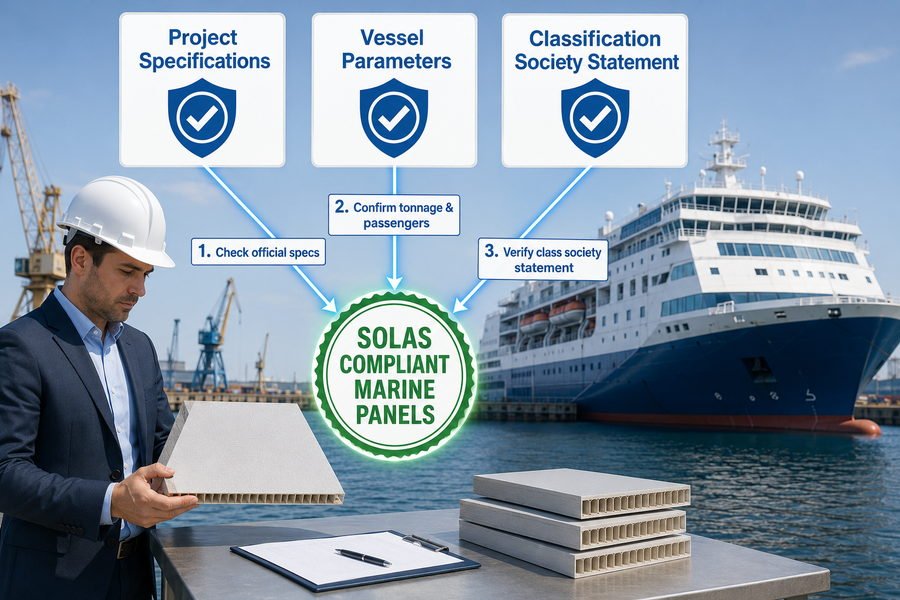
Buying marine panels in Asia can be tricky when you do not speak the local language. You might worry about quality and certifications. I understand this pain. I work as a marine outfitting specialist at Magellan Marine. I help buyers solve these exact problems every day. Do not worry. I will show you exactly how to verify these requirements step by step. Let us look at the details.
Which project documents confirm SOLAS scope for marine panel procurement?
Looking at a pile of project papers and feeling lost? Missing the right document means buying the wrong panels. I will tell you exactly which files to read.
You can confirm the SOLAS scope for marine panel procurement by checking four specific project documents: the General Arrangement (GA) plan, the Fire Control Plan, the Technical Specification Book, and the Room Finish Schedule. These four files tell you exactly what fire rating you need.
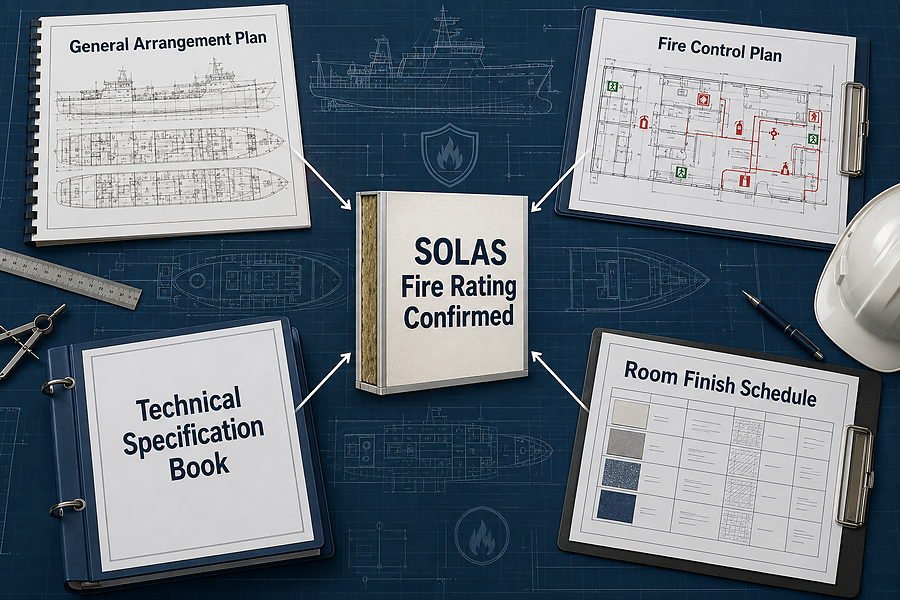
I see many buyers get confused by shipyard documents. They often send me just one drawing and ask for a price. This is dangerous. You must review all four documents to know the real SOLAS scope. Let me break down how I use each one at Magellan Marine.
Extracting Fire Ratings from General Arrangement and Fire Control Plans
First, you must look at the General Arrangement (GA) plan1. The GA plan shows the overall layout of the ship. It tells you where the cabins, public spaces, and engine rooms are. However, the GA plan does not show fire ratings clearly. To find the fire ratings, you need the Fire Control Plan. The Fire Control Plan uses standard symbols. The International Maritime Organization (IMO) defines these symbols under Resolution A.952(23)2. For example, a thick red line usually means an A-Class fire boundary. A thinner line might mean a B-Class partition. You must match the cabin walls on the GA plan with the fire lines on the Fire Control Plan. If a wall separates a cabin from the engine room, the plan will clearly mark it as A-60. A-60 means it must stop fire and heat for 60 minutes.3
Verifying Details in Technical Specification Books and Room Finish Schedules
Next, you must read the Technical Specification Book. This is a very thick document provided by the shipowner. You need to find the "Interior Outfitting" or "Accommodation" chapter. This book gives you the exact rules for the panels. It will state if the panels need a specific noise reduction rating, like 35 dB or 44 dB. After reading the book, you must check the Room Finish Schedule. This is usually an Excel spreadsheet. It lists every single room on the ship. It tells you what surface finish the panel needs. For example, a standard cabin might need PVC film finish. A galley will need a 0.7mm SUS304 stainless steel finish. If you skip any of these four documents, you might buy panels that fail the inspection.4
| Project Document | Main Purpose for Panel Procurement | Key Information Provided |
|---|---|---|
| General Arrangement (GA) Plan | Shows room locations | Room sizes, layout, and purpose |
| Fire Control Plan | Defines fire zones | A-Class and B-Class bulkhead locations |
| Technical Specification Book | Sets technical rules | Acoustic ratings, weight limits, panel thickness |
| Room Finish Schedule | Lists surface materials | PVC colors, stainless steel grades, ceiling types |
Which vessel parameters define SOLAS scope for interior outfitting materials?
Unsure if your ship size triggers strict rules? Overlooking ship details can ruin your budget. Let us look at the exact numbers that define the rules.
Vessel parameters defining SOLAS scope include three main factors: ship type (passenger vs. cargo), gross tonnage (over or under 500 GT), and passenger capacity (more or fewer than 36 passengers). These three metrics determine if your interior outfitting materials require strict A-Class or B-Class fire ratings.
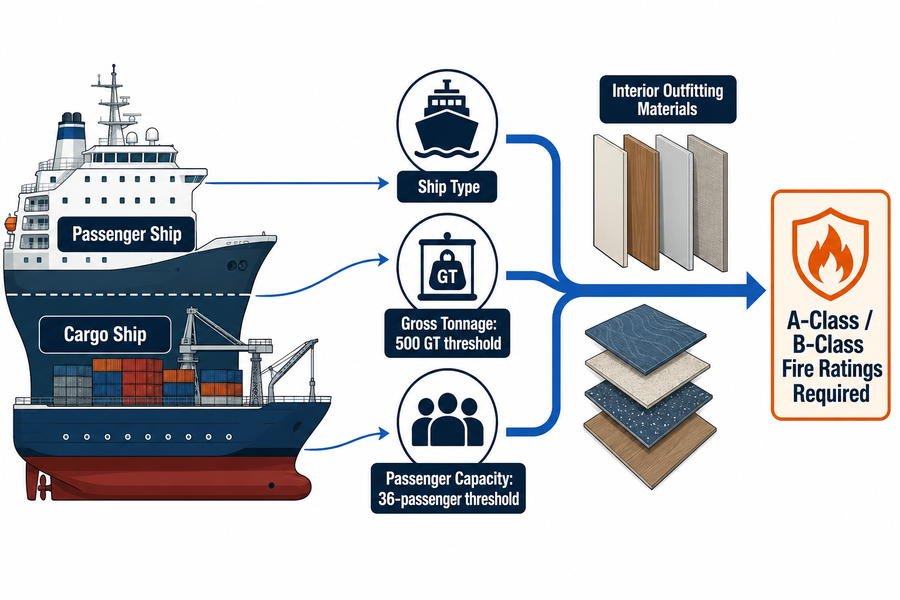
Shipyards often ask you to buy panels without explaining the ship type. This happens a lot when you deal with European or US buyers. They assume you already know the rules. But you must know the vessel parameters. The IMO sets clear rules in SOLAS Chapter II-25 based on these three factors.
Analyzing How Ship Type and Gross Tonnage Trigger SOLAS Rules
The first factor is the ship type. Passenger ships and cargo ships have very different rules. Passenger ships have the strictest fire safety rules. Cargo ships have lighter rules. The second factor is the Gross Tonnage (GT). According to SOLAS Chapter II-2, strict international fire safety rules apply to cargo ships of 500 GT and upwards6. If a cargo ship is under 500 GT, it might only need to follow local national rules. Local rules are usually cheaper and easier. A standard marine B-15 wall panel costs about $18 to $25 per square meter. But an A-60 panel for a larger ship costs $40 to $55 per square meter. Knowing the GT saves you from buying expensive panels when you do not need them.
Understanding the Impact of Passenger Capacity on Marine Panels
The third factor is the passenger capacity. SOLAS Part B divides passenger ships into two categories. The line is drawn at 36 passengers7. Ships carrying more than 36 passengers have extremely tough rules. For example, almost all corridor bulkheads must be B-15 class8. They must also have non-combustible core materials. Ships carrying 36 or fewer passengers have slightly softer rules. I always ask the buyer for these three details first. Ship type, GT, and passenger count. Once I have these three numbers, I know exactly which section of the SOLAS rulebook applies to the marine panels.
| Vessel Parameter | Critical Threshold | Impact on Marine Panel Selection |
|---|---|---|
| Ship Type | Passenger vs. Cargo | Passenger ships require more B-15 and A-Class partitions. |
| Gross Tonnage (GT) | 500 GT | Cargo ships ≥500 GT must fully comply with SOLAS Chapter II-2. |
| Passenger Capacity | 36 Passengers | >36 passengers triggers the strictest non-combustible material rules. |
Confused about who actually makes the final decision? Trusting the wrong person leads to rejected panels. I will show you who holds the real power here.
The binding SOLAS applicability statement for a newbuild is issued by either a Classification Society (like DNV, Lloyd's Register, or ABS) or the Flag State Authority. These two organizations hold the legal power to approve your marine panels and issue the final safety certificates.
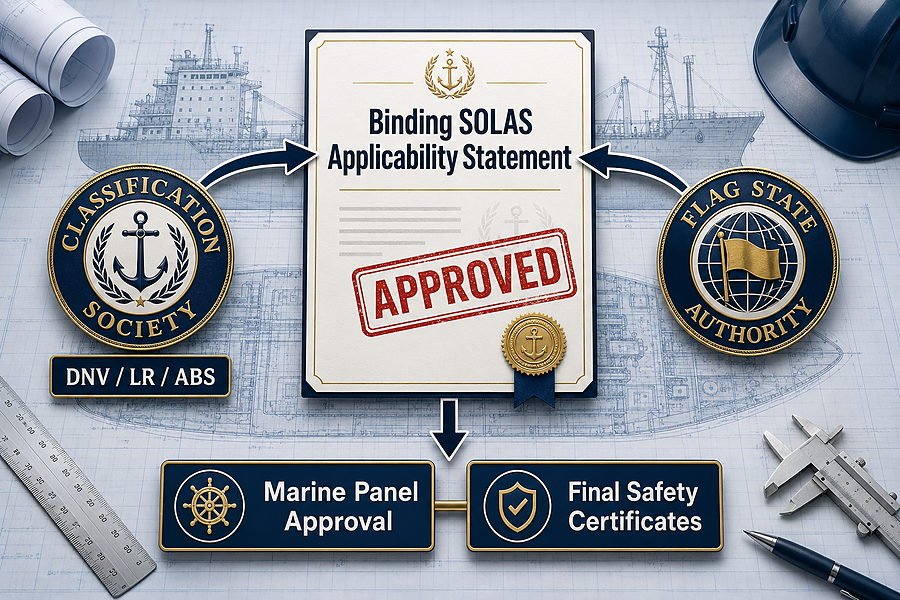
In my years in the shipbuilding industry, I see many people argue about panel rules. The shipyard engineer says one thing. The shipowner says another. But their opinions do not matter. Only two authorities have the real power. You must know who they are.
The Role of Classification Societies in Approving Marine Panels
The first authority is the Classification Society. These are organizations like DNV, Lloyd's Register (LR), or the American Bureau of Shipping (ABS). They are members of the International Association of Classification Societies (IACS)9. The shipowner hires them to check the ship. The Classification Society reviews the ship drawings. They stamp the drawings with "Approved." This stamped drawing is your binding statement. If the DNV-approved drawing says you need a B-15 door, you must buy a B-15 door with a valid DNV certificate. The Classification Society surveyor will come to the shipyard. They will check the certificates of your wall panels and ceiling panels. If the certificates do not match their rules, they will tell you to tear the panels down.
Flag State Authority Final Approvals for Ship Interior Materials
The second authority is the Flag State. Every ship must be registered in a country. This country is the Flag State. Examples are Panama, Liberia, or the Marshall Islands. The Flag State gives the Classification Society the power to act on its behalf.10 But the Flag State always has the final word. Sometimes, the Flag State has extra rules. For ships sailing in European waters, the panels must follow the Marine Equipment Directive (MED)11. This means the panels must have a "Wheelmark" logo. You cannot just use a standard ABS certificate for a European ship. You must have the MED Wheelmark certificate. Always ask your client: "What is the Classification Society, and what is the Flag State?"
| Approving Authority | Main Responsibility | Required Action for Procurement |
|---|---|---|
| Classification Society (e.g., DNV, ABS) | Approves drawings and inspects physical products | Ensure panel certificates match the specific Class Society. |
| Flag State Authority (e.g., Panama, EU) | Sets national rules and delegates inspection power | Check for specific regional rules like the EU MED Wheelmark. |
How can non-compliant marine panels be avoided during procurement?
Worried about buying fake or failed products in Asia? Getting bad panels ruins your shipyard relationships. Here is my proven method to buy safely.
You avoid non-compliant marine panels by taking four strict steps: demanding MED Type Approval certificates, verifying the factory's Quality System Certificate (Module D), conducting third-party lab testing, and performing pre-shipment inspections. These four actions ensure the factory delivers real, safe products.
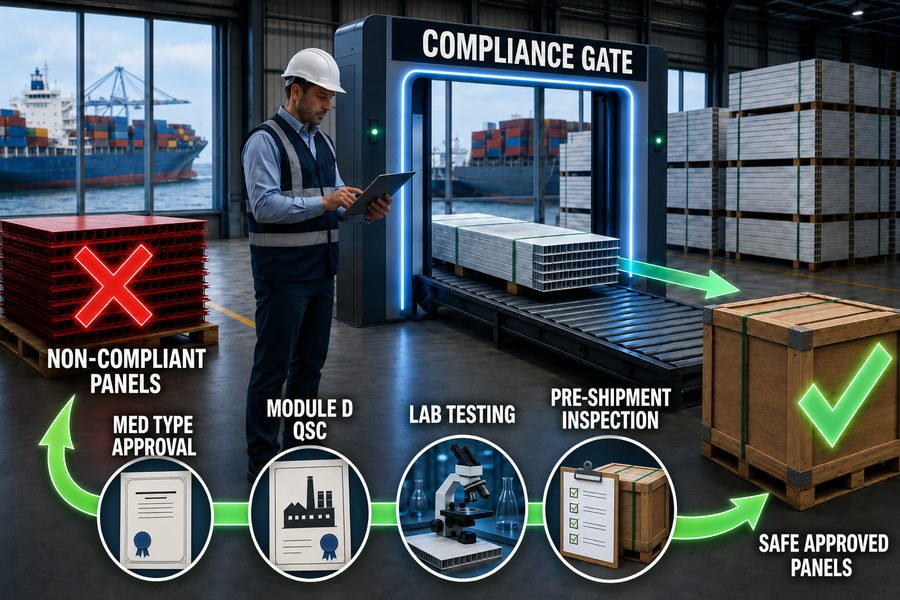
Buying panels from developing countries offers great prices. But you face big risks. Some small factories will cheat. They will show you a good certificate but send you bad panels. You need a strong system to stop this. I use these four steps to protect my clients.
Verifying MED Type Approvals and Factory Quality Systems
First, you must demand the MED Type Approval certificate. This is also called the Module B certificate. It proves the panel design passed the fire test.12 According to the IMO FTP Code 2010, this certificate is only valid for five years. You must check the expiration date. Second, you must verify the factory's Quality System Certificate. This is called the Module D certificate. Module B means the design is good. Module D means the factory can make the panel exactly like the design every time. Both certificates must come from a recognized body, like DNV or BV. If a factory only has Module B but no Module D, they cannot legally sell MED Wheelmark panels. Do not buy from them.
Implementing Lab Testing and Pre-Shipment Inspections for Panels
Third, you should conduct third-party lab testing for big orders. Sometimes, bad factories use cheaper rockwool inside the panel to save money. Good marine rockwool has a density of 120 kg/m3 to 140 kg/m3. Cheap rockwool has only 80 kg/m3. It will fail a fire test.13 You can hire a lab like SGS or Intertek to test a random panel. A basic material test costs about $500. It is worth the money. Fourth, you must perform a pre-shipment inspection. You or an agent must go to the factory before they load the container. You must measure the steel plate thickness. It should be 0.6mm or 0.7mm. You must check the PVC film color. Doing these four steps guarantees you get high-quality, compliant marine outfitting products.
| Procurement Verification Step | What It Checks | Estimated Cost / Effort |
|---|---|---|
| Demand Module B Certificate | Verifies the panel design passed IMO fire tests | Free (Factory must provide) |
| Verify Module D Certificate | Confirms the factory has a controlled quality system | Free (Factory must provide) |
| Conduct Third-Party Lab Testing | Checks rockwool density and steel thickness | $500 - $1,500 per test |
| Perform Pre-Shipment Inspection | Ensures actual cargo matches the approved sample | $200 - $400 per manday |
What red flags show a marine panel supplier misunderstands SOLAS scope?
Are your suppliers speaking confidently but hiding their ignorance? Missing these warning signs will cost you money. I will help you spot the bad suppliers quickly.
Red flags showing a supplier misunderstands SOLAS include three warning signs: offering standard commercial panels instead of marine-grade, providing expired or mismatched test certificates, and failing to understand the difference between A-Class and B-Class fire ratings. You must drop suppliers showing any of these three signs.
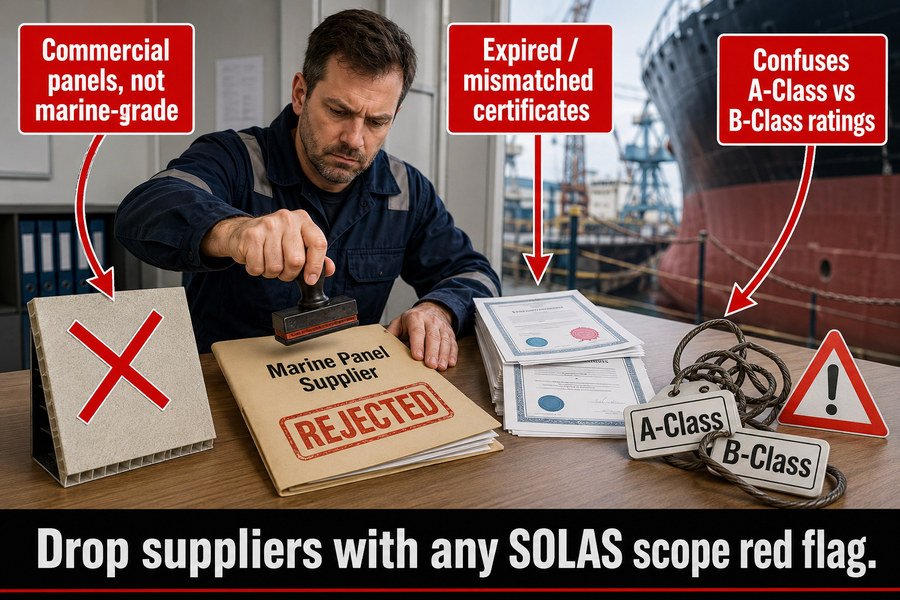
Communication is hard when buying from local sales reps in Asia. Their English might not be perfect. But language is not the real problem. The real problem is a lack of technical knowledge. A bad supplier will say "yes" to everything just to get your order. You must watch out for these three red flags.
Spotting Commercial-Grade Offers and Mismatched Certificates
The first red flag is offering commercial panels. A supplier might quote you a very low price. When you ask why, they say they use standard construction rockwool. Marine-grade rockwool is specially treated. It handles high humidity and vibrations at sea.14 Commercial rockwool breaks down on a ship. If a supplier does not know this, walk away. The second red flag is sending expired or mismatched certificates. A lazy salesperson will send you a test report from 2015. Remember, IMO certificates expire after five years15. Or, they might send a certificate for a 50mm panel when you asked for a 25mm panel. This shows they do not understand that every thickness needs its own fire test16. They are just guessing.
Identifying Suppliers Who Confuse A-Class and B-Class Fire Ratings
The third red flag is failing to understand fire classes. This is the biggest warning sign. I once saw a supplier try to sell a B-15 door for an engine room. Engine rooms must have A-60 doors17. B-15 means the door stops fire for 30 minutes and stops heat for 15 minutes. A-60 means it stops both fire and heat for 60 minutes. They are completely different products. An A-60 door is much heavier and uses different hinges. If a supplier says, "Our B-15 panel is very strong, you can use it for A-60," immediately stop talking to them. They will cause your project to fail the final Class inspection.
| Warning Sign (Red Flag) | What the Supplier Did Wrong | Project Consequence |
|---|---|---|
| Offers commercial-grade panels | Quotes cheap construction materials instead of marine-grade | Panels will rot or collapse due to ship vibration and moisture. |
| Provides expired certificates | Sends IMO/MED documents older than 5 years | Class surveyor will reject the panels upon arrival. |
| Confuses A-Class and B-Class | Suggests using a B-15 panel for an A-60 engine room boundary | Total failure of fire safety inspection; forced replacement. |
How can SOLAS scope be pre-screened before tender release?
Releasing a tender without knowing the rules? This leads to wild price differences from suppliers. Here is how I lock down the details first.
You can pre-screen the SOLAS scope before a tender release through three actions: hiring a naval architect for a pre-audit, sending an RFI (Request for Information) to classification societies, and using a standardized compliance checklist. These three steps guarantee your tender documents are perfectly clear.
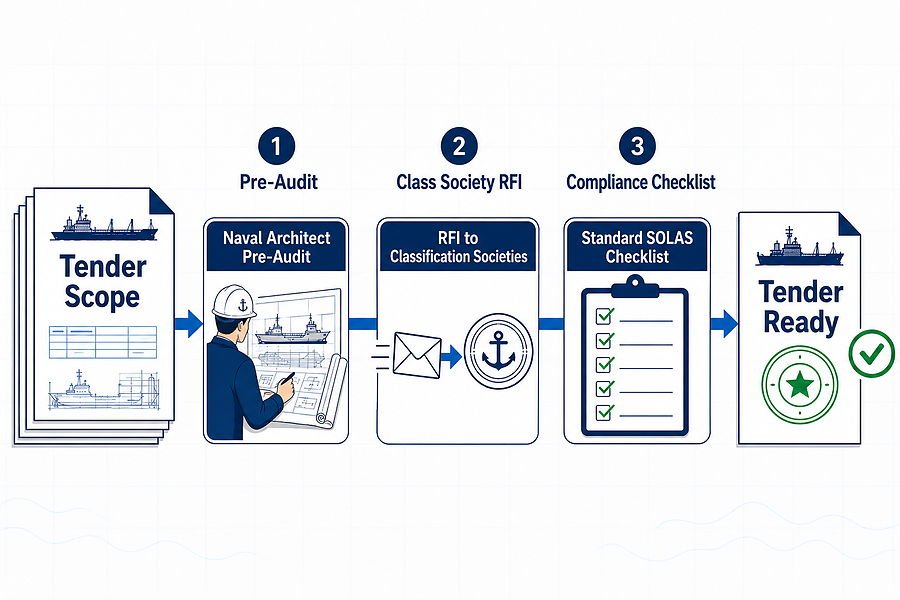
If you send vague requests to suppliers, you will get messy quotes. One factory will quote cheap C-Class panels. Another will quote expensive A-Class panels. You cannot compare the prices. You must do the hard work before you release the tender. I advise my clients to use these three actions.
The first action is hiring a naval architect for a pre-audit. If your company lacks technical experts, buy the expertise. A freelance naval architect charges about $100 to $150 per hour.18 They can review your General Arrangement plan and write down the exact panel requirements19 in just a few hours. This small cost saves you thousands of dollars later. The second action is sending an RFI to the Classification Society. Do not guess the rules. Send an email to the DNV or ABS local office.20 Ask them specific questions about the ship type and passenger count. They will usually reply within one to two weeks with clear guidance. You can put this exact guidance into your tender document.
Building a Standardized Compliance Checklist for Panel Tenders
The third action is using a standardized compliance checklist. I always give my clients a checklist template. When you send the tender to Chinese or Vietnamese factories, force them to fill out the checklist. The checklist must ask: What is the fire rating? What is the core material density? What is the certificate number? When does the certificate expire?21 If the supplier leaves the checklist blank, you immediately know they are not professional. By doing these three steps, you force all suppliers to quote on the exact same standard. This makes your procurement job much easier and safer.
| Pre-Screening Action | Purpose Before Tender Release | Expected Time / Cost |
|---|---|---|
| Hire a Naval Architect | Translates GA plans into clear technical specifications | $100 - $150 per hour (takes a few hours) |
| Send RFI to Class Society | Gets official ruling on confusing fire boundary rules | Free; Takes 1 to 2 weeks for a reply |
| Use Compliance Checklist | Forces suppliers to state their exact specs and cert dates | Free; standardizes all supplier quotes instantly |
Conclusion
Verifying SOLAS compliance for marine panels requires checking project documents, ship parameters, and class approvals. Follow these strict steps to secure safe, high-quality outfitting products for your shipyard projects.
-
"Optimisation of Naval Ship Compartment Layout Design Using ...", https://www.academia.edu/71914992/Optimisation_of_Naval_Ship_Compartment_Layout_Design_Using_Genetic_Algorithm. A ship general arrangement plan is commonly described in naval architecture references as a drawing that shows the vessel’s overall compartment layout, including accommodation, machinery, and service spaces. Evidence role: definition; source type: education. Supports: The GA plan shows the overall layout of the ship and indicates where cabins, public spaces, and engine rooms are located.. Scope note: This supports the general document function, not the content or format of any specific shipyard’s GA plan. ↩
-
"[PDF] Resolution A.952(23) Adopted on 5 December 2003 (Agenda item ...", https://wwwcdn.imo.org/localresources/en/KnowledgeCentre/IndexofIMOResolutions/AssemblyDocuments/A.952(23).pdf. IMO Resolution A.952(23) provides graphical symbols for shipboard fire control plans, supporting the statement that fire-control drawings use internationally standardized symbols. Evidence role: definition; source type: institution. Supports: The International Maritime Organization defines standard symbols for Fire Control Plans under Resolution A.952(23).. Scope note: The resolution supports standard symbol usage, but individual drawing color conventions may still vary by flag, class, or shipyard practice. ↩
-
"What Is the Purpose and Scope of the IMO FTP Code? - Magellan ...", https://magellanmarinetech.com/what-purpose-scope-of-imo-ftp-code/. SOLAS fire-safety provisions define A-class divisions as divisions tested to prevent smoke and flame passage for one hour, with the A-60 rating requiring insulation performance for 60 minutes under the prescribed fire test criteria. Evidence role: definition; source type: institution. Supports: An A-60 boundary must provide fire and heat resistance for 60 minutes under SOLAS/IMO test criteria.. ↩
-
"History of SOLAS fire protection requirements", https://www.imo.org/en/OurWork/Safety/Pages/History-of-fire-protection-requirements.aspx. Classification-society and statutory plan-approval procedures for passenger and cargo ships typically require review of fire-protection arrangements, construction details, and material specifications, indicating that procurement decisions based on incomplete drawings can conflict with approval or survey requirements. Evidence role: general_support; source type: institution. Supports: Buying panels without checking all relevant drawings, specifications, and schedules can lead to noncompliance during inspection.. Scope note: This supports the risk mechanism in general; it does not prove that omission of any one named document will always cause an inspection failure. ↩
-
"Summary of SOLAS chapter II-2 - International Maritime Organization", https://www.imo.org/en/ourwork/safety/pages/summaryofsolaschapterii-2-default.aspx. SOLAS Chapter II-2 sets international requirements for ship fire safety, including fire prevention, containment, detection, and escape, with requirements varying by ship category and application thresholds. Evidence role: definition; source type: institution. Supports: The IMO sets clear fire-safety rules in SOLAS Chapter II-2 that determine which marine-panel requirements apply.. Scope note: This supports the regulatory context, but the precise applicability of each rule still depends on the current SOLAS text and flag-state implementation. ↩
-
"[PDF] solas - International Maritime Organization", https://wwwcdn.imo.org/localresources/en/publications/Documents/Supplements/English/QH110E_supplement_January2026.pdf. SOLAS Chapter II-2 states that its fire-safety provisions apply to cargo ships of 500 gross tonnage and above, establishing the 500 GT threshold for international fire-protection requirements. Evidence role: general_support; source type: institution. Supports: Strict international fire safety rules under SOLAS Chapter II-2 apply to cargo ships of 500 GT and upwards.. Scope note: National rules, exemptions, and special ship categories may modify practical compliance obligations for particular vessels. ↩
-
"History of SOLAS fire protection requirements", https://www.imo.org/en/OurWork/Safety/Pages/History-of-fire-protection-requirements.aspx. SOLAS Chapter II-2 uses the carriage of more than 36 passengers as a regulatory distinction for passenger ships, with additional fire-safety requirements applying above that passenger threshold. Evidence role: general_support; source type: institution. Supports: SOLAS Part B draws a key regulatory line for passenger ships at more than 36 passengers.. Scope note: The threshold supports the classification distinction, but the exact panel requirement must be checked against the relevant SOLAS regulation and ship arrangement. ↩
-
"Summary of SOLAS chapter II-2 - International Maritime Organization", https://www.imo.org/en/ourwork/safety/pages/summaryofsolaschapterii-2-default.aspx. SOLAS Chapter II-2 fire-containment provisions specify fire-resistance classes for divisions in passenger-ship accommodation and service spaces, including B-class requirements for corridor bulkheads in relevant arrangements. Evidence role: mechanism; source type: institution. Supports: For passenger ships above the relevant threshold, corridor bulkheads are commonly required to meet B-class fire-resistance standards such as B-15.. Scope note: This is contextual support; the word “almost” and the exact B-15 requirement depend on ship layout, space category, and the applicable SOLAS table. ↩
-
"International Association of Classification Societies", https://en.wikipedia.org/wiki/International_Association_of_Classification_Societies. IACS identifies DNV, Lloyd’s Register, and the American Bureau of Shipping among its member classification societies, supporting the article’s examples of recognized class bodies. Evidence role: definition; source type: institution. Supports: DNV, Lloyd's Register, and ABS are classification societies that are members of IACS.. ↩
-
"RECOGNIZED ORGANIZATIONS", https://www.imo.org/en/OurWork/IIIS/Pages/Recognized-Organizations.aspx. IMO instruments recognize that flag administrations may authorize recognized organizations, including classification societies, to perform statutory certification and survey functions on their behalf. Evidence role: mechanism; source type: institution. Supports: Flag States can delegate inspection and certification functions to classification societies or other recognized organizations.. Scope note: Delegation does not transfer all flag-state authority; the scope depends on the flag administration’s authorization and applicable IMO instruments. ↩
-
"Directive 96/98/EC - Wikipedia", https://en.wikipedia.org/wiki/Directive_96/98/EC. Directive 2014/90/EU establishes EU requirements for covered marine equipment placed on board EU ships and provides for the wheel-mark conformity mark, supporting the need for MED certification where the directive applies. Evidence role: historical_context; source type: government. Supports: Marine panels or related interior materials may require MED Wheelmark certification when they fall within the scope of the EU Marine Equipment Directive.. Scope note: The directive applies to covered equipment on EU-flagged ships and specified circumstances under EU law; it is not triggered solely because any vessel sails in European waters. ↩
-
"What Is the Purpose and Scope of the IMO FTP Code? - Magellan ...", https://magellanmarinetech.com/what-purpose-scope-of-imo-ftp-code/. EU Marine Equipment Directive conformity-assessment rules describe Module B as EC type examination, while fire-resistant marine products are tested against IMO fire-test procedures; together these sources support that the certificate concerns an approved product type rather than a shipment-by-shipment inspection. Evidence role: definition; source type: government. Supports: The MED Module B certificate indicates that the panel design/type has passed the applicable fire test.. Scope note: This support is contextual: the exact fire-test standard and product category should be confirmed against the certificate schedule for the specific panel. ↩
-
"How to choose the right marine wall panels for marine interior ...", https://magellanmarinetech.com/how-choose-right-marine-wall-panels-for-marine-interior-projects/. Fire-resistance studies and technical standards for mineral-wool sandwich panels show that insulation density and composition affect fire performance, providing background support for checking rockwool density in marine panels. Evidence role: mechanism; source type: paper. Supports: Rockwool density is relevant to marine panel fire performance, and lower-density substitutions can compromise compliance.. Scope note: This would not directly prove that every 80 kg/m³ core fails or that 120–140 kg/m³ is universally required; the pass/fail result depends on the certified panel design and IMO FTP test configuration. ↩
-
"How to choose the right marine wall panels for marine interior ...", https://magellanmarinetech.com/how-choose-right-marine-wall-panels-for-marine-interior-projects/. Marine insulation guidance and test standards describe shipboard insulation as needing suitability for maritime service conditions, including moisture exposure, mechanical integrity, and fire performance, supporting the distinction between ordinary construction insulation and marine-approved insulation. Evidence role: general_support; source type: institution. Supports: Marine-grade rockwool is specially treated and better suited to high humidity and ship vibration than ordinary construction rockwool.. Scope note: This would support the need for marine-rated material in context, but it may not directly prove that every commercial rockwool product will fail on ships. ↩
-
"Survival Craft Equipment-Update to Type Approval Requirements", https://www.federalregister.gov/documents/2022/11/14/2022-23666/survival-craft-equipment-update-to-type-approval-requirements. Marine equipment type-approval and conformity-certification schemes commonly issue certificates for a fixed validity period, often up to five years, so certificate dates must be checked before relying on approval documents. Evidence role: general_support; source type: government. Supports: IMO/MED-style approval certificates for marine products are time-limited and commonly expire after five years.. Scope note: The wording should be checked carefully because IMO does not itself issue all such certificates; validity periods depend on the flag administration, notified body, or approval scheme. ↩
-
"How Does the IMO FTP Code Connect with Other Marine Fire Safety ...", https://magellanmarinetech.com/how-imo-ftp-code-connect-with-other-marine-fire-safety-frameworks/. The IMO Fire Test Procedures Code and marine type-approval practice evaluate fire divisions according to the tested construction, including dimensions and insulation arrangement, so approval of one panel thickness does not automatically establish equivalent fire performance for another thickness. Evidence role: mechanism; source type: institution. Supports: A fire-test certificate for one panel thickness cannot automatically be used as proof for a different panel thickness.. Scope note: Some approvals may cover a range of thicknesses if the range is tested, assessed, or explicitly included in the certificate. ↩
-
"What Are Marine Fire Doors?", https://magellanmarinetech.com/what-are-marine-fire-doors/. SOLAS fire-containment rules require high fire integrity for boundaries of machinery spaces of category A, and openings in such divisions generally must preserve the fire rating of the division, which explains why an A-60-rated closure may be required for an engine-room boundary. Evidence role: expert_consensus; source type: institution. Supports: Engine-room boundaries commonly require A-60-rated doors rather than B-15 doors.. Scope note: The exact rating depends on the vessel type, space category, and adjacent space in the applicable SOLAS table or flag/class interpretation. ↩
-
"Marine Engineers and Naval Architects - Bureau of Labor Statistics", https://www.bls.gov/oes/2023/may/oes172121.htm. U.S. Bureau of Labor Statistics wage data for marine engineers and naval architects can provide a neutral benchmark for professional labor costs, supporting the plausibility of consultant hourly rates in this range when overhead and freelance pricing are considered. Evidence role: statistic; source type: government. Supports: Freelance naval architects commonly charge about $100 to $150 per hour.. Scope note: BLS data reports employed wage levels, not freelance consulting rates, so it supports the claim contextually rather than directly. ↩
-
"What is Naval Architecture and Marine Engineering? - Webb Institute", https://www.webb.edu/about-webb-institute/what-is-a-naval-architect/. Occupational and educational descriptions of naval architecture show that naval architects develop and evaluate ship designs, arrangements, structures, and technical specifications, supporting their suitability for translating a General Arrangement plan into procurement requirements. Evidence role: definition; source type: education. Supports: Naval architects are qualified to review General Arrangement plans and define technical panel requirements.. Scope note: Such sources establish the professional scope of naval architects but may not specify the exact time required for a particular pre-audit. ↩
-
"International Association of Classification Societies - Wikipedia", https://en.wikipedia.org/wiki/International_Association_of_Classification_Societies. The International Association of Classification Societies describes classification societies as organizations that establish and apply technical rules for the design, construction, and survey of ships, supporting the practice of seeking class guidance on vessel-specific compliance questions. Evidence role: expert_consensus; source type: institution. Supports: Classification societies such as DNV or ABS are appropriate bodies to consult for ship-specific rule and compliance guidance.. Scope note: This supports the role of class societies generally; it does not verify response times or guarantee that a particular local office will issue project-specific advice by email. ↩
-
"How Does the IMO FTP Code Connect with Other Marine Fire Safety ...", https://magellanmarinetech.com/how-imo-ftp-code-connect-with-other-marine-fire-safety-frameworks/. IMO fire-safety instruments and marine equipment approval systems require documented evidence of fire performance and product approval for materials used on ships, supporting the inclusion of fire rating and certificate details in panel tender checklists. Evidence role: mechanism; source type: institution. Supports: Marine panel procurement checklists should request fire ratings, material details, certificate numbers, and certificate validity dates.. Scope note: The source may establish regulatory documentation requirements broadly; core density is typically a product-performance specification and may need support from manufacturer test standards or class approval records rather than IMO rules alone. ↩