Are sudden compliance failures delaying your marine panel orders? Missing maritime safety rule updates ruins project timelines. Here is how recent regulations change how you buy ship interior materials.
Recent SOLAS amendments affect marine wall and ceiling panel procurement by strictly enforcing four major changes: lowering allowable surface calorific values, demanding updated toxicity test reports, requiring modern Wheelmark certifications for European projects, and phasing out hazardous adhesives to meet new environmental thresholds.
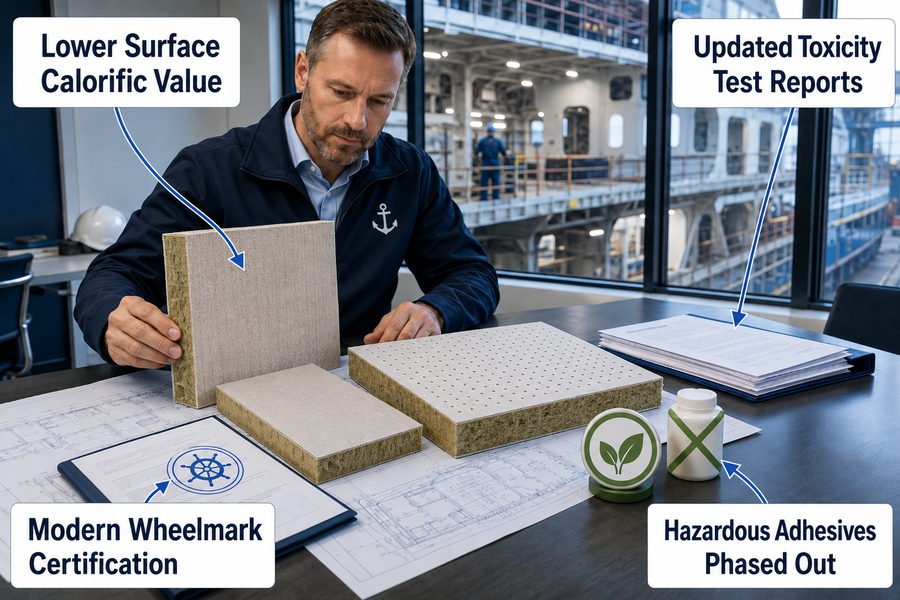
I see buyers get stuck when their panels fail shipyard inspections. When you ignore these regulatory updates, you buy obsolete products that European and US shipyards will reject. But when you understand the rules, you control your lead times and keep your pricing sharp. I want to share my experience from Magellan Marine to help you avoid these costly mistakes. Let us break down the exact changes you need to track.
Which Recent SOLAS Amendments Impact Marine Wall & Ceiling Panel Specs?
Do complex maritime codes confuse your purchasing process? Misunderstanding these rules leads to buying the wrong core materials. Here are the exact SOLAS regulations that change your specifications.
Recent SOLAS amendments impacting marine wall and ceiling panel specs fall into three critical areas: Chapter II-2 Regulation 5 controlling fire growth, Chapter II-2 Regulation 6 limiting smoke and toxicity, and the updated FTP Code governing non-combustibility and surface flammability limits.
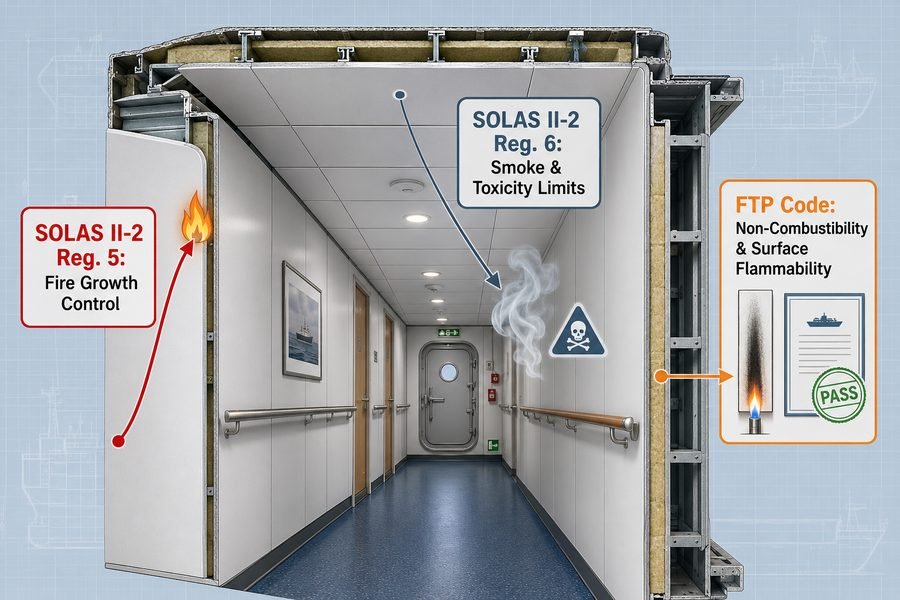
I talk to many procurement officers who buy panels in Asia for big European shipyards. They often get confused by the thick SOLAS rulebooks. You do not need to read the whole book. You just need to focus on three main areas.
Understanding SOLAS Chapter II-2 Fire and Smoke Regulations
First, we must look at Chapter II-2 Regulation 51. This rule controls fire growth potential. It means the panel must not help a fire spread. The rule limits how much combustible material you can use on the panel face. For example, the calorific value of these surfaces must not exceed 45 MJ/m22 according to the IMO MSC.307(88) standard. If your PVC film has a higher value, the inspector will fail it.
Next, we look at Chapter II-2 Regulation 6. This rule covers smoke generation and toxicity. When a panel gets hot, it cannot release toxic gas that harms people. The paint or PVC film on your marine ceiling panel must pass strict lab tests. The carbon monoxide (CO) level must stay below 1450 ppm during the fire test. The hydrogen cyanide (HCN) must stay below 140 ppm. These numbers are hard limits. Shipyards in Europe will check these exact values before they install your panels.
How the FTP Code Redefines Non-Combustibility and Flammability
Finally, we have the updated International Code for Application of Fire Test Procedures (FTP Code). The FTP Code provides the exact testing rules. Part 1 of the FTP Code tests non-combustibility. The rockwool core of your panel must pass this test to prove it will not burn. The lab measures the mass loss, and it must be less than 50% in the 750°C test furnace3.
Part 5 of the FTP Code tests surface flammability. The lab applies a flame to the panel surface to ensure it does not catch fire easily. When IMO updates the FTP Code, the testing methods change. Your supplier must use the newest testing method to get a valid certificate. If they do not, your panels are useless.
| SOLAS Regulatory Area | Main Focus Area | Specific Requirement Limit | Impact on Panel Procurement |
|---|---|---|---|
| Chapter II-2 Reg 5 | Fire Growth Potential | Calorific value < 45 MJ/m2 | Limits thickness of PVC and paint finishes |
| Chapter II-2 Reg 6 | Smoke and Toxicity | CO < 1450 ppm, HCN < 140 ppm | Requires safe, non-toxic surface adhesives |
| FTP Code Part 1 | Non-Combustibility | Mass loss < 50% in furnace | Requires high-quality mineral wool cores |
| FTP Code Part 5 | Surface Flammability | Flame spread distance limits | Prevents use of cheap, highly flammable laminates |
Why Recheck Marine Wall Panel Datasheets After SOLAS Updates?
Do you assume your old supplier datasheets are still valid? That mistake causes failed inspections. Re-verifying your panel specifications prevents expensive re-ordering and ensures compliance.
You must recheck marine wall panel datasheets after SOLAS updates for four crucial reasons: to verify Type Approval Certificate expiration dates, confirm compliance with new maximum toxicity limits, ensure alignment with revised acoustic standards, and validate that core material density meets current non-combustibility thresholds.
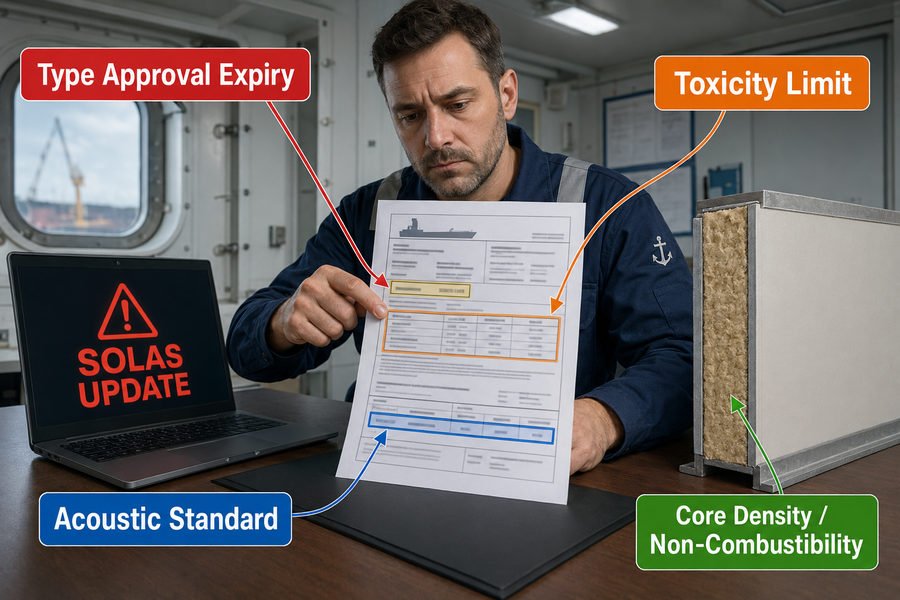
I remember a client who ordered 2,000 square meters of marine wall panels from a factory in China. They used an old datasheet from two years ago. The European shipyard rejected the entire batch upon arrival. It cost them thousands of dollars in delays. You can avoid this by checking four specific details on every datasheet.
Verifying Type Approval Certificates and Toxicity Limits
First, you must verify the Type Approval Certificate (TAC) expiration dates. A TAC usually lasts exactly 5 years from the issue date.4 When SOLAS updates its rules, classification societies like DNV or Lloyd's Register will not renew the TAC unless the panel passes the new tests. You must check the date on the datasheet to make sure the certificate is still active.
Second, you need to confirm compliance with new maximum toxicity limits. Sometimes, older panels used cheap glues that met the old standards but fail the new SOLAS toxicity limits. You must read the test report summary on the datasheet to confirm the sulfur dioxide (SO2) levels are under 120 ppm5. You must also verify hydrogen chloride (HCl) is under 600 ppm.
Assessing Acoustic Insulation Standards and Core Density
Third, ensure alignment with revised acoustic insulation standards. While SOLAS focuses on fire, related maritime labor conventions update noise codes at the same time6. A standard B-15 marine wall panel needs an acoustic insulation value (Rw) of at least 35 dB. Some new European shipyard specs require 40 dB for a specific cabin type. If your old datasheet shows 30 dB, it is not good enough.
Fourth, you must validate that the core material density meets current non-combustibility thresholds. The density of the rockwool inside the panel affects both fire resistance and weight.7 A typical B-15 class panel requires a rockwool density of 120 kg/m3. If a supplier drops the density to 100 kg/m3 to save money, it will fail the latest SOLAS Part 1 tests. The datasheet must clearly state the correct core density.
| Datasheet Verification Check | Old Standard Risk | Current SOLAS Requirement | Action for Procurement |
|---|---|---|---|
| Type Approval Certificate | TAC is expired | Valid for the current year | Request the latest 5-year certificate |
| Maximum Toxicity Limits | SO2 > 120 ppm | SO2 < 120 ppm | Check lab test values directly |
| Acoustic Insulation (Rw) | 30 dB sound reduction | 35 dB to 44 dB reduction | Match panel dB rating to room type |
| Core Material Density | 100 kg/m3 (fails fire test) | 120 kg/m3 for B-15 Class | Confirm density on the technical spec sheet |
How Do Outdated SOLAS References Trigger Marine Ceiling Panel Submittal Rejection?
Are shipyard engineers rejecting your materials during the submittal phase? Submitting old documentation is the fastest way to get disqualified. Here is how to prevent immediate rejection.
Outdated SOLAS references trigger marine ceiling panel submittal rejection in three specific ways: by citing expired IMO resolution numbers on fire test reports, presenting invalid Declaration of Conformity documents, and failing to include the mandatory Wheelmark certification required for European shipyard projects.
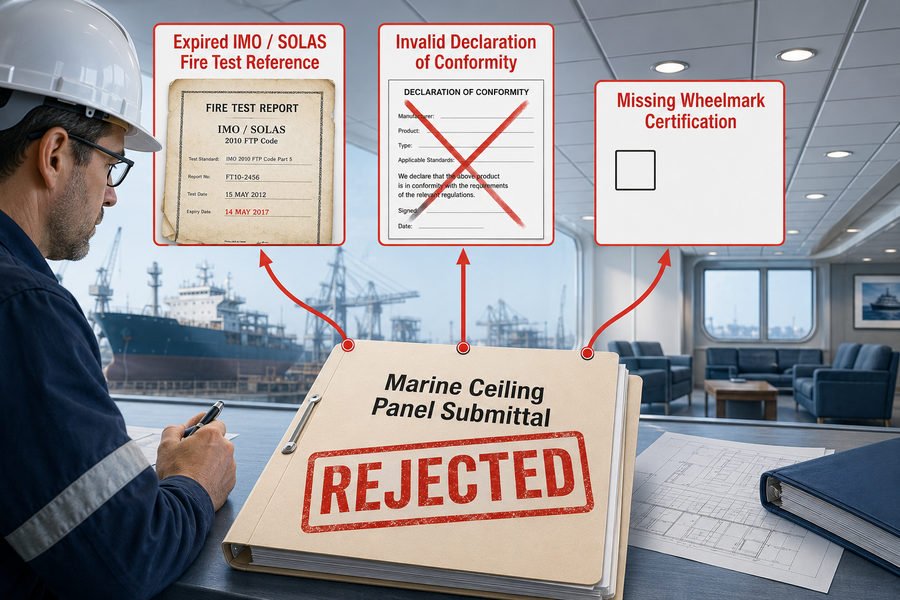
Shipyard engineers are strict. They do not have time to guess if your panel is safe. They look at your paperwork. If the paperwork is wrong, they reject the physical panels immediately. I help my clients fix these paperwork issues every week. There are three specific ways outdated documents will ruin your project.
The Impact of Expired IMO Resolution Numbers and Invalid DoC Documents
The first way you get rejected is by citing expired IMO resolution numbers on your fire test reports. The International Maritime Organization (IMO) updates its test procedures over time. The old FTP Code was known as IMO Resolution A.653(16). The newer version is MSC.307(88).8 If your ceiling panel test report shows the old A.653(16) number, the shipyard will stop the approval process. They require the exact, newest resolution number printed clearly on the cover page.
The second reason for rejection is presenting an invalid Declaration of Conformity (DoC). The DoC is a legal document where the manufacturer states the panel meets all current rules.9 If the DoC lists an old SOLAS amendment that was replaced two years ago, the document becomes legally invalid. You must ask the factory to draft a new DoC that clearly names the latest SOLAS regulations in effect today.
Mandatory Wheelmark Certification for European Shipyard Projects
The third way outdated references hurt you involves the Wheelmark certification. If you are doing an interior decoration project for a large shipyard in Europe, you must follow the Marine Equipment Directive (MED 2014/90/EU). The MED requires the Wheelmark logo on the product and the paperwork.10
The Wheelmark proves the product meets the latest SOLAS rules. To get it, the factory needs a Module B certificate (Type Approval) and a Module D certificate (Production Quality Assurance). If your panel only has a local classification certificate and lacks the Wheelmark, the European shipyard quality assurance team will reject it without even opening the box.
| Document Type | Common Outdated Error | Consequence at Shipyard | Corrective Action |
|---|---|---|---|
| Fire Test Report | Cites old Resolution A.653(16) | Immediate submittal rejection | Retest panel under MSC.307(88) |
| Declaration of Conformity | References old SOLAS dates | Legally invalid submission | Update DoC with current dates and rules |
| MED Certification | Missing the Wheelmark logo | Banned from European vessels | Apply for MED Module B and D certification |
Which SOLAS Amendment Changes Should Shipowners Flag Before Approving Marine Panel Orders?
Do shipowners hesitate to sign off on your orders? They face heavy scrutiny during port inspections. Pointing out the right compliance details secures your deal immediately.
Shipowners must flag four primary SOLAS amendment changes before approving orders: the transition to stricter low-flame spread surface materials, updated requirements for fire rating boundary joints, enhanced documentation for continuous weight monitoring, and the mandatory phase-out of high-formaldehyde hazardous chemical treatments.
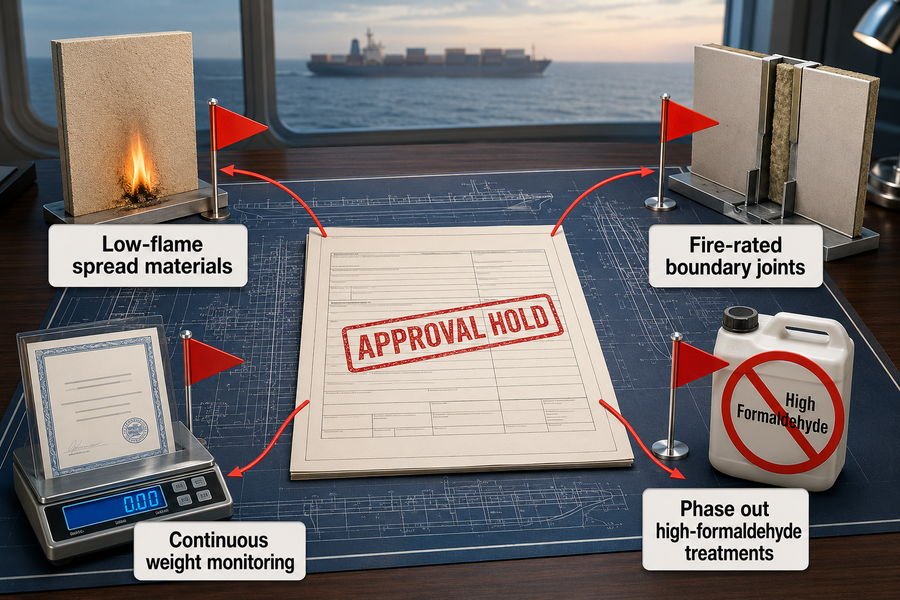
When I sit down with shipowners, they always ask about risk. They want to know if the materials we install will pass Port State Control inspections five years from now. As a buyer, you can show them you understand their risks. You need to flag four main changes before they sign the final order.
Transitioning to Stricter Surface Materials and Fire Boundary Joints
First, you must flag the transition to stricter low-flame spread surface materials. Older panels used thick PVC films for decoration. Now, SOLAS rules force us to use much thinner films11. The standard PVC film thickness is now typically limited to a maximum of 150 microns to keep the fuel load low. You must show the shipowner that your chosen panels use these new, ultra-thin, low-flame finishes.
Second, highlight the updated requirements for fire rating boundary joints. An A-60 class bulkhead must stop fire and heat for 60 minutes12. A B-15 class panel must stop fire for 30 minutes and heat for 15 minutes. Recent SOLAS changes are very strict about the joints connecting these panels. You must prove to the owner that the installation method matches the exact joint details tested in the laboratory.
Managing Continuous Weight Monitoring and Chemical Phase-Outs
Third, flag the enhanced documentation for continuous weight monitoring. Modern ships must track every kilogram added during interior outfitting to maintain correct stability calculations13. A standard 50mm marine wall panel weighs about 16 kg/m2. If you buy panels that are heavier than the datasheet claims, the shipowner will face major stability issues. You must flag the weight tolerance limits on the order.
Fourth, point out the mandatory phase-out of high-formaldehyde hazardous chemical treatments. Recent environmental updates to maritime law restrict certain chemicals used in fire retardants and glues. For example, some old panel glues contained formaldehyde levels that are now banned. The shipowner needs you to confirm that the new panels use zero-formaldehyde adhesives. It must meet the E0 standard, which means formaldehyde emission is less than 0.05 mg/L14.
| Factor to Flag for Shipowners | Old Standard | New Safety Reality | Benefit to the Shipowner |
|---|---|---|---|
| Surface Material Thickness | Thick PVC films allowed | Max 150 microns thickness | Passes strict low-flame spread inspections |
| Fire Rating Boundary Joints | General joint approval | Lab-specific joint profile required | Prevents fire leakage between cabins |
| Panel Weight Monitoring | Estimated panel weight | Exact weight tracking (16 kg/m2) | Keeps vessel stability calculations accurate |
| Hazardous Chemical Treatments | High formaldehyde glues | Zero-formaldehyde (E0 standard) | Meets new environmental and health rules |
How Do SOLAS Amendment Effective Dates Align With Marine Wall Panel Delivery?
Are your panels arriving but failing due to bad timing? Misaligning delivery dates with new regulations causes major losses. Here is how to sync deliveries with legal effective dates.
SOLAS amendment effective dates align with marine wall panel delivery through three critical timelines: the vessel's official keel laying date which locks in the regulatory baseline, the actual installation date where Type Approvals must remain active, and retroactive rule deadlines that force sudden material upgrades.
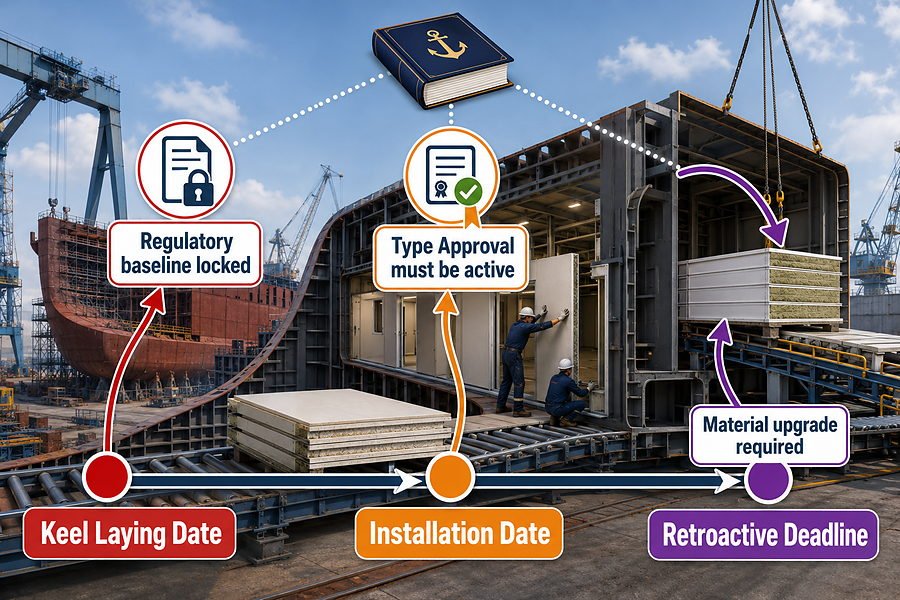
Timing is everything in shipbuilding. I once helped a client who bought panels in October for a February installation. The Type Approval Certificate expired in December. We had to rush the factory to renew the certificate before the European shipyard accepted the goods. You must track three critical timelines.
How the Keel Laying Date Locks in Your Regulatory Baseline
The first timeline is the vessel's official keel laying date. In the maritime industry, the day the shipyard lays the keel (starts building the hull) is very important. This date locks in the regulatory baseline.15 For example, if SOLAS introduces a new rule that applies to ships built on or after January 1, 2026, and your ship's keel was laid in November 2025, you might be allowed to use the older rules.
You must ask the shipyard for the exact keel laying date. Once you have this date, you tell your Asian supplier. The supplier will then know exactly which version of the SOLAS chapter and FTP code their panels must meet16. This prevents you from overpaying for unnecessary upgrades or buying under-qualified materials.
Tracking Installation Dates and Retroactive Rule Deadlines
The second timeline is the actual installation date. This is where many buyers make mistakes. Your Type Approval Certificate must remain active on the day the panel is actually installed into the ship. It is not enough for the certificate to be valid on the day you pay the deposit. Shipping panels from Asia to Europe takes 30 to 45 days. If the certificate expires while the panels are on the ocean, the shipyard will reject them. A TAC takes 3 to 6 months to renew, so check the dates early.
The third timeline involves retroactive rule deadlines. Sometimes, the IMO decides a new safety rule is so important that older ships must follow it too17. These are retroactive rules. They force sudden material upgrades during a ship's scheduled dry dock. If you are buying panels for a repair project, you cannot just buy the same old panels the ship used 10 years ago. You must buy panels that meet the new retroactive deadline standard.
| Timeline Factor | Why It Matters for Procurement | Action Required by Buyer |
|---|---|---|
| Keel Laying Date | Locks in the baseline SOLAS rule version | Match the panel spec to the keel date |
| Actual Installation Date | TAC must be active on this specific day | Check TAC expiration against the project schedule |
| Retroactive Rule Deadlines | Old ships must upgrade to new standards | Do not copy old specs for repair projects |
Why Do Designers Revise Marine Ceiling Panel Selections After Each SOLAS Amendment?
Are interior designers changing panel specs at the last minute? Safety rule updates ruin their original aesthetic plans. Here is why designers must constantly revise their ceiling panel choices.
Designers revise marine ceiling panel selections after each SOLAS amendment due to four factors: strict new vessel weight budgets, limitations on aesthetic PVC film thickness, altered light reflection properties from fire-safe paints, and the need to redesign ceiling joint systems to pass newer fire draft tests.
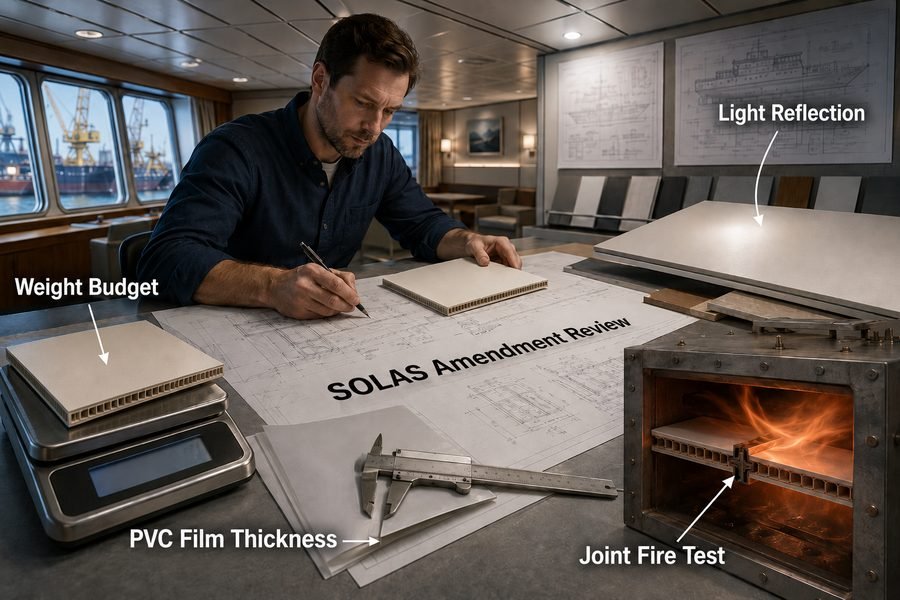
It is frustrating when an interior designer changes the material order right before you send the deposit to the factory. But they do not do it to annoy you. SOLAS rules force them to change their designs. I see this happen constantly with European design firms. They have to adapt to four major factors.
Adapting to Strict Vessel Weight Budgets and PVC Film Limitations
First, designers face strict new vessel weight budgets. Newer environmental rules force ships to install heavy exhaust gas cleaning systems, called scrubbers18. To balance the ship, the shipyard tells the designer to cut weight from the interior. The designer must revise the ceiling panel order, switching from a standard 14 kg/m2 steel panel to an 11 kg/m2 aluminum lightweight panel.
Second, designers face limitations on aesthetic PVC film thickness. As we discussed, SOLAS now limits PVC films to about 150 microns19 to prevent fire spread. In the past, designers loved using thick, 300-micron films because they offered deep, realistic wood-grain textures. Now, those thick films are illegal. The designer must revise their selection and choose a different color or a flat painted finish that passes the fire test.
Managing Altered Light Reflection and Redesigned Ceiling Joint Systems
Third, designers must manage altered light reflection properties. When designers switch from banned PVC films to new fire-safe paints, the room looks different. Fire-safe marine paints often have lower gloss levels. A standard paint might have a 60% gloss level, but the fire-safe version might only have a 20% gloss level. This lower light reflection makes the cabin look darker20. The designer must then revise the ceiling panel selection to a brighter white color to fix the lighting issue.
Fourth, designers need to redesign ceiling joint systems. SOLAS fire draft tests are getting harder to pass. In the past, designers used simple "C-profile" joints that looked very smooth and clean. But those simple joints let too much hot gas through during new laboratory tests21. Now, designers must revise the plans to use complex "Z-profile" locking joints. These new joints look different and change the ceiling grid layout, forcing a complete redesign of the order.
| Design Revision Factor | Old Design Method | New Reality Under SOLAS | Impact on Purchasing |
|---|---|---|---|
| Vessel Weight Budgets | Standard 14 kg/m2 steel panels | Lightweight 11 kg/m2 panels | Must source cost-effective aluminum options |
| PVC Film Thickness | 300-micron deep texture films | 150-micron flat films | Cannot buy heavily textured wood-grain finishes |
| Light Reflection Properties | 60% high-gloss finishes | 20% low-gloss fire-safe finishes | Must order brighter panel colors for cabins |
| Ceiling Joint Systems | Simple, smooth C-profiles | Complex, locking Z-profiles | Must buy specific lab-tested joint accessories |
Conclusion
Understanding recent SOLAS amendments ensures you procure the right marine wall and ceiling panels. Verifying dates, certificates, and test limits keeps your European shipyard projects profitable and on schedule.
-
"Summary of SOLAS chapter II-2 - International Maritime Organization", https://www.imo.org/en/ourwork/safety/pages/summaryofsolaschapterii-2-default.aspx. SOLAS Chapter II-2, Regulation 5 addresses fire growth potential by requiring controls on combustible materials and surface characteristics in accommodation and service spaces; this supports the regulatory basis for assessing panel facings under fire-growth criteria. Evidence role: general_support; source type: institution. Supports: Chapter II-2 Regulation 5 controls fire growth potential and limits combustible material on panel surfaces.. Scope note: The regulation establishes the obligation and framework, while detailed test procedures and numerical acceptance criteria are specified in the FTP Code and related IMO instruments. ↩
-
"RESOLUTION MSC.307(88) (adopted on 3 December ...", https://wwwcdn.imo.org/localresources/en/KnowledgeCentre/IndexofIMOResolutions/MSCResolutions/MSC.307(88).pdf. The IMO 2010 FTP Code adopted by MSC.307(88) includes criteria for surface materials, including limits on calorific value expressed per unit area; this supports the stated threshold for combustible surface finishes when the cited FTP Code provision applies. Evidence role: statistic; source type: institution. Supports: The calorific value of relevant panel surface materials must not exceed 45 MJ/m² under the applicable IMO FTP Code criteria.. Scope note: The source should be checked for the exact material category and application, because the 45 MJ/m² limit may apply only to specified surfaces or arrangements rather than every panel face in all ship spaces. ↩
-
"[PDF] RESOLUTION MSC.307(88) (adopted on 3 December 2010 ...", https://wwwcdn.imo.org/localresources/en/KnowledgeCentre/IndexofIMOResolutions/MSCResolutions/MSC.307(88).pdf. The IMO 2010 FTP Code Part 1 non-combustibility test specifies furnace testing at approximately 750°C and includes a mass-loss acceptance criterion below 50%; this supports the described non-combustibility requirement for materials such as mineral-wool cores when they are tested under that procedure. Evidence role: mechanism; source type: institution. Supports: FTP Code Part 1 assesses non-combustibility using a 750°C furnace test with a mass-loss criterion below 50%.. Scope note: The test confirms performance under the standardized FTP Code non-combustibility procedure; it does not by itself establish the suitability of an entire composite panel assembly unless the assembly or relevant components are within the certificate’s scope. ↩
-
"LIST OF CERTIFICATES AND DOCUMENTS REQUIRED", https://wwwcdn.imo.org/localresources/en/publications/Documents/IMO-Vega/B-FAL.2-Circ.133%20-%20List%20Of%20Certificates%20And%20Documents%20RequiredTo%20Be%20Carried%20On%20Board%20Ships,%202022%20(Secretariat).pdf. Classification-society type approval rules commonly define a finite certificate validity period, often five years, supporting the need to verify the issue and expiry dates on marine equipment certificates. Evidence role: general_support; source type: institution. Supports: A Type Approval Certificate for marine wall panels usually has a five-year validity period from the issue date.. Scope note: Validity periods may vary by classification society, equipment category, and certificate conditions; the source would support the general verification practice rather than every TAC universally lasting exactly five years. ↩
-
"[PDF] RESOLUTION MSC.399(95) (adopted on 5 June 2015 ...", https://wwwcdn.imo.org/localresources/en/KnowledgeCentre/IndexofIMOResolutions/MSCResolutions/MSC.399(95).pdf. The IMO FTP Code smoke and toxicity test provisions specify maximum gas concentration limits, including sulfur dioxide thresholds, for materials tested for shipboard fire safety compliance. Evidence role: statistic; source type: institution. Supports: Marine wall panel datasheets should show SO2 toxicity test values below 120 ppm where the relevant SOLAS/FTP Code toxicity criteria apply.. Scope note: The limit applies within the relevant IMO FTP Code test method and acceptance criteria; it does not by itself confirm that a particular panel assembly has passed the full certification process. ↩
-
"[PDF] MSC.337(91) (adopted on 30 November 2012) CODE ON NOISE ...", https://wwwcdn.imo.org/localresources/en/KnowledgeCentre/IndexofIMOResolutions/MSCResolutions/MSC.337(91).pdf. IMO shipboard noise instruments and ILO maritime labour standards address seafarer exposure to noise and accommodation conditions, providing context for why acoustic specifications may be reviewed separately from SOLAS fire requirements. Evidence role: historical_context; source type: institution. Supports: Shipboard acoustic requirements are governed through maritime noise and labour standards in addition to SOLAS fire-safety rules.. Scope note: Such sources may show that maritime noise and labour standards exist, but they may not prove that updates occur at the same time as SOLAS amendments. ↩
-
"Determination of Thermal Properties of Mineral Wool Required for ...", https://pmc.ncbi.nlm.nih.gov/articles/PMC10488771/. Research and technical literature on mineral-wool insulated fire-rated panels shows that insulation density is a material parameter influencing heat-transfer behavior, fire-resistance performance, and panel mass. Evidence role: mechanism; source type: paper. Supports: Rockwool density affects the fire-resistance behavior and weight of marine wall panels.. Scope note: This supports the mechanism linking density to performance and weight; it does not establish a universal SOLAS-required rockwool density for every B-15 wall panel. ↩
-
"[PDF] RESOLUTION MSC.61(67) (adopted on 5 December 1996 ...", https://wwwcdn.imo.org/localresources/en/KnowledgeCentre/IndexofIMOResolutions/MSCResolutions/MSC.61(67).pdf. An IMO or flag-administration source can document that Resolution MSC.307(88) adopted the 2010 FTP Code and that Resolution A.653(16) belongs to an earlier IMO fire-test framework for surface flammability. Evidence role: historical_context; source type: institution. Supports: The article claims that older fire-test documentation may cite IMO Resolution A.653(16), while the newer applicable FTP Code reference is MSC.307(88).. Scope note: This support is contextual because A.653(16) is an older fire-test resolution, not necessarily the name of the entire old FTP Code. ↩
-
"Directive 96/98/EC - Wikipedia", https://en.wikipedia.org/wiki/Directive_96/98/EC. The Marine Equipment Directive describes the EU declaration of conformity as the manufacturer’s formal statement that marine equipment satisfies the applicable requirements of the Directive. Evidence role: definition; source type: government. Supports: The article claims that a Declaration of Conformity is a legal manufacturer statement that the product complies with current rules.. Scope note: The source would support the legal function of a DoC under the MED; it may not address every non-EU declaration format used by shipyards. ↩
-
"How Do EU Rules Differ From IMO Standards for Marine Panels ...", https://magellanmarinetech.com/how-eu-rules-differ-from-imo-standards-for-marine-panels/. Directive 2014/90/EU establishes the wheel mark for compliant marine equipment and sets requirements for affixing it, while related conformity documentation records compliance with the Directive. Evidence role: general_support; source type: government. Supports: The article claims that Marine Equipment Directive 2014/90/EU requires Wheelmark identification for covered marine equipment and its compliance documents.. Scope note: The Directive directly addresses marking of equipment; the exact form and placement of associated paperwork may be specified through implementing measures or notified-body documentation. ↩
-
"What Is the Purpose and Scope of the IMO FTP Code? - Magellan ...", https://magellanmarinetech.com/what-purpose-scope-of-imo-ftp-code/. The cited source should document SOLAS/IMO requirements for low flame-spread surface materials in ship accommodation spaces and explain how surface finishes are evaluated for fire performance; it may provide regulatory context rather than proving a universal film-thickness limit. Evidence role: historical_context; source type: institution. Supports: SOLAS rules have pushed ship interior surface materials toward stricter low-flame-spread requirements.. Scope note: SOLAS and the IMO Fire Test Procedures Code regulate fire performance, but a source may not confirm the article’s specific thickness claim unless it cites an applicable flag-state, class, or test-standard interpretation. ↩
-
"[PDF] RESOLUTION A.754(18) adopted on 4 November 1993 ...", https://wwwcdn.imo.org/localresources/en/KnowledgeCentre/IndexofIMOResolutions/AssemblyDocuments/A.754(18).pdf. The cited source should define A-class fire divisions and A-60 insulation performance under SOLAS/IMO terminology, including the requirement that the division prevent passage of smoke and flame for the prescribed test period and limit temperature rise for 60 minutes. Evidence role: definition; source type: institution. Supports: An A-60 class bulkhead has defined fire-resistance and insulation-performance requirements for a 60-minute period.. ↩
-
"[PDF] RESOLUTION MSC.267(85) (adopted on 4 December 2008 ...", https://wwwcdn.imo.org/localresources/en/KnowledgeCentre/IndexofIMOResolutions/MSCResolutions/MSC.267(85).pdf. The cited source should support the principle that vessel lightship weight, loading conditions, and subsequent weight changes are inputs to stability assessment and must be controlled or documented; it may not specifically require tracking literally every kilogram of interior outfitting. Evidence role: mechanism; source type: government. Supports: Accurate tracking of added outfitting weight is important because vessel stability calculations depend on the ship’s weight distribution and center of gravity.. Scope note: Authoritative stability rules generally require accurate weight and center-of-gravity information, but the phrase “every kilogram” may be an operational best practice rather than a direct statutory wording. ↩
-
"Formaldehyde - EPA", https://www.epa.gov/formaldehyde/frequent-questions-regulated-stakeholders-about-implementing-formaldehyde-standards. The cited source should identify the E0 formaldehyde-emission classification and its threshold value, commonly expressed as not more than 0.5 mg/L or 0.05 mg/L depending on the test method and jurisdiction; the note should clarify the applicable standard used for the stated limit. Evidence role: definition; source type: research. Supports: The E0 classification denotes a very low formaldehyde-emission threshold for wood-based panels or adhesives.. Scope note: E0 is not a single globally uniform maritime standard, and threshold units vary by test method, product type, and national standard, so the source must match the article’s mg/L formulation. ↩
-
"Amendments to IMO instruments: upcoming and recent entry into ...", https://www.imo.org/en/About/Conventions/Pages/Amendments-to-IMO-instruments.aspx. IMO/SOLAS applicability provisions commonly distinguish ships by construction date, with “constructed” generally tied to the keel being laid or a comparable stage of construction, supporting the use of the keel-laying date as a regulatory baseline. Evidence role: mechanism; source type: institution. Supports: The vessel’s official keel laying date determines which baseline version of maritime regulations applies.. Scope note: Individual SOLAS amendments may define applicability differently, so the source supports the general mechanism rather than every possible rule. ↩
-
"What Is the Purpose and Scope of the IMO FTP Code? - Magellan ...", https://magellanmarinetech.com/what-purpose-scope-of-imo-ftp-code/. IMO materials on SOLAS Chapter II-2 and the International Code for Application of Fire Test Procedures describe how shipboard fire-safety materials and products are tested and approved under SOLAS requirements. Evidence role: definition; source type: institution. Supports: Ship panels may need to comply with the applicable SOLAS fire-safety chapter and FTP Code requirements.. Scope note: The exact SOLAS regulation and FTP Code test method depend on the panel’s intended location, construction, and fire-safety function. ↩
-
"Amendments to IMO instruments: upcoming and recent entry into ...", https://www.imo.org/en/About/Conventions/Pages/Amendments-to-IMO-instruments.aspx. IMO explanatory materials on SOLAS amendments note that while many new requirements apply to ships built after a specified date, some safety amendments can also apply to existing ships, supporting the concept of retroactive compliance obligations. Evidence role: historical_context; source type: institution. Supports: Some IMO safety rules can require existing ships to comply, not only newly built ships.. Scope note: Retroactive application is not universal; it depends on the wording and entry-into-force provisions of each amendment. ↩
-
"IMO 2020 – cutting sulphur oxide emissions", https://www.imo.org/en/mediacentre/hottopics/pages/sulphur-2020.aspx. IMO materials on the global sulphur limit describe exhaust gas cleaning systems as one compliance option for reducing sulphur oxide emissions from ships, alongside compliant low-sulphur fuels; this supports the regulatory context for scrubber installation but not the claim that all ships are required to install them. Evidence role: historical_context; source type: institution. Supports: Newer environmental rules have led some ships to install heavy exhaust gas cleaning systems, called scrubbers.. Scope note: Contextual support only: IMO rules restrict sulphur emissions, but they do not universally mandate scrubbers. ↩
-
"What Is the Purpose and Scope of the IMO FTP Code? - Magellan ...", https://magellanmarinetech.com/what-purpose-scope-of-imo-ftp-code/. The SOLAS fire-safety regime and IMO FTP Code regulate flame spread, smoke, toxicity, and calorific characteristics of materials used on ships; this provides context for restrictions on decorative surface materials, though it may not establish a universal 150-micron PVC-film limit. Evidence role: expert_consensus; source type: institution. Supports: SOLAS fire-safety requirements restrict the use of certain PVC decorative films on ship interiors.. Scope note: The source may support performance-based fire restrictions rather than the specific 150-micron figure, which may depend on product testing or flag-state interpretation. ↩
-
"Color and gloss constancy under diverse lighting environments - PMC", https://pmc.ncbi.nlm.nih.gov/articles/PMC10351023/. Lighting-design references explain that surface reflectance and gloss influence perceived brightness and illuminance distribution in interiors; this supports the mechanism by which a lower-reflectance ceiling finish can make a cabin appear darker. Evidence role: mechanism; source type: education. Supports: Lower-reflectance or lower-gloss ceiling finishes can make an interior cabin appear darker.. Scope note: This supports the optical principle, not the article’s specific 60% and 20% gloss values for marine fire-safe paints. ↩
-
"[PDF] RESOLUTION MSC.307(88) (adopted on 3 December 2010 ...", https://wwwcdn.imo.org/localresources/en/KnowledgeCentre/IndexofIMOResolutions/MSCResolutions/MSC.307(88).pdf. IMO FTP Code fire-resistance test procedures assess the integrity and insulation of ship divisions, including whether flames or hot gases pass through joints and openings; this supports the need for tested joint designs, though not any specific C-profile or Z-profile geometry. Evidence role: mechanism; source type: institution. Supports: Marine ceiling joint systems must prevent passage of hot gases during fire-resistance testing.. Scope note: Contextual support only: the regulatory test criteria address joint integrity, but the performance of C-profile versus Z-profile systems would require product-specific test reports. ↩