You buy marine panels to pass safety rules, but confusing ratings can fail your shipyard inspections. This costs you time and money. I will explain these durations clearly today.
Fire rating duration means the exact time a marine panel blocks flames and heat during a standard lab test. Under SOLAS rules, durations cover 0, 15, 30, and 60 minutes for A-Class and B-Class panels. This exact time decides where you can safely install the panel on a ship.
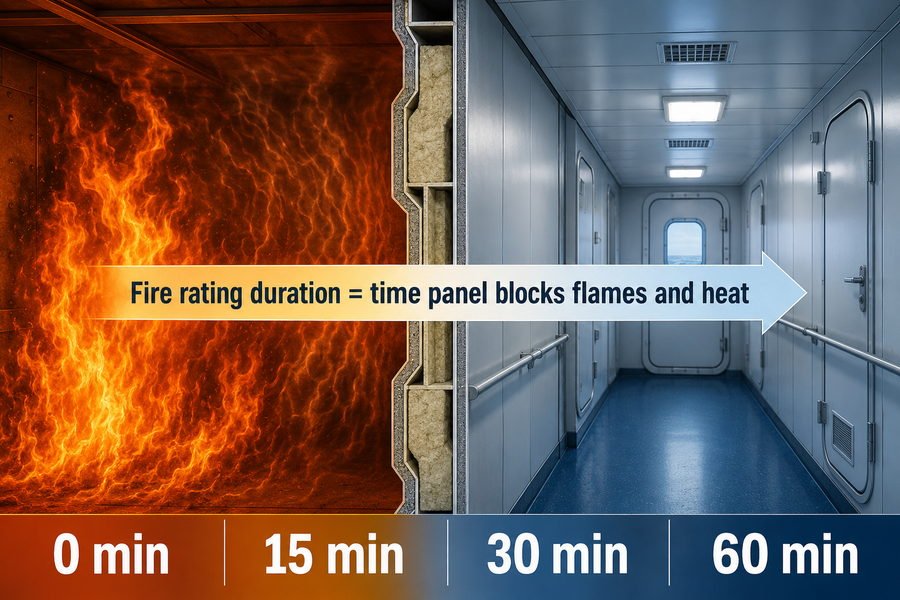
I learned this the hard way when a shipyard rejected a huge batch of panels early in my career. Let us dive into how testing labs actually measure these minutes.
How Is a 30, 60, or 120 Minute Rating Measured on a Marine Wall Panel?
Testing panels is a complex process. If you do not understand the test, you might buy the wrong panel. I will show you exactly how labs measure these ratings.
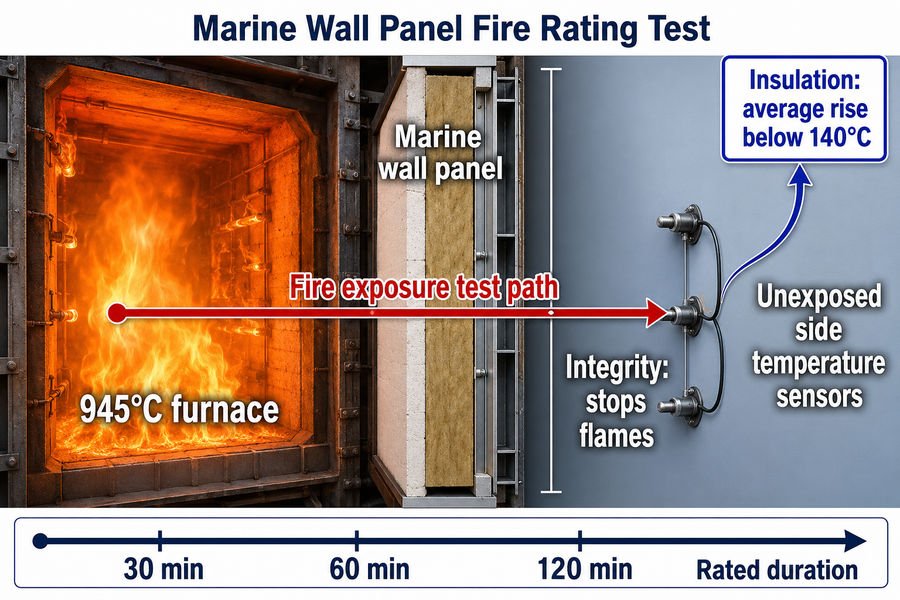
Labs measure marine wall panel fire ratings using the IMO 2010 FTP Code Part 3 test. They put the panel in a furnace at 945°C for 60 minutes. The panel must stop flames (integrity) and keep the unexposed side below 140°C average rise (insulation) for the rated 30, 60, or 120 minutes.
The Standard Furnace Test for Marine Wall Panels
I want to explain the IMO 2010 FTP Code Part 3. This is the global standard rule book. Labs use a big furnace for this test. They build a test wall that is 2.44 meters high and 2.44 meters wide. They put your panel in the furnace door. They light the fire. The temperature goes up very fast. At 5 minutes, the heat reaches 576 degrees Celsius. At 30 minutes, it is 842 degrees Celsius. At 60 minutes, it reaches 945 degrees Celsius. For a 120-minute test, it goes up to 1049 degrees Celsius.1 You must check these temperatures on your test report.
Measuring Integrity and Insulation During the Test
Labs check two main things. The first thing is integrity. Integrity means the panel stops smoke and fire. Labs put a cotton pad near the panel. If the pad catches fire, the panel fails the integrity test. The second thing is insulation. Insulation means the panel stops heat. Labs put five thermocouples on the cold side of the panel. A thermocouple is a heat sensor. The rules say the average heat rise cannot go over 140 degrees Celsius. Also, no single point can rise more than 180 degrees Celsius.2
If the panel passes both checks for 60 minutes, it gets a 60-minute rating. A 30-minute rating means it passes for 30 minutes. Some special panels need a 120-minute rating. These take a longer furnace test. I always ask my suppliers for the exact test report. The report must show the temperature curves. You should check the test lab name. Good labs are DNV, ABS, or Lloyd's Register.
| Rating Duration | Furnace Temperature | Average Heat Rise Limit | Max Single Point Heat Rise Limit |
|---|---|---|---|
| 30 Minutes | 842°C | 140°C | 180°C |
| 60 Minutes | 945°C | 140°C | 180°C |
| 120 Minutes | 1049°C | 140°C | 180°C |
What Does a "60 Minute Rating" on a Marine Ceiling Panel Actually Guarantee?
You pay good money for 60-minute panels. But what do you actually get? A misunderstanding here can ruin a big shipyard project. I will explain the real guarantees.
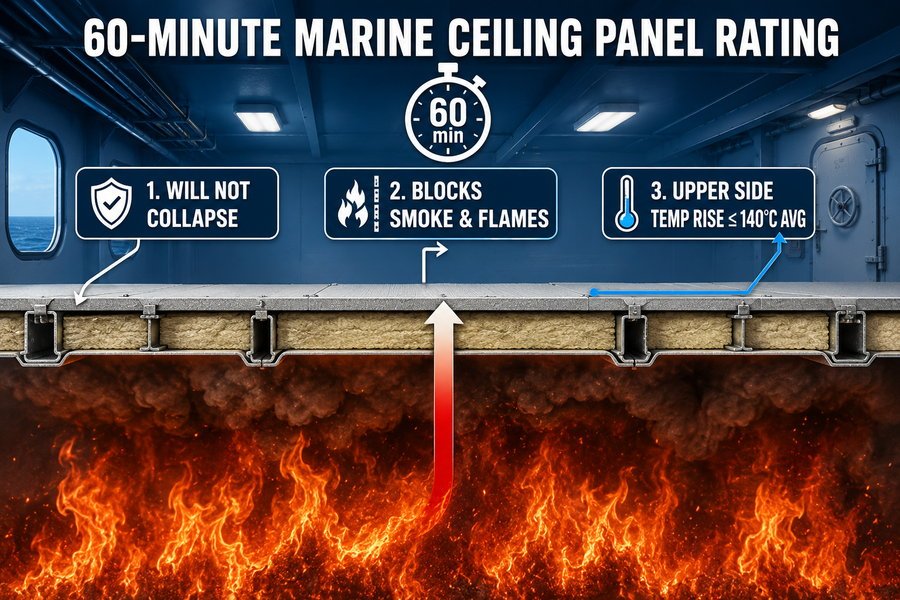
A 60-minute rating on a marine ceiling panel guarantees three complete protections under IMO rules. First, it guarantees the panel will not collapse. Second, it guarantees smoke and flames cannot pass through. Third, it guarantees the temperature on the unexposed upper side will not rise more than 140°C on average.
Guarantee 1: Structural Stability of the Marine Ceiling
When you buy a 60-minute A-Class ceiling panel, you buy safety. This rating gives you three very specific guarantees. I will explain each one so you know what you are paying for. The first guarantee is structural stability. A ceiling panel hangs above people. During a fire, the metal and the rock wool get very hot. The IMO 2010 FTP Code requires the ceiling to stay up. It cannot fall down for 60 minutes. The steel frame must hold the panel. This gives passengers one full hour to walk safely under it. Shipyards check this frame very closely.
Guarantee 2: Flame and Smoke Integrity
The second guarantee is flame and smoke integrity. A fire makes toxic smoke. The 60-minute rating means all the joints between panels stay tight. The test uses a 6 millimeter gap gauge and a 25 millimeter gap gauge.3 The inspector tries to push these metal sticks through the panel joints. If the 6mm gauge goes through and moves along the gap, the test fails. The panel must block all flames for 60 full minutes.
Guarantee 3: Thermal Insulation Limits
The third guarantee is thermal insulation. The fire below the ceiling reaches 945 degrees Celsius. But the floor above the ceiling must stay cool. The rules state the average temperature rise on the top side cannot exceed 140 degrees Celsius. This stops heat from starting a new fire on the next deck up. I always tell my clients to check the rock wool density. A density of 120 kilograms per cubic meter usually guarantees this insulation result.4
| Guarantee Type | IMO Testing Method | Pass Criteria for 60 Minutes |
|---|---|---|
| Structural Stability | Visual observation during furnace test | Ceiling does not collapse or break apart |
| Flame Integrity | Cotton pad and metal gap gauges | No flame through, gauges cannot pass |
| Thermal Insulation | Thermocouples on unexposed side | Average temp rise ≤ 140°C |
Why Do Marine Wall Panels Fail Before Their Stated Rating Duration?
Panels sometimes fail early during shipyard installations. This causes massive headaches and delays. You need to know the common traps. I will show you why panels fail.
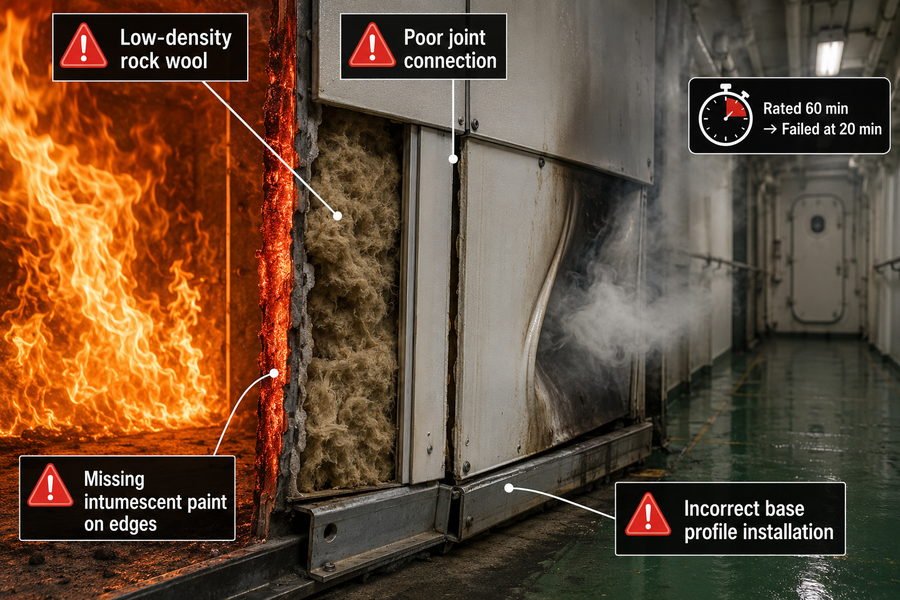
Marine wall panels fail before their stated rating duration for four main reasons: using cheap low-density rock wool, poor joint connections, missing intumescent paint on edges, and wrong installation methods. Even a certified panel will fail in 20 minutes if the shipyard workers install the base profiles incorrectly.
Internal Material Failures: Low-Density Rock Wool and Missing Paint
You buy a panel with a beautiful test certificate. But the panel fails a real inspection. Why does this happen? I have seen this many times in Asian shipyards. The panel fails for four specific reasons. The first reason is low-density rock wool. The factory wants to save money. They use rock wool with a density of 80 kilograms per cubic meter instead of 120 kilograms per cubic meter5. The panel feels the same. But in a fire, the thin rock wool burns away fast. Heat goes right through. The temperature rises above the 140 degrees Celsius limit6 in just 20 or 30 minutes.
The second material reason is missing intumescent paint. Good factories put a special fire paint on the panel edges. This paint expands when it gets hot.7 It seals the joints tight. Some cheap factories skip this paint to save 1 or 2 dollars per square meter. Without the paint, smoke leaks out fast.
External Failures: Poor Joint Connections and Wrong Installation
The third reason is poor joint connections. Marine panels connect with a tongue and groove system. Sometimes the metal shape is wrong. In a fire, the metal bends. A gap opens. Flames shoot through the gap. This breaks the integrity rule immediately.
The fourth reason is wrong installation methods by the workers. The panel is perfect, but the shipyard cuts big holes for cables. They do not seal the holes with firestop putty. Or they do not screw the bottom track to the steel deck properly. A 60-minute panel only works if you use a 60-minute installation method.8
| Failure Reason | Cost Saving for Factory | Result in a Fire Test | Solution |
|---|---|---|---|
| Low-density rock wool | Saves $2 to $4 per m² | Fails insulation limit fast | Specify 120 kg/m³ density |
| Poor joint connections | Saves tooling costs | Flames leak through joints | Buy samples to test joints |
| Missing intumescent paint | Saves $1 to $2 per m² | Smoke escapes from edges | Check edges before buying |
| Wrong installation | Saves labor time | Entire fire zone fails | Train shipyard workers well |
How to Choose Rating Duration for Marine Ceiling Panels in Cabin Areas?
Picking the right ceiling panel saves you money. Picking the wrong one wastes your budget. I will teach you the rules for cabin areas.
You choose the rating duration for marine cabin ceiling panels by checking SOLAS Chapter II-2 rules. You must select B-0 (0 minutes insulation), B-15 (15 minutes insulation), or A-30 (30 minutes insulation) based on what the cabin is next to, such as a corridor, stairway, or another cabin.
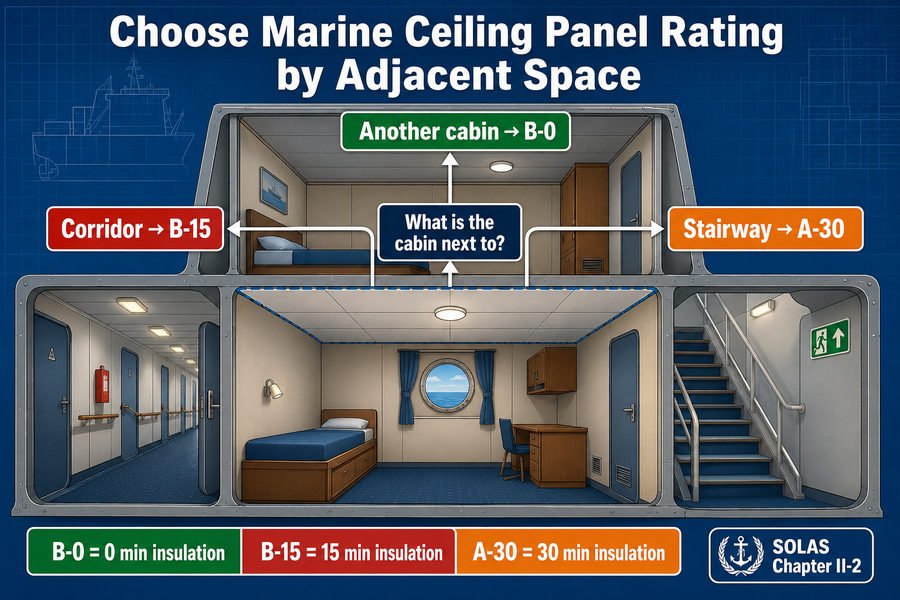
Choosing B-0 and B-15 Ratings for Standard Cabins
You want to buy ceiling panels for ship cabins. You want a good price. But you must meet the rules. The International Convention for the Safety of Life at Sea (SOLAS) Chapter II-2 gives us the exact answers. You have three main choices for cabin ceilings. I will explain how to pick between B-0, B-15, and A-30.
First, let us look at B-0 and B-15 ratings. "B-Class" means the panel stops flames for 30 minutes. The number "0" or "15" tells you the insulation time.9 A B-0 ceiling panel stops flames for 30 minutes, but it has 0 minutes of heat insulation. You use B-0 ceilings inside a single fire zone where there is low risk. A B-15 ceiling panel gives you 15 minutes of heat insulation. The average temperature rise stays below 140 degrees Celsius for 15 minutes. You must use B-15 ceilings in corridors outside the cabins.10 A B-15 panel usually costs 3 to 5 dollars more per square meter than a B-0 panel.
Choosing A-30 Ratings for Cabins Near High-Risk Areas
Next, let us look at A-30 ratings. "A-Class" panels stop flames for 60 minutes. An A-30 panel gives you 30 minutes of heat insulation. You must use an A-30 ceiling when the cabin is right below a high-risk area. For example, if the cabin is under a public dining room or a stairway, SOLAS requires stronger protection. An A-30 ceiling panel is thicker. It is usually 50 millimeters thick. It costs around 25 to 35 dollars per square meter. I always tell my buyers to check the ship general arrangement plan. You match the room type to the SOLAS table to find the right rating.
| Panel Rating | Integrity Time | Insulation Time | Typical Cabin Area Location | Estimated Cost per m² |
|---|---|---|---|---|
| B-0 Ceiling | 30 minutes | 0 minutes | Inside standard passenger cabins | $18 - $22 |
| B-15 Ceiling | 30 minutes | 15 minutes | Corridors outside cabins | $22 - $26 |
| A-30 Ceiling | 60 minutes | 30 minutes | Cabins under public spaces or stairs | $25 - $35 |
How to Match Marine Panel Rating Duration to Vessel Bulkhead Requirements?
You have the ship drawings, but matching panels to bulkheads is confusing. A mistake here stops the ship from sailing. I will show you the exact matching process.
You match panel rating duration to vessel bulkheads by using the structural fire protection tables in the SOLAS manual. You find the exact requirement, which will be A-60, A-30, A-15, A-0, B-15, B-0, or C-Class, and then buy panels that have matching certificates from classification societies like DNV or ABS.
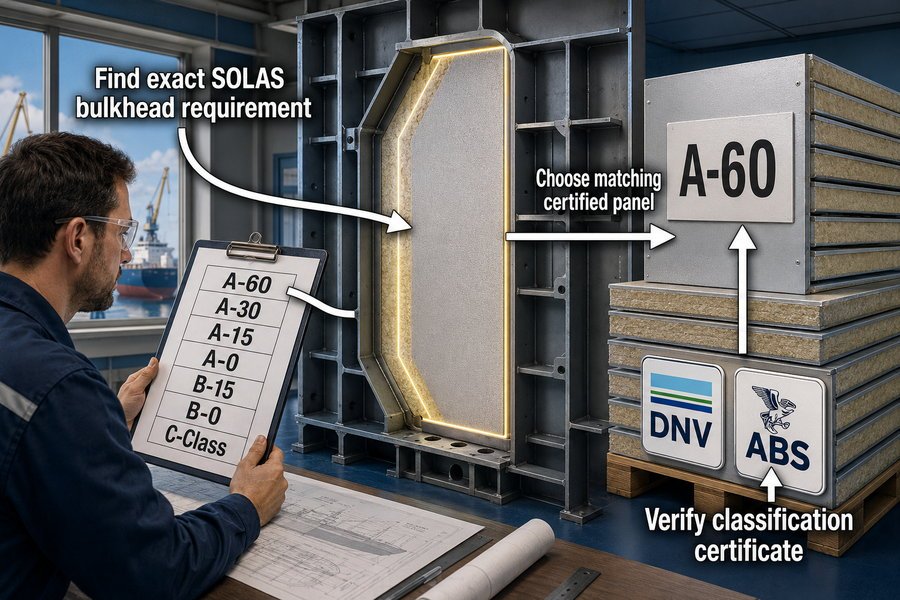
Finding the Requirement in the SOLAS Structural Fire Protection Tables
Every commercial ship has a structural fire protection plan. The naval architect draws this plan. Your job as a buyer is to match your panels to this plan. It sounds hard, but it is just a matching game. You must use the SOLAS manual.11 I will explain exactly how you match the seven possible ratings.
First, you must look at the SOLAS tables. The table shows a matrix. It lists one room type on the top. It lists another room type on the side.12 Where the two lines cross, you find the rating duration. For example, if a cabin is next to a machinery space, the box will say A-60. If a cabin is next to another cabin, the box will say B-0. This gives you your target requirement.
Matching the Requirement with Approved A-Class, B-Class, and C-Class Panels
Second, you match that target with real panels. You have seven classes to choose from. A-60 provides 60 minutes of insulation. A-30 provides 30 minutes. A-15 provides 15 minutes. A-0 provides 0 minutes of insulation, but 60 minutes of flame integrity.13 B-15 provides 15 minutes of insulation and 30 minutes of integrity. B-0 provides 0 minutes of insulation and 30 minutes of integrity. The last choice is C-Class. C-Class panels only need to be non-combustible. They have no time duration requirement at all.14
When you find your required class, you must ask the supplier for the exact certificate. If the bulkhead needs an A-30 panel, you cannot just buy any panel. You must ask the factory for an A-30 Type Approval Certificate. Good certificates come from societies like DNV, ABS, or Lloyd's Register. A C-Class panel might cost 15 dollars per square meter. An A-60 panel might cost 45 dollars per square meter. Do not overpay by putting A-60 panels where the drawing only asks for B-15.
| Class Rating | Integrity Duration | Insulation Duration | Typical Bulkhead Application | Required Certificate |
|---|---|---|---|---|
| A-60 | 60 minutes | 60 minutes | High fire risk boundaries | DNV / ABS Type Approval |
| A-30 | 60 minutes | 30 minutes | Medium fire risk boundaries | DNV / ABS Type Approval |
| A-15 | 60 minutes | 15 minutes | Low fire risk boundaries | DNV / ABS Type Approval |
| A-0 | 60 minutes | 0 minutes | Basic steel subdivisions | DNV / ABS Type Approval |
| B-15 | 30 minutes | 15 minutes | Escape corridors | DNV / ABS Type Approval |
| B-0 | 30 minutes | 0 minutes | Between adjacent cabins | DNV / ABS Type Approval |
| C-Class | No requirement | No requirement | Open spaces, non-rated areas | Non-combustible test |
What Rating Durations Are Standard for Marine Wall Panels at Engine Room Boundaries?
Engine rooms are the most dangerous places on a ship. You cannot make cheap choices here. I will tell you the exact standards you must follow.
The standard rating duration for marine wall panels at engine room boundaries is strictly A-60 (60 minutes insulation and integrity). However, if the adjacent room has a very low fire risk, like a void space, SOLAS regulations sometimes allow a reduced standard of an A-0 rating (0 minutes insulation).
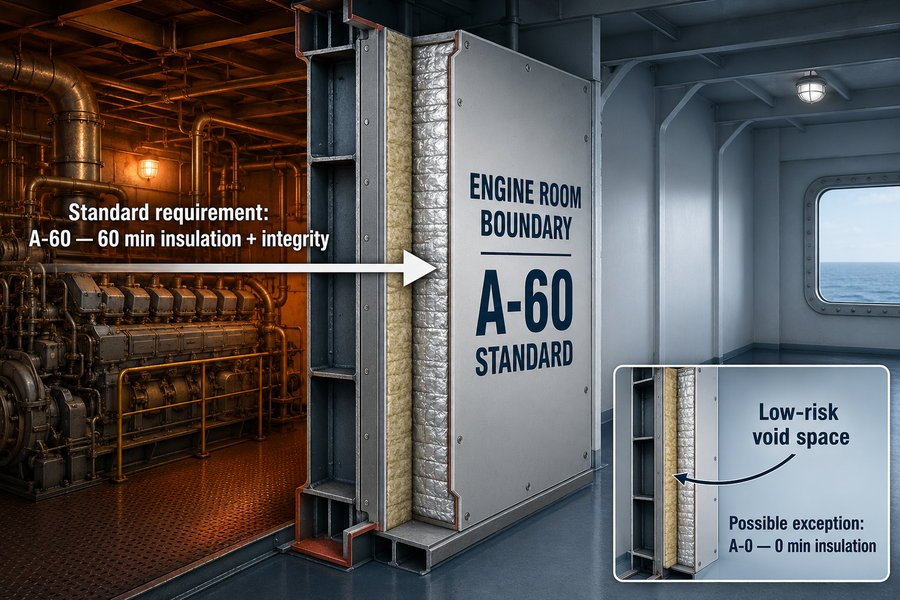
The Strict A-60 Standard for High-Risk Engine Room Boundaries
The engine room is full of hot oil, running machines, and fuel lines. It is the number one place for ship fires15. Because of this, the rules are very strict. You only have two choices for wall panels here. I will explain the A-60 standard and the A-0 exception.
The primary standard for engine room boundaries is always an A-60 rating16. This means the wall panel must block flames for 60 minutes. It must also block heat for 60 minutes. If the engine room is next to a control room, a corridor, or a passenger area, you have no other choice.17 You must buy an A-60 panel. These panels are heavy. They usually use a double layer of rock wool. The total rock wool thickness is often 100 millimeters. The density is very high, usually around 120 to 150 kilograms per cubic meter. These heavy panels cost between 45 and 60 dollars per square meter. I tell my clients never to buy cheap panels for this area. The port state control inspectors always check engine room boundaries very closely.
The Exception for A-0 Ratings Next to Low-Risk Spaces
But there is one exception. SOLAS regulations sometimes allow an A-0 rating18. You can use an A-0 panel if the engine room is next to a space with almost zero fire risk. A good example is a void space or an empty water tank. An A-0 panel must still stop flames for 60 minutes. But it does not need to stop heat. It has 0 minutes of insulation duration. An A-0 panel is much thinner and cheaper. It might only cost 25 dollars per square meter. But you must read the ship drawings very carefully before you buy an A-0 panel. If you put an A-0 panel next to a corridor, the inspector will make you tear it down.
| Boundary Rating | Integrity Time | Insulation Time | Typical Rock Wool Thickness | Adjacent Room Type |
|---|---|---|---|---|
| A-60 Standard | 60 minutes | 60 minutes | 100 mm | Corridors, Control Rooms, Cabins |
| A-0 Exception | 60 minutes | 0 minutes | 25 mm - 50 mm | Void Spaces, Sanitary Spaces, Tanks |
Conclusion
Understanding fire rating durations for marine panels ensures ship safety and saves money. Always check the IMO FTP Code and SOLAS tables before you buy any interior outfitting products.
-
"[PDF] RESOLUTION MSC.307(88) (adopted on 3 December 2010 ...", https://wwwcdn.imo.org/localresources/en/KnowledgeCentre/IndexofIMOResolutions/MSCResolutions/MSC.307(88).pdf. IMO 2010 FTP Code, Part 3 specifies the standard fire exposure time-temperature curve for fire-resistance tests, including nominal furnace temperatures of about 576 °C at 5 minutes, 842 °C at 30 minutes, 945 °C at 60 minutes, and 1049 °C at 120 minutes. Evidence role: definition; source type: institution. Supports: The IMO 2010 FTP Code Part 3 furnace test uses a defined time-temperature curve with temperatures of 576 °C at 5 minutes, 842 °C at 30 minutes, 945 °C at 60 minutes, and 1049 °C at 120 minutes.. ↩
-
"What Is the Purpose and Scope of the IMO FTP Code? - Magellan ...", https://magellanmarinetech.com/what-purpose-scope-of-imo-ftp-code/. IMO 2010 FTP Code, Part 3 defines insulation performance by temperature rise on the unexposed face, with acceptance criteria of no more than 140 °C average rise and no more than 180 °C rise at any individual point above the initial temperature. Evidence role: definition; source type: institution. Supports: Under IMO 2010 FTP Code Part 3, insulation performance is judged using limits of 140 °C average temperature rise and 180 °C maximum individual temperature rise.. ↩
-
"[PDF] RESOLUTION MSC.307(88) (adopted on 3 December 2010 ...", https://wwwcdn.imo.org/localresources/en/KnowledgeCentre/IndexofIMOResolutions/MSCResolutions/MSC.307(88).pdf. The IMO 2010 FTP Code fire-resistance test procedures describe integrity assessment using specified gap gauges, including 6 mm and 25 mm gauges, to evaluate whether openings have developed during the test. Evidence role: definition; source type: institution. Supports: The IMO 2010 FTP Code fire test uses 6 mm and 25 mm gap gauges to assess flame and smoke integrity.. Scope note: This supports the test method generally; the exact pass/fail interpretation should be checked against the relevant FTP Code part and specimen classification. ↩
-
"[PDF] RESOLUTION A.754(18) adopted on 4 November 1993 ...", https://wwwcdn.imo.org/localresources/en/KnowledgeCentre/IndexofIMOResolutions/AssemblyDocuments/A.754(18).pdf. Research and technical literature on mineral wool fire performance indicates that density can affect thermal insulation behavior, but IMO A-60 compliance is determined by testing the complete ceiling assembly rather than by insulation density alone. Evidence role: general_support; source type: paper. Supports: Mineral wool density is relevant to thermal insulation performance, but a 120 kg/m³ density alone does not independently guarantee the IMO A-60 insulation result.. Scope note: The source can contextualize the role of mineral wool density, but it would not directly prove that 120 kg/m³ insulation guarantees an IMO A-60 result for every panel design. ↩
-
"Determination of Thermal Properties of Mineral Wool Required for ...", https://pmc.ncbi.nlm.nih.gov/articles/PMC10488771/. Studies of mineral wool and insulated panel fire performance report that insulation density and composition affect thermal resistance and fire-test behavior, providing context for why substituting lower-density rock wool can reduce fire-resistance performance. Evidence role: mechanism; source type: paper. Supports: Using lower-density rock wool can weaken the insulation performance of a fire-rated panel.. Scope note: Such sources generally support the relationship between density and fire performance; they may not directly prove that every 80 kg/m³ panel fails relative to a 120 kg/m³ panel without product-specific test data. ↩
-
"What Is the Purpose and Scope of the IMO FTP Code? - Magellan ...", https://magellanmarinetech.com/what-purpose-scope-of-imo-ftp-code/. The IMO FTP Code describes the insulation criterion for A-class divisions as a temperature-rise limit, including an average rise of no more than 140°C above the initial temperature during the specified fire test. Evidence role: definition; source type: institution. Supports: Marine fire-rated panels are assessed against a 140°C insulation temperature-rise limit.. Scope note: This supports the regulatory temperature criterion, not the article’s specific estimate that failure occurs in 20 or 30 minutes. ↩
-
"[PDF] intumescent “instant firewalls” for low-cost fire protection", https://tsapps.nist.gov/publication/get_pdf.cfm?pub_id=909436. Technical literature on intumescent coatings explains that these materials swell and form a char layer when heated, which can help protect substrates or seal gaps exposed to fire. Evidence role: mechanism; source type: paper. Supports: Intumescent paint expands under heat and can contribute to sealing or protecting fire-exposed panel edges.. Scope note: This supports the general operating mechanism of intumescent coatings, not the specific cost figures or the performance of a particular panel manufacturer’s edge treatment. ↩
-
"[PDF] RESOLUTION MSC.307(88) (adopted on 3 December 2010 ...", https://wwwcdn.imo.org/localresources/en/KnowledgeCentre/IndexofIMOResolutions/MSCResolutions/MSC.307(88).pdf. Fire-resistance standards and guidance treat ratings as properties of tested assemblies, including joints, supports, and penetrations, and require firestopping of openings to maintain the rated separation. Evidence role: expert_consensus; source type: government. Supports: A fire-rated panel’s performance depends on installation details such as sealed penetrations, joints, and attachment methods.. Scope note: This supports the principle that installation details affect the rating; it does not verify the article’s particular examples of shipyard workmanship. ↩
-
"What Is the Purpose and Scope of the IMO FTP Code? - Magellan ...", https://magellanmarinetech.com/what-purpose-scope-of-imo-ftp-code/. SOLAS Chapter II-2 defines B-class divisions by their ability to prevent flame passage for the first 30 minutes of the standard fire test, while suffixes such as B-0 and B-15 indicate the required insulation period under specified temperature-rise limits. Evidence role: definition; source type: institution. Supports: B-Class divisions provide 30 minutes of fire integrity, and the B-0/B-15 suffix identifies the insulation time.. ↩
-
"Summary of SOLAS chapter II-2 - International Maritime Organization", https://www.imo.org/en/ourwork/safety/pages/summaryofsolaschapterii-2-default.aspx. SOLAS Chapter II-2 Regulation 9 uses fire integrity tables to assign minimum A- or B-class divisions between accommodation spaces, corridors, stairways, public rooms, and other categories; these tables provide the regulatory context for when a B-15 boundary may be required adjacent to cabins. Evidence role: general_support; source type: institution. Supports: B-15 ceilings may be required in corridors outside cabins under SOLAS fire integrity requirements.. Scope note: The exact required rating depends on vessel type, space category, and the applicable SOLAS table, so the source supports the regulatory method rather than proving that every cabin corridor ceiling must be B-15. ↩
-
"Summary of SOLAS chapter II-2 - International Maritime Organization", https://www.imo.org/en/ourwork/safety/pages/summaryofsolaschapterii-2-default.aspx. SOLAS Chapter II-2 sets out international requirements for fire protection, fire detection, and fire extinction on ships, including structural fire protection provisions used to determine required division ratings. Evidence role: general_support; source type: institution. Supports: SOLAS is the governing reference for determining structural fire protection requirements on commercial ships.. Scope note: The source establishes the regulatory framework but does not by itself verify any individual vessel’s fire-control drawing or purchasing specification. ↩
-
"[PDF] Supplement - International Maritime Organization", https://wwwcdn.imo.org/localresources/en/publications/Documents/Supplements/English/QF110E_122015.pdf. SOLAS II-2 Regulation 9 uses tabulated relationships between space categories to prescribe minimum fire integrity standards for bulkheads and decks separating those spaces. Evidence role: mechanism; source type: institution. Supports: SOLAS structural fire protection requirements are determined by cross-referencing the categories of adjoining spaces in fire integrity tables.. Scope note: The tables vary by ship type and arrangement, so the source supports the method of cross-referencing space categories rather than the specific examples in the article. ↩
-
"Are Marine Fire Divisions the Same as Marine Panel Ratings?", https://magellanmarinetech.com/are-marine-fire-divisions-same-as-marine-panel-ratings/. SOLAS definitions for A-class divisions require prevention of smoke and flame passage for a one-hour standard fire test, with insulation limits corresponding to A-60, A-30, A-15, or A-0 classifications. Evidence role: definition; source type: institution. Supports: A-class divisions have 60 minutes of integrity, while their insulation duration is designated by the suffix 60, 30, 15, or 0.. Scope note: The citation supports the classification definitions; actual panel acceptability still depends on the approved construction tested and certified for the intended installation. ↩
-
"What Is the Purpose and Scope of the IMO FTP Code? - Magellan ...", https://magellanmarinetech.com/what-purpose-scope-of-imo-ftp-code/. SOLAS definitions for B-class divisions specify prevention of flame passage for the first half hour of the standard fire test, with B-15 and B-0 insulation designations, while C-class divisions are constructed of approved non-combustible materials and are not required to meet smoke, flame, or temperature-rise criteria. Evidence role: definition; source type: institution. Supports: B-class divisions have 30 minutes of integrity with B-15 or B-0 insulation ratings, and C-class divisions are non-combustible without a time-rated fire-test requirement.. Scope note: This supports the regulatory definitions of B- and C-class divisions, not whether a particular marketed panel has passed the required approval tests. ↩
-
"[PDF] MSC.1-Circ.1321-Guidelines-For-Measures-To-Prevent-Fires-In ...", https://greenvoyage2050.imo.org/wp-content/uploads/2023/02/MSC.1-Circ.1321-Guidelines-For-Measures-To-Prevent-Fires-In-Engine-Rooms-And-Cargo-Pump-Rooms-Secretariat.pdf. A maritime casualty statistics source should be cited to show that machinery spaces or engine rooms are among the most frequent origins of shipboard fires. Evidence role: statistic; source type: institution. Supports: The engine room is the number one place for ship fires.. Scope note: Available statistics may classify incidents by vessel type or by broader categories such as “machinery spaces,” so they may support the risk ranking only contextually rather than proving it for all ships. ↩
-
"What Is the Purpose and Scope of the IMO FTP Code? - Magellan ...", https://magellanmarinetech.com/what-purpose-scope-of-imo-ftp-code/. The IMO fire test/classification framework defines A-class divisions as maintaining integrity for 60 minutes, with A-60 divisions also satisfying specified temperature-rise limits for 60 minutes. Evidence role: definition; source type: institution. Supports: An A-60 panel must resist flame passage for 60 minutes and meet insulation criteria for 60 minutes.. ↩
-
"[PDF] MSC.99(73) - International Maritime Organization", https://wwwcdn.imo.org/localresources/en/KnowledgeCentre/IndexofIMOResolutions/MSCResolutions/MSC.99(73).pdf. SOLAS Chapter II-2 fire integrity tables specify required fire ratings for boundaries between machinery spaces of category A and adjacent accommodation, service, control, or corridor spaces, commonly requiring A-class insulated divisions such as A-60 in higher-risk adjacencies. Evidence role: expert_consensus; source type: institution. Supports: Engine-room boundaries next to control rooms, corridors, or passenger areas generally require A-60-rated panels.. Scope note: The exact required rating depends on vessel type, space category, flag-state interpretation, and the applicable SOLAS table, so the source may qualify rather than absolutely prove “no other choice” in every case. ↩
-
"[PDF] RESOLUTION A.754(18) adopted on 4 November 1993 ...", https://wwwcdn.imo.org/localresources/en/KnowledgeCentre/IndexofIMOResolutions/AssemblyDocuments/A.754(18).pdf. SOLAS fire integrity tables include cases where boundaries involving lower-risk spaces may be assigned A-0 rather than A-60, while IMO definitions still require A-0 divisions to maintain fire integrity for 60 minutes without an insulation-time requirement. Evidence role: definition; source type: institution. Supports: SOLAS may permit A-0 panels for some boundaries adjacent to low-risk spaces, and A-0 has 60 minutes of integrity but no insulation duration.. Scope note: The allowance is conditional on the exact space categories and vessel application, so the citation should not be read as approval for any engine-room boundary without plan review. ↩