Do you worry about customs holding your interior panels? Delays cost thousands daily. I know this pain. Let us fix this compliance issue before it ruins your project schedule.
To avoid EU rejection of marine accommodation panels, you must secure the "Wheelmark" certification under the Marine Equipment Directive (MED). This requires a valid Module B (Type Examination) and Module D or E (Production Quality), ensuring full compliance with SOLAS fire safety standards before the panels reach EU ports.
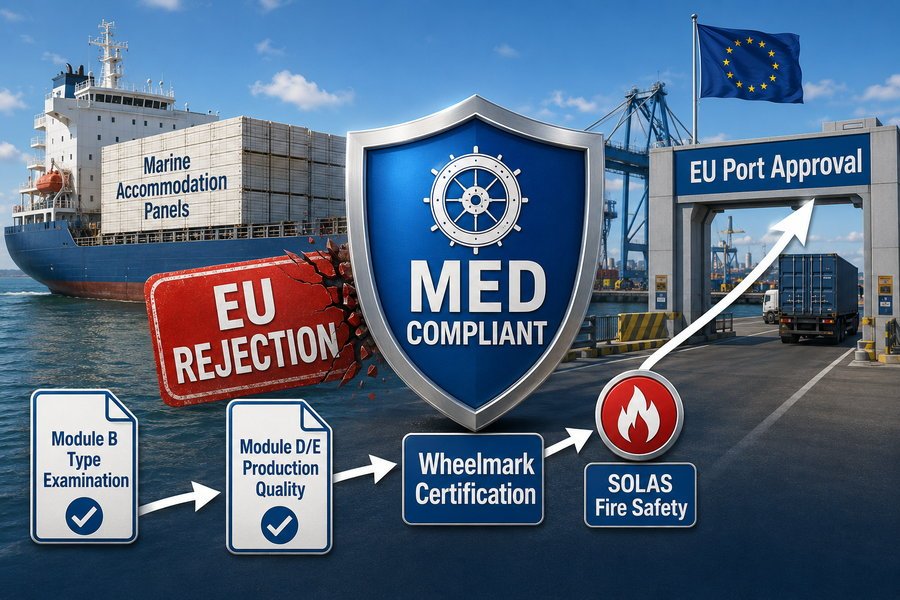
Getting this wrong means costly project halts. Customs officers do not care about your tight deadline. Keep reading to see exactly where shipments fail and how to secure your supply chain.
Why Are "Marine-Grade" Accommodation Panels Rejected at EU Ports Without Wheelmark?
You buy high-quality panels, but port authorities still block them. You feel angry and confused. Why does general marine grade fail? Here is the exact reason EU customs stop your shipment.
"Marine-grade" panels are rejected at EU ports because the EU strictly requires the MED "Wheelmark" symbol for fire safety compliance. General marine grade does not legally prove adherence to the specific 2014/90/EU directive, which mandates rigorous standardized testing like the FTP Code 2010 for surface flammability and toxicity.
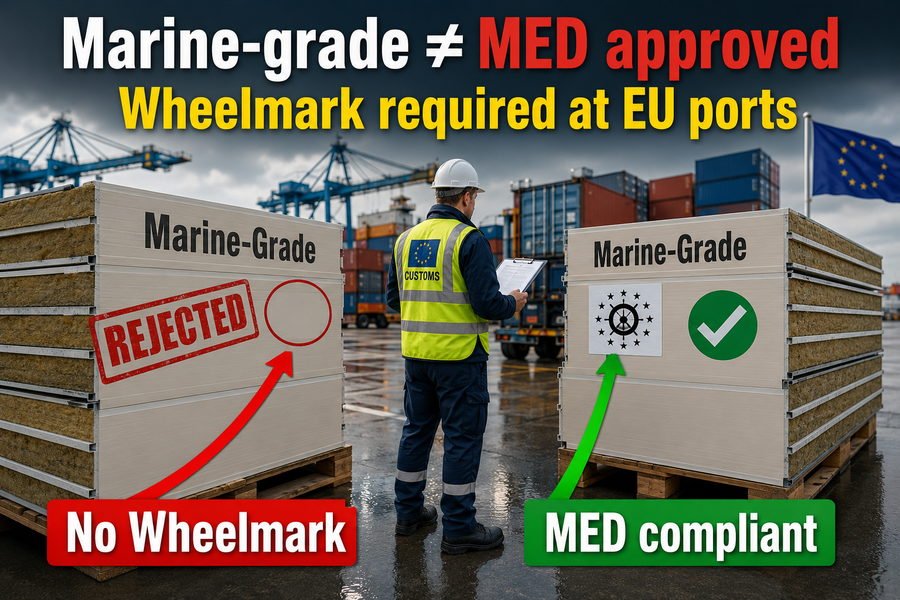
The Legal Mandate of the 2014/90/EU Directive for Marine Panels
Many buyers think "marine grade" is a universal standard. This is a huge mistake. The European Union has its own specific law. This law is the Marine Equipment Directive (MED) 2014/90/EU. It took effect in September 2016. Any ship flying an EU flag must use equipment that complies with this law.1 Also, shipyards located in Europe must follow these rules. The "Wheelmark" is the physical proof of this compliance.2 EU customs officers look for this mark first. If they do not see the Wheelmark on your marine accommodation panels, they will reject the container. General marine grade just means the panel survives salty air. It does not mean it passes European fire laws. As a buyer, you must ask your Asian suppliers for MED certificates, not just a promise of good quality.
Failure to Meet FTP Code 2010 Flammability and Toxicity Standards
The MED requires very strict fire testing. The standard used is the International Maritime Organization (IMO) FTP Code 2010. General marine panels often fail these tests. The FTP Code 2010 has different parts. Part 5 tests surface flammability. Part 2 tests smoke and toxicity.3 For example, when a panel burns, the carbon monoxide (CO) level must not exceed 1450 ppm. The sulfur dioxide (SO2) limit is 120 ppm.4 General marine panels from cheap factories usually produce toxic smoke that exceeds these limits. The EU ports reject these panels because they are deadly in a real ship fire. You cannot rely on a factory saying their panels are safe. You need the official test reports linked to the Wheelmark.
| Feature | General "Marine-Grade" Panel | MED Wheelmark Certified Panel |
|---|---|---|
| Legal Status in EU | Often Rejected | Fully Accepted |
| Fire Test Standard | Varies by manufacturer | Strict IMO FTP Code 2010 |
| Toxicity Limits | Unknown or high | CO < 1450 ppm, SO2 < 120 ppm |
| Port Inspection Result | Container held or delayed | Fast customs clearance |
Which MED Documentation Gaps Hold Marine Accommodation Panels at EU Customs?
Your supplier sent papers, but the customs officer said no. Your installation crew is waiting, and you are losing money. Missing one piece of paper wastes weeks. Let us look at the exact missing documents.
Marine accommodation panels are held at EU customs due to three primary MED documentation gaps: missing or expired Module B (Type Approval) certificates, lack of Module D/E (Quality System) certificates linking back to the factory, and the absence of a proper Declaration of Conformity (DoC) signed by the manufacturer.
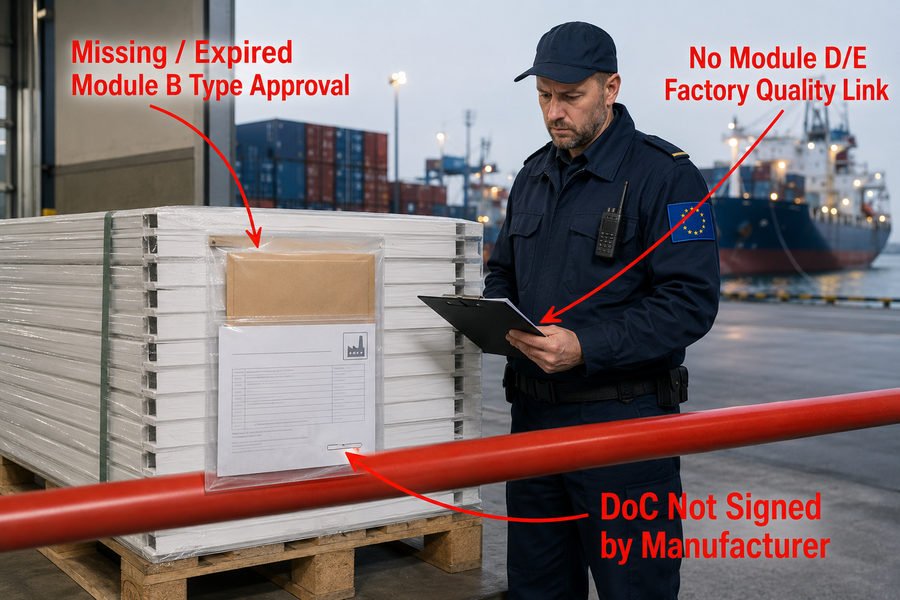
Missing or Expired Module B Type Approval Certificates
The Module B certificate proves the panel design passes the fire tests. Think of it as the basic recipe approval. Many suppliers send a Module B certificate, but you must look closely. EU customs officers always check the expiration date. A Module B certificate is usually valid for 5 years. I have seen many buyers receive certificates that expired six months ago. If the Module B is expired, customs will hold your marine accommodation panels. Also, the certificate must match the exact panel type. You cannot use a Module B for an A-60 bulkhead panel to import a B-15 cabin ceiling panel. You must ensure the certificate is currently valid and perfectly matches the goods in your container.
Missing Module D/E Quality System Certificates and DoC Gaps
Module B is not enough. You also need Module D or Module E. Module D proves the factory has an approved quality system. It ensures every panel they make is exactly like the tested sample. Many small factories in Asia can buy one good panel, pass the Module B test, but they do not have Module D. Without Module D, the Module B is useless at the port. Finally, you must have the Declaration of Conformity (DoC). The manufacturer signs this document. It is a legal promise. The DoC must list the Module B certificate number, the Module D certificate number, and the Notified Body number. If the supplier forgets to sign the DoC, or if they type the wrong number, customs will stop the shipment. You must check these three documents together before the ship leaves the loading port.
| Document Type | Purpose | Common Problem at EU Customs |
|---|---|---|
| Module B Certificate | Proves panel design passes fire tests | Expired validity date |
| Module D/E Certificate | Proves factory quality control | Factory lacks this certification entirely |
| Declaration of Conformity (DoC) | Legal statement linking certificates | Missing signature or wrong Notified Body number |
Does Class Type Approval Replace MED for Marine Accommodation Panels?
Many buyers think an ABS or DNV class certificate is enough. I used to see this mistake a lot when I started in the industry. This mistake leads to instant port rejection. Let me clarify the difference for you.
Class Type Approval does not replace MED certification for marine accommodation panels on EU-flagged vessels. While Class Approval verifies general classification rules for structure or machinery, MED is a statutory EU legal requirement specifically verifying SOLAS fire safety compliance (FTP Code) through an appointed European Notified Body.
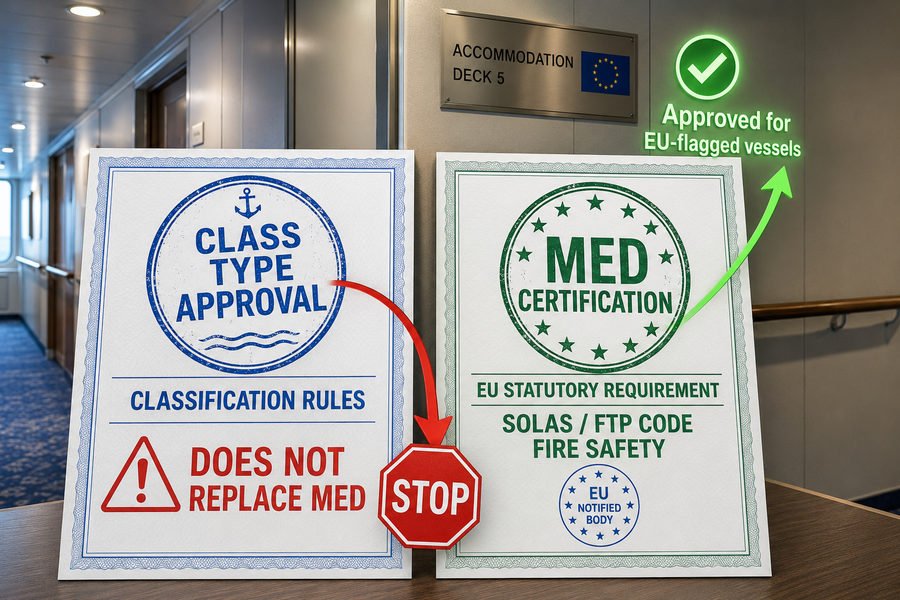
The Scope of Class Type Approval Versus Statutory Certifications
Class societies like the American Bureau of Shipping (ABS) or Lloyd's Register (LR) issue Class Type Approvals. These rules focus on the strength of the ship. They make sure the ship will not sink in a storm. Class approval is great for steel plates and engines. However, it does not cover statutory laws. Statutory laws come from governments. The Marine Equipment Directive is a statutory law from the European Union5. It focuses strictly on human safety, like stopping fires from spreading. A Class Type Approval only means the product meets the private rules of that specific class society6. It does not mean it meets the legal requirements of the European government. You cannot show a Class certificate to an EU customs officer and expect them to clear your marine accommodation panels.
Why the Appointed European Notified Body is Mandatory for MED
To get the MED Wheelmark, the testing and certification must involve a Notified Body7. A Notified Body is an organization chosen by an EU member state government. For example, DNV holds Notified Body number 0575. You can find all legal Notified Bodies on the EU NANDO database. Only a Notified Body can issue Module B and Module D certificates for the MED8. An Asian class society branch cannot issue a Wheelmark if they are not a designated Notified Body. If your supplier gives you a certificate from a local testing lab that is not an EU Notified Body, the certificate is invalid in Europe. You must always check the four-digit Notified Body number under the Wheelmark logo on your panels.
| Feature | Class Type Approval | MED Certification (Wheelmark) |
|---|---|---|
| Main Purpose | Ship structure and machinery reliability | Statutory fire and human safety (SOLAS) |
| Issuing Authority | IACS Member (e.g., ABS, LR, NK) | Appointed EU Notified Body (e.g., NB 0575) |
| Legal Status in EU Ports | Not sufficient for fire panels | Mandatory and legally required |
| Focus for Panels | General durability | Strict FTP Code 2010 flammability |
How to Confirm Supplier MED Scope Covers the Exact Marine Accommodation Panel Model?
You checked the supplier's MED certificate, but the delivered panels still failed inspection. Your client is very angry. A mismatched model number is a disaster. Here is how you verify it before buying.
To confirm a supplier's MED scope covers your exact marine accommodation panel, you must cross-reference four elements: the specific product name on the Module B certificate, the exact panel thickness range (e.g., 25mm to 50mm), the permitted core material density (e.g., 100 kg/m³), and the allowed surface finishes.
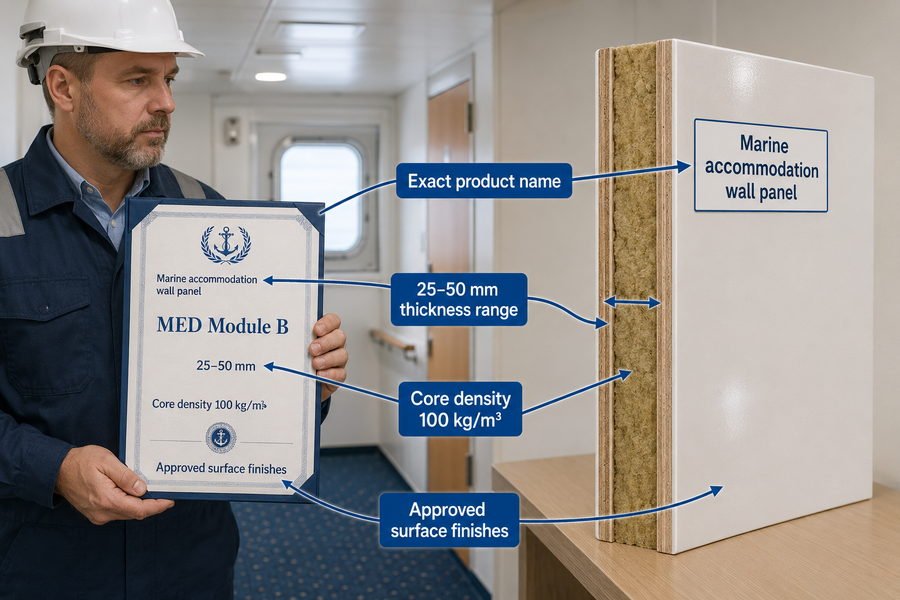
Matching Product Names and Panel Thickness Ranges on Module B
The first step is looking at the product name. If you order "Panel Type A" and the Module B certificate says "Panel Type B", you have a big problem. Customs will reject the load. The names must match exactly on your Purchase Order, the shipping invoice, and the Module B certificate. Next, you must check the approved thickness range. Fire tests depend heavily on thickness.9 A certificate might say "Approved for 50mm thickness". If you order 25mm marine accommodation panels to save money and weight, your panels are not certified. The fire rating changes completely with thickness. If the certificate lists a range like 25mm to 50mm, then your 25mm panel is safe. You must read the fine print on the second page of the Module B document to find this range.
Verifying Core Material Density and Approved Surface Finishes
The core material is what stops the fire. Usually, this is rockwool. The MED certificate will state the exact density of the rockwool tested. It might say the density must be 120 kg/m³. If your supplier tries to use 100 kg/m³ rockwool to cut costs, the panel loses its Wheelmark status10. You must force the supplier to confirm the density matches the certificate. Also, you must check the surface finishes. The certificate will list the allowed surface materials, such as PVC film up to 0.15mm thick. If you ask for a thicker decorative PVC film, it might produce too much toxic smoke during a fire11. A 0.20mm film will fail the FTP Code Part 5 test. If the finish on your panel is not listed on the certificate, the panel is non-compliant.
| Verification Element | What to Look For | Example of a Dangerous Mismatch |
|---|---|---|
| Product Name | Exact match on DoC, Module B, and Invoice | Cert says "M-Panel", Invoice says "M-Panel Pro" |
| Thickness Range | Allowed sizes in millimeters | Cert allows 50mm, you ordered 25mm |
| Core Density | Rockwool weight in kg/m³ | Cert demands 120 kg/m³, supplier uses 100 kg/m³ |
| Surface Finish | Approved top layer material | Cert allows 0.15mm PVC, panel has 0.20mm PVC |
What Liabilities Arise from Installing Non-MED Marine Accommodation Panels on EU Vessels?
Think you can just install uncertified panels and hope no one notices? I have seen companies try this. The risks go far beyond a small fine. This bad decision threatens your entire business.
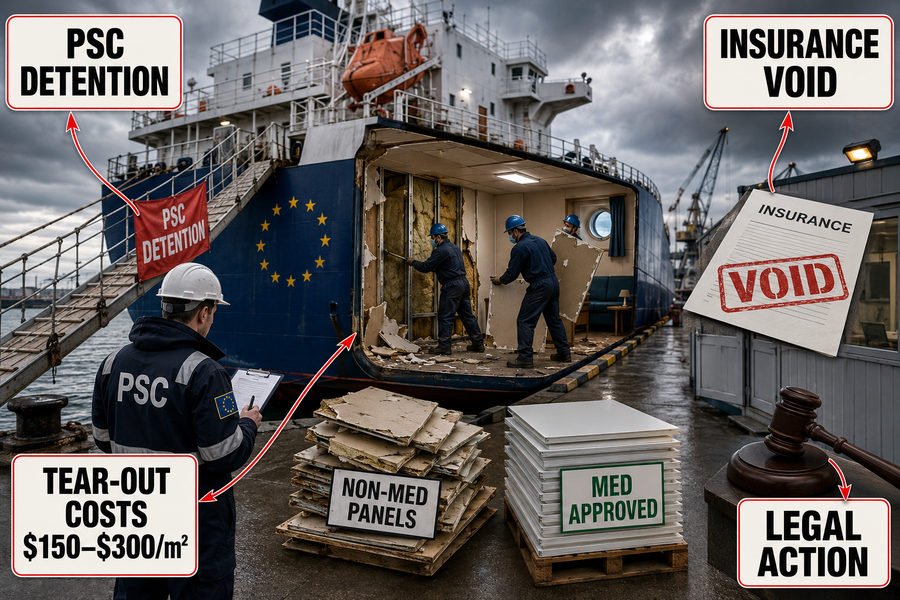
Installing non-MED marine accommodation panels on EU vessels creates four severe liabilities: immediate detention of the vessel by Port State Control, voiding of marine insurance policies, mandatory tear-out and replacement costs (averaging $150 to $300 per square meter), and potential legal action for breach of maritime safety laws.
Immediate Port State Control Detention and Voiding of Marine Insurance
When a ship arrives at an EU port, inspectors from Port State Control (PSC) board the vessel. They operate under the Paris MoU agreement. They check the ship for safety. If they find interior panels without the MED Wheelmark, they have the power to detain the ship. Detention means the ship cannot leave the port. This costs the ship owner tens of thousands of dollars every single day12. The shipyard will blame you. Also, installing non-compliant panels voids the ship's marine insurance13. If a fire starts in the cabin area, the insurance company will investigate. When they find uncertified panels, they will refuse to pay the claim. The financial liability will fall directly on the interior decoration company that bought and installed those panels.
High Mandatory Replacement Costs and Legal Action Risks
If you get caught with non-MED panels, the authorities will not just give you a warning. They will force you to tear out all the non-compliant panels14. You must buy new, certified marine accommodation panels and install them again. The cost of materials and labor for ship interior outfitting usually ranges from $150 to $300 per square meter. If you decorated an entire passenger deck, this replacement cost will easily bankrupt a small company. Furthermore, you face legal action. Breaking EU maritime safety laws is a serious offense. The shipyard can sue you for breach of contract. Port authorities can fine your company. You must understand that buying cheaper, uncertified panels from Asia is never worth the massive financial and legal risks in Europe.
| Liability Risk | Direct Consequence | Estimated Financial Impact |
|---|---|---|
| PSC Detention | Ship is blocked from leaving port | $10,000+ per day in port fees and lost revenue |
| Voided Insurance | Claim denied during a fire event | Millions of dollars in ship damage |
| Mandatory Tear-out | Removing and replacing bad panels | $150 to $300 per square meter |
| Legal Action | Lawsuits from shipyards | High legal fees and ruined company reputation |
How to Pre-Verify MED Applicability Before a Marine Accommodation Panel PO?
You are ready to issue the Purchase Order to an Asian supplier. Your budget looks good. Stop and check first. This final step prevents massive headaches later.
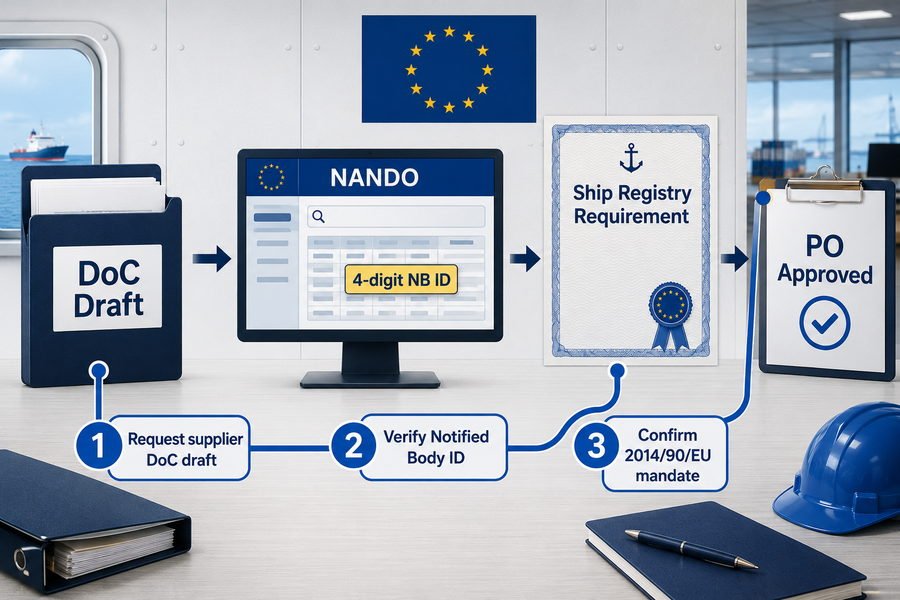
To pre-verify MED applicability before placing a Purchase Order, you must complete three steps: request the supplier's DoC draft, verify the Notified Body's four-digit identification number in the EU NANDO database, and confirm the specific ship registry explicitly mandates the 2014/90/EU directive for its interior outfitting materials.
Requesting the Supplier DoC Draft and Verifying the NANDO Database
Before you send any money, you must ask the sales representative for a draft Declaration of Conformity (DoC). Do not accept a screenshot of a certificate. You need the full document. Look closely at the DoC. It must show the Notified Body number. This is always a four-digit number.15 For example, DNV is 0575. Element Materials Technology is 2812. Take this number and go to the official European Union NANDO website. This database lists all legal Notified Bodies.16 Type the number into the search bar. If the company name matches the certificate, you are safe. If the database says the number is invalid, your supplier gave you a fake certificate. I do this check for every new factory I work with. It takes five minutes and saves millions.
Confirming the Ship Registry Mandates for 2014/90/EU Directive
You must also verify the end destination of your panels. The MED directive applies to ships flying the flag of an EU member state, or Norway, Iceland, and Liechtenstein.17 It also applies to ships being built in European shipyards.18 You need to ask your shipyard client about the ship registry. What flag will the ship fly? If it is a French or German flag, you must have the MED Wheelmark. If the ship flies a different flag but the owner plans to register it in the EU later, you still need the Wheelmark. If you confirm the registry mandates the 2014/90/EU directive, you can safely write "MED Wheelmark Required" on your Purchase Order. This makes the supplier legally responsible to provide the right marine accommodation panels.
| Pre-Verification Step | Action Required | Desired Outcome |
|---|---|---|
| Step 1: DoC Draft | Ask supplier for a sample DoC | Document shows clear Module B/D numbers |
| Step 2: NANDO Check | Search the 4-digit Notified Body code | Code perfectly matches a certified EU lab |
| Step 3: Flag Check | Ask shipyard for the vessel registry | Determine if 2014/90/EU is legally required |
Conclusion
Securing MED Wheelmark compliance for marine accommodation panels stops EU customs delays, avoids costly replacements, and ensures crew safety. Always verify certificates carefully before issuing your purchase orders.
-
"Marine Equipment Directive enters into force in the EEA - Efta.Int", https://www.efta.int/media-resources/news/marine-equipment-directive-enters-force-eea. Directive 2014/90/EU sets EU rules for marine equipment placed on board ships flying the flag of an EU Member State, including conformity-assessment requirements before such equipment is installed. Evidence role: general_support; source type: government. Supports: Ships flying an EU Member State flag must use marine equipment that complies with the Marine Equipment Directive where the equipment falls within the directive’s scope.. Scope note: The directive concerns specified categories of marine equipment and does not by itself prove that every item on every EU-flagged ship is covered. ↩
-
"Directive 96/98/EC - Wikipedia", https://en.wikipedia.org/wiki/Directive_96/98/EC. EU marine-equipment guidance describes the Wheelmark as the conformity mark affixed to equipment that has successfully completed the required conformity-assessment procedure under the Marine Equipment Directive. Evidence role: definition; source type: government. Supports: The Wheelmark functions as the visible conformity mark for equipment certified under the Marine Equipment Directive.. Scope note: The mark indicates conformity assessment under the directive; it is not independent proof of performance beyond the scope of the certified equipment and applicable standards. ↩
-
"[PDF] RESOLUTION MSC.307(88) (adopted on 3 December 2010 ...", https://wwwcdn.imo.org/localresources/en/KnowledgeCentre/IndexofIMOResolutions/MSCResolutions/MSC.307(88).pdf. The IMO 2010 FTP Code organizes fire-test procedures into parts, including Part 2 for smoke and toxicity testing and Part 5 for surface flammability testing of materials used on ships. Evidence role: definition; source type: institution. Supports: IMO FTP Code 2010 Part 5 addresses surface flammability, while Part 2 addresses smoke and toxicity.. Scope note: This supports the structure and subject matter of the FTP Code parts, not whether a particular panel product passes those tests. ↩
-
"What Has Changed in the 2010 IMO FTP Code Compared to the ...", https://magellanmarinetech.com/what-has-changed-in-2010-imo-ftp-code-compared-to-the-original-version/. The 2010 FTP Code smoke-and-toxicity test criteria specify maximum gas concentrations including carbon monoxide at 1450 ppm and sulfur dioxide at 120 ppm for the relevant test conditions. Evidence role: statistic; source type: institution. Supports: The FTP Code 2010 smoke-and-toxicity criteria include CO and SO2 concentration limits of 1450 ppm and 120 ppm, respectively.. Scope note: The limits apply within the FTP Code’s specified test method and acceptance criteria; they should not be read as general air-exposure limits for all fire scenarios. ↩
-
"Directive 96/98/EC - Wikipedia", https://en.wikipedia.org/wiki/Directive_96/98/EC. Directive 2014/90/EU establishes European Union legal requirements for marine equipment placed on board EU ships and provides the legal framework for the wheel mark, supporting the claim that the MED is an EU statutory instrument. Evidence role: historical_context; source type: government. Supports: The Marine Equipment Directive is a European Union legal instrument governing certain marine equipment.. Scope note: The directive covers marine equipment within its defined scope and does not by itself prove that every accommodation panel is covered without reference to the applicable implementing acts or product category. ↩
-
"RECOGNIZED ORGANIZATIONS", https://www.imo.org/en/OurWork/IIIS/Pages/Recognized-Organizations.aspx. Classification societies establish and apply technical rules for ships and equipment, while statutory requirements are imposed under public law by flag states or other competent authorities; this supports the distinction between class approval and legal certification. Evidence role: definition; source type: institution. Supports: A Class Type Approval indicates conformity with a class society’s own rules, not necessarily compliance with statutory legal requirements.. Scope note: The source may describe the institutional distinction generally rather than address accommodation panels specifically. ↩
-
"Directive 96/98/EC - Wikipedia", https://en.wikipedia.org/wiki/Directive_96/98/EC. EU guidance and the MED conformity-assessment framework require designated notified bodies to perform specified assessment tasks before eligible marine equipment may bear the wheel mark, supporting the need for notified-body involvement. Evidence role: mechanism; source type: government. Supports: MED Wheelmark certification requires involvement of an EU-designated Notified Body for the relevant conformity assessment procedures.. Scope note: The exact module required depends on the equipment category and conformity-assessment route selected under the MED implementing measures. ↩
-
"Conformity Assessment of Medical Devices: An Overview from a ...", https://pmc.ncbi.nlm.nih.gov/articles/PMC12821529/. The MED conformity-assessment provisions identify Module B and Module D as procedures involving notified bodies, supporting the claim that these certificates are issued within the notified-body system. Evidence role: definition; source type: government. Supports: MED Module B and Module D certification is tied to EU-designated Notified Bodies.. Scope note: The citation would support the role of notified bodies in these modules, but not necessarily verify any individual certificate or supplier claim. ↩
-
"What Is the Purpose and Scope of the IMO FTP Code? - Magellan ...", https://magellanmarinetech.com/what-purpose-scope-of-imo-ftp-code/. Fire-resistance testing standards and studies of insulated or sandwich panels treat specimen thickness as a material and construction parameter affecting thermal insulation and fire performance; this supports checking the approved thickness range, although the magnitude of the effect depends on the exact panel assembly and test method. Evidence role: mechanism; source type: paper. Supports: Panel thickness can materially affect fire-test results and therefore the validity of a certificate for a different thickness.. Scope note: Support is contextual unless the source tests the same marine accommodation panel design discussed in the article. ↩
-
"Directive 96/98/EC - Wikipedia", https://en.wikipedia.org/wiki/Directive_96/98/EC. The Marine Equipment Directive links Wheelmark marking to conformity with the approved type and applicable conformity-assessment procedures; this supports the statement that substituting an unapproved core density can invalidate Wheelmark conformity, although it does not establish the specific 120 kg/m³ versus 100 kg/m³ example. Evidence role: general_support; source type: government. Supports: Using a core density different from the certified construction can make the panel non-conforming with its Wheelmark approval.. Scope note: The source would support the conformity principle rather than the specific density values, which would need the actual Module B certificate or test report. ↩
-
"What Is the Purpose and Scope of the IMO FTP Code? - Magellan ...", https://magellanmarinetech.com/what-purpose-scope-of-imo-ftp-code/. The IMO FTP Code includes procedures for assessing smoke and toxicity from surface materials used on ships, and fire-safety literature identifies PVC combustion products as a potential source of dense smoke and toxic or corrosive gases; this supports concern about thicker PVC finishes, although it does not prove that every 0.20 mm PVC film fails the test. Evidence role: mechanism; source type: institution. Supports: A thicker or unapproved PVC surface finish may increase smoke and toxicity risk under marine fire-test requirements.. Scope note: The evidence would be contextual unless it evaluates the same PVC film formulation, adhesive, substrate, and FTP Code Part 5 test configuration. ↩
-
"[PDF] PROCEDURES FOR PORT STATE CONTROL, 2023", https://wwwcdn.imo.org/localresources/en/OurWork/IIIS/Documents/A%2033-Res.1185%20-%20PROCEDURES%20FOR%20PORT%20STATE%20CONTROL,%202023%20(Secretariat)%20(1).pdf. Studies of ship delay, demurrage, and port-call costs show that detention or prolonged port stays can generate substantial daily costs through lost vessel earnings, port charges, and schedule disruption. Evidence role: statistic; source type: research. Supports: PSC detention can impose daily costs on a shipowner that may reach tens of thousands of dollars.. Scope note: The source would provide contextual cost ranges for vessel delay; actual detention costs vary by vessel type, charter market, port tariff, and cargo schedule. ↩
-
"[PDF] applying the knowing neglect standard in time hull insurance", https://digitalcommons.mainelaw.maine.edu/cgi/viewcontent.cgi?article=1889&context=mlr. Marine insurance law and standard policy conditions commonly treat regulatory compliance, seaworthiness, and material risk disclosure as relevant to coverage, and non-compliant safety equipment may affect an insurer’s liability after a casualty. Evidence role: general_support; source type: government. Supports: Installing non-compliant panels can jeopardize marine insurance coverage or lead to claim disputes after a fire.. Scope note: This supports the legal relevance of non-compliance to coverage but not the absolute statement that insurance is automatically void in every jurisdiction or policy. ↩
-
"[PDF] PROCEDURES FOR PORT STATE CONTROL, 2023", https://wwwcdn.imo.org/localresources/en/OurWork/IIIS/Documents/A%2033-Res.1185%20-%20PROCEDURES%20FOR%20PORT%20STATE%20CONTROL,%202023%20(Secretariat)%20(1).pdf. EU marine-equipment and market-surveillance rules authorize corrective measures for non-conforming equipment, including withdrawal, prohibition of use or placement on the market, and steps to bring equipment into compliance. Evidence role: mechanism; source type: government. Supports: Authorities can require corrective action for non-MED-compliant marine panels, potentially including removal and replacement.. Scope note: This supports the availability of corrective enforcement measures, but the precise remedy—removal, replacement, detention until rectification, or market withdrawal—depends on the authority’s finding and national implementation. ↩
-
"Conformity Assessment of Medical Devices: An Overview from a ...", https://pmc.ncbi.nlm.nih.gov/articles/PMC12821529/. The European Commission’s NANDO system identifies notified bodies by assigned four-digit identification numbers, which are used in EU conformity-assessment documentation. Evidence role: definition; source type: institution. Supports: A supplier’s Declaration of Conformity should include a four-digit Notified Body identification number when a notified body is involved.. Scope note: This supports the numbering convention for notified bodies generally; the precise document fields required on a Declaration of Conformity depend on the applicable conformity-assessment module and product legislation. ↩
-
"Notified body - Wikipedia", https://en.wikipedia.org/wiki/Notified_body. The European Commission describes NANDO as the information system listing bodies notified by EU Member States and other relevant authorities to carry out conformity-assessment tasks under EU harmonisation legislation. Evidence role: definition; source type: institution. Supports: The official NANDO database is the authoritative EU listing for notified bodies and their notified scopes.. Scope note: NANDO records notification status for specific legislation and scopes; a listing should be checked against the relevant directive or regulation rather than treated as universal approval for all products. ↩
-
"Factsheet - 32014L0090 | European Free Trade Association - Efta.Int", https://www.efta.int/eea-lex/32014l0090. Directive 2014/90/EU defines its application by reference to marine equipment placed on board EU ships, while EEA materials indicate that the directive is incorporated into the European Economic Area framework covering Norway, Iceland, and Liechtenstein. Evidence role: general_support; source type: government. Supports: The Marine Equipment Directive applies to EU-flagged ships and is extended in the EEA context to Norway, Iceland, and Liechtenstein.. Scope note: The directive text directly supports the EU-flagged-ship scope; applicability to Norway, Iceland, and Liechtenstein is supported through EEA incorporation rather than the directive’s original EU-only wording. ↩
-
"Marine Equipment Directive enters into force in the EEA - Efta.Int", https://www.efta.int/media-resources/news/marine-equipment-directive-enters-force-eea. Directive 2014/90/EU regulates marine equipment intended to be placed on board EU ships, including equipment placed on board during construction or repair, but its scope is tied to the ship’s EU status rather than to shipyard location alone. Evidence role: mechanism; source type: government. Supports: The Marine Equipment Directive can apply during ship construction when equipment is intended for EU ships, but shipyard location alone is not the core criterion.. Scope note: This source would qualify the article’s wording: European shipyard location is not by itself the legal trigger unless the equipment is for an EU ship or otherwise falls under the directive’s specified scope. ↩