Buying marine panels without checking MED modules risks shipyard rejection. If you ignore Module B and D, you waste money and delay your European and US projects.
MED Module B and D control marine accommodation panel procurement by ensuring design approval and consistent production quality. Module B verifies the prototype meets fire safety standards (like SOLAS), while Module D guarantees the factory's quality system consistently reproduces that approved panel for mass production.
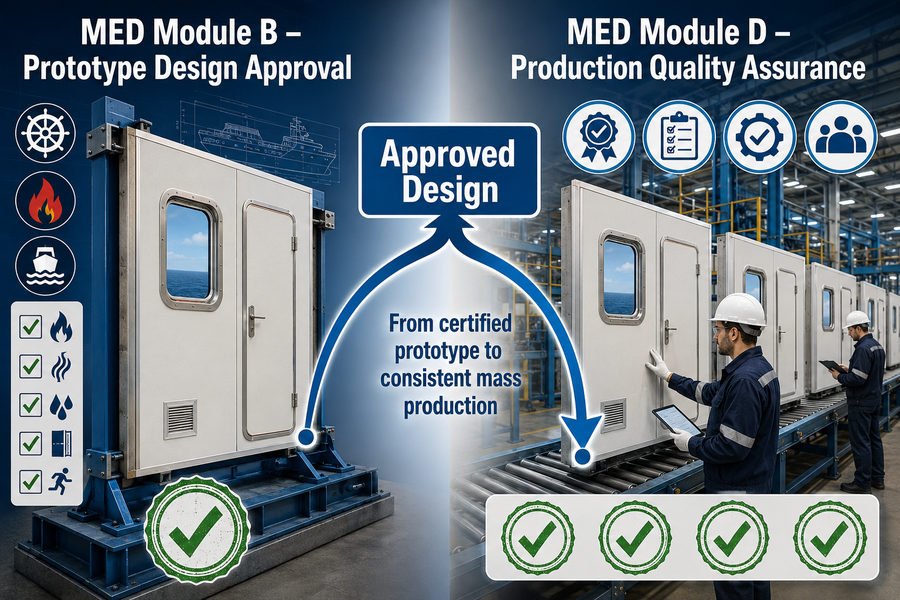
You need marine panels that pass European and US shipyard checks. But confusing these two certificates is a common mistake that ruins project timelines. Let us break down exactly how these modules work.
MED Module B vs Module D for Marine Accommodation Panels: What's the Difference?
Do you mix up Module B and D when talking to suppliers? Using the wrong certificate name causes miscommunication and hides bad factory quality.
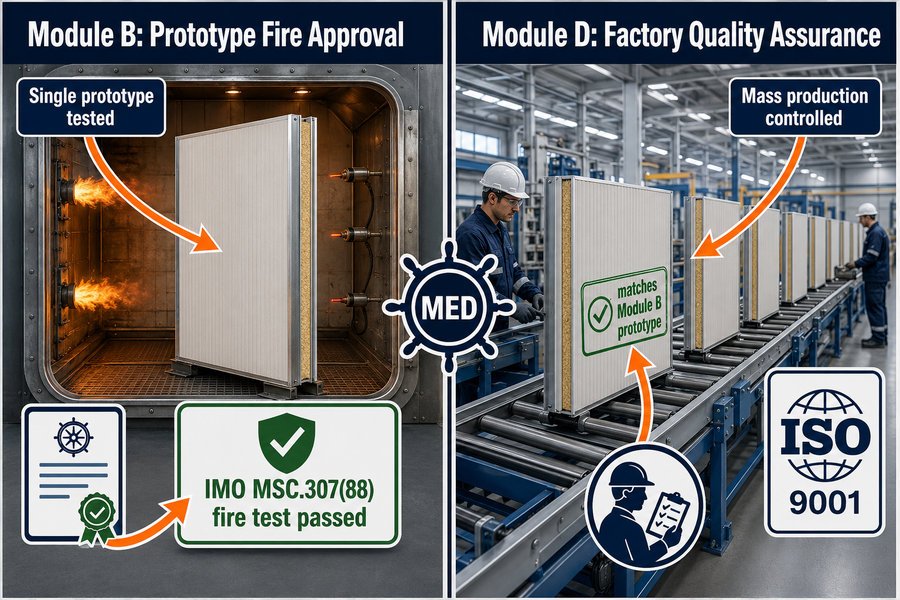
Module B is the EC Type Examination, proving a single panel prototype passes fire tests (e.g., IMO Res. MSC.307(88)). Module D is the Production-Quality Assurance, proving the factory's ISO 9001-based system can mass-produce panels matching the Module B prototype without defects.
The Core Focus of MED Module B for Marine Panels
Module B focuses entirely on the product design. When I worked in the marine outfitting factory, we spent months preparing for the Module B tests. We built a perfect prototype of our B-15 wall panel. We sent this prototype to a certified fire test laboratory. The lab burns the panel according to the 2010 FTP Code (IMO Resolution MSC.307(88))1. They check for non-combustibility, smoke generation, and toxicity. If the panel stops the fire and meets the temperature limits for the required time, it passes. The Notified Body then issues the Module B certificate. This document only proves that the specific design works. It does not prove the factory can make 1,000 good panels.
The Core Focus of MED Module D for Factory Production
Module D focuses entirely on the factory. It guarantees mass production quality. Shipyards in Europe and the United States do not care about one perfect prototype. They need every panel in the container to match that prototype. To get Module D, the factory must have a strong quality management system. This is almost always based on the ISO 9001 standard. Auditors visit the factory floor. They check the raw materials, the glue pressing machines, and the worker training. They ensure the factory uses the exact same steel and rockwool listed in the Module B certificate. If the factory changes a supplier without telling the auditor, they lose the certificate. You must understand this difference to control your supply chain.
| Feature | MED Module B | MED Module D |
|---|---|---|
| Main Target | Product Prototype | Factory Production System |
| Test Method | Fire Testing Lab (e.g., 2010 FTP Code) | Factory Quality Audit (e.g., ISO 9001) |
| Proof Provided | The design stops fire safely | The factory builds every panel correctly |
| Procurement Value | Shows the supplier has technical ability | Shows the supplier has manufacturing stability |
Why Must Marine Accommodation Panel Suppliers Hold Both Module B and D?
Finding a cheap supplier with only one certificate seems like a good deal. But European and US shipyards will reject the panels immediately.
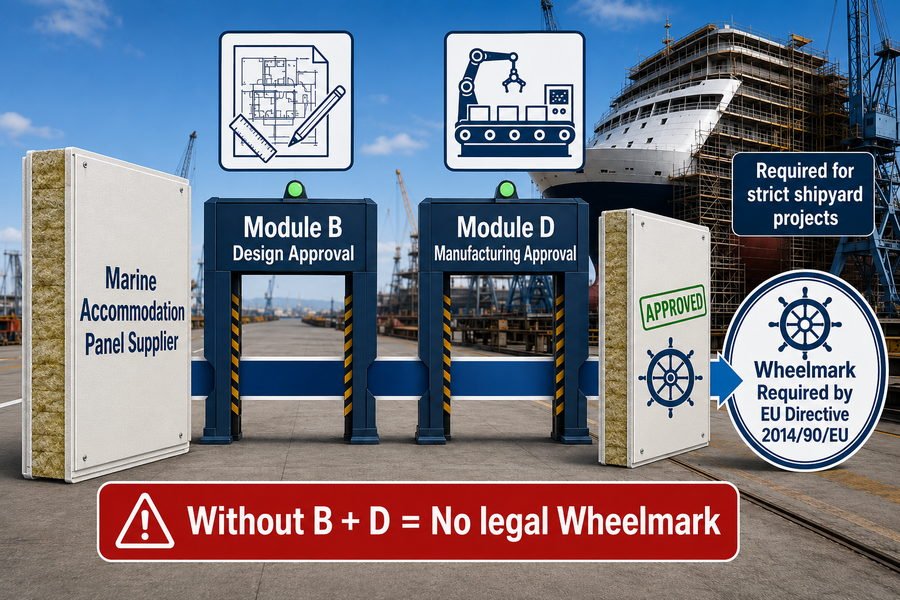
Suppliers must hold both because European law (Directive 2014/90/EU) requires the "Wheelmark" logo. Module B only approves the design, while Module D approves the manufacturing. Without both, the panels cannot legally get the Wheelmark, making them useless for strict shipyard projects.
The Legal Requirement of Directive 2014/90/EU for Wheelmark
You cannot sell marine panels to European-flagged ships without the Wheelmark.2 This rule comes from the Marine Equipment Directive (Directive 2014/90/EU). The Wheelmark is the ultimate proof of safety. The law clearly states that a manufacturer can only print the Wheelmark on their panels if they hold both a valid design certificate and a valid production certificate. Module B provides the design approval. Module D provides the production approval. I see many procurement officers from developing countries buy panels with just a Module B certificate. They think they saved money. Then the panels arrive at a European shipyard, and the port state control inspector stops the installation. The inspector looks for the Wheelmark. If there is no Wheelmark, the panels go in the trash.
The Risk of Buying Panels with Only Module B
Buying panels from a factory with only Module B is a massive risk. Some small factories in Asia pay to pass the Module B fire test once. But they refuse to pay for the expensive Module D audits. Because they lack Module D, they cannot legally use the Wheelmark. You might receive panels built with cheaper, unapproved materials. The rockwool density might be 100 kg/m³ instead of the approved 120 kg/m³. You have no guarantee. At Magellan Marine, I always tell clients to ask for both documents before discussing prices. If the supplier makes excuses about Module D, walk away.
| Certificate Status | Wheelmark Allowed? | Consequence for Procurement |
|---|---|---|
| Holds Both Module B and D | Yes | Panels accepted globally. Safe to buy. |
| Holds Only Module B | No | Shipyard rejection. Total loss of investment. |
| Holds Only Module D | Impossible | Module D requires a valid Module B first. |
| Holds Neither | No | Illegal for marine use. Do not buy. |
How Often Are Module D Audits Done at Marine Accommodation Panel Factories?
Are you worried the factory quality drops after you place the order? A valid certificate does not mean recent inspections.
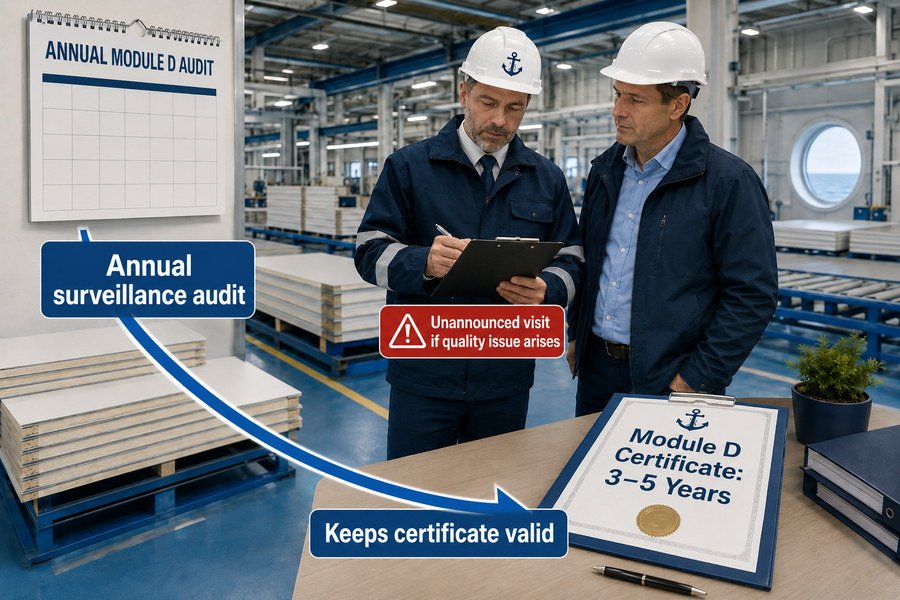
Notified Bodies conduct Module D audits at marine accommodation panel factories at least once a year. The certificate lasts for 3 to 5 years, but the factory must pass these mandatory annual surveillance audits, plus unannounced visits if quality issues arise, to keep it valid.
The Timeline of Mandatory Annual Surveillance Audits
When a marine panel factory earns a Module D certificate, the paper usually shows a validity period of 3 to 5 years. However, this long date can fool buyers. The certificate is not unconditionally valid for that whole time. The Marine Equipment Directive requires the Notified Body to audit the factory at least once every 12 months3. We call this the annual surveillance audit. During my factory days, I handled these audits. The inspector checks our production records for the past year. They look at our material purchase orders to ensure we did not buy cheap, fake rockwool. If a factory fails this annual check, the Notified Body suspends the Module D certificate immediately. As a buyer, you must always ask the supplier for their latest annual audit report, not just the certificate.
Unannounced Factory Visits and Certificate Validity
The annual audit is planned. But the Notified Body also has the power to conduct unannounced visits. They do this if there are quality complaints from shipyards or port state control. If a European shipyard finds that a batch of wall panels fails a fire inspection, they report it to the Notified Body. The auditor will show up at the Asian factory without warning. They will test panels straight from the production line. If the factory fails, they lose the certificate. This strict schedule keeps factories honest. It protects your investment because you know an independent expert monitors the factory floor constantly.
| Audit Type | Frequency | Trigger Condition |
|---|---|---|
| Full Initial Audit | Every 3 to 5 years | Certificate renewal period |
| Surveillance Audit | Once every 12 months | Mandatory legal requirement |
| Unannounced Visit | Random | Quality complaints or shipyard reports |
Which Notified Bodies Issue Module D for Marine Accommodation Panels?
Do you trust every testing lab? Some local labs issue cheap certificates that strict shipyards do not recognize.
Module D certificates for marine panels are issued by EU-recognized Notified Bodies. The 5 major ones include DNV (NB 0098), Lloyd's Register (LR, NB 0038), Bureau Veritas (BV, NB 0062), RINA (NB 0474), and ABS Europe (NB 2843). They have the authority to audit marine factories globally.
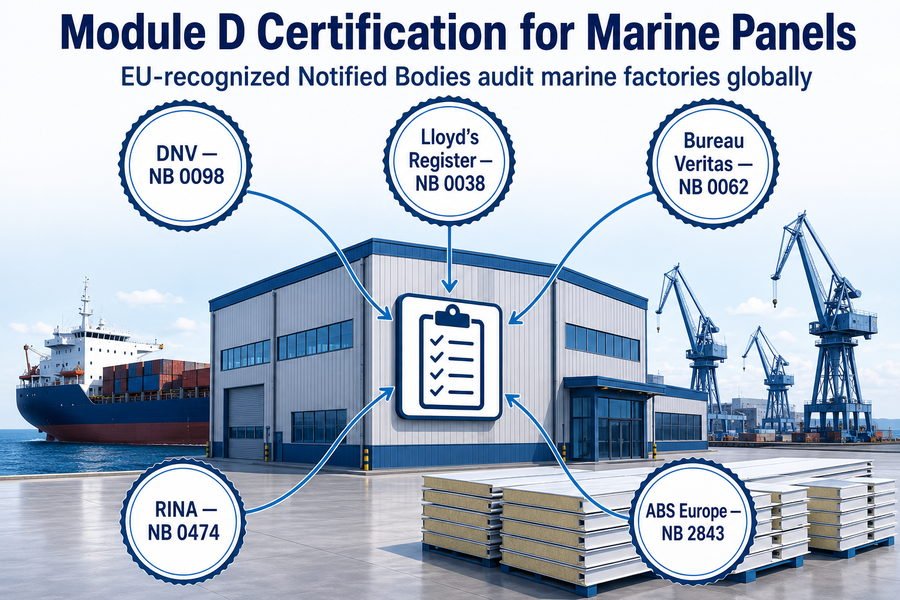
The Role of Major EU-Recognized Notified Bodies
Not every classification society can issue a MED Module D certificate. The European Union strictly controls this. They authorize specific organizations, called Notified Bodies, to perform these audits. There are many Notified Bodies, but in the marine outfitting industry, 5 major players dominate the market. DNV (Notified Body number 0098) is widely respected. Lloyd's Register (LR, NB 0038) and Bureau Veritas (BV, NB 0062) are also top choices. RINA (NB 0474) and ABS Europe (NB 2843) complete the big five. When I evaluate a new supplier at Magellan Marine, I always check who issued their Module D. If I see DNV or LR, I know the factory passed a very hard audit. These top 5 bodies have local offices in China and Vietnam. This means they can send strict auditors directly to the factories you buy from.
Identifying the Notified Body Number on the Wheelmark
The Notified Body leaves a permanent mark on the panel. The law requires the manufacturer to print the Wheelmark logo on every single panel. Next to this logo, they must print the Notified Body number and the year of production.4 For example, if DNV audits the factory, the panel will show the Wheelmark logo followed by "0098/2026". 0098 is DNV's official number, and 2026 is the year. You must check this number when you receive the goods. If the factory shows you a DNV certificate on paper, but the panels have a different four-digit number next to the Wheelmark, they are lying to you.
| Notified Body Name | Notified Body Number (NB) | Market Reputation |
|---|---|---|
| DNV | 0098 | Very High (Strict audits) |
| Lloyd's Register (LR) | 0038 | Very High (Global recognition) |
| Bureau Veritas (BV) | 0062 | High (Common in Europe) |
| RINA | 0474 | High (Strong in cruise ships) |
| ABS Europe | 2843 | High (Strong in US/EU projects) |
What if a Module D Audit Fails During a Marine Accommodation Panel Order?
What happens if the factory fails an audit while making your panels? Your entire supply chain stops.
If a factory fails a Module D audit, the Notified Body suspends the certificate immediately. The factory loses the right to affix the Wheelmark, meaning your panels cannot ship legally. You face 3 consequences: shipment delays, mandatory defect investigations, and switching to backup suppliers.
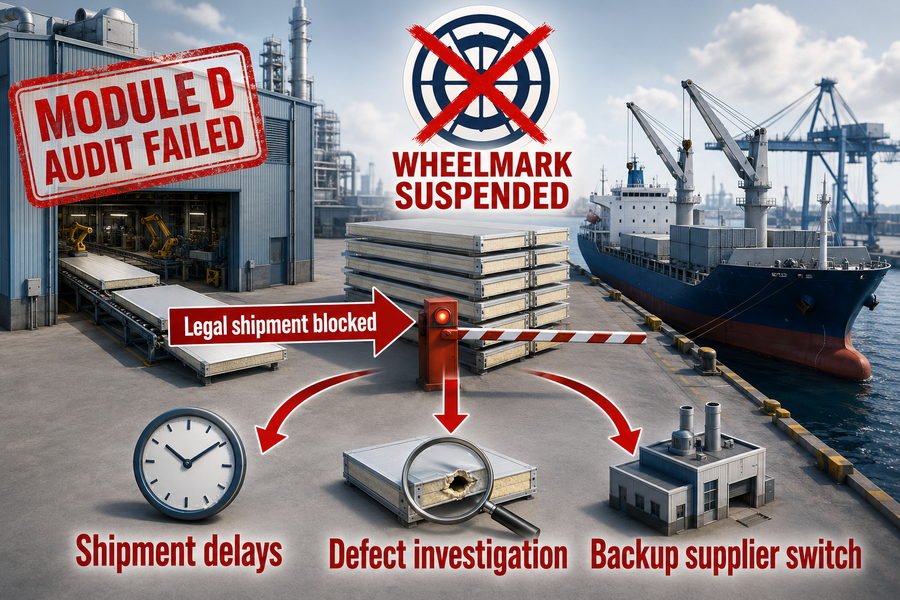
Immediate Suspension of Wheelmark Affixing Rights
A failed Module D audit creates an immediate crisis. The Notified Body does not give the factory time to finish current orders. They suspend the certificate on the same day. Under EU law, a suspended factory instantly loses the right to print the Wheelmark logo on their products5. If your panels are halfway finished on the production line, the factory cannot legally finish them with the Wheelmark. If they ship them without the mark, your European shipyard will reject the container. I saw this happen in 2018. A factory changed their glue brand to save money. The auditor caught them. Production stopped completely. The buyer had 5 containers stuck at the port, and none of them could be used.
Three Major Consequences for Your Panel Procurement
When the factory loses their Module D, you face 3 severe consequences. First, you face massive shipment delays. The factory must fix their quality system and request a new audit6, which takes at least 2 to 3 months. Second, you face mandatory defect investigations. If you already received panels from this factory recently, the shipyard will force you to prove those older panels are safe. You might have to pay for expensive local fire tests. Third, you must switch to backup suppliers immediately. You have to find a new factory, negotiate new prices, and start the order from zero. This destroys your profit margin. Always have a second supplier approved and ready.
| Consequence | Impact on Your Project | How to Mitigate |
|---|---|---|
| Shipment Delays | Project stops for 2 to 3 months. | Keep safety stock of standard panels. |
| Defect Investigations | High costs for local fire testing. | Ask factory for raw material batch records. |
| Switching Suppliers | Higher prices from rush orders. | Always qualify a second supplier in advance. |
Conclusion
Checking MED Module B and D secures your marine panel quality. Verify these certificates early to avoid fake suppliers, ensure Wheelmark compliance, and keep your shipyard projects on schedule.
-
"What Smoke Toxicity and Density Limits Must Marine Wall and ...", https://magellanmarinetech.com/what-smoke-toxicity-density-limits-must-marine-wall-ceiling-panels-meet/. The IMO 2010 FTP Code, adopted by Resolution MSC.307(88), provides internationally recognized fire-test procedures for marine materials and components, including tests relevant to non-combustibility, smoke and toxicity, and fire-resisting divisions. Evidence role: definition; source type: institution. Supports: Marine panel prototypes are tested under the 2010 FTP Code for properties such as non-combustibility, smoke generation, toxicity, and fire resistance.. Scope note: The Code defines applicable test procedures; it does not by itself verify that any specific panel design has passed them. ↩
-
"How to Avoid EU Rejection of Marine Accommodation Panels ...", https://magellanmarinetech.com/how-avoid-eu-rejection-marine-accommodation-panels-for-med-non-compliance/. Directive 2014/90/EU requires marine equipment placed on board EU-flagged ships to comply with applicable international instruments and to bear the wheel mark after the required conformity assessment. Evidence role: general_support; source type: government. Supports: Marine panels intended for European-flagged ships must bear the Wheelmark when they fall within the scope of Directive 2014/90/EU.. Scope note: This supports the general legal requirement; the specific applicability to a given panel type depends on whether that product is listed as marine equipment under the relevant implementing acts. ↩
-
"Conformity Assessment of Medical Devices: An Overview from a ...", https://pmc.ncbi.nlm.nih.gov/articles/PMC12821529/. EU Marine Equipment Directive conformity-assessment provisions for Module D describe notified-body surveillance of the manufacturer’s approved quality system and specify periodic auditing obligations, supporting the claim that ongoing audits are required after certification. Evidence role: general_support; source type: government. Supports: The Marine Equipment Directive requires the Notified Body to audit the factory at least once every 12 months.. Scope note: The source should be checked for the exact audit interval applicable to the relevant MED implementing measure and module version, because some EU conformity-assessment texts describe periodic surveillance without using identical wording. ↩
-
"Directive 96/98/EC - Wikipedia", https://en.wikipedia.org/wiki/Directive_96/98/EC. Article 10 of Directive 2014/90/EU provides that the wheel mark must be followed by the notified body identification number, where that body is involved in production control, and by the year in which the mark is affixed. Evidence role: definition; source type: government. Supports: Marine equipment bearing the wheel mark must also show the relevant notified body number and year marking.. Scope note: The directive refers to the year the mark is affixed, which may be treated operationally as the production year but is not worded exactly as “year of production.” ↩
-
"Directive 96/98/EC - Wikipedia", https://en.wikipedia.org/wiki/Directive_96/98/EC. The EU Marine Equipment Directive establishes that the wheel mark may be affixed only to marine equipment that complies with the directive’s conformity-assessment requirements, so a suspended or invalid conformity certificate removes the legal basis for marking affected products. Evidence role: general_support; source type: government. Supports: A factory whose relevant certification is suspended cannot lawfully affix the Wheelmark to products covered by that certification.. Scope note: The directive supports the legal principle but may not describe every notified body’s same-day suspension procedure. ↩
-
"Conformity Assessment of Medical Devices: An Overview from a ...", https://pmc.ncbi.nlm.nih.gov/articles/PMC12821529/. EU conformity-assessment rules for Module D describe production quality assurance as dependent on an approved quality system subject to notified-body assessment and surveillance, supporting the need for corrective action and reassessment after serious nonconformities. Evidence role: mechanism; source type: government. Supports: After losing Module D approval, the manufacturer must correct the quality-system problem and undergo notified-body assessment before relying on that approval again.. Scope note: This supports the regulatory mechanism for corrective action and reassessment, not the article’s specific estimate of how long the process takes. ↩