Procurement is tough when certificates mismatch shipyard demands. Losing a big contract over wrong panel stamps hurts. Let's clear up this approval confusion right now to protect your profits.
MED (Marine Equipment Directive) is the EU's legal framework enforcing IMO standards via the Wheelmark, whereas IMO creates the global baseline rules like the FTP Code. Class approvals verify compliance for specific flag states. You need MED for EU flags, but Class approvals for non-EU flag vessels.
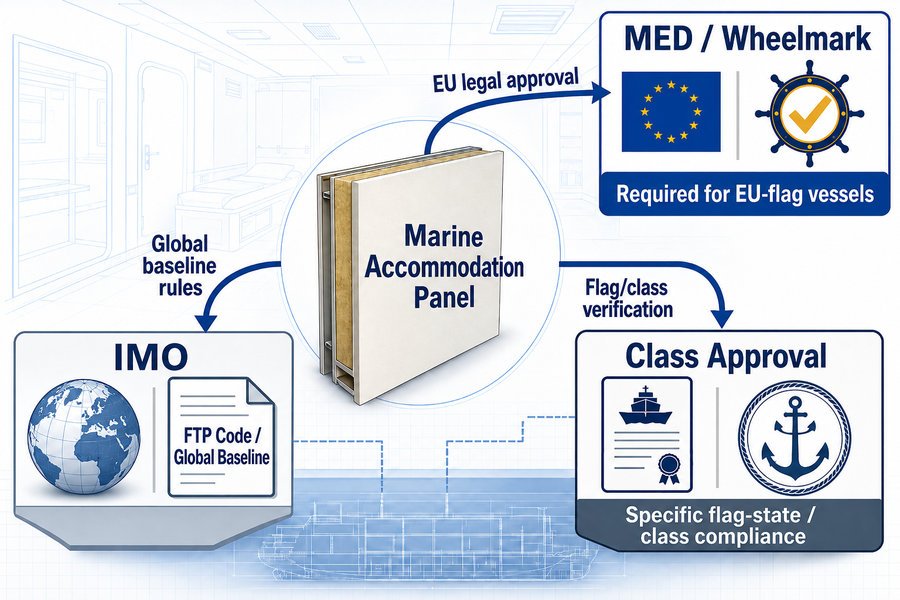
Navigating this maze of acronyms is something I do daily at Magellan Marine. You buy panels in Asia to fit out ships in Europe or the US, and getting the right paper is just as important as getting the right price. Let us break down each specific scenario you will face.
Is MED for Marine Accommodation Panels Equivalent to IMO FTP Code?
Confusing MED rules with IMO rules can lead to rejected panels at the shipyard. Your project stalls if inspectors find gaps. Understanding their exact relationship is the key to smooth sailing.
No, MED and IMO FTP Code are not strictly equivalent. The IMO FTP Code serves as the global technical testing standard for fire safety, while MED acts as the European Union's legal directive. MED enforces these IMO standards but adds specific conformity assessment procedures required to earn the Wheelmark.
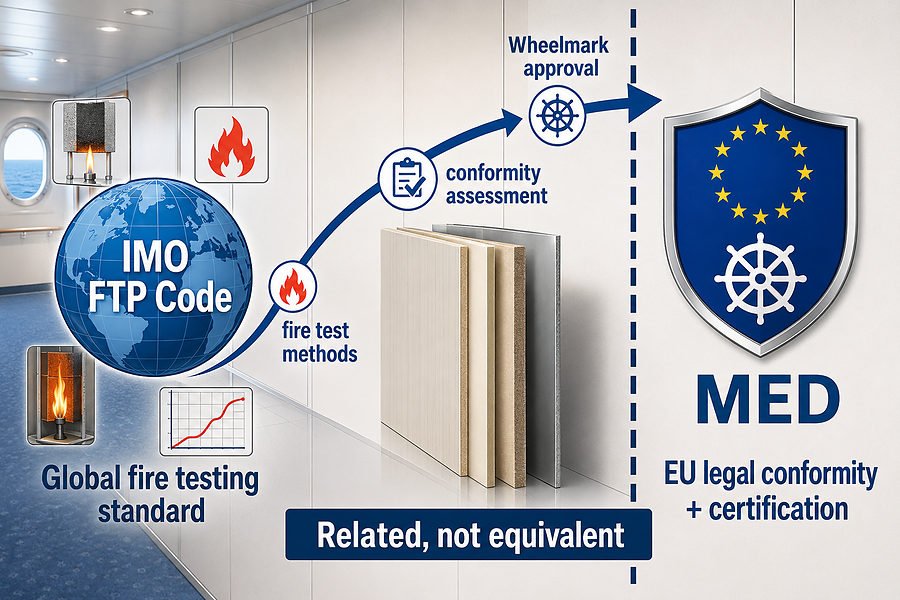
Many buyers ask me if an IMO test report means they have an MED approval. I always tell them no, they are not strictly equivalent1. To understand why, we must look at what each rule actually does.
The Role of the IMO FTP Code as a Global Technical Standard
The IMO FTP Code (International Code for Application of Fire Test Procedures) is the technical rulebook. It tells the laboratory exactly how to burn the panel. When you send a marine wall panel to a lab, they follow the IMO 2010 FTP Code Part 3 for A-Class and B-Class divisions2. The standard dictates the time and temperature. For example, an A-60 class bulkhead panel must withstand a furnace temperature that reaches 945°C for 60 minutes3. The unexposed side of the panel cannot rise more than 140°C on average. This is a strict technical standard. IMO creates the rules, but IMO does not issue certificates. They just provide the testing baseline that the whole world uses.
How the Marine Equipment Directive Enforces Rules and Adds Conformity Procedures
MED is the legal directive for the European Union. Specifically, it is Directive 2014/90/EU. MED takes the technical standards from the IMO and makes them mandatory for any ship flying an EU flag. But MED goes a step further by adding strict conformity assessment procedures. A factory cannot just pass the IMO fire test. To get the MED Wheelmark, the factory must also pass a Module D quality system audit. A Notified Body must visit the factory every year to check their production lines. This ensures every panel coming off the line matches the one tested in the lab. This legal enforcement and factory auditing make MED different from just having an IMO test report.
| Feature | IMO FTP Code | Marine Equipment Directive (MED) |
|---|---|---|
| Nature of Rule | Technical testing standard | Legal enforcement directive |
| Issuer | International Maritime Organization | European Union |
| Factory Audit Required | No (Testing only) | Yes (Conformity assessment procedures) |
| Visual Mark | None | Wheelmark |
Do DNV or Lloyd's Type Approvals Cover MED for Marine Accommodation Panels?
Buying a standard DNV-approved panel does not mean it is ready for a European ship. Assuming it does will cause major shipyard delays. Let us separate Class rules from MED rules.
Class Type Approvals like standard DNV or Lloyd's certificates do not automatically cover MED. While Class Societies issue their own certificates, they only grant MED Wheelmarks when acting as an EU Notified Body under Directive 2014/90/EU. A standard Class certificate remains completely separate from an MED certificate.
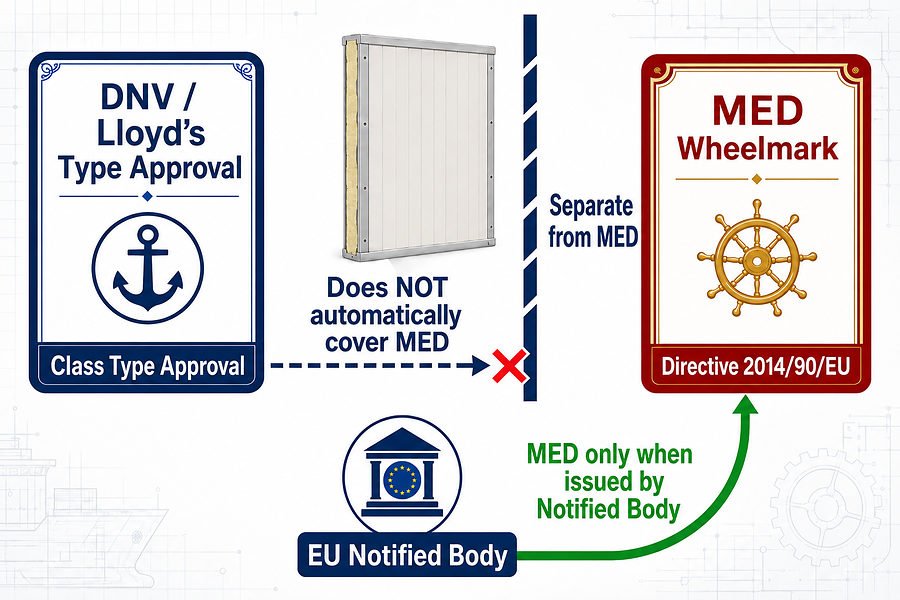
When I worked at the marine outfitting factory, clients often sent me a standard DNV Type Approval and asked for the Wheelmark sticker. I had to explain that one does not equal the other. You must understand how Class Societies wear two different hats.
Understanding Standard Class Type Approvals Issued by Societies
A standard Class Type Approval is a certificate issued by a classification society like DNV, Lloyd's Register (LR), or Bureau Veritas (BV) based on their own society rules. These rules always incorporate the IMO 2010 FTP Code4, but the certificate is strictly for ships classed by that society that do not fly an EU flag. For instance, if you build a ship flying the flag of Panama and classed by DNV, you only need the standard DNV Type Approval. The Class Society reviews the IMO fire test reports, checks the technical drawings, and issues the certificate. Standard Class Type Approvals do not automatically cover MED because they do not involve the EU legal framework.
The Function of Notified Bodies in Issuing Separate MED Certificates
To get an MED certificate, you need an EU Notified Body. The confusion happens because major Class Societies also act as Notified Bodies under Directive 2014/90/EU5. DNV has Notified Body number 0098, and Lloyd's Register is 00386. When a Class Society acts as a Notified Body, they are working on behalf of the European Union, not just their own society. They issue a completely separate MED certificate (usually a Module B certificate for the product and a Module D for the factory). The factory pays different fees for this. A standard DNV fire door approval might cost around $3,000 for document review, while adding the MED Wheelmark requires annual audits that cost an extra $2,000 to $4,000 per year.
| Certificate Type | Issuer Role | Target Vessel Flag | Includes Wheelmark? |
|---|---|---|---|
| Standard Class Type Approval | Classification Society | Non-EU Flags (e.g., Panama, Liberia) | No |
| MED Approval | EU Notified Body (often a Class Society) | EU Flags (e.g., France, Germany) | Yes |
Are USCG-Approved Marine Accommodation Panels Accepted on EU-Flag Ships?
Sourcing USCG panels for European ships often leads to costly rework if you do not check the rules. If the surveyor rejects them, your profit vanishes. You must know the exact crossover agreements.
Yes, USCG-approved panels are accepted on EU-flag ships, but only because of the Mutual Recognition Agreement (MRA) between the United States and the European Union. This agreement allows specific life-saving and fire-protection equipment, including accommodation panels tested to IMO FTP Code 2010, to avoid redundant testing.
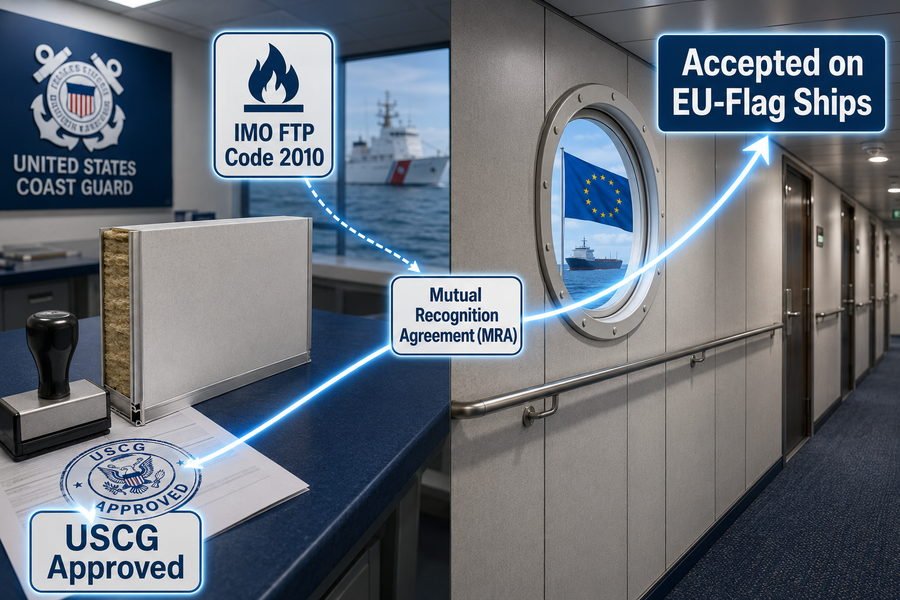
This is a great loophole for procurement officers. Finding a good factory in China that has USCG but not MED is common. Thanks to international agreements, you can often use those panels in Europe.
The Mechanics of the EU-US Mutual Recognition Agreement (MRA)
The Mutual Recognition Agreement (MRA) between the US and the EU was signed in 2004 and updated in 2019. This agreement creates a bridge between the two largest marine markets. The MRA says that if a product has a valid MED Wheelmark, the United States Coast Guard (USCG) will accept it. Likewise, if a product has a USCG approval, European flag states will accept it.7 This means you do not have to pay for redundant testing. Fire tests are expensive. A standard A-60 bulkhead fire test at an accredited lab like RISE or DBI costs between $8,000 and $12,000. The MRA saves factories from paying this fee twice, which keeps the panel price lower for you.
Product Scope and IMO FTP Code Requirements in the MRA
The MRA does not cover every item on a ship. It covers specific life-saving appliances and fire-protection equipment. Marine accommodation panels fall perfectly into this scope.8 However, the agreement is strict about testing standards. The panels must be tested to the IMO FTP Code 2010. If the USCG approval is based on older national standards, the EU will reject it. When you check the USCG certificate, look for the approval series number. Fire-resisting divisions usually fall under USCG series 164.136. The certificate must clearly state that it complies with the MRA and the IMO FTP Code. If it has this, you can safely install the panel on a ship in Germany or Italy.
| Requirement Area | Condition for Acceptance |
|---|---|
| Governing Agreement | US-EU Mutual Recognition Agreement (MRA) |
| Equipment Category | Fire-protection equipment (including panels) |
| Testing Standard Required | IMO FTP Code 2010 |
| Testing Redundancy | No redundant fire testing required |
Which Approval Rules Dual-Flag Newbuilds Using Marine Accommodation Panels?
Supplying panels for dual-flag newbuilds creates massive compliance headaches. Pick the wrong standard, and one registry blocks the entire vessel. Here is how to satisfy both authorities.
For dual-flag newbuilds, the stricter standard always rules the approval process. You must secure documentation that satisfies both flag states simultaneously. Typically, this means obtaining a Class Type Approval for the primary registry, alongside an MED Wheelmark or USCG approval if an EU or US flag is involved.
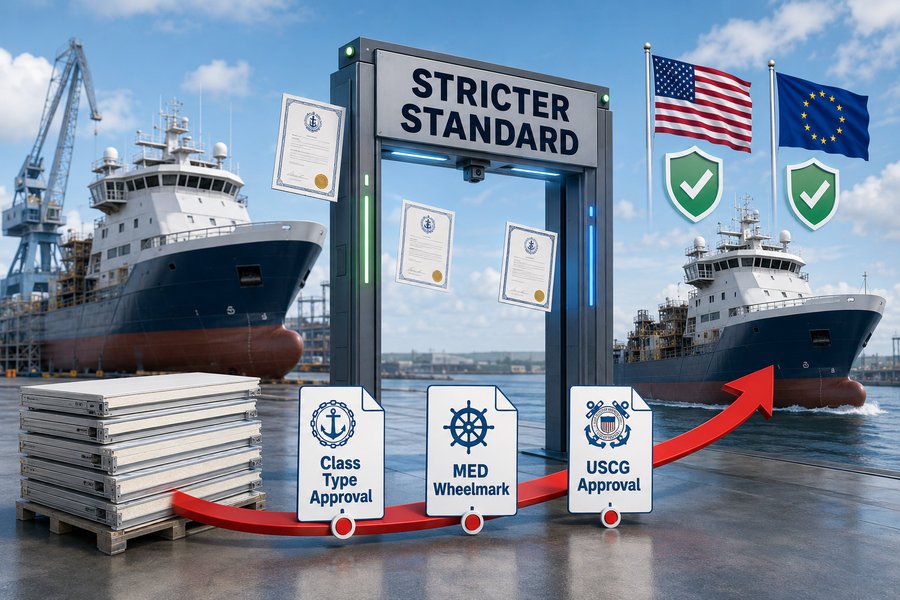
Sometimes shipowners register a vessel in two countries for tax reasons.9 I once helped a client outfitting a cruise ship registered in both the Bahamas and Italy. The paperwork was a nightmare until we applied a simple rule.
Applying the Stricter Standard Principle to Dual-Flag Panels
When dealing with dual-flag newbuilds, the surveyor will look at both sets of national rules. The principle is simple: the stricter standard always rules10. You cannot pick the easier path. If Flag A requires a standard IMO fire test but Flag B requires IMO tests plus low-flame-spread surface tests11, you must buy panels that pass both. The shipyard requires 100% compliance. If you buy a cheaper panel that only meets the lower standard, the surveyor for the stricter flag will fail the inspection. You will have to tear out the walls. Always ask the shipyard for the exact fire plan and flag requirements before you place your order in Asia.
Coordinating Documentation for Class, MED, and USCG Approvals
You must secure documentation that satisfies both flag states simultaneously. This means building a complete certificate package. First, you need the Class Type Approval for the primary registry of the ship. If the ship is classed by Bureau Veritas, get the BV certificate. Second, look at the flags. If one flag is an EU member state (like Italy), you must also provide the MED Wheelmark certificate.12 If the other flag is the US, the MRA means the MED certificate will usually cover the USCG requirement. But if the second flag is China, you will need a China Classification Society (CCS) certificate too. You must gather all these papers from your supplier and submit them together to the shipyard.
| Aspect of Dual-Flag | Strategy for Panel Compliance |
|---|---|
| Guiding Principle | The stricter standard always rules |
| Action Required | Satisfy both flag states simultaneously |
| Primary Requirement | Class Type Approval for the primary registry |
| Secondary Requirement | MED Wheelmark or USCG approval for EU/US flags |
Can One Marine Accommodation Panel Hold MED, USCG and CCS Approvals?
Finding suppliers with triple approvals is hard but highly valuable. Missing even one limits your bidding power. Knowing if one panel can hold all three changes your purchasing strategy.
Yes, a single marine accommodation panel can simultaneously hold MED, USCG, and CCS approvals. Manufacturers achieve this by passing the baseline IMO 2010 FTP Code fire tests and then submitting those identical test reports to different notifying bodies and class societies to issue their respective independent certificates.
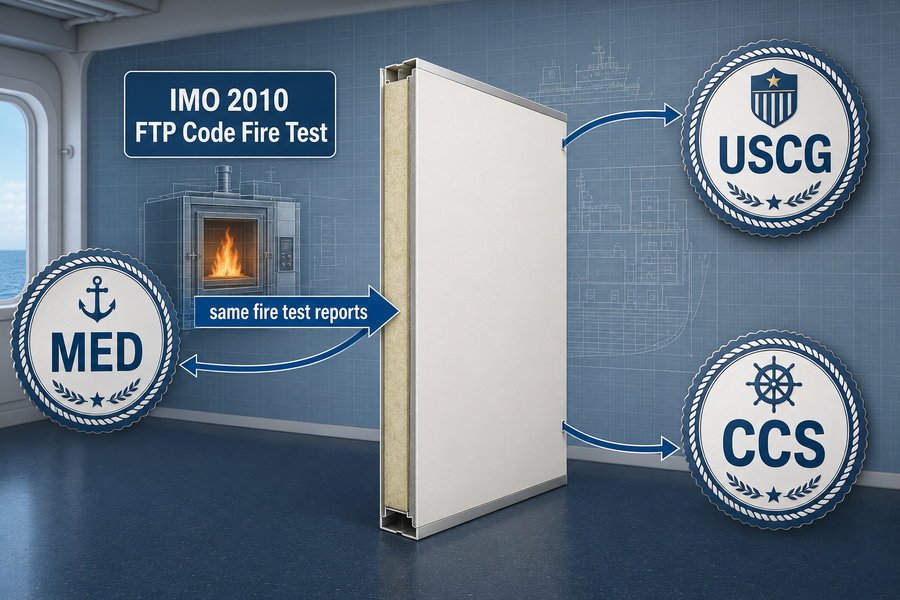
You want to find factories in China or Vietnam that have all the certificates. It makes your life easy. Many buyers think the factory has to burn three different doors to get three certificates. That is not true.
Utilizing Baseline IMO Fire Tests for Multiple Panel Certificates
A single marine accommodation panel can simultaneously hold MED, USCG, and CCS approvals because they all speak the same technical language. They all use the baseline IMO 2010 FTP Code.13 When a good factory develops a new marine fire door, they send it to a major, internationally recognized lab like Far East Fire Testing Centre (FEFTC) in Shanghai. They pay around $10,000 for one big fire test. The lab produces a detailed, 50-page test report showing the door passed the A-60 standard. The factory can then take these identical test reports and send them out. They send one copy to DNV for MED, one to the USCG, and one to CCS. Because the baseline test is accepted globally, the factory gets all three approvals from one physical test.14
Managing Factory Audits for Independent Certificates
While the test report is shared, the factory still has to deal with different notifying bodies and class societies to issue their respective independent certificates. Each organization demands its own factory audit. To keep the MED approval, an EU Notified Body must audit the factory every year under Module D. To keep the CCS approval, a Chinese surveyor visits the factory to issue a Works Approval, usually valid for 4 to 5 years. The USCG might rely on the MRA or send their own recognized inspectors.15 A factory holding all three certificates proves they have excellent quality control. They spend over $10,000 every year just paying for these different auditors. This is why their panels might cost a few dollars more per square meter, but it is worth it for your peace of mind.
| Certificate | Technical Basis | Audit Requirement for Factory |
|---|---|---|
| MED | IMO 2010 FTP Code | Annual Module D quality system audit |
| USCG | IMO 2010 FTP Code | Follow-up inspections / MRA acceptance |
| CCS | IMO 2010 FTP Code | Initial Works Approval, renewed every 4-5 years |
How to Map MED Test Reports to Class Type Approvals for Marine Accommodation Panels?
Converting existing test reports into new class approvals is confusing. A rejected report forces you to pay for new fire tests. Here is the mapping process you need to follow.
To map MED test reports to Class Type Approvals, you must ensure the test laboratory is recognized by the Class Society, the testing conforms to the latest IMO FTP Code, and the report is less than 5 years old. Submit the report alongside your panel's technical drawings for verification.
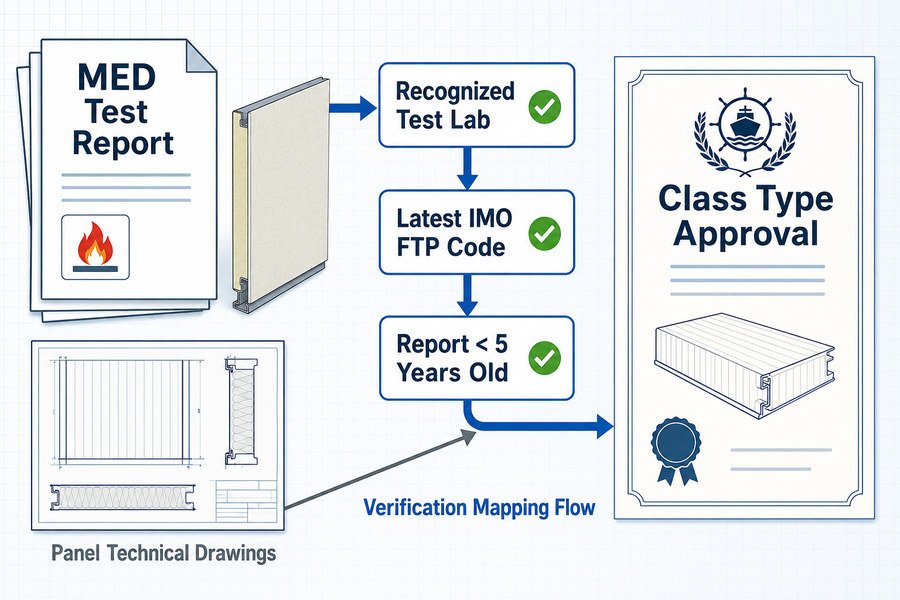
Sometimes you find a cheap supplier in Vietnam. They have an MED test report, but your shipyard demands an ABS (American Bureau of Shipping) Type Approval. You have to map the existing test to a new certificate.
Verifying the Testing Laboratory and IMO FTP Compliance
The first step is checking the lab. You must ensure the test laboratory is recognized by the Class Society. Class societies like ABS or DNV keep a list of approved labs. The lab must usually hold an ISO/IEC 17025 accreditation.16 If the lab is not on the Class Society's approved list, they will throw the report away. Next, you must confirm the testing conforms to the latest IMO FTP Code. The IMO updated the rules in 2010.17 If the Vietnamese factory shows you a test report from 2008 based on the old 1998 FTP Code, you cannot use it. The Class Society will demand a brand-new test. Always check the first page of the report to ensure it says "IMO 2010 FTP Code Part 318".
The Document Submission Process for Panel Class Approvals
If the lab and the code are correct, check the date. The test report must be less than 5 years old.19 Most Class Societies consider reports older than 5 years to be expired for the purpose of issuing a new Type Approval. Once you confirm the date, you can start the application. You submit the report alongside your panel's technical drawings for verification. The drawings must perfectly match the panel described in the test report. The steel thickness, the rockwool density, and the glue type must be identical. You send this package to the Class Society surveyor, pay the review fee of roughly $2,500, and wait. If everything maps correctly, they will issue the new Class Type Approval in a few weeks.
| Mapping Checklist Item | Requirement to Pass Class Review |
|---|---|
| Laboratory Status | Must be ISO/IEC 17025 accredited and Class-recognized |
| Testing Standard | Must conform strictly to IMO 2010 FTP Code |
| Report Age | Must be less than 5 years old |
| Supporting Documents | Technical drawings must identically match the tested panel |
Conclusion
Approvals dictate your market reach. By clearly understanding the boundaries between MED, IMO, USCG, and Class societies, you can source panels smartly, avoid shipyard delays, and keep your interior outfitting projects highly profitable.
-
"How Do EU Rules Differ From IMO Standards for Marine Panels ...", https://magellanmarinetech.com/how-eu-rules-differ-from-imo-standards-for-marine-panels/. Directive 2014/90/EU establishes a conformity-assessment and marking regime for marine equipment placed on EU ships, whereas the IMO FTP Code specifies fire-test procedures; this supports the distinction between an MED approval and an IMO test report. Evidence role: general_support; source type: government. Supports: An IMO test report and MED approval are not strictly equivalent.. Scope note: The source would support the regulatory distinction, not any specific buyer misunderstanding or commercial practice. ↩
-
"[PDF] RESOLUTION MSC.307(88) (adopted on 3 December 2010 ...", https://wwwcdn.imo.org/localresources/en/KnowledgeCentre/IndexofIMOResolutions/MSCResolutions/MSC.307(88).pdf. The 2010 IMO FTP Code identifies Part 3 as the test procedure for A, B, and F class divisions, providing the technical basis for laboratory fire-resistance testing of such marine divisions. Evidence role: definition; source type: institution. Supports: IMO 2010 FTP Code Part 3 governs fire testing for A-Class and B-Class divisions.. Scope note: The source defines the test procedure category but does not itself certify an individual product’s compliance. ↩
-
"[PDF] RESOLUTION MSC.307(88) (adopted on 3 December 2010 ...", https://wwwcdn.imo.org/localresources/en/KnowledgeCentre/IndexofIMOResolutions/MSCResolutions/MSC.307(88).pdf. The IMO FTP Code fire-resistance test for class divisions uses the standard fire curve and A-class divisions are tested for 60 minutes, with the furnace temperature reaching approximately 945°C at that duration. Evidence role: mechanism; source type: institution. Supports: An A-60 class bulkhead panel is tested for 60 minutes under a furnace curve reaching about 945°C.. Scope note: This supports the prescribed test exposure; actual approval also depends on additional performance criteria and the tested construction details. ↩
-
"[PDF] RESOLUTION MSC.307(88) (adopted on 3 December 2010 ...", https://wwwcdn.imo.org/localresources/en/KnowledgeCentre/IndexofIMOResolutions/MSCResolutions/MSC.307(88).pdf. The IMO 2010 FTP Code establishes internationally adopted fire-test procedures for materials and products used on ships, providing context for why marine fire approvals commonly refer to IMO fire-testing standards. Evidence role: definition; source type: institution. Supports: Classification-society fire approvals are based on rules that incorporate or reference the IMO 2010 FTP Code.. Scope note: This supports the role of the FTP Code as an international testing framework, but it does not by itself prove that every classification-society rule always incorporates it. ↩
-
"Directive 96/98/EC - Wikipedia", https://en.wikipedia.org/wiki/Directive_96/98/EC. Directive 2014/90/EU sets the EU legal framework for marine equipment placed on EU-flagged ships, including conformity assessment by notified bodies and use of the wheel mark. Evidence role: historical_context; source type: government. Supports: MED certification is governed by Directive 2014/90/EU and is separate from ordinary class approval.. ↩
-
"Directive 96/98/EC - Wikipedia", https://en.wikipedia.org/wiki/Directive_96/98/EC. The European Commission’s NANDO database lists notified-body identification numbers for bodies designated under EU legislation, including marine-equipment designations, and can be used to verify the stated numbers for the relevant DNV and Lloyd’s Register entities. Evidence role: case_reference; source type: government. Supports: DNV and Lloyd’s Register have specific EU notified-body identification numbers used for MED conformity assessment.. Scope note: Notified-body designations may depend on the specific legal entity and can change over time, so the database should be checked for the current designation. ↩
-
"Products covered by Mutual Recognition Agreements (MRAs). - eCFR", https://www.ecfr.gov/current/title-46/chapter-I/subchapter-Q/part-159/subpart-159.003/section-159.003-9. The EU–US Marine Equipment Mutual Recognition Agreement provides for mutual acceptance of conformity-assessed marine equipment within listed categories, including certain EU MED and USCG approvals; this supports the reciprocal-acceptance claim, but only for equipment and conditions covered by the agreement’s annexes. Evidence role: general_support; source type: government. Supports: The EU-US MRA allows reciprocal acceptance of covered marine equipment approvals between the USCG and European authorities.. Scope note: The agreement does not create blanket acceptance for all marine products; scope and conditions must be checked category by category. ↩
-
"46 CFR Part 164 Subpart 164.136 -- Fire Doors - eCFR", https://www.ecfr.gov/current/title-46/chapter-I/subchapter-Q/part-164/subpart-164.136. Official MRA materials and marine-equipment regulations identify fire-protection equipment, including structural fire-protection or fire-resisting divisions, as covered categories; this contextualizes accommodation panels only when they are certified as such divisions rather than as ordinary interior panels. Evidence role: definition; source type: government. Supports: Marine accommodation panels can fall within the MRA scope when they are approved as fire-protection equipment such as fire-resisting divisions.. Scope note: The support is conditional: not every accommodation panel is covered unless its approval certificate classifies it within the relevant fire-protection category. ↩
-
"Registration of ships and fraudulent registration matters", https://www.imo.org/en/ourwork/legal/pages/registration-of-ships-and-fraudulent-registration-matters.aspx. A neutral source on ship registration should be used to explain that open registries and flag-state choices may be influenced by taxation and regulatory costs; this provides context for the commercial motivation behind registry decisions. Evidence role: historical_context; source type: institution. Supports: Shipowners may choose vessel registration arrangements partly for tax reasons.. Scope note: This would support the tax-motivation context, but it may not directly prove that simultaneous dual registration is generally permitted or used for tax reasons in all jurisdictions. ↩
-
"RECOGNIZED ORGANIZATIONS", https://www.imo.org/en/OurWork/IIIS/Pages/Recognized-Organizations.aspx. A classification-society or flag-administration source should be cited to show that vessels and marine equipment must comply with all applicable statutory and class requirements, and that where overlapping requirements apply, compliance is normally assessed against the more stringent requirement. Evidence role: expert_consensus; source type: institution. Supports: For dual-flag compliance planning, the stricter applicable standard should be treated as controlling.. Scope note: This would document the compliance logic in general terms; it may not state the article’s exact phrase or address every possible dual-flag arrangement. ↩
-
"What Is the IMO FTP Code for Marine Interior Materials?", https://magellanmarinetech.com/what-imo-ftp-code-for-marine-interior-materials/. The IMO Fire Test Procedures Code should be cited to establish that marine materials may be evaluated under specified fire-test procedures, including surface flammability or low-flame-spread testing for certain bulkhead, ceiling, and lining materials. Evidence role: definition; source type: institution. Supports: Marine interior panels may need to pass IMO fire-test procedures, including low-flame-spread surface testing where applicable.. Scope note: The source would define the relevant IMO testing framework, but the exact tests required still depend on vessel type, location of use, flag interpretation, and the approved fire-control plan. ↩
-
"Directive 96/98/EC - Wikipedia", https://en.wikipedia.org/wiki/Directive_96/98/EC. Directive 2014/90/EU on marine equipment should be cited to show that equipment placed on board EU-flagged ships and falling within the Directive’s scope must meet EU conformity-assessment requirements and bear the Wheelmark. Evidence role: general_support; source type: government. Supports: Marine equipment for an EU-flagged ship may require MED Wheelmark certification.. Scope note: This directly supports the EU-flag requirement only for equipment covered by the Marine Equipment Directive; items outside the Directive or accepted under specific exemptions may be treated differently. ↩
-
"How Does the IMO FTP Code Connect with Other Marine Fire Safety ...", https://magellanmarinetech.com/how-imo-ftp-code-connect-with-other-marine-fire-safety-frameworks/. Official IMO and flag-administration materials establish that marine fire-test procedures for shipboard products are organized around the 2010 FTP Code, and related approval regimes may incorporate those procedures by reference. Evidence role: definition; source type: institution. Supports: MED, USCG, and CCS approvals use the IMO 2010 FTP Code as a common technical basis.. Scope note: This supports the shared technical basis in general; it may not prove that every MED, USCG, and CCS approval pathway treats every product category identically. ↩
-
"How Does the IMO FTP Code Govern Fire Testing Procedures for ...", https://magellanmarinetech.com/how-does-imo-ftp-code-govern-fire-testing-procedures-for-marine-panels/. Regulatory guidance on marine equipment conformity assessment indicates that test reports based on IMO FTP Code methods can be used as technical evidence for multiple approval processes, subject to each authority’s acceptance and administrative requirements. Evidence role: general_support; source type: institution. Supports: A single IMO FTP Code fire test report can be used as supporting evidence for MED, USCG, and CCS approvals.. Scope note: This is contextual support for reuse of test evidence; it does not demonstrate that one test report will always be accepted by all three bodies for every panel or door design. ↩
-
"46 CFR Part 159 Subpart 159.001 -- General - eCFR", https://www.ecfr.gov/current/title-46/chapter-I/subchapter-Q/part-159/subpart-159.001. U.S. Coast Guard and European Commission materials on the marine equipment Mutual Recognition Agreement describe circumstances in which approved marine equipment may be accepted across jurisdictions, while USCG regulations separately provide for inspections and follow-up oversight of approved equipment. Evidence role: historical_context; source type: government. Supports: USCG approval or acceptance may involve Marine Equipment MRA procedures or USCG-recognized inspection and follow-up mechanisms.. Scope note: This supports the existence of MRA acceptance and inspection mechanisms; it may not specify the exact inspection practice for a particular factory or product. ↩
-
"Key Facts: ISO Accreditation | Food Safety and Inspection Service", http://www.fsis.usda.gov/science-data/laboratories-procedures/accredited-laboratory-program/key-facts-iso-accreditation. ISO/IEC 17025 specifies general requirements for the competence of testing and calibration laboratories, supporting the claim that accreditation to this standard is commonly used to establish laboratory competence for test reports. Evidence role: definition; source type: institution. Supports: Testing laboratories used for class approval reports are usually expected to hold ISO/IEC 17025 accreditation.. Scope note: This supports laboratory competence generally; individual class societies may impose additional recognition or approval requirements. ↩
-
"How Does IMO MSC.307(88) Apply To Marine Interior Panels?", https://magellanmarinetech.com/how-imo-msc-30788-apply-to-marine-interior-panels/. IMO Resolution MSC.307(88) adopted the International Code for Application of Fire Test Procedures, 2010, establishing the 2010 FTP Code as the updated fire-test procedure framework for SOLAS-related marine applications. Evidence role: historical_context; source type: institution. Supports: The IMO updated the FTP Code in 2010.. Scope note: The source establishes adoption of the 2010 FTP Code; applicability to a specific product or approval depends on the vessel, flag, and class approval context. ↩
-
"[PDF] RESOLUTION MSC.307(88) (adopted on 3 December 2010 ...", https://wwwcdn.imo.org/localresources/en/KnowledgeCentre/IndexofIMOResolutions/MSCResolutions/MSC.307(88).pdf. The 2010 FTP Code identifies Part 3 as the test procedure for ‘A’, ‘B’ and ‘F’ class divisions, supporting the article’s statement that panel fire-test reports should reference Part 3 when the approval concerns such divisions. Evidence role: definition; source type: institution. Supports: For relevant marine fire-rated panels, the report should identify testing under IMO 2010 FTP Code Part 3.. Scope note: This supports the relevance of Part 3 for fire-rated divisions; it does not by itself prove that every panel approval must use Part 3 in all classification scenarios. ↩
-
"[PDF] RESOLUTION MSC.61(67) (adopted on 5 December 1996 ...", https://wwwcdn.imo.org/localresources/en/KnowledgeCentre/IndexofIMOResolutions/MSCResolutions/MSC.61(67).pdf. ABS type-approval guidance for fire-protection materials and equipment can be used to document whether submitted fire-test reports are subject to recency limits, including any five-year acceptance window used during approval review. Evidence role: expert_consensus; source type: institution. Supports: A test report used for issuing a new class Type Approval must generally be recent, with the article specifying a five-year limit.. Scope note: A five-year rule may be class- or product-specific, so the source should be checked against the exact ABS approval program and product category. ↩