Buying marine panels without a Wheel Mark means your project will fail port state control. Are you confused by the complex certification process? Here is exactly how it works.
The Wheel Mark certification process for marine accommodation panels requires two complete steps: obtaining a Module B (EC Type-Examination) certificate for the product design, followed by either a Module D (Production Quality Assurance), Module E (Product Quality Assurance), or Module F (Product Verification) certificate to prove consistent manufacturing quality.
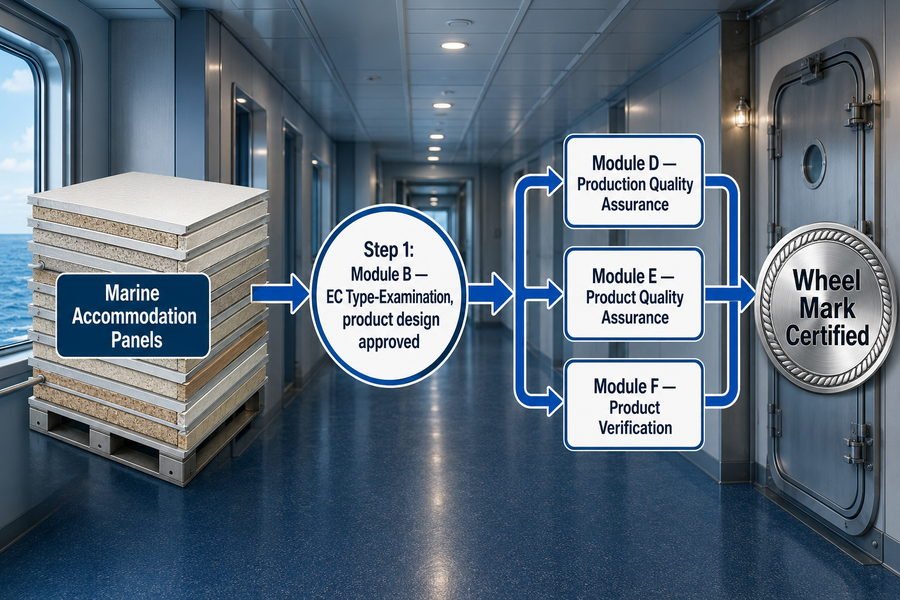
Many buyers think one piece of paper is enough. This mistake costs thousands of dollars. Let's break down the exact steps so you never face rejected shipments.
Which MED Conformity Assessment Modules Apply to Marine Accommodation Panels?
Are you guessing which modules you need for your panels? Choosing the wrong module wastes time and money. Here are the exact modules you must look for.
Marine accommodation panels fall under the Marine Equipment Directive (MED) fire protection category (MED/3.11). They strictly require a combination of Module B (EC Type-Examination) plus one of three production modules: Module D (Production Quality Assurance), Module E (Product Quality Assurance), or Module F (Product Verification).
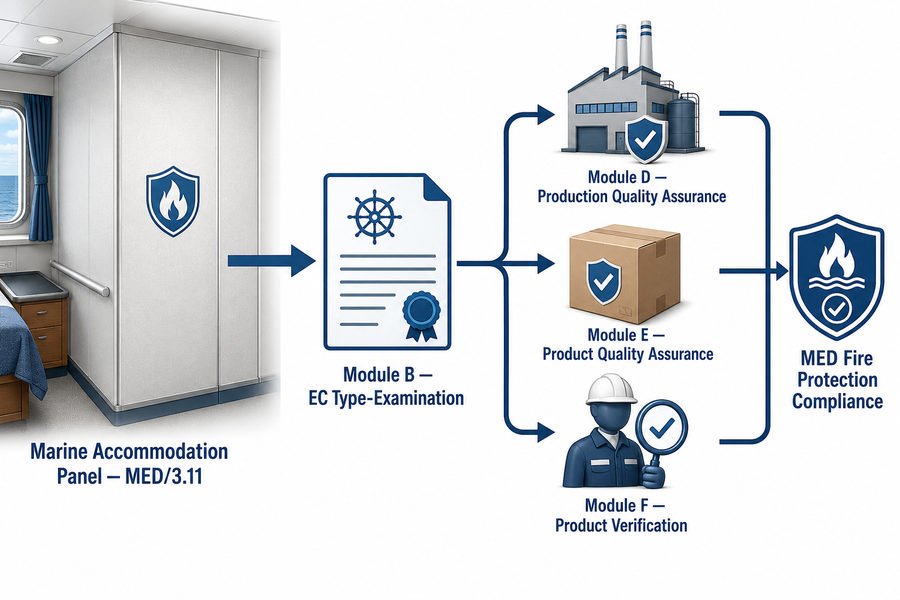
I see many buyers get confused by the different module letters. You must understand how they work together. You cannot just pick one. The law requires a specific combination to prove your marine accommodation panels are safe for ships.
Module B Explained for Marine Panel Design
Module B is the foundation of the whole process. We call it the EC Type-Examination. This module only tests the product design. The manufacturer builds a prototype panel. They send this prototype to a fire testing laboratory. The lab burns the panel according to the IMO 2010 FTP Code Part 31. The lab checks if the panel stops fire and smoke. If the panel passes, the manufacturer gets a Module B certificate. This certificate proves the design is good. However, this module does not look at the factory. It only looks at one perfect sample.
Production Modules D, E, and F for Marine Panel Manufacturing
Module B is not enough. You must pair it with a production module. You have three choices: Module D, Module E, or Module F.
Module D (Production Quality Assurance) is the most common. The testing agency audits the whole factory system. They check the ISO 9001 quality system to make sure the factory can build thousands of identical panels.
Module E (Product Quality Assurance) is similar to Module D. But Module E only checks the final inspection and testing process. It does not audit the whole manufacturing process. Very few marine panel factories use Module E.
Module F (Product Verification)2 is different. The testing agency comes to the factory and tests a sample from every single batch of panels before shipping. This is very expensive and slow. Factories only use Module F if they do not have a quality management system.
| Module Type | Focus Area | Cost Efficiency | Best Used For |
|---|---|---|---|
| Module B | Prototype Design Test | N/A (Mandatory) | Proving the initial design passes fire standards |
| Module D | Factory Quality System | High | Mass production factories with ISO 9001 |
| Module E | Final Product Inspection | Medium | Factories with strong final testing only |
| Module F | Batch-by-Batch Testing | Low | Small orders or factories without quality systems |
Which Notified Bodies Issue Wheel Mark Certificates for Marine Accommodation Panels?
Stuck waiting for emails from unqualified labs? Using the wrong testing agency will make your certificates invalid in Europe. You must use recognized Notified Bodies.
Only European Commission-appointed Notified Bodies (NBs) with an assigned 4-digit identification number can issue Wheel Mark certificates for marine accommodation panels. The top four global NBs for marine outfitting are DNV (NB 0098), Lloyd's Register (NB 0038), Bureau Veritas (NB 0062), and RINA (NB 0474).
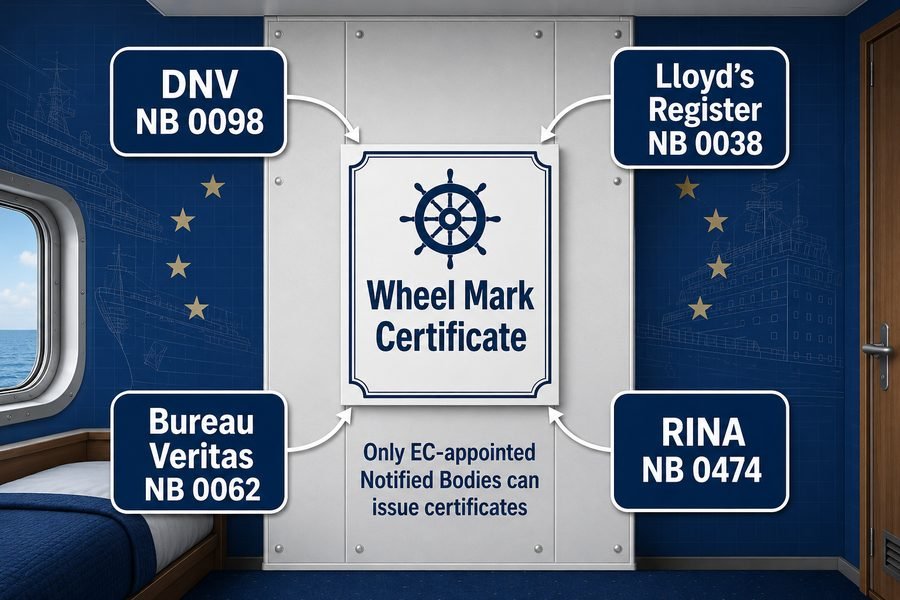
I always tell my clients to check the testing agency first. Many local test labs claim they can issue marine certificates. This is usually a lie. You must verify their status.
The Role of the 4-Digit Notified Body Number
The European Commission strictly controls who can issue a Wheel Mark. They use the NANDO database. NANDO stands for New Approach Notified and Designated Organisations3. The Commission gives a unique 4-digit number to approved agencies. We call these agencies Notified Bodies. If a certificate does not have this 4-digit number, the certificate is fake. For example, a local Chinese or Vietnamese testing lab cannot issue a Wheel Mark on its own4. They must work under the authority of a European Notified Body. The 4-digit number must appear on the product label right next to the Wheel Mark logo5.
Major European Classification Societies Acting as Notified Bodies
The shipbuilding industry trusts classification societies. The European Commission appoints the major classification societies as Notified Bodies.
DNV is very popular in Asia. Their Notified Body number is 0098. I see DNV certificates on about 60% of the panels I buy from China. According to IACS guidelines, a full Module B fire test with DNV usually costs between $8,000 and $15,0006.
Lloyd's Register uses number 0038. They are very strict and highly respected in Europe.
Bureau Veritas uses number 0062. They have many local offices in developing countries, which makes communication easier.
RINA uses number 0474. RINA is an Italian society. Many European interior contractors like RINA certificates for Mediterranean cruise ship projects. You must choose a supplier who uses one of these big four agencies.
| Notified Body Name | NB Identification Number | Market Presence in Outfitting |
|---|---|---|
| DNV | 0098 | Very High (Common in Asia) |
| Lloyd's Register (LR) | 0038 | High (Preferred in UK/Northern Europe) |
| Bureau Veritas (BV) | 0062 | High (Good local support networks) |
| RINA | 0474 | Medium (Popular for passenger ships) |
MED Module B vs Module D for Marine Accommodation Panels: What's the Difference?
Do you confuse the product test with the factory audit? Mixing these up means customs will block your panels. Here is the clear difference between them.
Module B tests the actual panel prototype for fire resistance in a lab, proving the design is safe. Module D audits the factory's quality management system (usually ISO 9001 based) to ensure every mass-produced panel matches the exact safety standards of the original Module B prototype.
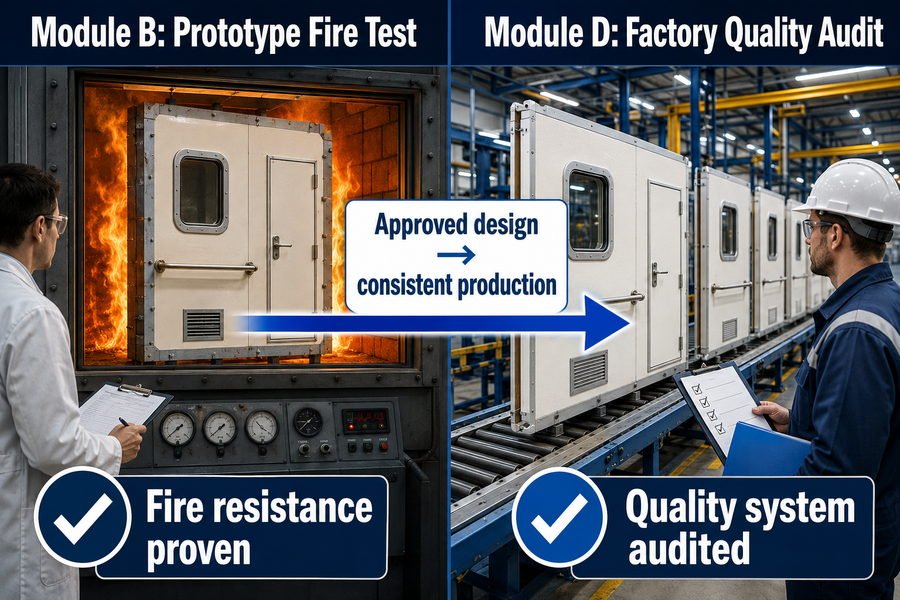
You cannot build a safe ship if you do not understand this difference. I see purchasing managers buy panels with only a Module B certificate. The shipyard rejects the panels. The buyer loses money. You need both, and they do different jobs.
The Laboratory Focus of Module B Testing
Module B is a physical test. The manufacturer builds a real 50mm thick A-Class or B-Class marine wall panel. The Notified Body puts this panel into a giant test furnace. The IMO 2010 FTP Code dictates the rules.7 For an A-60 panel, the furnace heats up to 945 degrees Celsius for 60 minutes.8 The Notified Body measures the temperature on the unexposed side of the panel. The temperature must not rise more than 140 degrees Celsius above the starting temperature. If the panel survives, the design gets the Module B certificate. This certificate only says the design works. It does not say the factory is good at making them every day.
The Factory Focus of Module D Quality Assurance
Module D is a paper and process audit. It does not burn any panels. Instead, a surveyor from the Notified Body visits the factory. The surveyor looks at the factory's ISO 9001 quality management system. The surveyor checks how the workers cut the 0.6mm galvanized steel sheets. The surveyor checks how they mix the glue. The surveyor ensures the factory buys the correct 120kg/m3 density rockwool. The goal of Module D is simple. The Notified Body wants proof that panel number 1,000 is exactly the same as the prototype panel that passed the Module B test in the lab. Module D guarantees consistent mass production.
| Feature | Module B (EC Type-Examination) | Module D (Production Quality Assurance) |
|---|---|---|
| What is evaluated? | One physical prototype panel | The factory's quality system and processes |
| Where does it happen? | Certified fire testing laboratory | Inside the manufacturer's factory |
| Standard used | IMO 2010 FTP Code Part 3 | ISO 9001:2015 and MED requirements |
| Final Outcome | Approves the product design | Approves the mass production method |
What Documents Prove Full Wheel Mark Conformity for Marine Accommodation Panels?
Are you missing paperwork when the shipyard asks for proof? Submitting incomplete documents delays your payment. You need this specific set of papers.
Full Wheel Mark conformity for marine accommodation panels requires three specific documents: a valid Module B Certificate, a valid Module D/E/F Certificate, and a signed Declaration of Conformity (DoC). The DoC must list both certificates and be signed by the manufacturer before shipping.
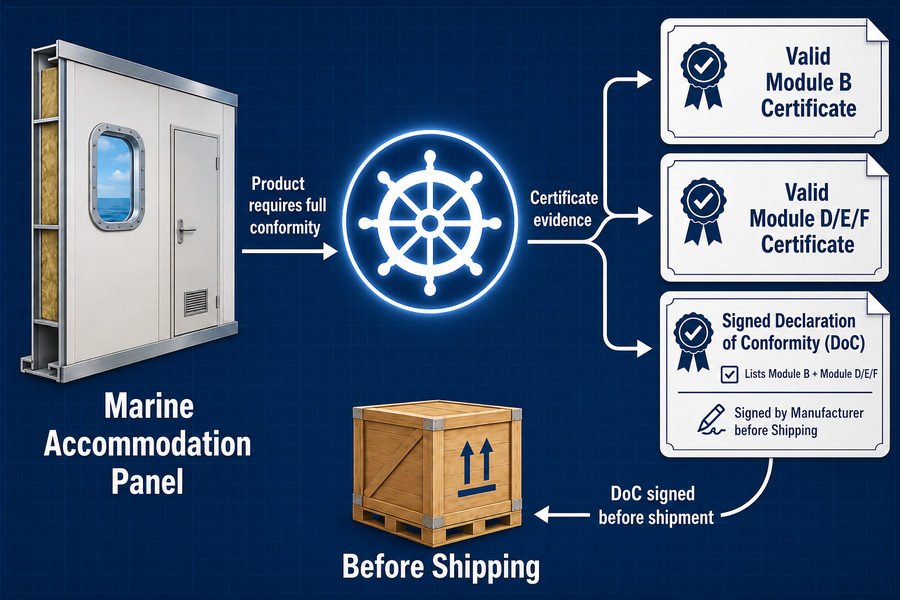
The shipyard quality inspector will ask you for documents before you install the panels. If you hand them a random test report, they will stop your work. You must prepare a complete document package.
Essential Component 1: The Module B Certificate
The first document you need is the Module B certificate9. You must read it carefully. Check the product description on the certificate. If you bought an A-15 acoustic panel, the Module B certificate must specifically say "A-15 class bulkhead." It cannot say B-15. Check the drawing number on the certificate. The drawing number must match the shop drawings you gave the shipyard. Look at the date. The certificate must be valid on the day the factory manufactured the panels. If the Module B certificate does not match your physical product perfectly, the inspector will reject your entire shipment.
Essential Component 2: The Production Certificate and Declaration of Conformity
The second document is the production certificate. This is usually the Module D certificate, but it could be Module E or Module F. This certificate proves the factory has the legal right to place the Wheel Mark logo on the panels.
The third document is the Declaration of Conformity. We call it the DoC. The European Directive 2014/90/EU Article 16 strictly requires this document. The manufacturer writes the DoC. The DoC is a legal promise. The DoC must state the product name, the Module B certificate number, and the Module D certificate number. The factory manager must sign and stamp the DoC. You must hand over all three documents—Module B, Module D (or E/F), and the signed DoC—to the shipyard. Missing even one document means you do not have Wheel Mark compliance.
| Document Name | Who Issues It? | What Does It Prove? |
|---|---|---|
| Module B Certificate | Notified Body (e.g., DNV, BV) | The panel design passed the IMO fire test. |
| Module D/E/F Certificate | Notified Body (e.g., DNV, BV) | The factory maintains strict quality control. |
| Declaration of Conformity (DoC) | The Panel Manufacturer | Legal declaration linking the product to the certificates. |
How Long Is a Marine Accommodation Panel Wheel Mark Certificate Valid?
Buying panels with expired certificates ruins your project timeline. Do you know when these certificates expire? You must check the dates carefully.
A marine accommodation panel Module B (EC Type-Examination) certificate is valid for a maximum of 5 years. A Module D (Production Quality Assurance) certificate is usually valid for 3 years, but it strictly requires successful annual factory surveillance audits to remain active during that period.
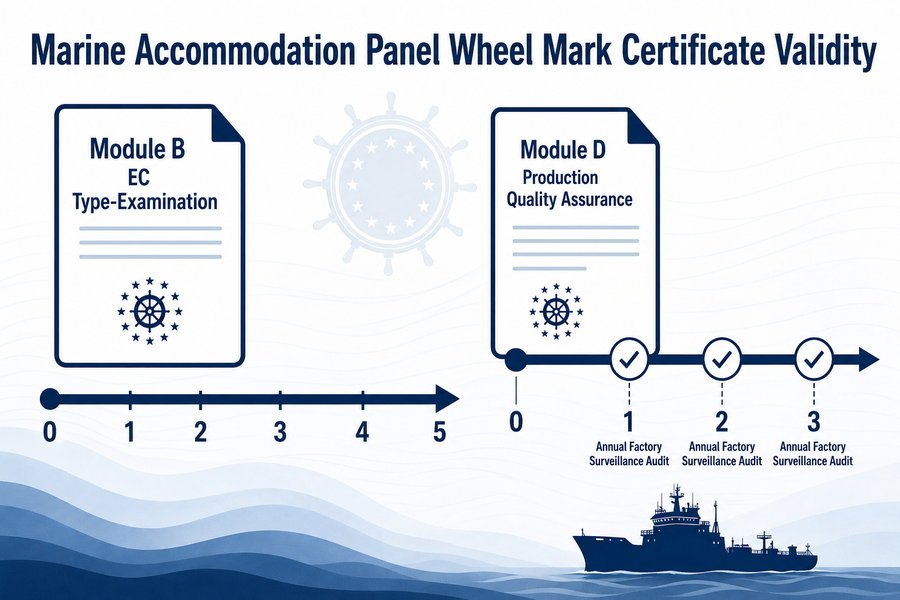
You must act like a detective when you look at certificates from a new supplier. Many factories in Asia will send you certificates that expired last month. They hope you will not check the dates.
The 5-Year Expiration Cycle for Module B Certificates
The European Marine Equipment Directive 2014/90/EU sets strict rules for certificate validity. According to Article 12, a Module B certificate has a maximum validity period of 5 years. After 5 years, the certificate dies. The manufacturer must apply for a renewal. Sometimes, the IMO changes the fire test rules during those 5 years. If the rules change, the factory cannot just renew the paper. They must build a new prototype and pay for a new fire test. Always check the expiration date on the Module B certificate. If the certificate expires before your ship delivery date, you must ask the supplier for their renewal plan.
The 3-Year Cycle and Annual Audits for Module D Certificates
Module D certificates are different. They usually have a 3-year validity period. But there is a trap. The 3-year date is not guaranteed. The Notified Body requires an annual surveillance audit. Every year, a surveyor goes to the factory. They check if the factory still follows the rules. In Asia, DNV and BV charge about $2,000 to $4,000 for this annual visit. If the factory fails the audit, or if they refuse to pay the fee, the Notified Body suspends the Module D certificate immediately10. This means the 3-year certificate becomes invalid after just one year. You must ask the supplier to show you the latest annual audit endorsement stamp on their Module D certificate.
| Certificate Type | Maximum Validity | Maintenance Requirement | Consequence of Failure |
|---|---|---|---|
| Module B (Design) | 5 Years | None during the 5 years | Certificate expires; requires renewal or re-test. |
| Module D (Production) | 3 Years | Annual Surveillance Audit | Immediate suspension of the certificate. |
Why Is an EC Type-Examination Certificate Alone Not Enough for Wheel Mark Compliance?
Did your supplier only send you a test report? Accepting just one certificate is a massive risk. Here is why the single certificate is useless.
An EC Type-Examination (Module B) certificate only proves that one single prototype passed a fire test. It is not enough for Wheel Mark compliance because it cannot guarantee that the hundreds of panels manufactured afterward maintain the same material density, glue thickness, and fire resistance as the prototype.
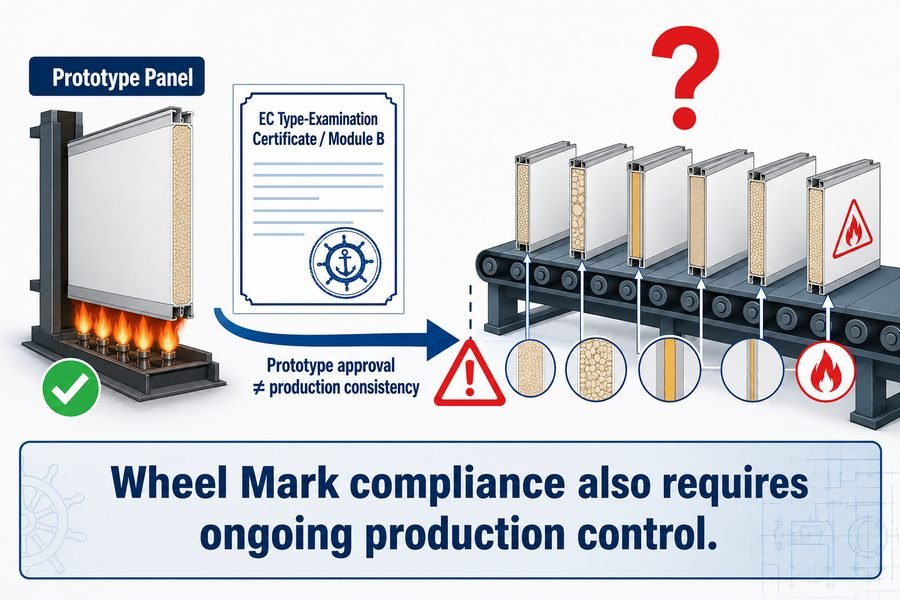
Some sales reps will show you a beautiful Module B certificate and say, "We have the Wheel Mark." I have seen this trick many times. It is dangerous. You must protect your project by demanding more.
The Limitation of Single Prototype Testing
Factories build a special panel for the Module B test. We call it a "golden sample." The workers take their time. They use the best materials. They apply the glue perfectly. They send this perfect panel to the testing lab. Of course, it passes the fire test and gets the Module B certificate. But this certificate represents just one piece of metal and rockwool. It tells you nothing about the factory's real capability. The factory might have terrible machines. They might have careless workers. A single Module B certificate cannot prove that the factory can produce 5,000 panels for your cruise ship project with zero mistakes.
The Necessity of Mass Production Quality Control
This is why the law requires a production module like Module D. Without Module D, the factory might cheat to save money. For example, a proper A-Class panel requires rockwool with a density of 120kg/m3. The factory might secretly use 100kg/m3 rockwool for your mass order to cut costs. The proper design requires 150g/m2 of polyurethane adhesive. The factory might only use 100g/m2. If they change the density or the glue thickness, the panel loses its fire resistance.11 It will fail during a real ship fire. Module D puts an auditor in the factory to stop this cheating. The auditor ensures every single mass-produced panel uses the exact density and glue thickness12 as the original prototype.
| Production Factor | Risk with Only Module B | Protection Provided by Module B + Module D |
|---|---|---|
| Material Density | Supplier uses cheaper, low-density rockwool. | Auditor checks rockwool purchase invoices and density. |
| Glue Thickness | Supplier uses less glue, causing delamination. | Auditor verifies glue application rates on the line. |
| Fire Resistance | Panels fail in a real fire due to poor assembly. | Assures all panels meet the strict IMO test standard. |
Conclusion
Securing Wheel Mark compliance requires both Module B testing and Module D factory audits. Always check these two certificates and the DoC to ensure your marine outfitting project succeeds smoothly.
-
"How Does the IMO FTP Code Connect with Other Marine Fire ...", https://magellanmarinetech.com/how-imo-ftp-code-connect-with-other-marine-fire-safety-frameworks/. The IMO 2010 FTP Code includes Part 3 test procedures for A, B, and F class divisions, providing the fire-test context used to evaluate fire-resisting marine divisions such as bulkheads, ceilings, and linings. Evidence role: definition; source type: institution. Supports: Marine panel prototypes are fire-tested under the IMO 2010 FTP Code Part 3 when assessing fire-resisting divisions.. Scope note: This supports the relevant fire-test framework; it does not by itself prove that a particular panel has passed the test. ↩
-
"Conformity Assessment of Medical Devices: An Overview from a ...", https://pmc.ncbi.nlm.nih.gov/articles/PMC12821529/. EU conformity-assessment rules describe Module F product verification as a process in which a notified body examines and tests products, or statistically selected samples, to verify conformity with the approved type. Evidence role: definition; source type: government. Supports: Module F relies on product or batch verification rather than an audited production quality-management system.. Scope note: The source supports the verification mechanism; statements about relative cost or speed are operational interpretations rather than direct regulatory conclusions. ↩
-
"Notified body - Wikipedia", https://en.wikipedia.org/wiki/Notified_body. The European Commission describes NANDO as the information system listing notified bodies designated under EU harmonisation legislation, including bodies authorised for conformity assessment tasks. Evidence role: definition; source type: government. Supports: NANDO stands for New Approach Notified and Designated Organisations and is used to identify notified bodies.. Scope note: This supports the meaning and function of NANDO generally; it does not verify any individual certificate. ↩
-
"Directive 96/98/EC - Wikipedia", https://en.wikipedia.org/wiki/Directive_96/98/EC. Under the EU Marine Equipment Directive, conformity assessment for wheel-marked marine equipment is performed by notified bodies designated by EU Member States and listed in NANDO, which indicates that non-designated local laboratories may only contribute testing under an authorised conformity-assessment arrangement rather than issue the EU mark independently. Evidence role: expert_consensus; source type: government. Supports: Only designated notified bodies, not ordinary local test laboratories acting independently, can issue conformity assessment leading to the Wheel Mark.. Scope note: This provides regulatory context; it does not prove that every Chinese or Vietnamese laboratory lacks designation, so the specific lab status must still be checked in NANDO. ↩
-
"Directive 96/98/EC - Wikipedia", https://en.wikipedia.org/wiki/Directive_96/98/EC. EU Marine Equipment Directive implementing rules specify that the wheel mark must be followed by the identification number of the notified body involved in production-control assessment and by the year in which the mark is affixed. Evidence role: mechanism; source type: government. Supports: Marine equipment bearing the Wheel Mark must include a notified body identification number adjacent to or following the mark.. Scope note: The rule concerns equipment within the scope of the Marine Equipment Directive and the relevant conformity-assessment modules; placement details may vary by implementing text and marking format. ↩
-
"How to Spot Unreliable Fire Test Reports for Marine Wall and ...", https://magellanmarinetech.com/how-spot-unreliable-fire-test-reports-for-marine-wall-ceiling-panels/. IACS publications describe technical and procedural requirements for classification and statutory survey work, but they do not ordinarily establish commercial fees for a notified body’s Module B fire-testing service; any price range would need support from published fee schedules, tender records, or market data rather than IACS technical guidance alone. Evidence role: general_support; source type: institution. Supports: The article attributes an $8,000–$15,000 DNV Module B fire-test cost range to IACS guidelines.. Scope note: This note would contextualize the role of IACS guidance and may undermine the article’s attribution if no IACS cost guidance exists; it would not directly substantiate the stated dollar range. ↩
-
"[PDF] RESOLUTION MSC.307(88) (adopted on 3 December 2010 ...", https://wwwcdn.imo.org/localresources/en/KnowledgeCentre/IndexofIMOResolutions/MSCResolutions/MSC.307(88).pdf. The IMO 2010 FTP Code sets fire-test procedures for ship construction materials, including Part 3 procedures for A, B and F class divisions, providing the regulatory test context for marine wall-panel fire performance. Evidence role: definition; source type: institution. Supports: Marine A-Class and B-Class wall-panel fire testing is governed by the IMO 2010 FTP Code.. Scope note: The FTP Code establishes the test procedures; it does not by itself prove that any particular manufacturer's panel has passed them. ↩
-
"How Are Integrity and Insulation Judged in Marine Panel Fire Tests?", https://magellanmarinetech.com/how-integrity-insulation-judged-in-marine-panel-fire-tests/. The standard fire-test time-temperature curve used in IMO FTP Code division testing reaches approximately 945 °C at 60 minutes, which supports the stated furnace exposure for an A-60 classification. Evidence role: mechanism; source type: institution. Supports: An A-60 marine fire test exposes the specimen to a standard furnace curve reaching about 945 °C after 60 minutes.. Scope note: The temperature value follows from the standard curve; the full A-60 classification also depends on integrity and insulation criteria, not furnace temperature alone. ↩
-
"How to Avoid EU Rejection of Marine Accommodation Panels for ...", https://magellanmarinetech.com/how-avoid-eu-rejection-marine-accommodation-panels-for-med-non-compliance/. The Marine Equipment Directive conformity-assessment framework describes Module B as EU-type examination, in which a notified body examines the technical design of marine equipment and certifies that it meets applicable requirements. Evidence role: definition; source type: government. Supports: The first required document is a Module B certificate showing that the panel design has been type-examined for the relevant marine-equipment requirements.. Scope note: This supports the general legal function of Module B; the exact fire-class wording and drawing-number checks depend on the specific certificate and approval conditions. ↩
-
"How to Avoid EU Rejection of Marine Accommodation Panels for ...", https://magellanmarinetech.com/how-avoid-eu-rejection-marine-accommodation-panels-for-med-non-compliance/. Directive 2014/90/EU Annex II, Module D describes notified-body surveillance of production quality assurance systems and provides for restriction, suspension, or withdrawal of approval where requirements are not met; this supports the suspension mechanism, although it does not prove that suspension is always immediate or triggered by non-payment of audit fees. Evidence role: mechanism; source type: government. Supports: A Notified Body can suspend a Module D certificate if the manufacturer fails to maintain the required quality-assurance system.. Scope note: The official legal text supports suspension for non-compliance with requirements, but not the article’s stronger wording about immediacy or refusal to pay fees. ↩
-
"Determination of Thermal Properties of Mineral Wool Required for ...", https://pmc.ncbi.nlm.nih.gov/articles/PMC10488771/. Fire-performance studies of insulated or sandwich panel assemblies show that insulation properties, density, bonding, and layer configuration influence heat transfer, integrity, and delamination behavior under fire exposure, supporting the material relevance of density and adhesive changes. Evidence role: mechanism; source type: paper. Supports: Changes in insulation density or adhesive application can materially affect the fire resistance of a panel assembly.. Scope note: Such studies provide contextual support for the mechanism; they do not prove that every specific panel design will fail after a given density or adhesive change without testing that design. ↩
-
"Conformity Assessment of Medical Devices: An Overview from a ...", https://pmc.ncbi.nlm.nih.gov/articles/PMC12821529/. Module D production-quality assurance requires an approved quality system for production, final inspection, and testing, with notified-body assessment and periodic surveillance, supporting the role of external auditing in maintaining conformity with the approved type. Evidence role: definition; source type: government. Supports: Module D creates notified-body oversight of production quality controls intended to keep manufactured products consistent with the approved type.. Scope note: Module D supports systematic production control and surveillance; it does not necessarily mean the auditor physically verifies every individual panel or every parameter on every unit. ↩