Shipbuilders often try to save money by using land building panels. But this mistake ruins projects. I will show you why standard panels cause expensive failures on ships.
Substituting building panels for marine panels causes costly rework because land-based materials lack mandatory SOLAS fire ratings, fail marine vibration tests, and emit toxic smoke. This forces shipyards to completely tear out the non-compliant panels, buy new certified marine panels, and pay high labor costs for re-installation.
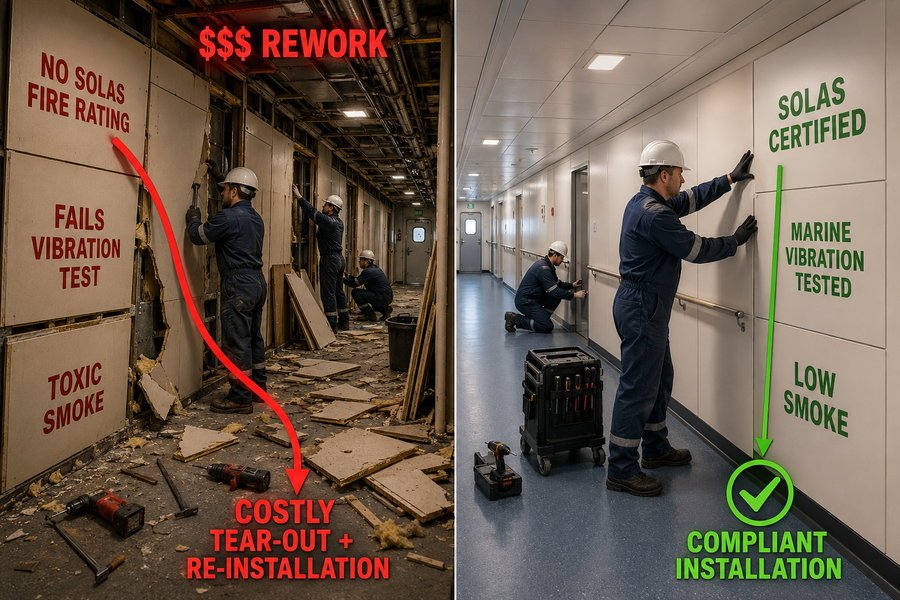
You might think cheap building panels look exactly like marine panels. But the rules for ships are very strict, and breaking them will cost you a lot of money later. Let us look closely at what actually happens when inspectors find these wrong panels.
What Happens When Class Surveyors Find Non-Approved Accommodation Panels at Final Inspection?
You finish the cabin interior, but the inspector rejects it. Your project stops immediately. Here is exactly what happens when surveyors find unapproved wall panels on your ship.
When class surveyors find non-approved accommodation panels, they immediately issue a non-conformity report (NCR), halt the compartment's handover, demand a complete tear-out of unapproved materials, and require installation of MED-certified panels. You must also pay for a follow-up inspection.
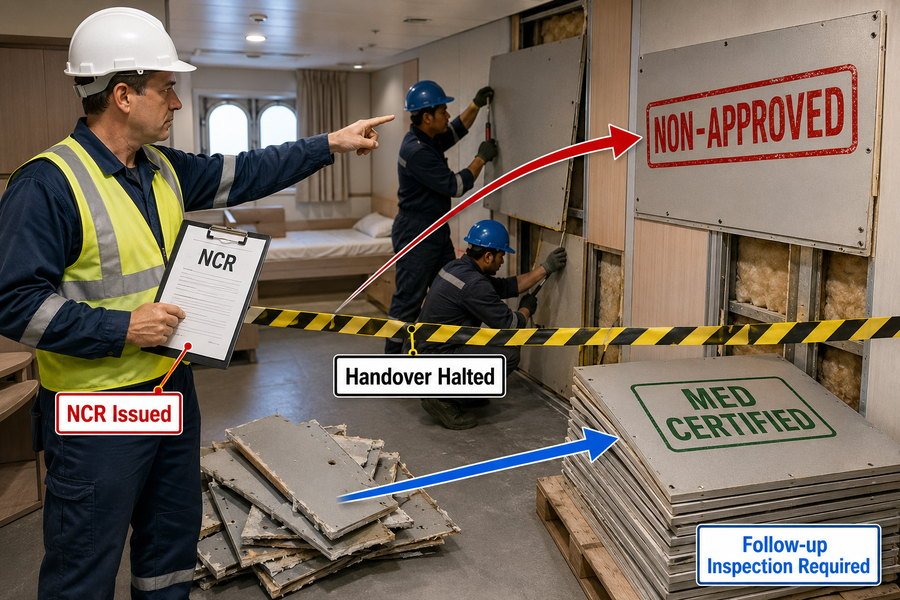
The Immediate Non-Conformity Report (NCR) Process
I remember a project where the shipyard used unapproved panels to save costs. The class surveyor walked in and immediately issued a non-conformity report (NCR). The NCR is an official document from classification societies like DNV or Lloyd's Register.1 It clearly states that the ship does not meet the safety rules. Once the surveyor writes the NCR, they halt the compartment's handover. This means the shipyard cannot give the room to the ship owner. The whole project stops in that area. The surveyor will not let you just paint over the panels or add extra screws. They follow the Safety of Life at Sea (SOLAS) rules very strictly2, and they do not accept easy fixes.
The Costly Tear-Out and Re-Inspection Cycle
After the surveyor halts the work, they demand a complete tear-out of the unapproved materials. My client had to pay workers to remove every single wall panel and ceiling board in the cabin. The workers threw the old, useless panels in the trash. Then, the shipyard had to buy and require the installation of Marine Equipment Directive (MED) certified panels3. The MED panels have the famous Wheelmark logo on them.4 After the workers install the new marine panels, the process is still not over. You must also pay for a follow-up inspection. The surveyor comes back to check the new panels. According to standard IACS (International Association of Classification Societies) billing, an extra surveyor visit can cost between $1,000 and $2,000 per day. You pay for their travel, time, and hotel. This makes the cheap building panels very expensive in the end.
| Action Taken by Surveyor | Impact on Shipyard | Estimated Additional Cost |
|---|---|---|
| Issue Non-Conformity Report (NCR) | Stops official paperwork | Administrative delays |
| Halt Compartment Handover | Delays final ship delivery | $10,000+ per day in penalties |
| Demand Complete Tear-Out | Destroys previous work | Double labor costs |
| Require MED-Certified Panels | Forces new material purchase | Full price of new marine panels |
| Conduct Follow-up Inspection | Requires new surveyor visit | $1,000 - $2,000 per day |
How Much Delivery Delay Results From Replacing Non-Compliant Accommodation Panels?
A failed panel inspection ruins your master schedule. Ship owners charge heavy daily cash penalties for late ships. Here is the exact delay time you will face.
Replacing non-compliant panels causes a 6 to 12-week delivery delay. This includes 1 to 2 weeks for teardown, 4 to 8 weeks to order and ship new certified marine panels, and 1 to 2 weeks for the final re-installation and re-inspection.
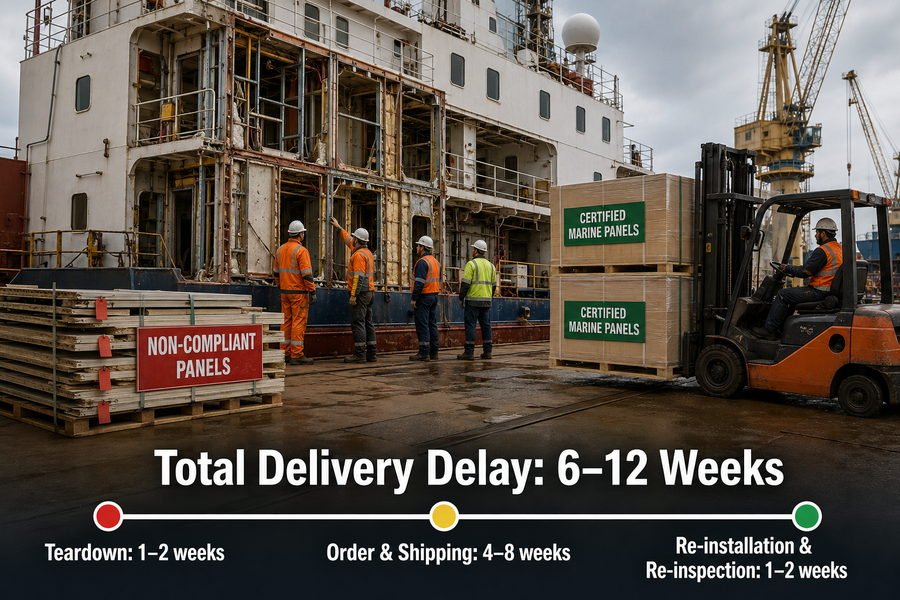
Time Required for Teardown and Re-Installation
Replacing bad panels takes a lot of time. First, you face 1 to 2 weeks for teardown. Workers must carefully remove the wrong panels so they do not break the pipes or wires behind them. You cannot rush this step. If workers break the electrical cables, the delay will be much worse. After the teardown, the room sits empty. Later, when the new panels arrive, you face another 1 to 2 weeks for the final re-installation and re-inspection. The interior decoration team must fit the new marine panels perfectly. Then, you wait for the class surveyor to come back and approve the room.5 This adds real time to your ship delivery date.
The Lead Time for Ordering Certified Marine Panels
The biggest delay comes from the middle step. You will wait 4 to 8 weeks to order and ship new certified marine panels. Factories in China or Vietnam do not keep thousands of custom marine panels in their warehouse. When you order them, the factory must buy the raw rockwool, cut the steel, and press the panels. Production takes about 2 to 3 weeks. Then, ocean shipping from Asia to Europe or the Americas takes another 3 to 5 weeks. This creates a massive gap in your work schedule. I always tell my clients to calculate the delay costs. Standard shipbuilding contracts include Liquidated Damages (LD) for late delivery.6 A typical penalty is $10,000 to $30,000 per day. A simple 6-week delay (42 days) can cost the shipyard $420,000 in penalties.
| Delay Phase | Expected Timeframe | Reason for Delay |
|---|---|---|
| Careful Teardown | 1 to 2 Weeks | Removing old panels without damaging ship systems |
| Ordering & Shipping New Panels | 4 to 8 Weeks | Custom production in Asia and slow ocean freight |
| Re-Installation & Re-Inspection | 1 to 2 Weeks | Fitting new panels and waiting for surveyor approval |
| Total Expected Delay | 6 to 12 Weeks | Complete project halt |
Why Are Standard Sandwich Panels Disqualified From Marine Accommodation Newbuilds?
Land sandwich panels are cheap and easy to buy. But they burn too fast on ships. I will explain the specific rules that disqualify these building panels.
Standard sandwich panels are disqualified from marine newbuilds because they fail the 60-minute A-Class fire test, lack the non-combustible core certification required by SOLAS Chapter II-2, and produce toxic gas levels that exceed the International Code for Application of Fire Test Procedures (FTP Code) limits.
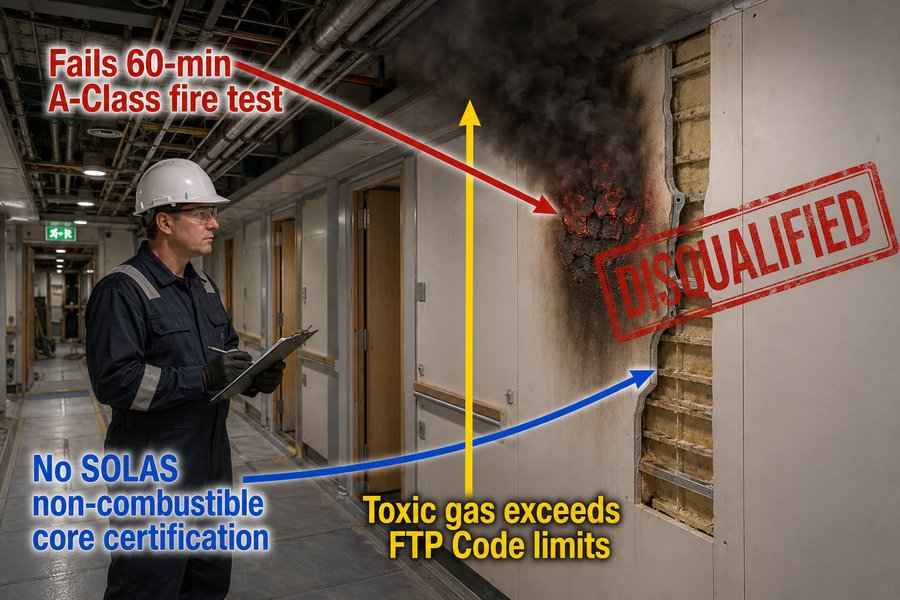
Failure to Meet the 60-Minute A-Class Fire Test
Standard building panels might look strong, but they fail the 60-minute A-Class fire test. Marine regulations require certain bulkheads to stop fire and smoke for a full hour. During an A-60 fire test, the furnace temperature reaches 945°C (1,733°F) in 60 minutes. A marine panel must stay cool on the unexposed side. The temperature on the safe side cannot rise more than 140°C above the starting temperature.7 Standard land panels cannot do this. Their glue melts, and the metal sheets fall apart in just 10 or 15 minutes. This fast failure puts the whole ship in danger, so marine surveyors disqualify them immediately.
Non-Combustible Core and Toxic Gas Requirements
The second reason is that building panels lack the non-combustible core certification required by SOLAS Chapter II-2. Many cheap building panels use EPS (Expanded Polystyrene) or standard polyurethane foam inside. These materials burn easily. SOLAS demands a core material like high-density rockwool (usually 100 kg/m³ to 150 kg/m³ density) that simply will not catch fire. Finally, building panels produce toxic gas levels that exceed the International Code for Application of Fire Test Procedures (FTP Code) limits.8 When cheap foams burn, they release dark smoke and deadly chemicals like carbon monoxide. On a ship, the crew cannot run outside. They are trapped in the middle of the ocean. The IMO FTP Code Part 2 tests strictly measure this smoke. Marine panels pass this test, but standard building panels fail it completely.
| Requirement | Standard Building Panel | Certified Marine Panel |
|---|---|---|
| 60-Minute A-Class Fire Test | Fails (Melts in 10-15 mins) | Passes (Survives 945°C) |
| Non-Combustible Core | Fails (Uses flammable foam) | Passes (Uses 100-150 kg/m³ rockwool) |
| Toxic Gas Emission Limits | Fails (High toxic smoke) | Passes (FTP Code Part 2 compliant) |
What Documentation Proves Marine Accommodation Panel Compliance Onboard?
Without the right papers, even the best marine panels are useless. Missing documents mean failed inspections. You must have these exact certificates ready for the surveyor.
To prove marine panel compliance, you must provide three documents: the Type Approval Certificate (such as the MED Wheelmark), the Declaration of Conformity (DoC) linking the batch to the ship, and the Manufacturer's Material Test Report detailing the non-combustibility results according to the IMO FTP Code.
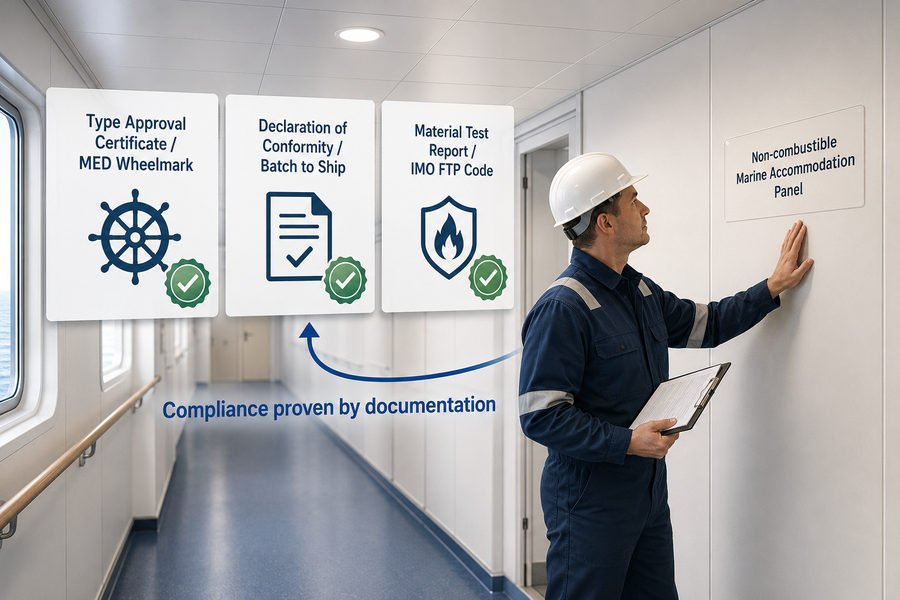
The Importance of the Type Approval Certificate
The class surveyor will not just look at the panel and say it is okay. You must give them specific papers. First, you must provide the Type Approval Certificate. In Europe, this is often the MED Wheelmark certificate9. This document proves that a major testing lab burned a sample panel and it passed the rules. The certificate will show the panel thickness, the steel thickness, and the glue type. The surveyor checks if the panel on the ship matches the panel on this certificate. If you buy a panel that is 50mm thick, but the certificate only covers 25mm panels, the surveyor will reject it. This certificate is your first line of defense.
Validating with the Declaration of Conformity and Test Reports
Next, you need the Declaration of Conformity (DoC) linking the batch to the ship. A Type Approval just says the factory can make good panels. The DoC is a legal paper from the factory saying, "We made this specific batch of panels for your exact ship, and we followed the approved design." It usually lists the ship's specific hull number. Finally, you must show the Manufacturer's Material Test Report detailing the non-combustibility results according to the IMO FTP Code10. This report goes deep into the raw materials. It shows the density of the rockwool inside the panel, often listing the exact 120 kg/m³ value. It proves the core will not burn. If you buy from cheap suppliers, they often fake these papers or do not have them at all. You must check all three documents before you pay the supplier.
| Required Document | Purpose | Key Information Included |
|---|---|---|
| Type Approval Certificate (MED) | Proves the design passes fire tests | Panel thickness, approved materials |
| Declaration of Conformity (DoC) | Links the physical panels to your ship | Ship hull number, batch number |
| Material Test Report | Proves raw materials meet FTP Code | Rockwool density (e.g., 120 kg/m³), fire results |
How Does Accommodation Panel Rework Disrupt Shipyard Installation Schedules?
Tearing out wall panels does not just hurt the interior team. It stops the entire shipyard. Let us look at how panel rework destroys your master schedule.
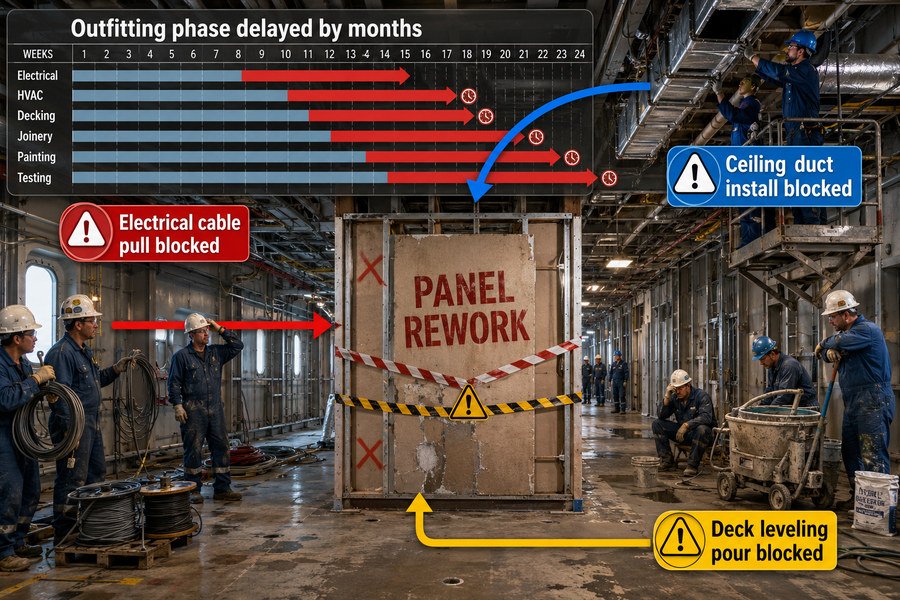
Panel rework disrupts shipyard schedules by blocking three critical paths: electrical teams cannot pull cables behind walls, HVAC teams cannot install ceiling ducts, and flooring teams cannot pour the deck leveling compound. This gridlock delays the entire outfitting phase by months.
Blocking Electrical and HVAC Installation Paths
Building a ship is like a puzzle. Every step depends on the step before it. Panel rework disrupts shipyard schedules by blocking three critical paths. First, electrical teams cannot pull cables behind walls11. Marine electricians need to run thick power cables from the main board to the cabins. They hide these cables behind the accommodation panels. If you have to tear down the bad panels, the electricians must stop working. They cannot mount switches or lights. Second, HVAC teams cannot install ceiling ducts. The air conditioning pipes run above the ceiling panels. If the ceiling panels are unapproved and must be removed, the HVAC workers cannot attach the air vents. They must wait until the new, approved marine ceiling panels arrive.
Delaying Flooring and Final Outfitting Work
The disruption gets worse as it moves down the chain. Third, flooring teams cannot pour the deck leveling compound. In a ship cabin, the walls are usually installed over the raw steel deck first. Then, workers pour a special marine cement to make the floor flat. Finally, they add PVC floors or carpets. If the wall panels are wrong, you cannot finish the floors. The workers cannot seal the edges. All these teams—electricians, HVAC workers, and floor layers—must sit and wait. You still have to pay their daily wages while they do nothing. This gridlock delays the entire outfitting phase by months12. The shipyard loses control of the project flow, and the costs go up every single day.
| Blocked Work Team | Dependent Action | Result of Panel Rework |
|---|---|---|
| Electrical Team | Pulling cables behind walls | Cannot install cabin power or lighting |
| HVAC Team | Installing ceiling ducts | Cannot attach air vents or finish ventilation |
| Flooring Team | Pouring leveling compound | Cannot flatten decks or install carpets |
Conclusion
Substituting building panels for marine panels leads to rejected inspections, massive delays, and schedule disruptions. Always use certified marine panels with proper documentation to ensure a smooth, profitable project.
-
"[PDF] SPLIETHOFF_000016 NTSB and USCG Investigation", https://data.ntsb.gov/Docket/Document/docBLOB?ID=15881259&FileExtension=pdf&FileName=SPLIETHOFF_000016%20-%20000021%20LR%20Survey%20Status%20Report%20-%209420784%20-%2024102022-Rel.pdf. A classification-society rules or guidance source should support that survey findings may be recorded as non-conformities or deficiencies in formal survey documentation issued by organizations such as DNV or Lloyd’s Register. Evidence role: definition; source type: institution. Supports: An NCR is an official document issued by classification societies such as DNV or Lloyd’s Register when a vessel or component does not conform to applicable requirements.. Scope note: Terminology and procedures can vary by class society and survey type, so the source may support the general function of an NCR rather than this exact wording. ↩
-
"International Convention for the Safety of Life at Sea (SOLAS), 1974", https://www.imo.org/en/about/conventions/pages/international-convention-for-the-safety-of-life-at-sea-(solas),-1974.aspx. An IMO or SOLAS explanatory source should support that SOLAS establishes international minimum safety standards for the construction, equipment, and operation of ships, which classification and flag-state survey processes use as a compliance framework. Evidence role: historical_context; source type: institution. Supports: Marine surveyors apply SOLAS-related safety requirements when assessing ship compliance.. Scope note: Such a source would establish the regulatory context for strict safety compliance, but it may not specifically prove how a particular surveyor handled the panels in the anecdote. ↩
-
"Marine Equipment Directive enters into force in the EEA - Efta.Int", https://www.efta.int/media-resources/news/marine-equipment-directive-enters-force-eea. An EU or notified-body source should support that the Marine Equipment Directive regulates specified marine equipment placed on EU ships and uses conformity assessment to show compliance with applicable international requirements. Evidence role: definition; source type: government. Supports: Replacement panels used in regulated ship applications may need Marine Equipment Directive certification when the MED applies.. Scope note: The source may establish the MED certification framework generally; whether a specific panel type must be MED-certified depends on its intended use, fire-rating category, vessel flag, and applicable approvals. ↩
-
"Marine Equipment Directive enters into force in the EEA - Efta.Int", https://www.efta.int/media-resources/news/marine-equipment-directive-enters-force-eea. An EU guidance or notified-body source should support that compliant marine equipment under the Marine Equipment Directive is marked with the Wheel Mark as evidence of conformity after the required assessment procedures. Evidence role: definition; source type: government. Supports: Marine Equipment Directive compliant equipment is identified by the Wheelmark logo.. Scope note: The Wheel Mark indicates conformity under the MED framework, but it does not by itself describe the technical performance of a particular product without the associated certificate and approval scope. ↩
-
"Why Do Marine Accommodation Panel Certificates Differ Across ...", https://magellanmarinetech.com/why-marine-accommodation-panel-certificates-differ-across-class-societies/. Classification-society and IMO materials describe survey and certification processes in which approved surveyors verify that ship structures, systems, and fire-safety arrangements comply with applicable class and statutory requirements. Evidence role: general_support; source type: institution. Supports: A class surveyor may need to inspect and approve the room after marine panel re-installation.. Scope note: This supports the need for surveyor verification after installation work, but it does not establish the exact waiting time for a surveyor visit on a particular project. ↩
-
"Form of Shipbuilding Contract - SEC.gov", https://www.sec.gov/Archives/edgar/data/1166663/000119312503014910/dex46.htm. Scholarly commentary on shipbuilding contracts identifies liquidated damages for delayed delivery as a standard contractual mechanism used to allocate delay risk between buyer and yard. Evidence role: expert_consensus; source type: paper. Supports: Standard shipbuilding contracts include Liquidated Damages (LD) for late delivery.. Scope note: This supports the general use of LD clauses in shipbuilding contracts, but it does not verify the specific dollar amounts stated later in the paragraph. ↩
-
"[PDF] RESOLUTION MSC.307(88) (adopted on 3 December 2010 ...", https://wwwcdn.imo.org/localresources/en/KnowledgeCentre/IndexofIMOResolutions/MSCResolutions/MSC.307(88).pdf. The IMO FTP Code/SOLAS fire-test criteria for A-class divisions specify a standard fire exposure and require the average temperature rise on the unexposed face to remain within defined limits, commonly including a 140°C average-rise criterion for insulated A-class divisions. Evidence role: definition; source type: institution. Supports: During an A-60 fire test, the furnace temperature reaches 945°C in 60 minutes and the unexposed side of the panel cannot rise more than 140°C above the starting temperature.. Scope note: This supports the regulatory test criterion, but it does not demonstrate that ordinary land-based panels fail the test. ↩
-
"[PDF] RESOLUTION MSC.307(88) (adopted on 3 December 2010 ...", https://wwwcdn.imo.org/localresources/en/KnowledgeCentre/IndexofIMOResolutions/MSCResolutions/MSC.307(88).pdf. The IMO FTP Code Part 2 establishes procedures and criteria for measuring smoke generation and toxic gas components from materials used in ship construction, including gases such as carbon monoxide; this supports the existence of marine smoke-toxicity limits but does not by itself prove that all standard building panels exceed them. Evidence role: general_support; source type: institution. Supports: The IMO FTP Code Part 2 sets smoke and toxic-gas testing requirements relevant to marine panels, and building-panel foams may fail those limits without suitable certification.. Scope note: Contextual support only; direct proof would require test reports for the specific panel types being compared. ↩
-
"Directive 96/98/EC - Wikipedia", https://en.wikipedia.org/wiki/Directive_96/98/EC. The EU Marine Equipment Directive establishes the wheel mark as evidence that specified marine equipment has undergone required conformity-assessment procedures for use on EU-flagged ships. Evidence role: definition; source type: government. Supports: In Europe, the Type Approval Certificate for marine panels is often the MED Wheelmark certificate.. Scope note: This supports the regulatory function of a MED/Wheelmark certificate generally, but it does not verify that any specific panel or batch is covered by a particular certificate. ↩
-
"How Does the IMO FTP Code Connect with Other Marine Fire Safety ...", https://magellanmarinetech.com/how-imo-ftp-code-connect-with-other-marine-fire-safety-frameworks/. The IMO Fire Test Procedures Code includes a non-combustibility test method used to assess whether materials meet fire-safety requirements for shipboard applications. Evidence role: definition; source type: institution. Supports: Manufacturer material test reports should document non-combustibility results according to the IMO FTP Code.. Scope note: This supports the relevance of FTP Code non-combustibility results, but the source would not prove that a given panel core is compliant unless the cited test report applies to that material and construction. ↩
-
"Procedure for estimating the effectiveness of ship modular outfitting", https://www.academia.edu/93577294/Procedure_for_estimating_the_effectiveness_of_ship_modular_outfitting. A technical source on ship accommodation outfitting should document that electrical services are commonly routed within wall or ceiling voids before final linings and fixtures are closed, supporting the dependency between panel access and cable installation. Evidence role: mechanism; source type: education. Supports: Electrical installation in ship cabins can be blocked when wall panels must be removed or are not yet approved because cables and fixtures depend on access behind panels.. Scope note: This would support the general installation sequence, but may not directly prove that every panel rework event halts all electrical work. ↩
-
"[PDF] COST-EFFECTIVENESS ANALYSIS OF ACHIEVING A 355-SHIP ...", https://calhoun.nps.edu/server/api/core/bitstreams/f0b7c1ca-5bd6-41c8-b99e-5125771f47ac/content. A peer-reviewed shipbuilding rework or production-planning study can support that rework during outfitting is associated with schedule slippage and cost growth, providing contextual support for the claim that cascading trade stoppages can substantially delay completion. Evidence role: general_support; source type: paper. Supports: Panel rework can create cascading stoppages among dependent trades and significantly delay the ship outfitting phase while increasing costs.. Scope note: Unless the source reports a directly comparable panel-rework case, it supports the broader relationship between rework and schedule delay rather than proving a specific delay of months in this scenario. ↩