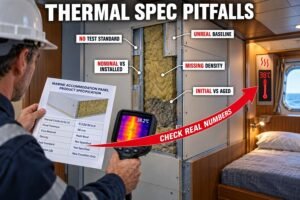
Are your ship interiors looking great but failing safety inspections? Beautiful cabins are completely useless if they fail marine codes. Let us look at what accommodation panels actually do.
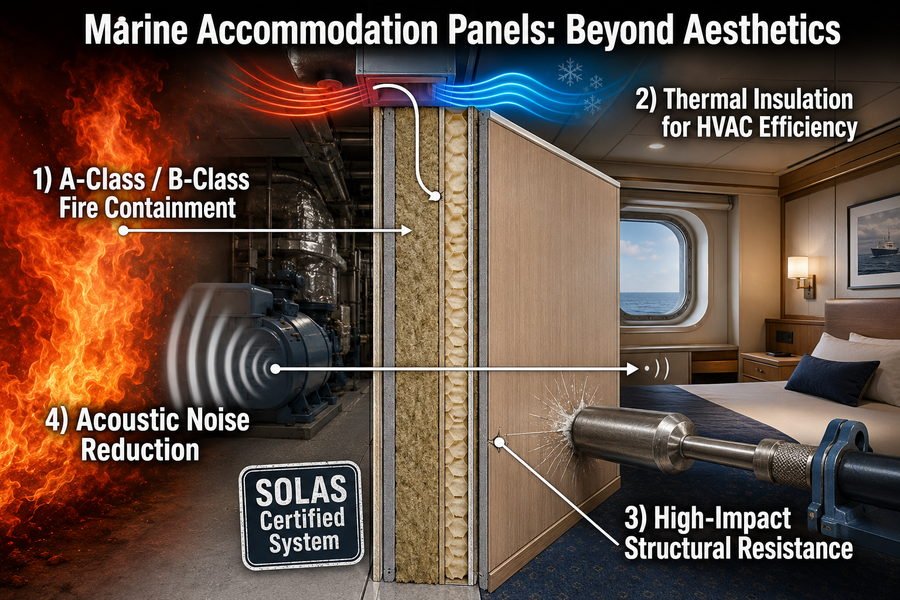
Marine accommodation panels serve critical non-aesthetic roles across four main areas: A-Class and B-Class fire containment, thermal insulation for HVAC efficiency, high-impact structural resistance, and acoustic noise reduction. They are engineered systems certified to meet strict SOLAS regulations while providing the rigid base for decorative surface finishes.
As a marine outfitting specialist, I often see buyers focus only on colors and patterns. However, true quality lies in the core materials. When you buy from factories in Asia, you must check the technical specs. Let me show you how these panels work behind the scenes so you can control your quality and price.
Which Marine Accommodation Panels Provide Fire Containment Between Compartments?
Worried about a fire spreading on your ship? A weak wall can lead to total loss. You need panels that stop flames dead.
Fire containment is achieved by two primary panel categories: A-Class panels (A-60, A-30, A-15, A-0) which stop fire and heat for up to 60 minutes on steel bulkheads, and B-Class panels (B-15, B-0) which provide 15 minutes of protection for interior cabin partitions.
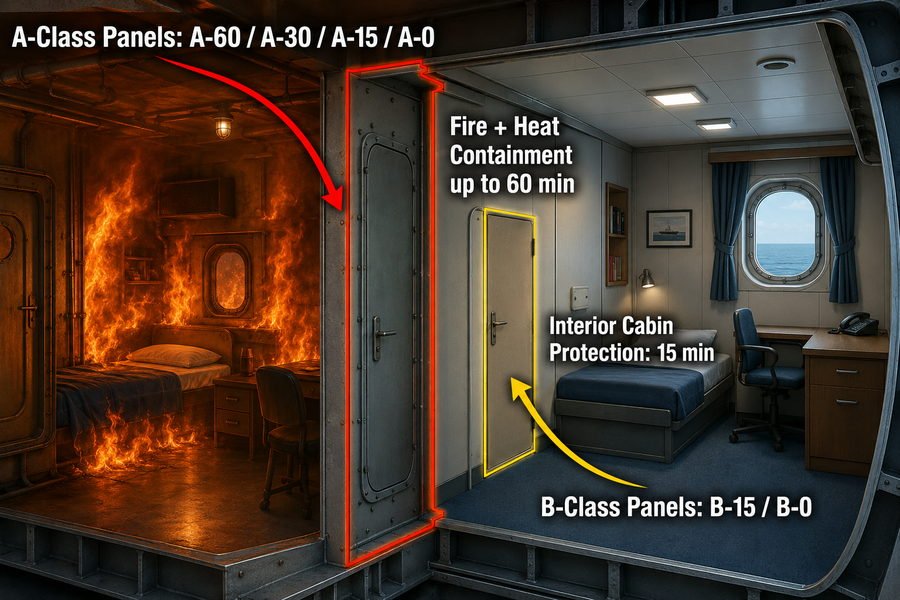
Requirements for A-Class Fire Containment Panels
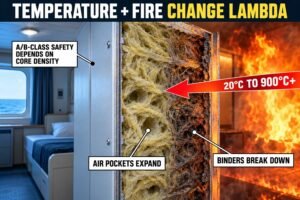
When we talk about stopping fires on ships, we must talk about A-Class panels first. According to SOLAS Chapter II-2, A-Class divisions are built from steel or equivalent materials1. They must stop smoke and flames from passing through for 60 minutes. But they also control heat. An A-60 panel uses high-density rockwool (usually 100 to 120 kg/m3) to ensure the unexposed side does not rise more than 139°C above the starting temperature for 60 minutes2. An A-30 panel does this for 30 minutes, an A-15 for 15 minutes, and an A-0 only stops the flames for 60 minutes with no temperature limit. When I worked in the factory, we tested these panels in huge furnaces. You must buy A-Class panels for high-risk areas like engine rooms and main escape routes3. If you buy cheap panels that fail this test, your entire ship project will stop.
Specifications for B-Class Interior Cabin Panels
The second category is B-Class panels. You use these for the interior cabin partitions and corridors. Under SOLAS rules, B-Class panels must stop flames for 30 minutes4. The B-15 panel controls the temperature rise to 139°C for 15 minutes, while the B-0 panel has no temperature limit. I have helped many buyers from ship interior companies find great B-15 panels in China and Vietnam. These Asian suppliers offer B-15 panels with marine certificates (like MED) for 20% less cost than European brands. By knowing the difference between A-Class and B-Class, you can buy exactly what you need. You do not need expensive A-60 panels for a simple bedroom wall.
| Panel Category | Flame Resistance Time | Insulation Time (Temp limit 139°C) | Primary Application Area | Typical Core Density |
|---|---|---|---|---|
| A-60 Class | 60 Minutes | 60 Minutes | Engine rooms, main bulkheads | 100 - 120 kg/m3 |
| A-30 Class | 60 Minutes | 30 Minutes | High-risk boundary walls | 100 - 120 kg/m3 |
| A-15 Class | 60 Minutes | 15 Minutes | Intermediate fire zones | 100 - 120 kg/m3 |
| A-0 Class | 60 Minutes | 0 Minutes | Standard steel divisions | Varies |
| B-15 Class | 30 Minutes | 15 Minutes | Cabin partitions, corridors | 100 kg/m3 |
| B-0 Class | 30 Minutes | 0 Minutes | Low-risk interior walls | 100 kg/m3 |
Do Marine Accommodation Ceiling Panels Provide Thermal Insulation or Only Surface Finish?
Are your ship cabins too hot or freezing cold? Bad ceilings waste cooling energy fast. The right ceiling panel fixes this problem instantly.
Marine ceiling panels provide both surface finish and critical thermal insulation. They use mineral wool cores ranging from 25mm to 50mm thick, with thermal conductivity (K-value) as low as 0.035 W/mK, to prevent heat transfer between decks and reduce the load on ship HVAC systems.
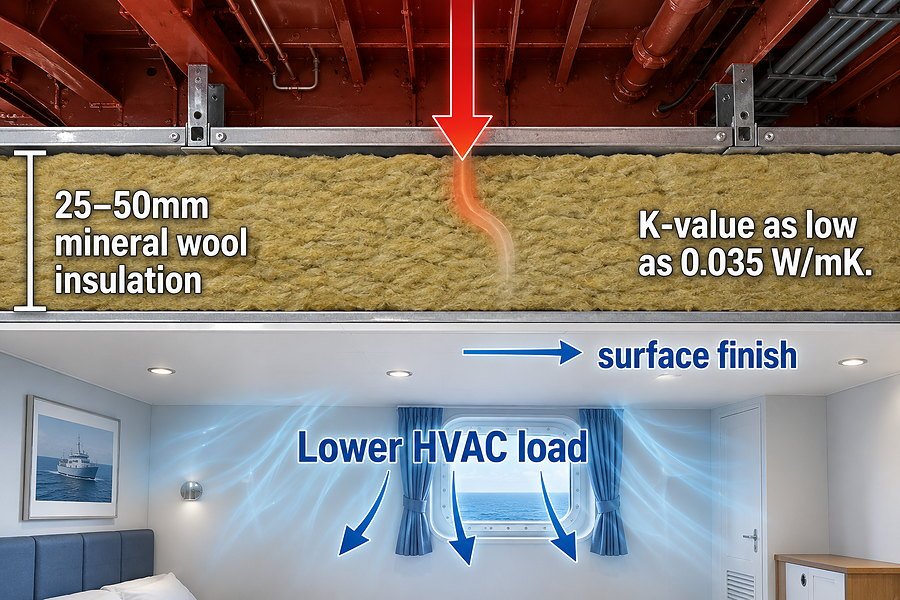
Thermal Insulation Properties of Marine Ceiling Panels
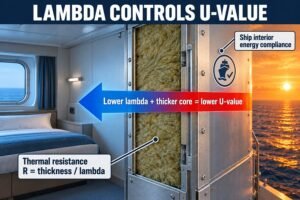
Many people think marine ceiling panels just hide pipes and wires. This is wrong. The surface finish is nice, but the main job is thermal insulation. According to ISO 8301 testing standards, good marine ceiling panels have a thermal conductivity (K-value) between 0.035 W/mK and 0.044 W/mK.5 This means they block heat very well. If the sun beats down on the upper deck, the steel gets very hot.6 Without thermal insulation in the ceiling, the cabin below will become an oven. The air conditioning will work at 100% power and still fail. By using a ceiling panel with a high-quality mineral wool core, you stop this heat transfer. I saw this happen on a ferry project. The buyer wanted to save money and bought uninsulated metal ceilings. The cabins got too hot, and they had to spend $15,000 extra on bigger air conditioners.
How Core Thickness Impacts Heat Transfer Between Decks
The secret to this insulation is the core thickness. These panels come in sizes like 25mm, 30mm, and 50mm thick. The thicker the mineral wool, the better it stops heat.7 A 25mm panel is standard for inner decks where the temperature is similar on both sides. A 30mm panel is good for areas near machine rooms. But for decks right under the sun or next to cold storage, you must use a 50mm thick panel. By choosing the right thickness, you reduce the load on the ship HVAC systems by up to 20%8. This saves fuel and money over the life of the ship. When I negotiate with suppliers in China, I always specify the exact thickness and K-value to ensure my clients get real thermal protection, not just a painted piece of metal.
| Ceiling Core Thickness | Thermal Conductivity (K-value) | Estimated HVAC Energy Savings | Best Application Area |
|---|---|---|---|
| 25mm Mineral Wool | ~0.044 W/mK | Base level | Interior decks, standard cabins |
| 30mm Mineral Wool | ~0.040 W/mK | Moderate | Corridors near machinery spaces |
| 50mm Mineral Wool | ~0.035 W/mK | High (up to 20%) | Decks under sun exposure |
Which Marine Accommodation Panel Type Resists Impact in High-Traffic Corridors?
Are your corridor walls getting dented by heavy luggage and carts? Damaged walls look terrible and cost money to replace.
High-traffic corridors require two specific impact-resistant panel types: PVC-film laminated composite panels with 0.6mm to 1.0mm galvanized steel skins, and aluminum honeycomb panels. Both types absorb kinetic energy from carts and luggage, preventing dents and structural damage in busy ship passageways.
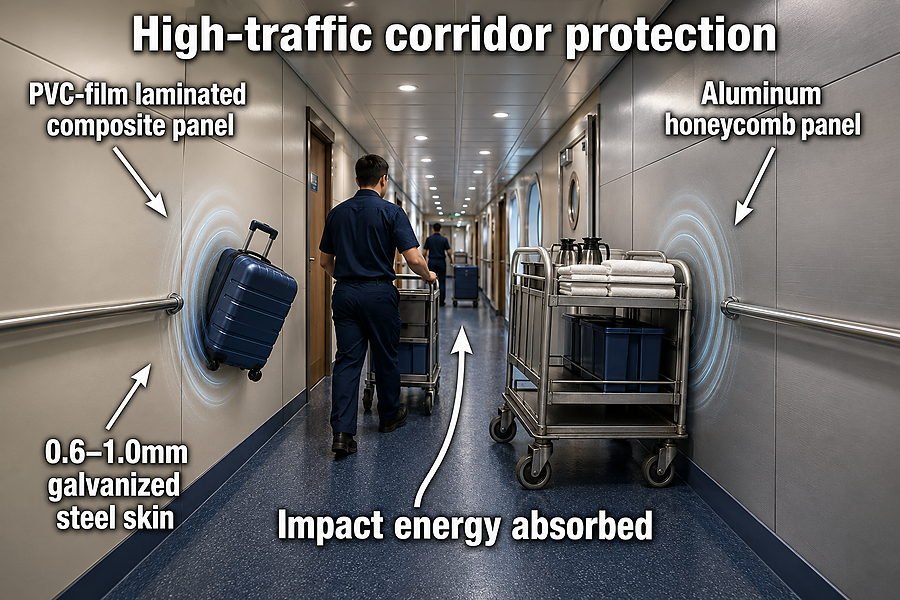
Impact Resistance of Steel Laminated Composite Panels
When a heavy food cart hits a standard cabin wall, it leaves an ugly dent. For high-traffic corridors, you must use PVC-film laminated composite panels with thicker metal skins. A standard panel uses a 0.4mm or 0.5mm steel skin. But an impact-resistant composite panel uses a 0.6mm, 0.8mm, or even 1.0mm galvanized steel skin9. This thicker steel absorbs the kinetic energy from luggage and carts10. The 150-micron PVC film on top also hides small scratches. I once helped a client who was doing the interior for a large European cruise ship. The shipyard complained that the corridor walls were denting during the building phase. We switched their order to 0.8mm steel skin composite panels from a factory in Asia. The price only went up by $3 per square meter, but the walls became completely dent-proof.
Durability of Aluminum Honeycomb Panels in Corridors
The second type of impact-resistant panel is the aluminum honeycomb panel. These panels are amazing for busy ship passageways. Instead of mineral wool, the core is made of a hexagonal aluminum grid. This honeycomb shape is incredibly strong. When something hits the panel, the honeycomb structure spreads the kinetic energy across the whole board11, preventing dents and structural damage. Honeycomb panels are very light but can take a huge impact. They are more expensive, usually starting around $45 per square meter, compared to $25 for steel rockwool panels. But for luxury ferries where carts hit the walls every day, aluminum honeycomb is the best choice. By knowing these two types, you can stop replacing broken walls and protect your profit margins.
| Panel Type | Skin Thickness | Core Material | Impact Resistance Level | Average Cost per SQM |
|---|---|---|---|---|
| Standard Panel | 0.4mm - 0.5mm | Rockwool | Low (dents easily) | $20 - $25 |
| Steel Laminated Composite | 0.6mm - 1.0mm | High-Density Rockwool | High (absorbs cart impacts) | $25 - $32 |
| Aluminum Honeycomb | 0.8mm - 1.0mm | Aluminum Grid | Maximum (spreads energy) | $45 - $60 |
Can One Marine Accommodation Panel Deliver Both Acoustic and Decorative Performance?
Are engine noises keeping passengers awake? Loud cabins lead to angry clients and bad reviews. You need a panel that blocks noise and looks good.
Yes, acoustic marine panels combine decorative PVC or melamine faces with sound-dampening mineral wool or perforated cores. These integrated panels provide a complete visual finish while achieving Sound Transmission Class (STC) ratings between 35 dB and 45 dB, effectively blocking engine and ambient noise.
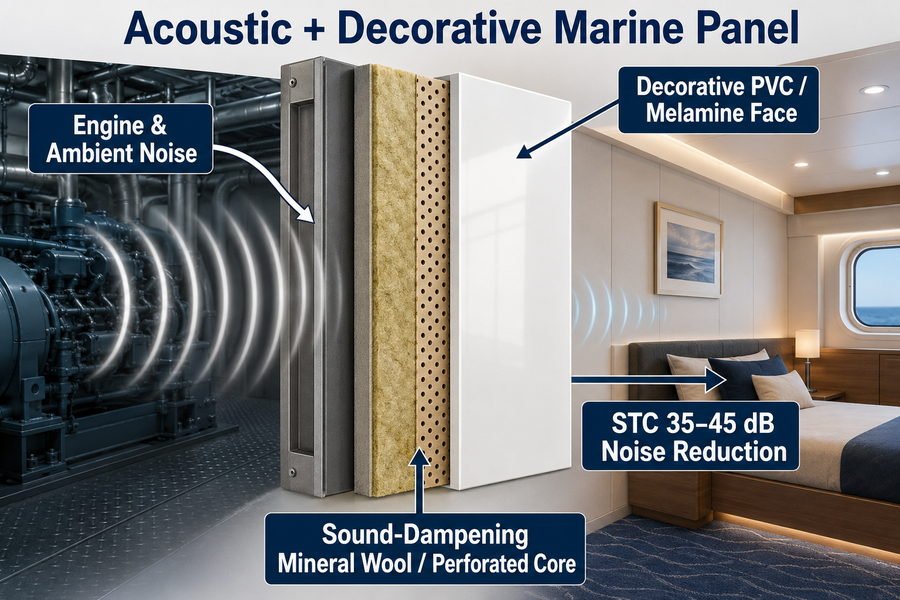
Acoustic Performance Ratings of Sound-Dampening Panels
Noise on a ship is a huge problem. Engines, pumps, and people make a lot of noise. You cannot just put regular walls everywhere. You need sound-dampening mineral wool cores. According to ISO 717-1 testing standards12, acoustic panels are measured by their Sound Transmission Class (STC) rating. A standard B-15 panel might only block 30 dB of sound. But a true acoustic marine panel blocks between 35 dB and 45 dB13. To reach 45 dB, the factory uses a very high-density mineral wool core, usually around 120 kg/m3 to 150 kg/m3, and sometimes adds a thin layer of lead or heavy rubber inside14. Sometimes they use perforated steel under the finish to catch the sound waves. This effectively blocks engine and ambient noise. If you put a 45 dB panel next to an engine room, the cabin next door will be quiet enough for sleeping15.
Integration of Decorative Finishes on Acoustic Cores
The best part is that you do not have to choose between quiet and ugly. These acoustic cores are fully integrated with beautiful decorative finishes. The factory glues decorative PVC film or melamine faces directly onto the heavy steel skins of the acoustic panel. You can order them in wood grain, marble, or solid colors. I worked on a project where the interior design company needed a highly decorative wall near a loud generator. They thought they had to build two walls: one for sound and one for looks. I showed them a single acoustic panel from China with a beautiful oak PVC finish that tested at 42 dB. They saved space, cut installation time in half, and got the complete visual finish they wanted.
| Panel Feature | Core Material / Density | Surface Finish | Acoustic Rating (STC) | Noise Blocked |
|---|---|---|---|---|
| Standard Wall | Rockwool (100 kg/m3) | PVC Film | ~30 dB | Normal talking |
| Basic Acoustic | Rockwool (120 kg/m3) | Melamine / PVC | 35 dB - 38 dB | Loud talking, TV |
| High Acoustic | Rockwool + Rubber Layer | Perforated / PVC | 42 dB - 45 dB | Engine / Pump noise |
What Load-Bearing Duties Do Structural Marine Accommodation Bulkhead Panels Carry?
Are you mounting heavy furniture on weak cabin walls? Thin panels will crack under the weight. Structural panels solve this mounting problem safely.
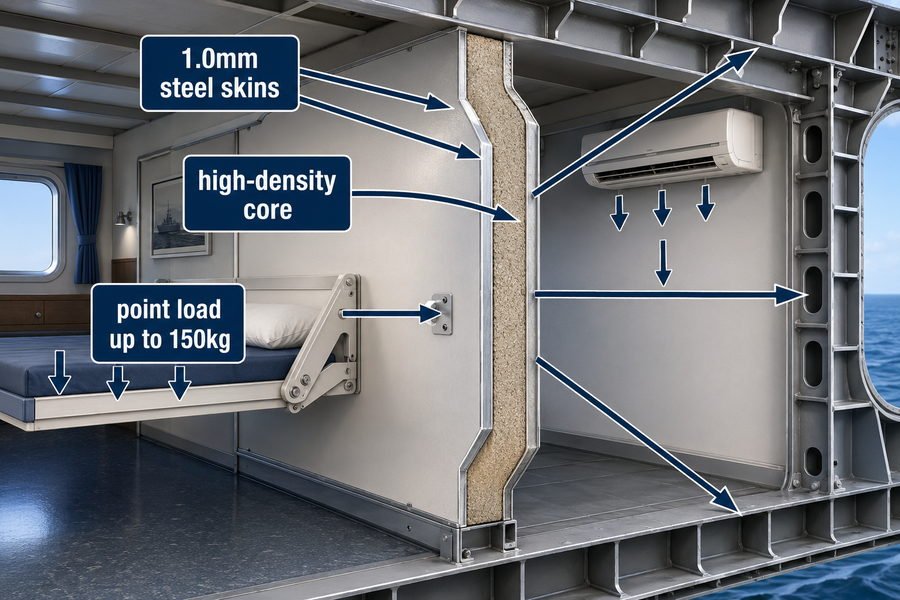
Structural marine bulkhead panels carry three main load-bearing duties: supporting interior fixtures like pull-down beds, bearing the weight of wall-mounted HVAC units, and adding rigid support to the ship's superstructure. They use thicker 1.0mm steel skins and high-density cores to handle point loads up to 150kg.
Supporting Pull-Down beds and Heavy Interior Fixtures
When you build a ship cabin, you must attach things to the walls. Standard panels cannot hold heavy weight. Structural marine bulkhead panels are built for heavy load-bearing duties. The first major duty is supporting interior fixtures like pull-down beds, heavy mirrors, and large televisions. If you screw a heavy pull-down bed into a standard 0.5mm steel panel, the screws will rip out when a person sleeps on it. Structural panels use thicker 1.0mm steel skins and high-density cores. Because of this strong build, they can safely handle point loads up to 150kg16. When you buy these panels, you must tell the factory where you will hang the beds. The factory can even put extra steel plates inside the panel at those exact spots.
Bearing Wall-Mounted HVAC Units and Superstructure Support
The second duty is bearing the weight of wall-mounted HVAC units. These air conditioners are heavy and vibrate constantly. A structural panel absorbs the vibration and holds the heavy unit securely. The third duty is adding rigid support to the ship's superstructure17. While these panels do not hold the ship together, they do stop the thin interior steel corridors from flexing and shaking during rough seas. I remember a project where the workers tried to mount a 60kg AC unit on a standard B-0 panel. The panel bent immediately. We had to order new structural panels with 1.0mm skins and 150 kg/m3 rockwool from our Asian supplier. The new panels held the AC units perfectly. It is always cheaper to buy the right structural panel first than to fix a broken wall later.
| Panel Duty | Panel Skin Thickness | Core Density | Maximum Point Load |
|---|---|---|---|
| Light Decor (Mirrors, Art) | 0.5mm - 0.6mm | 100 kg/m3 | ~20 kg |
| Medium Weight (TVs, Small Shelves) | 0.6mm - 0.8mm | 120 kg/m3 | ~50 kg |
| Heavy Structural (Beds, HVAC units) | 1.0mm+ / Internal Plates | 150 kg/m3 | Up to 150 kg |
Why Are Functional Marine Accommodation Panels Specified Separately From Decorative Linings?
Do you buy decorative skins before checking fire ratings? This simple mistake stops shipyard projects completely. Separate specifications prevent this disaster.
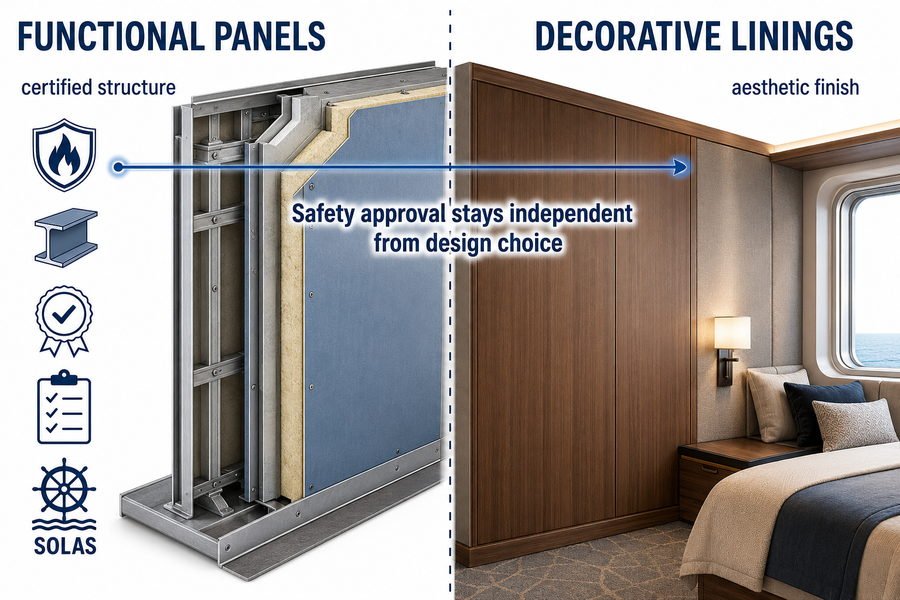
Functional panels and decorative linings are specified separately to address two distinct needs: functional panels must meet rigid SOLAS safety, fire, and structural certifications, while decorative linings are selected purely for interior design trends. Separating them allows buyers to secure safety approvals without restricting aesthetic choices.
Meeting Rigid SOLAS Safety and Fire Certifications
In the ship outfitting business, safety and beauty do not follow the same rules. Functional panels must meet rigid SOLAS safety, fire, and structural certifications.18 To get a MED certificate (the "wheelmark"), a factory must burn their panels in a furnace.19 This test costs over $5,000 per panel type and takes months. If a factory changes the steel or the rockwool, they must test it again.20 Therefore, the core functional panel is heavily regulated. You must buy functional panels that already have these safety approvals. If you mix the safety spec with the color spec in your purchasing order, you might find a factory that has the right color but fake fire certificates. Your ship will fail inspection, and your company will lose money.
Flexibility in Selecting Interior Design Trends
On the other hand, decorative linings are selected purely for interior design trends. Shipowners change their minds about colors all the time. By separating the specs, you get total flexibility. You can order the certified functional panel from a high-quality supplier in China. The lead time for these certified blank panels is usually 30 days. Then, you can pick any MED-certified decorative PVC film21 you want. The lead time for film is only 10 days. I taught a procurement officer how to do this. She used to wait 60 days for European factories to custom-make colored panels. I showed her how to buy standard certified B-15 blanks and apply certified decorative films. She secured her safety approvals instantly and never restricted her aesthetic choices again, cutting her lead time by three weeks.
| Specification Type | Primary Purpose | Key Certification Needed | Average Lead Time | Change Flexibility |
|---|---|---|---|---|
| Functional Panel Core | Fire safety, Insulation, Structure | SOLAS, MED (Fire Test) | 30 - 45 days | Very Low (needs re-testing) |
| Decorative Lining / Film | Aesthetics, Interior Design | MED (Low Flame Spread) | 7 - 14 days | Very High (easy to swap) |
Conclusion
Marine accommodation panels are complex engineering systems. By understanding their fire containment, thermal insulation, structural strength, and acoustic properties, you can purchase the perfect products from Asian suppliers safely and profitably.
-
"[PDF] Supplement - International Maritime Organization", https://wwwcdn.imo.org/localresources/en/publications/Documents/Supplements/English/QF110E_122015.pdf. SOLAS Chapter II-2 defines A-class divisions as divisions formed by steel or another equivalent material, supporting the article’s description of their basic construction requirement. Evidence role: definition; source type: institution. Supports: A-Class divisions are built from steel or equivalent materials.. ↩
-
"[PDF] RESOLUTION MSC.307(88) (adopted on 3 December 2010 ...", https://wwwcdn.imo.org/localresources/en/KnowledgeCentre/IndexofIMOResolutions/MSCResolutions/MSC.307(88).pdf. The IMO fire-test criteria for A-class divisions specify insulation performance by limiting the temperature rise on the unexposed face during the relevant test period, providing regulatory context for the A-60 insulation claim. Evidence role: definition; source type: institution. Supports: An A-60 panel limits the temperature rise on the unexposed side for 60 minutes.. Scope note: The official criterion is commonly stated as a 140°C average temperature rise, with an additional maximum-point limit; the article’s 139°C figure should be checked against the cited wording. ↩
-
"[PDF] MSC.99(73) - International Maritime Organization", https://wwwcdn.imo.org/localresources/en/KnowledgeCentre/IndexofIMOResolutions/MSCResolutions/MSC.99(73).pdf. SOLAS structural fire-protection provisions assign fire-integrity requirements to machinery spaces and escape-route boundaries, giving regulatory context for treating engine rooms and escape routes as areas requiring higher fire containment performance. Evidence role: general_support; source type: institution. Supports: A-Class panels are required in high-risk areas such as engine rooms and main escape routes.. Scope note: The source would support the regulatory importance of these spaces, but the exact required class depends on vessel type, space category, boundary, and flag-state implementation. ↩
-
"[PDF] recommendation for fire test procedures for “a” and “b” class ...", https://wwwcdn.imo.org/localresources/en/KnowledgeCentre/IndexofIMOResolutions/AssemblyDocuments/A.163(ES.IV).pdf. SOLAS Chapter II-2 defines B-class divisions by their ability to prevent the passage of flame for the first half hour of the standard fire test, supporting the stated 30-minute flame-resistance requirement. Evidence role: definition; source type: institution. Supports: B-Class panels must stop flames for 30 minutes.. ↩
-
"Determination of Thermal Properties of Mineral Wool Required for ...", https://pmc.ncbi.nlm.nih.gov/articles/PMC10488771/. ISO 8301 specifies a steady-state heat-flow-meter method for measuring thermal resistance and related thermal transmission properties of insulation materials; mineral-wool insulation products commonly report thermal conductivity values in the approximate 0.03–0.05 W/m·K range. Evidence role: definition; source type: institution. Supports: ISO 8301 is an appropriate standard for measuring thermal conductivity, and mineral-wool insulation can fall within the stated K-value range.. Scope note: ISO 8301 supports the measurement method, while the stated numeric range should be verified against manufacturer-independent mineral-wool material data or product standards rather than ISO 8301 itself. ↩
-
"The effects of solar radiation on thermal comfort - PubMed", https://pubmed.ncbi.nlm.nih.gov/17009012/. Marine and heat-transfer references describe steel decks as highly conductive exposed surfaces that absorb solar radiation and can transfer heat to adjacent compartments, increasing cooling demand below deck. Evidence role: mechanism; source type: education. Supports: Solar radiation can heat exposed steel decks and contribute to heat transfer into spaces below.. Scope note: Such sources support the physical mechanism of solar heat gain through exposed steel structures, not the specific cabin temperature outcome for any particular vessel. ↩
-
"Thermal conductivity and resistivity - Wikipedia", https://en.wikipedia.org/wiki/Thermal_conductivity_and_resistivity. Heat-transfer theory states that thermal resistance for a homogeneous insulation layer increases with thickness and decreases with thermal conductivity, so increasing mineral-wool thickness reduces conductive heat flow when other conditions are unchanged. Evidence role: mechanism; source type: education. Supports: Increasing mineral-wool core thickness improves resistance to conductive heat transfer.. Scope note: The relationship is strongest for steady-state conduction through a uniform layer; real panel performance also depends on joints, facings, thermal bridges, moisture, and installation quality. ↩
-
"Tradeoffs in optimization of Active Insulation Systems and HVAC", https://pure.psu.edu/en/publications/tradeoffs-in-optimization-of-active-insulation-systems-and-hvac-a/. Studies of ship energy efficiency and HVAC loads identify thermal insulation and reduced heat gain as measures that can lower cooling demand and fuel consumption; reported savings vary substantially by vessel type, climate, envelope design, and operating profile. Evidence role: statistic; source type: paper. Supports: Improved thermal insulation can reduce ship HVAC load, potentially by a meaningful percentage under suitable conditions.. Scope note: A source may support the general magnitude or direction of HVAC savings, but a precise 'up to 20%' figure would require a study or simulation matching comparable marine ceiling insulation conditions. ↩
-
"A Brief Review on Advanced Sandwich Structures with Customized ...", https://pmc.ncbi.nlm.nih.gov/articles/PMC9608463/. Studies of metal-faced sandwich panels report that face-sheet thickness is a key variable in indentation and low-velocity impact response, with thicker skins generally increasing local dent resistance and energy absorption. Evidence role: mechanism; source type: paper. Supports: Impact-resistant composite panels use thicker galvanized steel skins than standard panels to improve dent and impact resistance.. Scope note: This supports the engineering rationale for thicker skins but may not verify the specific commercial thicknesses listed for ship-cabin wall panels. ↩
-
"Sandwich Structures for Energy Absorption Applications: A Review", https://pmc.ncbi.nlm.nih.gov/articles/PMC8398022/. Low-velocity impact research on steel and metal sandwich panels shows that impact energy is dissipated through mechanisms such as plastic deformation of the face sheets, core crushing, and delamination or debonding at interfaces. Evidence role: mechanism; source type: paper. Supports: Thicker steel skins in laminated composite panels help absorb impact energy from moving objects such as luggage and carts.. Scope note: The evidence describes controlled impact tests and does not directly measure impacts from luggage or food carts in cruise-ship corridors. ↩
-
"Sandwich Structures for Energy Absorption Applications - PMC", https://pmc.ncbi.nlm.nih.gov/articles/PMC8398022/. Engineering literature on honeycomb sandwich panels describes the cellular core as distributing loads between face sheets and absorbing impact energy through progressive cell-wall deformation and core crushing. Evidence role: mechanism; source type: paper. Supports: Aluminum honeycomb cores spread impact loads and absorb energy, helping reduce localized dents and structural damage.. Scope note: The source would support the general impact mechanism of honeycomb sandwich structures, not necessarily every aluminum honeycomb product used in ship corridors. ↩
-
"Sound transmission class - Wikipedia", https://en.wikipedia.org/wiki/Sound_transmission_class. ISO 717-1 defines single-number quantities for airborne sound insulation, including the weighted sound reduction index (Rw); this supports the need for standardized acoustic ratings, but it does not identify STC as the ISO metric. Evidence role: definition; source type: institution. Supports: ISO 717-1 is the relevant standard for rating airborne sound insulation of panels.. Scope note: ISO 717-1 is contextually relevant, but STC is generally associated with ASTM terminology rather than ISO 717-1. ↩
-
"[PDF] MSC.337(91) (adopted on 30 November 2012) CODE ON NOISE ...", https://wwwcdn.imo.org/localresources/en/KnowledgeCentre/IndexofIMOResolutions/MSCResolutions/MSC.337(91).pdf. The IMO Code on Noise Levels on Board Ships uses airborne sound-insulation indices for shipboard partitions in decibel ranges that include values around 35–45 dB, providing regulatory context for such acoustic panel ratings; it is not a product-specific test result. Evidence role: general_support; source type: institution. Supports: Acoustic marine panels may be specified with airborne sound-insulation ratings in the 35–45 dB range.. Scope note: This would support the plausibility of the range in a marine-accommodation context, not prove that every acoustic marine panel achieves it. ↩
-
"Acoustic Analysis of Soundproofing Materials Using Recycled ... - PMC", https://pmc.ncbi.nlm.nih.gov/articles/PMC12250704/. Research on multilayer acoustic barriers and mass-law behavior shows that adding dense limp layers, such as lead sheet or mass-loaded rubber, can increase sound transmission loss in partitions; this supports the mechanism but not the exact rating of any one panel assembly. Evidence role: mechanism; source type: paper. Supports: Dense internal layers such as lead or heavy rubber can be used to improve acoustic transmission loss in a panel.. Scope note: The source would explain why dense layers can improve transmission loss, while the achieved dB rating still depends on the full panel construction, mounting, and test method. ↩
-
"[PDF] MSC.337(91) (adopted on 30 November 2012) CODE ON NOISE ...", https://wwwcdn.imo.org/localresources/en/KnowledgeCentre/IndexofIMOResolutions/MSCResolutions/MSC.337(91).pdf. International guidance on shipboard and environmental noise sets benchmark limits for accommodation or sleeping areas, giving context for what may be considered acceptable for sleep; it does not demonstrate that a 45 dB panel alone will achieve those levels next to an engine room. Evidence role: expert_consensus; source type: institution. Supports: A sleeping cabin requires noise levels below recognized accommodation or sleep-related noise thresholds.. Scope note: Sleep suitability depends on source noise level, flanking paths, penetrations, ventilation noise, installation quality, and room background noise, not only the panel rating. ↩
-
"How to choose the right marine wall panels for marine interior ...", https://magellanmarinetech.com/how-choose-right-marine-wall-panels-for-marine-interior-projects/. Independent load-testing documentation or class-approved technical data shows that reinforced marine accommodation bulkhead panels can carry concentrated fixture loads in the range of 150 kg when tested with specified fasteners and reinforcement details; this does not establish the same capacity for untested panel designs or installation methods. Evidence role: statistic; source type: institution. Supports: Structural marine bulkhead panels with thicker skins and high-density cores can safely handle point loads up to 150 kg.. Scope note: Support is configuration-specific; point-load capacity depends on panel construction, internal reinforcement, fastener type, span, and installation details. ↩
-
"[PDF] course objectives chapter 6 6. ship structures", https://www.usna.edu/NAOE/_files/documents/Courses/EN400/02.06%20Chapter%206.pdf. Naval-architecture or classification-society guidance describes how bulkheads, stiffened panels, and mechanically integrated partitions can contribute to local structural stiffness and vibration response in ship structures; this is contextual support and does not directly prove that non-primary accommodation panels provide measurable superstructure support in every installation. Evidence role: mechanism; source type: institution. Supports: Structural marine bulkhead panels can add rigidity and reduce flexing or shaking in ship interior corridor structures during rough seas.. Scope note: The support is likely contextual because interior accommodation panels may be non-primary structure unless specifically designed and attached as structural members. ↩
-
"[PDF] Supplement - International Maritime Organization", https://wwwcdn.imo.org/localresources/en/publications/Documents/Supplements/English/QF110E_122015.pdf. SOLAS Chapter II-2 and the IMO Fire Test Procedures Code establish fire-safety performance requirements and test procedures for materials used in ship construction and accommodation spaces, supporting the need for certified functional panels in regulated vessel interiors. Evidence role: definition; source type: institution. Supports: Functional ship interior panels are subject to SOLAS-related safety and fire certification requirements.. Scope note: These instruments define regulatory requirements and test frameworks; they do not evaluate any particular supplier or panel product. ↩
-
"[PDF] RESOLUTION MSC.307(88) (adopted on 3 December 2010 ...", https://wwwcdn.imo.org/localresources/en/KnowledgeCentre/IndexofIMOResolutions/MSCResolutions/MSC.307(88).pdf. The EU Marine Equipment Directive requires wheelmark-approved marine equipment to undergo conformity assessment against applicable international testing standards; for fire-resisting divisions and surface materials, the referenced IMO FTP Code includes furnace and fire-exposure test methods. Evidence role: mechanism; source type: government. Supports: Obtaining MED wheelmark approval for relevant ship interior fire-safety products involves formal conformity assessment and fire testing.. Scope note: The source would support the general certification and fire-test mechanism, while the exact test setup depends on the product category and applicable FTP Code part. ↩
-
"[PDF] RESOLUTION MSC.307(88) (adopted on 3 December 2010 ...", https://wwwcdn.imo.org/localresources/en/KnowledgeCentre/IndexofIMOResolutions/MSCResolutions/MSC.307(88).pdf. Marine type-approval and conformity-assessment rules generally tie certification to the tested product design, materials, and construction; material or construction changes may require reassessment or additional testing to confirm continued compliance. Evidence role: expert_consensus; source type: government. Supports: Changing key materials in a certified marine panel can require renewed assessment or testing.. Scope note: This supports the principle that material changes can trigger reassessment; whether a specific steel or insulation substitution requires full retesting depends on the certificate scope and notified-body decision. ↩
-
"[PDF] RESOLUTION MSC.307(88) (adopted on 3 December 2010 ...", https://wwwcdn.imo.org/localresources/en/KnowledgeCentre/IndexofIMOResolutions/MSCResolutions/MSC.307(88).pdf. Marine interior surface materials used in accommodation and service spaces are commonly assessed for low flame-spread characteristics under SOLAS and the IMO FTP Code, and MED wheelmark approval can apply to such surface materials when they fall within the directive’s equipment categories. Evidence role: definition; source type: institution. Supports: Decorative interior films used on ships may require or carry MED certification for low flame spread.. Scope note: This supports the regulatory category for low-flame-spread decorative surface materials, not the availability or suitability of every PVC film product. ↩