Getting panel specs wrong wastes money. Failed inspections and delayed ships hurt your profit. I will show you how to match the exact panel to its correct role.
To avoid mis-specifying marine accommodation panels, you must correctly identify them across three roles: non-combustible B-class panels for cabin partitions, structural A-class panels for fire zones, and decorative-only panels for aesthetic overlays. Specifying the wrong class leads to immediate SOLAS compliance failure and safety hazards.
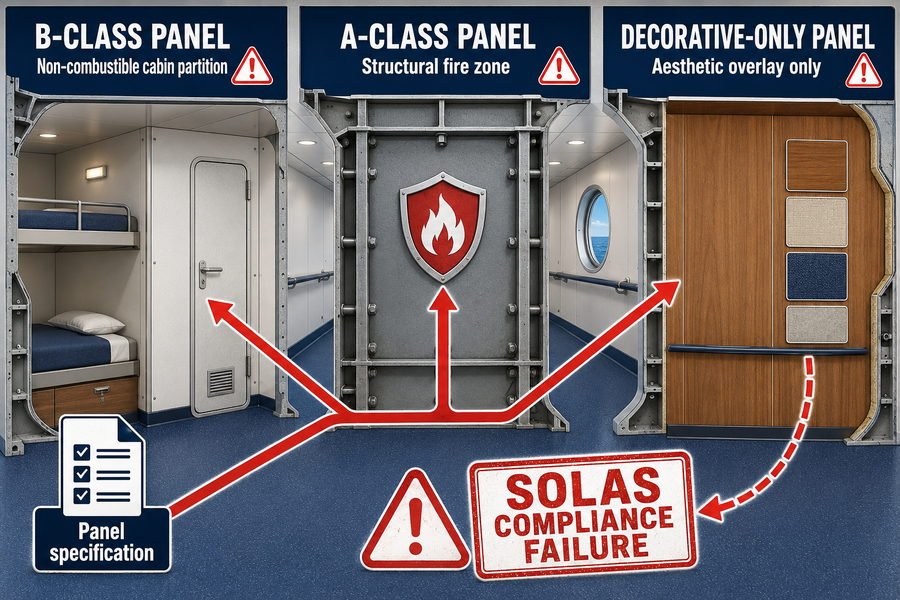
Let us look at the details so you never make these costly mistakes in your ship interior projects.
How to Identify From a Datasheet If a Marine Accommodation Panel Is Decorative-Only or Fire-Rated?
Datasheets can confuse buyers. A wrong reading means you buy useless panels. Here is how to quickly spot if a panel stops fire or just looks good.
You can identify a panel's fire rating by checking three datasheet elements: the specific IMO FTP Code testing standard, the core material density (typically 120-150 kg/m³ for B-15), and the presence of a recognized Classification Society Type Approval Certificate, rather than just basic ISO quality marks.
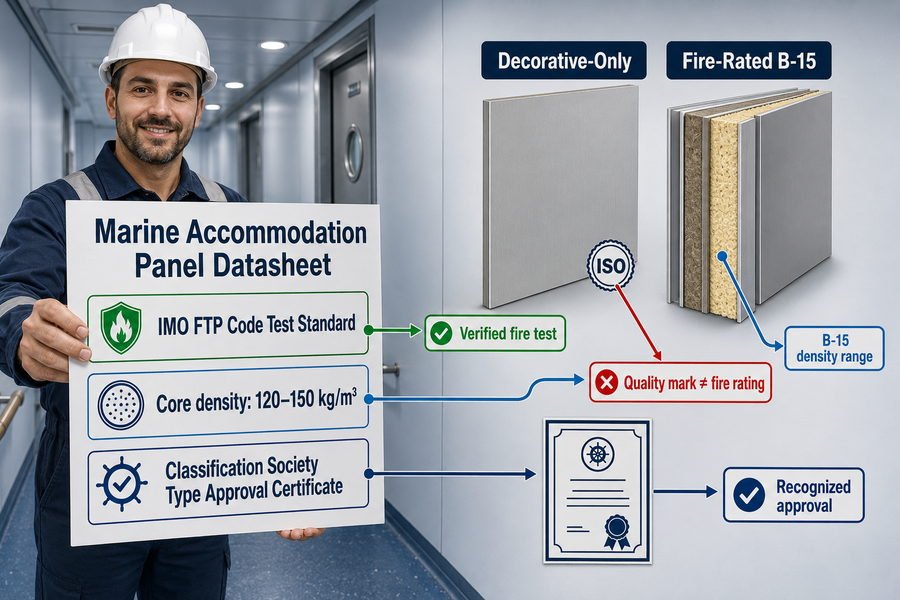
I always tell my clients to look closely at the datasheet. You cannot trust a sales pitch. You must find the three elements I mentioned above. Let us break them down.
Identifying the IMO FTP Code Testing Standard on Datasheets
The first element is the testing standard. A decorative panel might just show basic ISO 9001. This is just a factory quality mark. It does not mean the panel stops fire. A true fire-rated marine accommodation panel must list the IMO FTP (Fire Test Procedures) Code. For example, it should say it passes IMO Resolution MSC.307(88)1. If you do not see IMO FTP Code Part 3 on the sheet, the panel is only for decoration. It has no functional fire role. I once saw a buyer purchase 500 panels. They only had CE marks for indoor furniture. The shipyard rejected all of them.
Verifying Core Material Density for Marine Fire Ratings
The second element is the core material. The density of the inside material tells you its true role. A standard decorative panel often uses light honeycomb aluminum or cheap foam. But a functional B-15 fire-rated panel uses rock wool. The datasheet must show a rock wool density of 120 kg/m³ to 150 kg/m³2. If the density is lower, like 80 kg/m³, it cannot hold back a fire for 15 minutes. It is that simple. I always check this number first.
Checking for Valid Classification Society Type Approval Certificates
The third element is the certificate. A factory test report is not enough. You need a Type Approval Certificate. This must come from a major classification society. Good examples are DNV, ABS, or Lloyd's Register. The datasheet should have a clear certificate number. You can type this number into the DNV or ABS website to check if it is real.
| Metric | Decorative Panel Datasheet | Fire-Rated Panel Datasheet |
|---|---|---|
| Testing Standard | ISO 9001, CE Furniture | IMO FTP Code Part 3 |
| Core Material | Aluminum honeycomb, EPS | Mineral Rock Wool |
| Core Density | Under 80 kg/m³ | 120 kg/m³ to 150 kg/m³ |
| Certificate Type | Factory lab report | DNV/ABS Type Approval |
What Spec Red Flags Show a Decorative Marine Accommodation Panel Misused as Functional?
Using cheap panels for safety walls is dangerous. Inspectors will catch this quickly. Watch out for these obvious warning signs in your specifications.
Four major red flags indicate a decorative panel is misused as functional: a lack of structural load data, missing acoustic reduction values (Rw), the use of combustible foam cores instead of mineral wool, and surface spread of flame ratings that do not meet SOLAS Chapter II-2 requirements.
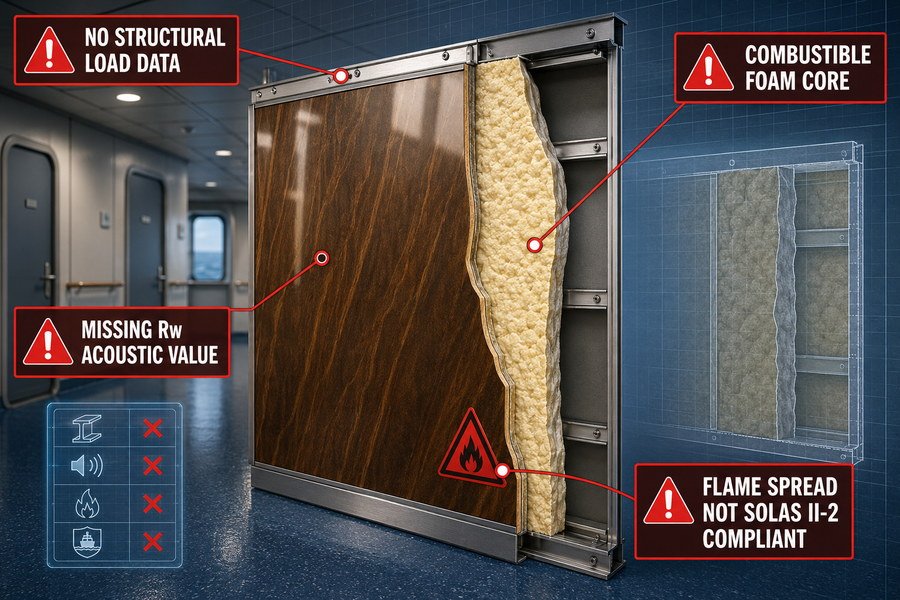
You must spot bad specifications before you pay the deposit. Suppliers sometimes try to sell cheap decorative panels as functional walls. If you see the four red flags from my summary, stop the deal immediately.
Red Flag 1 and 2: Missing Structural Load Data and Acoustic Values
Functional marine accommodation panels do more than look good. They hold up ceilings and stop noise. The first red flag is missing structural load data. A functional wall panel must show its maximum load capacity. It should hold at least 150 kg per square meter of force.3 If the spec sheet does not show load limits, it is just a thin decorative skin. The second red flag is missing acoustic reduction values. In ship cabins, noise control is a basic human need. The spec must show the Rw (Sound Reduction Index) value. According to standard marine practice, a functional cabin panel should offer an Rw of 30 dB to 35 dB4. If this number is missing, the panel is hollow. It will not give passengers any privacy.
Red Flag 3 and 4: Combustible Cores and Failing SOLAS Flame Spread Rules
The third red flag is the core material. Functional panels use non-combustible mineral wool. If the specification lists Polyurethane (PU) foam or Expanded Polystyrene (EPS), run away. These are highly combustible.5 They are strictly decorative or for cold rooms, not for passenger cabins. The fourth red flag is the flame spread rating. The surface of the panel must meet SOLAS Chapter II-2 rules for low flame spread. This means the surface will not help a fire grow. If the spec does not explicitly mention "low flame spread" according to IMO FTP Code Part 5, it is a huge risk.
| Specification Item | Safe Functional Panel | Dangerous Red Flag |
|---|---|---|
| Structural Load | Holds > 150 kg/m² | No data provided |
| Acoustic Rating (Rw) | 30 dB to 35 dB | Missing or N/A |
| Core Material | Non-combustible mineral wool | PU Foam or EPS |
| Flame Spread | Meets IMO FTP Code Part 5 | General interior grade |
Which Marine Accommodation Panel Role Errors Are Most Common in Refit Projects?
Refit projects move fast. Rushed buying leads to the same repeat mistakes. I see these specific errors happen in almost every shipyard.
The three most common role errors in refits are: installing B-0 panels where B-15 is required, using heavy A-class panels for simple wet room partitions, and applying non-marine standard decorative laminates that produce toxic smoke when exposed to high temperatures.
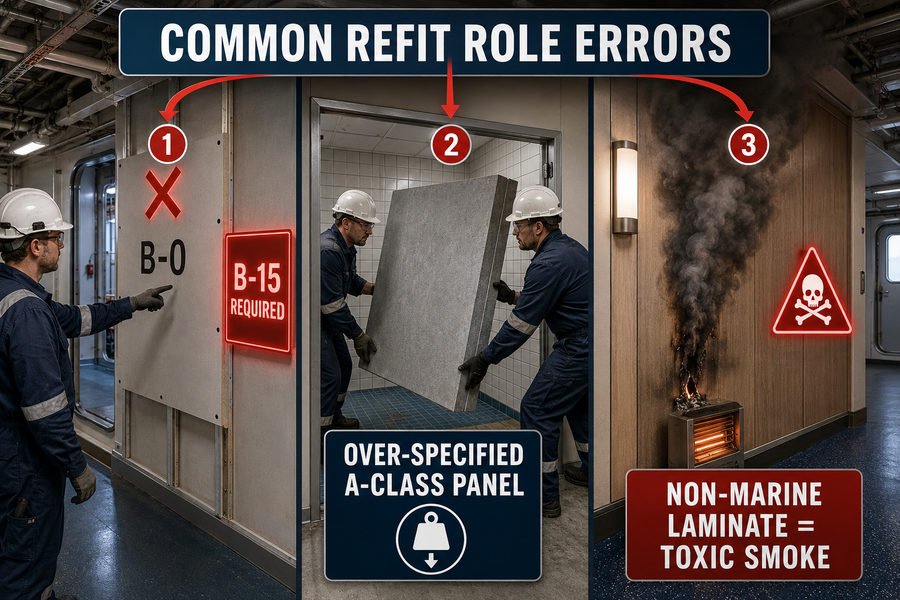
Refit projects are fast. Buyers are in a rush. This rush causes people to buy the wrong panels. I see three big errors happen all the time. Let us look at each one.
Error 1: Confusing B-0 and B-15 Marine Accommodation Panel Requirements
The first error is mixing up B-class ratings. People think all B-class panels are the same. They are not. A B-0 panel stops flames for 15 minutes, but it does not stop heat. A B-15 panel stops flames and keeps the unexposed side cool for 15 minutes. Buyers often buy B-0 panels because they are cheaper. But SOLAS rules clearly state that cabin walls next to corridors must be B-156. If you install B-0 panels there, the surveyor will make you tear them down. You must know the exact boundary rules on the ship plan.
Error 2 and 3: Over-Specifying Wet Rooms and Toxic Decorative Laminates
The second error is using A-class panels in simple wet rooms. A-class panels are very heavy. They have a thick steel core. You need them for engine room walls. You do not need them for a basic toilet room inside a cabin. Using A-class here wastes money and adds too much weight to the ship. A simple C-class or B-0 panel is enough. The third error is about the surface. Buyers choose a beautiful decorative laminate. But they forget to check if it is marine-grade. Normal house laminates make toxic smoke when they get hot. IMO rules say the toxic smoke must be below specific limits, like carbon monoxide under 1450 ppm during testing7. If you use normal laminates, the ship will fail safety checks.
| Project Error | Panel Used | Correct Panel Required | Direct Consequence |
|---|---|---|---|
| Wrong Cabin Wall | B-0 (flame only) | B-15 (flame and heat) | Rejected by marine surveyor |
| Over-Spec Wet Room | A-60 (heavy steel) | C-class or B-0 | Wasted money, excess weight |
| Toxic Surfaces | House grade laminate | IMO approved laminate | Fails smoke toxicity test |
Why Do Generic "Marine Accommodation Panel" Quotes Cause Onboard Compliance Failures?
Vague quotes hide missing details. Buying based on a generic name is a huge trap. It always leads to panels failing final inspections.
Generic quotes cause compliance failures because they omit three critical compliance factors: exact fire class designation (A, B, or C), required panel thickness (typically 25mm or 50mm), and the specific MED (Marine Equipment Directive) wheelmark certification necessary for European shipyard acceptance.
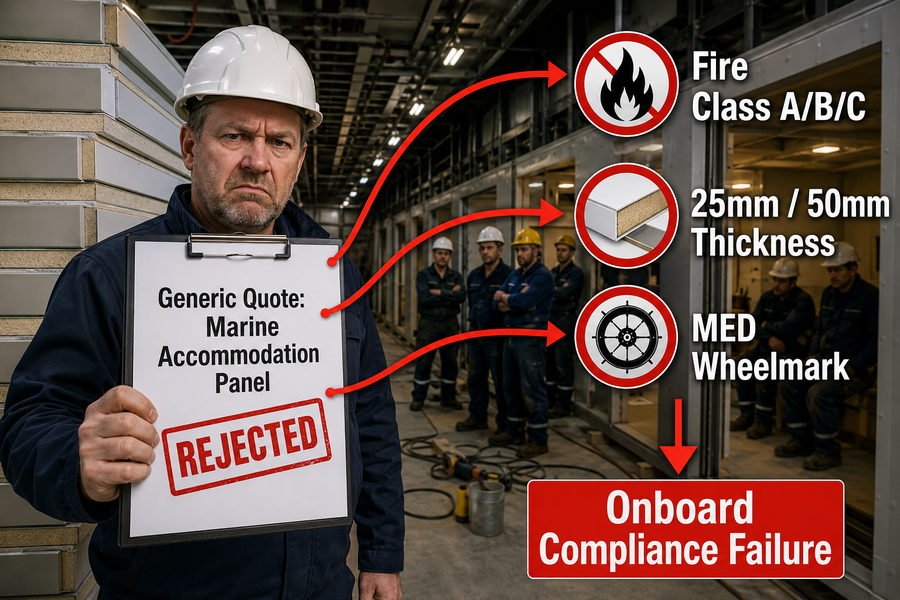
I always warn my clients about simple quotes. A quote that just says "Marine Accommodation Panel - 1000 square meters" is a trap. It misses three vital things. Let me explain why this causes compliance failures.
Factor 1: The Danger of Omitting Exact Fire Class Designations
The first missing factor is the exact fire class. Ships have different zones. Each zone has a strict rule. You must know if the panel is A-class, B-class, or C-class8. If the quote does not say "B-15" or "A-60", you do not know what you are buying. When the panels arrive, the port inspector will ask for the B-15 certificate. If your panels are only C-class, you cannot use them. Your generic quote just wasted thousands of dollars.
Factor 2 and 3: Missing Thickness Specs and MED Wheelmark Certifications
The second missing factor is thickness. A standard B-15 panel is usually 50mm thick. Some lightweight versions are 25mm thick. If the quote does not list the thickness, the panel might not fit the bottom tracks on the ship floor. If you buy 50mm tracks but receive 25mm panels, you cannot build the wall. The third missing factor is the MED Wheelmark. If your ship operates in Europe, the panels must have this mark. It proves the panel meets European safety rules. A generic quote usually comes from a factory that does not have this expensive certificate. If you install non-Wheelmark panels on a European ship, the authorities will not let the ship leave the port.
| Missing Detail in Quote | What You Might Receive | Why It Fails Compliance |
|---|---|---|
| Fire Class (A/B/C) | C-class decorative panel | Cannot be used in fire zones |
| Panel Thickness | 25mm panel | Does not fit 50mm floor tracks |
| MED Wheelmark | Local factory standard | Rejected by European ports |
How Do Marine Accommodation Panel Role Mismatches Delay Project Handover?
Shipyards penalize late deliveries. A wrong panel stops all other cabin work. Let me explain how one mistake delays the whole ship.
Panel role mismatches delay handovers through three compounding bottlenecks: mandatory rework ordered by Port State Control, a four-to-six week lead time to manufacture replacement certified panels, and the subsequent delay of dependent trades like electrical wiring and ceiling installation.
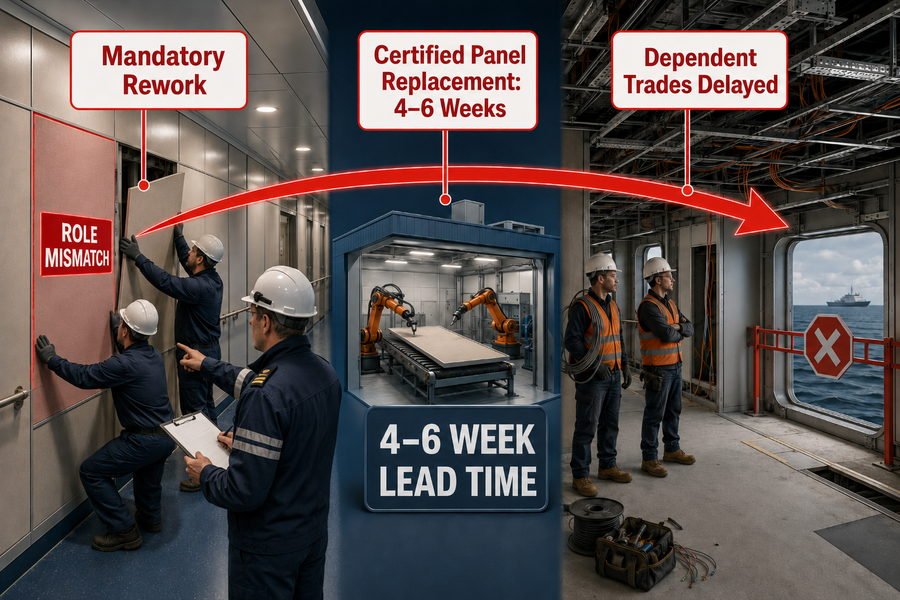
Time is money in the shipyard. A mismatch in panel roles does not just cause a small problem. It causes a chain reaction of delays. I have seen this happen, and it always involves three main bottlenecks.
Bottleneck 1: Mandatory Rework Ordered by Port State Control Inspectors
The first bottleneck happens when the inspector visits. Port State Control (PSC) takes fire safety very seriously. If they see a decorative C-class panel where a B-15 fire partition should be, they issue a defect notice9. They will order a mandatory rework. This means your workers must stop what they are doing. They must tear down the wrong walls. This rework alone wastes several days of labor. You pay your workers for building the wall twice, and taking it down once.
Bottleneck 2 and 3: Six-Week Replacement Lead Times and Paused Cabin Trades
The second bottleneck is the lead time. You cannot just go to a local hardware store to buy marine-certified B-15 panels. You must order them from a qualified marine factory. According to average factory schedules in China or Vietnam, manufacturing new panels takes about four to six weeks. Shipping by sea adds another four weeks10. Your project is now stopped for over two months. The third bottleneck is the impact on other trades. You cannot install the ceiling until the wall panels are up. You cannot pull the electrical wires. You cannot install the beds or desks. The whole cabin outfitting team just sits and waits.
| Delay Source | Time Wasted | Business Impact |
|---|---|---|
| Mandatory Rework | 3 to 7 days | Extra labor costs |
| Replacement Lead Time | 4 to 6 weeks | Shipyard penalties for late delivery |
| Paused Trades | Complete stop | Electrical and ceiling teams idle |
What Questions Expose a Supplier's Grasp of Decorative vs Functional Marine Accommodation Panels?
Bad suppliers will say yes to anything. You must test their real knowledge. Ask these questions to find out if they truly understand marine outfitting.
To expose a supplier's knowledge, ask two targeted questions: "What is the continuous temperature limit of the panel's adhesive?" (should be over 80°C) and "Can you provide the sound reduction index for this specific B-15 configuration?" (should be at least 30 dB to 35 dB).
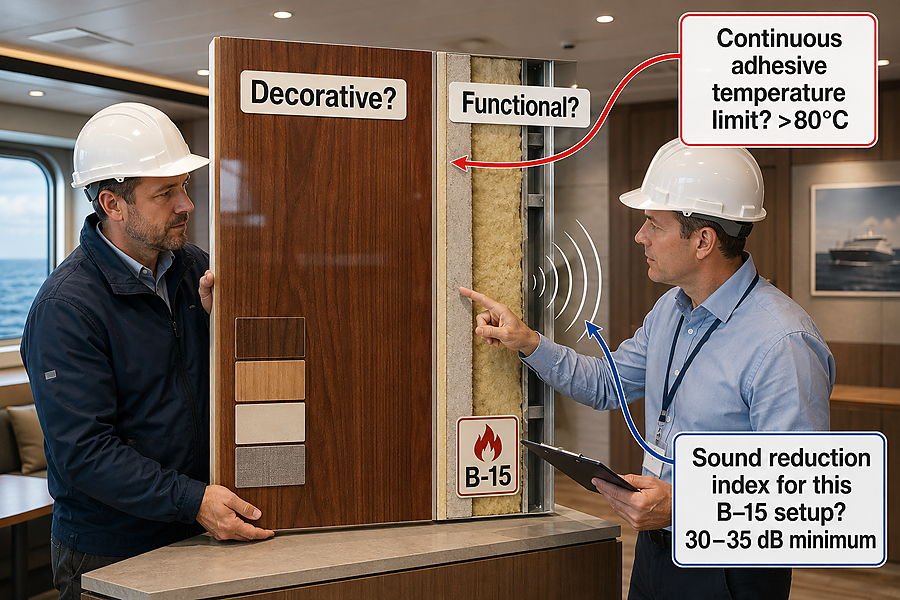
You must interview your supplier before you buy. Many salespeople speak good English but do not know technical details. I use two specific questions to test them. These questions reveal if they understand functional marine panels.
Question 1: Testing Knowledge on Panel Adhesive Temperature Limits
First, I ask: "What is the continuous temperature limit of the panel's adhesive?" Marine panels have a steel skin glued to a rock wool core. When the ship travels to hot places, the steel gets very hot11. If the glue is cheap, the steel skin will bubble and fall off. A good supplier will immediately answer that they use special two-component polyurethane adhesives. They will state the temperature limit is over 80°C. If the supplier looks confused or says "it is just normal glue," they only know how to make cheap decorative panels for houses. Do not buy from them.
Question 2: Verifying Expertise on Sound Reduction Index (Rw) Values
Second, I ask: "Can you provide the sound reduction index12 for this specific B-15 configuration?" This tests their engineering knowledge. A B-15 panel is functional. It must stop noise between cabins. The supplier should confidently reply with a specific number. They should say, "Yes, our standard 50mm B-15 panel has an Rw of 32 dB." They should also offer to send the lab test report. If the supplier says "it is very quiet" but cannot give you a number between 30 dB and 35 dB, they do not test their products properly. They are guessing. You cannot build a safe, comfortable ship based on guesses.
| Your Question | Good Supplier Answer | Bad Supplier Answer |
|---|---|---|
| Adhesive Temp Limit? | "Over 80°C using two-part PU glue." | "It is strong normal glue." |
| Sound Reduction (Rw)? | "32 dB for our 50mm B-15 panel." | "It is very quiet." |
Conclusion
Stop guessing with panel specs. Always verify fire ratings, ask suppliers tough questions, and check datasheets carefully. This keeps your ships safe, compliant, and on schedule.
-
"[PDF] RESOLUTION MSC.307(88) (adopted on 3 December 2010 ...", https://wwwcdn.imo.org/localresources/en/KnowledgeCentre/IndexofIMOResolutions/MSCResolutions/MSC.307(88).pdf. IMO Resolution MSC.307(88) adopted the 2010 Fire Test Procedures Code, which sets internationally recognized fire-test procedures for materials and constructions used on ships. Evidence role: definition; source type: institution. Supports: A true fire-rated marine accommodation panel should reference the IMO FTP Code, such as IMO Resolution MSC.307(88), rather than relying only on general marks.. Scope note: The resolution establishes the relevant test-code framework; it does not by itself verify that any individual panel has passed the test. ↩
-
"How to choose the right marine wall panels for marine interior ...", https://magellanmarinetech.com/how-choose-right-marine-wall-panels-for-marine-interior-projects/. Research on mineral-wool and sandwich-panel fire performance shows that core material properties, including density and thickness, affect thermal insulation and fire-resistance behavior, providing contextual support for checking rock-wool density on fire-rated panel datasheets. Evidence role: mechanism; source type: paper. Supports: The density of the rock-wool core is relevant to whether a marine fire-rated panel can achieve the claimed fire-resistance performance.. Scope note: This is contextual support for density as a performance factor; it does not establish that 120–150 kg/m³ is a universal IMO requirement or that 80 kg/m³ always fails B-15 testing. ↩
-
"[PDF] resolution msc.143(77) - International Maritime Organization", https://wwwcdn.imo.org/localresources/en/KnowledgeCentre/IndexofIMOResolutions/MSCResolutions/MSC.143(77).pdf. A marine classification-society rule, shipyard specification, or approved accommodation-panel test report can substantiate whether functional accommodation panels are required or commonly tested for stated load capacity, including any 150 kg/m² criterion. Evidence role: statistic; source type: institution. Supports: A functional marine wall panel should disclose maximum load capacity and hold at least 150 kg per square meter.. Scope note: The 150 kg/m² threshold may be product-, vessel-, or class-specific unless the cited source states it as a general requirement. ↩
-
"What Defines A Genuine Marine Accommodation Panel?", https://magellanmarinetech.com/what-defines-genuine-marine-accommodation-panel/. An acoustics standard, ship-accommodation guideline, or peer-reviewed marine-noise source can support the use of weighted sound reduction index Rw for partitions and provide context for cabin privacy ranges around 30–35 dB. Evidence role: statistic; source type: paper. Supports: Functional ship cabin panels should state an Rw value and commonly provide about 30 dB to 35 dB sound reduction.. Scope note: A general acoustics source may define Rw but may not prove that 30–35 dB is mandatory for all ship cabins. ↩
-
"What Is the IMO FTP Code for Marine Interior Materials?", https://magellanmarinetech.com/what-imo-ftp-code-for-marine-interior-materials/. Fire-safety research and material-classification sources document that polyurethane foam and expanded polystyrene are combustible polymeric insulation materials and can contribute to fire growth and smoke production under fire exposure. Evidence role: mechanism; source type: research. Supports: PU foam and EPS cores are combustible materials and pose a fire-safety concern in marine accommodation panels.. Scope note: Combustibility depends on formulation, density, facings, and fire-retardant treatment, so the source may support the general hazard rather than every specific PU or EPS product. ↩
-
"[PDF] RESOLUTION A.327(IX) adopted on 12 November 1975 ...", https://wwwcdn.imo.org/localresources/en/KnowledgeCentre/IndexofIMOResolutions/AssemblyDocuments/A.327(9).pdf. SOLAS Chapter II-2, Regulation 9 sets minimum fire-integrity requirements for bulkheads and decks by adjacent space category, including accommodation and corridor boundaries, and uses B-class ratings such as B-0 and B-15 for these divisions. Evidence role: case_reference; source type: institution. Supports: SOLAS rules specify required fire ratings for accommodation boundaries such as cabin walls next to corridors.. Scope note: The exact required rating depends on vessel type, service, and the applicable SOLAS table, so the source may support the need to verify the boundary rather than prove that every cabin-corridor wall is always B-15. ↩
-
"What Smoke Toxicity and Density Limits Must Marine Wall and ...", https://magellanmarinetech.com/what-smoke-toxicity-density-limits-must-marine-wall-ceiling-panels-meet/. The IMO FTP Code smoke and toxicity test provisions specify maximum gas-concentration limits for fire-test effluents, including a carbon monoxide limit of 1450 ppm, for materials used in relevant shipboard applications. Evidence role: statistic; source type: institution. Supports: IMO fire-test rules include a carbon monoxide toxicity limit of 1450 ppm during testing.. Scope note: This supports the cited test threshold, but whether a particular decorative laminate must meet it depends on its installation location and the applicable approval regime. ↩
-
"[PDF] recommendation for fire test procedures for “a” and “b” class ...", https://wwwcdn.imo.org/localresources/en/KnowledgeCentre/IndexofIMOResolutions/AssemblyDocuments/A.163(ES.IV).pdf. The IMO Fire Test Procedures Code and SOLAS fire-protection framework define A-, B-, and C-class divisions and associate them with specific fire-resistance and construction criteria used in shipboard accommodation and service spaces. Evidence role: definition; source type: institution. Supports: Marine accommodation panels must be specified by exact fire class, such as A-, B-, or C-class designations, because those classes correspond to regulatory fire-protection requirements.. Scope note: This supports the regulatory meaning of the classifications, but it does not verify whether any specific quoted panel is certified to a given class. ↩
-
"[PDF] PROCEDURES FOR PORT STATE CONTROL, 2023", https://wwwcdn.imo.org/localresources/en/OurWork/IIIS/Documents/A%2033-Res.1185%20-%20PROCEDURES%20FOR%20PORT%20STATE%20CONTROL,%202023%20(Secretariat)%20(1).pdf. Port State Control guidance and regional PSC procedures describe inspectors recording deficiencies and requiring corrective action when a ship does not comply with applicable safety conventions, including SOLAS fire-safety requirements. Evidence role: general_support; source type: institution. Supports: A Port State Control inspector can issue a deficiency/defect notice when a required B-15 fire partition is replaced by a non-compliant decorative C-class panel.. Scope note: The source would support the regulatory mechanism, but the exact enforcement outcome depends on the vessel, flag state, inspection regime, and severity of the deficiency. ↩
-
"How to choose the right marine wall panels for marine interior ...", https://magellanmarinetech.com/how-choose-right-marine-wall-panels-for-marine-interior-projects/. Research or institutional sources on shipbuilding supply chains and maritime transport can support the contextual point that specialized marine outfitting components are often long-lead procurement items and that intercontinental sea freight is measured in weeks. Evidence role: general_support; source type: research. Supports: Replacement marine-certified panels can create multi-week delays because production and ocean shipping both add substantial lead time.. Scope note: Such sources may not directly verify the stated four-to-six-week factory schedule for every B-15 panel supplier in China or Vietnam; manufacturer-specific production times can vary. ↩
-
"Temperature Profiles of Sunlight-Exposed Surfaces in a Desert ...", https://pmc.ncbi.nlm.nih.gov/articles/PMC10211493/. Studies of sun-exposed metal surfaces show that surface temperatures can substantially exceed ambient air temperature under high solar radiation, supporting the relevance of adhesive heat resistance in exterior or semi-exposed panel assemblies. Evidence role: general_support; source type: paper. Supports: When ships operate in hot climates, steel panel skins can reach high temperatures, making adhesive temperature limits relevant.. Scope note: Such sources may document metal-surface heating generally rather than temperatures measured on this exact marine panel construction. ↩
-
"Analysis between weighted sound reduction index according to ISO ...", https://www.academia.edu/21437199/Analysis_between_weighted_sound_reduction_index_according_to_ISO_717_1_and_indices_according_to_ISO_16717_1. ISO 717-1 defines the weighted sound reduction index, Rw, as a single-number rating derived from laboratory sound-insulation measurements, supporting the use of a specific dB value rather than a qualitative description. Evidence role: definition; source type: institution. Supports: A supplier should be able to provide a specific Rw value for a tested panel configuration because Rw is a standardized acoustic performance metric.. Scope note: This supports the meaning and standardized use of Rw, but it does not verify the stated Rw value of any particular B-15 panel product. ↩