Picking the wrong panel core causes failed ship inspections. You lose time and a lot of money. Here is how to choose the correct core for your ship project.
Marine accommodation panel core options include rock wool for high fire safety, aluminum honeycomb for lightweight strength, calcium silicate for hard wet areas, and polyurethane for cold rooms. These four distinct cores cover all shipbuilding needs from A-60 fire ratings to weight reduction and thermal insulation.
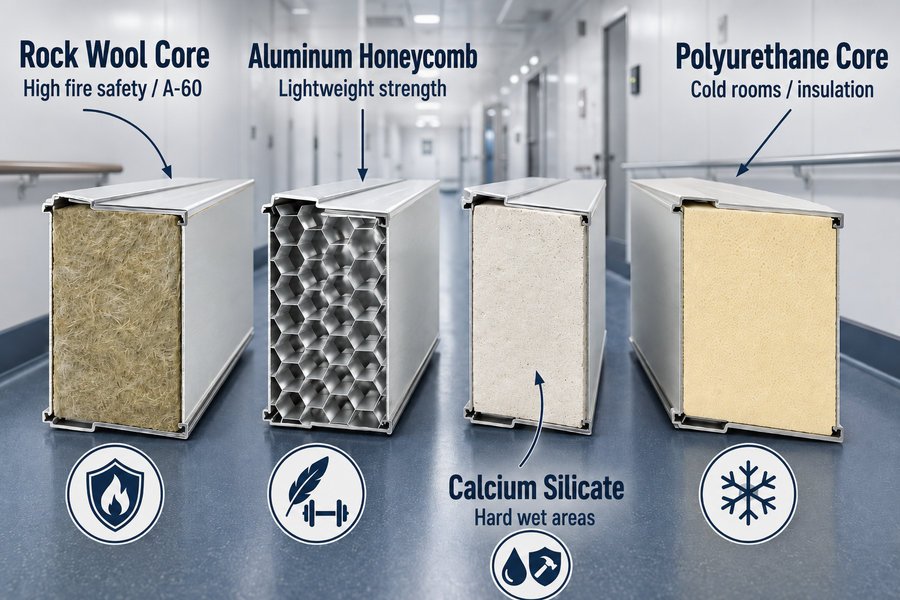
If you want to keep shipyard owners happy and pass every marine inspection, you need to know exactly what goes inside your panels. Every core does a different job. Let me break down the technical details for you.
Which Core Materials Meet SOLAS Approval for Marine Accommodation Panels?
Failing a SOLAS safety inspection stops your whole project. This creates huge delays at the shipyard. Using approved core materials fixes this problem fast.
SOLAS approves three main non-combustible core materials for marine panels: rock wool, aluminum honeycomb, and calcium silicate. Rock wool handles standard A-class and B-class fire zones, aluminum honeycomb fits fast ferries requiring weight savings, and calcium silicate works best in damp spaces.
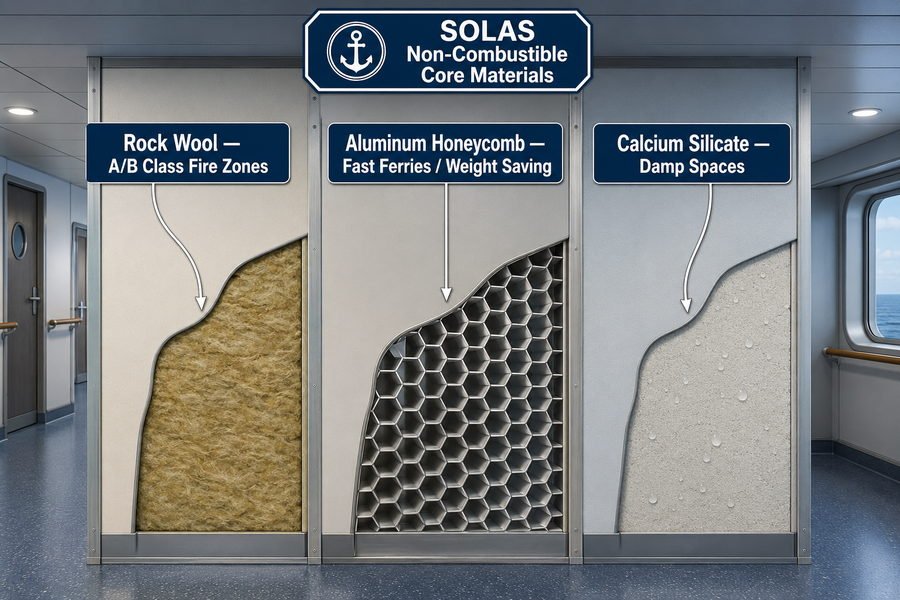
I learned about SOLAS rules the hard way. Back in my early factory days, a client used an unapproved plastic core. The marine inspector rejected the whole deck. SOLAS stands for Safety of Life at Sea. They have strict rules. They demand non-combustible materials for most ship areas.1 We must follow IMO rules to get the steering wheel mark2 on our products. Let us look at the three approved cores from the snippet.
SOLAS Approval for Rock Wool Cores
Rock wool is the most common SOLAS-approved core in the world. Factories make it from melted rocks. They spin the liquid rock into fibers. SOLAS likes it because it does not burn3. It easily passes the basic non-combustibility test. We use it a lot for B-class and A-class bulkheads. The price is low. It usually costs about $12 to $18 per square meter. It is easy to buy in Asia. Factory workers cut it easily with standard saws. When you open a panel, the rock wool sits tight inside. It absorbs sound very well too. This makes cabins quiet.
SOLAS Approval for Aluminum Honeycomb and Calcium Silicate Cores
Next is the aluminum honeycomb core. SOLAS approves this for specific light ships. High-speed crafts use it often. Factories make it from thin aluminum foils. The foils form a hexagon shape like a bee nest. It is very light. But it is expensive. It costs around $35 to $50 per square meter. SOLAS accepts it under the High-Speed Craft Code.4 The third approved core is calcium silicate. This is a very hard board. Factories mix quartz sand and lime. SOLAS approves it for wet areas like bathrooms and kitchens. It does not rot in water. It is heavy but very safe. We see this in heavy A-class decks.
| Core Material Type | SOLAS Approval Status | Best Application Area | Average Cost per SQM |
|---|---|---|---|
| Rock Wool | Fully Approved (Non-combustible) | Standard Cabins, Corridors | $12 - $18 |
| Aluminum Honeycomb | Approved (HSC Code) | Fast Ferries, Yachts | $35 - $50 |
| Calcium Silicate | Fully Approved (Non-combustible) | Bathrooms, Wet Areas | $20 - $30 |
Aluminum Honeycomb vs Rock Wool Core in Marine Accommodation Panels: What's the Difference?
Heavy wall panels make ships burn more engine fuel. But weak panels fail fire tests. You must balance the panel weight and safety rules.
The main differences between aluminum honeycomb and rock wool cores are weight, fire rating, and price. Aluminum honeycomb weighs 80% less and costs $40 per square meter but lacks high fire resistance. Rock wool provides A-60 fire ratings, costs $15 per square meter, but adds heavy weight.
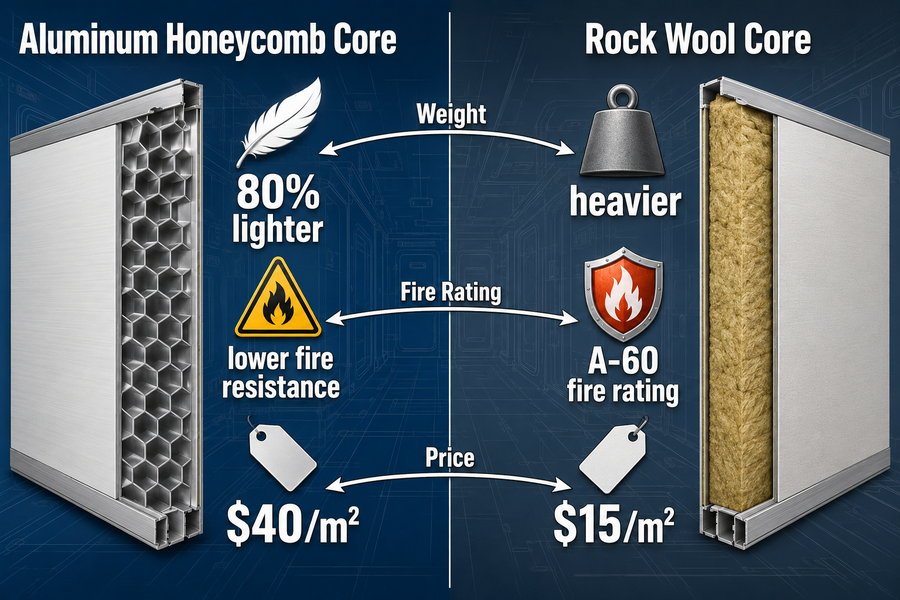
When my clients ask me to quote panels, they always ask this question. Should I buy honeycomb or rock wool? I tell them to look at the ship design. You cannot use the same panel for every ship. We must look at the three big differences from the snippet. These are weight, fire rating, and price.
Weight Differences Between Honeycomb and Rock Wool Cores
Let us talk about weight first. Ships need to be light to save fuel. Aluminum honeycomb is very light. A standard 50mm thick honeycomb panel weighs about 6 to 8 kg per square meter5. This is because the inside is mostly air. Rock wool is very heavy. A standard 50mm thick rock wool panel weighs about 16 to 20 kg per square meter. I want to give you an example. A small cabin has 20 square meters of wall. With rock wool, the walls weigh 400 kg. With honeycomb, the walls weigh only 160 kg. You save 240 kg in one room. Fast ferries always choose honeycomb for this reason.
Fire Rating and Price Differences for Panel Cores
Fire rating is the next big difference. Rock wool is the king of fire safety. It handles high heat easily. You can build an A-60 bulkhead6 with rock wool. It stops fire for 60 minutes. Aluminum honeycomb melts fast. It usually only gets a C-class rating. You cannot use it in high-risk zones. The last difference is price. Price is very important for procurement work. Rock wool is cheap to buy. It costs about $15 to $20 per square meter in China. Aluminum honeycomb is hard to make. It costs $35 to $45 per square meter. You pay more money to save weight.
| Specification | Aluminum Honeycomb Core | Rock Wool Core |
|---|---|---|
| Weight (50mm panel) | 6 - 8 kg/m2 | 16 - 20 kg/m2 |
| Fire Rating Limit | C-Class (Usually) | A-60 Class |
| Average Price | $35 - $45 / m2 | $15 - $20 / m2 |
| Installation Effort | Easy for one worker | Needs two workers |
Which Cores Achieve A-60 Fire Rating in Marine Accommodation Panels?
Failing an A-60 fire test is a big disaster. It ruins your ship budget. Using the correct high-heat cores guarantees you pass the test.
Only two core setups reliably achieve an A-60 fire rating: high-density rock wool (120-150 kg/m3) and composite ceramic fiber boards. Rock wool is the standard choice for bulkheads, while ceramic fiber is used for specialized high-heat areas like engine room boundaries.
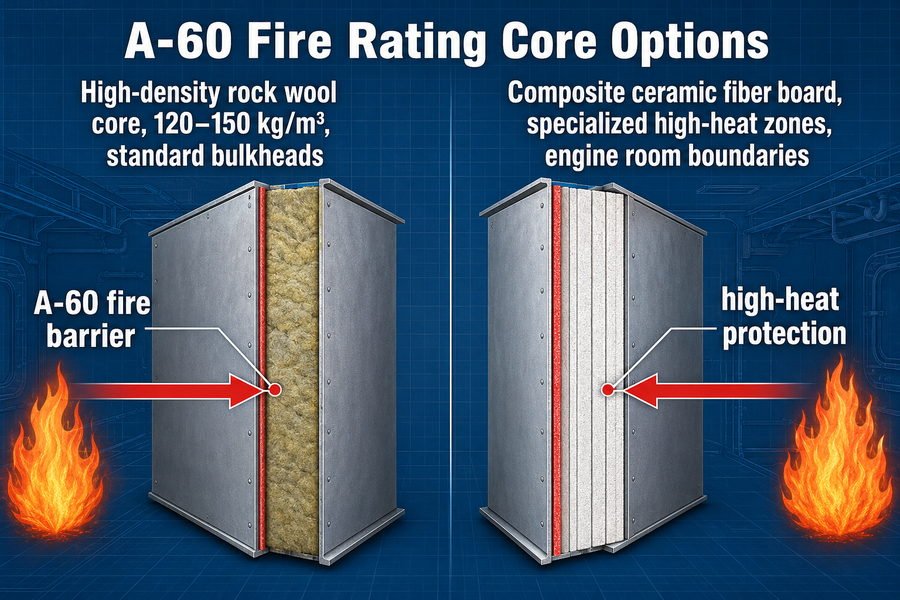
A-60 is the hardest fire rating to get for normal cabins. The panel must block fire and heat for 60 full minutes. The test furnace reaches 945 degrees Celsius. The cold side of the panel cannot get hotter than 180 degrees Celsius.7 I helped a European client pass this test last year. We had to choose the right cores. As I said in the snippet, you only have two real choices. You can use high-density rock wool or ceramic fiber boards.
High-Density Rock Wool for A-60 Fire Ratings
High-density rock wool is the most popular choice. But you cannot use normal cheap rock wool. Normal rock wool has a density of 80 kg/m3. That will fail the A-60 test quickly. The heat will pass through it. For A-60, you need a density of 120 kg/m3 to 150 kg/m3. The panel thickness must be at least 50mm. Some factories use 100mm thick panels for extra safety. The steel skin outside must be at least 0.6mm thick. This is the cheapest way to get an A-60 mark. The raw core costs about $8 to $12 per square meter. The final panel costs about $25 per square meter.
Ceramic Fiber Boards for Specialized A-60 Panels
Sometimes rock wool is too thick. If you need a thin panel for an engine room wall, you use composite ceramic fiber boards. Factories make these from aluminum silicate. Ceramic fiber handles heat much better than rock wool. It can stop a 1000-degree fire easily. It is very dense and hard. But it is very expensive. A ceramic fiber panel can cost $80 to $100 per square meter. It is also bad for human skin during cutting.8 Workers must wear heavy suits. I only tell my clients to use this when space is very tight on the ship.
| Core Material | Required Density | Thickness for A-60 | Estimated Cost |
|---|---|---|---|
| High-Density Rock Wool | 120 - 150 kg/m3 | 50mm - 100mm | $25 / m2 |
| Ceramic Fiber Board | 300+ kg/m3 | 25mm - 50mm | $80 - $100 / m2 |
What Are Typical Core Density Ranges for Marine Accommodation Panels?
Wrong core density causes weak walls and heavy cabins. You lose money on ocean shipping. Knowing the exact density values solves this problem fast.
Typical core density ranges for marine panels include: standard rock wool at 100-120 kg/m3 for normal bulkheads, lightweight aluminum honeycomb at 25-35 kg/m3 for fast ferries, and high-density calcium silicate at 200-250 kg/m3 for rigid wet area partitions.
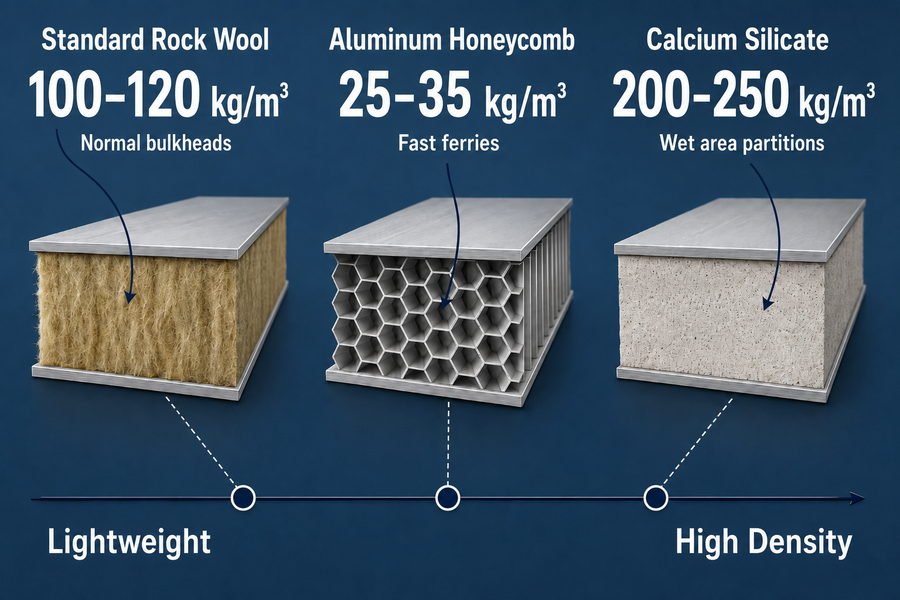
Density is a key number in ship outfitting. It tells you how heavy and how strong the panel is. If you buy from factories in Asia, you must check the density on the paper data sheet. Some bad suppliers use low density to save money. This makes the panel weak. I always weigh the panels when I visit factories. We cut a 10cm by 10cm block. We weigh it on a scale. Then we check the volume. Let us look at the three density ranges I listed in the snippet.
Density Ranges for Rock Wool and Calcium Silicate Cores
Rock wool density changes based on the ship fire class. For standard B-15 class cabin walls, the factory uses a density of 100 kg/m3. If you need A-30 or A-60, the density goes up to 120 kg/m3 or 150 kg/m3.9 If the density is too low, the panel feels soft when you push it. Calcium silicate has a very high density. It ranges from 200 kg/m3 to 250 kg/m3. Some boards even reach 800 kg/m3. This makes the board very hard and heavy. We use it in public toilets. It does not bend when people lean on it.
Density Ranges for Aluminum Honeycomb Cores
Aluminum honeycomb is different. We do not measure solid mass. We measure the weight of the thin aluminum foil and the air space inside the hex shapes. The typical density for a marine honeycomb core is 25 kg/m3 to 35 kg/m3. The foil thickness is usually 0.04mm to 0.06mm. The cell size is about 6mm to 10mm.10 This low density makes the panel very light. But it still has good push strength. A 30 kg/m3 honeycomb panel can handle normal cabin use easily without breaking.
| Core Material | Typical Density Range | Best Use Case |
|---|---|---|
| Standard Rock Wool | 100 - 150 kg/m3 | B-15 and A-60 Walls |
| Aluminum Honeycomb | 25 - 35 kg/m3 | Lightweight Ceilings |
| Calcium Silicate | 200 - 250 kg/m3 | Wet Area Partitions |
Which Cores Pass IMO FTP Code Part 1 for Marine Accommodation Panels?
Using combustible cores leads to rejected ships at the dock. This wastes months of hard work. You must use materials that pass the fire rules.
Three core materials pass the IMO FTP Code Part 1 non-combustibility test: mineral wool (including rock wool and glass wool), pure aluminum honeycomb, and calcium silicate boards. These materials do not flame or release extreme heat when placed in a 750-degree Celsius test furnace.
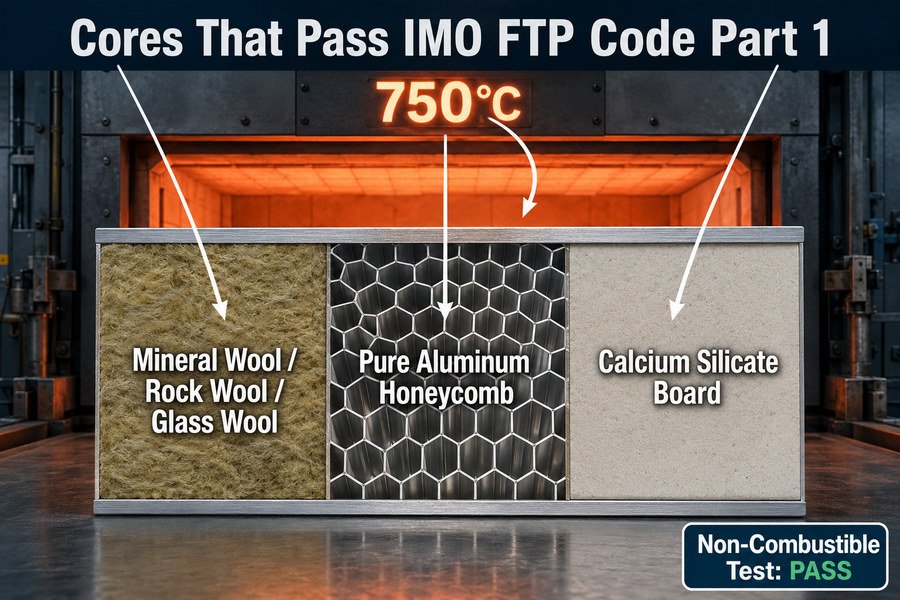
The IMO FTP Code Part 1 is the most important rule book for marine interiors. FTP stands for Fire Test Procedures. Part 1 tests if a material will burn. I read this code book many times at my desk. The test is simple but very hard to pass. The lab puts a small sample piece in a furnace at 750 degrees Celsius for 30 minutes11. If the sample loses more than 50% of its weight, it fails. If the furnace gets 30 degrees hotter, it fails. Let us discuss the three cores from the snippet.
Mineral Wool Passing IMO FTP Code Part 1
Mineral wool always passes this test. This group includes rock wool and glass wool. They are made from melted stone or melted glass. Because they are stone, they do not burn. When the laboratory puts rock wool in the 750-degree furnace, it just sits there. It does not make flames. It does not make the furnace hotter. The IMO rule MSC.307(88) says standard rock wool is totally safe. The weight loss is usually less than 5%.
Aluminum Honeycomb and Calcium Silicate Passing the Test
Pure aluminum honeycomb also passes Part 1. Aluminum melts at 660 degrees Celsius. So, in the 750-degree furnace, it melts into a liquid puddle. But it does not catch fire. It does not make dark smoke. So, it passes the non-combustible rule. Calcium silicate boards pass easily too. They are made of cement and sand. They handle the heat without any problems. Do not use polyurethane (PU) foam cores. PU is cheap plastic. It burns fast and makes toxic black smoke.12 It will fail Part 1 every single time.
| Core Material | Reaction at 750°C | IMO FTP Part 1 Result | Weight Loss |
|---|---|---|---|
| Mineral Wool | No change, no flames | Pass | < 5% |
| Aluminum Honeycomb | Melts, no flames | Pass | < 2% |
| Calcium Silicate | No change, no flames | Pass | < 10% |
| Polyurethane (PU) | Burns violently, toxic smoke | Fail | > 80% |
How Does Core Material Affect Marine Accommodation Panel Surface Flatness?
Wavy panel surfaces look cheap and ugly to buyers. Your shipyard clients will complain loudly. Choosing the right core guarantees a smooth and perfect wall.
Core material directly dictates panel flatness through rigidity and bonding strength. Rigid cores like aluminum honeycomb create perfectly flat, mirror-like surfaces. Semi-rigid cores like high-density rock wool show slight waves under harsh light, while soft cores cause visible surface dimpling.
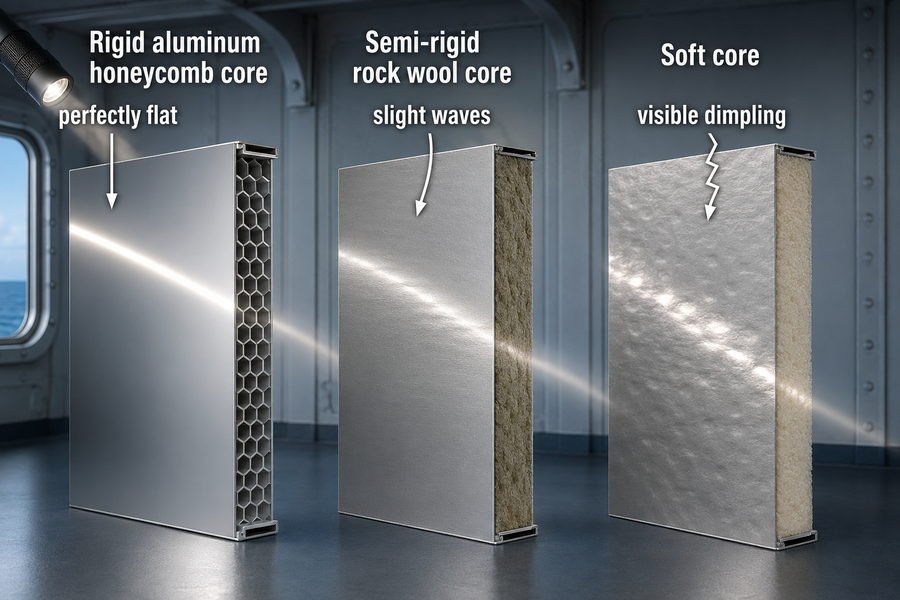
Decorating a ship interior is like building a nice hotel. The walls must look good. Procurement officers always hate it when panels arrive with wavy surfaces. We call this the "oil canning" effect in the factory. The steel skin looks like a crushed soda can. The core material inside is the main reason for this problem. The factory glue process also matters. They use 200 grams of glue per square meter. Let me explain how the three core types from the snippet affect your wall flatness.
Impact of Rigid Cores on Panel Surface Flatness
If you want a perfect wall, you use a rigid core. Aluminum honeycomb is the best choice for this. The honeycomb shape supports the steel skin at thousands of small points.13 The glue holds everything tight in the press machine. The surface flatness tolerance is usually less than 1mm per meter. You can put high-gloss PVC film on a honeycomb panel. It will look like a clear mirror. Calcium silicate is also a rigid core. It gives a very flat surface. It never bends.
Impact of Semi-Rigid and Soft Cores on Flatness
Rock wool is a semi-rigid core. It is made of pressed fibers. The surface of bare rock wool is not perfectly flat. It has small bumps. When the factory glues the steel skin to the rock wool in the press machine, the steel follows the small bumps in the wool. A normal rock wool panel has a flatness tolerance of 2mm to 3mm per meter.14 If you look at it from the side with a bright light, you see waves. Soft cores like low-density glass wool are the worst. The glue pulls the steel in, and you get large visible dimples. I always tell clients to use matte PVC film on rock wool to hide the small waves.
| Core Type | Material Example | Flatness Tolerance (per meter) | Best Film Finish |
|---|---|---|---|
| Rigid | Aluminum Honeycomb | < 1 mm (Excellent) | High-Gloss or Matte |
| Semi-Rigid | High-Density Rock Wool | 2 mm - 3 mm (Good) | Matte only |
| Soft | Low-Density Glass Wool | > 4 mm (Poor) | Matte only |
Conclusion
Choosing the right marine panel core balances fire safety, weight, and price. Know your SOLAS rules and density needs to buy the best panels for your next ship project.
-
"How Does the IMO FTP Code Connect with Other Marine Fire Safety ...", https://magellanmarinetech.com/how-imo-ftp-code-connect-with-other-marine-fire-safety-frameworks/. SOLAS Chapter II-2 and the IMO Fire Test Procedures Code establish fire-safety requirements and standardized non-combustibility testing for materials used in ship construction, supporting the general statement that many shipboard divisions and linings must meet non-combustibility standards. Evidence role: general_support; source type: institution. Supports: SOLAS rules require non-combustible materials in many ship areas.. Scope note: The exact requirement depends on vessel type, space category, structural element, and applicable SOLAS exemptions. ↩
-
"Marine Equipment Directive enters into force in the EEA - Efta.Int", https://www.efta.int/media-resources/news/marine-equipment-directive-enters-force-eea. The EU Marine Equipment Directive provides that marine equipment may carry the wheel mark after conformity assessment against applicable international instruments, including IMO conventions and codes, supporting the link between IMO-based requirements and the wheel-mark system. Evidence role: definition; source type: government. Supports: Products must meet applicable IMO-based marine equipment requirements to receive the wheel mark.. Scope note: The wheel mark is an EU marine-equipment conformity mark and is not identical to SOLAS approval in every jurisdiction. ↩
-
"Determination of Thermal Properties of Mineral Wool Required for ...", https://pmc.ncbi.nlm.nih.gov/articles/PMC10488771/. Technical literature on mineral wool describes stone or rock wool as an inorganic fiber insulation material with high fire resistance and common non-combustible classifications, supporting its use where non-combustibility is required. Evidence role: mechanism; source type: paper. Supports: Rock wool is used in SOLAS-type applications because it is non-combustible or highly fire resistant.. Scope note: Fire classification depends on the tested product, binder content, facing materials, and the specific standard used, so this does not certify every rock-wool panel assembly. ↩
-
"What Are Aluminum Honeycomb Panels?", https://magellanmarinetech.com/what-are-aluminum-honeycomb-panels/. The IMO High-Speed Craft Code sets safety requirements for high-speed craft, including fire-safety provisions and acceptance criteria for materials and construction arrangements, providing contextual support for the claim that lightweight materials such as aluminum honeycomb may be used when they satisfy the Code. Evidence role: general_support; source type: institution. Supports: Aluminum honeycomb cores can be accepted for high-speed craft when they comply with the IMO High-Speed Craft Code.. Scope note: The Code does not grant blanket approval to all aluminum honeycomb cores; approval depends on the full panel construction, fire testing, and flag-state or class-society acceptance. ↩
-
"What Are Marine Aluminum Honeycomb Panels?", https://magellanmarinetech.com/what-are-marine-aluminum-honeycomb-panels/. Independent technical data or peer-reviewed studies on aluminum honeycomb sandwich panels can support the cited areal-mass range for lightweight 50 mm panels, showing that honeycomb cores have low density because much of the core volume is void space. Evidence role: statistic; source type: paper. Supports: A standard 50mm thick aluminum honeycomb panel weighs about 6 to 8 kg per square meter.. Scope note: Panel weight varies with face-sheet material, skin thickness, adhesive, core cell size, and marine certification requirements, so a source may support the range contextually rather than as a universal standard. ↩
-
"How Does the IMO FTP Code Connect with Other Marine Fire Safety ...", https://magellanmarinetech.com/how-imo-ftp-code-connect-with-other-marine-fire-safety-frameworks/. The IMO/SOLAS fire-test framework defines A-class divisions and the A-60 rating by performance in a standard fire test for 60 minutes, supporting the meaning of an A-60 bulkhead in marine construction. Evidence role: definition; source type: institution. Supports: An A-60 bulkhead is a marine fire-rated division intended to resist fire exposure for 60 minutes under the relevant IMO/SOLAS test framework.. Scope note: This supports what the A-60 classification means; it does not by itself prove that every rock wool panel assembly will achieve A-60 without certified testing of the full construction. ↩
-
"Are Marine Fire Divisions the Same as Marine Panel Ratings?", https://magellanmarinetech.com/are-marine-fire-divisions-same-as-marine-panel-ratings/. The IMO FTP Code criteria for A-class divisions specify that, during the relevant fire-resistance period, the unexposed face must not exceed prescribed temperature-rise limits, including a maximum rise of 180°C at any point. Evidence role: definition; source type: institution. Supports: A-60 testing limits the temperature increase on the unexposed side of the panel during a 60-minute fire test.. Scope note: This supports the regulatory temperature criterion but indicates it is a temperature rise above the initial temperature, not an absolute cold-side temperature of 180°C. ↩
-
"Occupational Exposure to Refractory Ceramic Fibers | NIOSH - CDC", https://www.cdc.gov/niosh/docs/2006-123/default.html. Occupational health sources on refractory ceramic fibers report that handling or cutting these fibers can cause mechanical irritation of the skin, eyes, and respiratory tract, supporting the need for protective controls during fabrication. Evidence role: expert_consensus; source type: government. Supports: Cutting ceramic fiber boards can irritate workers’ skin and requires protective precautions.. Scope note: This supports the general health-risk rationale for protective equipment, but it does not by itself establish that “heavy suits” are required in every cutting operation. ↩
-
"How to choose the right marine wall panels for marine interior ...", https://magellanmarinetech.com/how-choose-right-marine-wall-panels-for-marine-interior-projects/. Classification-society or IMO fire-test documentation for marine bulkhead panels can substantiate that mineral-wool core density is specified as part of approved B- and A-class constructions, with higher fire-rating assemblies commonly using denser insulation cores. Evidence role: general_support; source type: institution. Supports: Rock wool core density for ship cabin wall panels varies by fire class, with B-15 panels around 100 kg/m3 and A-30/A-60 panels using higher densities around 120–150 kg/m3.. Scope note: Such sources may support density ranges for approved panel systems rather than prove that every factory uses exactly 100, 120, or 150 kg/m3. ↩
-
"[PDF] ALUMINUM HONEYCOMB", https://www.phys.hawaii.edu/~idlab/taskAndSchedule/iTOP_Commissioning/mechanics/Showa%20Aluminum%20Honeycomb.pdf. Engineering literature on aluminium honeycomb sandwich cores reports that core density is governed by foil thickness and cell geometry, and provides representative low-density ranges for honeycomb cores used in lightweight structural panels. Evidence role: mechanism; source type: paper. Supports: Marine aluminum honeycomb cores commonly have densities around 25–35 kg/m3, with foil thickness and cell size determining the final core density.. Scope note: The source may describe aluminium honeycomb cores generally rather than marine outfitting panels specifically, so it should be used as contextual support for the stated range. ↩
-
"[PDF] RESOLUTION MSC.307(88) (adopted on 3 December 2010 ...", https://wwwcdn.imo.org/localresources/en/KnowledgeCentre/IndexofIMOResolutions/MSCResolutions/MSC.307(88).pdf. The IMO 2010 FTP Code, adopted by Resolution MSC.307(88), Part 1, specifies a non-combustibility furnace test at about 750°C for a 30-minute exposure and sets criteria including temperature rise and mass loss. Evidence role: definition; source type: institution. Supports: IMO FTP Code Part 1 uses a 750°C furnace exposure for 30 minutes and includes failure criteria based on mass loss and furnace temperature rise.. ↩
-
"[PDF] Reduction of hydrogen cyanide concentrations and acute inhalation ...", https://nvlpubs.nist.gov/nistpubs/Legacy/IR/nistir4441.pdf. Fire-safety studies of polyurethane foam combustion describe rapid burning and the production of dense smoke with toxic gases such as carbon monoxide and hydrogen cyanide; this supports the general fire-hazard mechanism, although it does not by itself prove that every PU core formulation fails IMO FTP Part 1 without product-specific testing. Evidence role: mechanism; source type: paper. Supports: Polyurethane foam burns readily and can produce toxic black smoke during combustion.. Scope note: Supports the general combustion and smoke-toxicity behavior of polyurethane foam, not a universal test result for all PU products under IMO FTP Part 1. ↩
-
"[PDF] Evaluation of Composite Honeycomb Sandwich Panels Under ...", https://ntrs.nasa.gov/api/citations/19980137411/downloads/19980137411.pdf. Guidance on honeycomb sandwich structures explains that honeycomb cores separate and stabilize thin face sheets while transmitting shear, a mechanism consistent with distributed support of metal skins. Evidence role: mechanism; source type: government. Supports: The honeycomb shape supports the steel skin at thousands of small points.. Scope note: This supports the mechanical principle but does not quantify the exact number of support points in a specific panel. ↩
-
"[PDF] Performance of Sandwich Panels in FPL Experimental Unit", https://www.fpl.fs.usda.gov/documnts/fplrp/fplrp12.pdf. A dimensional-tolerance standard for factory-made double-skin metal-faced insulating panels, such as EN 14509, provides a neutral framework for measuring and reporting panel flatness, which can contextualize the stated 2–3 mm/m figure. Evidence role: statistic; source type: institution. Supports: A normal rock wool panel has a flatness tolerance of 2mm to 3mm per meter.. Scope note: The standard or test method may not establish one universal tolerance for all rock-wool panels; actual values can vary by panel thickness, facing material, density, and manufacturing process. ↩