
Are heavy steel panels driving up your shipping costs from Asia to Europe? Extra weight ruins profit margins. Using GRP/FRP face sheets cuts weight dramatically while keeping your marine interiors compliant.
GRP (Glass Reinforced Plastic) and FRP (Fiber Reinforced Plastic) face sheets are significantly lighter than traditional steel, typically weighing 1.5 to 2.5 kg/m² compared to steel's 4.5 to 6.0 kg/m², saving up to 60% in weight while maintaining structural integrity and A-Class fire resistance when bonded properly.
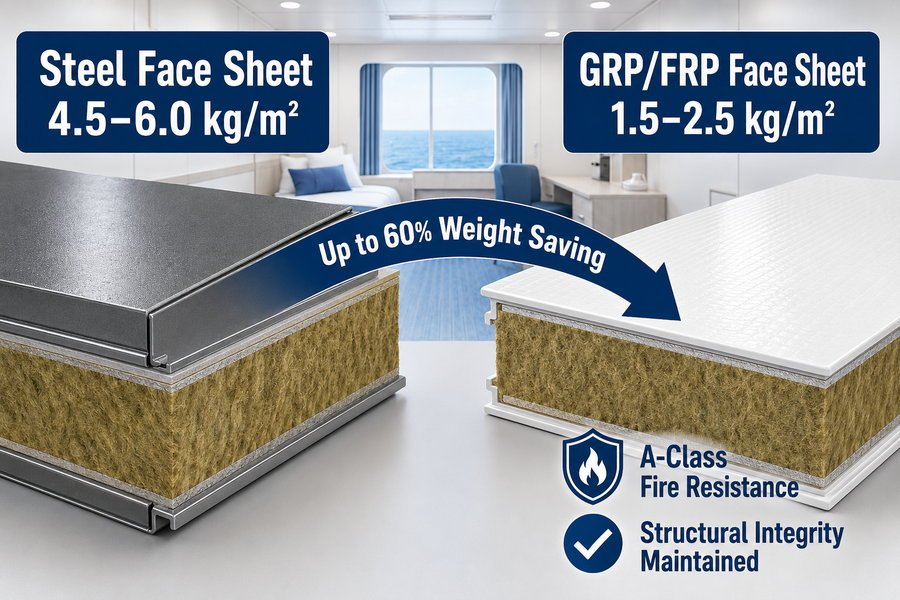
You might wonder if lighter panels can really handle the strict demands of European and US shipyards. I will break down exactly how this weight difference impacts your bottom line and project timelines. Keep reading to see the real numbers behind this smart material switch.
What Is the Typical Areal Weight (kg/m²) of a GRP/FRP Marine Accommodation Panel Face Sheet?
Struggling to calculate accurate freight costs for panel shipments? Guessing panel weights leads to budget overruns. Let us look at the exact areal weights of GRP/FRP marine panel face sheets.
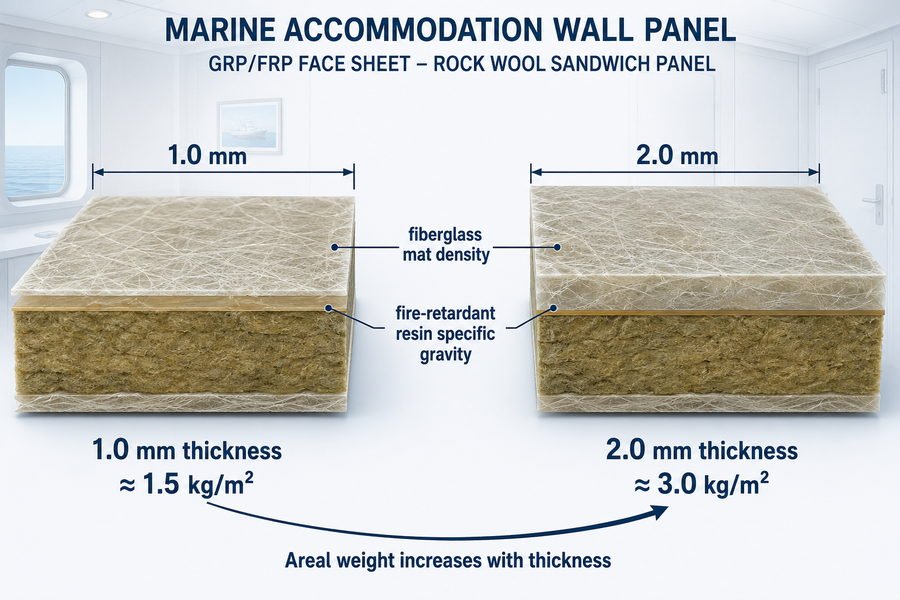
A typical GRP/FRP marine accommodation panel face sheet weighs between 1.5 kg/m² for a 1.0mm thickness and 3.0 kg/m² for a 2.0mm thickness. The two main factors determining this exact weight are the fiberglass mat density and the specific gravity of the fire-retardant resin mix.
Getting the exact weight is the first step to controlling your logistics costs from overseas factories. You need to know these numbers before booking any shipping containers. Let us dive deep into what makes up this exact panel weight.
Breakdown of GRP/FRP Face Sheet Thickness and Weight Range
When you buy marine interior outfitting products, you need exact numbers. I remember when I worked at the factory, we weighed thousands of panels. A standard GRP/FRP face sheet has a specific gravity of about 1.5 g/cm³1, according to standard marine material data sheets. This means a 1.0mm thick sheet weighs exactly 1.5 kilograms per square meter (kg/m²)2. If your shipyard client requires a thicker face sheet to resist heavy impacts in public corridors, you might use a 1.5mm thickness. This 1.5mm sheet will weigh 2.25 kg/m². For the most heavy-duty applications, a 2.0mm face sheet weighs 3.0 kg/m². These predictable weight ranges make it very easy to plan your shipping. A standard 20-foot container has a strict weight limit. Knowing the exact weight per square meter helps you pack the container fully without paying overload fines.
The Role of Resin and Fiberglass in Areal Weight
The total weight of the face sheet comes directly from two main components. I must explain both to give you the complete picture. The first factor is the fiberglass mat density. Manufacturers use different layers of woven glass fibers to give the sheet strength. More glass layers mean a heavier sheet. The second factor is the specific gravity of the fire-retardant resin mix. Marine regulations like SOLAS require panels to resist fire3. To achieve this, factories mix heavy mineral powders, like aluminum trihydrate, into the liquid resin. This fire-retardant powder increases the density of the resin4. Therefore, a marine-grade GRP sheet is slightly heavier than a normal commercial GRP sheet. However, it still remains much lighter than metal alternatives. Understanding these two components helps you discuss product specifications confidently with shipyard engineers.
| Face Sheet Material | Thickness (mm) | Typical Weight (kg/m²) | Best Shipyard Application |
|---|---|---|---|
| Standard GRP/FRP | 1.0 mm | 1.5 kg/m² | Standard passenger cabins and crew quarters |
| Reinforced GRP/FRP | 1.5 mm | 2.25 kg/m² | High-traffic corridors and public spaces |
| Heavy-Duty GRP/FRP | 2.0 mm | 3.0 kg/m² | Cargo areas and equipment rooms |
How Much Weight Does GRP/FRP Face Sheet Save Versus Galvanized Steel Skin?
Do heavy steel panels make your interior modules too heavy for standard yard cranes? Overweight modules slow down installation. Switching to GRP/FRP face sheets solves this problem directly.
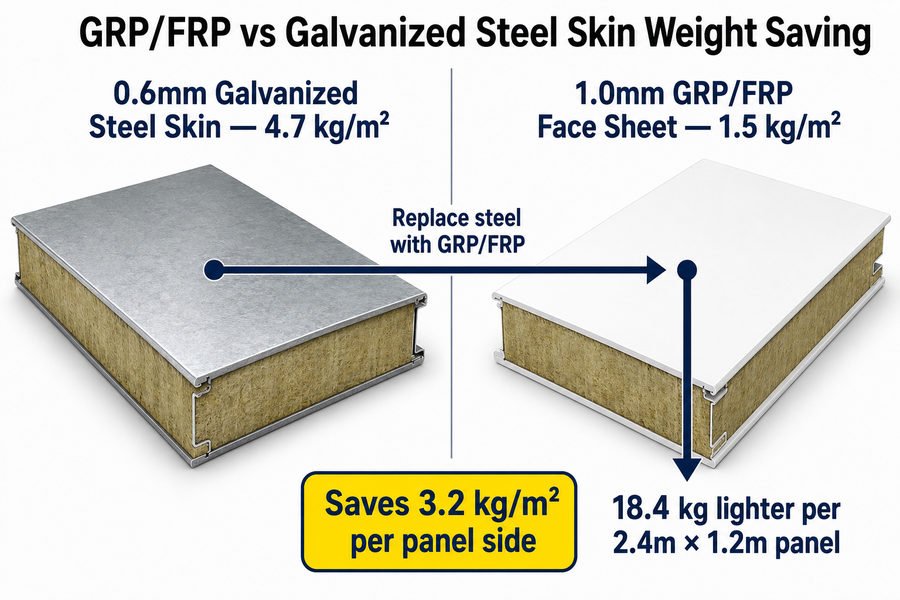
Replacing a standard 0.6mm galvanized steel skin (4.7 kg/m²) with a 1.0mm GRP/FRP face sheet (1.5 kg/m²) saves exactly 3.2 kg/m² per panel side. For a standard 2.4m x 1.2m accommodation panel, this equals an impressive 18.4 kg total weight reduction for both sides combined.
You need to understand these exact savings to show your European shipyard clients why your panels are better. I want to show you the precise math so you can use it in your next sales meeting. Here is the exact breakdown of these massive weight savings.
Calculating the Exact Weight Difference Between Steel and GRP/FRP
Shipyard engineers love hard data. To sell successfully, you must provide clear math. Standard marine-grade galvanized steel has a high density of 7,850 kg/m³ (or 7.85 g/cm³)5. Most marine wall panels use a 0.6mm thick steel skin6. If we multiply the density by the thickness, we find that a 0.6mm steel skin weighs exactly 4.71 kg/m². Now, let us look at the alternative. A 1.0mm GRP/FRP face sheet has a density of about 1,500 kg/m³7. This makes its weight exactly 1.5 kg/m². When you subtract 1.5 from 4.71, you get a direct weight saving of 3.21 kg/m² for just one side of the panel. This number is huge in the shipbuilding industry. When I help my clients win bids, I always highlight this 3.21 kg/m² saving. It proves that you can deliver a lightweight solution without sacrificing panel dimensions.
Total Weight Savings per Standard Marine Accommodation Panel
We must look at the whole panel to see the true impact. A standard marine accommodation panel measures 2400mm high by 1200mm wide. This equals a surface area of 2.88 square meters. Since a wall panel has two sides, we must multiply the savings. First, we multiply the area (2.88 m²) by the saving per square meter (3.21 kg). This gives us a saving of 9.24 kg per side. Because a partition panel has two face sheets, we multiply 9.24 kg by two. The total weight saving is 18.48 kg per single panel. A typical cruise ship cabin uses about 15 panels[8]. This means you save roughly 277 kg per cabin. If you are fitting out a ship with 1,000 cabins, the total weight saving becomes enormous. This clear math makes your interior decoration company highly competitive in European markets.
| Metric | 0.6mm Galvanized Steel Skin | 1.0mm GRP/FRP Face Sheet | Total Savings Using GRP |
|---|---|---|---|
| Density (g/cm³) | 7.85 | 1.50 | N/A |
| Weight per square meter | 4.71 kg/m² | 1.50 kg/m² | 3.21 kg/m² |
| Weight for 2.4m x 1.2m area | 13.56 kg | 4.32 kg | 9.24 kg |
| Total Panel Weight (2 sides) | 27.12 kg | 8.64 kg | 18.48 kg |
Does Thinner GRP/FRP Face Sheet Weaken Marine Accommodation Panels?
Worried that a lighter, thinner panel will fail shipyard quality inspections? Weak panels lead to rejected projects and unpaid invoices. The truth about GRP/FRP strength might surprise you.
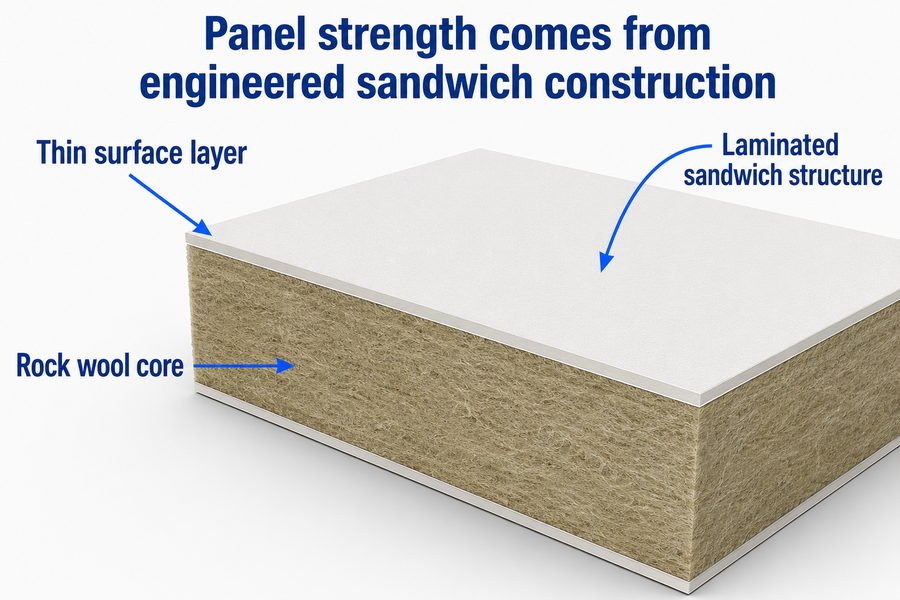
A thinner GRP/FRP face sheet does not weaken marine accommodation panels if properly engineered. Panel strength relies on three core factors: the composite sandwich construction, the core material's sheer strength, and the specific directional weave of the fiberglass reinforcing mats.
Many procurement officers think heavier materials always mean stronger panels, but modern marine engineering proves this wrong. I will explain exactly why lighter panels still meet strict marine safety codes. Keep reading to understand the mechanics of composite panel strength.
Understanding Composite Sandwich Construction and Core Shear Strength
To understand why thin GRP panels do not break easily, you must understand the sandwich effect. A marine panel is not just a flat sheet; it is a structural sandwich. The GRP acts as the outer skin, while the middle is filled with a core material like high-density rockwool (usually 120-150 kg/m³ density). When someone pushes against the panel, the outer GRP skin stretches, but the core material keeps the two skins rigidly separated. This separation creates incredible stiffness.8 The second factor from our summary is the core material's shear strength. The adhesive glue binds the GRP skin tightly to the rockwool core. If the panel tries to bend, the core resists the sliding motion between the two skins9. This means the overall strength comes from the whole system working together, not just the thickness of the outer plastic sheet.
The Impact of Fiberglass Directional Weave on Panel Integrity
The third factor that guarantees the strength of a thin GRP face sheet is the specific directional weave of the fiberglass reinforcing mats. Unlike steel, which has the same strength in every direction, GRP is an engineered composite. Factories arrange the tiny glass fibers in specific cross-hatch patterns. These woven mats absorb impact energy beautifully.10 If a heavy catering cart bumps into a GRP panel in a ship corridor, the woven fibers distribute the force across a wide area. A 0.6mm steel panel might get a permanent, ugly dent from the same cart. However, the 1.0mm GRP panel will often flex slightly and bounce back to its original shape without cracking. I have seen this happen many times during shipyard outfitting. Because of this smart weave technology, you get a panel that is thinner and lighter but still incredibly tough against daily shipyard abuse.
| Strength Factor | Function in Marine Panel | Result for the Final Product |
|---|---|---|
| Sandwich Construction | Keeps outer skins separated | Provides overall stiffness and rigidity |
| Core Shear Strength | Prevents skins from sliding | Stops the panel from bending under pressure |
| Directional Glass Weave | Distributes impact energy | Prevents permanent dents and cracking |
Why Does GRP/FRP Face Sheet Weight Matter for Passenger Ship Deadweight?
Are cruise ship operators demanding lighter interiors to save fuel? Ignoring these demands means losing bids to European competitors. GRP/FRP face sheets reduce overall deadweight drastically.
GRP/FRP face sheet weight directly impacts a passenger ship's deadweight, which governs four critical operational metrics: total fuel consumption, maximum passenger capacity, vessel stability (center of gravity), and overall environmental emissions compliance under the IMO's Energy Efficiency Design Index (EEDI).
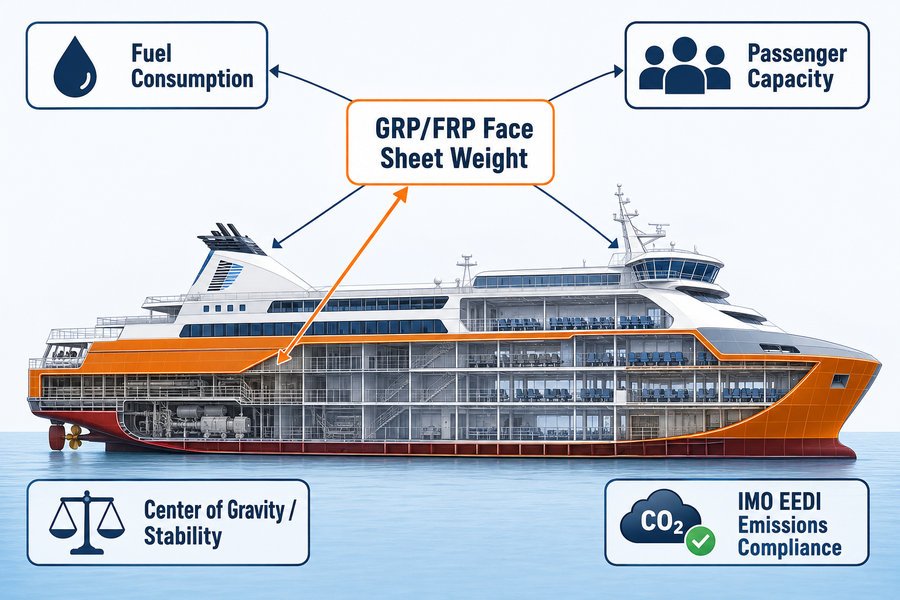
Shipyards track every single kilogram when building a modern cruise ship. If you can provide a lighter interior package, you become their most valued supplier. Let us look at how panel weight changes the entire ship's performance.
How Panel Weight Affects Ship Fuel Consumption and EEDI Regulations
Weight is the enemy of fuel efficiency on the ocean. When you use lighter GRP panels, you lower the ship's total deadweight. The first critical metric this improves is total fuel consumption. A lighter ship sits higher in the water. This creates less drag against the hull, meaning the engines burn less heavy fuel oil or LNG to push the vessel forward.11 I always tell my clients that fuel is a ship owner's biggest expense. By saving weight on the interior walls, you save them money every single day. The second critical metric is the Energy Efficiency Design Index (EEDI) set by the International Maritime Organization (IMO). Modern ships must meet strict emissions rules.12 Because lighter panels reduce fuel burning, they directly reduce carbon emissions. Selling lightweight GRP panels helps European shipyards meet these mandatory green regulations easily.
Impact of Face Sheet Weight on Vessel Stability and Passenger Capacity
The location of the weight on a ship is just as important as the total amount. Most accommodation cabins are located high above the waterline on the upper decks. This brings us to the third critical metric: vessel stability. If you build upper deck cabins with heavy steel panels, you raise the ship's center of gravity. A high center of gravity makes the ship roll dangerously in rough seas.13 By using lightweight GRP panels on the top decks, you lower the center of gravity, making the ship much safer and more comfortable for guests. The fourth critical metric is maximum passenger capacity. Ship designers have a strict maximum weight limit for the vessel. If you save 300 tons on the interior wall panels, the designer can add 300 tons of extra payload.14 This means they can add more passenger cabins, more swimming pools, or more revenue-generating restaurants.
| Operational Metric | Impact of Heavy Steel Panels | Advantage of Lighter GRP Panels |
|---|---|---|
| Fuel Consumption | High drag requires more engine power | Less drag saves daily fuel costs |
| IMO EEDI Compliance | Burns more fuel, higher emissions | Burns less fuel, helps meet strict laws |
| Vessel Stability | Raises center of gravity, causes rolling | Lowers center of gravity, improves safety |
| Passenger Capacity | Eats into available payload weight | Frees up weight for more paying guests |
What Is the Strength-to-Weight Ratio of GRP/FRP Marine Accommodation Panel Face Sheets?
Finding it hard to balance low material weight with high structural integrity? Flimsy panels get damaged during shipping from Asia. GRP/FRP offers an unbeatable strength-to-weight ratio.
The strength-to-weight ratio of GRP/FRP marine face sheets is exceptionally high, typically offering a tensile strength of 80 to 120 MPa at a density of just 1.5 g/cm³. This ratio outperforms standard marine-grade steel, which has higher absolute strength but a heavy density of 7.85 g/cm³.
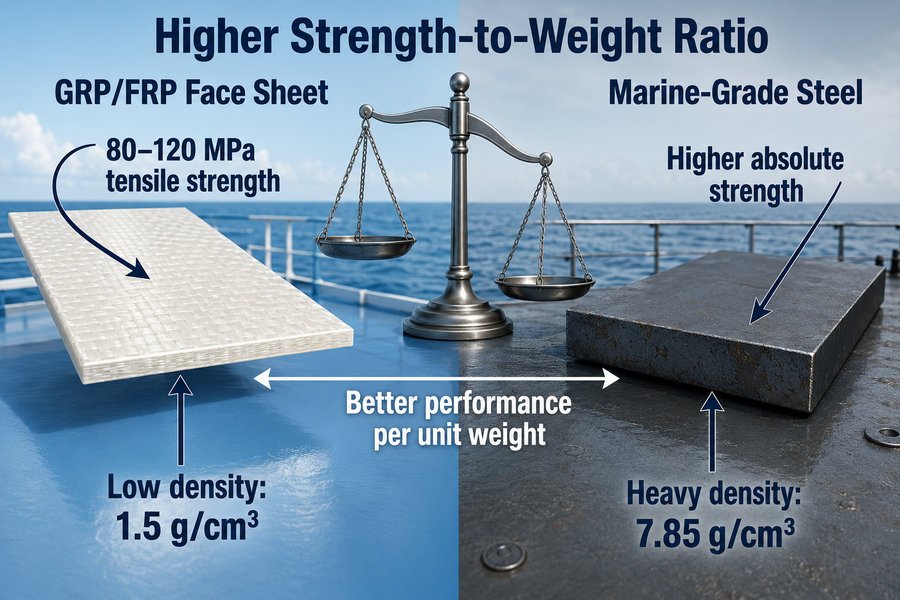
This specific ratio is the secret behind modern marine interior outfitting. I will show you the exact material properties that make GRP/FRP so effective. Keep reading to see how these numbers stack up against traditional metals.
Analyzing the Tensile Strength and Density of GRP/FRP
To understand why GRP is the best choice, we must look at the specific engineering numbers. A standard marine-grade GRP face sheet has a tensile strength ranging from 80 to 120 Megapascals (MPa)15, depending on the glass fiber content. This means it can withstand a massive amount of pulling force before it tears. At the same time, as we discussed earlier, its density is extremely low, sitting at just 1.5 g/cm³16. The strength-to-weight ratio is calculated by dividing the tensile strength by the density. When you divide 100 MPa by 1.5 g/cm³, you get a very high efficiency number. I learned early in my career that this high ratio means you get maximum protection for minimal weight penalty. This is why aerospace engineers use composite materials17, and it is exactly why marine engineers are switching to them for ship interiors.
Comparing Specific Strength Against Marine Grade Steel
Now, let us compare this directly to the old standard. Standard marine-grade galvanized steel is undeniably strong. It typically has a tensile strength of about 350 to 400 MPa18. If you look only at this number, steel seems better. However, steel has a massive density of 7.85 g/cm³. When you calculate its strength-to-weight ratio by dividing 400 MPa by 7.85 g/cm³, the resulting number is much lower than that of GRP. Steel carries too much dead weight for the strength it provides. When you are buying panels in Asia to sell to a high-end shipyard, you need materials that work smarter. GRP/FRP panels use their material much more efficiently. They provide more than enough absolute strength to pass SOLAS fire and impact tests, but they do it without loading the ship down with useless metal mass.
| Material | Typical Tensile Strength (MPa) | Density (g/cm³) | Specific Strength Performance |
|---|---|---|---|
| GRP/FRP Face Sheet | 80 - 120 MPa | 1.50 | High efficiency, low deadweight |
| Galvanized Steel Skin | 350 - 400 MPa | 7.85 | Low efficiency, high deadweight |
How Does Face Sheet Weight Affect Marine Accommodation Panel Handling in Outfitting?
Are shipyard workers complaining about lifting heavy steel panels in tight ship cabins? High labor fatigue slows down your installation schedule. Lighter GRP/FRP face sheets make handling much easier.
Face sheet weight affects marine accommodation panel handling by directly determining three key installation factors: the number of workers required per panel, the risk of workplace lifting injuries, and the overall speed of cabin assembly during the interior outfitting process.
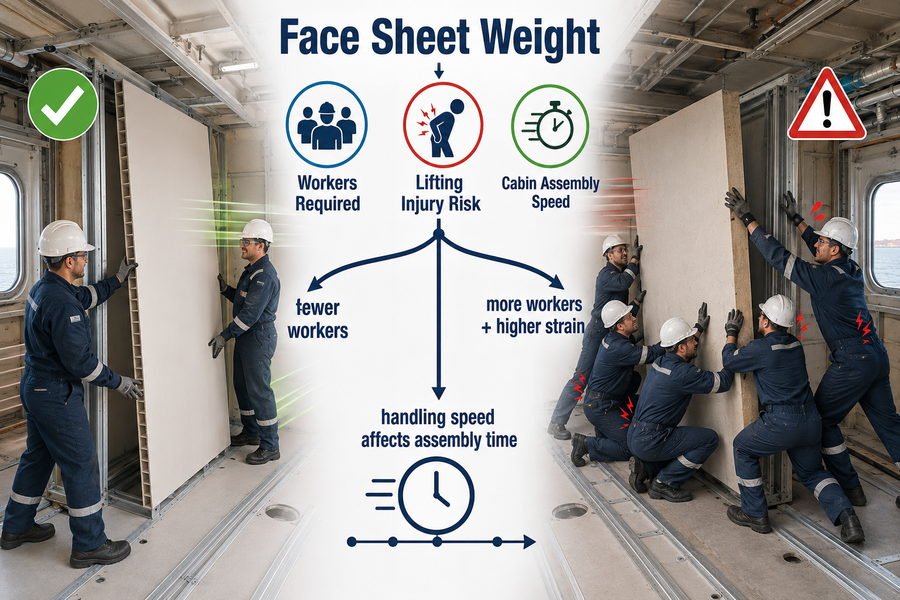
Time is money in any shipyard project. If your panels are easy to move, your installation teams will finish the job faster and cheaper. Let us explore the real-world labor savings of lighter panels.
Reducing Worker Requirements and Lifting Injuries in Ship Cabins
Labor costs in European and US shipyards are incredibly high.19 The weight of the panel dictates exactly how much labor you must pay for. This is the first key factor. A standard 2.4m steel-faced panel can weigh over 50 kilograms20 depending on the core. Navigating a 50kg panel through narrow ship corridors and tight cabin doors usually requires at least three workers.21 Two to lift, and one to guide. By switching to GRP face sheets, the panel weight drops significantly. Now, only two workers can easily carry and position the same panel. This reduces your labor cost per cabin instantly. The second key factor is the risk of workplace lifting injuries. Heavy steel panels cause back strains, crushed fingers, and shoulder injuries. Shipyards hate safety incidents because they halt production. Lighter GRP panels drastically reduce operator fatigue and physical strain, keeping the safety managers happy.
Accelerating Cabin Assembly Speed During Marine Outfitting
The third key factor determined by panel weight is the overall speed of cabin assembly. When workers handle heavy steel panels, they move slowly and take frequent rest breaks. Positioning a heavy panel into the bottom U-profile floor track takes time and careful adjustment. If they drop it, the heavy edge can damage the floor track. Lighter GRP/FRP panels change this completely. Workers can move swiftly down the corridor. They can lift the panel, angle it into the top ceiling profile, and drop it into the floor track in seconds. Because the panels are lightweight, the workers maintain a high pace from the morning shift all the way to the evening. In my experience supplying major shipyard projects, switching to lightweight panels can cut interior installation time by up to 25%.22 This fast assembly speed lets you hand over the completed cabins much sooner.
| Installation Factor | Heavy Steel Panels | Lightweight GRP Panels |
|---|---|---|
| Number of Workers Needed | Usually 3 workers per panel | Usually 2 workers per panel |
| Risk of Lifting Injuries | High risk of back and finger strain | Low risk, minimal operator fatigue |
| Cabin Assembly Speed | Slow, frequent rest breaks needed | Fast, steady pace maintained all day |
Conclusion
Using GRP/FRP face sheets on marine accommodation panels drastically reduces ship deadweight, cuts freight costs, and speeds up shipyard installation, all while meeting strict marine safety standards.
-
"Long Chopped Glass Fiber Reinforced Low-Density Unsaturated ...", https://pmc.ncbi.nlm.nih.gov/articles/PMC8658567/. Materials reference data for glass-fiber-reinforced polymers commonly report densities in the approximate range of 1.4–2.0 g/cm³, supporting the use of about 1.5 g/cm³ as a plausible planning value for GRP/FRP sheet weight calculations. Evidence role: general_support; source type: education. Supports: A standard GRP/FRP face sheet has a specific gravity of about 1.5 g/cm³.. Scope note: The exact density varies with fiber content, resin chemistry, fillers, and manufacturing process, so this supports an approximate value rather than a universal specification. ↩
-
"Area density - Wikipedia", https://en.wikipedia.org/wiki/Area_density. Areal mass can be calculated as density multiplied by thickness; using a density of 1.5 g/cm³ and a thickness of 1.0 mm gives 1.5 kg/m², confirming the arithmetic basis of the stated sheet weight. Evidence role: mechanism; source type: education. Supports: A 1.0 mm GRP/FRP sheet with a density of 1.5 g/cm³ weighs 1.5 kg/m².. Scope note: The calculation is exact only if the assumed density is accurate and uniform across the sheet; real products may differ because of fiber-resin ratio, fillers, and tolerances. ↩
-
"[PDF] RESOLUTION MSC.307(88) (adopted on 3 December 2010 ...", https://wwwcdn.imo.org/localresources/en/KnowledgeCentre/IndexofIMOResolutions/MSCResolutions/MSC.307(88).pdf. The International Convention for the Safety of Life at Sea and the IMO Fire Test Procedures Code establish fire-safety requirements and testing methods for materials used in ships, providing regulatory context for the statement that marine interior panels must meet fire-resistance or low-flame-spread requirements. Evidence role: expert_consensus; source type: institution. Supports: Marine regulations such as SOLAS require ship interior panels or materials to meet fire-safety requirements.. Scope note: SOLAS requirements vary by vessel type, location of use, and material classification; the source supports the regulatory context rather than proving that every GRP panel must meet the same fire test. ↩
-
"Use of aluminum trihydrate filler to improve the strength properties of ...", https://bioresources.cnr.ncsu.edu/resources/use-of-aluminum-trihydrate-filler-to-improve-the-strength-properties-of-cellulosic-paper-exposed-to-high-temperature-treatment/. Technical literature on polymer composites describes aluminum trihydrate as a mineral flame-retardant filler used in resins; because it is an inorganic filler with higher density than many organic resins, its addition can increase composite density while improving flame-retardant behavior. Evidence role: mechanism; source type: paper. Supports: Adding aluminum trihydrate or similar mineral flame-retardant fillers to resin can increase the density of marine-grade GRP/FRP sheets.. Scope note: The amount of density increase depends on filler loading, resin type, and other additives, so the source supports the mechanism rather than a specific weight increase for the article’s product. ↩
-
"Investigation of Heat Treatment on Mechanical Propertiesof Mild Steel", https://www.academia.edu/83537212/Investigation_of_Heat_Treatment_on_Mechanical_Propertiesof_Mild_Steel. A materials-property reference supports that carbon and galvanized steels are commonly treated as having a density near 7.85 g/cm³, which underlies the article’s mass-per-area calculation for a 0.6 mm steel skin. Evidence role: definition; source type: education. Supports: Standard marine-grade galvanized steel has a density of about 7,850 kg/m³.. Scope note: The value is a standard engineering approximation; actual density can vary slightly by alloy composition and coating mass. ↩
-
"What Defines A Genuine Marine Accommodation Panel?", https://magellanmarinetech.com/what-defines-genuine-marine-accommodation-panel/. Marine accommodation-panel specifications and type-approval documentation can show that steel-faced cabin or partition panels are commonly supplied with thin sheet-steel facings, including values around 0.6 mm, providing context for the thickness assumed in the calculation. Evidence role: general_support; source type: institution. Supports: Most marine wall panels use a 0.6 mm thick steel skin.. Scope note: This supports the plausibility of the assumed thickness, not that all or most marine wall panels use exactly 0.6 mm steel skins across all ship types and suppliers. ↩
-
"Fiberglass - Wikipedia", https://en.wikipedia.org/wiki/Fiberglass. Composite-material references report typical glass-fiber-reinforced polymer densities in the approximate range of 1.4–2.0 g/cm³, supporting the article’s use of 1,500 kg/m³ as a reasonable representative value for a GRP/FRP face sheet. Evidence role: definition; source type: education. Supports: A 1.0 mm GRP/FRP face sheet has a density of about 1,500 kg/m³.. Scope note: The density depends on resin type, glass content, fillers, and manufacturing process, so 1,500 kg/m³ should be treated as an assumed representative value rather than a universal constant. ↩
-
"Optimal sandwich panel's core design for an enhanced impact ...", https://pmc.ncbi.nlm.nih.gov/articles/PMC11731508/. Engineering references on sandwich structures explain that separating thin face sheets with a lightweight core increases bending stiffness because the faces carry tensile and compressive stresses while the core maintains spacing. Evidence role: mechanism; source type: education. Supports: In sandwich construction, keeping the outer skins separated by a core substantially increases panel stiffness.. Scope note: The support is a general structural-mechanics principle and does not quantify the stiffness of the specific panel described. ↩
-
"[PDF] Sandwich Constructions - USNA", https://www.usna.edu/Users/mecheng/pjoyce/composites/Short_Course_2003/13_PAX_Short_Course_Sandwich-Constructions.pdf. Technical literature on sandwich composites states that the core carries transverse shear and helps prevent relative displacement between the face sheets during bending. Evidence role: mechanism; source type: paper. Supports: The core material in a sandwich panel resists shear movement between the two outer skins when the panel bends.. Scope note: This supports the mechanics of core shear in sandwich panels generally, not the tested shear strength of a particular rockwool-GRP product. ↩
-
"Energy absorption and damage prediction in natural fibre ... - PMC", https://pmc.ncbi.nlm.nih.gov/articles/PMC12627825/. Studies of woven glass-fiber-reinforced polymer composites report that fiber architecture and layup affect impact response and energy absorption by distributing loads through the reinforcement network. Evidence role: mechanism; source type: paper. Supports: Woven fiberglass reinforcement can help distribute impact loads and absorb impact energy in GRP composites.. Scope note: Such evidence supports the general mechanism of impact-energy absorption in woven GFRP, but it does not directly prove the specific catering-cart or steel-panel comparison in the article. ↩
-
"[PDF] Chapter 7 Resistance and Powering of Ships - USNA", https://www.usna.edu/NAOE/_files/documents/Courses/EN400/02.07%20Chapter%207.pdf. Naval-architecture sources explain that reducing a ship’s displacement and draft can reduce hull resistance and the propulsive power required at a given speed, which in turn can lower fuel consumption. Evidence role: mechanism; source type: education. Supports: Reducing ship weight can reduce draft, hydrodynamic resistance, required engine power, and fuel consumption.. Scope note: The magnitude of the saving depends on hull form, speed, sea state, loading condition, and operating profile. ↩
-
"Improving the energy efficiency of ships", https://www.imo.org/en/ourwork/environment/pages/improving%20the%20energy%20efficiency%20of%20ships.aspx. IMO materials describe the Energy Efficiency Design Index as a mandatory energy-efficiency measure introduced under MARPOL Annex VI for covered new ships, with phased requirements intended to reduce CO₂ emissions from shipping. Evidence role: historical_context; source type: institution. Supports: The EEDI is an IMO regulatory instrument imposing mandatory energy-efficiency requirements on many new ships.. Scope note: EEDI requirements apply by ship type, size, and build date, so the statement should not be read as applying uniformly to every modern vessel. ↩
-
"Metacentric height - Wikipedia", https://en.wikipedia.org/wiki/Metacentric_height. Ship-stability references explain that placing weight high in a vessel raises the vertical center of gravity and can reduce metacentric height, thereby reducing initial stability and increasing vulnerability to excessive roll or capsize. Evidence role: mechanism; source type: government. Supports: Heavy materials placed on upper decks can raise a ship’s center of gravity and adversely affect stability and rolling behavior.. Scope note: Roll behavior also depends on hull geometry, loading distribution, damping, sea state, and active or passive stabilization systems. ↩
-
"Deadweight tonnage - Wikipedia", https://en.wikipedia.org/wiki/Deadweight_tonnage. Naval-architecture and load-line sources define payload or deadweight in relation to a vessel’s allowable loaded displacement and lightship weight, supporting the principle that reducing lightship weight can increase available deadweight at the same permitted draft. Evidence role: general_support; source type: education. Supports: Reducing interior panel weight can increase the weight margin available for payload within a vessel’s allowable displacement limits.. Scope note: The exchange is not always exactly one-to-one because stability, volume, structural strength, safety rules, and operational requirements may constrain how saved weight can be reused. ↩
-
"Mechanical Characterization of the Tensile Properties of Glass Fiber ...", https://pmc.ncbi.nlm.nih.gov/articles/PMC6432005/. Published materials data for glass-fiber-reinforced polymer laminates report tensile strengths in the same order of magnitude as the cited 80–120 MPa range, with values varying by resin system, fiber fraction, and fiber orientation. Evidence role: statistic; source type: paper. Supports: A standard marine-grade GRP face sheet has a tensile strength ranging from 80 to 120 MPa, depending on glass fiber content.. Scope note: This supports the plausibility of the range for some GRP/FRP laminates, but it does not establish that every marine-grade face sheet has these properties. ↩
-
"Fibre-reinforced plastic - Wikipedia", https://en.wikipedia.org/wiki/Fibre-reinforced_plastic. Reference materials for fiberglass-reinforced plastics commonly list densities around 1.5–2.0 g/cm³, supporting the use of 1.5 g/cm³ as a representative low-density value for some GRP/FRP products. Evidence role: statistic; source type: encyclopedia. Supports: GRP/FRP has a low density of about 1.5 g/cm³.. Scope note: The cited density is representative rather than universal; actual panel density depends on resin, reinforcement, core material, and fillers. ↩
-
"[PDF] Chapter 2: Aerospace Materials Characteristics", https://ntrs.nasa.gov/api/citations/20180001137/downloads/20180001137.pdf. Aerospace engineering literature documents the widespread use of fiber-reinforced polymer composites in aircraft structures because of their high specific strength and stiffness relative to many metals. Evidence role: expert_consensus; source type: research. Supports: Aerospace engineers use composite materials because high strength-to-weight ratios reduce weight while maintaining structural performance.. Scope note: This provides contextual support for the value of high strength-to-weight materials; it does not directly prove that the same material choice is optimal for all marine interiors. ↩
-
"[PDF] Mechanical properties of structural steel - GovInfo", https://www.govinfo.gov/content/pkg/GOVPUB-C13-8620f9e60cbfd1c3ac9e0bf55ba3770c/pdf/GOVPUB-C13-8620f9e60cbfd1c3ac9e0bf55ba3770c.pdf. Engineering references for structural and galvanized steels report tensile strengths in the hundreds of megapascals, consistent with a 350–400 MPa comparison value for some common steel grades. Evidence role: statistic; source type: institution. Supports: Standard marine-grade galvanized steel typically has a tensile strength of about 350–400 MPa.. Scope note: Galvanizing is a coating process and does not by itself define steel tensile strength; the exact value depends on the underlying steel grade and standard. ↩
-
"Full Report: Why data matters for shipbuilding industrial policy - OECD", https://www.oecd.org/en/publications/why-data-matters-for-shipbuilding-industrial-policy_9ab37ecb-en/full-report.html. An institutional or government shipbuilding report can document labor as a major cost component in European and U.S. shipbuilding and provide contextual wage or productivity data for these regions. Evidence role: statistic; source type: government. Supports: Labor costs in European and US shipyards are high enough that panel-handling labor materially affects project cost.. Scope note: Such sources may support the general cost sensitivity of labor but may not quantify labor costs for cabin-panel installation specifically. ↩
-
"How to choose the right marine wall panels for marine interior ...", https://magellanmarinetech.com/how-choose-right-marine-wall-panels-for-marine-interior-projects/. A technical source on steel-faced sandwich panels or marine accommodation panels can substantiate typical mass-per-area values and show that a full-height panel of about 2.4 m can exceed 50 kg depending on facing thickness and core material. Evidence role: statistic; source type: paper. Supports: A standard 2.4 m steel-faced panel can weigh more than 50 kg depending on its construction.. Scope note: Support may be based on representative panel constructions or material-density calculations rather than the exact panel used in the article. ↩
-
"Solutions for Electrical Contractors - Materials Handling - Heavy Lifting", http://www.osha.gov/etools/electrical-contractors/materials-handling/heavy. Occupational-safety guidance on manual handling can support the premise that awkward loads around 50 kg exceed ordinary single-person handling limits and often require team handling or mechanical assistance. Evidence role: expert_consensus; source type: government. Supports: Moving a 50 kg panel through constrained ship interiors generally requires more than one worker and may require team handling.. Scope note: Manual-handling guidance supports the ergonomic rationale for multiple workers but may not directly prescribe three workers for this exact ship-cabin panel task. ↩
-
"How to choose the right marine wall panels for marine interior ...", https://magellanmarinetech.com/how-choose-right-marine-wall-panels-for-marine-interior-projects/. A peer-reviewed or institutional study on shipbuilding outfitting productivity can support the general relationship between reduced component weight, easier handling, and lower installation labor hours. Evidence role: statistic; source type: paper. Supports: Switching to lightweight panels can reduce interior installation time, potentially by a substantial percentage.. Scope note: The specific “up to 25%” reduction requires direct project data; broader productivity studies would provide contextual rather than conclusive proof for this exact percentage. ↩