
Are your marine wall panels getting damaged too fast? Replacing dented panels hurts your project timeline and budget. Steel face sheets offer a strong solution for tough ship areas.
Steel face sheets for marine panels provide superior durability in high-traffic areas compared to aluminum. They resist heavy impacts, trolley bumps, and daily wear in corridors, galleys, and crew spaces. Steel sheets, usually 0.6mm to 0.8mm thick, meet strict IMO safety and European shipyard quality standards.
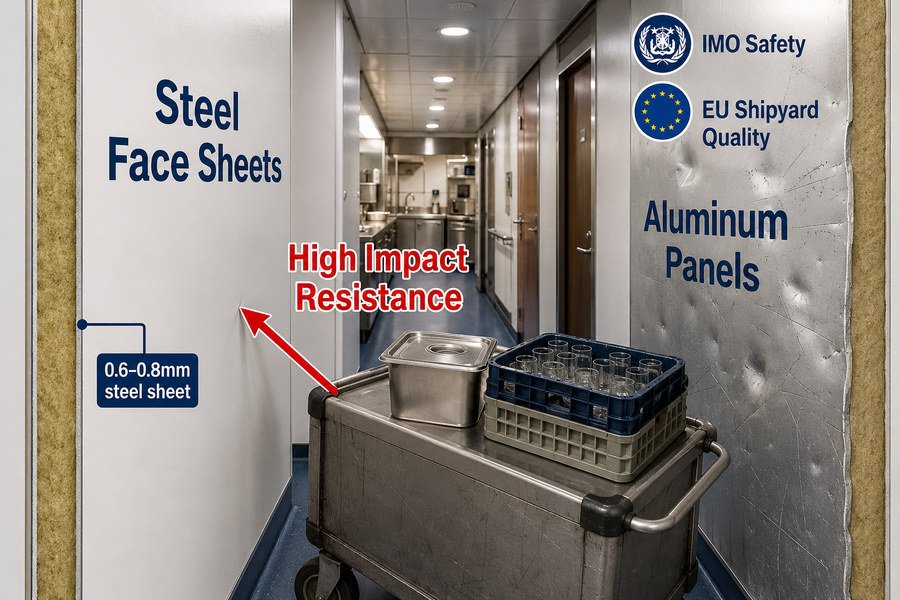
I remember an early project where we used thin aluminum panels in a busy ship corridor. After just three months, food carts caused huge dents. I had to pay to replace them, which killed my profit margin. Let us look at why and where you must use steel panels instead.
Which Marine Accommodation Zones Require Steel Face Sheets Instead of Aluminum Face Sheets?
You install nice aluminum panels, but a week later, they look terrible. High-traffic ship zones ruin soft materials fast. Using steel panels stops this damage and saves replacement costs.
Four main marine zones strictly require steel face sheets: heavy-traffic corridors, busy galleys, equipment-heavy workshops, and central mess rooms. These areas face constant movement from carts, heavy tools, and crew members, making aluminum too weak to handle the daily physical stress without severe denting.
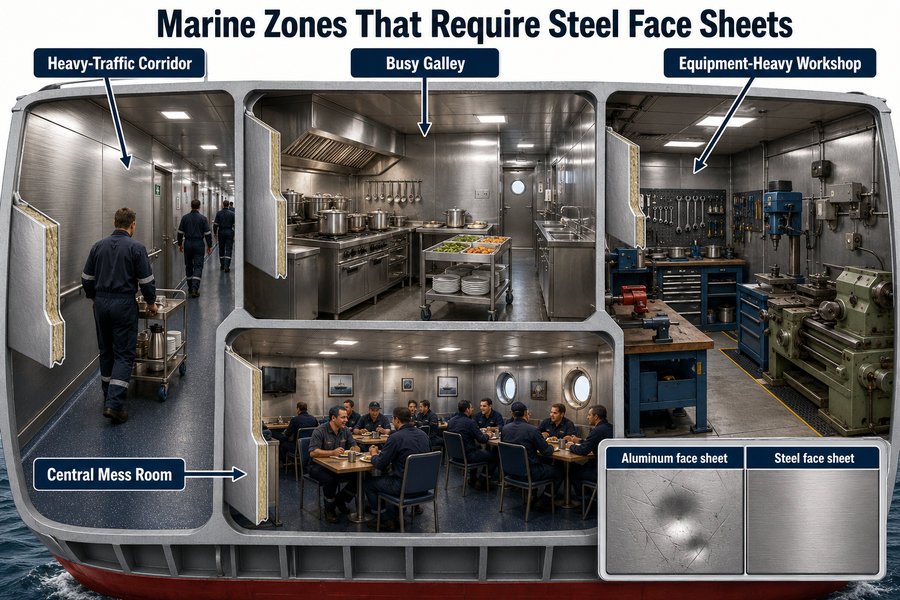
Heavy-Traffic Corridors and Busy Galleys on Ships
I always tell my clients to look at the traffic flow before buying materials. A main ship corridor is not a quiet office. Crew members push heavy equipment through these narrow spaces 24 hours a day. When a 150 kg cleaning cart hits an aluminum panel, it leaves a big dent. Steel face sheets, normally made of hot-dip galvanized steel, stop this.1 In galleys, the problem is worse. Cooks move heavy metal pots and metal food trolleys. If a trolley hits an aluminum panel, the panel breaks. A steel face sheet panel takes the hit and stays flat.2 I had a client who saved $15,000 in repair costs on a large cruise ship just by switching to steel in the galleys. High-quality European shipyards demand this level of durability. They will not accept soft panels in these busy work areas.
Equipment-Heavy Workshops and Central Mess Rooms
Workshops on a ship hold heavy metal tools. A dropped wrench or a heavy metal part will destroy an aluminum wall panel quickly. Steel panels absorb the shock easily without breaking. Central mess rooms also see hundreds of crew members every day.3 Chairs bang against the walls constantly during meal times. Aluminum cannot handle this repeated hitting. Steel handles it perfectly. According to guidelines from major classification societies like DNV, materials in these zones must endure high mechanical stress. Using a standard steel sheet here guarantees the wall stays beautiful for years. You save money because you do not buy new panels every year. It makes the logistics of maintenance much easier for the shipowner.
| Marine Accommodation Zone | Primary Impact Source | Recommended Face Sheet Material | Risk of Denting (if using Aluminum) |
|---|---|---|---|
| Heavy-Traffic Corridors | Cleaning carts, luggage | Steel (0.6mm - 0.7mm) | Very High |
| Busy Galleys | Food trolleys, metal pots | Steel (0.6mm - 0.8mm) | Extreme |
| Equipment-Heavy Workshops | Dropped tools, machinery | Steel (0.6mm) | High |
| Central Mess Rooms | Moving chairs, foot traffic | Steel (0.6mm) | High |
What Impact Resistance Do Steel-Faced Marine Accommodation Panels Offer?
Do you know how much force your ship walls can take? Weak walls fail under heavy blows, causing safety risks. Steel panels provide measurable, strong impact resistance for ships.
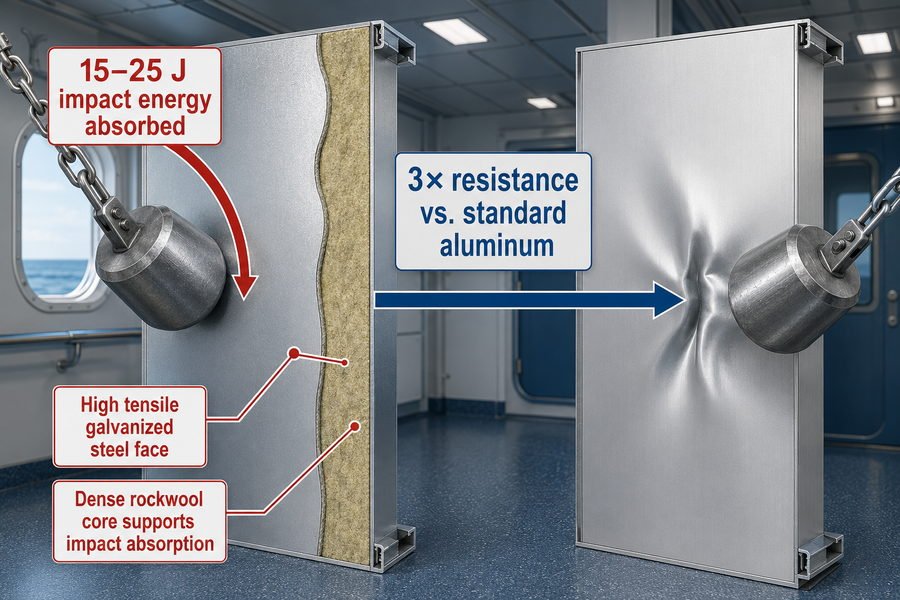
Steel-faced marine panels offer high impact resistance, typically absorbing 15 to 25 Joules of energy without permanent deformation. This is three times the resistance of standard aluminum panels. This performance comes from the high tensile strength of the galvanized steel and the dense rockwool core behind it.
Measuring Energy Absorption in Marine Steel Panels
Let us talk about real numbers. When you buy a marine panel, you must check the impact test reports. European shipyard standards usually require a hard body impact test. A standard 0.6mm steel-faced panel with a 120 kg/m³ rockwool core can absorb between 15 and 25 Joules of impact energy.4 I saw a lab test where a 1 kg steel ball was dropped from a height of 2 meters. This drop creates about 19.6 Joules of force. The steel panel had a very small mark, less than 1mm deep. When the lab tested an aluminum panel of the same thickness, the steel ball went almost completely through the metal face. This proves that steel panels offer massive protection. You can show these test results to your shipyard clients to prove you provide high-quality materials.
Why Tensile Strength Matters for Marine Wall Panels
The secret to this resistance is the tensile strength of the steel. Standard hot-dip galvanized steel used in marine panels, like the DX51D grade, has a tensile strength of about 270 to 500 MPa5 (Megapascals). This is based on the European standard EN 10346. Aluminum used for marine panels usually has a tensile strength of only 130 to 180 MPa. Because steel is much stronger, it spreads the energy of a hit over a larger area. The dense rockwool core then takes the rest of the shock. This combination of strong metal and dense core is why I always tell my buyers to check the steel grade on the factory certificate. Do not just look at the low price; look at the MPa value.
| Panel Face Material | Typical Tensile Strength | Energy Absorption Capacity | Permanent Damage at 20 Joules |
|---|---|---|---|
| Standard Aluminum (0.6mm) | 130 - 180 MPa | 5 - 8 Joules | Yes (Deep Dent / Puncture) |
| Galvanized Steel (0.6mm) | 270 - 500 MPa | 15 - 25 Joules | No (Minor Surface Mark) |
How Does Steel Face Sheet Thickness Affect Dent Resistance on Marine Accommodation Corridor Panels?
Choosing the wrong metal thickness leads to dented ship corridors. A very thin sheet saves money now but costs you later. The right thickness ensures long-lasting, flat marine walls.
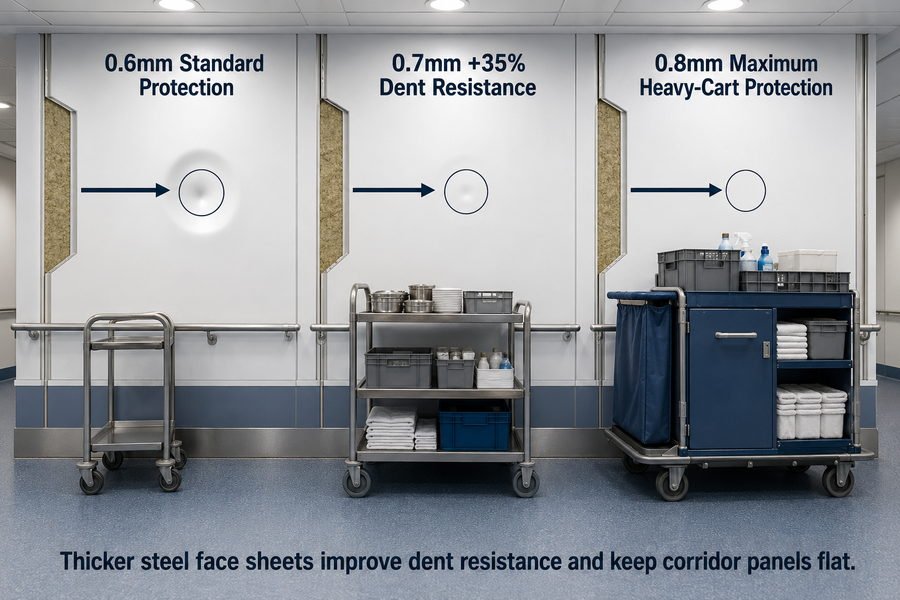
Steel face sheet thickness directly controls dent resistance. A 0.6mm sheet provides standard protection for normal areas. A 0.7mm sheet increases dent resistance by 35% for busy corridors. A 0.8mm sheet offers maximum protection against extreme heavy cart impacts, ensuring the wall remains flat and structurally intact.
Standard Protection with 0.6mm Steel Sheets
Thickness is the most important factor for preventing dents. In my factory days, we tested many steel thicknesses. The marine outfitting industry standard is 0.6mm.6 This thickness works very well for normal crew cabins and quiet office areas on the ship. It stops small bumps from luggage and light daily use. But in a main corridor, 0.6mm is sometimes not enough. If a heavy catering cart hits a 0.6mm panel hard, it can still leave a shallow dent. You must explain this to your shipyard buyers. Let them know that 0.6mm is a basic standard, not a heavy-duty solution. It keeps the initial purchase price low, but it has limits.
Upgrading to 0.7mm and 0.8mm for Heavy Traffic Zones
If you are outfitting a busy corridor for a European cruise ship, you must use thicker steel. Upgrading to a 0.7mm steel face sheet increases the dent resistance by about 35 percent.7 The metal is stiffer. It bends less. For the absolute maximum protection, you use a 0.8mm steel sheet. We use 0.8mm panels in areas where big supply carts turn corners. At corners, the impact angle is very sharp. A 0.8mm sheet handles these sharp hits perfectly. The cost of upgrading from 0.6mm to 0.8mm is usually about $2 to $3 per square meter. This small extra cost saves the shipowner hundreds of dollars in repair labor later. It is a very easy upgrade to sell to a smart buyer.
| Steel Face Sheet Thickness | Best Application Area | Dent Resistance Level | Estimated Extra Cost per m² |
|---|---|---|---|
| 0.6mm | Cabins, Offices, Quiet Zones | Standard | Base Price |
| 0.7mm | Main Corridors, Light Galleys | High (+35% vs 0.6mm) | +$1.00 to $1.50 |
| 0.8mm | Corner Turns, Heavy Galleys | Maximum | +$2.00 to $3.00 |
Which Marine Crew Accommodation Areas Justify Steel Face Sheet Specification?
Are you spending too much on high-grade panels for every room? Over-specifying materials wastes your tight budget. You must know exactly which crew areas actually need expensive steel protection.
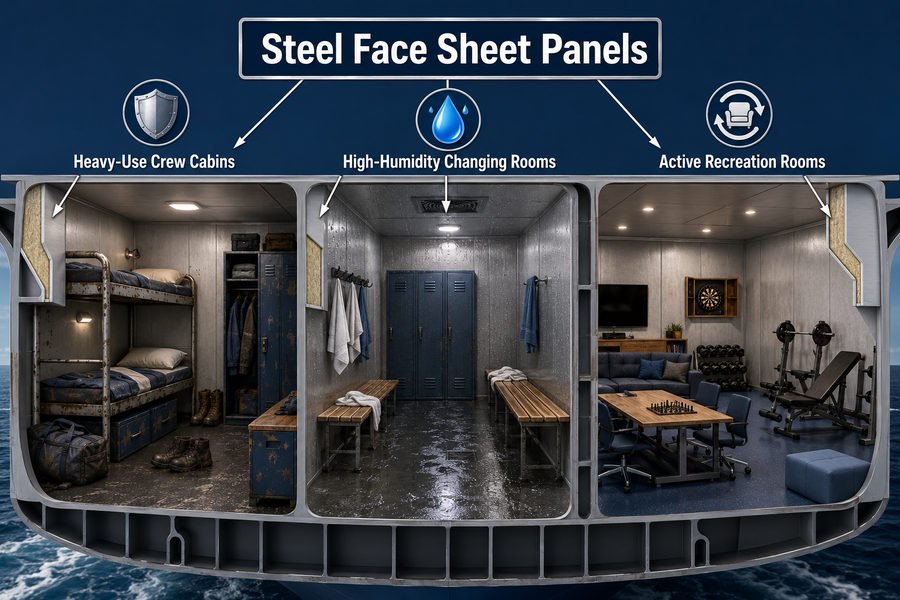
Three specific marine crew accommodation areas justify steel face sheets: heavy-use crew cabins, high-humidity changing rooms, and active recreation rooms. These spaces experience intense daily use, heavy gear storage, and moving furniture, making the extra cost of steel panels a smart, long-term investment for shipowners.
Heavy-Use Crew Cabins and High-Humidity Changing Rooms
You do not need steel everywhere, but you need it where the crew lives hard. Crew cabins on commercial ships see a lot of action. Crew members store heavy metal tool bags and bulky safety gear in small spaces. When they throw a heavy bag against the wall, an aluminum panel will dent easily8. Steel face sheets stop this damage. Changing rooms also need steel panels. These rooms have high humidity from showers. While aluminum does not rust, galvanized steel covered with a good PVC film gives a harder, better surface9. When crew members hit the walls with metal locker doors, the steel does not break. This keeps the changing rooms looking clean and professional.
Active Recreation Rooms and Gym Areas
Recreation rooms are the third area that justifies the cost of steel. On a long voyage, the crew uses these rooms every day to relax. They move heavy chairs, play table tennis, and use gym equipment. I visited a ship where a free weight was dropped against a wall. It hit a steel panel, so it only scratched the PVC film. If it was an aluminum panel, the weight would have cracked the panel core completely. When you bid for an interior project in Europe or the United States, showing that you put steel panels in these three specific areas proves you understand ship life. It shows you care about high quality and long-term maintenance, not just cheap prices.
| Crew Accommodation Area | Reason for Steel Specification | Common Damage Source | Return on Investment |
|---|---|---|---|
| Heavy-Use Crew Cabins | Small spaces with heavy gear | Tool bags, safety boots | High (Fewer replacements) |
| High-Humidity Changing Rooms | Constant locker door impacts | Metal doors, heavy hooks | Medium (Better appearance) |
| Active Recreation Rooms | Moving furniture and sports gear | Chairs, free weights | Very High (Prevents core breakage) |
What Surface Hardness Is Typical for Marine Accommodation Panel Steel Face Sheets?
Scratches and gouges ruin the look of your ship interiors. Soft panel surfaces look old very quickly. Proper surface hardness keeps the marine panels looking brand new for years.
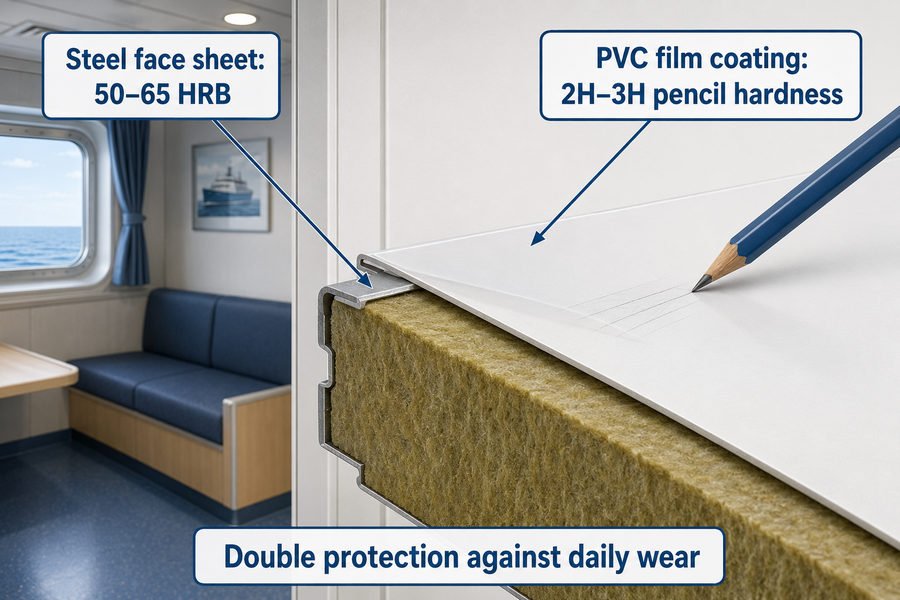
The surface hardness of marine accommodation steel face sheets typically ranges from 50 to 65 HRB (Rockwell Hardness) for the base metal. Additionally, the protective PVC film coating adds a scratch-resistant layer, usually rated at 2H to 3H pencil hardness, ensuring double protection against daily wear.
Rockwell Hardness of the Base Galvanized Steel
Hardness is different from strength. Hardness measures how well the metal stops scratches and surface cuts. For marine accommodation panels, factories use hot-dip galvanized steel. According to standard testing, this base steel usually has a Rockwell Hardness (HRB) between 50 and 6510. This is a very solid number. It means keys, metal belt buckles, and standard hand tools will not easily cut into the steel base. During factory inspections in China, I always ask the quality control team to show me the hardness test certificate from the steel mill. If the HRB is below 50, the steel is too soft. Soft steel will show deep gouges quickly, which makes the shipyard customer very angry.
Pencil Hardness of the Protective PVC Film Layer
But the raw steel is not what you see on the wall. The steel is covered by a decorative PVC film or a painted layer. This surface layer also has a hardness rating. We measure this in "pencil hardness." A good quality marine PVC film has a hardness of 2H to 3H. This means a very hard pencil pushed hard against the film will not scratch it. This double layer system—the 50 to 65 HRB steel base and the 2H to 3H PVC film—gives you the best protection. It stops both deep gouges and light surface scratches. When you talk to your suppliers, you must ask them for both the HRB of the steel and the pencil hardness of the film to ensure top quality.
| Material Layer | Hardness Metric | Typical Value Range | Primary Benefit |
|---|---|---|---|
| Galvanized Steel Base | Rockwell Hardness (HRB) | 50 - 65 HRB | Prevents deep gouges and cuts |
| Marine PVC Film | Pencil Hardness | 2H - 3H | Prevents light surface scratches |
How Do Steel-Faced Marine Galley Accommodation Panels Resist Trolley Impacts?
Food trolleys are heavy and hard to control on a moving ship. They crash into galley walls constantly. Steel panels are designed to fight these exact dynamic point loads.
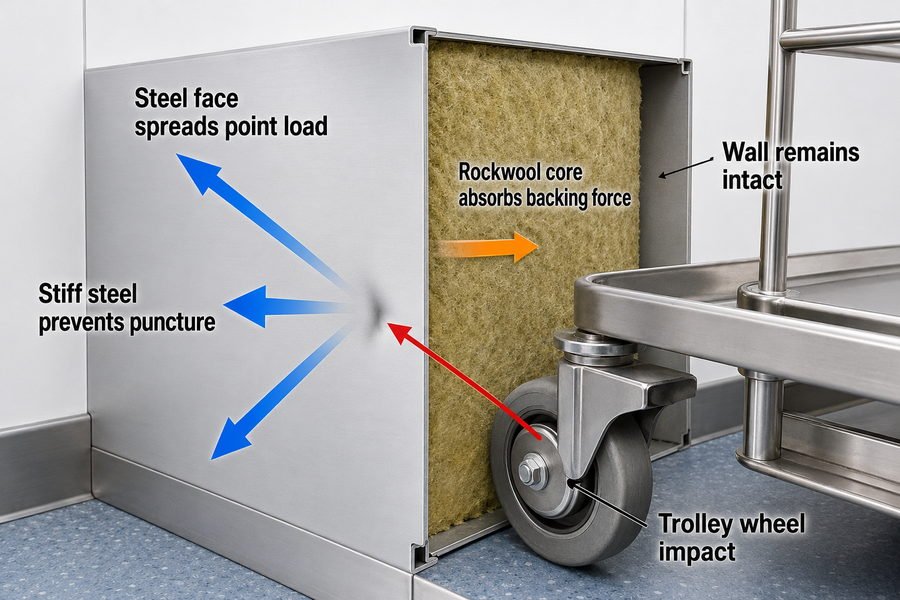
Steel-faced marine galley panels resist trolley impacts through three mechanisms: high point-load distribution, strong material stiffness, and a resilient rockwool core backing. The stiff steel spreads the sharp impact force of a heavy trolley wheel over a wider area, preventing deep punctures and keeping the wall intact.
High Point-Load Distribution and Material Stiffness
A food trolley hitting a wall is called a dynamic point load. The wheel or the sharp corner of the trolley hits a very small spot on the panel. A fully loaded galley trolley can weigh 100 kg. If the ship rolls, the trolley hits the wall with great speed. Steel resists this because of its high stiffness, also known as Young's Modulus. Steel has a Young's Modulus of about 200 GPa (Gigapascals).11 This high stiffness means the steel face sheet acts like a strong shield. It takes the sharp point force and spreads it out over a wider circle on the panel face. It stops the trolley corner from cutting a hole in the wall. Aluminum has a much lower stiffness, so it just bends inward.
The Role of Resilient Rockwool Core Backing
The steel face sheet does not work alone. The third mechanism is the rockwool core glued behind the steel. In a good marine panel, the steel is bonded to a rockwool core with a high density of 120 kg/m³ to 150 kg/m³. When the steel spreads the trolley impact, the dense rockwool acts like a firm cushion12. It absorbs the energy so the panel does not bend backward. I had a case where a buyer tried to use low-density rockwool (80 kg/m³) to save money. Even with strong steel faces, the panels dented because the core failed behind the metal. You must have all three mechanisms working together to resist galley trolleys successfully.
| Impact Resistance Mechanism | Component Responsible | Technical Value | Function in Impact Resistance |
|---|---|---|---|
| Point-Load Distribution | Steel Face Sheet | 200 GPa Stiffness | Spreads sharp force over a wide area |
| Material Stiffness | Galvanized Steel | 270 - 500 MPa Tensile | Prevents metal from stretching or tearing |
| Resilient Backing | Rockwool Core | 120 - 150 kg/m³ Density | Absorbs energy and supports the metal face |
Conclusion
Using steel face sheets for marine panels is a smart choice for high-impact zones. Choosing the right thickness and hardness protects your marine interiors and lowers long-term repair costs.
-
"Material Hardness - University of Maryland", https://web.calce.umd.edu/TSFA/Hardness_ad_.htm. Engineering material-property data show that common structural and galvanized steels generally have higher yield strength and hardness than many aluminum alloys, supporting the use of steel face sheets where resistance to plastic denting is important. Evidence role: mechanism; source type: education. Supports: Steel face sheets, commonly galvanized, are more resistant than aluminum face sheets to dents from impacts in heavy-traffic ship corridors.. Scope note: This supports the material-property rationale, but it does not directly prove performance for the specific wall-panel construction or impact scenario described. ↩
-
"Aluminum Honeycomb vs Rock Wool Core", https://magellanmarinetech.com/aluminum-honeycomb-rock-wool-core-mechanical-performance-marine-accommodation-panels/. Studies and engineering references on sandwich panels and metallic face sheets describe how higher-strength steel facings can improve impact resistance and reduce permanent indentation compared with lower-strength facings. Evidence role: mechanism; source type: paper. Supports: Steel face sheet panels can better resist impact deformation in galley-like conditions than aluminum-faced panels.. Scope note: The evidence is likely to be general to metal-faced panels or sandwich structures rather than a test of the exact marine galley panel described. ↩
-
"List of largest cruise ships - Wikipedia", https://en.wikipedia.org/wiki/List_of_largest_cruise_ships. Public data on large commercial vessels and cruise ships show crew complements that can number in the hundreds or more, making high daily occupancy of shared crew spaces such as mess rooms plausible. Evidence role: general_support; source type: institution. Supports: Central mess rooms on large ships may experience daily use by hundreds of crew members.. Scope note: Crew-complement data support the scale of potential use but do not directly measure traffic counts in any specific central mess room. ↩
-
"Aluminum Honeycomb vs Rock Wool Core", https://magellanmarinetech.com/aluminum-honeycomb-rock-wool-core-mechanical-performance-marine-accommodation-panels/. A standardized impact-test report or peer-reviewed low-velocity impact study on steel-faced mineral-wool sandwich panels can substantiate the stated joule range for comparable panel construction; if the tested panel differs in face thickness, core density, span, or support conditions, the evidence should be treated as contextual rather than directly equivalent. Evidence role: general_support; source type: paper. Supports: A 0.6 mm steel-faced panel with a 120 kg/m³ rockwool core can absorb approximately 15–25 J of impact energy.. Scope note: Impact absorption depends strongly on test setup, panel dimensions, boundary conditions, face thickness, and core specification, so support must closely match the described panel to prove the exact range. ↩
-
"(PDF) Statistical research of steel grades: DX51D, DX52D and DX53D", https://www.academia.edu/94935665/Statistical_research_of_steel_grades_DX51D_DX52D_and_DX53D. The EN 10346 material specification for continuously hot-dip coated steel flat products gives mechanical-property ranges for DX51D, including tensile strength values in the stated order of magnitude; this supports the grade-level property claim but not the impact performance of a finished marine panel. Evidence role: definition; source type: institution. Supports: DX51D hot-dip galvanized steel has a tensile strength range of roughly 270–500 MPa under EN 10346.. Scope note: Material tensile strength alone does not directly prove panel-level impact resistance, which also depends on panel design, core material, bonding, and test conditions. ↩
-
"How to choose the right marine wall panels for marine interior ...", https://magellanmarinetech.com/how-choose-right-marine-wall-panels-for-marine-interior-projects/. A classification-society rule, shipyard specification, or marine accommodation-panel standard documenting 0.6 mm steel face sheets would support the statement that this thickness is commonly used as a baseline in marine interior outfitting. Evidence role: general_support; source type: institution. Supports: 0.6 mm steel sheet thickness is a standard or common baseline for marine outfitting panels.. Scope note: Such a source may show common practice or a specification baseline, but may not prove a universal industry-wide standard across all vessel types and regions. ↩
-
"[PDF] Plastic buckling of columns at the micron scale - Harvard University", https://groups.seas.harvard.edu/hutchinson/papers/2022-5-SGPColumnBuckling.pdf. Engineering references on plate or sheet bending show that bending strength or section modulus scales with the square of sheet thickness, which makes a change from 0.6 mm to 0.7 mm approximately a 36% increase in bending capacity under simplified assumptions. Evidence role: mechanism; source type: education. Supports: Increasing steel face-sheet thickness from 0.6 mm to 0.7 mm can raise dent or bending resistance by roughly 35%.. Scope note: This supports the mechanical basis for the percentage estimate, but actual dent resistance also depends on steel grade, panel backing, impact geometry, and fastening conditions. ↩
-
"Material Hardness - University of Maryland", https://web.calce.umd.edu/TSFA/Hardness_ad_.htm. Materials-property references generally show that common steels have higher hardness and elastic modulus than common aluminum alloys, which is consistent with greater dent resistance under comparable impact conditions. Evidence role: mechanism; source type: education. Supports: Aluminum wall panels are more likely than steel-faced panels to dent under heavy impacts in crew cabins.. Scope note: This is contextual support only; actual denting depends on alloy grade, sheet thickness, panel backing, core material, and impact geometry. ↩
-
"Effects of Ambient Temperature and State of Galvanized Layer on ...", https://pmc.ncbi.nlm.nih.gov/articles/PMC10220731/. Technical literature on galvanized and polymer-coated steel indicates that zinc coatings provide sacrificial corrosion protection and polymer films can add a barrier layer in wet or humid service environments. Evidence role: mechanism; source type: research. Supports: PVC-coated galvanized steel can be a durable surface choice for humid changing rooms because the coating system improves corrosion resistance and surface protection.. Scope note: The source would support the corrosion-protection mechanism and surface-barrier rationale, but not prove that every PVC-coated galvanized panel is superior in all ship changing-room installations. ↩
-
"[PDF] Material Overview • ANSI", https://www.purdue.edu/bidc/wp-content/uploads/2021/08/ISOGrade.pdf. A materials standard, mill certificate dataset, or neutral materials database documenting Rockwell B hardness values for hot-dip galvanized steel sheet would support the stated hardness range for the steel substrate. Evidence role: statistic; source type: institution. Supports: Hot-dip galvanized steel used as the base material for marine accommodation panels usually has a Rockwell B hardness between 50 and 65 HRB.. Scope note: The range is contextual rather than universal because Rockwell hardness varies by steel grade, temper, coating specification, and production route. ↩
-
"[PDF] MATERIAL Type Cost ($/kg) Density (ρ ,Mg/m3) Young's Modulus (E ...", https://web.mit.edu/course/3/3.11/www/modules/props.pdf. Materials reference data list the elastic modulus of common structural steels at approximately 200 GPa, supporting the stated stiffness value used in the impact-resistance explanation. Evidence role: definition; source type: education. Supports: Steel has a Young's Modulus of about 200 GPa.. ↩
-
"Determination of Thermal Properties of Mineral Wool Required for ...", https://pmc.ncbi.nlm.nih.gov/articles/PMC10488771/. Research on sandwich panels with mineral-wool cores reports that core density and compressive behavior influence panel stiffness, load transfer, and impact response, which contextualizes the role of dense rockwool as backing support behind metal faces. Evidence role: mechanism; source type: paper. Supports: Dense rockwool backing helps support the steel face sheet and absorb impact energy so the panel is less likely to bend backward.. Scope note: This supports the general sandwich-panel mechanism; it may not directly prove the specific 120–150 kg/m³ density range or the described trolley-impact case. ↩