Are you struggling to select the right steel grade for your marine wall panels? Choosing the wrong material leads to rust and rejected inspections. I can help you decide.
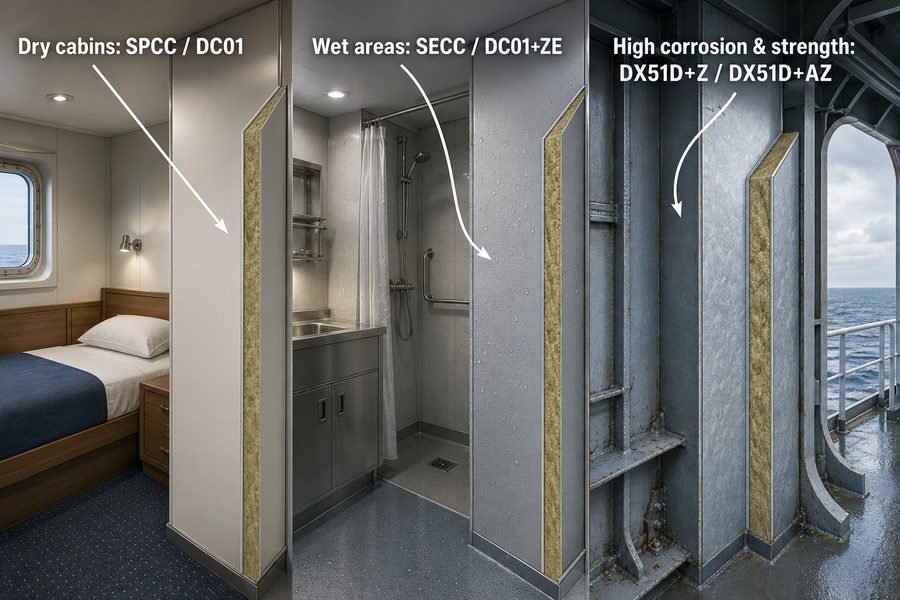
The most suitable steel grades for marine accommodation panel face sheets include SPCC and DC01 for dry cabins, SECC and DC01+ZE for moisture-prone areas, and DX51D+Z or DX51D+AZ for areas requiring high structural and corrosion resistance. These cover all standard dry, wet, and high-strength marine interior requirements.
Let us look closely at the exact specifications you need to order to ensure your next shipyard project passes inspection smoothly and stays within budget.
Which Cold-Rolled Steel Grades Suit Marine Accommodation Panel Face Sheets?
Does your cold-rolled steel face sheet crack during the bending process? Poor formability wastes money. You must select the correct base grade for smooth panel manufacturing.
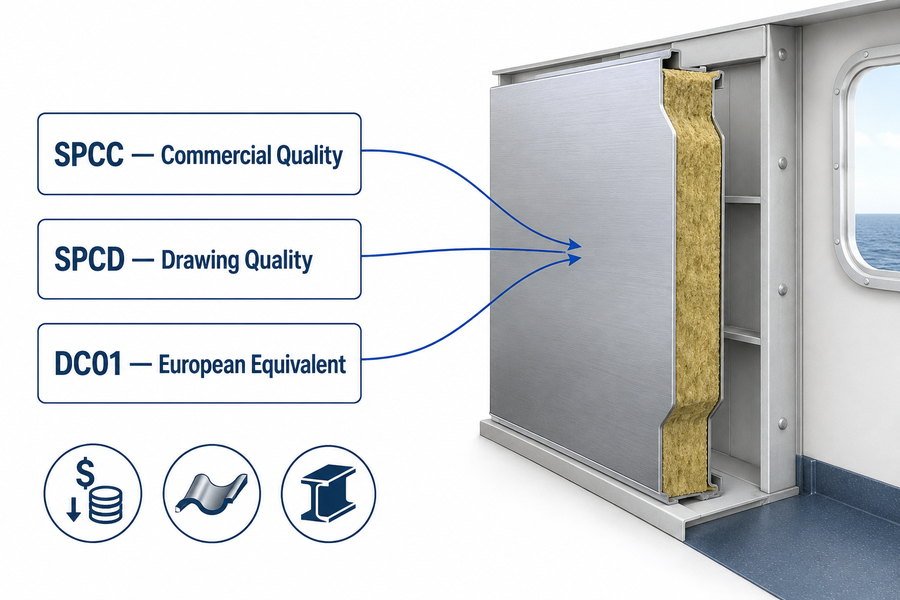
For marine accommodation panel face sheets, the three suitable cold-rolled steel grades are SPCC (commercial quality), SPCD (drawing quality), and DC01 (European standard equivalent). These three grades provide the necessary balance of cost, formability, and rigid support required for standard cabin bulkheads and ceilings.
Understanding SPCC and SPCD Cold-Rolled Steel Properties
I have seen many buyers choose the wrong base steel. They just ask for "steel panels" and get poor results. You must specify the exact grade. SPCC is the Japanese JIS G 3141 standard for commercial quality cold-rolled steel. Ship panel factories use SPCC for standard flat wall panels because it bends easily to 90 degrees using standard press brake machines. It has a typical yield strength between 160 MPa and 240 MPa.1 I always recommend SPCC for basic cabin partitions because it keeps your raw material costs low. However, some panels require deeper bending or complex edge profiles, such as those forming ceiling interlocking joints. In those cases, you must use SPCD. SPCD is the drawing quality grade. It allows deeper stamping without cracking at the corners. Its yield strength is slightly lower, ranging from 150 MPa to 220 MPa, which makes the metal softer and more forgiving during production.
Using DC01 Steel as the European Equivalent
Many of your shipyard clients in Europe will ask for European standard materials instead of Japanese standards. You must use DC01 steel for these projects. DC01 is defined by the EN 10130 standard. It is almost identical to SPCC in daily application. DC01 has a maximum yield strength of 280 MPa and a minimum elongation of 28%. When I review material certificates for European shipyard projects, the classification society surveyors always look for the DC01 designation. You can confidently buy DC01 from steel mills in Asia and know it will perfectly satisfy your European buyers. These three specific grades—SPCC, SPCD, and DC01—cover all basic cold-rolled manufacturing needs for marine interiors.
| Steel Grade | Defining Standard | Typical Yield Strength | Best Marine Panel Application |
|---|---|---|---|
| SPCC | JIS G 3141 | 160 - 240 MPa | Standard flat cabin bulkheads |
| SPCD | JIS G 3141 | 150 - 220 MPa | Complex ceiling joints and deep bends |
| DC01 | EN 10130 | Max 280 MPa | European shipyard projects |
What Steel Face Sheet Thickness Range Is Typical for Marine Accommodation Panels?
Are your marine panels too heavy or too flimsy? Incorrect thickness ruins the installation and increases shipping costs. You need the exact standard measurements used in the industry.
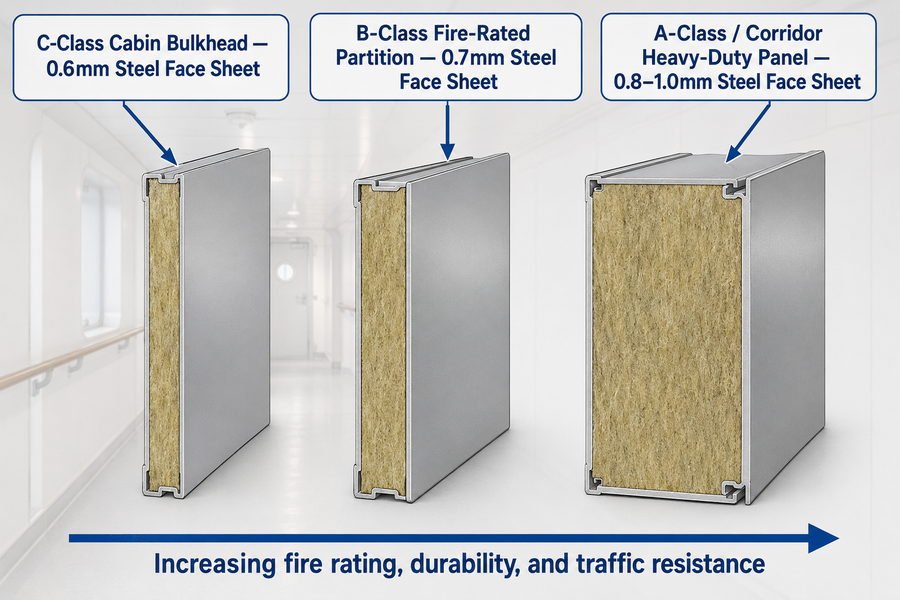
The typical steel face sheet thickness for marine accommodation panels falls into three specific categories: 0.6mm for standard C-class cabin bulkheads, 0.7mm for B-class fire-rated partitions, and 0.8mm to 1.0mm for heavy-duty A-class panels or high-traffic corridor walls.
The 0.6mm and 0.7mm Thickness Standards for C-Class and B-Class Panels
Steel thickness directly controls the price and the weight of your marine panel. I see procurement staff struggle with this daily. If you order standard C-class cabin panels2, you must specify a 0.6mm steel face sheet. According to typical marine manufacturing practices, 0.6mm provides enough rigidity for lightweight partitions where fire rating is not strictly tested. A 0.6mm steel sheet weighs approximately 4.71 kilograms per square meter. This keeps the overall panel light, which saves fuel for the vessel. When you upgrade to B-class fire-rated partitions, such as B-15 wall panels, you need a 0.7mm face sheet. A 0.7mm thickness ensures the steel will not warp too quickly when exposed to a standard fire test reaching 843°C in 30 minutes3, as required by SOLAS regulations. This extra 0.1mm difference might seem small, but it changes the whole structural integrity and prevents panel collapse during a fire.
The 0.8mm to 1.0mm Thickness Requirement for A-Class Panels
High-traffic areas and A-class fire boundaries require much thicker steel. You must use 0.8mm to 1.0mm steel sheets for heavy-duty A-Class panels, like A-60 bulkheads4. These bulkheads face severe structural stress and must withstand a furnace fire test reaching 927°C for a full 60 minutes. A 0.8mm steel sheet weighs about 6.28 kilograms per square meter. Furthermore, panels in public corridors endure heavy luggage impacts from passengers. A 0.6mm sheet will dent immediately under impact. Therefore, a 0.8mm or 1.0mm sheet is absolutely necessary to resist mechanical damage. When you negotiate with Asian suppliers, check their quotation carefully. Some factories try to supply 0.5mm steel to lower their price. You will face massive complaints from the shipyard if the panels dent during installation.
| Thickness | Weight (kg/m2) | Fire Test Exposure | Primary Panel Application |
|---|---|---|---|
| 0.6mm | ~4.71 kg | None (Non-combustible) | C-Class partitions |
| 0.7mm | ~5.50 kg | 843°C for 30 mins | B-Class (B-15) bulkheads |
| 0.8mm - 1.0mm | ~6.28 kg - 7.85 kg | 927°C for 60 mins | A-Class (A-60) & corridors |
Galvanized Steel vs Pre-Painted Steel for Marine Accommodation Panel Face Sheets?
Are you confused between buying bare galvanized steel or pre-painted steel rolls? Making the wrong choice delays your production and destroys your final profit margin.
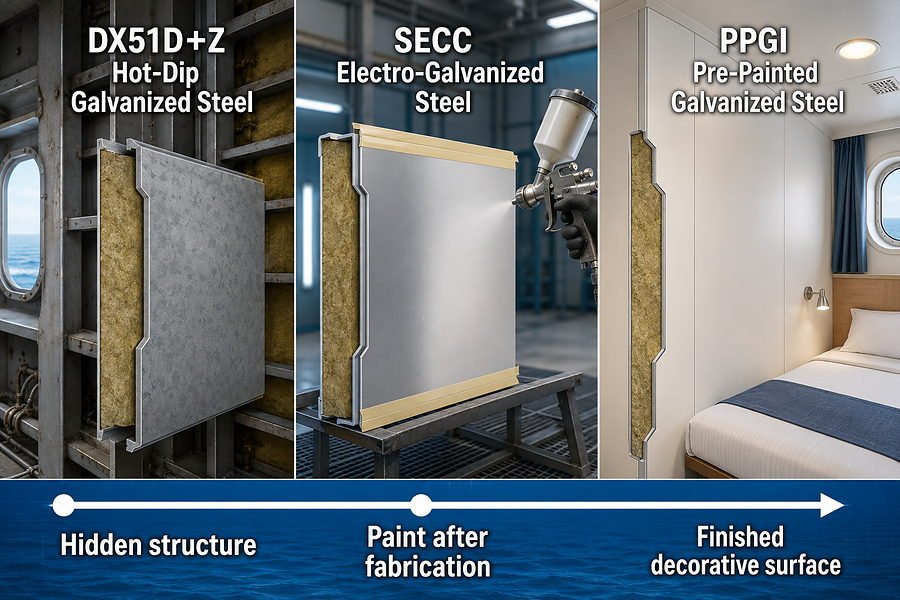
Marine accommodation panels utilize three surface strategies: hot-dip galvanized steel (DX51D+Z) for hidden structural areas, electro-galvanized steel (SECC) for panels requiring post-fabrication painting, and pre-painted galvanized steel (PPGI) for immediate use as finished, decorative cabin interior surfaces.
Utilizing Hot-Dip Galvanized and Electro-Galvanized Steel Sheets
You must understand the difference between surface treatments to control your manufacturing costs. I have helped many buyers switch their material strategy to save money. We use hot-dip galvanized steel5, specifically DX51D+Z according to the EN 10346 standard, strictly for hidden structural areas. This steel has a thick zinc coating, usually designated as Z120 or Z275. This means it has 120g to 275g of zinc per square meter. It offers excellent rust protection but has a rough, spangled appearance. You should only use it behind the ceiling or inside the core frame. If you plan to paint or apply PVC film to the panels yourself in your factory, you must buy electro-galvanized steel, known as SECC. SECC has a very thin, uniform zinc layer, often just 10g to 20g per square meter. The surface is perfectly smooth. Marine paint and PVC adhesives bond to SECC much better than to hot-dip galvanized steel.
The Advantages of Pre-Painted Galvanized Steel (PPGI) for Finished Cabins
The most popular choice for modern shipyard interiors is pre-painted galvanized steel, also known as PPGI. PPGI arrives at your panel factory already coated with a decorative finish. The steel mill bakes a polyester (PE) or polyvinylidene fluoride (PVDF) paint onto the galvanized base coil. The typical paint thickness is 20 to 25 microns on the top side. You skip the entire painting process in your own factory. You just cut the PPGI sheet, glue it to the rock wool core, and the panel is completely finished. This greatly reduces your production lead time. While PPGI costs roughly $100 to $150 more per ton than bare SECC steel, it saves you huge amounts of labor and eliminates the need for a painting facility.
| Surface Treatment | Code Example | Zinc Coating Level | Factory Processing Required | Best Application |
|---|---|---|---|---|
| Hot-Dip Galvanized | DX51D+Z | 120g - 275g / m2 | Cutting and bending only | Hidden frames, structural supports |
| Electro-Galvanized | SECC | 10g - 20g / m2 | Surface prep, painting, or PVC gluing | Custom colored panels painted in-house |
| Pre-Painted Galvanized | PPGI | Base zinc + 25μm paint | None (Ready to install) | Finished cabin walls and ceilings |
Which Steel Face Sheet Specification Is Required for A-Class Marine Accommodation Panels?
Does your A-Class marine bulkhead fail the fire test? Standard commercial steel melts and warps too fast. You must use the strictly regulated steel specifications.
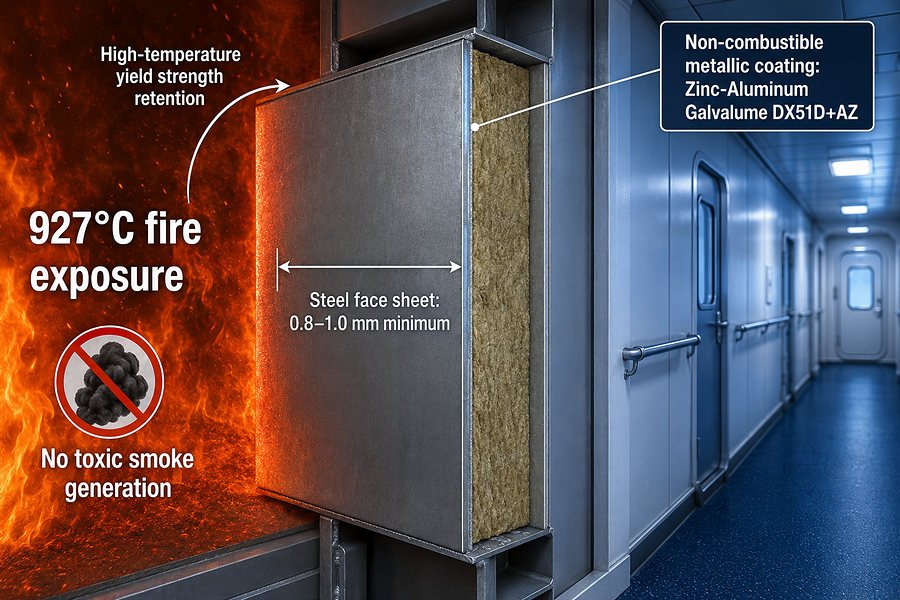
A-Class marine accommodation panels require three specific steel face sheet specifications: a minimum thickness of 0.8mm to 1.0mm, a high-temperature yield strength retention capability, and a non-combustible metallic coating like Zinc-Aluminum (Galvalume DX51D+AZ) to prevent toxic smoke generation under 927°C heat.
Minimum Thickness and Yield Strength Retention for A-Class Panels
A-Class panels act as the critical fire boundaries on a ship. The steel you use here is a matter of life and death. You cannot use thin, cheap metal. As I mentioned earlier, the first strict specification is the minimum thickness. The steel face sheet must be at least 0.8mm to 1.0mm thick. But thickness alone is not enough. The steel must possess high-temperature yield strength retention capability. During an A-60 fire test, the furnace temperature reaches 927°C within 60 minutes, according to the IMO 2010 FTP Code Part 36. Standard low-carbon steel loses more than 50% of its yield strength when temperatures exceed 600°C7. Therefore, the structural integrity of the partition relies heavily on this thicker, continuous steel sheet to keep the internal rockwool core compressed and standing upright without buckling.
Utilizing Galvalume (DX51D+AZ) for Extreme Heat Resistance
The third vital specification is the surface metallic coating. A standard zinc coating on hot-dip galvanized steel melts at approximately 419°C. In an A-Class fire, standard zinc burns away quickly and can create issues with the adhesive bond. Instead, you should use Galvalume steel, specified as DX51D+AZ. This specialized coating consists of 55% aluminum, 43.4% zinc, and 1.6% silicon8. Aluminum has a much higher melting point of 660°C. The Galvalume coating protects the steel base much longer during the severe fire test. Furthermore, this metallic coating is completely non-combustible. It guarantees zero toxic smoke generation9 when exposed to extreme heat. I highly recommend specifying DX51D+AZ with a 0.8mm minimum thickness when purchasing face sheets for A-60 marine bulkheads.
| Specification Category | Required Standard | Reference Regulation | Purpose During Fire Test |
|---|---|---|---|
| Sheet Thickness | 0.8mm to 1.0mm minimum | SOLAS Chapter II-2 | Prevents fast heat penetration and warping |
| Structural Integrity | High-temp yield retention | IMO 2010 FTP Code | Keeps panel standing upright at 927°C |
| Surface Coating | Galvalume (DX51D+AZ) | IMO 2010 FTP Code Part 1 | Resists melting up to 660°C, zero smoke |
What Mill Certificates Should Accompany Marine Accommodation Panel Steel Face Sheets?
Do classification societies reject your imported marine panels? Missing documentation halts your entire project. You must demand the correct factory certificates before the cargo ships.
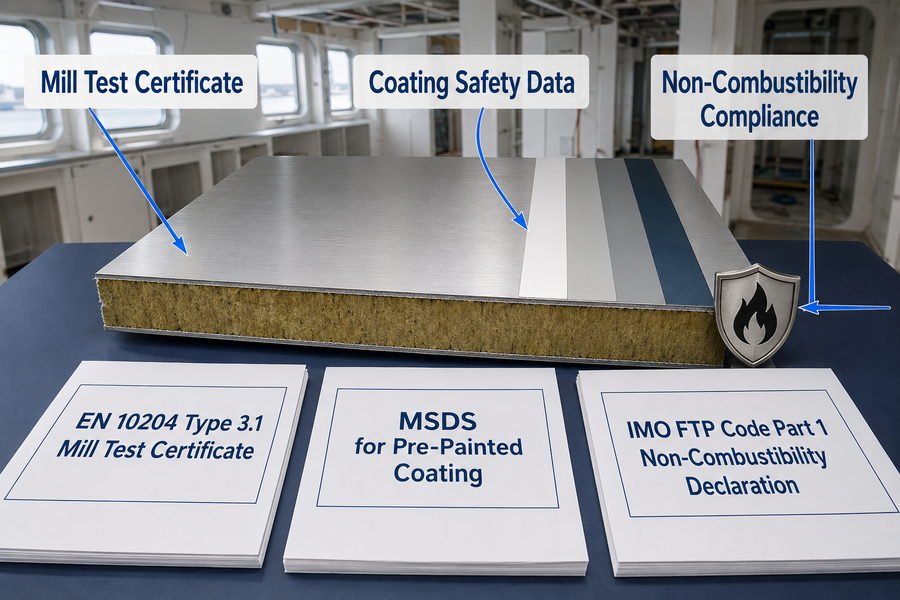
Marine accommodation panel steel face sheets must be accompanied by three essential documents: the EN 10204 Type 3.1 Mill Test Certificate, a Material Safety Data Sheet (MSDS) for any pre-painted coatings, and a Non-Combustibility Declaration confirming compliance with the IMO FTP Code Part 1.
The Importance of the EN 10204 Type 3.1 Mill Test Certificate
When you buy steel coils from marine suppliers in China or Vietnam, the physical metal is only half of the purchase. The paper documentation is the other half. I have seen containers of marine panels blocked at customs or rejected by shipyards because the buyer forgot the paperwork. You must secure the EN 10204 Type 3.1 Mill Test Certificate (MTC). This certificate proves the steel factory tested the specific batch of metal you bought. It traces directly to the heat number stamped on the steel coil. It lists the exact chemical composition, including carbon, manganese, and phosphorus levels. It also lists the mechanical properties, such as yield strength, tensile strength, and elongation. The 3.1 MTC must be stamped by the steel mill's independent authorized quality inspector. Shipyard surveyors will review this document to verify the steel matches the approved design drawings.
Providing the MSDS and Non-Combustibility Declaration
Next, you must provide a Material Safety Data Sheet, commonly known as an MSDS, for any pre-painted coatings (PPGI) or PVC films attached to the steel. The MSDS lists the chemical makeup of the paint and proves it does not contain prohibited toxic substances like lead or asbestos. Finally, you absolutely need a Non-Combustibility Declaration. The International Maritime Organization (IMO) mandates this under the FTP Code Part 110. This declaration certifies that the steel and its metallic coating will not catch fire. If the steel has a decorative paint layer, the paint must have a low flame-spread certificate proving it will not accelerate a fire. You must collect all three of these documents from your supplier. Without them, your panels have no value.
| Document Name | Issuing Authority | Key Information Provided | Purpose |
|---|---|---|---|
| EN 10204 Type 3.1 MTC | Steel Mill Quality Dept. | Chemical and mechanical test results | Proves physical strength matches design |
| MSDS | Paint or Film Manufacturer | Chemical composition of coating | Proves absence of toxic materials |
| Non-Combustibility Declaration | Approved Testing Lab | Pass status for IMO FTP Code Part 1 | Proves material will not burn or smoke |
Conclusion
Selecting the correct steel grade, thickness, and surface treatment ensures your marine panels pass strict fire tests. Always demand the proper mill certificates to protect your project and profits.
-
"[PDF] Material Overview • ANSI", https://www.purdue.edu/bidc/wp-content/uploads/2021/08/ISOGrade.pdf. Published material data for SPCC cold-rolled steel commonly report yield-strength values in the approximate 160–240 MPa range, depending on temper and processing condition. Evidence role: statistic; source type: research. Supports: SPCC typically has a yield strength between about 160 MPa and 240 MPa.. Scope note: The range is contextual because mechanical properties can vary by thickness, temper grade, mill practice, and certificate requirements. ↩
-
"How Does the IMO FTP Code Connect with Other Marine Fire Safety ...", https://magellanmarinetech.com/how-imo-ftp-code-connect-with-other-marine-fire-safety-frameworks/. SOLAS fire-protection definitions distinguish C-class divisions from A- and B-class divisions by requiring approved non-combustible materials without the same prescribed smoke/flame passage and insulation test periods applied to A- and B-class divisions. Evidence role: definition; source type: institution. Supports: C-class cabin panels are generally lightweight non-combustible partitions and are not subject to the same strict tested fire-rating requirements as B- or A-class divisions.. Scope note: This supports the fire-class distinction, not the article’s specific 0.6 mm face-sheet thickness. ↩
-
"[PDF] RESOLUTION MSC.307(88) (adopted on 3 December 2010 ...", https://wwwcdn.imo.org/localresources/en/KnowledgeCentre/IndexofIMOResolutions/MSCResolutions/MSC.307(88).pdf. The standard time-temperature curve used for fire-resistance testing, expressed as T = 345 log10(8t + 1) + 20, gives a furnace temperature of about 842–843°C at 30 minutes, providing context for B-class marine fire-test exposure. Evidence role: mechanism; source type: institution. Supports: A standard fire test reaches approximately 843°C after 30 minutes under the recognized time-temperature curve used in marine fire testing.. Scope note: This supports the furnace temperature curve; it does not by itself prove that a 0.7 mm face sheet is required for every B-15 panel design. ↩
-
"How Does the IMO FTP Code Connect with Other Marine Fire Safety ...", https://magellanmarinetech.com/how-imo-ftp-code-connect-with-other-marine-fire-safety-frameworks/. SOLAS/IMO fire-protection rules define A-class divisions as steel or equivalent divisions capable of preventing smoke and flame passage for a one-hour standard fire test, with the A-60 rating indicating insulation performance for 60 minutes. Evidence role: definition; source type: institution. Supports: A-60 bulkheads are A-class marine fire divisions tested for 60 minutes under the standard fire-resistance regime.. Scope note: This supports the A-60 fire-class requirement and test duration, not the article’s separate claim that 0.8–1.0 mm steel face sheets are universally required. ↩
-
"Galvanization - Wikipedia", https://en.wikipedia.org/wiki/Galvanization. Metallurgical references describe hot-dip galvanizing as forming a zinc-based coating that provides corrosion protection to steel, supporting the claim that hot-dip galvanized sheet is selected where rust resistance is important. Evidence role: mechanism; source type: encyclopedia. Supports: Hot-dip galvanized steel provides corrosion protection through a zinc coating.. Scope note: General corrosion-protection evidence does not prove that hot-dip galvanized sheet is always the optimal choice for every hidden cabin or frame application; performance depends on coating mass, environment, and design details. ↩
-
"[PDF] RESOLUTION MSC.307(88) (adopted on 3 December 2010 ...", https://wwwcdn.imo.org/localresources/en/KnowledgeCentre/IndexofIMOResolutions/MSCResolutions/MSC.307(88).pdf. The IMO 2010 FTP Code Part 3 specifies the standard fire-exposure curve for A-class division tests, under which the furnace temperature is approximately 925–927°C at 60 minutes. Evidence role: definition; source type: institution. Supports: During an A-60 fire test, the furnace temperature reaches about 927°C within 60 minutes under IMO 2010 FTP Code Part 3.. Scope note: The source supports the prescribed test temperature curve, not the performance of any specific panel construction. ↩
-
"[PDF] Elevated-Temperature Properties of Steel for Structural-Fire Analysis", https://fsel.engr.utexas.edu/pdfs/LEE_PhD_Dissertation_opt1.pdf. Elevated-temperature structural-steel data, such as Eurocode 3 reduction factors and related fire-engineering studies, show that carbon structural steels retain substantially less yield strength at around 600°C than at room temperature. Evidence role: statistic; source type: paper. Supports: Standard low-carbon steel loses more than half of its yield strength at temperatures above about 600°C.. Scope note: The exact percentage depends on steel grade, test method, strain level, and whether yield or proof strength is used. ↩
-
"Zinc-55% aluminum-1.6% silicon coating compared with zinc coating", https://www.osti.gov/biblio/80151. Standards and technical references for 55% aluminum-zinc alloy-coated sheet steel describe the coating composition as approximately 55% aluminum, 43.4% zinc, and 1.6% silicon by weight. Evidence role: definition; source type: institution. Supports: Galvalume or 55% aluminum-zinc alloy coating consists of about 55% aluminum, 43.4% zinc, and 1.6% silicon.. Scope note: The composition describes the coating alloy generally; individual products may also be specified by coating mass, substrate grade, and manufacturing standard. ↩
-
"[PDF] RESOLUTION MSC.307(88) (adopted on 3 December 2010 ...", https://wwwcdn.imo.org/localresources/en/KnowledgeCentre/IndexofIMOResolutions/MSCResolutions/MSC.307(88).pdf. The IMO FTP Code includes separate procedures for smoke and toxicity testing of materials, indicating that claims about smoke and toxic gas generation require test evidence under specified conditions. Evidence role: expert_consensus; source type: institution. Supports: Claims about zero toxic smoke generation under fire exposure require support from recognized smoke and toxicity testing methods.. Scope note: This source would not prove that Galvalume guarantees zero toxic smoke; it only establishes the relevant testing framework and the need for material-specific results. ↩
-
"[PDF] RESOLUTION MSC.307(88) (adopted on 3 December 2010 ...", https://wwwcdn.imo.org/localresources/en/KnowledgeCentre/IndexofIMOResolutions/MSCResolutions/MSC.307(88).pdf. The IMO Fire Test Procedures Code includes Part 1 for non-combustibility testing, and SOLAS fire-safety requirements reference the FTP Code for materials used in regulated ship applications. Evidence role: expert_consensus; source type: institution. Supports: IMO rules use FTP Code Part 1 as the non-combustibility test framework for relevant ship materials.. Scope note: The FTP Code does not mean every steel panel requires a separate declaration; applicability depends on the vessel, location, material assembly, and flag or class requirements. ↩