Shipyard warranty claims often stem from panel failures. Poor adhesive bonds ruin expensive interiors, costing you time and money. High-quality bond lines are the secret to lasting marine cabins.
Bond-line quality directly dictates panel lifespan by determining structural integrity, moisture resistance, and vibration tolerance. A superior bond prevents delamination and rust, ensuring panels survive the 15 to 25-year service life demanded by commercial ships, while poor bonds fail within two years under harsh maritime conditions.
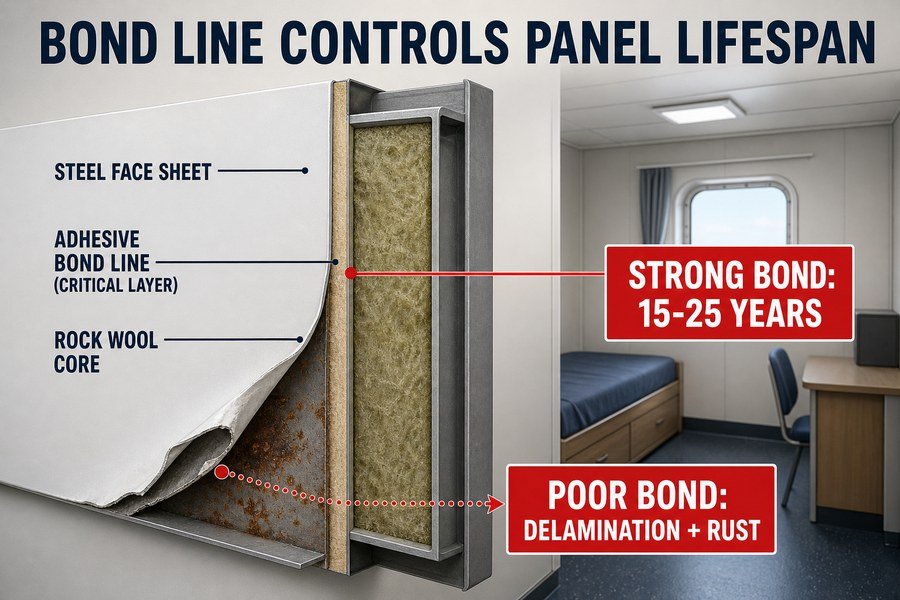
You might buy the best facing materials, but if the glue fails, the panel fails. Let us look at how different factors impact this vital bond and how you can spot the differences during procurement.
What Is the Service Life of Bonded Marine Accommodation Panels?
You need panels that last until the ship's next major refit. Replacing panels early eats your profit. Knowing the real lifespan helps you plan better interior projects.
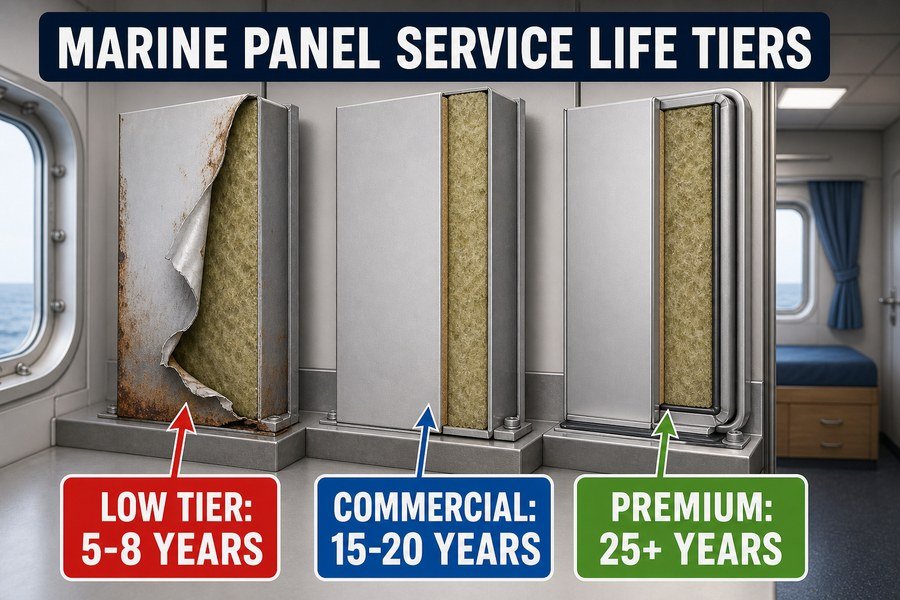
The service life of bonded marine accommodation panels spans 3 categories: 5-8 years for low-tier temporary panels, 15-20 years for standard commercial grade, and 25+ years for premium offshore panels. This depends entirely on adhesive type, facing thickness, and adherence to SOLAS fire safety regulations.
Service Life of Low-Tier and Standard Commercial Marine Panels
I remember a client who bought cheap panels for a bulk carrier. The panels failed in six years. They had to replace them during a drydock. This was a costly mistake. When we talk about the lifespan of bonded marine accommodation panels, we must look at three distinct categories. First, low-tier temporary panels usually last 5 to 8 years1. These use basic EVA adhesives. They are cheap but fail quickly. Second, standard commercial grade panels last 15 to 20 years. This is the industry standard for cargo ships and tankers. These panels use two-component polyurethane (PU) glues.
The SOLAS regulations require these panels to maintain their fire rating throughout their life. A standard B-15 bulkhead must stop flames for 30 minutes and keep the unexposed side below 140°C above ambient for 15 minutes.2 If the bond line fails early, the steel or aluminum facing detaches from the rockwool core. This instantly voids the fire certificate. You must check the manufacturer's technical data sheet (TDS). Look for a minimum tensile shear strength of 5.0 MPa (MegaPascals) for standard panels, as tested under ISO 4587 standards. This strength guarantees the 15 to 20-year lifespan.
Service Life of Premium Offshore Marine Panels
Third, premium offshore panels last 25 or more years. We use these on cruise ships and oil rigs. They use advanced modified silane polymers. These cost more upfront but save money later. Let us look at the cost over time. If a standard B-15 class fire panel costs $35 per square meter and lasts 20 years, the cost per year is $1.75. If a cheap panel costs $25 but needs replacing in 8 years, the cost per year is $3.12. You lose money with cheap panels. You need to match the panel life to the ship's drydock schedule.
| Panel Category | Expected Service Life | Typical Adhesive Used | Average Cost per Square Meter |
|---|---|---|---|
| Low-Tier Temporary | 5 to 8 Years | Basic EVA | $20 to $25 |
| Standard Commercial | 15 to 20 Years | Two-Component PU | $35 to $45 |
| Premium Offshore | 25+ Years | Modified Silane Polymer | $55 to $70 |
How Does Saltwater Degrade Marine Accommodation Panel Bonds?
Saltwater mist creeps into ships and ruins interiors. You might see the panel edges peeling. We must understand how salt attacks the glue to stop this damage.
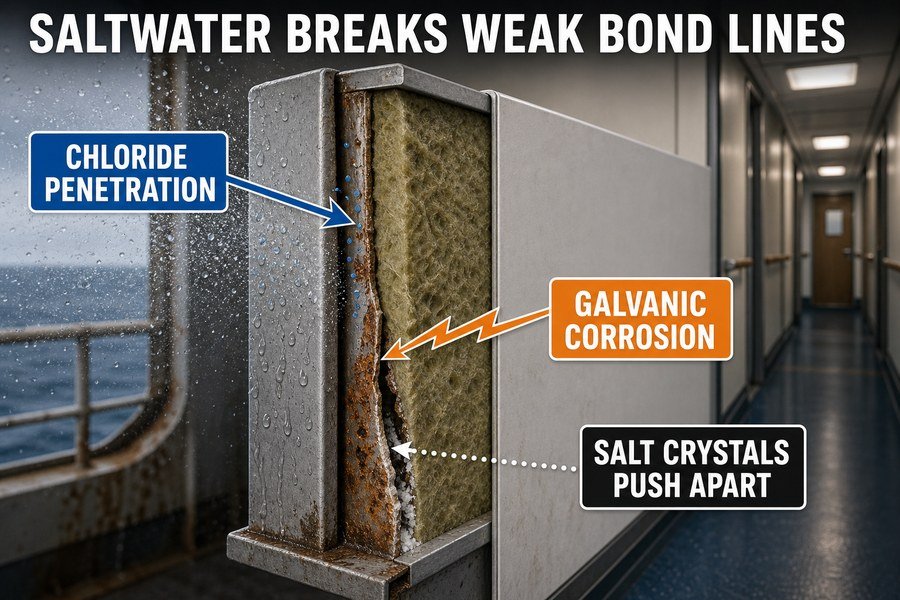
Saltwater degrades marine panel bonds through 3 distinct mechanisms: chloride ion penetration that attacks the adhesive structure, galvanic corrosion at the metal-adhesive interface, and salt crystallization that physically pushes the layers apart. Together, these cause total delamination and structural failure if edges are unsealed.
Chloride Ion Penetration and Galvanic Corrosion in Marine Panels
When you buy panels for a shipyard, the coastal environment is your biggest enemy. Saltwater degrades marine panel bonds through three specific mechanisms. You must know these to choose the right products. First, we have chloride ion penetration. Seawater contains about 35 grams of salt per liter.3 These chloride ions penetrate porous adhesive structures. They break down the chemical cross-links in cheap glues.4 Second, we see galvanic corrosion at the metal-adhesive interface. When salt water touches the galvanized steel skin and the moisture hits the glue, it creates a small electrical cell5. This rusts the steel from the inside. The glue loses its grip. According to ISO 9227 salt spray tests, a poor bond line will show 10mm of edge peel within just 500 hours of salt spray exposure.
To prevent this, factories must use edge-sealing techniques. A high-quality marine panel uses a folded edge design or a PVC profile sealed with marine-grade silicone. The silicone must meet the ASTM B117 standard for salt spray resistance. It must survive at least 1,000 hours with zero penetration. When you review quotes from factories in Asia, always ask how they seal the panel edges. If they leave the rockwool and glue line exposed, do not buy them. The salt air during ocean transport alone will start the degradation process before you even install them in the cabins.
Salt Crystallization Expansion in Accommodation Panel Edges
Third, salt crystallization physically pushes the layers apart. When salt water enters a micro-crack and dries, the salt crystals grow. This crystal growth exerts a physical pressure of up to 40 MPa.6 This pressure easily snaps the adhesive bonds. I have seen panels pop open purely from salt buildup on poorly sealed cargo ships.
| Degradation Mechanism | Damage Type | Prevention Method | ISO Test Standard |
|---|---|---|---|
| Chloride Penetration | Chemical Breakdown | Use Non-Porous Adhesives | ISO 9227 |
| Galvanic Corrosion | Rust at Metal Interface | Zinc Coating and Edge Sealing | ASTM B117 |
| Salt Crystallization | Physical Pushing Force | Marine Grade Silicone Seals | ISO 9142 |
How Does Humidity Cycling Weaken Marine Accommodation Panel Bonds?
Ships travel from freezing climates to tropical oceans. This constant weather change causes hidden damage. Your cabin bulkheads will bubble and warp if the glue cannot handle humidity.
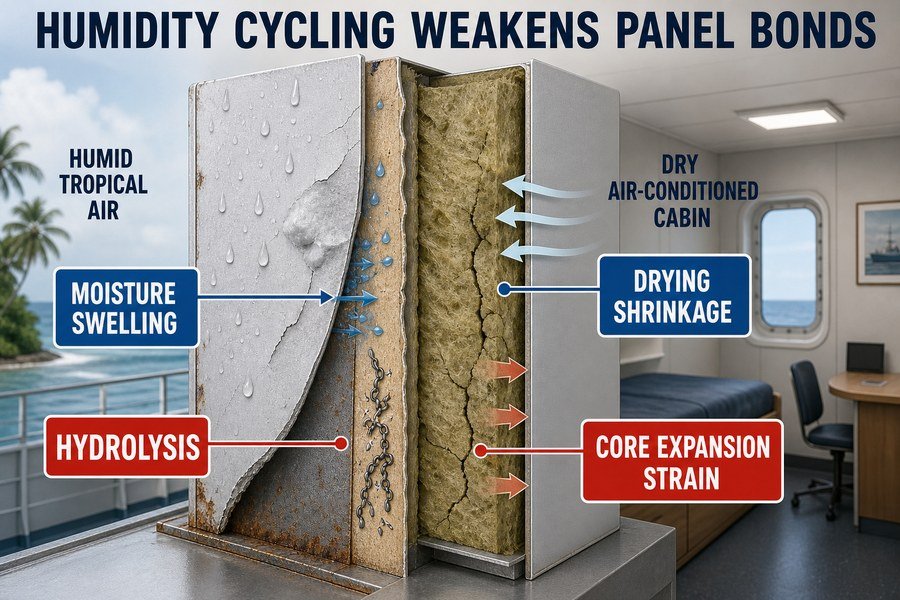
Humidity cycling weakens panel bonds in 4 ways: moisture absorption causing adhesive swelling, subsequent drying causing shrinkage, hydrolysis breaking chemical bonds, and core material expansion straining the glue line. This repeated stress cycle induces microscopic cracks that eventually severe the facing from the core.
Moisture Swelling and Drying Shrinkage in Marine Adhesives
A ship sails from Norway to Indonesia. The temperature and moisture change fast. This humidity cycling is a major test for your interior materials. Humidity cycling weakens panel bonds in four specific ways.7 First, moisture absorption causes the adhesive to swell. Glues that are not water-resistant soak up moisture from the air. Second, the subsequent drying causes shrinkage. When the ship enters a dry, air-conditioned zone, the moisture leaves the glue. The glue shrinks. This constant swelling and shrinking creates severe fatigue in the glue layer.
To fix this, you must buy panels made with reactive hot melt (PUR) adhesives. PUR adhesives undergo a chemical cross-linking process with moisture in the air during curing.8 Once cured, they do not react to humidity cycles. They can easily withstand relative humidity (RH) drops from 95% down to 30% daily without losing any peel strength.9 Always ask your supplier if their adhesive is fully moisture-curing PUR.
Hydrolysis Damage and Core Expansion in Accommodation Panels
Third, we have hydrolysis. This is a chemical reaction where water molecules break the long polymer chains in the adhesive.10 Lower-grade polyurethane adhesives are very sensitive to hydrolysis. Their bond strength drops from 6.0 MPa to less than 2.0 MPa after 30 cycles of high humidity testing based on ISO 9142 standard tests. Fourth, the core material expansion strains the glue line. If you use a mineral wool core, it can absorb water vapor. As the core expands, it pulls against the steel facing. The glue sits in the middle and takes all the stress.
The repeated stress cycle creates microscopic cracks. Once these cracks form, the facing separates from the core. We call this a "blister" or a "bubble" on the panel surface.
| Humidity Factor | Effect on Panel | Stress Level on Bond | Solution |
|---|---|---|---|
| Moisture Swelling | Adhesive expands | High | Use Moisture-Curing PUR |
| Drying Shrinkage | Adhesive contracts | High | Flexible Polymer Chains |
| Hydrolysis | Chemical bonds break | Critical | Hydrolysis-Resistant Glue |
| Core Expansion | Rockwool pulls steel | Medium | High Tensile Strength Glue |
How Do Load Cycles Affect Marine Accommodation Panel Bond Integrity?
Passengers lean on walls. Doors slam constantly. Heavy seas cause the ship hull to flex. These load cycles push and pull the panel bonds every single day.
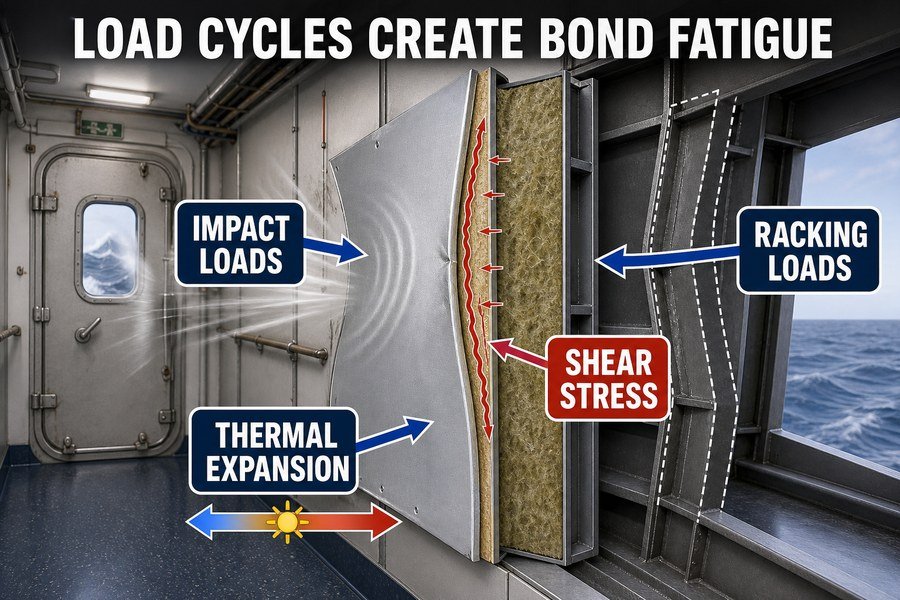
Load cycles affect bond integrity through 3 primary mechanisms: impact loads from daily cabin usage, racking loads from ship hull twisting in heavy seas, and thermal expansion loads from sun exposure. These constant dynamic forces cause fatigue failure and shear stress, permanently breaking weak adhesive links.
Impact Loads and Racking Loads on Marine Bulkheads
Ships are moving structures. The walls inside a ship face forces that land buildings never see. Load cycles affect bond integrity through three primary mechanisms. I always check these when evaluating a new supplier for my clients. First, we have impact loads from daily cabin usage. People bump into walls with luggage. Heavy marine fire doors slam shut. A standard B-15 marine door weighs around 45 kilograms. When it slams, it sends a shockwave through the adjacent wall panels.
Second, racking loads occur from ship hull twisting in heavy seas11. When a vessel hits large waves, the steel hull flexes. The interior accommodation panels must absorb this movement. If the adhesive is too rigid, it will snap. The glue must have an elongation at break of at least 30% to 50% according to DIN EN ISO 52712. This flexibility allows the panel to bend without breaking the bond. I tell all procurement managers to avoid rigid epoxy glues for long-wall partitions. Flexible polyurethane or silane-modified polymers are the only safe choices.
Thermal Expansion Loads on Ship Cabin Panels
Third, thermal expansion loads occur from sun exposure. A steel deck gets very hot. The panels expand. The steel facing expands faster than the rockwool core13. This creates massive shear stress on the glue line. These constant dynamic forces cause fatigue failure14. Think of bending a paperclip back and forth until it snaps. The same thing happens to brittle glue.
During your procurement process, you should request dynamic fatigue test reports. High-quality suppliers run cyclic load tests. They apply 1,000 Newtons of force to the panel 10,000 times. If the panel stays together, the glue is good.
| Load Type | Source of Load | Required Adhesive Property | ISO Test Standard |
|---|---|---|---|
| Impact Loads | Doors slamming, luggage | Shock Absorption | ISO 6272 |
| Racking Loads | Ship hull twisting in waves | 30% to 50% Elongation | DIN EN ISO 527 |
| Thermal Loads | Sun heating the steel deck | High Shear Strength | ISO 4587 |
Which Aging Tests Predict Marine Accommodation Panel Bond Life?
You cannot wait twenty years to see if a panel is good. We use laboratory tests to speed up time. These tests prove the quality before you buy.
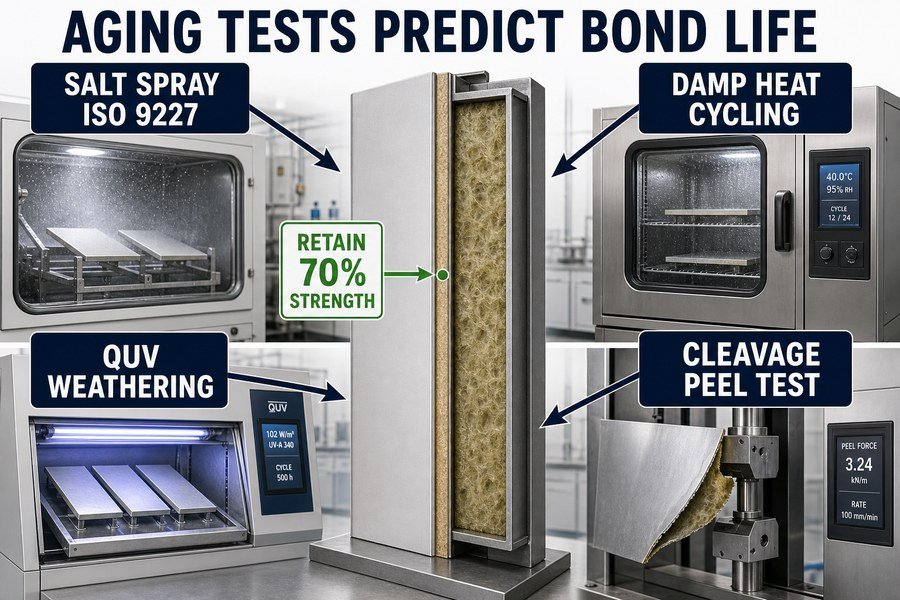
To predict bond life, laboratories use 4 standard aging tests: the Salt Spray Test (ISO 9227) for corrosion, Damp Heat Cycling (IEC 60068) for humidity fatigue, the QUV Accelerated Weathering Test for UV degradation, and the Cleavage Peel Test (ASTM D3807) to measure remaining bond strength after aging.
Salt Spray Test and Damp Heat Cycling for Marine Panels
When you buy products from overseas, you need proof of quality. Paper certificates are not enough. You must look at the specific test data. Laboratories use four standard aging tests to predict the bond life of marine accommodation panels. First, the Salt Spray Test (ISO 9227)15 checks for corrosion resistance. The panels sit in a chamber with a 5% sodium chloride fog at 35°C for 500 to 1,000 hours. This simulates years of sea air exposure.
Second, Damp Heat Cycling (IEC 60068) tests humidity fatigue. The lab changes the temperature from 25°C to 55°C while keeping the humidity at 95%. This happens in 12-hour cycles for 21 days. This proves the panel will not blister when sailing through the tropics. When I negotiate with suppliers in China or Vietnam, I always ask for these exact reports. Many small factories cannot provide them. This is a clear warning sign.
QUV Weathering and Cleavage Peel Tests for Adhesive Bonds
Third, the QUV Accelerated Weathering Test checks for UV degradation16. Even interior panels near windows face strong sunlight. This test blasts the panels with UV radiation and condensation. Fourth, the Cleavage Peel Test (ASTM D3807) measures the actual remaining strength. After the panels go through the first three tests, a machine tries to rip the steel facing off the core.
A good marine panel must retain at least 70% of its original peel strength17 after these aging tests. For example, if the initial peel strength is 60 N/cm, it must not drop below 42 N/cm after testing. By insisting on these test results, you ensure you only buy panels that will truly last the full 20-year service life.
| Test Name | International Standard | Duration or Parameters | Minimum Pass Criteria |
|---|---|---|---|
| Salt Spray Test | ISO 9227 | 500 to 1,000 Hours | Zero edge delamination |
| Damp Heat Cycling | IEC 60068 | 21 Days (25°C to 55°C) | No surface blistering |
| QUV Weathering | ASTM G154 | 1,000 Hours | No adhesive cracking |
| Cleavage Peel Test | ASTM D3807 | Pull until failure | Retain 70% original strength |
Does Adhesive Yellowing Signal Marine Accommodation Panel Bond Decay?
You might notice yellow stains on the edges of old panels. This looks bad, but is it dangerous? Let us find out if color changes mean structural failure.
Adhesive yellowing falls into 2 categories: harmless cosmetic yellowing caused by UV light affecting aromatic polyurethanes, and critical structural yellowing caused by chemical oxidation and thermal degradation. While cosmetic yellowing only affects appearance, oxidative yellowing indicates the glue is becoming brittle, losing flexibility, and nearing total bond failure.
Harmless Cosmetic Yellowing in Marine Adhesives
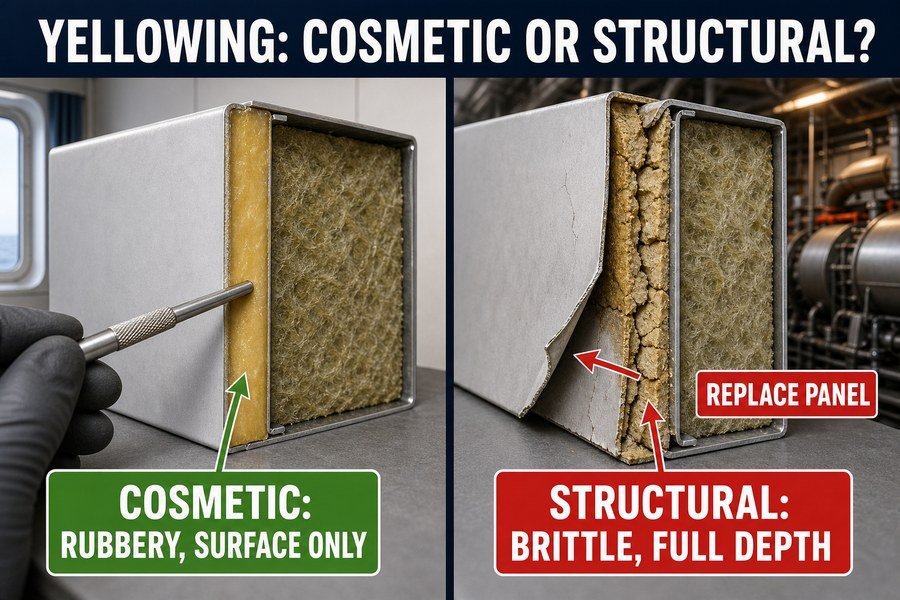
When inspecting a refit project, you will often see yellowed glue lines. Clients always ask me if they need to replace these panels. The answer depends on why it is yellow. Adhesive yellowing falls into two distinct categories. You must know the difference to save money. First, we have harmless cosmetic yellowing. This happens primarily to aromatic polyurethane adhesives when exposed to UV light18. The UV rays change the surface molecules, creating a yellow or brown tint.
However, this is just a skin-deep reaction. It only goes about 0.1 mm deep.19 The bond underneath remains 100% strong. If the panel is in a brightly lit cabin but still feels solid when you push on it, it is usually safe. You do not need to spend money replacing panels with mere cosmetic yellowing.
Critical Structural Yellowing and Bond Failure in Ship Panels
Second, we have critical structural yellowing. This is caused by chemical oxidation and thermal degradation over many years. The heat from the ship's engine rooms or prolonged high ambient temperatures literally cooks the adhesive. This type of yellowing goes all the way through the glue line. It indicates that the polymer chains are breaking down20.
While cosmetic yellowing only affects appearance, oxidative yellowing indicates the glue is becoming brittle. The adhesive loses its flexibility. Its elongation drops from 40% down to less than 5%.21 Soon, ship vibrations will shatter this brittle glue, leading to total bond failure. You can test this easily. Take a small probe and gently press the exposed yellow glue at the panel edge. If the glue is still rubbery, it is cosmetic. If the glue chips, cracks, or turns to powder, it is structural decay. In this case, you must replace the panels immediately.
| Yellowing Category | Primary Cause | Depth of Damage | Physical State of Glue | Action Required |
|---|---|---|---|---|
| Cosmetic | UV Light Exposure | 0.1 mm (Surface only) | Rubbery and Flexible | None (Safe to use) |
| Structural | Heat and Oxidation | Full depth | Brittle and Powdery | Replace immediately |
How Do Ship Vibrations Cause Marine Accommodation Panel Delamination?
The main engine of a ship runs constantly. This sends endless vibrations through every deck. This silent shaking slowly tears cheap cabins apart piece by piece over time.
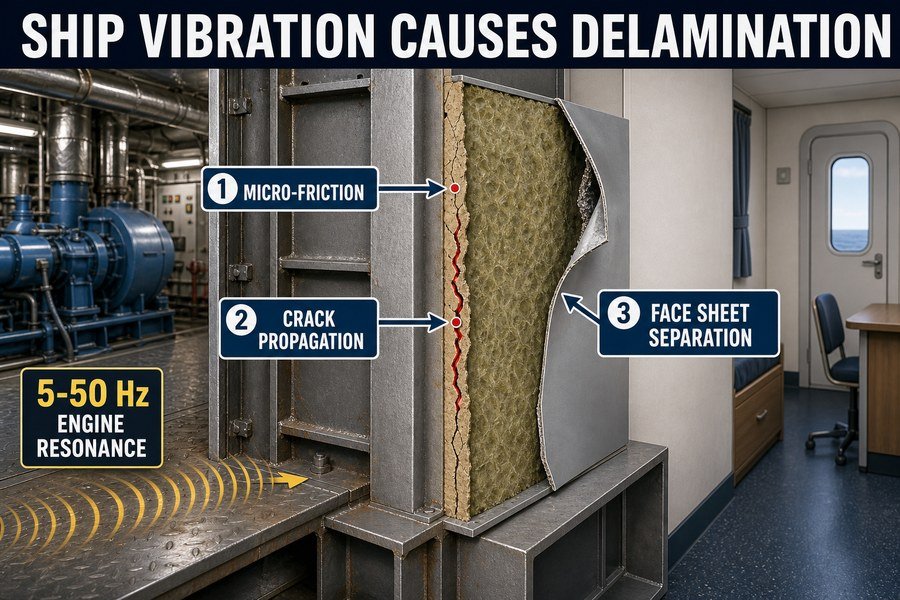
Ship vibrations cause panel delamination through 3 stages: continuous low-frequency engine resonance causing micro-frictions, propagation of these micro-cracks along the rigid adhesive line, and final catastrophic separation of the steel facing. This occurs primarily when shipyards use cheap, non-elastic adhesives that cannot absorb the 5 Hz to 50 Hz engine frequencies.
Continuous Low-Frequency Engine Resonance on Marine Bulkheads
Ship engines create powerful vibrations. These vibrations travel through the steel decks straight into the cabin walls. Ship vibrations cause panel delamination through three specific stages. I have seen this ruin many beautiful ship interiors. First, we have continuous low-frequency engine resonance causing micro-frictions. A large two-stroke marine diesel engine creates vibrations between 5 Hertz and 50 Hertz.22 These low frequencies are very destructive. They cause the steel panel facing and the rockwool core to vibrate at slightly different speeds. This creates tiny micro-frictions right at the glue line.
To stop this, you must demand vibration-damping adhesives. High-quality marine suppliers use specialized viscoelastic polyurethanes. These adhesives turn the mechanical vibration energy into a tiny amount of heat, absorbing the shock.23 The glue must have a high loss factor when tested under dynamic mechanical analysis (DMA).
Micro-Crack Propagation and Catastrophic Panel Separation
Second, we see the propagation of these micro-cracks along the rigid adhesive line. If the factory used a cheap, hard glue, it cannot flex with the vibration. The micro-frictions turn into micro-cracks. Day after day, these cracks link together.24 They form a long tear inside the panel. Third, we get the final catastrophic separation of the steel facing. Once the crack reaches a critical length, the whole metal sheet detaches from the core. The panel loses its structural shape and its fire rating.25
This failure occurs primarily when shipyards use cheap, non-elastic adhesives. When you buy, ask the factory for their vibration resistance test reports. A good panel should withstand at least 2 million cycles of 10 Hz vibration at a 2 mm amplitude without any loss of bond strength. This is the only way to ensure the cabins survive the ship's engine.
| Delamination Stage | Vibration Effect on Panel | Damage Level | Timeframe on Vessel |
|---|---|---|---|
| 1. Engine Resonance | Micro-frictions at glue line | Invisible | 1 to 3 Years |
| 2. Crack Propagation | Cracks link along rigid glue | Internal Tearing | 3 to 5 Years |
| 3. Catastrophic Separation | Steel facing falls off core | Total Failure | 5+ Years |
Conclusion
Bond-line quality is the true heart of marine panel lifespan. By demanding flexible, moisture-resistant adhesives and strict testing data, you secure long-lasting, safe interiors for your shipbuilding projects.
-
"[PDF] Shelf Life Assessment of poly (ethylene-co-vinyl acetate) and ... - OSTI", https://www.osti.gov/servlets/purl/1115545. A neutral materials or marine-engineering source should support the stated 5–8 year service-life range for low-cost bonded accommodation panels, preferably by documenting field durability or accelerated-aging behavior of EVA-bonded sandwich panels in humid or marine environments. Evidence role: statistic; source type: paper. Supports: Low-tier temporary marine accommodation panels usually last 5 to 8 years.. Scope note: The source may support EVA adhesive durability limits under relevant environmental exposure rather than directly proving this exact service-life range for all low-tier marine panels. ↩
-
"46 CFR 116.415 -- Fire control boundaries. - eCFR", https://www.ecfr.gov/current/title-46/chapter-I/subchapter-K/part-116/subpart-D/section-116.415. The IMO FTP Code and SOLAS fire-safety framework define B-class divisions as preventing flame passage for the first 30 minutes and require B-15 insulation performance to limit average unexposed-face temperature rise to 140°C within 15 minutes. Evidence role: definition; source type: institution. Supports: A B-15 bulkhead must prevent flame passage for 30 minutes and meet the specified 15-minute temperature-rise criterion.. Scope note: This supports the regulatory performance definition of B-15 divisions, not the article’s broader claims about adhesive failure or certificate invalidation. ↩
-
"Sea Water", http://cimss.ssec.wisc.edu/sage/oceanography/lesson3/ocean/seawater.htm. Standard oceanographic references report average seawater salinity near 35 g/kg, commonly approximated as about 35 g/L for practical discussion of marine exposure. Evidence role: statistic; source type: education. Supports: Seawater contains about 35 grams of salt per liter.. Scope note: The exact salt concentration varies by ocean region, temperature, and evaporation/precipitation conditions. ↩
-
"Effect of cross-linking on the diffusion of water, ions, and ... - PubMed", https://pubmed.ncbi.nlm.nih.gov/19239244/. Materials research on polymer adhesives and coatings describes how water and dissolved ions can diffuse into polymer networks and contribute to hydrolysis, plasticization, swelling, or interfacial weakening under marine exposure. Evidence role: mechanism; source type: paper. Supports: Chloride-containing seawater can penetrate adhesive systems and contribute to chemical degradation or weakening of adhesive bonds.. Scope note: Such sources usually support moisture- and ion-assisted degradation mechanisms generally; they may not prove that all low-cost glues undergo cross-link scission in the same way. ↩
-
"Galvanic corrosion - Wikipedia", https://en.wikipedia.org/wiki/Galvanic_corrosion. Corrosion references explain that galvanic corrosion occurs when dissimilar electrochemical areas or metals are electrically connected in the presence of an electrolyte such as seawater, forming a corrosion cell that drives anodic metal dissolution. Evidence role: mechanism; source type: government. Supports: Saltwater contact at a metal interface can form an electrochemical cell that promotes galvanic or localized corrosion.. Scope note: The source would support the electrochemical principle; the exact corrosion rate in a specific marine panel depends on coating condition, metal pairing, electrolyte access, and geometry. ↩
-
"Multiscale simulation of salt crystallization-induced damage in ...", https://pmc.ncbi.nlm.nih.gov/articles/PMC12823642/. Studies of salt crystallization in porous materials report that crystallization pressure can reach tens of megapascals under constrained conditions, providing a physical mechanism for cracking or separation in susceptible materials. Evidence role: mechanism; source type: paper. Supports: Salt crystallization in confined pores or cracks can generate pressures up to the order of tens of megapascals, including values around 40 MPa under certain conditions.. Scope note: Reported pressures depend strongly on pore size, supersaturation, salt type, and confinement; the value is contextual rather than a direct measurement for the specific panel construction described. ↩
-
"[PDF] Adhesion loss at epoxy/glass interfaces under hygrothermal ...", https://preserve.lehigh.edu/system/files/derivatives/coverpage/389911.pdf. A peer-reviewed study or standards-based review on bonded sandwich panels under hygrothermal cycling can substantiate that repeated moisture and temperature changes degrade adhesive joints through swelling, shrinkage, chemical aging, and substrate/core movement. Evidence role: general_support; source type: paper. Supports: Humidity cycling weakens panel bonds through multiple mechanisms including swelling, shrinkage, hydrolysis, and core-related stresses.. Scope note: Such evidence would support the general degradation mechanisms, but may not prove that these are always the only four mechanisms in every marine panel construction. ↩
-
"Curing Kinetics and Structure-Property Relationship of Moisture ...", https://ui.adsabs.harvard.edu/abs/2023EurPJ.20112579M/abstract. A polymer chemistry reference can support that one-component moisture-curing polyurethane reactive hot-melt adhesives cure when isocyanate groups react with ambient moisture, forming cross-linked polyurethane or polyurea networks. Evidence role: mechanism; source type: education. Supports: PUR adhesives chemically cross-link with moisture during curing.. Scope note: This describes the curing chemistry of moisture-curing PUR systems generally; individual commercial formulations may use additional components or curing pathways. ↩
-
"Sustainable Reactive Polyurethane Hot Melt Adhesives Based ...", https://pmc.ncbi.nlm.nih.gov/articles/PMC8779523/. An independent accelerated-aging test report or peer-reviewed adhesive-joint study should be used to document whether cured PUR adhesive bonds retain peel strength after cyclic exposure between high and low relative humidity conditions. Evidence role: statistic; source type: paper. Supports: Cured PUR adhesive bonds can retain peel strength after daily humidity cycling between 95% RH and 30% RH.. Scope note: The claim is formulation- and substrate-specific; evidence from one PUR adhesive or test assembly would not establish identical performance for all PUR-bonded marine panels. ↩
-
"A reaction-diffusion framework for hydrolytic degradation ... - PubMed", https://pubmed.ncbi.nlm.nih.gov/37343906/. A polymer science reference can verify that hydrolysis is the cleavage of chemical bonds by reaction with water and that hydrolytically susceptible polymer linkages may undergo chain scission, reducing molecular weight and mechanical properties. Evidence role: definition; source type: encyclopedia. Supports: Hydrolysis can break polymer chains in an adhesive through reaction with water.. Scope note: This supports the definition and general degradation mechanism of hydrolysis, not the rate or severity for a particular marine adhesive formulation. ↩
-
"[PDF] Assessment of Cumulative Lifetime Seaway Loads for Ships", https://ctsm.umd.edu/archive-papers/sikorajpmichael16718.pdf. A naval-architecture source on wave-induced hull-girder bending and torsion supports the mechanism that ships flex under sea loads and can impose racking-type deformation on attached structures. Evidence role: mechanism; source type: education. Supports: Racking loads can occur because a ship hull twists and flexes in heavy seas.. Scope note: This would provide general structural context and may not quantify loads on a specific accommodation bulkhead design. ↩
-
"Strength in Adhesion: A Multi-Mechanics Review Covering Tensile ...", https://pmc.ncbi.nlm.nih.gov/articles/PMC12526568/. DIN EN ISO 527 supports the use of elongation at break as a standardized tensile property measurement for plastics and related materials. Evidence role: definition; source type: institution. Supports: DIN EN ISO 527 is relevant to measuring elongation at break, while the specific 30%–50% minimum requires separate design or qualification evidence.. Scope note: The standard defines test methods and reporting of tensile properties; it does not by itself establish a 30%–50% minimum requirement for marine bulkhead adhesives. ↩
-
"Determination of Thermal Properties of Mineral Wool Required for ...", https://pmc.ncbi.nlm.nih.gov/articles/PMC10488771/. Published materials data on coefficients of thermal expansion can support the statement that steel facings and mineral-wool cores respond differently to temperature changes, creating potential differential movement in composite panels. Evidence role: mechanism; source type: research. Supports: Steel facing and rockwool core materials can undergo different thermal expansion, producing differential movement in a panel.. Scope note: Exact expansion rates depend on alloy, rockwool product, density, temperature range, and panel construction. ↩
-
"Enhancing Fatigue Life and Strength of Adhesively Bonded ... - PMC", https://pmc.ncbi.nlm.nih.gov/articles/PMC10573937/. Research on fatigue in adhesively bonded joints supports that repeated mechanical or thermal cycling can initiate damage and reduce bond strength over time. Evidence role: expert_consensus; source type: paper. Supports: Repeated dynamic loads can cause fatigue failure in adhesive bonds.. Scope note: General adhesive-joint fatigue literature supports the mechanism but may not directly prove failure in the specific marine bulkhead configuration described. ↩
-
"[PDF] Letter Circular 530: salt spray test", https://nvlpubs.nist.gov/nistpubs/Legacy/LC/nbslettercircular530.pdf. ISO 9227 defines neutral salt-spray exposure as an accelerated corrosion-resistance test using a sodium chloride mist under controlled chamber conditions, commonly cited for comparative assessment of coated or metallic specimens. Evidence role: definition; source type: institution. Supports: ISO 9227 salt-spray testing is used to assess corrosion resistance of panels or materials exposed to marine-like chloride conditions.. Scope note: Salt-spray results are comparative accelerated-aging data and do not by themselves establish an exact number of years of marine exposure. ↩
-
"Correlation of a Temperate UV-Weathering Cycle to Outdoor ... - PMC", https://pmc.ncbi.nlm.nih.gov/articles/PMC7920266/. ASTM G154 describes fluorescent ultraviolet exposure combined with moisture or condensation cycles as a laboratory practice for evaluating weathering-related changes in nonmetallic materials. Evidence role: mechanism; source type: institution. Supports: QUV or fluorescent-UV accelerated weathering is used to evaluate UV and moisture degradation mechanisms in materials.. Scope note: ASTM G154 provides a controlled comparative weathering method; it does not by itself predict exact outdoor or shipboard service life for a particular marine panel. ↩
-
"[PDF] Environmental Aging of Scotch-WeldTM AF-555M Structural ...", https://ntrs.nasa.gov/api/citations/20100021071/downloads/20100021071.pdf. Adhesive-bond durability studies commonly report residual peel or cleavage strength after environmental aging as a measure of bond degradation, supporting retained-strength criteria as a way to evaluate post-aging performance. Evidence role: general_support; source type: paper. Supports: Post-aging retained peel strength is an appropriate metric for evaluating adhesive bond durability, though the specific 70% threshold requires direct specification support.. Scope note: A 70% minimum is likely a project, purchaser, or specification threshold unless a cited standard or classification rule explicitly requires that value for the relevant panel type. ↩
-
"Preparation of Yellowing-Resistant Waterborne Polyurethane ... - PMC", https://pmc.ncbi.nlm.nih.gov/articles/PMC11085269/. Studies of aromatic polyurethanes under UV exposure describe photo-oxidative reactions that form chromophoric degradation products and visible yellowing, supporting the link between UV exposure and discoloration in aromatic polyurethane materials; the evidence is contextual because marine adhesive formulations can contain stabilizers and fillers that alter weathering behavior. Evidence role: mechanism; source type: paper. Supports: Harmless cosmetic yellowing happens primarily to aromatic polyurethane adhesives when exposed to UV light.. Scope note: Contextual support only; the source may discuss aromatic polyurethanes generally rather than the specific marine adhesive products used in ship interiors. ↩
-
"Observation of the Effect of Aging on the Structural Changes ... - PMC", https://pmc.ncbi.nlm.nih.gov/articles/PMC10780686/. Accelerated-weathering or cross-section studies of polyurethane coatings and adhesives can document whether UV-induced discoloration and chemical oxidation are concentrated near the exposed surface, but direct support for a fixed 0.1 mm penetration depth would be formulation- and exposure-specific. Evidence role: statistic; source type: paper. Supports: Cosmetic UV yellowing in the adhesive is limited to about 0.1 mm of surface depth.. Scope note: The exact 0.1 mm value is likely not universal and would need evidence from a closely comparable adhesive, exposure time, and UV intensity. ↩
-
"[PDF] LA-UR-23-26387 - OSTI", https://www.osti.gov/servlets/purl/1985821. Polymer-degradation literature describes thermal oxidation of polyurethane and related adhesive polymers as involving chain scission, changes in molecular weight, and embrittlement, supporting the mechanism that heat and oxygen can degrade the adhesive network over time; the evidence may not establish the rate of degradation in a specific ship-panel environment. Evidence role: mechanism; source type: paper. Supports: Thermal and oxidative aging of the adhesive indicates that polymer chains are breaking down.. Scope note: Supports the degradation mechanism generally, not the precise timeline or severity for all marine panel installations. ↩
-
"[PDF] LA-UR-23-26387 - OSTI", https://www.osti.gov/servlets/purl/1985821. Mechanical-aging studies of polyurethane or elastomeric adhesives report that thermal-oxidative degradation can sharply reduce elongation at break and increase brittleness, providing a basis for the claimed loss of flexibility; a source would need comparable adhesive data to substantiate the specific 40% to <5% numerical change. Evidence role: statistic; source type: paper. Supports: Oxidative yellowing can reduce adhesive elongation from about 40% to less than 5%.. Scope note: General aging studies may support the direction of change but not the exact percentages unless the tested adhesive and conditions match the article’s scenario. ↩
-
"[PDF] Vibration Diagnostics Methods of Marine Diesel Engines ... - NATO", https://publications.sto.nato.int/publications/STO%20Meeting%20Proceedings/STO-MP-AVT-306/MP-AVT-306-09.pdf. A technical source on ship vibration or marine diesel excitation frequencies supports that low-speed two-stroke marine diesel engines can generate low-frequency vibration components in the single-digit to tens-of-hertz range, providing context for the stated 5–50 Hz band. Evidence role: general_support; source type: paper. Supports: Large two-stroke marine diesel engines can generate vibration frequencies in the 5–50 Hz range.. Scope note: The exact frequency range depends on engine speed, cylinder configuration, propeller interaction, hull structure, and measurement location, so a source may support the range contextually rather than as a universal value. ↩
-
"[PDF] Materials for Vibration Damping", https://www.acsu.buffalo.edu/~ddlchung/Materials%20for%20vibration%20damping.pdf. Materials-science literature on viscoelastic damping explains that viscoelastic polymers dissipate part of cyclic mechanical energy as heat, which supports the mechanism described for vibration-damping adhesives. Evidence role: mechanism; source type: paper. Supports: Viscoelastic polyurethane or polymer adhesives can dissipate mechanical vibration energy as heat and thereby damp vibration.. Scope note: This supports the general damping mechanism of viscoelastic polymers; it does not by itself verify the performance of any particular marine adhesive or panel assembly. ↩
-
"Mode I Crack Propagation Experimental Analysis of Adhesive ... - PMC", https://pmc.ncbi.nlm.nih.gov/articles/PMC8402028/. Research on adhesive joints and composite sandwich structures under cyclic loading supports that repeated stresses can initiate microcracks and promote fatigue crack growth or coalescence along adhesive interfaces. Evidence role: mechanism; source type: paper. Supports: Cyclic vibration or fatigue loading can cause microcracks in adhesive bonds to propagate and link into larger interfacial damage.. Scope note: The source would support the fatigue-damage mechanism in bonded structures generally; direct applicability to steel-rockwool marine bulkhead panels depends on the adhesive, core, facing, and loading conditions tested. ↩
-
"[PDF] Evaluation of the fire performance of sandwich panel used in the ...", https://nvlpubs.nist.gov/nistpubs/Legacy/RPT/nbsreport10469.pdf. Fire-resistance standards and sandwich-panel fire-test literature indicate that the fire rating of a panel assembly is established for an intact tested construction, so delamination or separation of facings can invalidate the conditions under which that rating was demonstrated. Evidence role: expert_consensus; source type: institution. Supports: Delamination or separation of a panel facing can compromise the structural integrity and tested fire-resistance rating of a marine interior panel assembly.. Scope note: This supports the principle that fire ratings apply to tested assemblies; it may not prove that every instance of facing separation causes the same loss of fire performance without a specific fire test. ↩