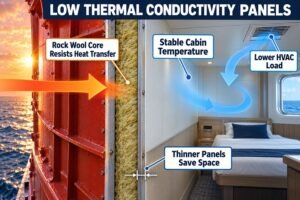
Picking the wrong interior panels can cause huge project delays. Failing safety inspections costs thousands of dollars every day. Here is how to evaluate panels for your exact needs.
Evaluating marine interior panel suitability requires checking five core elements: SOLAS fire ratings (B-0 to B-15), acoustic performance (up to 45 dB), weight limits (typically 14-22 kg/m²), installation method (T-grid or continuous), and cost. Covering all these ensures the panels match your exact shipyard constraints and budget.
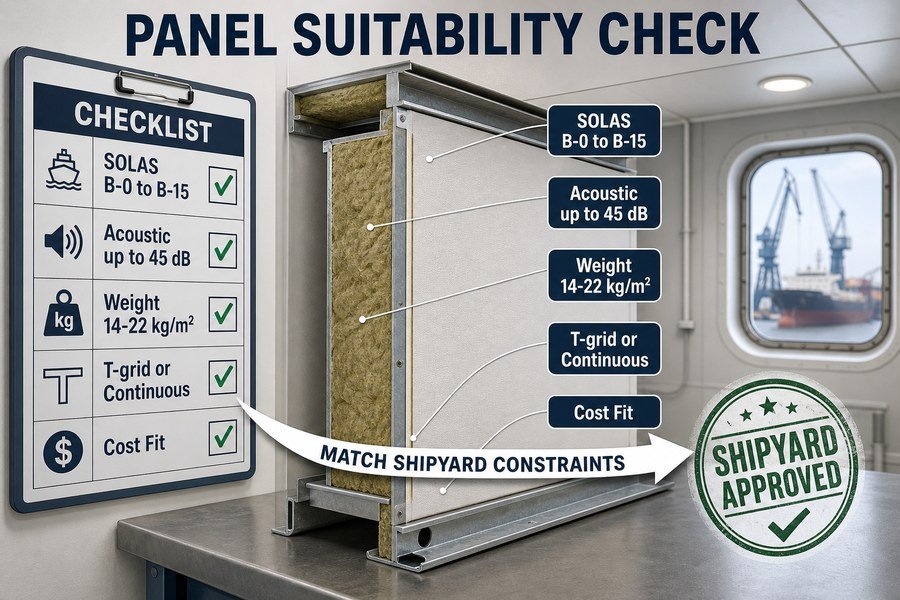
When I worked at the marine outfitting factory, I saw many buyers struggle with panel orders. Choosing the right panel is not just about finding a low price in Asia. It is about matching the panel to the vessel's unique demands. If you buy a cheap panel but it fails the shipyard inspection, you lose money. Over the years, I have helped many clients solve this exact problem. Let me share my direct experience on how to get this right every single time.
What Criteria Determine Marine Interior Panel Suitability for Newbuild Versus Refit Projects?
Mixing up newbuild and refit standards wastes your money. Refits have strict space limits, and newbuild panels might not fit. You must know the exact criteria for both.
Newbuild suitability focuses on three criteria: high volume cost-efficiency, standard sizing (often 2050mm x 550mm), and primary SOLAS compliance. Refit suitability depends on three different criteria: custom sizing to match old frames, lightweight materials for easy handling in tight spaces, and fast delivery schedules to minimize docking time.
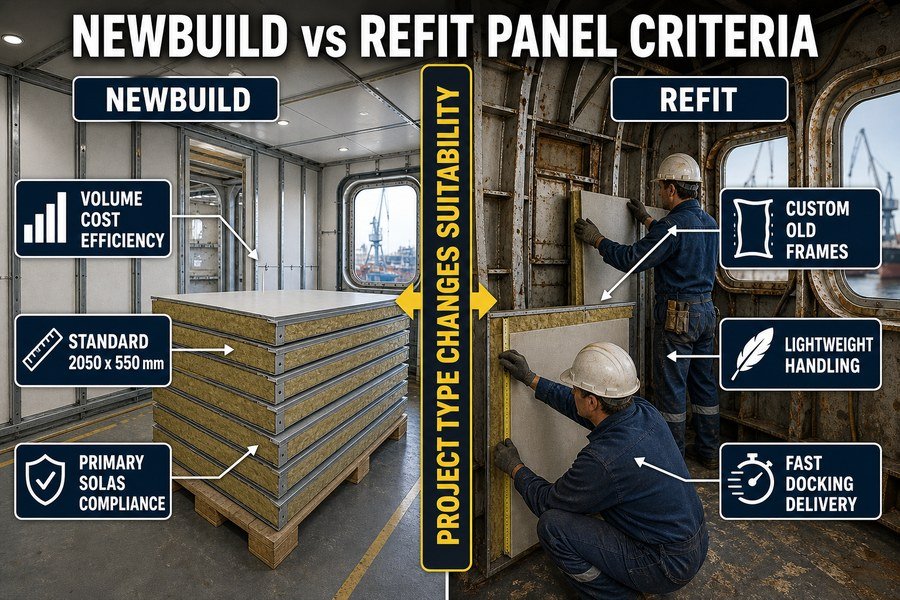
To fully grasp how to select panels, we must look at the specific requirements of both newbuilds and refits. These two types of projects demand very different things from your suppliers.
Three Key Criteria for Newbuild Vessel Panel Selection
When you buy panels for a newbuild project, you are usually buying in large volumes. The first criterion is high volume cost-efficiency. If a cruise ship needs 50,000 square meters of wall panels, saving $5 per square meter saves $250,000. Sourcing from developing countries like China or Vietnam is very common here. A standard B-15 rockwool wall panel usually costs between $30 and $50 per square meter, depending on the surface finish.
The second criterion is standard sizing. Newbuild ships have perfectly straight steel structures. This means you can order standard panel sizes. The most common size is 2050mm in length and 550mm or 600mm in width.1 Standard sizes allow factories to produce panels quickly.
The third criterion is primary SOLAS compliance. Newbuilds must pass strict initial inspections. The panels must meet the International Convention for the Safety of Life at Sea (SOLAS) Chapter II-2 requirements2. You must provide the shipyard with valid Marine Equipment Directive (MED) certificates. Without these certificates, the shipyard will reject the whole batch.
Three Key Criteria for Vessel Refit Panel Selection
Refit projects are entirely different. The first criterion here is custom sizing to match old frames. An old ship does not have straight walls anymore. The steel deck might sag by 20mm or 30mm. Therefore, standard 2050mm panels will not fit. You often have to order custom lengths, like 1980mm or 2015mm, to fit the existing tracks.
The second criterion is lightweight materials. Refit workers must carry these panels by hand through narrow, existing corridors. A standard 50mm thick rockwool panel weighs about 18 kg/m². For difficult refits, buyers sometimes switch to aluminum honeycomb panels, which weigh less than 10 kg/m².3
The third criterion is fast delivery schedules. Ship docking time is very expensive. A medium-sized vessel might cost $10,000 to $20,000 per day in drydock fees.4 Your supplier must deliver the panels within 3 to 4 weeks. If the sea freight from Asia takes 30 days, you must plan perfectly to avoid delaying the whole project.
| Project Type | Key Criteria 1 | Key Criteria 2 | Key Criteria 3 | Typical Cost/Time Factor |
|---|---|---|---|---|
| Newbuild | High volume cost-efficiency | Standard sizing (e.g., 2050x550mm) | Primary SOLAS compliance | Lower unit cost ($30-$50/sqm), longer lead time |
| Refit | Custom sizing for old frames | Lightweight materials (<18 kg/m²) | Fast delivery schedules | Higher unit cost due to custom sizes, tight deadlines |
How Can Marine Wall Panel Selection Be Matched to Specific Project Constraints?
Every marine project has hard limits like weight caps and strict budgets. Ignoring these limits leads to structural failures or severe profit loss. Match panels directly to constraints.
Matching panel selection to project constraints means addressing four limits: weight caps (keeping panels under 18 kg/m² for ferries), fire safety minimums (IMO FTP Code Part 3), acoustic targets (reaching 35-45 dB Rw), and budget ceilings ($30-$50 per square meter for standard Asian supply).
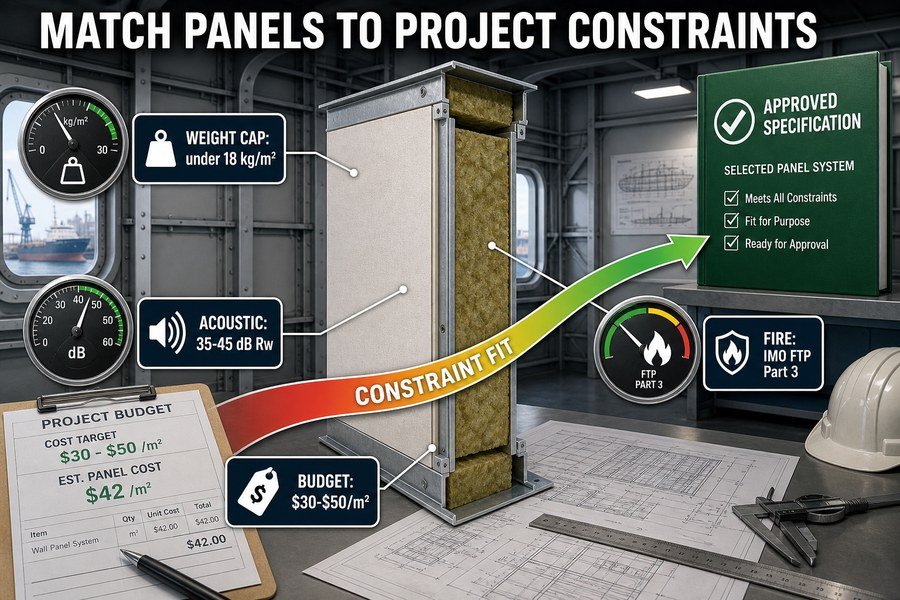
Every shipyard has a technical specification book. This book tells you exactly what the limits are. If you want to be a successful procurement officer, you must know how to match your products to these four strict limits.
Addressing Weight and Fire Safety Constraints in Marine Projects
Weight caps are a major constraint, especially for specific vessel types. Fast ferries, governed by the High-Speed Craft (HSC) Code, must be as light as possible to save fuel and maintain speed.5 A standard B-15 rockwool panel weighs about 18 kg/m² to 20 kg/m². If the shipyard gives you a weight cap of 15 kg/m², you cannot use standard rockwool. You must switch to lighter materials like aluminum honeycomb panels, which can weigh around 8 kg/m² to 10 kg/m².
At the same time, you must meet fire safety minimums. The International Maritime Organization (IMO) Fire Test Procedures (FTP) Code Part 3 dictates how these panels must perform in a fire.6 A B-15 panel must prevent flames from passing through for 30 minutes, and the temperature on the unexposed side must not rise more than 139°C above the original temperature for 15 minutes.7 You must check the supplier's test reports to ensure their lightweight panels still pass this fire test.
Managing Acoustic Targets and Budget Limits in Interior Outfitting
Acoustic targets are becoming very strict on modern ships. According to IMO Resolution MSC.337(91), the noise level in standard crew cabins must not exceed 60 dB8, and passenger cabins require even better sound insulation. To achieve this, the wall panels must have a specific Sound Reduction Index (Rw). Standard marine wall panels offer around 35 dB Rw. If a luxury cruise shipyard demands 45 dB Rw, you must ask the supplier to add a special sound-damping steel sheet inside the panel core.
Finally, you must manage budget ceilings. As a buyer for interior decoration projects, your profit depends on buying high-quality products at competitive prices. Buying panels from Europe can cost over $80 per square meter. By sourcing from reliable factories in China, you can meet the same budget ceilings of $30 to $50 per square meter. However, you must ensure the Asian supplier actually uses high-density rockwool (usually 120 kg/m³) to maintain the acoustic and fire ratings.
| Project Constraint | Target Value / Limit | Panel Solution / Adjustment | Relevant Standard |
|---|---|---|---|
| Weight Caps | Under 18 kg/m² (or <10 kg/m² for HSC) | Use aluminum honeycomb instead of heavy rockwool | HSC Code |
| Fire Safety | B-15 or B-0 rating | Ensure core material passes the 30-min flame test | IMO FTP Code Part 3 |
| Acoustic Targets | 35 dB to 45 dB Rw | Add sound-damping steel layers inside the core | IMO Res. MSC.337(91) |
| Budget Ceilings | $30 to $50 per square meter | Source from qualified Asian factories | Commercial Requirement |
What Suitability Checklist Guides Marine Accommodation Panel Selection per Vessel Project Type?
Forgetting just one technical detail can ruin your entire panel order. A missing certificate can stop the shipyard from legally using your products. Use a strict, step-by-step checklist.
A complete accommodation panel checklist must include five steps: verify the required fire class (A, B, or C), confirm the exact dimensions (thickness of 50mm or 25mm), check for MED (Wheelmark) certification, review the joint type (flush or gap), and confirm secure wooden pallet packing for ocean freight.
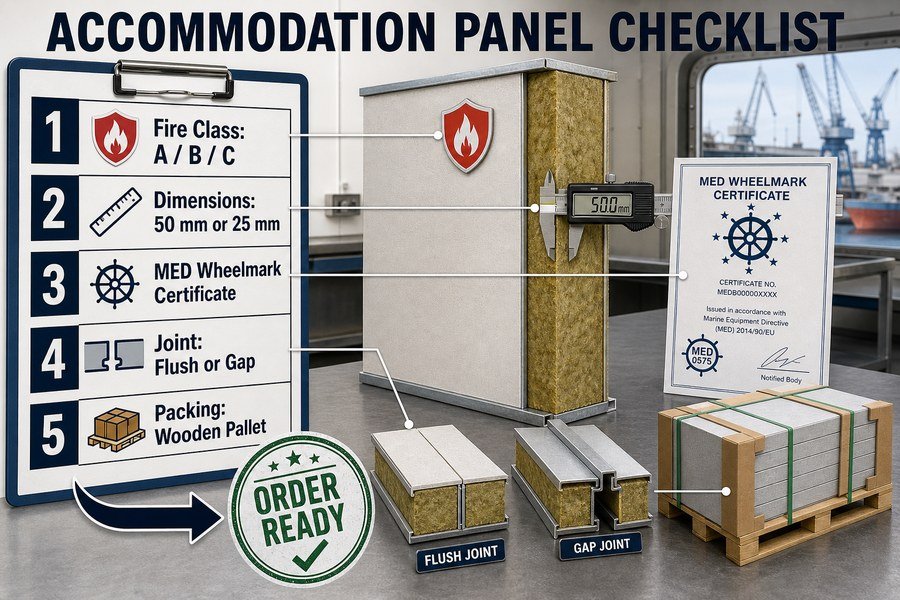
When you communicate with local sales in English, misunderstandings happen easily. A simple checklist prevents mistakes. I always tell my clients to use this five-step checklist before signing any purchase order. It covers all the technical and logistical needs.
Step-by-Step Checklist for Fire Class, Dimensions, and Certification
The first step is to verify the required fire class. Ship spaces are divided into zones.9 Corridors and escape routes usually require B-15 class panels.10 Normal cabin dividers might only need B-0 class. Some non-combustible areas only need C class panels, which have no specific fire resistance time but must not burn.11 You must check the shipyard's general arrangement plan.
The second step is to confirm the exact dimensions. The standard thickness for a B-15 wall panel is 50mm. However, some C class ceiling panels are only 25mm thick. You must also check the width. Standard widths are 550mm and 600mm. If your ceiling grid is spaced at 600mm, buying 550mm panels will ruin the installation.
The third step is checking for MED (Wheelmark) certification. This is a crucial document for ships trading in European waters. The Marine Equipment Directive 2014/90/EU mandates this mark.12 You must ask the supplier to send a clear PDF copy of their Module B and Module D certificates. Check the expiration date. If the certificate expires in two months, but your ship delivers in six months, you will face major legal problems.
Checking Joint Types and Logistics Packaging for Marine Panels
The fourth step is reviewing the joint type. Panels connect to each other in different ways. Some use a "flush joint," meaning the panels touch directly with a 0mm gap. This looks very clean and modern. Others use a "gap joint," which leaves a visible 10mm or 15mm gap filled with a PVC profile. Gap joints are easier to install on uneven decks. You must ask the shipyard which style they prefer.
The fifth and final step is confirming the packing method. Marine panels are fragile before they are installed. If you are shipping them via Less than Container Load (LCL) or Full Container Load (FCL) from China to Europe or the US, the ocean freight takes weeks. The supplier must pack the panels horizontally on strong wooden pallets. The pallets must have solid corner protections and be wrapped in waterproof film.13 Bad packing will result in dented panels, and you will have to order replacements, destroying your lead time.
| Checklist Step | Focus Area | Target Specification / Action | Risk if Ignored |
|---|---|---|---|
| 1. Fire Class | SOLAS Zone requirement | B-15, B-0, or C class | Ship fails fire safety inspection |
| 2. Dimensions | Panel thickness and width | 50mm/25mm thick, 550mm/600mm wide | Panels will not fit into the bottom tracks |
| 3. Certification | MED Wheelmark | Valid Module B and Module D certificates | Shipyard legally rejects the products |
| 4. Joint Type | Visual appearance and fit | Flush joint (0mm) or gap joint (10mm) | Installation becomes too difficult or ugly |
| 5. Packaging | Ocean freight safety | Strong wooden pallets, corner protection | Panels arrive dented and unusable |
How Do Vessel Refit Constraints Override Standard Newbuild Marine Interior Panel Choices?
Refits always bring unexpected physical surprises inside the ship. Standard newbuild panels often will not fit into old, bent ship steel frames. You must adapt to the harsh refit reality.
Refit constraints override newbuild choices in four ways: existing ceiling heights force custom panel lengths, old floor tracks require modifying bottom profiles, narrow ship doorways limit panel widths to 500mm or less, and short drydock schedules demand air-freighted fast-cure adhesives instead of standard sea-freight silicone.
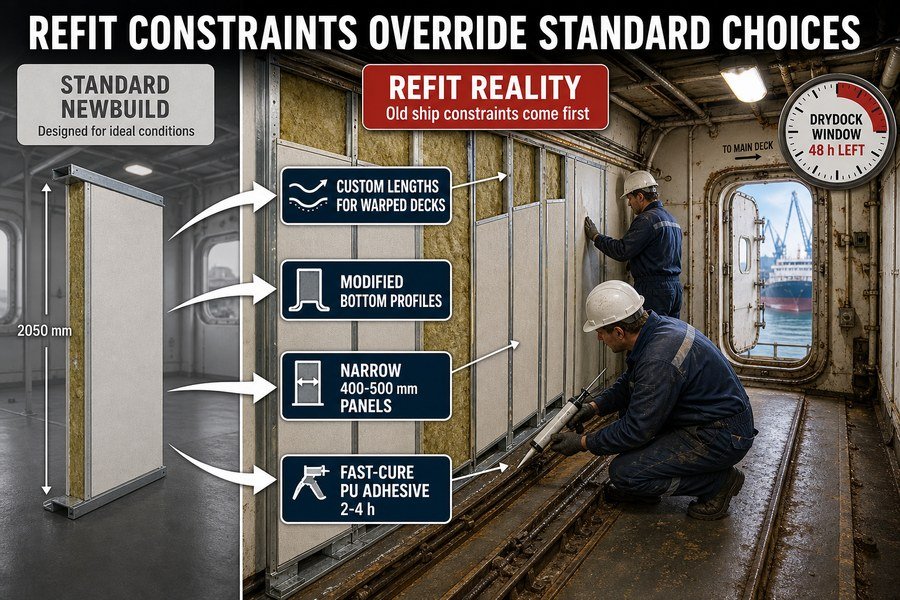
Refit projects are messy. You cannot buy materials for a refit the same way you buy for a newbuild. In a newbuild, you dictate the design. In a refit, the old ship dictates what you can use. You must adjust your buying habits to solve these four specific refit problems.
How Existing Ship Structures Force Custom Lengths and Profiles
The first override involves ceiling heights. On a new ship, the distance from the steel deck to the ceiling grid is perfectly uniform, usually allowing a standard 2050mm wall panel. On a ship that is 15 years old, the steel deck has warped14. The height might be 1980mm in one corner and 2010mm in another. You cannot order one standard length. You must instruct your supplier to cut custom lengths based on a precise on-board survey.
The second override involves the floor tracks. In newbuilds, you weld a standard 30mm x 40mm U-channel to the deck. In a refit, the shipyard often wants to keep the old tracks to save time and welding costs. If the old track is an irregular size, a standard 50mm panel might not slide in. You must ask the factory to modify the bottom profile of the new panels. Sometimes they must cut a small step into the panel base so it sits properly in the old, rusty track.
Overcoming Narrow Doorways and Short Drydock Schedules During Refits
The third override is panel width due to narrow access points. You have to physically move the panels from the dock into the ship's interior. Old ships have very narrow watertight doors and steep staircases15. A standard 600mm wide panel often cannot turn the corner in a tight hallway. Because of this, buyers must override the standard choice and order custom 400mm or 500mm wide panels just so the workers can carry them inside.
The fourth override is the choice of adhesives and logistics. In a newbuild, you use standard marine silicone that cures in 24 hours, shipped cheaply by sea. Refits happen during drydocking, which lasts maybe 14 to 21 days. Every hour counts. If a panel breaks during installation, you cannot wait 30 days for a sea-freight replacement. You must ship replacement panels and special fast-cure polyurethane (PU) adhesives by air freight. These adhesives cure in 2 to 4 hours, allowing the crew to paint or finish the room the very same day.
| Standard Newbuild Choice | Refit Constraint | Required Refit Override | Reason for Override |
|---|---|---|---|
| Standard lengths (2050mm) | Warped old steel decks | Custom cut lengths (e.g., 1980mm) | Match the actual, uneven room height |
| Standard U-channel tracks | Preserving old deck tracks | Modified bottom panel profiles | Fit the new panel into existing hardware |
| Standard widths (600mm) | Narrow watertight doors | Narrow custom widths (400mm-500mm) | Allow workers to carry panels inside |
| Standard silicone (24h cure) | Extremely short drydock time | Fast-cure PU adhesives (2h-4h cure) | Finish the room before the ship leaves dock |
How Is Marine Bulkhead Panel Adaptability Assessed Across Newbuild and Refit Scenarios?
Rigid, hard-to-modify panels slow down interior installation work. If a panel cannot be easily cut or adjusted on-site, your labor costs will double. Check panel adaptability before you buy.
Panel adaptability is assessed by checking three factors: ease of on-site cutting (PVC-covered rockwool panels cut easily with standard saws), cable routing flexibility (built-in conduits for electrical wires), and color matching options (using standard RAL color charts to match existing older panels in refits).
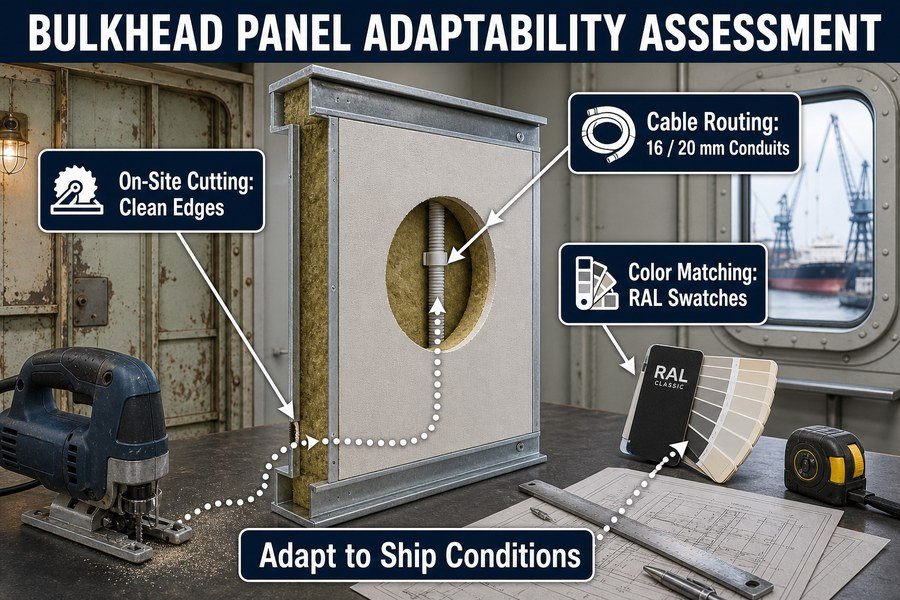
When your installation team opens the pallet, they need panels that are easy to work with. Ship walls have pipes, cables, and strange angles. A good panel must adapt to the ship, not the other way around. Evaluating this adaptability before purchase keeps your installation team happy and your labor costs low.
Assessing On-Site Cutting and Cable Routing Flexibility
The first factor is the ease of on-site cutting. Ship walls have pipes passing through them. The workers must cut holes in your panels. Standard marine panels are made of 0.6mm galvanized steel sheets with a PVC film on the outside, and a rockwool core.16 You need to ensure the steel is not too thick. A 0.6mm skin can be cut cleanly using a simple 1mm disc grinder or a jigsaw. If the supplier uses poor quality steel, the PVC film will burn or peel off when cut. I always advise asking the supplier for a small sample piece to test-cut before placing a massive order.
The second factor is cable routing flexibility. Every cabin needs power outlets and light switches. You cannot just run wires on the outside of the wall. Good marine panels have built-in cable conduits. These are usually 16mm or 20mm PVC pipes inserted directly into the 50mm rockwool core during manufacturing. When assessing a supplier, you must confirm they can install these pipes accurately, otherwise, the shipyard electricians will waste hours trying to drill through the dense rockwool themselves.
Evaluating Color Matching Options for Vessel Upgrades
The third factor is color matching options, which is highly critical in refits. If a ship is upgrading only one wall in a cabin, the new panel must exactly match the old panels. You cannot accept "approximate white." You must use the international RAL color system17.
When you order, do not just say "white." You must assess if the factory can supply exact codes, like RAL 9010 (Pure White) or RAL 9001 (Cream White). Furthermore, they must match the surface texture. Some panels have a smooth finish, while others have a slightly rough, embossed PVC finish. The ability of the supplier to send physical color and texture swatches to the shipyard for approval is a true test of their adaptability and professionalism.
| Adaptability Factor | Assessment Method | Ideal Outcome for Buyer | Benefit to Project |
|---|---|---|---|
| On-Site Cutting | Test cut a sample piece with a jigsaw | Clean cut, no peeling of the PVC film | Saves labor time, prevents material waste |
| Cable Routing | Check for internal PVC pipes | Factory installs 16mm/20mm conduits | Electricians can pull wires through in minutes |
| Color Matching | Compare factory swatches to standard RAL | Exact match to RAL 9010 or similar | Seamless look between old and new walls |
Conclusion
Choosing marine panels requires matching fire ratings, weights, budgets, and structural limits to your exact project. By using these checklists, you can deliver high-quality, cost-effective interiors every time.
-
"How to choose the right marine wall panels for marine interior ...", https://magellanmarinetech.com/how-choose-right-marine-wall-panels-for-marine-interior-projects/. A ship accommodation-panel standard, classification guidance, or technical handbook listing modular wall-panel dimensions around 2,050 mm by 550–600 mm would support the use of these dimensions as standard examples in marine interiors. Evidence role: general_support; source type: institution. Supports: Standard newbuild vessel wall panels are commonly ordered in sizes such as 2050 mm length and 550 mm or 600 mm width.. Scope note: Such a source would contextualize typical modular dimensions but may not prove that these are the most common sizes across all shipyards and regions. ↩
-
"Summary of SOLAS chapter II-2 - International Maritime Organization", https://www.imo.org/en/ourwork/safety/pages/summaryofsolaschapterii-2-default.aspx. IMO and/or EU Marine Equipment Directive documentation would support that SOLAS Chapter II-2 governs fire protection, detection, and extinction requirements for ships and that approved marine equipment may require conformity documentation under applicable regulatory regimes. Evidence role: definition; source type: institution. Supports: Newbuild vessel panels used in regulated ship interiors must satisfy SOLAS fire-safety requirements, and projects may require valid MED certificates as evidence of conformity.. Scope note: MED certification is specifically tied to EU-flagged vessels or projects contractually requiring MED approval; it is not a universal certificate requirement for every ship worldwide. ↩
-
"Aluminum Honeycomb vs Rock Wool Core", https://magellanmarinetech.com/aluminum-honeycomb-rock-wool-core-mechanical-performance-marine-accommodation-panels/. Published material data or peer-reviewed sandwich-panel studies comparing mineral-wool and aluminium-honeycomb core panels would support the general weight distinction between mineral-wool fire panels and lighter honeycomb panels. Evidence role: statistic; source type: paper. Supports: A 50 mm rockwool marine panel can weigh around 18 kg/m², while aluminium honeycomb alternatives can be below 10 kg/m².. Scope note: Panel weights vary with facing material, core density, fire rating, adhesive system, and manufacturer; the cited figures should be treated as representative rather than universal. ↩
-
"Modeling the Dry-Docking Cost - The Case of Tankers - Academia.edu", https://www.academia.edu/128591308/Modeling_the_Dry_Docking_Cost_The_Case_of_Tankers. Government procurement records, port-tariff schedules, or maritime economics studies documenting daily dry-dock or ship-repair berth charges would support the statement that drydock time can impose five-figure daily costs on vessel operators. Evidence role: statistic; source type: government. Supports: Drydock time for a medium-sized vessel can cost roughly $10,000 to $20,000 per day.. Scope note: Daily drydock costs differ substantially by vessel size, yard location, dock type, labor scope, and whether the figure includes only dock rental or broader off-hire and repair costs. ↩
-
"[PDF] INTERNATIONAL REGULATIONS FOR HIGH-SPEED CRAFT AN ...", https://wwwcdn.imo.org/localresources/en/OurWork/Safety/Documents/International.pdf. A naval-architecture or IMO source can support that high-speed craft, including fast ferries, are regulated under the HSC Code and that reducing structural weight is a central design consideration for achieving speed and fuel-efficiency targets. Evidence role: mechanism; source type: institution. Supports: Fast ferries are governed by the HSC Code, and lightweight construction is important for speed and fuel efficiency.. Scope note: Such sources may support the general relationship between lightweight construction, speed, and fuel consumption rather than the article’s specific procurement threshold values. ↩
-
"[PDF] RESOLUTION MSC.307(88) (adopted on 3 December 2010 ...", https://wwwcdn.imo.org/localresources/en/KnowledgeCentre/IndexofIMOResolutions/MSCResolutions/MSC.307(88).pdf. The IMO FTP Code Part 3 specifies test procedures and performance criteria for fire-resisting divisions, including B-class divisions used in ship accommodation and interior construction. Evidence role: definition; source type: institution. Supports: IMO FTP Code Part 3 sets the fire-test requirements for marine panels and fire-resisting divisions.. Scope note: The source would establish the regulatory test framework; individual panel compliance still depends on a valid product test certificate. ↩
-
"What Is the Purpose and Scope of the IMO FTP Code?", https://magellanmarinetech.com/what-purpose-scope-of-imo-ftp-code/. The FTP Code criteria for B-class divisions support that B-class divisions must resist flame passage for 30 minutes and that B-15 insulation performance is assessed by limiting the temperature rise on the unexposed face during the first 15 minutes of the standard fire test. Evidence role: definition; source type: institution. Supports: B-15 panels have defined flame-integrity and insulation-temperature criteria under the IMO fire-test regime.. Scope note: Published summaries may state the average temperature-rise limit as 140°C rather than 139°C; the article’s numerical wording should be checked against the exact code text. ↩
-
"[PDF] MSC.337(91) (adopted on 30 November 2012) CODE ON NOISE ...", https://wwwcdn.imo.org/localresources/en/KnowledgeCentre/IndexofIMOResolutions/MSCResolutions/MSC.337(91).pdf. IMO Resolution MSC.337(91), the Code on Noise Levels on Board Ships, sets maximum A-weighted sound-pressure levels for ship spaces and lists 60 dB(A) as the limit for cabins and hospitals on applicable ships. Evidence role: statistic; source type: institution. Supports: IMO Resolution MSC.337(91) sets a 60 dB noise limit for crew cabins on applicable ships.. Scope note: The code applies according to vessel type, size, and construction date; it does not by itself prove that every modern ship project or passenger-cabin specification uses a stricter value. ↩
-
"[PDF] resolution msc.27(61) - International Maritime Organization", https://wwwcdn.imo.org/localresources/en/KnowledgeCentre/IndexofIMOResolutions/MSCResolutions/MSC.27(61).pdf. SOLAS Chapter II-2 describes fire protection by separating ship spaces into main vertical and horizontal zones to contain fire and smoke spread. Evidence role: definition; source type: institution. Supports: Ship spaces are divided into zones for fire-safety planning.. Scope note: This supports the general zoning concept; exact zoning requirements depend on vessel type, size, and flag-state implementation. ↩
-
"How to choose the right marine fire door for different ship ...", https://magellanmarinetech.com/how-to-choose-right-marine-fire-door-for-different-ship-compartments/. SOLAS fire-containment rules include fire integrity requirements for accommodation and service-space boundaries, with B-class divisions such as B-15 used in specified corridor and escape-route contexts. Evidence role: expert_consensus; source type: institution. Supports: Corridors and escape routes often require B-15 fire-rated divisions or panels.. Scope note: The source would support the regulatory context for B-15 use, but the exact class required varies by ship type, space category, and approved fire-control plan. ↩
-
"What Do A-Class, B-Class, and C-Class Divisions Mean in Marine ...", https://magellanmarinetech.com/what-a-class-b-class-c-class-divisions-mean-in-marine-wall-ceiling-panels/. SOLAS defines C-class divisions as divisions constructed of approved non-combustible materials and states that they need not meet requirements for passage of smoke and flame or temperature rise. Evidence role: definition; source type: institution. Supports: C-class panels are non-combustible divisions without a specified fire-resistance duration comparable to B-0 or B-15.. Scope note: This supports the regulatory definition of C-class divisions, not the suitability of a particular commercial panel product. ↩
-
"Directive 96/98/EC - Wikipedia", https://en.wikipedia.org/wiki/Directive_96/98/EC. Directive 2014/90/EU establishes the EU conformity framework for specified marine equipment and requires compliant equipment to bear the wheel mark as evidence of conformity. Evidence role: historical_context; source type: government. Supports: The Marine Equipment Directive 2014/90/EU mandates the Wheelmark for covered marine equipment.. Scope note: The Directive primarily applies to equipment placed on board EU-flagged ships; it is not a blanket rule for every vessel merely trading in European waters. ↩
-
"IMO/ILO/UNECE Code of Practice for Packing of Cargo ...", https://www.imo.org/en/ourwork/safety/pages/ctu-code.aspx. The IMO/ILO/UNECE Code of Practice for Packing of Cargo Transport Units gives general guidance that cargo should be packed, supported, protected, and secured to withstand transport stresses and environmental exposure. Evidence role: general_support; source type: institution. Supports: Marine panels shipped by ocean freight should be packed with structural support and protection against impact and moisture.. Scope note: The CTU Code supports the general need for robust protective packing in sea transport; it does not prescribe these exact materials for marine wall or ceiling panels. ↩
-
"[PDF] Ultimate Strength, Corrosion, Fatigue, Fracture, and Systems", https://www.ctsm.umd.edu/archive/ayyubbmstambaug02639.pdf. Research on aging ship structures describes corrosion, fatigue, and deformation as service-life issues that can alter structural geometry and require condition assessment before repair or modification. Evidence role: mechanism; source type: paper. Supports: Older ships can have warped or uneven steel decks that affect refit measurements.. Scope note: This supports the general mechanism of aging-related structural distortion; it does not verify the example dimensions in the article. ↩
-
"How to choose the right marine fire door for different ship ...", https://magellanmarinetech.com/how-to-choose-right-marine-fire-door-for-different-ship-compartments/. Marine safety and ship-access references describe watertight doors, ladders, and compartment access routes as constrained openings in ship structures, providing context for logistical limits when moving large components through existing vessels. Evidence role: general_support; source type: government. Supports: Existing ship access routes can be narrow or difficult enough to constrain the size of materials carried into interior spaces.. Scope note: This would support the existence of constrained access routes, but not prove that any particular 600 mm panel cannot pass through a given vessel. ↩
-
"How to choose the right marine wall panels for marine interior ...", https://magellanmarinetech.com/how-choose-right-marine-wall-panels-for-marine-interior-projects/. Technical descriptions of marine accommodation sandwich panels commonly describe steel facings with mineral-wool insulation cores, supporting the stated construction pattern for ship interior wall panels. Evidence role: general_support; source type: institution. Supports: Standard marine panels commonly use galvanized steel sheets, an outer PVC film, and a rockwool or mineral-wool core.. Scope note: A neutral source may support the steel/mineral-wool construction generally without confirming the exact 0.6 mm thickness or PVC film for all products. ↩
-
"RAL colour standard - Wikipedia", https://en.wikipedia.org/wiki/RAL_colour_standard. Reference sources on the RAL colour system describe it as a standardized colour-matching system used internationally in design, architecture, industry, and trade, supporting its use for precise colour specification. Evidence role: definition; source type: encyclopedia. Supports: The RAL color system is an international standardized system suitable for specifying exact panel colours such as whites used in refits.. ↩