Ship fires spread fast on interior walls, putting crew at risk and causing yard delays. Selecting the right marine accommodation panels stops flame spread and ensures fast project approval.
Marine accommodation panels restrict surface flame spread through three main mechanisms: non-combustible core materials like rockwool, specialized low-calorific PVC or melamine face-sheet finishes, and intumescent adhesive layers that expand under heat. Together, these layers meet IMO FTP Code requirements by limiting both flame propagation and heat release.
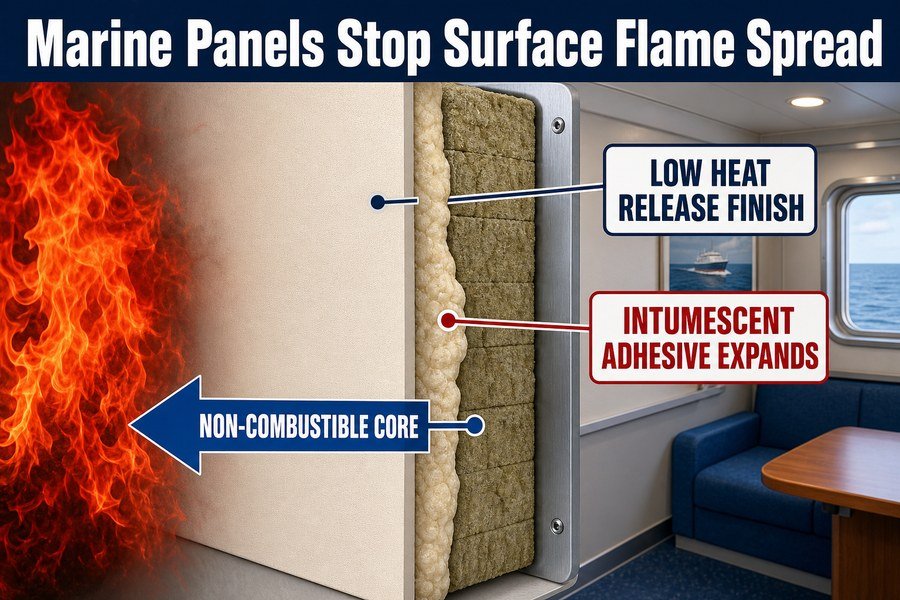
You might wonder exactly how these surface layers work together to stop a fire from moving across a room. Let us break down the exact parts of these panels to see what keeps your shipyard projects safe and compliant.
What Surface Properties Reduce Flame Propagation on a Marine Wall Panel?
Poor wall panel surfaces let fire travel in seconds, ruining costly interiors. Understanding the right surface properties stops this fast burn and keeps your supply chain reliable.
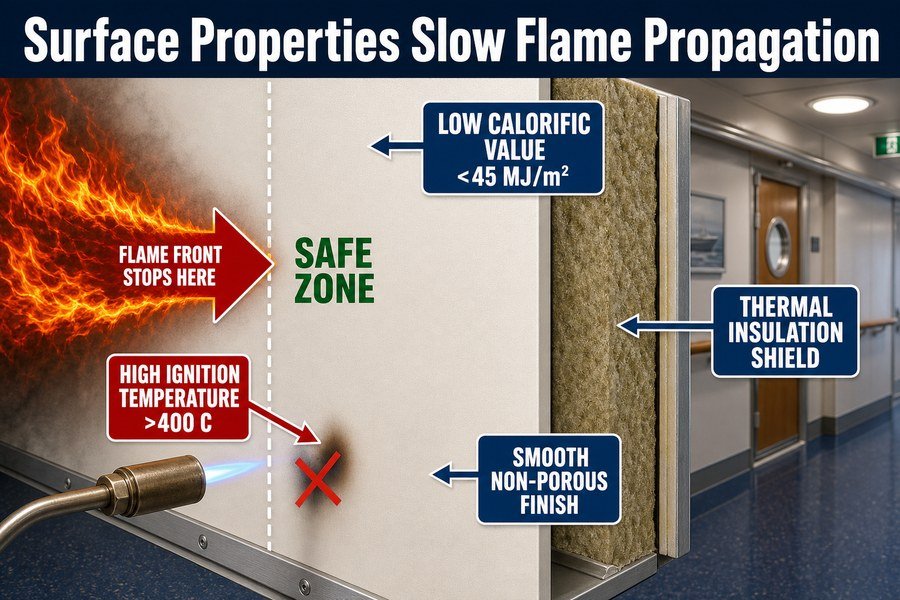
Four specific surface properties reduce flame propagation on a marine wall panel: low calorific value (under 45 MJ/m²), high ignition temperature (above 400°C), thermal insulation capability, and a smooth, non-porous texture that limits oxygen flow to the fuel source.
Low Calorific Value and High Ignition Temperature for Marine Wall Panels
When I buy materials, I look at the calorific value first. This value tells us how much heat the surface releases when it burns. The IMO FTP Code Part 5 sets a strict limit. The total heat release must stay under 45 MJ/m².1 If the value is higher, the panel adds fuel to the fire. I always check the test reports from the factory. We use special PVC films. These films have very low heat release numbers. Next, we look at the ignition temperature. This is the heat level needed to start a fire. A good marine wall panel needs a high ignition temperature. The surface must not catch fire below 400°C.2 In my factory days, I watched fire tests. Panels with cheap paint caught fire at 200°C. Panels with marine-grade PVC lasted much longer. You want the fire to stop, not grow. High ignition points give the crew more time to put out the fire.
Thermal Insulation Capability and Non-Porous Texture of Panel Surfaces
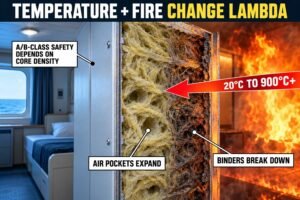
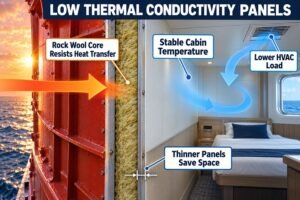
Thermal insulation is the third important property. The surface must stop heat from reaching the metal inside. If the metal gets too hot, the panel bends and breaks.3 A good surface finish acts like a shield. It slows down the heat transfer. Finally, the texture of the surface matters a lot. A rough surface is dangerous. Rough textures trap air and tiny dust particles. This dust acts like extra fuel. We use a smooth, non-porous texture for our marine panels. A smooth surface limits the oxygen that reaches the fire. Without oxygen, the flame cannot grow. A smooth PVC finish is also very easy to clean. This keeps oil and dirt off the wall. Oil and dirt make fires burn faster.4 By combining these four properties, you get a very safe product.
| Surface Property | Main Function | IMO Test Requirement / Standard |
|---|---|---|
| Low Calorific Value | Limits total heat released during a fire | Max total heat release 45 MJ/m² |
| High Ignition Temperature | Prevents the surface from catching fire easily | Must resist temperatures up to 400°C |
| Thermal Insulation | Stops heat from reaching the steel backing | Must maintain structural integrity |
| Smooth, Non-Porous Texture | Limits oxygen flow and prevents dust buildup | Visual inspection and factory finish standards |
Why Do Face-Sheet Finishes Dictate Marine Ceiling Panel Flame Spread Ratings?
A bad ceiling finish acts like a fast highway for fire, trapping heat above. Choosing the right face-sheet finish stops ceiling fires and ensures your yard passes inspection.
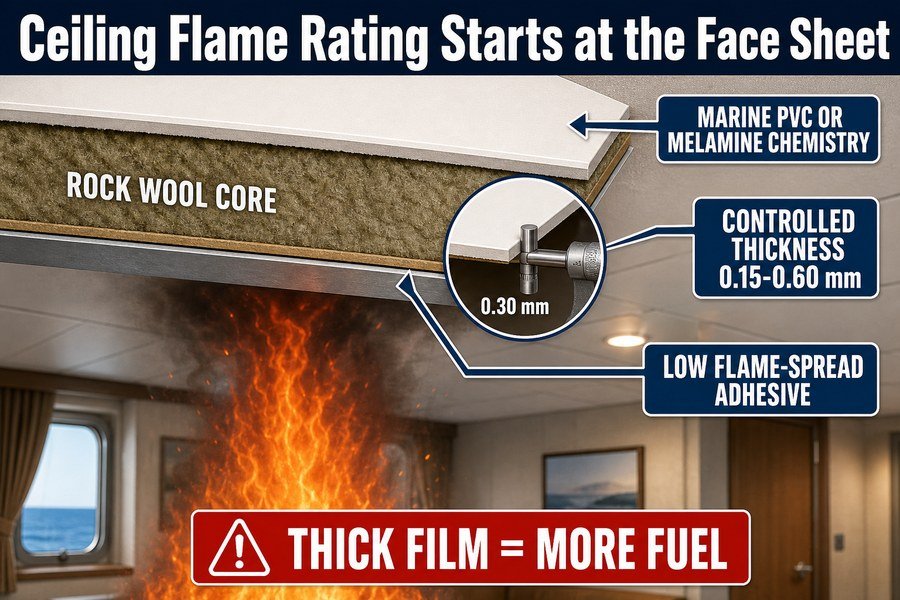
Face-sheet finishes dictate marine ceiling panel flame spread ratings because they are the first layer exposed to fire. The rating depends entirely on the finish's chemical makeup, its thickness (typically 0.15mm to 0.60mm), and the specific adhesive used to bind it to the metal sheet.
Chemical Makeup and Thickness Limits of Marine Face-Sheet Finishes
The face-sheet finish is the first thing a fire touches. Its chemical makeup decides everything. Most ship ceiling panels use PVC or melamine films. Standard plastic burns very fast. But marine-grade PVC has flame retardant chemicals mixed in. These chemicals stop the fire from spreading across the ceiling. Melamine is also very good because it naturally resists fire. I always ask the supplier about the exact chemical mix. Next, we must control the thickness of the finish. The IMO rules are very strict about this. They limit the volume of combustible materials on a surface.5 For a ceiling panel, the PVC film is usually 0.15mm thick. Sometimes it can go up to 0.60mm for heavy-duty areas. If the film is 1.0mm thick, it will fail the fire test. More thickness means more fuel for the fire. I tell my clients to always check the thickness gauge on the factory floor.
The Role of Adhesives in Marine Ceiling Panel Fire Ratings
The last factor is the adhesive. You need glue to stick the PVC film to the metal sheet. Many buyers forget about the glue. This is a big mistake. The glue is often the most dangerous part of the panel. Standard glue is highly flammable. When the fire heats the panel, the glue turns into a hot gas6. This gas pushes the PVC film off the metal. Then, the glue catches fire. We only use special low flame-spread adhesives. These adhesives are tested under IMO rules. They do not release flammable gases when they get hot. They keep the PVC film attached to the metal. If the film stays attached, the fire cannot spread as fast.
| Finish Component | Common Safe Range or Type | Fire Spread Risk if Incorrect |
|---|---|---|
| Chemical Makeup | Marine-grade PVC or Melamine | Standard plastic burns rapidly |
| Finish Thickness | 0.15mm to 0.60mm | Thick films provide too much fuel |
| Adhesive Type | Low flame-spread marine glue | Standard glue creates flammable gas |
How Do Marine Interior Panel Coatings Comply With IMO FTP Code Part 5?
Non-compliant coatings lead to failed sea trials and delayed payments. Knowing IMO FTP Code Part 5 requirements guarantees your panels pass all global marine safety checks.
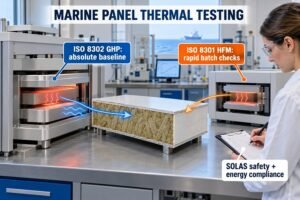
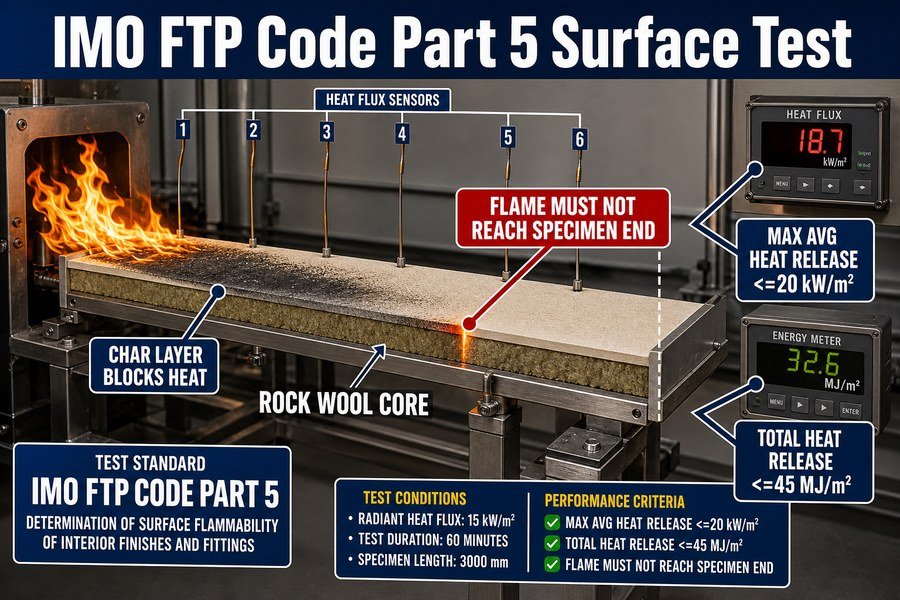
Marine interior panel coatings comply with IMO FTP Code Part 5 by passing three strict tests: limiting maximum average heat release rate (must be ≤ 20 kW/m²), capping total heat release (≤ 45 MJ/m²), and ensuring the flame spread distance does not reach the end of the test specimen.
Limiting Heat Release Rates for Marine Panel Coatings
To sell panels to large shipyards, your products must pass the IMO FTP Code Part 5 tests7. The first thing the test checks is the maximum average heat release rate. This measures how intense the fire gets. The IMO limit is very clear. The maximum average heat release rate must be less than or equal to 20 kW/m². If the panel releases heat faster than this, the room gets too hot too quickly. I have seen many cheap panels fail this specific rule. Next, the test measures the total heat release8. This is the total amount of heat given off during the whole test. The rule says this number must be less than or equal to 45 MJ/m². We carefully select the thickness and material of the coating to stay under this limit. A thin, high-quality coating releases very little heat. This keeps the ship safe and ensures the shipyard accepts your delivery.
Controlling Flame Spread Distance During IMO Testing
The third rule involves the actual movement of the flame. During the laboratory test, scientists put a long piece of the panel into a test machine. They apply a strong fire to one end. They watch how far the flame travels along the surface. To pass the test, the flame spread distance must not reach the end of the test specimen. If the fire stops moving, the panel passes. If the fire reaches the edge, the panel fails. The coating must actively slow down the fire. We use coatings that form a hard char layer when heated9. This char layer blocks the heat. It stops the fire from moving forward. I always check the lab video if a panel fails. It shows exactly where the coating stopped working.
| IMO FTP Code Part 5 Metric | Legal Limit | Importance for Ship Safety |
|---|---|---|
| Max Average Heat Release Rate | ≤ 20 kW/m² | Prevents the room from reaching flashover |
| Total Heat Release | ≤ 45 MJ/m² | Limits the total energy added to the fire |
| Flame Spread Distance | Must not reach specimen end | Stops fire from moving to other ship rooms |
What Causes Smoke and Toxicity in Marine Accommodation Panel Surfaces?
Thick smoke blinds crew members, while toxic gas causes fast poisoning. Understanding smoke and toxicity sources helps you buy safer interior panels for better shipyard reviews.
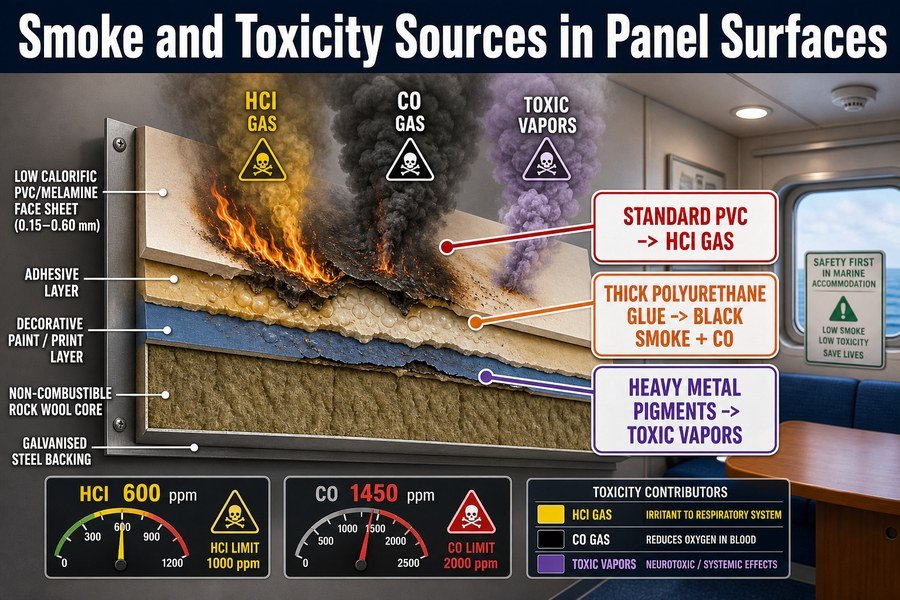
Smoke and toxicity in marine accommodation panel surfaces are caused by three primary factors: the thermal breakdown of halogenated polymers (like standard PVC), the burning of thick polyurethane adhesives, and the presence of heavy metal pigments used in cheap decorative surface paints.
Thermal Breakdown of Halogenated Polymers and Adhesives
Smoke and toxic gases are often more dangerous than the fire itself.10 The first cause of this danger is the thermal breakdown of halogenated polymers. Standard PVC is a halogenated polymer. When standard PVC burns, it releases hydrogen chloride (HCl) gas.11 This gas is very toxic. IMO FTP Code Part 2 says the HCl limit is 600 ppm. To stay safe, we use low-halogen or halogen-free PVC films on our panels. The second cause is the burning of thick polyurethane adhesives. Factories use polyurethane glue because it is cheap and strong. But when it burns, it creates thick black smoke12. This smoke blinds the crew. They cannot find the exits. The carbon monoxide (CO) levels go up very fast. The IMO limit for CO is 1450 ppm. I always tell buyers to avoid thick layers of cheap glue.
Heavy Metal Pigments in Cheap Marine Decorative Paints
The third cause of toxicity comes from the paint colors. Shipowners want beautiful wood or solid color designs. Cheap factories use heavy metal pigments to make these bright colors. They use lead or chromium in the paint. Under normal conditions, these metals sit quietly on the wall. But during a fire, the high heat burns the paint. The heavy metals turn into a deadly toxic gas. If a crew member breathes this gas, they can die in minutes. The IMO FTP Code Part 2 tests for all these toxic gases. We only use high-quality, metal-free pigments for our surface finishes. They cost a little more, but they pass the strict toxicity tests every time. Buying cheap panels with toxic paint will ruin your reputation with European shipyards.
| Toxic Source in Panel | Toxic Gas / Smoke Produced | IMO FTP Code Part 2 Limit |
|---|---|---|
| Halogenated Polymers (Standard PVC) | Hydrogen Chloride (HCl) Gas | Maximum 600 ppm |
| Thick Polyurethane Adhesives | Thick Black Smoke & Carbon Monoxide | Maximum 1450 ppm for CO |
| Heavy Metal Pigments | Toxic Metal Vapors (Lead/Chromium) | Strict bans on toxic metal release |
How Are High Flame-Spread Risks Identified in Decorative Marine Ceiling Panels?
Hidden fire risks in decorative ceilings can turn a small spark into a disaster. Spotting these risks early saves you from buying bad products and losing money.
High flame-spread risks in decorative marine ceiling panels are identified through four warning signs: lacking IMO MED wheelmark certification, using face veneers thicker than 1.5mm, employing untreated wood or standard plastics instead of marine-grade materials, and exhibiting delamination which exposes the combustible adhesive layer.
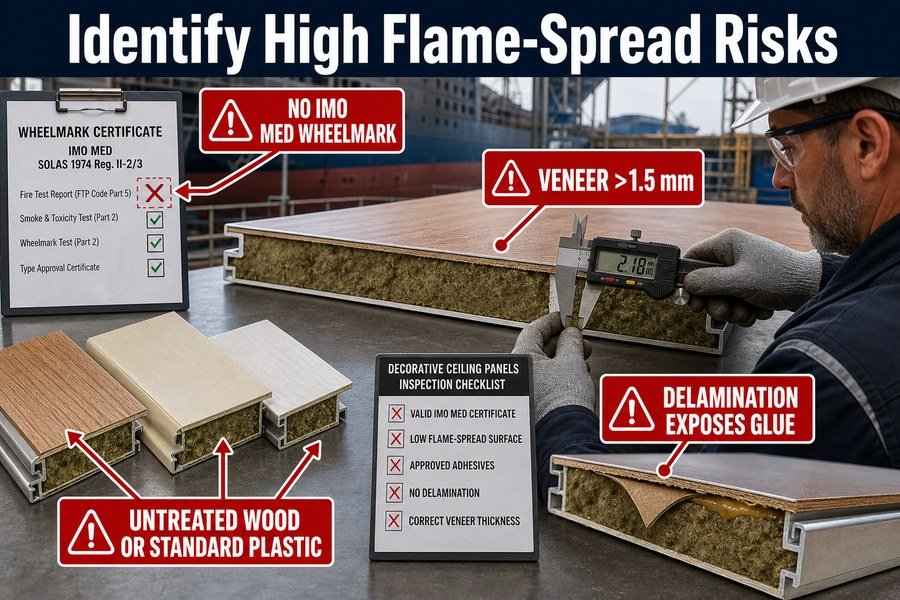
Checking for IMO MED Wheelmark and Proper Veneer Thickness
Identifying bad panels early saves you time and money. The first warning sign is lacking an IMO MED wheelmark certification. If the supplier cannot show you a valid wheelmark certificate, do not buy the panel. The wheelmark proves the product passed European marine safety tests.13 Without it, your panels have a high fire risk. The second sign is the thickness of the face veneer. SOLAS rules limit the amount of combustible material on a bulkhead. A safe PVC veneer is usually around 0.15mm thick. Sometimes, buyers want real wood looks and choose wood veneers. If these face veneers are thicker than 1.5mm, they are very dangerous.14 A 2.0mm thick veneer acts like a pile of dry firewood. I always use a digital caliper to check the thickness when I visit a new supplier.
Spotting Untreated Materials and Delamination in Marine Panels
The third warning sign is the use of untreated wood or standard plastics. Marine-grade materials are soaked in special chemicals that stop fire. Untreated materials burn quickly and spread the flame across the whole ceiling. You must ask the factory for proof of their chemical treatments. The fourth sign is delamination. This means the top film is peeling away from the metal board. I see this often in cheap panels. When the film peels, it creates an air gap. This gap exposes the inner adhesive layer to oxygen.15 As I mentioned before, the glue catches fire very easily. If a panel is peeling before you even install it, it is a huge fire risk. You must reject any panels that show signs of delamination.
| High Risk Warning Sign | Reason for Fire Risk | Inspection Method |
|---|---|---|
| No IMO MED Wheelmark | Product failed or skipped mandatory fire testing | Ask for original certificate documents |
| Veneer Thicker than 1.5mm | Too much combustible volume on the surface | Measure with a digital caliper |
| Untreated Wood/Plastics | Materials lack flame retardant chemicals | Review material safety data sheets |
| Delamination (Peeling) | Exposes highly flammable glue to oxygen | Visual check of panel edges |
Does a Marine Wall Panel's Surface Finish Lose Fire Resistance Over Time?
Old panels might fail fire inspections years after installation, costing shipowners heavily. Knowing how finishes age helps you choose durable products for long-term shipyard contracts.
A marine wall panel's surface finish can lose fire resistance over time due to three degradation factors: prolonged UV exposure breaking down flame-retardant chemicals, physical scratches exposing the inner adhesive, and constant moisture causing the protective film to separate from the galvanized steel backing.
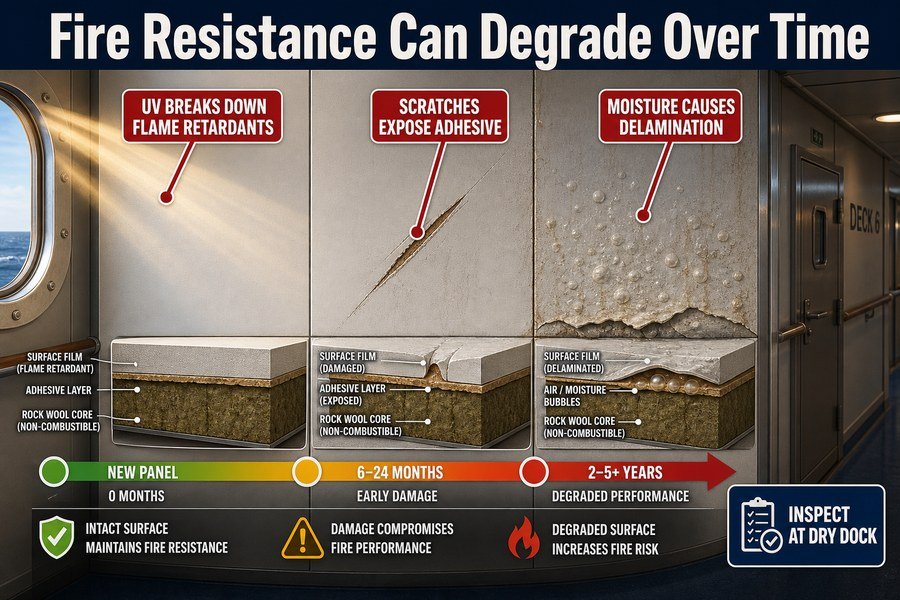
UV Exposure and Physical Scratches on Marine Wall Panels
A panel might pass a test today, but fail five years from now. The first reason is prolonged UV exposure. Sunlight comes through the ship's windows and hits the wall panels every day. This UV light slowly breaks down the flame-retardant chemicals inside the PVC film16. After 10 to 15 years, the surface loses its fire resistance17. It becomes brittle and burns easily. The second factor is physical scratches. The crew moves heavy metal boxes and tools through the corridors. They bump into the walls and scratch the thin 0.15mm protective film. A deep scratch cuts right through the safe PVC layer. This exposes the inner adhesive directly to the air. If a fire starts, the flame finds this scratch and burns the exposed glue. I always advise shipyards to install guard rails in busy hallways to stop this damage.
The Impact of Moisture on Protective Panel Films
The third degradation factor is constant moisture. A ship environment is very wet. High humidity is everywhere. Over many years, this moisture slowly gets behind the protective PVC film. Water breaks down the bond between the glue and the galvanized steel backing18. This causes the film to separate from the steel. We call this process long-term delamination. When the film separates, it creates air bubbles on the wall. These air bubbles are highly dangerous during a fire19. They trap heat and oxygen, causing the surface to burn much faster. To stop this, we use special marine-grade waterproof adhesives. We also make sure the steel is perfectly clean before we apply the glue. You should inspect the panels during every dry dock visit to check for these bubbles.
| Degradation Factor | Impact on Fire Resistance | Prevention and Maintenance |
|---|---|---|
| Prolonged UV Exposure | Breaks down flame retardants over 10-15 years | Use UV-resistant marine films |
| Physical Scratches | Exposes flammable adhesive to the air | Install corridor guard rails |
| Constant Moisture | Causes film separation and dangerous air bubbles | Use waterproof marine glue |
Conclusion
Selecting the right marine accommodation panels stops flame spread. By focusing on IMO certified finishes, core materials, and proper adhesives, you ensure safe, cost-effective, and compliant ship interiors.
-
"What Is the Purpose and Scope of the IMO FTP Code?", https://magellanmarinetech.com/what-purpose-scope-of-imo-ftp-code/. The IMO Fire Test Procedures Code, Part 5, specifies heat-release criteria for surface flammability testing of shipboard materials, including a 45 MJ/m² limit for total heat release in the relevant test context. Evidence role: definition; source type: institution. Supports: IMO FTP Code Part 5 limits total heat release for relevant marine surface materials to 45 MJ/m².. Scope note: This supports the stated threshold only within the scope of the FTP Code Part 5 test method and material category, not as a universal requirement for every marine wall-panel assembly. ↩
-
"How Are Fire Ratings Verified for Marine Wall and Ceiling Panels?", https://magellanmarinetech.com/how-fire-ratings-verified-for-marine-wall-ceiling-panels/. Fire-safety references on ignition temperature describe it as the temperature at which a material can ignite under specified test conditions and report that plastics and coated surfaces vary widely in ignition behavior, often requiring standardized testing rather than a single intrinsic value. Evidence role: definition; source type: government. Supports: Ignition temperature is a relevant fire-performance property for wall-panel surfaces, and a 400°C threshold should be tied to a recognized test condition or material data.. Scope note: This would contextualize the importance of ignition temperature but may not directly prove that 400°C is an IMO requirement unless paired with a specific marine test standard or product test report. ↩
-
"[PDF] Best practice guidelines for structural fire resistance design of ...", https://nvlpubs.nist.gov/nistpubs/technicalnotes/nist.tn.1681.pdf. Engineering fire-safety literature shows that steel and other metals lose stiffness and load-bearing capacity as temperature rises, which can lead to deformation or structural failure during fire exposure. Evidence role: mechanism; source type: research. Supports: Excessive heat transfer to a metal backing can cause loss of strength, deformation, or failure of a wall-panel assembly.. Scope note: This supports the general thermal-mechanical mechanism; a specific panel design would still require assembly-level fire testing to prove its deformation behavior. ↩
-
"[PDF] OSHA Technical Manual - Section IV, Chapter 6, Combustible Dusts", https://www.osha.gov/sites/default/files/otm_secIV_chap6.pdf. Fire-prevention guidance from public safety and occupational sources identifies accumulated combustible residues, including oils, grease, dust, and debris, as fuel loads that can increase fire ignition and spread risk. Evidence role: general_support; source type: government. Supports: Keeping wall-panel surfaces clean can reduce combustible residues that contribute to fire growth.. Scope note: This supports the broader housekeeping and fuel-load principle rather than quantifying the burn-rate effect for a particular PVC marine wall-panel surface. ↩
-
"What Is the Purpose and Scope of the IMO FTP Code?", https://magellanmarinetech.com/what-purpose-scope-of-imo-ftp-code/. SOLAS fire-safety provisions and the IMO Fire Test Procedures Code regulate combustible surface materials in ship interiors through requirements such as low flame-spread testing and limits on combustible content or calorific contribution for linings and finishes. Evidence role: general_support; source type: institution. Supports: IMO rules restrict combustible materials used on ship interior surfaces.. Scope note: The rules do not establish a single universal PVC-film thickness limit for every ceiling panel; compliance depends on the tested material system, vessel type, and applicable IMO/SOLAS category. ↩
-
"Durability of Polymer Metal Multilayer: Focus on the Adhesive ... - PMC", https://pmc.ncbi.nlm.nih.gov/articles/PMC6262294/. Fire and polymer-degradation studies show that many organic adhesives thermally decompose under heat, producing volatile combustible products and losing bond strength, which can contribute to delamination in layered materials. Evidence role: mechanism; source type: paper. Supports: Adhesives can thermally decompose into combustible gases and weaken the bond between a face film and metal substrate during fire exposure.. Scope note: This supports the general fire mechanism for polymer adhesives; it does not prove that every marine ceiling-panel adhesive will generate the same gases or delaminate under IMO test conditions. ↩
-
"What Is the Purpose and Scope of the IMO FTP Code?", https://magellanmarinetech.com/what-purpose-scope-of-imo-ftp-code/. The IMO 2010 FTP Code, adopted for use under SOLAS, sets out standardized fire-test procedures for shipboard materials, including Part 5 for surface flammability testing of surface materials used in marine interiors. Evidence role: historical_context; source type: institution. Supports: Marine panel products intended for large shipyards must pass IMO FTP Code Part 5 tests.. Scope note: This supports the regulatory context generally; actual approval requirements can depend on flag-state, class-society, product type, and the applicable FTP Code edition. ↩
-
"[PDF] The NIST 3 Megawatt Quantitative Heat Release Rate Facility", https://nvlpubs.nist.gov/nistpubs/Legacy/SP/nistspecialpublication1007.pdf. The IMO FTP Code Part 5 test method includes heat-release measurements as part of the surface flammability assessment, with acceptance criteria used to limit the contribution of surface materials to fire growth. Evidence role: definition; source type: institution. Supports: The test measures total heat release, meaning the total amount of heat given off during the whole test.. Scope note: This supports the relevance of total heat release as a tested parameter; a separate citation to the exact acceptance table is needed to confirm the stated 45 MJ/m² threshold for the relevant material category. ↩
-
"Fire-Resistant Coatings: Advances in Flame-Retardant ... - PMC", https://pmc.ncbi.nlm.nih.gov/articles/PMC12251703/. Fire-protection literature on intumescent and charring coatings describes how thermally induced char layers can act as insulating barriers that reduce heat transfer to the underlying substrate and slow flame spread. Evidence role: mechanism; source type: paper. Supports: Coatings can form a hard char layer when heated, and this char layer blocks heat and helps slow flame spread.. Scope note: This supports the general mechanism of char-forming coatings; it does not prove that any specific coating formulation will pass IMO FTP Code Part 5 without test data. ↩
-
"[PDF] Fire Conditions for Smoke Toxicity Measurement", https://tsapps.nist.gov/publication/get_pdf.cfm?pub_id=912940. Fire-safety statistics and reviews commonly identify smoke inhalation and toxic combustion products, especially carbon monoxide, as major contributors to fire fatalities, supporting the general claim that combustion effluents can be more lethal than flames. Evidence role: general_support; source type: government. Supports: Smoke and toxic gases are often more dangerous than the fire itself.. Scope note: This supports the general fire-safety context, not the relative danger in every shipboard fire scenario. ↩
-
"[PDF] Kinetic Study of Polyvinyl Chloride Pyrolysis with Characterization of ...", https://www.osti.gov/servlets/purl/2352421. Polyvinyl chloride combustion and thermal decomposition studies report hydrogen chloride as a principal acid gas produced from PVC because chlorine is chemically bound in the polymer chain. Evidence role: mechanism; source type: paper. Supports: When standard PVC burns, it releases hydrogen chloride (HCl) gas.. Scope note: The amount released depends on formulation, temperature, ventilation, and combustion conditions. ↩
-
"Analysis of Flammability and Smoke Emission of Plastic ... - PMC", https://pmc.ncbi.nlm.nih.gov/articles/PMC10054394/. Combustion research on polyurethane materials shows that they can generate dense smoke and toxic gases such as carbon monoxide during burning, consistent with the concern that polyurethane-containing adhesives may increase smoke and toxicity hazards. Evidence role: mechanism; source type: research. Supports: When thick polyurethane adhesives burn, they can create thick black smoke.. Scope note: Most published data concern polyurethane foams or bulk polymers, so the evidence is contextual unless the cited source specifically tests the adhesive formulation and thickness used in the panels. ↩
-
"Directive 96/98/EC - Wikipedia", https://en.wikipedia.org/wiki/Directive_96/98/EC. Official Marine Equipment Directive materials state that the wheel mark indicates marine equipment has completed the Directive’s conformity-assessment procedure against applicable international maritime safety standards; the mark confirms certification status, while the precise fire tests must be checked on the individual certificate. Evidence role: definition; source type: government. Supports: The wheelmark proves the product passed European marine safety tests.. Scope note: The wheelmark supports regulatory conformity, but it is not by itself proof of the panel’s current physical condition or suitability for every installation. ↩
-
"Are Marine Fire Divisions the Same as Marine Panel Ratings?", https://magellanmarinetech.com/are-marine-fire-divisions-same-as-marine-panel-ratings/. SOLAS/FTP-Code-based guidance treats combustible veneers as part of a ship’s allowable surface fire load and often evaluates them by calorific value or veneer-equivalent thickness; this supports concern that thicker wood veneers can increase fire load, but it does not establish a universal 1.5 mm danger threshold without material and installation data. Evidence role: general_support; source type: institution. Supports: If these face veneers are thicker than 1.5mm, they are very dangerous.. Scope note: The exact risk depends on veneer species, density, calorific value, substrate, treatment, and the vessel space where it is installed. ↩
-
"[PDF] HEAT DELAMINATION IN CROSS LAMINATED TIMBER", https://research.fs.usda.gov/download/treesearch/66340.pdf. Fire studies of laminated and sandwich composite materials report that delamination or void formation can expose polymer resin or adhesive layers and change oxygen access and flame-spread behavior; this supports the proposed mechanism, although the severity depends on the specific adhesive, laminate geometry, and fire exposure. Evidence role: mechanism; source type: paper. Supports: Delamination can create an air gap that exposes the adhesive layer to oxygen, increasing fire risk.. Scope note: The evidence is mechanistic and material-dependent, not direct proof that every delaminated marine panel presents the same ignition risk. ↩
-
"Modifications of Polymers through the Addition of Ultraviolet ...", https://pmc.ncbi.nlm.nih.gov/articles/PMC8747282/. A peer-reviewed materials-aging study on PVC weathering supports that ultraviolet radiation can promote photo-oxidation, chain scission, and additive depletion or migration in PVC-based films, mechanisms that may reduce protective performance over time. Evidence role: mechanism; source type: paper. Supports: UV exposure can degrade flame-retardant or protective components in PVC film over time.. Scope note: Such evidence would support the degradation mechanism generally, but may not directly test the specific marine wall-panel film described here. ↩
-
"What Is the Purpose and Scope of the IMO FTP Code?", https://magellanmarinetech.com/what-purpose-scope-of-imo-ftp-code/. A standards-based aging or marine-materials study can contextualize that polymeric surface films may lose mechanical and fire-performance properties after long-term environmental exposure, including UV, heat, and humidity. Evidence role: general_support; source type: paper. Supports: Long-term environmental exposure can reduce the fire-resistance performance of protective PVC surface films, potentially over a multi-year service life.. Scope note: This would contextualize long-term loss of fire performance, but a source is needed that directly substantiates the specific 10–15-year timeframe for this panel construction. ↩
-
"Molecular Understanding of the Interfacial Interaction and Corrosion ...", https://pmc.ncbi.nlm.nih.gov/articles/PMC10141672/. Adhesion-science literature supports that moisture at a metal–polymer interface can weaken adhesive bonds through interfacial water uptake, corrosion-related effects, and loss of adhesion. Evidence role: mechanism; source type: paper. Supports: Moisture ingress can weaken adhesive bonding between a polymer film or adhesive layer and a galvanized steel backing.. Scope note: General adhesion studies may not use the same marine adhesive, PVC film, or galvanized steel substrate as the article describes. ↩
-
"[PDF] Ignition and Lateral Flame - Spread Characteristics of", https://nvlpubs.nist.gov/nistpubs/Legacy/IR/nistir89-4030.pdf. Fire-safety research on delamination and air gaps in layered assemblies supports that voids can alter heat transfer, ventilation, and flame-spread behavior, potentially worsening burning under some configurations. Evidence role: mechanism; source type: research. Supports: Delamination bubbles or air gaps in wall-panel films can increase fire hazard by changing heat and oxygen availability and flame-spread behavior.. Scope note: The evidence would support the fire-risk mechanism of voids or air gaps generally; it may not prove that every bubble in this specific wall panel is highly dangerous. ↩