You need safe ships, but panel fires keep you awake at night. If cheap panels fail, lives and shipyard contracts are lost. Let us fix this core problem today.
The core material directly dictates a marine interior panel's fire resistance by providing thermal insulation, structural integrity, and non-combustibility. Mineral wool, calcium silicate, and honeycomb aluminum cores stop heat transfer and flame spread, ensuring the panel meets strict SOLAS A-Class and B-Class fire ratings during emergencies.
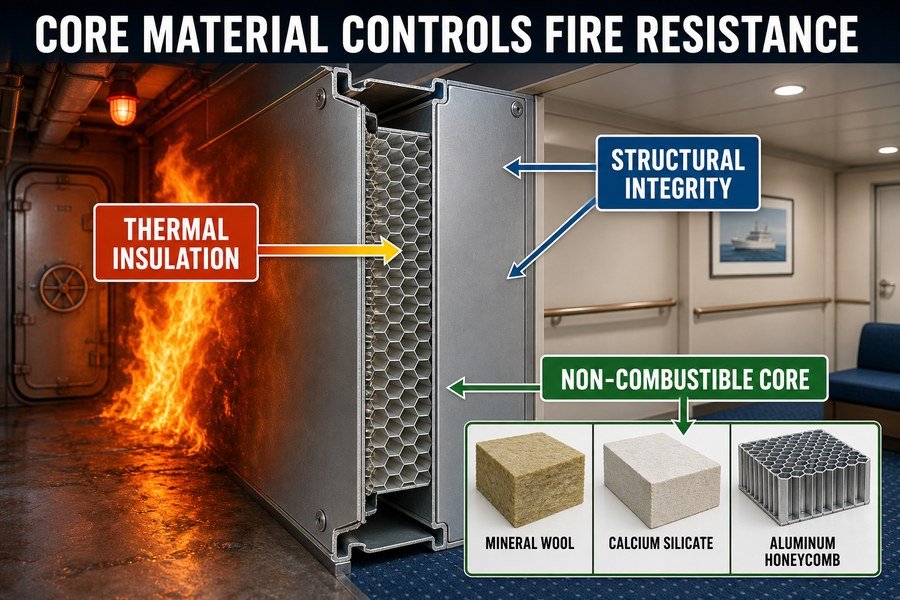
Let us look closer at how these core materials actually work inside the panels. If you understand the core, you can control your costs and keep your shipyard clients happy.
How Does a Mineral Wool Core Behave During a Marine Interior Panel Fire Test?
Worried about failing the standard fire test? A bad core ruins the whole panel, wasting your certification money. Here is exactly what happens when the heat turns up.
During a marine fire test (IMO FTP Code Part 3), a mineral wool core acts in three distinct stages: resisting initial thermal shock at 200°C, blocking heat transfer up to 945°C for 60 minutes, and maintaining structural form without releasing toxic gases or losing mass.
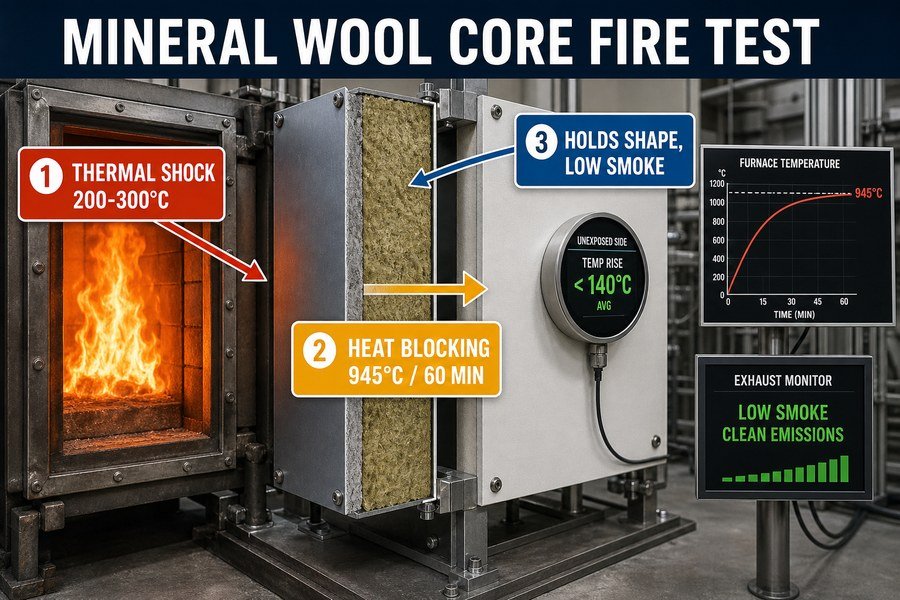
When I was testing panels for a European ferry project, I stood right next to the test furnace. I saw firsthand how important the core is. The IMO FTP Code Part 3 rules are very strict. We must look at the three stages of how the core acts during the test.
Stage 1: Resisting Initial Thermal Shock at 200°C
In the first five minutes of the fire test, the furnace temperature jumps quickly. It reaches around 200°C to 300°C almost immediately. The steel skin of the panel gets very hot and expands. But the mineral wool core stays calm. The core absorbs this sudden thermal shock. High-quality marine rockwool, which costs about $5 to $7 per square meter for raw material, will not crack or break during this sudden heat. If the core is cheap and weak, it shatters right here, and the test fails in five minutes.
Stage 2: Blocking Heat Transfer up to 945°C for 60 Minutes
As the test moves to 60 minutes, the furnace reaches 945°C based on the standard ISO 834 fire curve1. The main job of the core is to stop this heat from reaching the other side of the panel. The rules say the unexposed side cannot go more than 140°C above the room temperature on average2. A good 50mm thick mineral wool core traps air inside its fibers. This trapped air blocks the heat.3 In my experience, a bad core will let the unexposed side reach 180°C in just 45 minutes, failing the A-60 requirement.
Stage 3: Maintaining Structural Form Without Releasing Toxic Gases
At the end of the test, the core must still hold its shape. It must not turn to ash. It also must not release dangerous smoke. The IMO rules measure toxic gas levels.4 High-grade marine mineral wool uses very little organic binder, usually less than 3% by weight. This means it does not burn or smoke.
| Fire Test Stage | Furnace Temperature | Core Job | Pass Requirement (IMO FTP) |
|---|---|---|---|
| Initial Shock | Up to 300°C | Absorb heat expansion | Core does not crack or shatter |
| Heat Blocking | Up to 945°C | Stop heat transfer | Unexposed side average temp rise < 140°C |
| Form & Smoke | 945°C (at 60 mins) | Hold shape, no gas | Panel stays upright, toxic gas limits met |
Why Does Core Density Dictate a Marine Wall Panel's Fire Integrity?
Choosing low-density cores saves money but risks total failure. If panels warp during a fire, flames spread fast. Density is your main defense against heat.
Core density determines fire integrity by balancing three factors: thermal mass to absorb heat, physical strength to prevent panel buckling, and air gap reduction to stop convection. Rockwool densities from 120 kg/m³ to 150 kg/m³ are mandatory to achieve B-15 and A-60 ratings respectively.
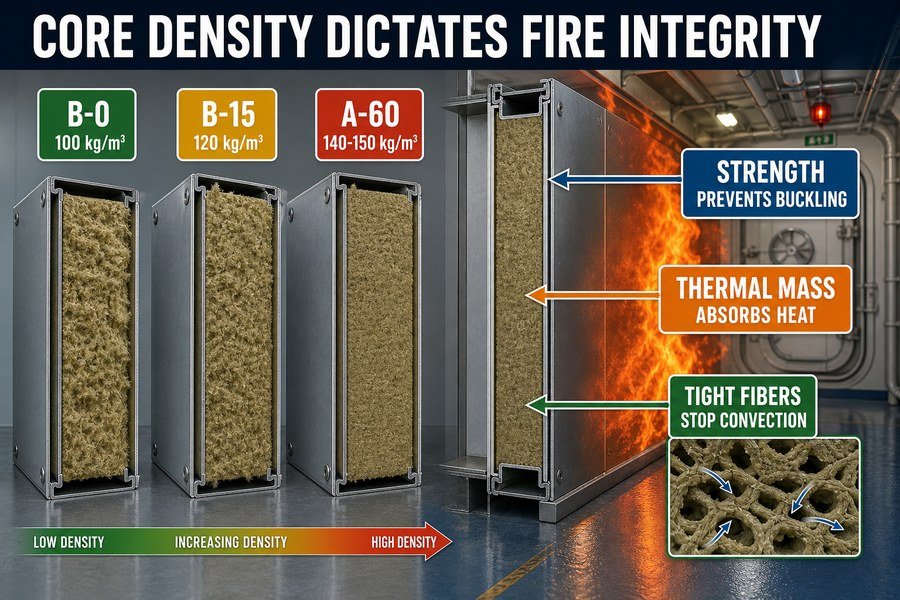
Density is just how much material is packed into one cubic meter. Many buyers want cheap panels with 100 kg/m³ density. I always tell my clients this is a bad idea. Let me explain the three reasons why density matters so much for fire integrity.
Factor 1: Thermal Mass to Absorb Heat
More density means more thermal mass.5 Thermal mass is the ability of a material to soak up and hold heat. A rockwool core with a density of 150 kg/m³ has 25% more rock material than a 120 kg/m³ core. This extra rock takes much longer to heat up. When the fire hits 900°C, the heavy core absorbs the energy instead of passing it through to the cold side. This buys you the full 60 minutes needed for an A-60 rating.
Factor 2: Physical Strength to Prevent Panel Buckling
Density gives the panel physical strength. Fire makes the steel faces of the panel expand and push hard. If the core is soft and light, the panel will buckle and bend. I saw a cheap panel bend nearly 10 centimeters in the middle during a test. A high-density core acts like a strong pillar. It holds the steel faces straight. This physical strength prevents the joints between panels from breaking open and letting flames through.
Factor 3: Air Gap Reduction to Stop Convection
A dense core has fibers packed very tightly together. This reduces the size of the tiny air gaps between the fibers. In a fire, hot air wants to move through these gaps. This movement is called convection. If the density is only 100 kg/m³, the gaps are big, and hot air moves quickly through the core. At 150 kg/m³ density, the fibers block the hot air flow.6
| Fire Rating | Required Core Density | Average Core Cost ($/sqm) | Primary Benefit of Density |
|---|---|---|---|
| B-0 | 100 kg/m³ | $3.50 - $4.50 | Basic physical support, no insulation limit |
| B-15 | 120 kg/m³ | $5.00 - $6.50 | Moderate heat absorption, limits convection |
| A-60 | 140 - 150 kg/m³ | $8.00 - $10.00 | High thermal mass, strong buckle resistance |
What Core Failures Reduce a Marine Ceiling Panel's Overall Fire Performance?
Ceilings are the hardest parts to protect. When fires break out, heat rises and attacks ceiling cores fast. Knowing how they fail saves lives and avoids rework.
Marine ceiling panel cores fail through four main mechanisms: binder burnout causing structural collapse, core shrinkage creating gaps, delamination from the steel skin, and melting of low-grade fibers. These four failures allow temperatures on the unexposed side to exceed the strictly allowed 140°C average rise limit.
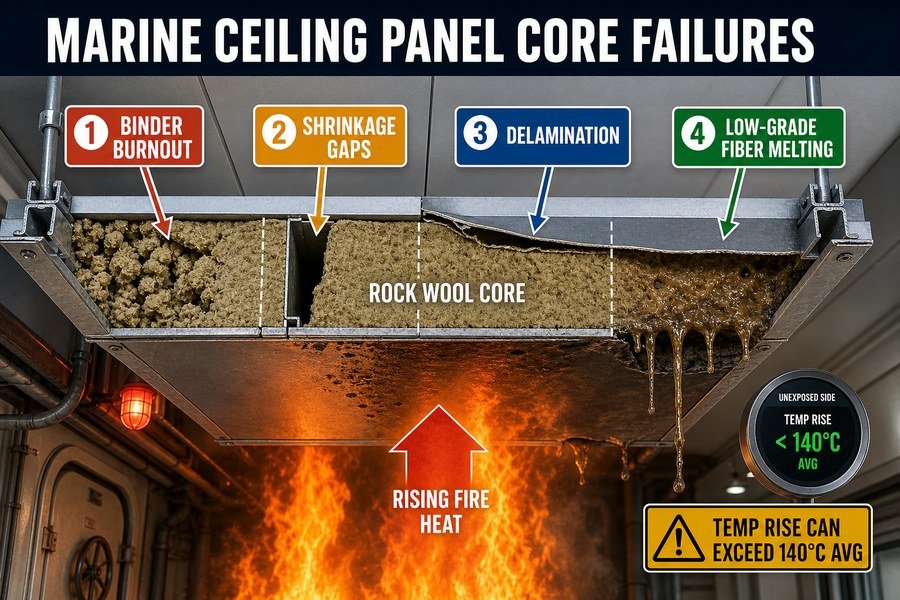
Ceiling panels hang above your head. Gravity pulls on them all the time. When a fire starts, the heat attacks the ceiling first. I once had a client whose ceiling panels failed in just 20 minutes because they bought the wrong product. Here are the four ways the core can fail.
Failure 1: Binder Burnout Causing Structural Collapse
Rockwool uses a chemical binder to stick the fibers together. If the manufacturer uses too much binder or cheap organic glue, this binder burns away very quickly at 300°C7. When the glue burns, the fibers fall apart. Because it is a ceiling panel, gravity pulls the loose fibers down. The core collapses inside the steel skin. Now, there is nothing stopping the heat.
Failure 2: Core Shrinkage Creating Gaps
High heat makes cheap materials shrink. When a bad core is exposed to 800°C, it can shrink by 3% to 5% in size8. Inside a standard 2400mm long ceiling panel, a 3% shrinkage means the core pulls back by over 70mm. This leaves a large empty space with no insulation. Fire goes right through this empty space. Good marine cores are pre-shrunk in the factory to stop this problem.
Failure 3: Delamination from the Steel Skin
The core is glued to the outer steel skin with a special adhesive. The standard is a two-part polyurethane (PU) glue. If the factory uses poor glue to save money, the fire will melt the glue in 10 minutes. The steel skin will fall away from the core. This is called delamination. Once the steel falls, the fire hits the bare core, destroying it quickly.
Failure 4: Melting of Low-Grade Fibers
Not all rockwool is the same. Good marine rockwool is made from basalt rock and melts at temperatures over 1000°C. Cheap rockwool is made from slag (factory waste) and can start melting at 700°C. Since a marine fire test reaches 945°C9, a slag core will turn into liquid glass and drip out of the ceiling.
| Failure Mechanism | Cause of Failure | Result During Fire Test | Time to Failure |
|---|---|---|---|
| Binder Burnout | Cheap organic glue burning | Core falls apart inside panel | 15 - 25 minutes |
| Core Shrinkage | Lack of factory heat treatment | Empty gaps form, flames pass | 30 - 40 minutes |
| Delamination | Low-quality skin adhesive | Steel skin falls off core | 10 - 20 minutes |
| Fiber Melting | Using cheap slag instead of basalt | Core turns to liquid and drips | 45 - 55 minutes |
How Is a Marine Accommodation Panel Core Confirmed Non-Combustible per SOLAS?
You cannot just claim a panel is safe. Port state controls will stop your ship if certificates are fake. Proper testing proves non-combustibility beyond any doubt.
Under SOLAS (IMO FTP Code Part 1), a core is confirmed non-combustible through a 750°C furnace test that measures three strict limits: furnace temperature rise must stay below 30°C, specimen surface flaming must not exceed 10 seconds, and mass loss must remain under 50%.
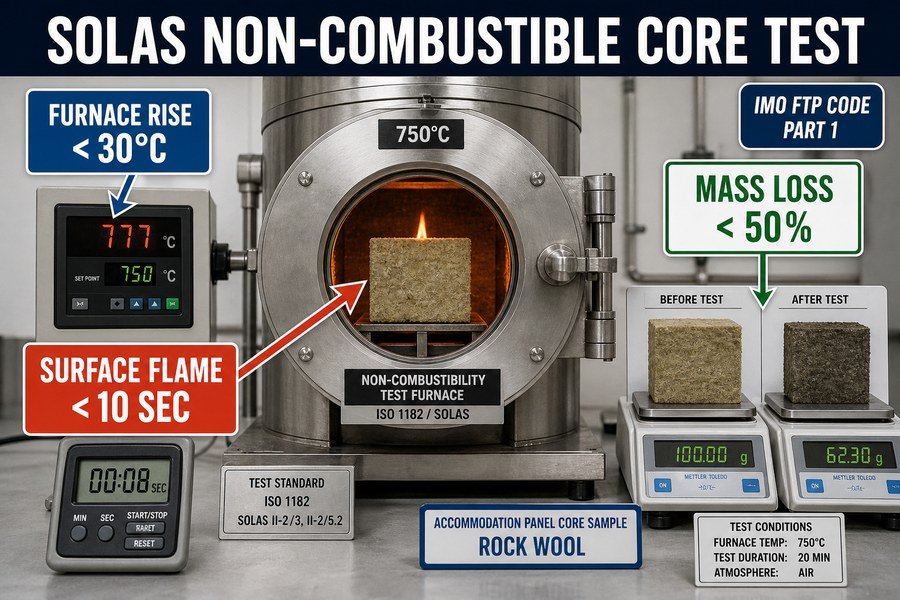
Every procurement officer asks me for non-combustible certificates. But few know what the certificate actually means. The test is very small but very hard. We cut a piece of the core material to the size of a coffee cup. Then we put it inside a special furnace. We watch three specific limits to see if it passes.
Limit 1: Maintaining Furnace Temperature Rise Below 30°C
The test furnace is heated to exactly 750°C before the core sample goes in.10 When we put the sample inside, the core must not add heat to the furnace. If the core has hidden plastics or too much glue, it will catch fire and make the furnace hotter. The IMO rules state that the furnace temperature cannot rise more than 30°C above the starting point. So, the maximum allowed is 780°C. If it goes higher, the material is combustible and fails.
Limit 2: Limiting Specimen Surface Flaming to Under 10 Seconds
We leave the sample in the furnace for 30 minutes. During this time, we look inside through a glass window. We watch for flames on the surface of the core. A true non-combustible marine core will not burn. The rules say that if the sample produces a flame, the flame cannot last longer than 10 seconds total for the whole 30 minutes11. If the core burns for 15 seconds, it fails and cannot go on a ship.
Limit 3: Keeping Panel Core Mass Loss Under 50%
Before the test, we weigh the core sample on a very exact scale. After the 30-minute test in 750°C heat, we take it out and weigh it again. The heat will burn off moisture and tiny bits of binder. But the rock or mineral itself should stay. The SOLAS rule says the sample cannot lose more than 50% of its starting weight. A good rockwool core usually only loses about 2% to 4% of its mass.12
| Non-Combustible Test Limit | IMO FTP Part 1 Requirement | What Happens if it Fails | What it Means for the Buyer |
|---|---|---|---|
| Furnace Temp Rise | Must be < 30°C | Core contains hidden fuels | Ship inspector rejects panel |
| Surface Flaming Time | Must be < 10 seconds | Core burns and spreads fire | Danger of fire spreading quickly |
| Specimen Mass Loss | Must be < 50% | Core turns to ash | Panel loses all structural safety |
How Do Aging and Vibration Affect a Marine Interior Panel's Long-Term Fire Reliability?
Ships vibrate constantly, and materials age over decades. An A-60 panel today might fail in five years if the core degrades. Let us look at long-term survival.
Aging and ship vibration reduce long-term fire reliability by causing two major issues: fiber settling which creates unprotected voids at the panel top, and adhesive degradation which weakens the core-to-skin bond. These issues can reduce a panel's fire insulation time by 15 to 20 minutes.
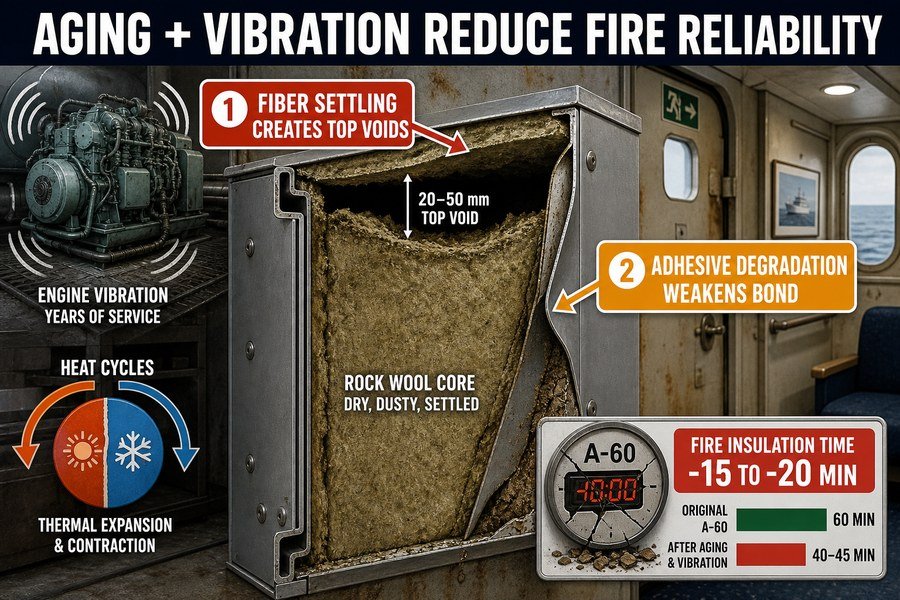
I visited an older cargo ship in Singapore a few years ago. The walls looked fine on the outside. But when we opened a panel, the inside was ruined. A ship engine shakes the whole vessel every day. The sea salt and heat make things old fast. This changes how the fire panel works over time. There are two big problems.
Issue 1: Engine Vibration Causing Fiber Settling and Unprotected Voids
Marine engines create low-frequency vibrations, usually between 5 Hz and 50 Hz.13 This constant shaking pulls on the heavy core material inside the wall panel. Over five or ten years, poor-quality rockwool fibers will break and slide down. We call this fiber settling. The rockwool packs tightly at the bottom of the panel. But at the top of the panel, it creates a void, an empty space of 20mm to 50mm. If a fire starts, flames will burn straight through this empty top void in a few minutes, completely failing the A-60 rating.
Issue 2: Thermal Aging Leading to Adhesive Degradation and Bond Failure
The glue holding the steel skin to the core gets old. Ships cross hot areas like the Middle East. The metal gets hot and cold, expanding and contracting. This is called thermal aging14. The constant movement breaks the chemical bonds in cheap glue. After several years, the glue turns to dry dust. The steel skin is no longer attached to the core. In a real fire, this loose steel skin will peel off immediately, exposing the core to direct flame. This cuts the panel's fire survival time by 15 to 20 minutes.
| Long-Term Threat | Physical Effect on Panel | Fire Safety Impact | Solution in Production |
|---|---|---|---|
| Engine Vibration (5-50 Hz) | Core fibers break and settle down | Voids form at panel top | Use high-density, long-fiber rockwool |
| Thermal Aging (Heat cycles) | Glue dries out and turns to dust | Steel skin falls off in a fire | Use high-grade marine PU adhesives |
How Does Moisture Absorption Affect Marine Ceiling Panels at High Temperatures?
Marine environments are wet and salty. When a core absorbs moisture, it acts like a bomb during a fire. Moisture ruins the insulation value completely.
Moisture absorption damages ceiling panels at high temperatures by triggering three reactions: rapid steam expansion that bursts panel skins, increased thermal conductivity that transfers heat faster, and salt-induced corrosion of the inner steel plates. This combination drops the fire rating from 60 minutes to under 30 minutes.
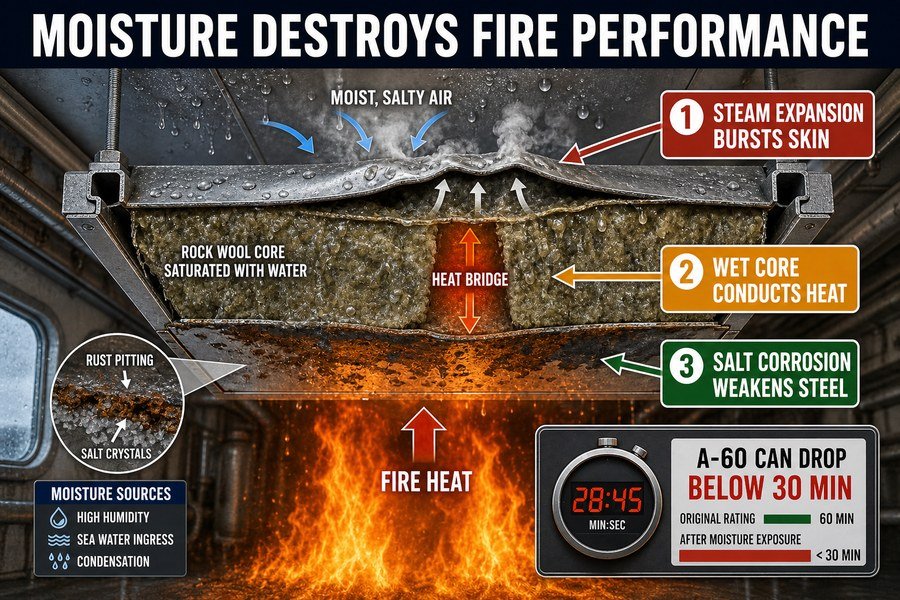
Ships live in water. The air humidity on a ship is often 85% to 95%15. If a panel core is not made well, it will act like a sponge and suck up this wet air. Water inside a fire panel is terrible. I have seen wet panels fail tests miserably. Let me break down the three reactions that happen when a wet panel catches fire.
Reaction 1: Rapid Steam Expansion Bursting Marine Ceiling Panel Skins
When a fire hits 100°C, the water inside the core boils and turns into steam. Water expands about 1700 times its size when it turns to steam.16 Because the core is trapped between two steel skins, the steam has nowhere to go. Pressure builds up fast. I have watched test panels blow apart like a small explosion because of steam pressure. The steel skin bursts open, and the core is destroyed instantly.
Reaction 2: Moisture Increasing Core Thermal Conductivity and Heat Transfer
Water is a great conductor of heat. Dry rockwool has a very low thermal conductivity, about 0.035 W/mK.17 This is what keeps the heat out. But if the core is wet, the thermal conductivity jumps up past 0.5 W/mK.18 The wet core stops being an insulator and becomes a bridge for the fire. The heat travels across the water inside the panel. This drops an A-60 panel's survival time down to 30 minutes or less.
Reaction 3: Salt-Induced Corrosion Weakening Inner Steel Plates
Ocean moisture carries salt. When the core absorbs wet ocean air, the salt sits against the inside of the steel skin. Over months and years, this hidden salt causes rust. The steel gets thin and weak from the inside out. When a fire finally happens, the rusted steel has no physical strength. It melts and tears away easily, exposing the core to the flames much faster than clean, strong steel would.
| Moisture Problem | Reaction During Fire | Impact on Panel Performance | Prevention Method |
|---|---|---|---|
| Water turns to steam | Pressure builds inside panel | Steel skin bursts open | Use water-repellent (hydrophobic) cores |
| Water conducts heat | Heat bridge forms across panel | Fire rating drops by 50% | Seal panel edges carefully |
| Salt causes rust | Inner steel plate weakens | Steel melts and tears quickly | Use galvanized steel and dry cores |
Conclusion
To sum up, core material, density, and resistance to moisture and vibration control your panel's fire safety. Choose certified, high-density cores to protect lives and secure your shipyard projects.
-
"Temperature in Steel Sections - Academia.edu", https://www.academia.edu/72932186/Temperature_in_Steel_Sections. The ISO 834 standard time–temperature curve gives a furnace temperature of approximately 945°C at 60 minutes, supporting the stated fire-exposure temperature for a one-hour fire-resistance test. Evidence role: definition; source type: institution. Supports: At 60 minutes, the furnace temperature reaches about 945°C under the ISO 834 standard fire curve.. ↩
-
"How Are Fire Ratings Verified for Marine Wall and Ceiling Panels?", https://magellanmarinetech.com/how-fire-ratings-verified-for-marine-wall-ceiling-panels/. IMO fire-test requirements for A-class divisions specify insulation performance by limiting the average temperature rise on the unexposed face to 140°C above the initial temperature during the relevant rating period. Evidence role: definition; source type: institution. Supports: The IMO A-class fire test limits the average temperature rise on the unexposed side to 140°C above ambient.. ↩
-
"[PDF] Heat, mass and momentum transport in wet mineral-wool insulation", https://htp.engin.umich.edu/wp-content/uploads/sites/119/2024/05/Wet-insulation.pdf. Research on mineral-wool insulation explains that its low thermal conductivity arises from a fibrous porous structure in which air-filled voids reduce conductive and convective heat transfer. Evidence role: mechanism; source type: paper. Supports: Mineral wool insulates partly because air trapped in its fibrous structure reduces heat transfer.. Scope note: This supports the general heat-transfer mechanism of mineral wool, not the fire-test performance of a specific 50 mm marine panel. ↩
-
"What Smoke Toxicity and Density Limits Must Marine Wall and ...", https://magellanmarinetech.com/what-smoke-toxicity-density-limits-must-marine-wall-ceiling-panels-meet/. The IMO FTP Code includes test procedures for smoke generation and toxicity, including measurement of specified gas concentrations from burning materials, providing context for the statement about toxic-gas assessment. Evidence role: definition; source type: institution. Supports: IMO fire-test procedures include measurement of toxic gas levels, although this is not the core purpose of the Part 3 division fire-resistance test.. Scope note: This support is contextual because smoke and toxicity testing is addressed in the FTP Code separately from the Part 3 fire-resistance test for divisions. ↩
-
"[PDF] 4.401 Lecture 12 Thermal Mass and Heat Flow", https://ocw.mit.edu/courses/4-401-environmental-technologies-in-buildings-fall-2018/c03cdb9ea591216d81a3f2febd616a3c_MIT4_401F18_lec12.pdf. Thermophysical references define volumetric heat capacity as density multiplied by specific heat capacity, supporting the statement that, for the same material, greater density increases heat storage per unit volume. Evidence role: mechanism; source type: education. Supports: For the same core material, increasing density increases thermal mass and the amount of heat the core can absorb per unit volume.. Scope note: This supports the heat-storage mechanism generally; it does not by itself prove that a given rockwool panel will achieve a specific fire rating. ↩
-
"[PDF] Heat, mass and momentum transport in wet mineral-wool insulation", https://htp.engin.umich.edu/wp-content/uploads/sites/119/2024/05/Wet-insulation.pdf. Research on fibrous insulation reports that increasing bulk density reduces pore size or permeability and raises airflow resistance, which can limit convective heat transfer through mineral wool-type materials. Evidence role: mechanism; source type: paper. Supports: Higher-density rockwool cores restrict internal air movement and reduce convective heat transfer compared with lower-density cores.. Scope note: This supports the general mechanism of density reducing air movement in fibrous insulation; it may not directly validate the specific 150 kg/m³ threshold without product-specific fire-test data. ↩
-
"Effects of binder decomposition on high-temperature ...", https://www.osti.gov/biblio/6687749. Thermal-analysis studies of mineral-wool binders report that common organic binders decompose and lose mass over the several-hundred-degree Celsius range, supporting the mechanism that binder degradation can reduce fiber cohesion during fire exposure. Evidence role: mechanism; source type: paper. Supports: Rockwool binder can burn or thermally decompose at around 300°C, weakening the core structure.. Scope note: The source may support binder decomposition ranges generally, rather than proving the exact 300°C threshold or failure time for this specific ceiling panel. ↩
-
"Determination of Thermal Properties of Mineral Wool Required for ...", https://pmc.ncbi.nlm.nih.gov/articles/PMC10488771/. High-temperature dimensional-stability tests for mineral-wool insulation document that some products exhibit measurable linear shrinkage after exposure to elevated temperatures, providing context for the risk of gap formation in fire-rated panels. Evidence role: statistic; source type: paper. Supports: Low-quality or insufficiently stabilized mineral wool can shrink under high heat, potentially by several percent.. Scope note: The cited test data may vary by product density, fiber chemistry, binder content, and test method; it may not directly establish the stated 3%–5% range for all low-grade cores. ↩
-
"How Are Fire Ratings Verified for Marine Wall and Ceiling Panels?", https://magellanmarinetech.com/how-fire-ratings-verified-for-marine-wall-ceiling-panels/. The IMO FTP Code and ISO 834 standard fire curve define furnace temperatures for fire-resistance tests; the curve reaches approximately 945°C at 60 minutes, supporting the stated marine fire-test temperature context. Evidence role: definition; source type: institution. Supports: Marine fire-resistance testing can use a standard time-temperature curve that reaches about 945°C at 60 minutes.. Scope note: This supports the standard test temperature curve, not the claim that a particular slag core will melt or drip under that exposure. ↩
-
"How Does the IMO FTP Code Govern Fire Testing Procedures for ...", https://magellanmarinetech.com/how-does-imo-ftp-code-govern-fire-testing-procedures-for-marine-panels/. The IMO FTP Code non-combustibility test specifies a furnace temperature of 750°C for evaluating whether a material qualifies as non-combustible under the marine fire-test procedure. Evidence role: definition; source type: institution. Supports: The non-combustibility test uses a furnace preheated to 750°C.. ↩
-
"How Does the IMO FTP Code Govern Fire Testing Procedures for ...", https://magellanmarinetech.com/how-does-imo-ftp-code-govern-fire-testing-procedures-for-marine-panels/. The IMO FTP Code Part 1 criteria for non-combustibility include a limit on sustained flaming, commonly stated as no continuous flaming for more than 10 seconds during the test exposure. Evidence role: definition; source type: institution. Supports: A sample fails the IMO non-combustibility test if flaming exceeds the specified 10-second limit during the test.. Scope note: Wording may vary between summaries and official code text; the source should be checked against the current applicable edition of the FTP Code. ↩
-
"[PDF] Noncombustibility of mineral wool and glass fiber insulation materials", https://nvlpubs.nist.gov/nistpubs/Legacy/RPT/nbsreport9988.pdf. Mineral wool and rockwool are primarily inorganic fibers with small amounts of organic binder, which helps explain why mass loss at high temperature can be low compared with the 50% FTP Code limit. Evidence role: mechanism; source type: paper. Supports: Rockwool cores can show low mass loss in high-temperature non-combustibility testing because most of the material is inorganic.. Scope note: Such sources support the material mechanism and typical composition, but they may not directly verify the stated 2%–4% mass-loss range for every marine rockwool core formulation. ↩
-
"[PDF] Torsional Vibration Damper Marine Engine - SUNY", https://devcoil.suny.edu/text/jdatah/070448/86K275N/torsional_vibration__damper_marine_engine.pdf. Research on shipboard vibration and machinery excitation documents that marine propulsion and auxiliary machinery can produce low-frequency vibration components in the single-digit to tens-of-hertz range, providing context for the stated 5–50 Hz operating vibration band. Evidence role: general_support; source type: paper. Supports: Marine engines create low-frequency vibrations, usually between 5 Hz and 50 Hz.. Scope note: Such sources may describe typical vibration spectra or case measurements rather than proving that every cargo ship engine produces vibration throughout the entire 5–50 Hz range. ↩
-
"[PDF] Thermal stability of high temperature epoxy adhesives as measured ...", https://www.osti.gov/servlets/purl/1120656. Materials-engineering studies of polymer and polyurethane adhesives show that heat exposure and repeated thermal cycling can reduce bond strength through chemical and physical aging mechanisms, supporting the use of thermal aging as a mechanism for adhesive degradation. Evidence role: mechanism; source type: paper. Supports: Thermal aging from heat cycles can degrade the adhesive bond between the steel skin and panel core over time.. Scope note: Evidence is likely to support the degradation mechanism generally; it may not directly quantify aging in the specific marine fire-panel construction described here. ↩
-
"[PDF] N72-27111 - NASA Technical Reports Server (NTRS)", https://ntrs.nasa.gov/api/citations/19720019461/downloads/19720019461.pdf?attachment=true. Marine-environment studies and shipboard habitability guidance report that enclosed ship spaces can experience high relative humidity, providing context for the stated 85%–95% range. Evidence role: statistic; source type: government. Supports: The air humidity on a ship is often 85% to 95%.. Scope note: Support may be contextual unless the source measures the same vessel type, climate, ventilation condition, and operating profile. ↩
-
"Table 3. Compressed Water and Superheated Steam", https://www.nist.gov/system/files/documents/srd/NISTIR5078-Tab3.pdf. Steam-table data show that saturated water vapor at about 100°C and atmospheric pressure has a specific volume roughly 1,600–1,700 times greater than liquid water, supporting the expansion mechanism described. Evidence role: mechanism; source type: government. Supports: Water expands about 1700 times its size when it turns to steam.. Scope note: The exact expansion ratio varies with pressure and temperature; a confined panel fire is not identical to atmospheric boiling conditions. ↩
-
"Determination of Thermal Properties of Mineral Wool Required for ...", https://pmc.ncbi.nlm.nih.gov/articles/PMC10488771/. Reference data for mineral wool insulation list thermal conductivity values commonly around 0.03–0.04 W/m·K, supporting the stated order of magnitude for dry rockwool. Evidence role: statistic; source type: encyclopedia. Supports: Dry rockwool has a very low thermal conductivity, about 0.035 W/mK.. Scope note: Reported values depend on density, fiber orientation, temperature, and product formulation. ↩
-
"[PDF] Water Vapor Permeability and Thermal Conductivity as a Function of ...", https://web.ornl.gov/sci/buildings/conf-archive/2004%20B9%20papers/077_Valovirta.pdf. Building-physics studies show that moisture substantially increases the effective thermal conductivity of porous insulation, and liquid water has a thermal conductivity near 0.6 W/m·K, which supports the mechanism behind higher heat transfer in wet cores. Evidence role: mechanism; source type: paper. Supports: If the core is wet, the thermal conductivity jumps up past 0.5 W/mK.. Scope note: This evidence may not directly prove that every wet marine panel core exceeds 0.5 W/m·K; the threshold depends on saturation level, pore structure, temperature, and material density. ↩