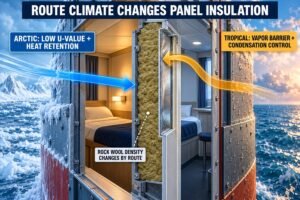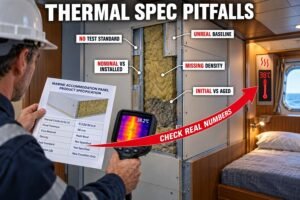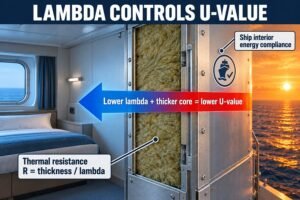
Ship fires spread fast, causing huge damage and lost lives. You might wonder if your panels can stop the heat. Here is exactly how heat moves through these panels.
Heat transfers through marine interior panels via three complete paths: thermal conduction through the core and steel face-sheets, convection within air gaps, and thermal radiation from the unexposed cold face. Controlling all three mechanisms is required to meet the 140°C average temperature rise limit under SOLAS regulations.
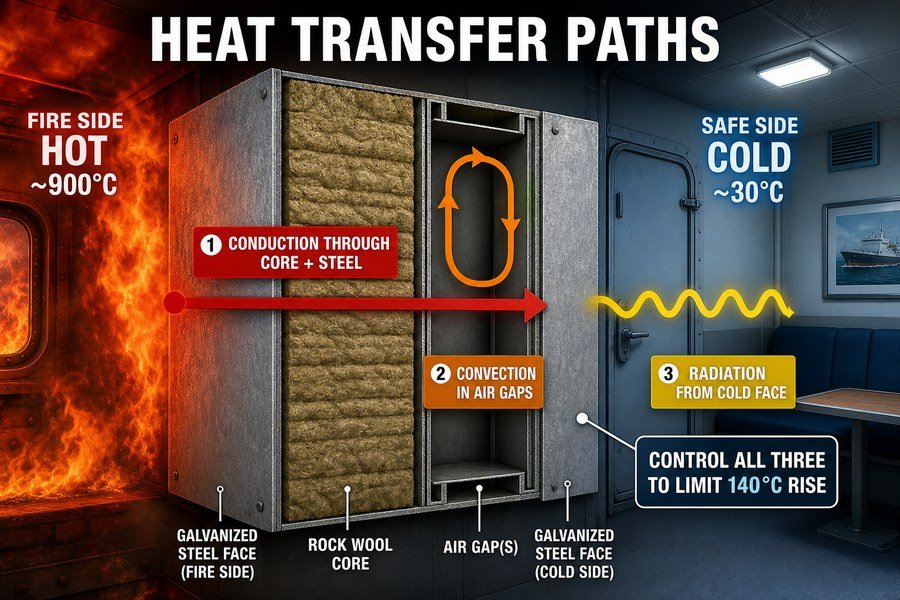
If you think a standard metal sheet will protect your crew, you should stop reading now. But if you want to know how real marine panels save lives, read on.
What Controls the Heat-Transfer Rate Through a Marine Accommodation Panel?
You buy panels, but the core materials often fail tests. This wastes your money and time. Knowing what controls heat transfer helps you pick the right factory every time.
The heat-transfer rate through a marine accommodation panel is controlled by four key factors: the thermal conductivity of the core material, panel thickness, core density, and the integrity of the joining profiles. Together, these determine if the panel passes the IMO FTP Code Part 3 fire test.
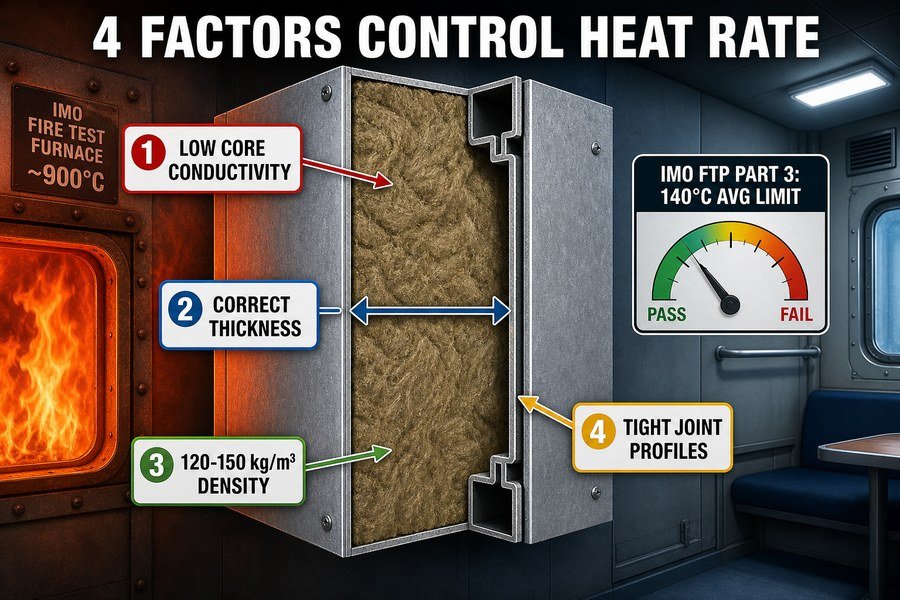
Impact of Thermal Conductivity and Core Density on Panel Heat Transfer
In my years working at Magellan Marine, I have seen many buyers choose cheap panels. They fail the fire test. Why? Because four key factors control heat flow. First is thermal conductivity. Rockwool is the main core material we use. Good rockwool has a thermal conductivity of about 0.035 to 0.040 W/(m·K) at room temperature1. But in a fire, this number goes up as it gets hotter. If the rockwool is poor quality, it conducts heat too fast.
Second is core density. You cannot just use light rockwool to save money. For A-Class panels, the IMO (International Maritime Organization) FTP Code requires a rockwool density of at least 120 kg/m³ to 150 kg/m³. If the factory uses a density of only 80 kg/m³, the heat transfers too quickly through the empty air pockets in the wool, and the panel fails the test.
Role of Panel Thickness and Joining Profiles in Fire Testing
Next, we look at panel thickness. Thickness is the third factor. A standard B-15 class wall panel is 25 mm or 50 mm thick. An A-60 class wall panel must be at least 50 mm thick, sometimes up to 100 mm, depending on the exact design and steel structure. If you cut the thickness by even 5 mm, the heat transfer rate jumps up.2
The fourth factor is the integrity of the joining profiles. These are the metal joints between two panels. If the joints do not fit tightly, flames and heat will go straight through the cracks. A gap of just 2 mm can cause a sudden temperature rise on the cold side. The unexposed side temperature cannot rise more than 140°C on average, or 180°C at any single point3, according to SOLAS rules. By checking these four things, you control your quality and keep your projects on schedule.
| Factor Controlling Heat Transfer | Typical Value Range for Marine Panels | Authoritative Requirement (IMO FTP Code Part 3) |
|---|---|---|
| Core Thermal Conductivity | 0.035 - 0.040 W/(m·K) at 20°C | Must maintain low conductivity during 945°C fire test |
| Core Density (Rockwool) | 120 kg/m³ to 150 kg/m³ | Mandatory minimum density to pass A-Class fire rating |
| Panel Thickness | 25 mm (B-0) to 100 mm (A-60) | Dictates the time delay for heat transfer to cold face |
| Joint Profile Gap | 0 mm (Flush and tight) | Gaps >0 mm lead to instant failure via heat leakage |
How Does a Marine Ceiling Panel Limit Temperature Rise on the Deck Above?
A weak ceiling panel lets heat destroy the deck above. This puts the whole ship at risk. Here is how ceilings stop heat and keep the upper deck safe.
A marine ceiling panel limits upper deck temperature rise through three main defense mechanisms: a non-combustible reflective surface that bounces radiant heat back, high-density mineral wool insulation that slows thermal conduction, and an air gap between the ceiling and the steel deck that disrupts heat convection.
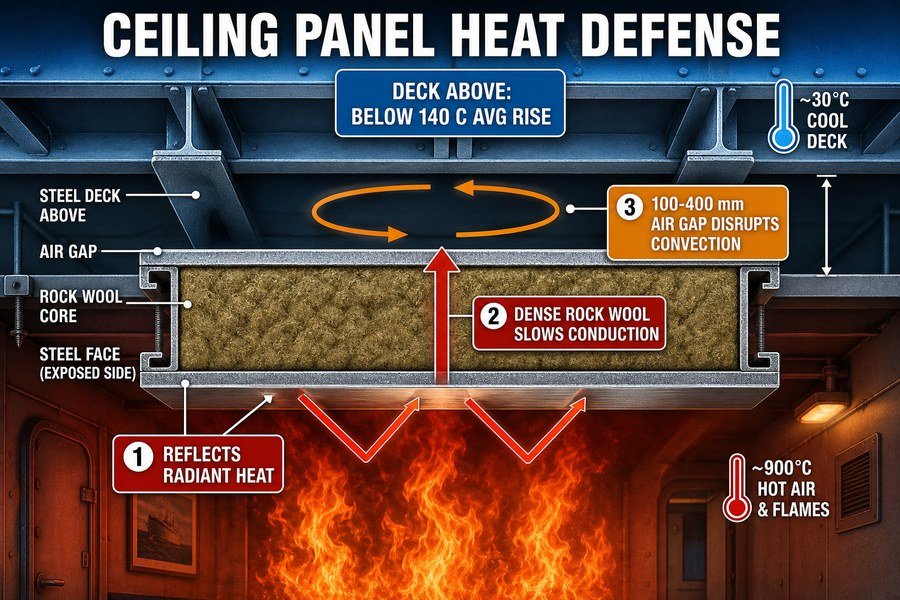
Reflective Surfaces and High-Density Mineral Wool Insulation Defense
When I started in the factory, I did not understand why ceiling panels were different from wall panels. Now I know that ceiling panels have a tough job. They must protect the steel deck above them from fires below. They do this using three main defense mechanisms. The first defense is a non-combustible reflective surface. The bottom side of the ceiling panel faces the room. When a fire starts, room temperatures can hit 900°C in just a few minutes4. The steel face of the ceiling reflects some of this radiant heat back into the room5. This slows down the amount of heat entering the panel in the first place.
The second defense is high-density mineral wool insulation. Just like wall panels, ceilings use rockwool. But ceiling rockwool must stay intact even when gravity pulls it down during a fire. A typical B-15 ceiling uses rockwool with a density of 150 kg/m³ and a thickness of 50 mm. This thick, heavy core blocks thermal conduction. The heat tries to move up, but the dense rockwool traps it.
The Role of the Air Gap in Disrupting Heat Convection
The third defense is the air gap. When you install a ceiling, you never attach it directly to the steel deck. You must leave a space. This air gap is usually between 100 mm and 400 mm deep, depending on the ship's design. The air in this gap acts as an extra insulator6. It breaks the direct path of heat convection from the ceiling panel to the steel deck.
The IMO FTP Code Part 3 requires the steel deck above to stay below a 140°C average rise7. If you skip the air gap or use cheap rockwool, the steel deck gets too hot. A hot deck can start a new fire on the floor above. This is why you must check the installation drawings carefully.
| Defense Mechanism | Function in Fire Safety | Critical Specification / Value |
|---|---|---|
| Reflective Steel Surface | Bounces radiant heat back into the burning cabin | Minimum 0.5 mm thick galvanized steel sheet |
| Mineral Wool Insulation | Slows direct thermal conduction upwards | 150 kg/m³ density, 50 mm minimum thickness |
| Ceiling Air Gap | Disrupts heat convection to the steel deck | 100 mm to 400 mm installation gap required |
Why Is Insulation Thickness Critical for Marine Wall Panel Heat Transfer?
Buying thin panels seems like a smart way to save money. But thin panels fail inspections. You must understand why thickness is the secret to stopping fire heat.
Insulation thickness is critical for marine wall panel heat transfer because it directly dictates the thermal resistance value, determines the time delay before the cold face overheats, and ensures compliance with specific fire ratings ranging from B-0 to A-60 under maritime safety regulations.
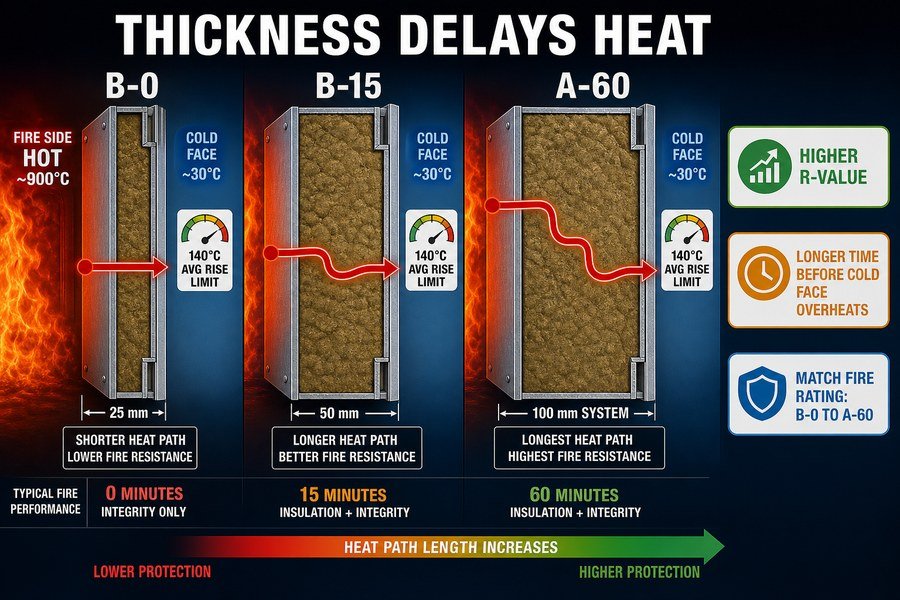
How Panel Thickness Dictates Thermal Resistance and Time Delay
Many buyers ask me if they can use a 25 mm panel instead of a 50 mm panel. They want to save money and save space on the ship. I always tell them no, unless the specific fire rating allows it. Thickness is critical for three big reasons. First, thickness directly dictates the thermal resistance value. Thermal resistance, or R-value, tells us how well the material blocks heat. If you double the thickness of rockwool, you double its R-value. A 50 mm rockwool core with a density of 120 kg/m³ has an R-value of about 1.43 m²·K/W. If you cut it down to 25 mm, the R-value drops to 0.71 m²·K/W.8 The heat will pass right through it.
Second, thickness determines the time delay before the cold face overheats. In a fire, the hot side gets very hot, very fast. The heat takes time to travel through the panel to the safe room. A thicker panel forces the heat to travel a longer distance. This buys precious time for the crew to escape. For an A-60 panel, the cold face must stay below a 140°C average rise for 60 whole minutes.9 A 50 mm panel can usually delay the heat for about 30 minutes, but a full 100 mm panel system is often needed to delay it for a full 60 minutes.10
Matching Panel Thickness to Specific Fire Ratings Like B-0 and A-60
Third, thickness ensures compliance with specific fire ratings. The IMO safety rules are very strict. A B-0 panel does not need to block heat for long; it mostly just stops flames.11 It can be very thin, maybe 25 mm. But a B-15 panel must block heat for 15 minutes, requiring at least 50 mm of insulation. An A-60 panel requires up to 100 mm of total insulation depending on the bulkhead design. If you use the wrong thickness, the marine surveyor will reject your ship and you will have to rebuild everything.
| Fire Rating (IMO) | Required Time Delay for Heat (140°C rise) | Typical Required Panel Thickness | R-Value Estimate (120 kg/m³ rockwool) |
|---|---|---|---|
| B-0 Class | 0 minutes (stops flames only) | 25 mm | ~0.71 m²·K/W |
| B-15 Class | 15 minutes | 50 mm | ~1.43 m²·K/W |
| A-30 Class | 30 minutes | 50 mm - 75 mm | ~1.43 to 2.14 m²·K/W |
| A-60 Class | 60 minutes | 100 mm (System total) | ~2.85 m²·K/W |
How Do Steel Face-Sheets Impact a Marine Interior Panel's Thermal Conduction?
Steel skins make panels strong, but steel gets very hot. This creates a hidden danger for your fire safety. Learn how metal sheets change the way heat moves.
Steel face-sheets impact a marine interior panel's thermal conduction in three distinct ways: they act as rapid heat spreaders across the panel surface, they create thermal bridges at the panel edges, and they protect the fragile mineral wool core from direct flame erosion during a fire.
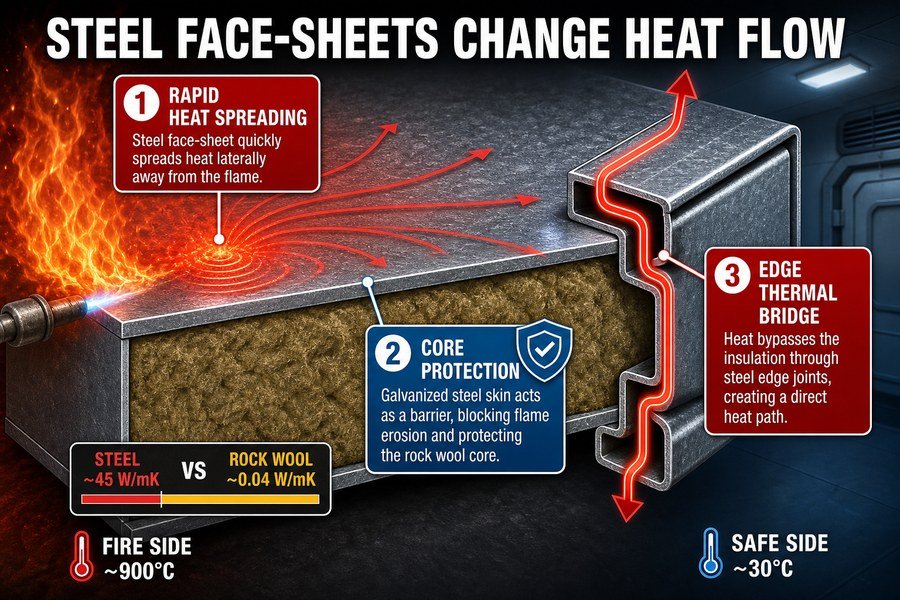
Steel Face-Sheets as Rapid Heat Spreaders and Core Protectors
We use galvanized steel or PVC-coated steel for the faces of our marine panels. A typical steel sheet is 0.5 mm or 0.6 mm thick. Steel is great for structural strength, but it conducts heat very fast. Steel face-sheets impact thermal conduction in three distinct ways. First, they act as rapid heat spreaders across the panel surface. Steel has a thermal conductivity of about 45 W/(m·K). This is more than 1000 times higher than the rockwool core.12 When a fire hits one spot on the panel, the steel face quickly pulls that heat and spreads it evenly over the whole surface. This prevents one single spot from melting too fast.
Second, steel protects the fragile mineral wool core from direct flame erosion. Rockwool handles heat well, but direct flames and high-pressure hot gases from a fire can tear it apart. The 0.6 mm steel skin acts as a hard shield. It keeps the fire away from the soft core. Without the steel sheet, the rockwool would break down and turn to dust before the 60-minute mark in an A-60 fire test, which reaches a peak of 945°C13.
The Danger of Thermal Bridges at Panel Edges
Third, steel creates thermal bridges at the panel edges14. This is the biggest technical problem we face in the factory. At the edge of the panel, the steel from the hot side folds over and connects near the steel from the cold side. Heat always takes the easiest path. It travels straight through the solid metal edge, completely bypassing the insulating rockwool.
We have to design special joint profiles with PVC or ceramic thermal breaks to stop this thermal bridge. If we do not stop it, the edge temperature on the safe side will quickly exceed the 180°C maximum single-point limit set by the IMO15.
| Steel Face-Sheet Function | Impact on Heat Transfer | Key Material Specification |
|---|---|---|
| Heat Spreading | Spreads heat evenly, preventing local burn-through | Thermal conductivity ~45 W/(m·K) |
| Core Protection | Blocks hot gases from eroding the rockwool | 0.5 mm to 0.6 mm galvanized steel |
| Edge Thermal Bridging | Creates a fast path for heat to bypass insulation | Must use ceramic/PVC breaks at joints |
How Are Thermal Bridging Risks Assessed in Marine Accommodation Panels?
Hidden thermal bridges will ruin your fire test results. You spend thousands on testing only to fail. Discover how we find and fix these hidden heat paths.
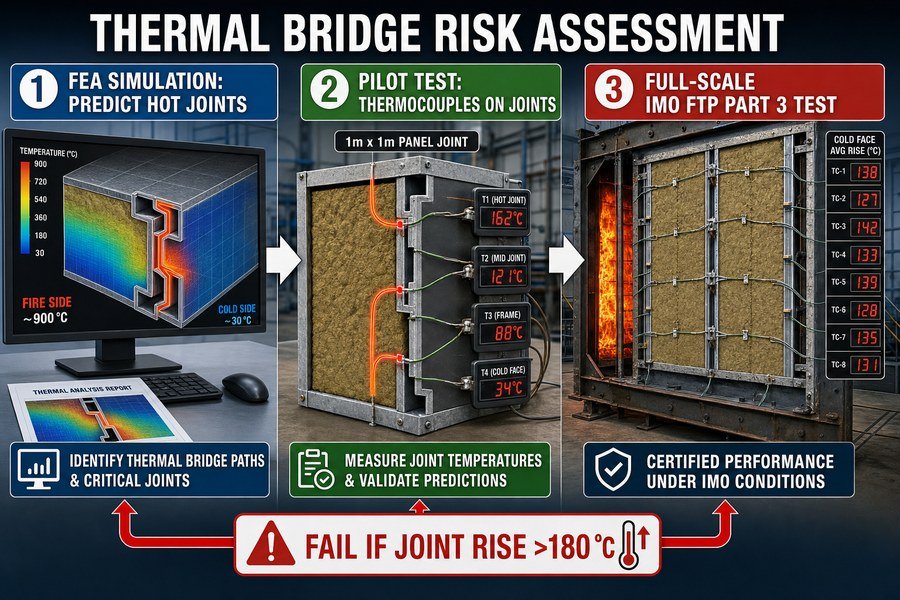
Thermal bridging risks in marine accommodation panels are assessed through three rigorous methods: computer simulation using finite element analysis, physical pilot testing with thermocouples placed directly on joints, and final full-scale fire testing according to the IMO FTP Code Part 3 standard in a certified laboratory.
Computer Simulation and Pilot Testing with Thermocouples
I once saw a client lose $10,000 because they ignored thermal bridges in their custom panel design. A thermal bridge is a piece of metal that goes from the hot side to the cold side. Heat crosses it easily. We assess thermal bridging risks through three rigorous methods to make sure this never happens to you.
First, we use computer simulation using finite element analysis (FEA)16. Before we build anything in the factory, our engineers draw the panel joint in a computer. The software models the standard fire curve up to 945°C. It predicts exactly how heat will move through the folded steel edges. It shows us where the cold face will get too hot, allowing us to fix the drawing early.
Second, we conduct physical pilot testing with thermocouples placed directly on joints. We build a small version of the panel, usually 1 meter by 1 meter. We stick thin wire temperature sensors, called thermocouples, right on the metal joints. We burn the panel in a small oven. If the thermocouple on the joint shows a temperature spike above a 180°C rise, we know the thermal bridge is too strong. We then redesign the joint before spending big money on the main test.
Final Full-Scale Fire Testing to IMO FTP Code Standards
Third, we do the final full-scale fire testing according to the IMO FTP Code Part 3 standard. This is the ultimate proof. We build a large test wall that is at least 2.44 meters wide by 2.5 meters high. An official from a certified laboratory, like DNV or Lloyd's Register, watches the whole test. They place 5 thermocouples in the center of the panels and several more right on the joints. If the joint thermocouple stays below a 180°C rise for the required time (like 60 minutes for A-60), the panel passes and gets its certificate.
| Assessment Method | Timing in Production | Target Outcome / Measurement |
|---|---|---|
| Computer Simulation (FEA) | Design phase (before manufacturing) | Predicts heat flow paths virtually |
| Pilot Testing (1m x 1m) | R&D phase (early manufacturing) | Measures joint temp spikes using thermocouples |
| Full-Scale IMO Fire Test | Final Certification phase | Official proof of <180°C max rise on joints |
How Does Radiant Heat Affect a Marine Wall Panel's Cold Face During a Fire?
You might think the fire is contained, but things can catch fire on the safe side. Radiant heat is a silent killer you must understand to protect ships.
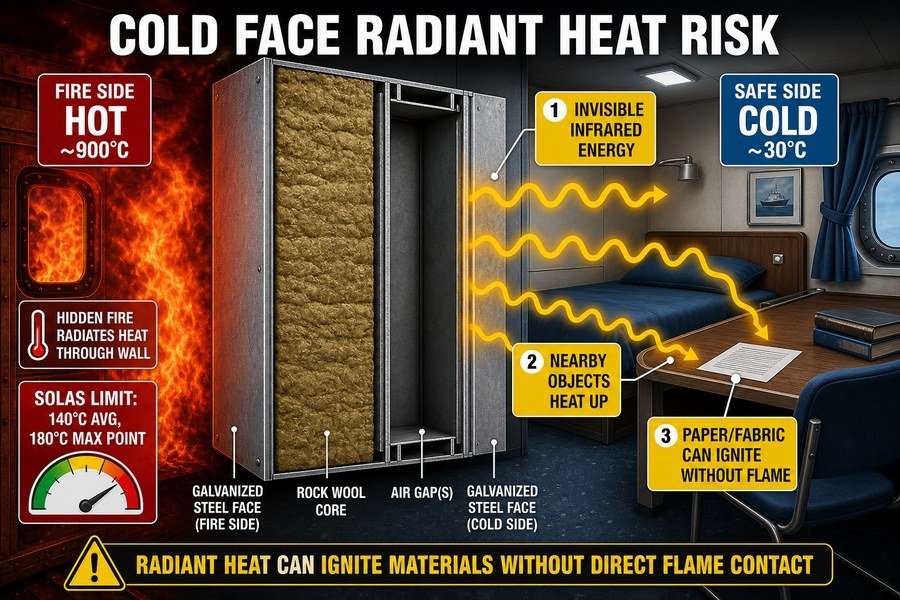
Radiant heat affects a marine wall panel's cold face by emitting invisible infrared energy into the safe room, raising the temperature of nearby objects, and potentially igniting combustible materials like paper or fabric even without direct flame contact, making cold face temperature limits strictly regulated.
The Emission of Invisible Infrared Energy and Heating Nearby Objects
When a fire burns on one side of a wall, the other side—the cold face—gets very warm. Even if no actual flames come through the steel, the cold face becomes a giant heater. Radiant heat affects the cold face in three major ways. First, the cold face starts emitting invisible infrared energy into the safe room17. You cannot see this energy, but you can feel it on your skin. If the panel's rockwool core is poor, the cold face gets hot very quickly and pumps massive amounts of this energy into the cabin.
Second, this energy raises the temperature of nearby objects. Imagine a bed, a wooden desk, or a curtain placed right next to the wall panel. As the cold face gets hot, it pushes radiant heat directly into the bed. The air in the room might be okay to breathe for a short time, but the solid objects absorb the radiant heat fast18. If the wall reaches 200°C, the bed absorbs that heat and gets dangerously hot.
The Risk of Igniting Combustibles and Strict Regulatory Limits
Third, this creates the potential to ignite combustible materials like paper or fabric even without direct flame contact. This is called auto-ignition. Paper can catch fire on its own if it gets hotter than 230°C19. This is why cold face temperature limits are strictly regulated by SOLAS.
The IMO FTP Code Part 320 states the average temperature rise on the cold face cannot exceed 140°C above the starting room temperature. If the room starts at 20°C, the average wall temperature cannot go over 160°C. Also, no single point can rise more than 180°C (meaning a max of 200°C total). This strict rule ensures that beds, clothes, and papers on the safe side do not burst into flames from radiant heat.
| Radiant Heat Effect | Danger to the Safe Cabin | IMO Regulatory Limit to Prevent Danger |
|---|---|---|
| Emits Infrared Energy | Heats the safe room rapidly | Average temperature rise capped at 140°C |
| Heats Nearby Objects | Beds and desks absorb heat | Max single point rise capped at 180°C |
| Ignites Combustibles | Paper auto-ignites at ~230°C | Limits keep total panel temp below 200°C |
Conclusion
Heat transfer through marine panels involves conduction, convection, and radiation. By controlling core density, thickness, and joints, you meet IMO standards and ensure your ship remains completely safe.
-
"Determination of Thermal Properties of Mineral Wool Required for ...", https://pmc.ncbi.nlm.nih.gov/articles/PMC10488771/. Published measurements of mineral-wool insulation report room-temperature thermal conductivity values in the approximate 0.03–0.04 W/(m·K) range and show that effective conductivity generally increases with mean temperature, supporting the stated order of magnitude for rockwool cores. Evidence role: statistic; source type: paper. Supports: Good rockwool has a thermal conductivity of about 0.035 to 0.040 W/(m·K) at room temperature, and the value rises as temperature increases.. Scope note: Values vary by product formulation, density, moisture content, and test method; this does not verify any specific panel product. ↩
-
"Determination of Thermal Properties of Mineral Wool ... - PMC", https://pmc.ncbi.nlm.nih.gov/articles/PMC10488771/. Standard conductive heat-transfer theory describes heat flux through a plane layer as proportional to thermal conductivity and temperature difference and inversely proportional to layer thickness, providing the physical basis for increased heat transfer when insulation thickness is reduced. Evidence role: mechanism; source type: education. Supports: Reducing panel thickness increases heat transfer rate through the panel.. Scope note: This supports the direction of the effect, not the precise magnitude implied for a 5 mm reduction in a certified marine fire-test assembly. ↩
-
"Are Marine Fire Divisions the Same as Marine Panel Ratings?", https://magellanmarinetech.com/are-marine-fire-divisions-same-as-marine-panel-ratings/. SOLAS and the IMO FTP Code criteria for A-class divisions define insulation performance by limiting the average unexposed-face temperature rise to 140°C above the original temperature and the temperature rise at any one point to 180°C. Evidence role: definition; source type: government. Supports: The unexposed side temperature cannot rise more than 140°C on average, or 180°C at any single point, under SOLAS/IMO fire-test criteria.. ↩
-
"[PDF] Estimating Temperatures in Compartment Fires", https://tsapps.nist.gov/publication/get_pdf.cfm?pub_id=907752. Fire dynamics literature documents that post-flashover compartment fires can reach gas temperatures on the order of 800–1,000°C, supporting the plausibility of rapid near-900°C room temperatures in severe enclosed fires. Evidence role: general_support; source type: government. Supports: Room temperatures in a fire can reach about 900°C within a few minutes.. Scope note: This supports severe post-flashover compartment fire conditions generally; actual temperatures and timing depend on fuel load, ventilation, and compartment geometry. ↩
-
"Emissivity", https://en.wikipedia.org/wiki/Emissivity. Heat-transfer references describe metallic surfaces as having relatively low emissivity and correspondingly higher reflectivity for thermal radiation, which explains why a steel facing can reduce radiant heat absorption compared with more emissive surfaces. Evidence role: mechanism; source type: education. Supports: A steel ceiling face can reflect part of the radiant heat from a fire back toward the room, reducing heat entering the panel.. Scope note: The degree of reflection depends strongly on coating, oxidation, surface roughness, temperature, and wavelength; the source would support the mechanism rather than a quantified performance value for this panel. ↩
-
"[PDF] Convection in Loose-Fill Attic Insulation— Measurements and ...", https://web.ornl.gov/sci/buildings/conf-archive/2004%20B9%20papers/014_Wahlgren.pdf. Building-physics and heat-transfer sources explain that enclosed or semi-enclosed air spaces can add thermal resistance because still air has low thermal conductivity and can reduce direct conductive heat transfer across an assembly. Evidence role: mechanism; source type: research. Supports: The air gap above a suspended ceiling can provide additional thermal resistance and reduce heat transfer toward the steel deck.. Scope note: This supports the insulating principle of an air space generally; in fire-rated marine ceilings, actual performance depends on gap depth, ventilation, fixings, panel joints, and tested assembly details. ↩
-
"What Is the Purpose and Scope of the IMO FTP Code?", https://magellanmarinetech.com/what-purpose-scope-of-imo-ftp-code/. The IMO Fire Test Procedures Code criteria for A-, B-, and F-class divisions use temperature-rise limits, including an average unexposed-side temperature rise of 140°C, to assess insulation performance in standard fire tests. Evidence role: expert_consensus; source type: institution. Supports: IMO FTP Code Part 3 includes a 140°C average temperature-rise criterion for the unexposed side of tested fire divisions.. Scope note: The exact applicability to a particular ceiling/deck assembly depends on its classification, test configuration, and approval documentation. ↩
-
"Determination of Thermal Properties of Mineral Wool Required for ...", https://pmc.ncbi.nlm.nih.gov/articles/PMC10488771/. The cited source defines thermal resistance for a plane layer as thickness divided by thermal conductivity and gives typical mineral-wool conductivity ranges, supporting these R-value estimates when a conductivity near 0.035 W/m·K is assumed. Evidence role: mechanism; source type: education. Supports: A 50 mm rockwool core is about R=1.43 m²·K/W and a 25 mm core is about R=0.71 m²·K/W.. Scope note: The stated values are calculations from typical conductivity; actual R-values vary by product formulation, temperature, moisture, compression, and test method. ↩
-
"What Is the Purpose and Scope of the IMO FTP Code?", https://magellanmarinetech.com/what-purpose-scope-of-imo-ftp-code/. The cited IMO/SOLAS fire-test definition states that an A-60 class division must limit the average temperature rise on the unexposed face to 140°C for 60 minutes, supporting the stated A-60 insulation criterion. Evidence role: definition; source type: institution. Supports: An A-60 panel must limit average unexposed-face temperature rise to 140°C for 60 minutes.. Scope note: This supports the regulatory performance criterion, not the suitability of any particular panel thickness or construction. ↩
-
"How to choose the right marine wall panels for marine interior ...", https://magellanmarinetech.com/how-choose-right-marine-wall-panels-for-marine-interior-projects/. Published fire-test studies or type-approval data for mineral-wool insulated marine divisions can document examples in which thinner systems achieve A-30 performance while thicker or multi-layer systems near 100 mm are used for A-60 performance, providing contextual support for the thickness-time relationship. Evidence role: case_reference; source type: paper. Supports: A thinner mineral-wool panel may correspond to about a 30-minute insulation rating, while A-60 performance often requires a thicker system around 100 mm depending on design.. Scope note: IMO classifications are performance-based rather than thickness-prescriptive, so this evidence would support the statement as a common design example, not as a universal rule. ↩
-
"Are Marine Fire Divisions the Same as Marine Panel Ratings?", https://magellanmarinetech.com/are-marine-fire-divisions-same-as-marine-panel-ratings/. The cited IMO/SOLAS definition of B-class divisions states that they must prevent flame passage for a specified fire test period, while B-0 has no required insulation period, supporting the distinction between flame integrity and thermal insulation time. Evidence role: definition; source type: institution. Supports: A B-0 panel is primarily an integrity/flame-stopping classification and has no required heat-insulation duration.. Scope note: The source supports the B-0 performance classification but does not by itself establish a universal minimum or typical panel thickness. ↩
-
"[PDF] Heat, mass and momentum transport in wet mineral-wool insulation", https://htp.engin.umich.edu/wp-content/uploads/sites/119/2024/05/Wet-insulation.pdf. Reference thermal-property data report carbon-steel conductivity in the tens of W·m−1·K−1 and mineral-wool insulation near hundredths of W·m−1·K−1, supporting the stated order-of-magnitude contrast between steel sheet and rockwool core conduction. Evidence role: statistic; source type: encyclopedia. Supports: Steel face-sheet conductivity is roughly more than 1000 times higher than the rockwool core.. Scope note: Exact conductivity varies with alloy, coating, density, temperature, and mineral-wool formulation, so the source would support the scale of the comparison rather than one fixed product value. ↩
-
"How Are Fire Ratings Verified for Marine Wall and Ceiling Panels?", https://magellanmarinetech.com/how-fire-ratings-verified-for-marine-wall-ceiling-panels/. IMO fire-test procedures for A-class divisions specify a standard time–temperature furnace curve and the A-60 classification duration, which provides contextual support for the stated 60-minute marine fire-test exposure and its approximate furnace temperature near the end of the test. Evidence role: historical_context; source type: institution. Supports: An A-60 marine fire test uses a standardized severe furnace exposure that is approximately 945°C at 60 minutes.. Scope note: The cited IMO curve supports the standardized furnace exposure, not the performance of any particular panel construction in that exposure. ↩
-
"[PDF] exploration and minimization of thermal bridging due to exterior ...", https://repositories.lib.utexas.edu/bitstreams/be880dc5-3c32-4bd0-be5e-ea1e2740b726/download. Building-science references define thermal bridges as conductive paths through or around insulation, and metal components are commonly cited as high-conductivity paths that increase heat transfer, supporting the mechanism described for folded steel panel edges. Evidence role: mechanism; source type: government. Supports: Steel at panel edges can form thermal bridges that bypass the insulating rockwool core.. Scope note: General thermal-bridge literature supports the heat-transfer mechanism; it does not verify the severity of bridging in this specific marine panel edge design. ↩
-
"What Is the Purpose and Scope of the IMO FTP Code?", https://magellanmarinetech.com/what-purpose-scope-of-imo-ftp-code/. IMO A-class division criteria limit the unexposed-side temperature rise during the relevant fire-resistance period, including a maximum temperature rise at any one point, supporting the cited single-point temperature criterion for A-60 divisions. Evidence role: expert_consensus; source type: institution. Supports: IMO fire-test criteria include a maximum single-point unexposed-side temperature-rise limit of 180°C for A-class divisions.. Scope note: The standard is a classification criterion for tested divisions; it does not by itself predict whether a specific joint profile will exceed the limit. ↩
-
"[PDF] Introduction to Numerical Methods in Heat Transfer", https://ntrs.nasa.gov/api/citations/20200006182/downloads/Introduction%20to%20Numerical%20Methods%20in%20Heat%20Transfer.pdf. A finite element heat-transfer reference supports that FEA is commonly used to approximate conduction and temperature distributions in solids, including complex geometries. Evidence role: mechanism; source type: education. Supports: Computer simulation using finite element analysis can be used to assess heat-flow paths in a panel joint before fabrication.. Scope note: This supports FEA as an accepted modelling method, but it does not substantiate the article’s stronger wording that the software predicts heat movement “exactly.” ↩
-
"[PDF] Radiative heat transfer - MIT OpenCourseWare", https://ocw.mit.edu/courses/2-997-direct-solar-thermal-to-electrical-energy-conversion-technologies-fall-2009/e4e64170a22c7c7e507f07d1c157dc10_MIT2_997F09_lec08.pdf. A heat-transfer reference explains that all surfaces above absolute zero emit thermal radiation and that, at ordinary engineering temperatures, much of this emission is in the infrared spectrum, supporting the statement that a heated cold face radiates invisible energy into the room. Evidence role: mechanism; source type: education. Supports: A heated cold face emits invisible infrared thermal radiation into the adjacent room.. Scope note: This supports the physical mechanism generally, not the emission intensity from a specific wall-panel construction. ↩
-
"Thermal radiation - Wikipedia", https://en.wikipedia.org/wiki/Thermal_radiation. Heat-transfer literature describes radiative heat exchange between a hotter surface and cooler nearby objects, with absorbed radiation increasing the objects’ temperature according to their absorptivity and geometry, supporting the mechanism of radiant heating of beds, desks, or curtains. Evidence role: mechanism; source type: education. Supports: Nearby solid objects can absorb radiant heat from a hot wall face and increase in temperature.. Scope note: The source would support the general mechanism, but not a specific heating rate for any particular bed, desk, curtain, or cabin layout. ↩
-
"[PDF] Self-ignition temperatures of combustible liquids", https://nvlpubs.nist.gov/nistpubs/jres/53/jresv53n1p49_a1b.pdf. Fire-safety references commonly report paper ignition or autoignition temperatures in the approximate range around 230°C, supporting the article’s use of 230°C as an order-of-magnitude threshold for self-ignition. Evidence role: statistic; source type: government. Supports: Paper can autoignite at approximately 230°C under some conditions.. Scope note: Paper ignition temperature varies with paper composition, thickness, moisture, airflow, sample geometry, and exposure duration, so 230°C should be treated as approximate rather than universal. ↩
-
"What Do A-Class, B-Class, and C-Class Divisions Mean in Marine ...", https://magellanmarinetech.com/what-a-class-b-class-c-class-divisions-mean-in-marine-wall-ceiling-panels/. The IMO FTP Code Part 3 fire-resistance criteria specify limits for temperature rise on the unexposed face, including an average rise of no more than 140°C and a maximum point rise of no more than 180°C, supporting the stated regulatory thresholds for fire-resisting divisions. Evidence role: case_reference; source type: institution. Supports: IMO FTP Code Part 3 sets cold-face temperature-rise limits of 140°C average and 180°C maximum point rise.. Scope note: This supports the existence of the regulatory limits; it does not by itself prove that the sole purpose of the limits is to prevent radiant ignition of cabin contents. ↩