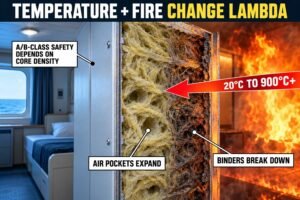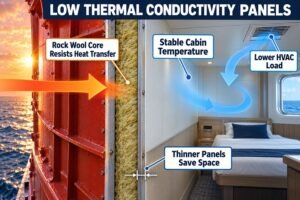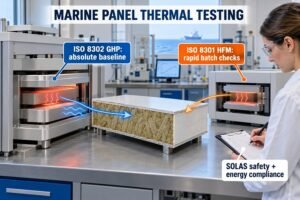
Fire ruins panels fast. If walls fall down, escape routes get blocked. Let us look at what makes marine wall panels stay straight and strong under extreme heat.
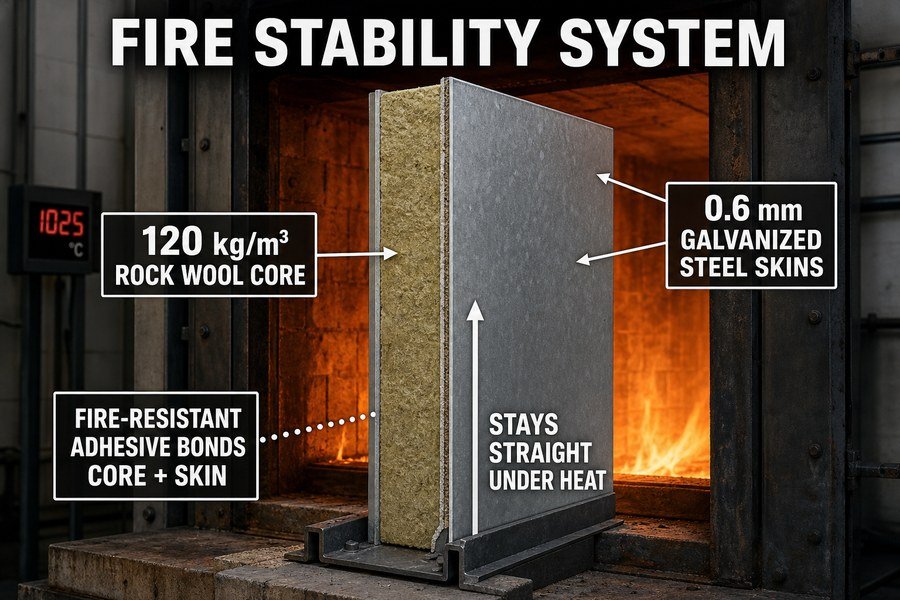
Vertical marine wall panels maintain stability under intense heat through three methods: using high-density rock wool cores (minimum 120 kg/m³), utilizing galvanized steel skins (0.6mm thickness), and applying fire-resistant adhesives to bond the core and skin together.
Knowing how panels hold up in a fire helps you buy the right products from your suppliers. Let us explore the details so you can avoid buying cheap, weak panels that will fail inspection.
How Does a Vertical Marine Wall Panel Stay Stable Under Intense Heat?
Cheap panels warp quickly. A warped panel fails safety tests and costs you money. I will show you how vertical marine wall panels keep their shape when the heat rises.
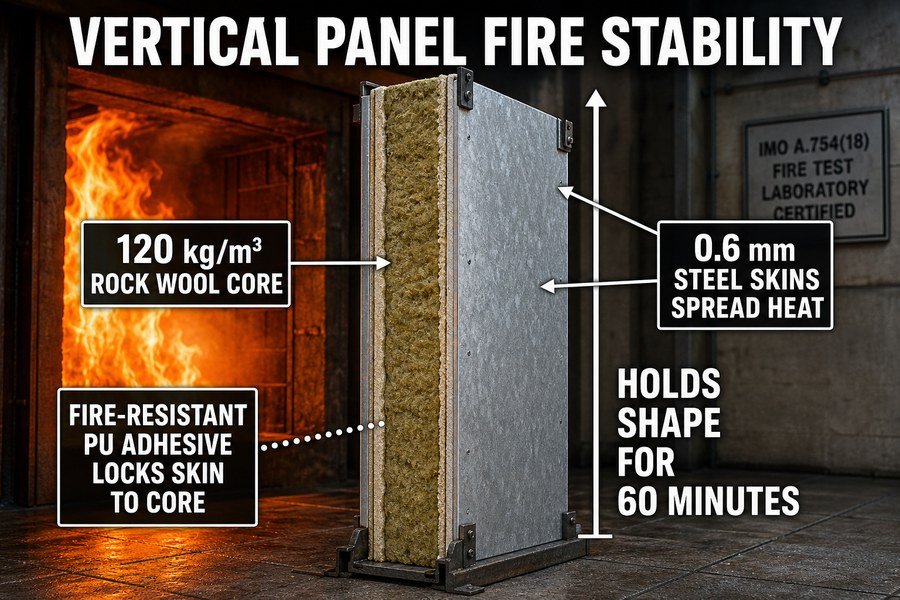
Vertical marine wall panels maintain stability under intense heat through three methods: using high-density rock wool cores (minimum 120 kg/m³), utilizing galvanized steel skins (at least 0.6mm thickness), and applying fire-resistant polyurethane adhesives to bond the core and skin together.
The Role of Rock Wool Core Density in Vertical Marine Panels
When I worked in the marine outfitting factory, I saw many buyers try to save money by picking low-density rock wool. This is a bad idea. The core density is the main thing that stops the panel from crushing under its own weight during a fire. According to standard marine outfitting practices based on SOLAS regulations, an A-Class fire-rated bulkhead needs a rock wool core with a density of at least 120 kg/m³. When the heat reaches 900°C during an IMO FTP Code Part 3 fire test, the rock wool fibers start to crystallize1. If the density is lower, like 80 kg/m³, the core just shrinks and collapses. But a 120 kg/m³ core packs the fibers tight enough to support the metal skins. The core acts like a solid pillar. This keeps the whole vertical marine panel standing up straight for 60 minutes.
How Galvanized Steel Skins and Fire Adhesives Prevent Buckling
The steel skin and the glue are just as important as the core. A vertical marine wall panel uses two steel skins. To pass international fire tests, these skins must be galvanized steel with a minimum thickness of 0.6mm2. Thin skins, like 0.4mm, will warp and buckle in the first five minutes of a fire. But thick steel can spread the heat evenly.
You also need good glue. We use fire-resistant polyurethane adhesives. You need about 150 to 200 grams of adhesive per square meter. The glue bonds the 0.6mm steel skin to the 120 kg/m³ rock wool. When the panel gets hot, the steel wants to expand. Because the glue holds the steel tight to the heavy core, the steel cannot buckle outward. All three parts work together.
| Component of Vertical Panel | Minimum Required Value | Purpose During a Fire |
|---|---|---|
| Rock Wool Core Density | 120 kg/m³ | Stops the panel from shrinking and collapsing. |
| Galvanized Steel Skin | 0.6mm thickness | Spreads heat and resists early warping. |
| Fire-Resistant Adhesive | 150g/m² application rate | Stops the steel skin from pulling away from the core. |
Why Is Deflection Tolerance Vital for Marine Wall Panel Joints During a Fire?
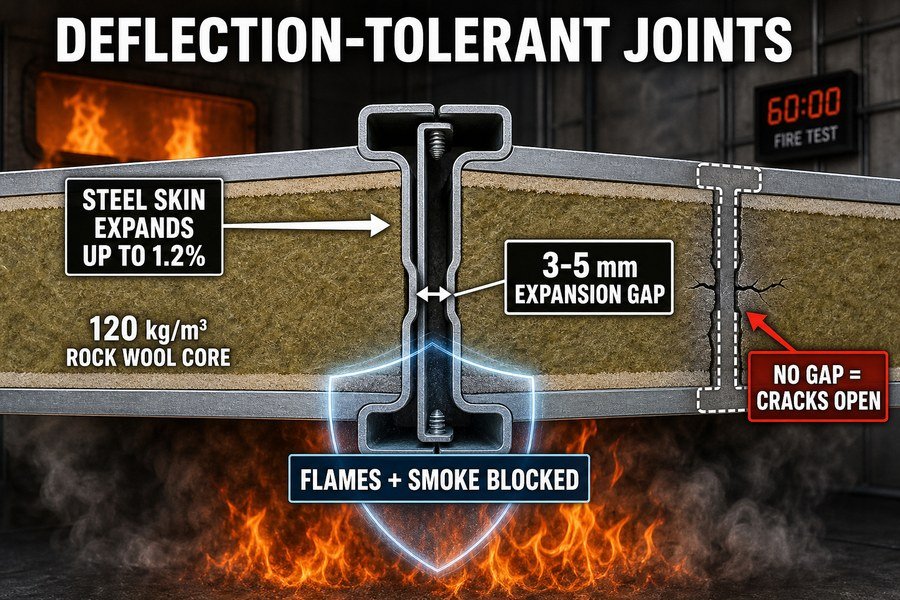
Heat makes metal grow. Rigid joints snap under this pressure. We will explore why your marine wall panel joints must bend without breaking to block deadly fire.
Deflection tolerance in marine wall panel joints is vital for two reasons: it accommodates the thermal expansion of steel skins (which grow by up to 1.2% at 900°C) and prevents joints from cracking open, effectively blocking flames and smoke from crossing the bulkhead.
The Role of Rock Wool Core Density in Vertical Marine Panels
When I worked in the marine outfitting factory, I saw many buyers try to save money by picking low-density rock wool. This is a bad idea. The core density is the main thing that stops the panel from crushing under its own weight during a fire. According to standard marine outfitting practices based on SOLAS regulations, an A-Class fire-rated bulkhead needs a rock wool core with a density of at least 120 kg/m³. When the heat reaches 900°C during an IMO FTP Code Part 3 fire test, the rock wool fibers start to crystallize3. If the density is lower, like 80 kg/m³, the core just shrinks and collapses. But a 120 kg/m³ core packs the fibers tight enough to support the metal skins. The core acts like a solid pillar. This keeps the whole vertical marine panel standing up straight for 60 minutes.
How Galvanized Steel Skins and Fire Adhesives Prevent Buckling
The steel skin and the glue are just as important as the core. A vertical marine wall panel uses two steel skins. To pass international fire tests, these skins must be galvanized steel with a minimum thickness of 0.6mm4. Thin skins, like 0.4mm, will warp and buckle in the first five minutes of a fire. But thick steel can spread the heat evenly.
You also need good glue. We use fire-resistant polyurethane adhesives. You need about 150 to 200 grams of adhesive per square meter. The glue bonds the 0.6mm steel skin to the 120 kg/m³ rock wool. When the panel gets hot, the steel wants to expand. Because the glue holds the steel tight to the heavy core, the steel cannot buckle outward. All three parts work together.
| Component of Vertical Panel | Minimum Required Value | Purpose During a Fire |
|---|---|---|
| Rock Wool Core Density | 120 kg/m³ | Stops the panel from shrinking and collapsing. |
| Galvanized Steel Skin | 0.6mm thickness | Spreads heat and resists early warping. |
| Fire-Resistant Adhesive | 150g/m² application rate | Stops the steel skin from pulling away from the core. |
What Causes Large-Span Marine Ceiling Panels to Sag During a Fire?
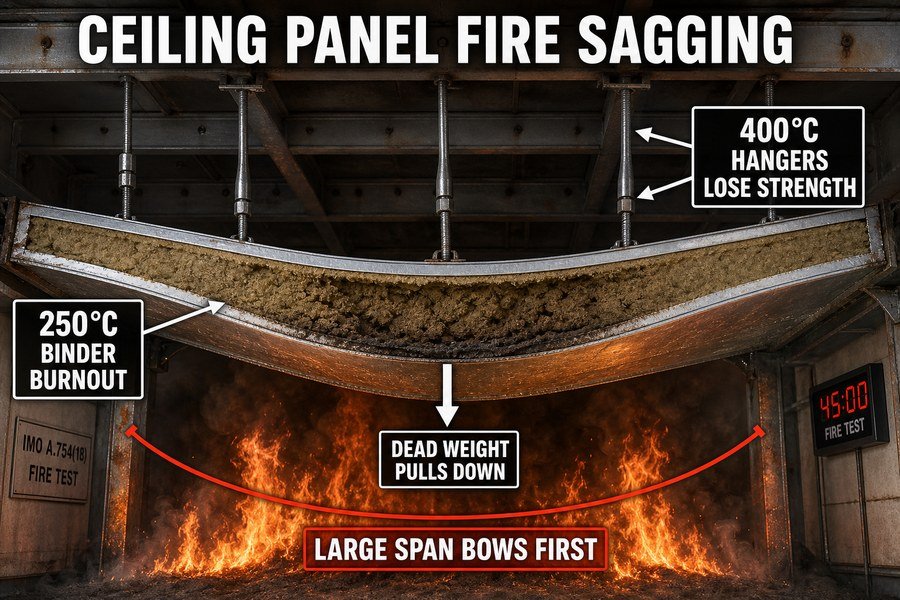
Ceilings drop down during fires. Falling panels hurt people and block fire hoses. Here is the truth about what causes large-span marine ceiling panels to sag when heated.
Large-span marine ceiling panels sag during fires due to three factors: the burnout of chemical binders inside the rock wool at 250°C, the heavy dead weight of the core material pulling down, and the yielding of steel suspension hangers at temperatures reaching 400°C.
The Role of Rock Wool Core Density in Vertical Marine Panels
When I worked in the marine outfitting factory, I saw many buyers try to save money by picking low-density rock wool. This is a bad idea. The core density is the main thing that stops the panel from crushing under its own weight during a fire. According to standard marine outfitting practices based on SOLAS regulations, an A-Class fire-rated bulkhead needs a rock wool core with a density of at least 120 kg/m³. When the heat reaches 900°C during an IMO FTP Code Part 3 fire test, the rock wool fibers start to crystallize5. If the density is lower, like 80 kg/m³, the core just shrinks and collapses. But a 120 kg/m³ core packs the fibers tight enough to support the metal skins. The core acts like a solid pillar. This keeps the whole vertical marine panel standing up straight for 60 minutes.
How Galvanized Steel Skins and Fire Adhesives Prevent Buckling
The steel skin and the glue are just as important as the core. A vertical marine wall panel uses two steel skins. To pass international fire tests, these skins must be galvanized steel with a minimum thickness of 0.6mm6. Thin skins, like 0.4mm, will warp and buckle in the first five minutes of a fire. But thick steel can spread the heat evenly.
You also need good glue. We use fire-resistant polyurethane adhesives. You need about 150 to 200 grams of adhesive per square meter. The glue bonds the 0.6mm steel skin to the 120 kg/m³ rock wool. When the panel gets hot, the steel wants to expand. Because the glue holds the steel tight to the heavy core, the steel cannot buckle outward. All three parts work together.
| Component of Vertical Panel | Minimum Required Value | Purpose During a Fire |
|---|---|---|
| Rock Wool Core Density | 120 kg/m³ | Stops the panel from shrinking and collapsing. |
| Galvanized Steel Skin | 0.6mm thickness | Spreads heat and resists early warping. |
| Fire-Resistant Adhesive | 150g/m² application rate | Stops the steel skin from pulling away from the core. |
How Does Steel Thermal Expansion Affect a Marine Wall Panel's Locks?
Doors jam when they get hot. A stuck lock traps the crew inside. I will explain exactly how the thermal expansion of steel ruins marine wall panel locks.
Steel thermal expansion affects marine wall panel locks in three ways: it causes the solid steel latch to bind inside the lock mechanism, it warps the door frame completely out of square, and it creates strike plate misalignment, preventing the door from opening.
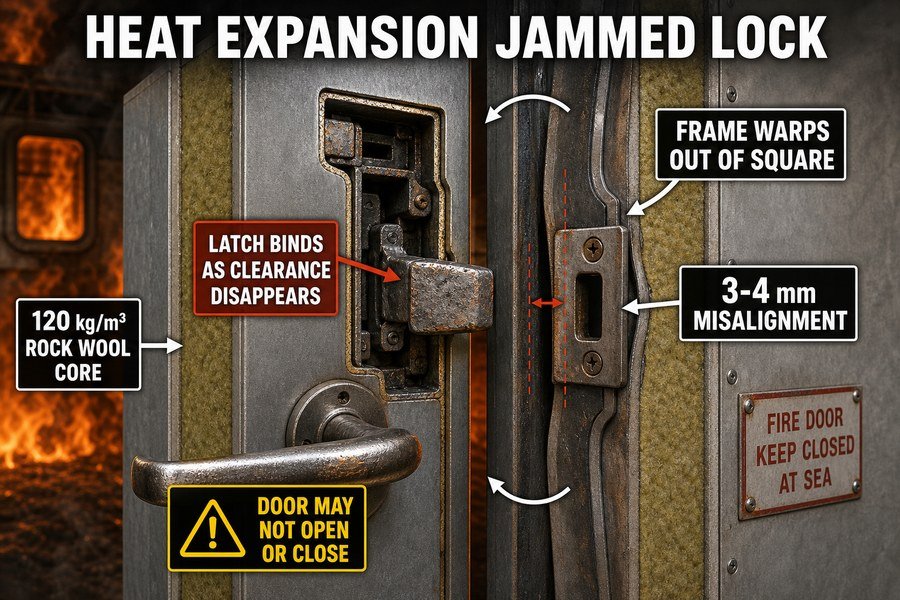
How Internal Latch Binding Stops Door Operation
The lock inside a marine fire door is mostly made of stainless steel or carbon steel. During a fire test, I have seen many doors fail just because of the lock. The first big problem is internal latch binding. The latch bolt is the thick piece of steel that slides in and out of the door to keep it shut. In normal conditions, the latch has a small clearance gap of about 0.5mm to slide smoothly.
When the fire heats the door to 500°C or more7, the solid steel latch expands8. Because the hole it slides through also expands unevenly, the clearance gap disappears. The latch bolt becomes too fat for the hole. It binds tight against the inside metal casing. Even if a crew member pushes hard on the door handle, the latch will not pull back. The door stays locked, trapping people inside the burning cabin.
Door Frame Warping and Strike Plate Misalignment
The thermal expansion of steel also ruins the door frame and the strike plate. The door frame is fixed to the marine wall panel. As the panel and the frame get hot, the steel sides of the frame expand and twist. They do not stay perfectly square anymore.
When the frame warps, it causes strike plate misalignment. The strike plate is the hole on the frame where the latch rests. If the frame twists by just 3mm or 4mm, the latch will no longer line up with the strike plate.9 When someone tries to close the door to stop the fire from spreading, the latch hits solid metal instead of the hole. The door bounces back open. This is a common reason why cheap marine fire doors fail shipyard inspections. The lock components must have engineered tolerances to handle the heat.
| Lock Problem Caused by Heat | Cause of the Problem | Consequence for the Marine Door |
|---|---|---|
| Internal Latch Binding | Latch bolt expands and gap disappears. | Handle will not turn; door will not open. |
| Door Frame Warping | Steel frame sides expand and twist. | Frame loses its perfect square shape. |
| Strike Plate Misalignment | Frame warps away from latch position. | Door cannot close to block the fire. |
What Visual Signs Indicate Poor Structural Stability in a Tested Marine Interior Panel?
Buying panels without checking test reports is risky. Bad panels fail safety tests, costing you a lot of money. We need to know the visual signs of poor structural stability.
During an IMO FTP Code fire test, poor structural stability shows four visual signs: excessive bowing beyond 100mm, joint separation showing visible gaps, skin delamination where metal peels off the core, and continuous smoke leakage lasting over 10 seconds.
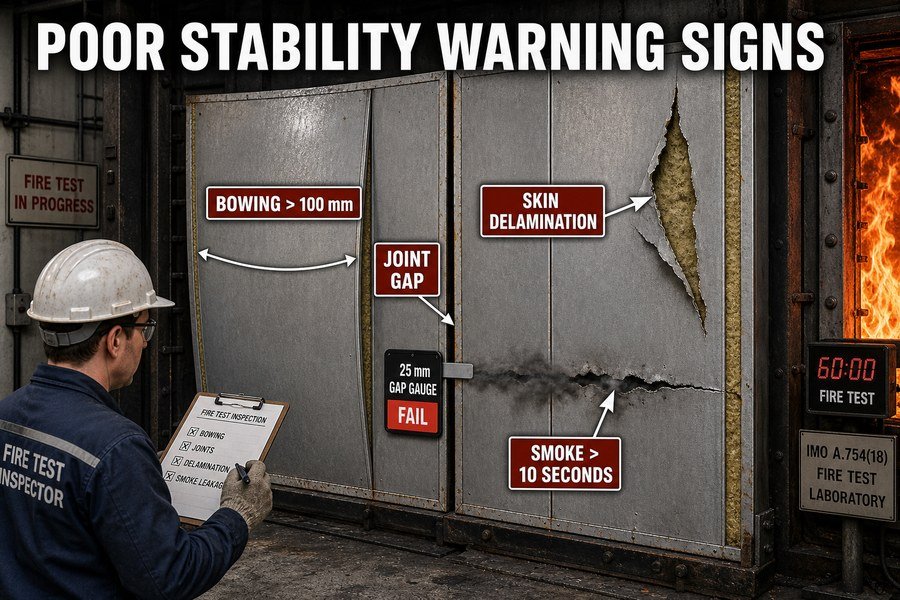
Identifying Excessive Bowing and Joint Separation in Marine Panels
When you look at a fire test video from a laboratory, you can easily see if the marine panel is bad. The first visual sign is excessive bowing. As the fire burns on one side, the panel bends toward the heat. The IMO FTP Code Part 3 allows some bowing, but if the panel bows more than 100mm from its original straight line, its structural stability is very poor. It means the core is failing.
The second visual sign is joint separation. Panels are connected side by side. When they bow too much, the joints pull apart. You will see a visible gap open up between the two panels. The testing engineers use gap gauges to check this. If they can pass a 25mm thick gap gauge through the joint into the fire, the panel fails the test10.
Spotting Skin Delamination and Continuous Smoke Leakage
The next visual sign is skin delamination11. This happens when the factory uses cheap glue. During the test, the hot steel skin completely detaches from the rock wool core. You will see the metal skin bubbling up and peeling away. Once the skin peels, the bare rock wool falls apart fast.
The last and most dangerous visual sign is continuous smoke leakage. When the panel warps and joints separate, smoke gets through. Small puffs of smoke are normal at the start. But if you see dark smoke leaking out continuously from a crack for more than 10 seconds12, it means the structure is broken. The IMO testing rules say this is an automatic failure. You must check your supplier's test reports to make sure their panels do not show any of these four signs.
| Visual Sign of Poor Stability | Description of the Problem | IMO FTP Code Part 3 Failure Limit |
|---|---|---|
| Excessive Bowing | Panel bends deeply toward the fire. | Extreme bending that causes joint failure. |
| Joint Separation | Gaps open between connected panels. | 25mm gap gauge passes through the joint. |
| Skin Delamination | Steel skin peels off the rock wool. | Leads to rapid core collapse. |
| Smoke Leakage | Toxic smoke passes through cracks. | Continuous flaming or smoke for >10 seconds. |
How Does Span Length Limit a Marine Ceiling Panel's Fire Survivability?
Big ship rooms need wide ceilings. But wide ceilings fall down faster in fires. Let me show you how span length limits the fire survivability of marine ceiling panels.
Span length limits a marine ceiling panel's fire survivability through two primary mechanisms: it exponentially increases the bending moment at the center of the panel, and it decreases the panel's support-to-weight ratio, causing it to collapse much faster under continuous heat.
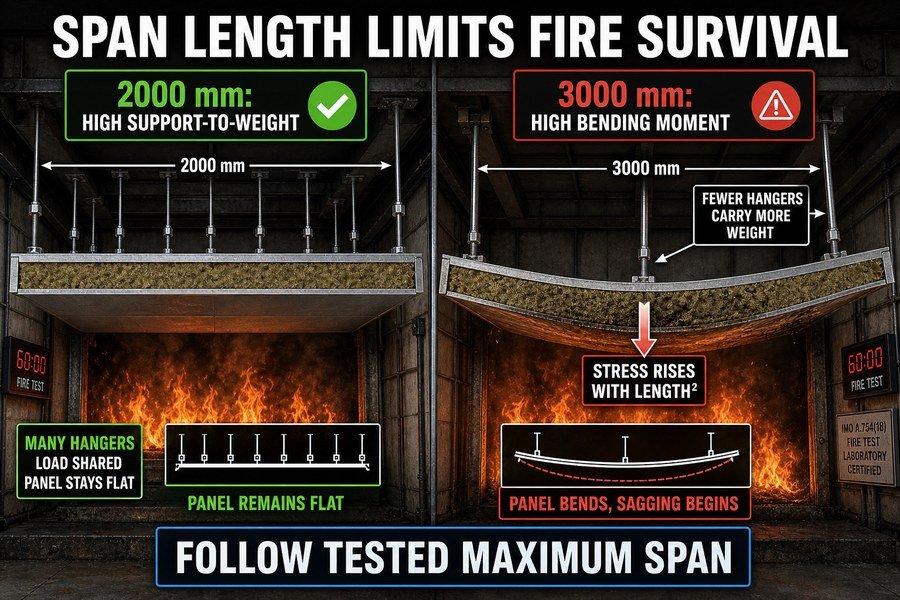
How Bending Moment Increases with Span Length in Ceilings
The span length is the distance between the support hangers on a ceiling. When you buy a B-15 class marine ceiling panel, it usually has a maximum tested span13. Often, this is around 2500mm. If your shipyard client asks you to install the panels with a 3000mm span to save time, you create a big danger.
In structural mechanics, the bending moment at the center of a flat board increases by the square of its length14. This means if you make the span just a little bit longer, the stress in the middle goes up a lot. In a fire, the metal gets soft. The high bending moment pushes down hard on the center of the panel. The panel snaps and breaks in the middle much sooner than a shorter panel would.
The Impact of a Reduced Support-to-Weight Ratio
The span length also changes the support-to-weight ratio. Every ceiling panel has a certain weight, mostly from the heavy 150 kg/m³ rock wool inside. If you use a short span like 2000mm, you have many steel hangers holding up a small amount of weight. The support-to-weight ratio is high.
If you stretch the span to 3000mm, you have fewer hangers trying to hold up a much larger, heavier piece of ceiling. The support-to-weight ratio becomes very low. When the fire heats the room to 800°C, the few hangers you have left will soften and yield quickly.15 Because they carry too much weight, they break. The whole ceiling drops. This is why you must always follow the manufacturer's maximum span length printed on the fire test certificate16.
| Ceiling Span Length | Bending Moment Stress Level | Support-to-Weight Ratio | Fire Survivability |
|---|---|---|---|
| 2000mm (Short) | Low stress in the center. | High ratio (Very safe). | Easily passes 15-minute B-Class test. |
| 2500mm (Standard) | Moderate stress in the center. | Balanced ratio. | Passes test, meets standard limits. |
| 3000mm (Over-limit) | High stress in the center. | Low ratio (Dangerous). | Fails early due to center snap or hanger break. |
Conclusion
Good structural stability saves lives. From high core density to smart joint deflection, every detail matters. Pick the right panels, check their limits, and build safer ships for your clients.
-
"The Influences of Moisture on the Mechanical, Morphological and ...", https://pmc.ncbi.nlm.nih.gov/articles/PMC7288152/. The cited source should describe mineral wool fiber structural changes, crystallization, sintering, or shrinkage under high-temperature exposure. Evidence role: mechanism; source type: paper. Supports: Rock wool fibers can undergo structural or dimensional changes when exposed to very high temperatures.. Scope note: Laboratory studies of mineral wool fibers may not directly predict the performance of a specific laminated marine panel without assembly-level fire testing. ↩
-
"When Are Steel Face Sheets Required for A-Class Marine ...", https://magellanmarinetech.com/when-steel-face-sheets-required-a-class-marine-accommodation-panels/. The cited source should show whether tested A-class marine panel assemblies specify galvanized steel skins of about 0.6 mm as part of their certified construction. Evidence role: case_reference; source type: institution. Supports: A-class marine fire-rated wall panel assemblies may use galvanized steel skins with a minimum thickness around 0.6 mm to meet fire-test certification.. Scope note: Assembly approvals can support this as a tested design parameter, but they do not prove that all international fire tests require galvanized steel skins of exactly 0.6 mm. ↩
-
"The Influences of Moisture on the Mechanical, Morphological and ...", https://pmc.ncbi.nlm.nih.gov/articles/PMC7288152/. The cited source should describe mineral wool fiber structural changes, crystallization, sintering, or shrinkage under high-temperature exposure. Evidence role: mechanism; source type: paper. Supports: Rock wool fibers can undergo structural or dimensional changes when exposed to very high temperatures.. Scope note: Laboratory studies of mineral wool fibers may not directly predict the performance of a specific laminated marine panel without assembly-level fire testing. ↩
-
"When Are Steel Face Sheets Required for A-Class Marine ...", https://magellanmarinetech.com/when-steel-face-sheets-required-a-class-marine-accommodation-panels/. The cited source should show whether tested A-class marine panel assemblies specify galvanized steel skins of about 0.6 mm as part of their certified construction. Evidence role: case_reference; source type: institution. Supports: A-class marine fire-rated wall panel assemblies may use galvanized steel skins with a minimum thickness around 0.6 mm to meet fire-test certification.. Scope note: Assembly approvals can support this as a tested design parameter, but they do not prove that all international fire tests require galvanized steel skins of exactly 0.6 mm. ↩
-
"The Influences of Moisture on the Mechanical, Morphological and ...", https://pmc.ncbi.nlm.nih.gov/articles/PMC7288152/. The cited source should describe mineral wool fiber structural changes, crystallization, sintering, or shrinkage under high-temperature exposure. Evidence role: mechanism; source type: paper. Supports: Rock wool fibers can undergo structural or dimensional changes when exposed to very high temperatures.. Scope note: Laboratory studies of mineral wool fibers may not directly predict the performance of a specific laminated marine panel without assembly-level fire testing. ↩
-
"When Are Steel Face Sheets Required for A-Class Marine ...", https://magellanmarinetech.com/when-steel-face-sheets-required-a-class-marine-accommodation-panels/. The cited source should show whether tested A-class marine panel assemblies specify galvanized steel skins of about 0.6 mm as part of their certified construction. Evidence role: case_reference; source type: institution. Supports: A-class marine fire-rated wall panel assemblies may use galvanized steel skins with a minimum thickness around 0.6 mm to meet fire-test certification.. Scope note: Assembly approvals can support this as a tested design parameter, but they do not prove that all international fire tests require galvanized steel skins of exactly 0.6 mm. ↩
-
"What Is the Purpose and Scope of the IMO FTP Code?", https://magellanmarinetech.com/what-purpose-scope-of-imo-ftp-code/. A fire-resistance testing standard, such as the IMO FTP Code or ISO 834 time-temperature curve, supports that standardized fire-door tests can expose assemblies to temperatures exceeding 500°C. Evidence role: historical_context; source type: institution. Supports: Marine fire-door testing or severe fire exposure can involve temperatures of 500°C or higher.. Scope note: This supports the plausibility of the stated test temperature, not the temperature reached in every real shipboard fire. ↩
-
"[PDF] Thermal Expansion - Rice University", https://www.owlnet.rice.edu/~msci301/ThermalExpansion.pdf. Engineering references on steel at elevated temperature document positive thermal expansion of carbon and stainless steels, supporting the mechanism by which a heated steel latch increases in size. Evidence role: mechanism; source type: research. Supports: A steel latch bolt expands when heated during a fire.. Scope note: Thermal-expansion data show dimensional change in steel generally; they do not by themselves prove that a particular latch design will bind. ↩
-
"How to Fix a Warped Marine Fire Door?", https://magellanmarinetech.com/how-fix-a-warped-marine-fire-door/. Fire-door inspection or hardware-alignment guidance can support that latch engagement depends on close alignment between the latch bolt and strike plate, and that small frame distortions may prevent proper latching. Evidence role: general_support; source type: government. Supports: Small door-frame distortions can misalign the strike plate enough to prevent a fire door from latching.. Scope note: The exact 3–4 mm threshold is likely hardware-specific; a general inspection or standards source may support sensitivity to misalignment but not prove this value for all marine fire doors. ↩
-
"What Is the Purpose and Scope of the IMO FTP Code?", https://magellanmarinetech.com/what-purpose-scope-of-imo-ftp-code/. The IMO FTP Code Part 3 integrity criteria describe failure when openings or gaps permit passage of specified gauges through a fire-resisting division during testing; this supports the stated role of a gap-gauge check. Evidence role: definition; source type: institution. Supports: A 25 mm gap gauge passing through a joint into the fire side constitutes a failure under the relevant fire-test integrity criteria.. Scope note: The citation should verify the exact gauge dimension and the condition under which its passage constitutes failure. ↩
-
"Sandwich Panels – Behavior in Fire Based on Fire Resistance Tests", https://www.academia.edu/125106695/Sandwich_Panels_Behavior_in_Fire_Based_on_Fire_Resistance_Tests. Research on sandwich panels and mineral-wool insulated steel panels shows that fire exposure can degrade adhesive bonds and promote debonding between metal facings and insulation cores, providing a mechanism for skin delamination. Evidence role: mechanism; source type: paper. Supports: During fire exposure, the steel skin of a marine panel may detach from the rock wool core because the bond between facing and core deteriorates.. Scope note: Such sources support adhesive degradation and debonding as a mechanism, but they do not by themselves prove that low-cost adhesive is the cause in a specific product. ↩
-
"Are Marine Fire Divisions the Same as Marine Panel Ratings?", https://magellanmarinetech.com/are-marine-fire-divisions-same-as-marine-panel-ratings/. The IMO FTP Code Part 3 integrity criteria include failure conditions associated with sustained flaming or smoke/flame passage through cracks or openings during fire-resistance testing; this supports treating continuous leakage as evidence of lost integrity. Evidence role: definition; source type: institution. Supports: Continuous smoke leakage through a crack for more than 10 seconds is treated as an automatic failure under IMO testing rules.. Scope note: The source should be used to confirm whether the 10-second duration applies specifically to smoke leakage, sustained flaming, or another integrity criterion. ↩
-
"What Is the Purpose and Scope of the IMO FTP Code?", https://magellanmarinetech.com/what-purpose-scope-of-imo-ftp-code/. The IMO Fire Test Procedures Code describes fire testing of B-class divisions by tested construction arrangements, supporting the point that certified fire performance is tied to the tested assembly configuration. Evidence role: definition; source type: institution. Supports: Marine B-15 ceiling panels are approved for use according to tested configurations, including installation details such as span or support arrangement.. Scope note: The code establishes the testing framework but may not state a universal span value for all B-15 ceiling products; the applicable limit is normally found in the product’s approval certificate or test report. ↩
-
"[PDF] BEAM DEFLECTION FORMULAS", https://home.engineering.iastate.edu/~shermanp/STAT447/STAT%20Articles/Beam_Deflection_Formulae.pdf. A structural mechanics reference giving the simply supported beam relation Mmax = wL²/8 supports the claim that midspan bending moment under uniform load grows with the square of span length. Evidence role: mechanism; source type: education. Supports: For a uniformly loaded ceiling panel modeled as a simply supported member, increasing span length increases midspan bending moment approximately with the square of the span.. Scope note: This directly supports the simplified beam model; actual ceiling panels may have different boundary conditions, composite behavior, and load distribution. ↩
-
"[PDF] Temperature-Dependent Material Modeling for Structural Steels", https://nvlpubs.nist.gov/nistpubs/TechnicalNotes/NIST.TN.1907.pdf. Eurocode and fire-engineering references on structural steel show that steel strength and stiffness are substantially reduced at elevated temperatures, providing support for the statement that steel hangers may yield under load during severe fire exposure. Evidence role: mechanism; source type: government. Supports: Steel hangers exposed to high fire temperatures can lose load-bearing capacity and yield under sustained ceiling loads.. Scope note: This supports the temperature-dependent loss of steel capacity in general; the actual failure time of specific hangers depends on steel grade, section size, insulation, load ratio, and fire exposure curve. ↩
-
"What Do A-Class, B-Class, and C-Class Divisions Mean in Marine ...", https://magellanmarinetech.com/what-a-class-b-class-c-class-divisions-mean-in-marine-wall-ceiling-panels/. Maritime approval and fire-test rules for fire-resisting divisions indicate that installed assemblies should conform to the tested and certified arrangement, supporting the need to follow the maximum span or support spacing stated in the certificate. Evidence role: expert_consensus; source type: institution. Supports: The manufacturer’s certified maximum span should be followed because the fire rating applies to the tested and approved ceiling configuration.. Scope note: This supports compliance with the approved configuration; it does not independently prove that every over-span installation will fail in the same mode or time. ↩