Shipyard inspectors reject panels when fires spread fast. You lose money and time. The right face-sheet design stops this problem and keeps your interior outfitting projects on track.
Face-sheet design impacts fire resistance by controlling three main factors: initial flame barrier duration, heat conduction rates across the panel, and structural integrity under heat. Proper material choice, thickness, and bonding prevent early warping, delamination, and joint failure, ensuring compliance with IMO SOLAS fire safety regulations.
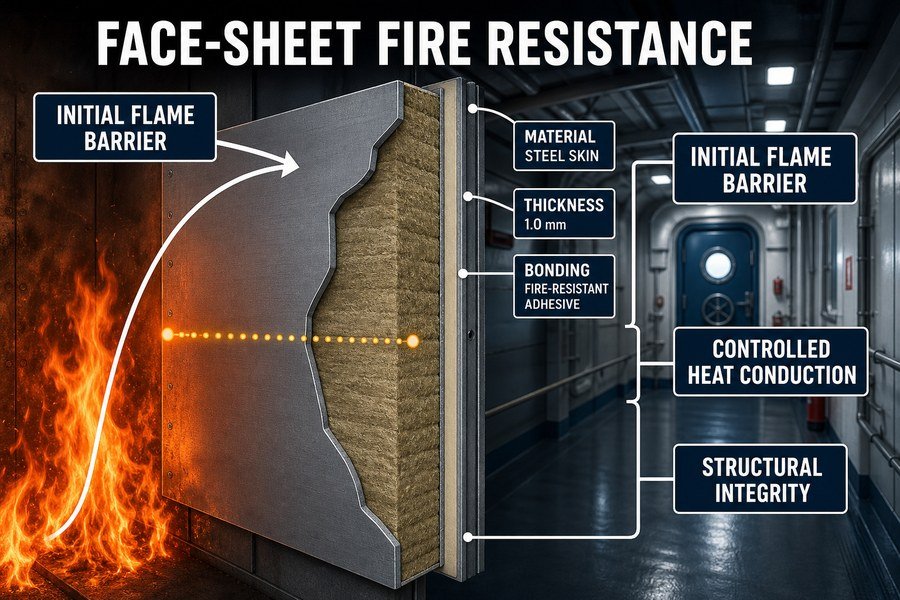
Let us look closely at how each detail of the face-sheet changes the safety of your panels.
How Does Steel Thickness Determine a Marine Wall Panel's Initial Fire Barrier?
Thin steel burns through fast in a fire test. Your A-Class or B-Class panels fail. Choosing the exact steel thickness gives you the needed barrier without adding high costs.
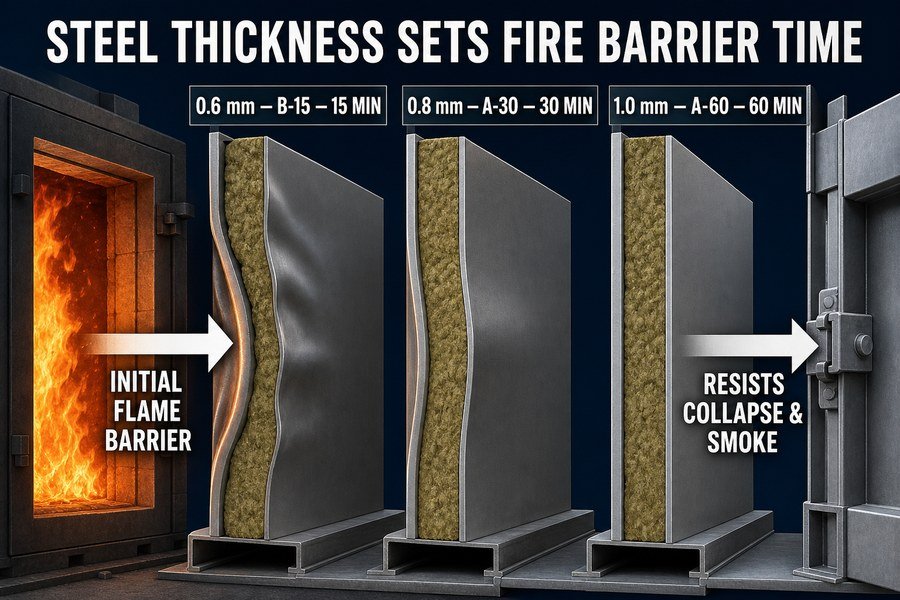
Steel thickness dictates the initial physical barrier against flames, with IMO standard B-15 panels requiring at least 0.6mm galvanized steel, while A-60 panels demand 0.6mm to 1.0mm thickness to resist structural collapse, prevent early burn-through, and block smoke penetration during the crucial first 15 to 60 minutes.
The Role of 0.6mm Steel in B-15 Marine Wall Panels
When we talk about marine outfitting, steel thickness is your first defense. You need the right metal thickness to stop fire from reaching the rockwool core. According to the IMO Fire Test Procedures (FTP) Code, a B-15 class panel must stop flames and smoke for 15 minutes. To achieve this, you must use at least 0.6mm galvanized steel for the face-sheet1. I once visited a small factory that tried to save costs. They used 0.4mm steel for a batch of B-Class cabin panels. During a local fire test, the 0.4mm steel simply melted away in 9 minutes. The fire penetrated the core, and the test failed. A 0.6mm thickness provides enough mass to absorb the initial shock of a 800°C flash fire. This thickness gives the panel structural balance. It is cheap enough to keep your costs low, but strong enough to pass the 15-minute standard.
How 1.0mm Steel Upgrades A-60 Marine Wall Panel Defenses
A-Class bulkheads have much stricter rules. An A-60 panel must contain a fire for 60 full minutes2. While high-density rockwool does the heavy lifting for insulation, the steel face-sheet must hold that rockwool in place. For these areas, we use steel thicknesses between 0.6mm and 1.0mm. Standard 0.6mm is often enough if the internal support frame is very strong. But many shipyards demand 1.0mm steel for A-60 engine room walls. Why? Because 1.0mm steel resists structural collapse much better under high heat. It also prevents early burn-through from direct flame blasts. Finally, thicker steel blocks high-pressure smoke penetration. Smoke kills more people on ships than fire3. A rigid 1.0mm face-sheet ensures the wall does not bend, keeping the smoke safely contained for the required 60 minutes.
| Panel Class Requirement | IMO Time Requirement | Minimum Steel Thickness | Purpose of Thickness Level |
|---|---|---|---|
| B-15 Cabin Wall | 15 Minutes | 0.6mm | Stops initial flame, keeps cost low. |
| A-30 Bulkhead | 30 Minutes | 0.6mm - 0.8mm | Delays burn-through, supports core. |
| A-60 Engine Bulkhead | 60 Minutes | 0.6mm - 1.0mm | Resists structural collapse, blocks smoke. |
Why Is the Face-Sheet-To-Core Bond Critical for Marine Ceiling Panel Fire Performance?
Poor glue makes ceiling panels drop their metal faces when hot. Fire spreads into the hidden spaces. A strong bond holds the core safe.
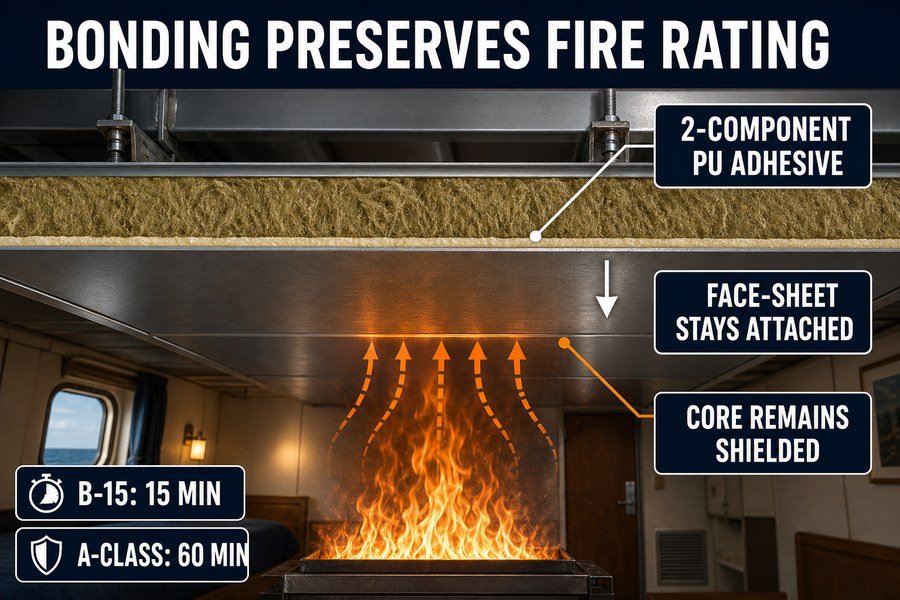
The face-sheet-to-core bond is critical because it prevents early structural separation. A certified two-component polyurethane adhesive ensures the face-sheet stays attached to the rockwool core, maintaining the 60-minute A-Class or 15-minute B-Class fire rating by stopping fire from directly attacking the raw, unshielded insulation layer.
Preventing Insulation Exposure in Marine Ceiling Panels
The glue inside your ceiling panel is just as important as the steel outside. The face-sheet-to-core bond holds the whole system together4. Its main job is to prevent early structural separation. Gravity pulls down on ceiling panels. When a fire breaks out, the heat makes the steel expand. If the bond is weak, the steel face-sheet falls off. I worked on a project where a supplier used cheap, single-component glue. The glue melted at just 80°C. The metal faces fell onto the cabin floor in five minutes. This directly exposed the raw, unshielded insulation layer to the flames. The rockwool cannot stop fire by itself if the steel shell is gone. You must protect the rockwool to maintain the fire rating.
The Impact of Two-Component Polyurethane Adhesive on Fire Ratings
To keep the A-Class 60-minute or B-Class 15-minute rating5, you must use a certified two-component polyurethane (PU) adhesive. This is not a place to save pennies. Two-component PU adhesive creates a chemical cross-link6. It does not just dry; it cures. This curing process means the glue will not melt back into a liquid when exposed to high heat. According to standard manufacturing practices, you need a spread rate of 150 to 200 grams per square meter to ensure a total bond. This specific amount grips every fiber of the rockwool. By holding the steel tightly to the core, the two-component adhesive stops the fire from attacking the weak points. The ceiling stays solid. Your interior decoration project easily passes shipyard inspections because the bond holds up under the strict IMO FTP Code Part 3 temperature curves.
| Adhesive Type | Heat Resistance Limit | Structural Separation Risk | Best Application |
|---|---|---|---|
| Single-Component Glue | Approx. 80°C | Very High (Fails fast) | Not recommended for marine. |
| Epoxy Resin | Approx. 120°C | Medium | Good but hard to apply evenly. |
| Two-Component PU Glue | Over 150°C | Very Low (Holds firm) | B-15 and A-60 ceiling panels. |
How Does Early Face-Sheet Delamination Accelerate Marine Ceiling Panel Failure?
When a ceiling face-sheet peels away early, the fire quickly destroys the ceiling. Your safety certification is voided. You must know why delamination speeds up failure.
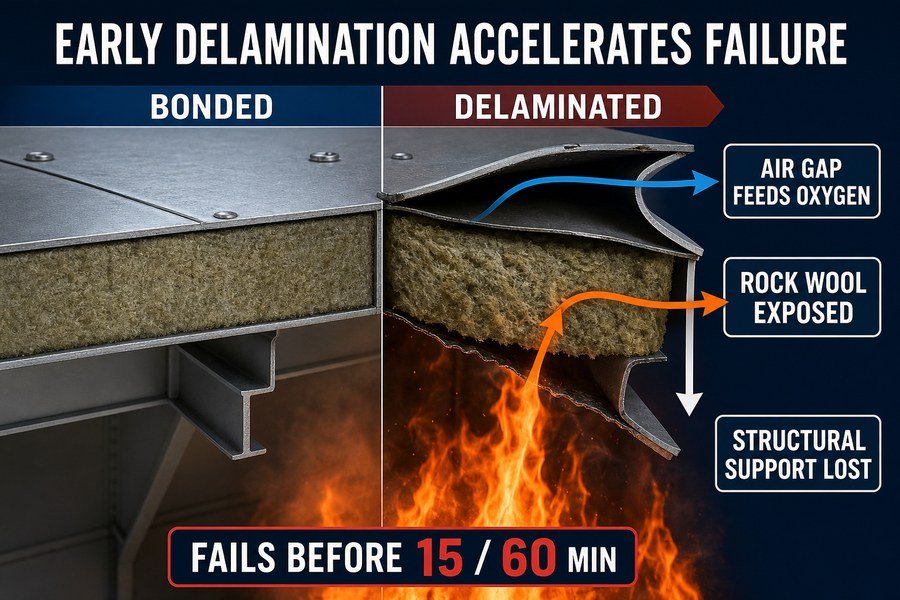
Early face-sheet delamination accelerates failure in three ways: it exposes the internal rockwool to direct flames, creates air gaps that feed oxygen to the fire, and removes the structural support of the ceiling, causing the entire panel assembly to collapse long before its 15 or 60-minute rated limit.
Oxygen Feeding Caused by Face-Sheet Delamination Air Gaps
Delamination means the metal skin peels away from the inner core. When this happens early in a fire, disaster follows fast. The first problem is that it creates air gaps. Fire needs oxygen to burn. A tightly bonded panel cuts off the oxygen supply to the core. But when the steel face delaminates, it creates a pocket of air between the hot metal and the rockwool. This feeds oxygen directly to the fire.7 Any dust or glue residue inside that gap catches fire instantly. I have seen fire test videos where a small delamination bubble turned into a huge flame tunnel in seconds. The second problem is that delamination exposes the internal rockwool to direct flames. Standard marine rockwool has a density of 120kg/m3. It is meant to resist heat, not direct, roaring fire on its raw surface. Direct flames will burn away the binders in the rockwool very fast.8
Structural Collapse of Marine Ceiling Panels Due to Core Exposure
The third and most dangerous result of early delamination is total structural collapse. The steel face-sheet is not just a cover. It provides the structural support for the entire ceiling assembly.9 The rockwool core has no rigid strength on its own. It is like a soft sponge. When the steel peels away and drops, it removes the tension that holds the ceiling flat. Without the steel skin, the panel assembly loses its shape. It bows and breaks. The ceiling will collapse long before it reaches its 15-minute B-15 limit or its 60-minute A-60 limit. I always advise my European clients to demand factory peel-strength test reports. A good panel must have a peel strength of at least 0.15 N/mm²10. If the factory cannot prove this number, the risk of early delamination and structural failure is too high. Do not buy them.
| Delamination Effect | Immediate Consequence | Impact on IMO Fire Rating |
|---|---|---|
| Exposes Rockwool | Binder burns away, insulation fails. | Fails temperature criteria early. |
| Creates Air Gaps | Feeds oxygen, creates flame tunnels. | Fails flame penetration criteria. |
| Removes Structural Support | Panel bows, drops from ceiling grid. | Fails structural integrity test. |
How Do Face Materials Affect Heat Conduction in Marine Accommodation Panels?
Heat passes through wrong face materials fast. The unexposed side gets too hot. People get burned. Picking the right face material slows down heat transfer.
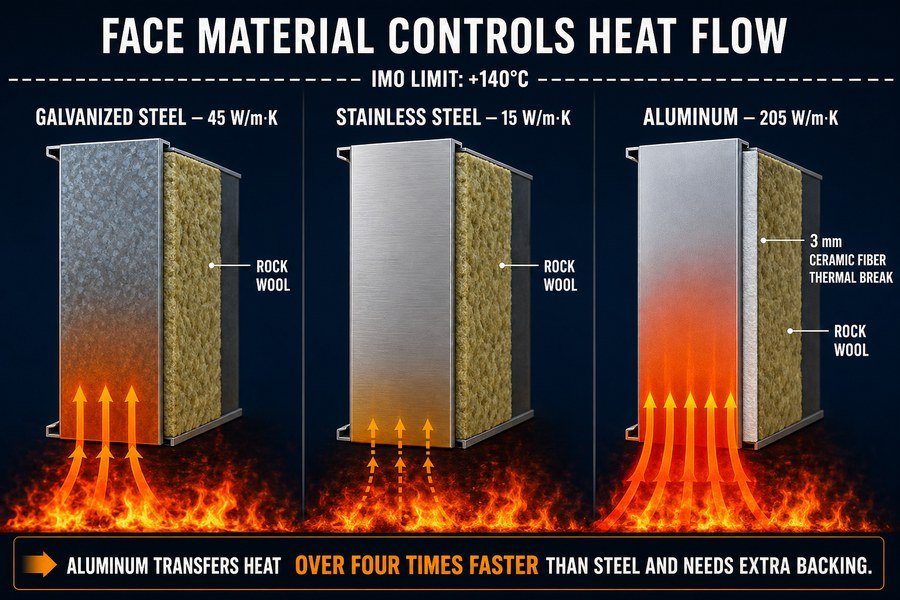
Face materials affect heat conduction based on their thermal conductivity values. Standard PVC-coated galvanized steel conducts heat at 45 W/m·K but relies on the core for insulation, whereas aluminum conducts at 205 W/m·K and requires extra ceramic fiber backing to prevent the unexposed side from exceeding the 140°C IMO limit.
Heat Conduction Properties of PVC-Coated Galvanized Steel
The material you choose for the outside of your wall panel changes how fast heat travels through it. Heat conduction is measured in Watts per meter-Kelvin (W/m·K). Standard marine panels use PVC-coated galvanized steel. Steel has a thermal conductivity value of about 45 W/m·K.11 This means steel moves heat moderately fast. However, it relies heavily on the rockwool core for actual insulation. The steel face stops the flame, and the 120kg/m3 rockwool behind it stops the heat. The IMO SOLAS regulations state that during a fire test, the unexposed side of the panel cannot rise more than 140°C above its starting temperature12. Because steel transfers heat at 45 W/m·K, a standard 50mm thick rockwool core is usually enough to keep the unexposed side safe and under the 140°C limit for 15 minutes.
Managing High Heat Transfer in Aluminum Marine Accommodation Panels
Many modern fast ferries and luxury ships want lighter walls. They ask for aluminum face-sheets. Aluminum is very light, but it has a huge problem with fire. Aluminum conducts heat at roughly 205 W/m·K.13 This is more than four times faster than steel. The heat shoots right through the aluminum face. If you use standard rockwool behind aluminum, the unexposed side will get too hot very fast. It will easily break the 140°C IMO limit, causing a test failure. I helped a buyer from Indonesia fix this exact issue. They bought cheap aluminum panels that failed shipyard inspection. To solve this, we changed the design. We required an extra ceramic fiber backing. By placing a 3mm thick ceramic paper between the aluminum face and the rockwool core, we created a thermal break14. This extra layer slowed down the 205 W/m·K heat transfer. The panel passed the B-15 test. You must plan for these material differences.
| Face Material | Thermal Conductivity (W/m·K) | Heat Transfer Speed | Extra Insulation Needed? |
|---|---|---|---|
| Galvanized Steel | 45 | Moderate | No (Standard core is enough) |
| Stainless Steel | 15 | Slow | No |
| Aluminum Alloy | 205 | Very Fast | Yes (Requires ceramic backing) |
What Face-Sheet Defects Signal Poor Fire Resistance in Marine Interior Panels?
Buying cheap panels often brings hidden defects. These flaws ruin fire ratings and cause shipyard rejections. Spotting these defects early saves your project and money.
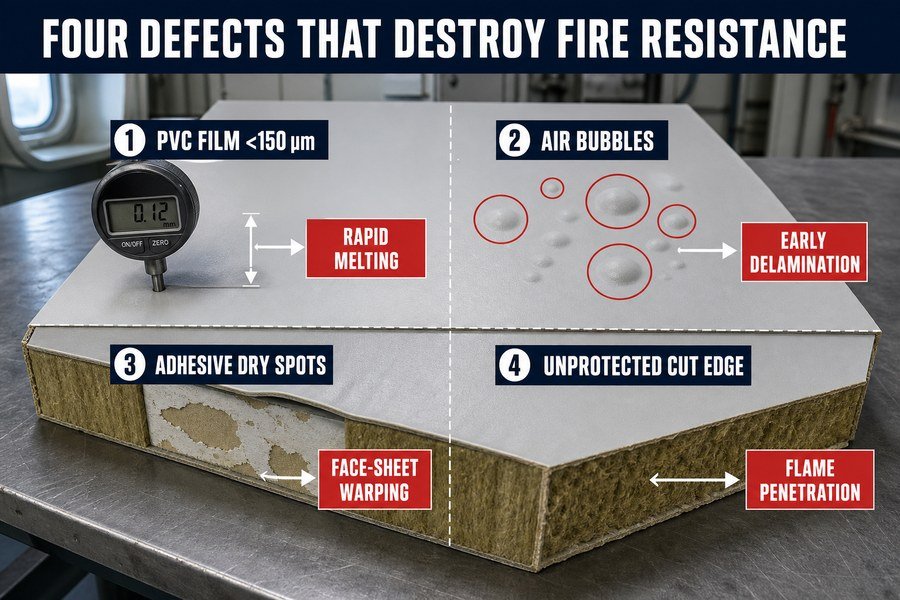
Four critical face-sheet defects signal poor fire resistance: inconsistent PVC film thickness (under 150 microns), visible air bubbles under the surface, uneven adhesive application leaving dry spots, and unprotected cut edges. These flaws lead to rapid melting, early delamination, and immediate flame penetration during IMO standard fire tests.
Identifying Inconsistent PVC Film Thickness and Air Bubbles
When you inspect panels at a factory in China or Vietnam, you must look closely at the surface. The first major defect is inconsistent PVC film thickness. The decorative PVC film on the steel should be exactly 150 microns thick. I carry a small thickness gauge to check this. If the film is under 150 microns, it signals poor quality control. Thin PVC film leads to rapid melting when a fire starts. It also releases more toxic smoke, which will fail the IMO FTP Code Part 5 smoke and toxicity test15. The second defect is visible air bubbles under the surface. You can see or feel these small bumps. Air bubbles mean the PVC film did not stick to the steel properly. When the heat rises, the air inside these bubbles expands16. This causes the film to crack and burn faster, starting early delamination of the decorative layer.
The Dangers of Uneven Adhesive Application and Unprotected Cut Edges
The next two defects are inside and on the edges of the panel. Uneven adhesive application leaving dry spots is very dangerous. Factory machines sometimes skip areas when spraying glue. A dry spot has zero bond strength. When fire hits the panel, the steel over the dry spot warps immediately. This starts early delamination of the steel from the rockwool. You can test for dry spots by tapping the panel with a coin. A hollow sound means no glue. The fourth defect is unprotected cut edges. When factories cut panels to size, they expose the raw rockwool core. Good manufacturers fold the steel over the edge to seal it. Cheap manufacturers leave the edge open. Unprotected cut edges allow immediate flame penetration right into the core during a fire.17 I always tell my clients to reject panels with bare edges. These four flaws will destroy your fire safety rating.
| Face-Sheet Defect | Visual / Physical Check | Direct Fire Consequence |
|---|---|---|
| PVC < 150 microns | Use thickness gauge tool. | Rapid melting, toxic smoke release. |
| Air Bubbles | Visual inspection, surface feel. | Film cracks, fire spreads on surface. |
| Adhesive Dry Spots | Tap test with a metal coin. | Metal warps, early delamination. |
| Unprotected Edges | Look at the sides of the panel. | Immediate flame penetration into core. |
How Does Face-Sheet Warping Compromise Marine Wall Panel Edge Joints?
Heat makes metal bend. When your panel faces warp, the joints open up. Fire goes right through the wall. You must stop joint warping.
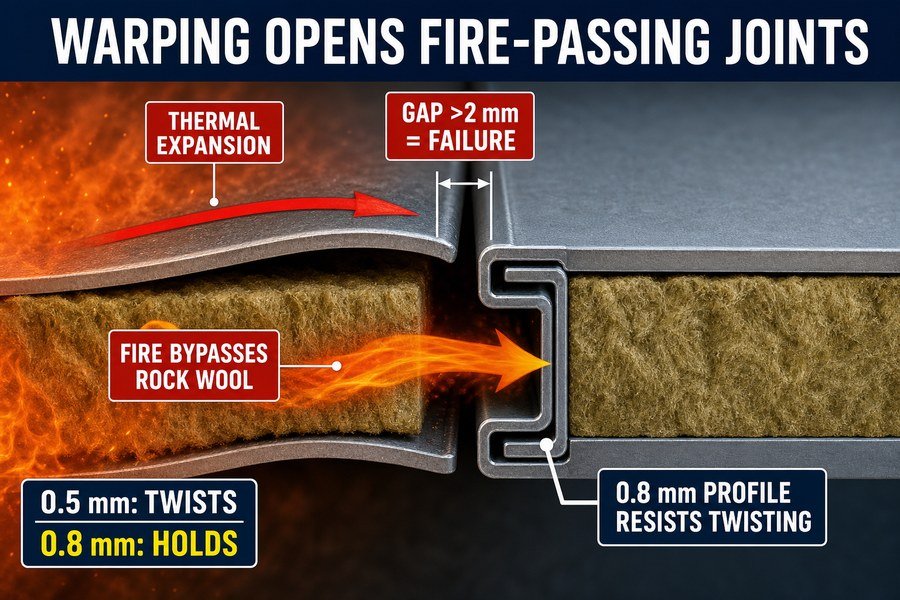
Face-sheet warping compromises edge joints by causing thermal expansion that twists the metal profiles, creating gaps wider than 2mm between adjoining panels. This breaks the continuous smoke and flame barrier, allowing fire to bypass the rockwool core entirely and fail the B-Class or A-Class joint integrity test.
The Process of Thermal Expansion in Marine Wall Panel Joints
Marine panels do not sit alone. They connect to each other. The point where two panels meet is the edge joint. This is the weakest point in any fire wall18. When a cabin catches fire, the temperature can hit 900°C in minutes19. Heat causes metal to grow. This is called thermal expansion. Galvanized steel expands at a rate of roughly 12 x 10^-6 meters per meter-Kelvin20. In a hot fire, a standard 2.4-meter tall panel face-sheet expands heavily. Because the metal has nowhere to go, it bends and twists. This twisting motion rips the metal joint profiles apart. Face-sheet warping directly compromises the edge joints. It pulls the tongue out of the groove. When the metal twists, it creates open gaps wider than 2mm between the adjoining panels.
Preventing Joint Failure Through Profile Design and Tolerance Control
Once a gap opens up, the fire does not need to burn through the rockwool anymore. It just goes right through the crack. This breaks the continuous smoke and flame barrier. Smoke pours into the next room. Flames bypass the core entirely. In a certified fire test, a gap larger than 2mm will cause an automatic failure of the B-Class or A-Class joint integrity test21. I remember a case where a supplier used thin 0.5mm steel for their internal Z-profiles. During the test, thermal expansion twisted the profile like paper. The joints opened up by 5mm. Smoke filled the test chamber. To fix this, I advised the factory to upgrade the joint profile to 0.8mm steel. Thicker steel at the joints resists twisting. It holds the panels tight, even when the flat face-sheet tries to warp. You must check the thickness of the joint profiles, not just the flat face.
| Joint Profile Feature | Risk Under 900°C Fire | Gap Result | Fire Test Outcome |
|---|---|---|---|
| 0.5mm Z-Profile | Heavy twisting, warps easily. | Gaps > 2mm | Immediate Failure (Smoke/Flame pass) |
| 0.6mm C-Profile | Moderate twisting. | Gaps 1mm - 2mm | Borderline Pass (High risk) |
| 0.8mm Box Profile | Resists thermal twisting well. | Gaps < 1mm | Solid Pass (Maintains barrier) |
Conclusion
Proper face-sheet design, including precise steel thickness, strong two-component bonding, and correct material choice, stops early delamination and joint warping. This guarantees your marine panels pass IMO fire regulations.
-
"How to choose the right marine wall panels for marine interior ...", https://magellanmarinetech.com/how-choose-right-marine-wall-panels-for-marine-interior-projects/. Classification-society or approved fire-test documentation for B-class sandwich panels can show whether tested B-15 wall constructions commonly use galvanized steel face sheets of about 0.6 mm, but such evidence would support a tested construction rather than establish a universal IMO minimum thickness. Evidence role: case_reference; source type: institution. Supports: A 0.6 mm galvanized steel face sheet is presented as a minimum requirement for achieving B-15 panel performance.. Scope note: IMO performance standards generally specify fire-test outcomes, not a single mandatory steel-sheet thickness for all panel designs. ↩
-
"46 CFR Part 116 Subpart D -- Fire Protection - eCFR", https://www.ecfr.gov/current/title-46/chapter-I/subchapter-K/part-116/subpart-D. IMO/SOLAS fire-protection rules define A-class divisions and A-60 ratings by standard fire-test criteria, including integrity and insulation performance for 60 minutes. Evidence role: definition; source type: institution. Supports: An A-60 marine wall or bulkhead is required to meet a 60-minute fire-resistance rating under maritime fire-test standards.. Scope note: The regulatory wording distinguishes integrity from insulation and does not necessarily use the informal phrase “contain a fire.” ↩
-
"[PDF] Fire Conditions for Smoke Toxicity Measurement", https://tsapps.nist.gov/publication/get_pdf.cfm?pub_id=912940. Fire-safety research and maritime casualty analyses identify smoke inhalation and toxic combustion gases as major causes of death in fires, supporting the safety importance of smoke control in shipboard fire protection. Evidence role: general_support; source type: government. Supports: Smoke and toxic gases are a leading life-safety hazard in shipboard fires and can be more deadly than direct flame exposure.. Scope note: General fire-fatality statistics may not prove that smoke exceeds flame as a cause of death in every shipboard-fire dataset unless the source is specifically maritime-focused. ↩
-
"[PDF] Virtually every aircraft has some sandwich structure Replaces skin ...", https://www.usna.edu/Users/mecheng/pjoyce/composites/Short_Course_2003/13_PAX_Short_Course_Sandwich-Constructions.pdf. A technical source on sandwich-panel mechanics explains that the face sheets carry in-plane stresses while the core and adhesive bond transfer shear between layers, supporting the statement that the face-sheet-to-core bond is structurally essential. Evidence role: mechanism; source type: education. Supports: The face-sheet-to-core bond is critical to the structural integrity of a ceiling sandwich panel.. Scope note: This would support the general sandwich-panel mechanism; it may not directly test the specific marine ceiling panel described in the article. ↩
-
"What Is the Purpose and Scope of the IMO FTP Code?", https://magellanmarinetech.com/what-purpose-scope-of-imo-ftp-code/. The IMO FTP Code/SOLAS definitions classify A-60 and B-15 divisions by fire-test performance periods, supporting the article’s use of 60-minute and 15-minute ratings for marine divisions. Evidence role: definition; source type: institution. Supports: A-60 and B-15 are recognized marine fire-resistance classifications corresponding to specified test durations.. Scope note: This supports the meaning of the ratings, but not the claim that a particular adhesive is sufficient to achieve them. ↩
-
"[PDF] The Chemistry of Polyurethane Coatings", http://iiif.library.cmu.edu/file/Heinz_box00141_fld00017_bdl0013_doc0001/Heinz_box00141_fld00017_bdl0013_doc0001.pdf. Polyurethane chemistry references describe two-component polyurethane systems as reacting polyols with isocyanates to form crosslinked polymer networks, supporting the mechanism by which cured PU adhesives differ from simple drying adhesives. Evidence role: mechanism; source type: paper. Supports: Two-component polyurethane adhesive cures through chemical cross-linking rather than merely drying.. Scope note: This supports the curing mechanism generally; heat resistance varies by formulation and would require product-specific test data. ↩
-
"[PDF] FIRE FIGHTING TACTICS UNDER WIND DRIVEN CONDITIONS", https://fire.engineering.nyu.edu/home/documents/NIST_TN_1618.pdf. Fire-safety research on ventilated cavities and delaminated sandwich assemblies describes how gaps can admit oxygen and allow flame spread along an interface, supporting the proposed fire-spread mechanism. Evidence role: mechanism; source type: paper. Supports: A delaminated face sheet can create an air gap that supplies oxygen and promotes fire spread along the panel interface.. Scope note: This would support the mechanism generally; it would not prove that every marine ceiling-panel delamination creates the same flame-tunnel behavior. ↩
-
"Dissolution behavior of stone wool fibers in synthetic lung fluids", https://pubmed.ncbi.nlm.nih.gov/38232781/. Thermal-analysis studies of mineral-wool insulation report that organic binders decompose or oxidize at elevated fire temperatures while the mineral fibers remain largely noncombustible, supporting the claim that direct flame exposure can remove binder material. Evidence role: mechanism; source type: paper. Supports: Direct flame or high-temperature exposure can degrade the organic binders in rockwool/mineral-wool insulation.. Scope note: The source would support binder degradation under heat, but the rate of binder loss depends on binder chemistry, product formulation, and fire exposure conditions. ↩
-
"[PDF] Mechanical Properties Characterization of Composite Sandwich ...", https://ntrs.nasa.gov/api/citations/19880000739/downloads/19880000739.pdf. References on sandwich-structure mechanics explain that face sheets carry the primary tensile and compressive bending stresses while the core transfers shear and stabilizes the faces, supporting the structural role attributed to the steel skin. Evidence role: mechanism; source type: education. Supports: In a sandwich ceiling panel, the steel face sheet contributes materially to structural stiffness and load-bearing behavior rather than acting only as a cover.. Scope note: This supports the general structural principle; actual collapse behavior also depends on panel span, fixings, grid design, adhesive condition, and fire exposure. ↩
-
"Low-Velocity Impact Behavior of Foam Core Sandwich Panels with ...", https://pmc.ncbi.nlm.nih.gov/articles/PMC8914689/. An applicable bonded-panel testing standard, classification-society rule, or marine approval guideline specifying peel or adhesion strength criteria would support the stated numerical threshold and the need for factory peel-strength documentation. Evidence role: general_support; source type: institution. Supports: A marine ceiling panel should meet a minimum peel-strength value of 0.15 N/mm² to reduce delamination risk.. Scope note: The threshold is only directly supported if the cited standard uses the same test method, units, panel construction, and acceptance criterion. ↩
-
"Thermal conductivity and resistivity - Wikipedia", https://en.wikipedia.org/wiki/Thermal_conductivity_and_resistivity. Standard materials references list carbon steel thermal conductivity in the approximate range of 45–60 W/m·K at room temperature, supporting the article’s use of about 45 W/m·K as an order-of-magnitude value for steel face sheets. Evidence role: statistic; source type: encyclopedia. Supports: Steel has a thermal conductivity value of about 45 W/m·K.. Scope note: The exact value varies by steel grade, temperature, and coating; galvanized sheet steel may not match a single tabulated value exactly. ↩
-
"What Do A-Class, B-Class, and C-Class Divisions Mean in Marine ...", https://magellanmarinetech.com/what-a-class-b-class-c-class-divisions-mean-in-marine-wall-ceiling-panels/. The IMO fire-test criteria for fire-resisting divisions specify limits on the temperature rise of the unexposed face, including an average rise criterion of 140°C above the initial temperature for relevant division classifications. Evidence role: definition; source type: institution. Supports: IMO SOLAS fire-test rules limit the permitted temperature rise on the unexposed side of a panel during classification testing.. Scope note: The regulation distinguishes average and maximum point temperature-rise limits; the article’s wording simplifies this into a single 140°C limit. ↩
-
"Thermal Conductivity - HyperPhysics", http://hyperphysics.phy-astr.gsu.edu/hbase/Tables/thrcn.html. Materials-property tables commonly report pure aluminum thermal conductivity at about 205–237 W/m·K at room temperature, which supports the claim that aluminum conducts heat far faster than typical steels. Evidence role: statistic; source type: encyclopedia. Supports: Aluminum conducts heat at roughly 205 W/m·K and therefore conducts heat much faster than steel.. Scope note: Marine aluminum alloys can have lower conductivity than pure aluminum, so the cited value is most precise as a representative aluminum value rather than a universal alloy value. ↩
-
"Advancements in Thermal Insulation through Ceramic Micro ...", https://pmc.ncbi.nlm.nih.gov/articles/PMC11124260/. Ceramic-fiber insulation papers are documented as low-thermal-conductivity refractory insulation materials, supporting the mechanism by which a thin ceramic layer can reduce conductive heat transfer between a metal face sheet and the insulation core. Evidence role: mechanism; source type: research. Supports: Adding a ceramic paper layer between the aluminum face and rockwool core can function as a thermal break that slows heat transfer.. Scope note: A general materials source supports the thermal-break mechanism but does not prove that a specific 3 mm layer will pass a B-15 test without system-level fire-test data. ↩
-
"What Is the Purpose and Scope of the IMO FTP Code?", https://magellanmarinetech.com/what-purpose-scope-of-imo-ftp-code/. An IMO FTP Code source should be cited to document the applicable marine fire-test framework for surface materials and smoke/toxicity evaluation; this would support the regulatory context, but not by itself prove that a PVC layer below 150 µm necessarily fails the test. Evidence role: expert_consensus; source type: institution. Supports: Thin PVC film releases more toxic smoke and will fail the IMO FTP Code smoke and toxicity requirements.. Scope note: The source may clarify the test parts and criteria, while the claimed failure outcome would still require test data for the specific panel construction. ↩
-
"[PDF] The mechanics of coating delamination in thermal gradients", https://groups.seas.harvard.edu/hutchinson/papers/TBC-CMASdelam.pdf. A coatings or polymer-engineering source should be cited to explain that trapped gas or voids can expand when heated and contribute to blistering, cracking, or loss of adhesion in coated metal systems; this supports the mechanism generally rather than proving the burn rate of the specific panel. Evidence role: mechanism; source type: paper. Supports: Trapped air bubbles under the PVC film expand under heat and can cause cracking or delamination.. Scope note: General coating-failure mechanisms may not quantify the fire-performance impact for this particular PVC-steel-rockwool assembly. ↩
-
"Best practice guidelines for structural fire resistance design of ...", https://nvlpubs.nist.gov/nistpubs/technicalnotes/nist.tn.1681.pdf. A fire-resistance testing or building-code source should be cited to show that joints, edges, and openings are critical weak points in fire-resisting panel assemblies because they can permit heat, flame, or hot gases to bypass protective facings; this supports the general hazard but not the word “immediate” without assembly-specific test evidence. Evidence role: general_support; source type: government. Supports: Bare or unsealed panel edges can compromise fire resistance by allowing flame or hot gases to reach the core or internal layers.. Scope note: The source would likely support the importance of protected edges and joints, while the exact timing of flame penetration depends on the tested panel design and installation details. ↩
-
"[PDF] Best practice guidelines for structural fire resistance design of ...", https://nvlpubs.nist.gov/nistpubs/technicalnotes/nist.tn.1681.pdf. Fire-resistance literature and building-code guidance commonly treat joints, penetrations, and interfaces as critical discontinuities in otherwise rated fire barriers because they can provide preferential paths for smoke, hot gases, or flame if not protected or tested as an assembly. Evidence role: expert_consensus; source type: government. Supports: Edge joints are especially vulnerable points in fire-rated wall assemblies.. Scope note: This supports the general vulnerability of joints in fire barriers, not the absolute claim that every marine wall’s edge joint is always the single weakest point. ↩
-
"How Does Heat Transfer Through Marine Interior Panels Under Fire?", https://magellanmarinetech.com/how-heat-transfer-through-marine-interior-panels-under-fire/. Standard fire exposure curves and compartment-fire studies show that post-flashover enclosure fires can reach temperatures on the order of 800–1000°C, providing context for using about 900°C as a severe fire-exposure temperature. Evidence role: general_support; source type: government. Supports: A cabin or compartment fire can plausibly reach temperatures near 900°C during severe fire development.. Scope note: Actual cabin temperatures depend on ventilation, fuel load, compartment geometry, and suppression; the source would support plausibility rather than prove every cabin fire reaches 900°C within minutes. ↩
-
"[PDF] Thermal Expansion - Rice University", https://www.owlnet.rice.edu/~msci301/ThermalExpansion.pdf. Reference data for carbon and galvanized steels typically give a linear thermal expansion coefficient near 11–13 × 10^-6 K⁻¹ at ordinary temperatures, supporting the use of roughly 12 × 10^-6 m/m·K for engineering estimates. Evidence role: statistic; source type: education. Supports: Galvanized steel has a linear thermal expansion coefficient of about 12 × 10^-6 m/m·K.. Scope note: The coefficient varies with alloy composition, coating, temperature range, and whether the value is averaged over high fire temperatures. ↩
-
"What Is the Purpose and Scope of the IMO FTP Code?", https://magellanmarinetech.com/what-purpose-scope-of-imo-ftp-code/. The IMO Fire Test Procedures Code defines A- and B-class division fire tests and integrity-related failure criteria for openings, sustained flaming, and passage of hot gases, supporting the need for joints to remain closed during certified marine fire testing. Evidence role: case_reference; source type: institution. Supports: Certified A-class and B-class marine fire tests assess joint integrity and can fail assemblies when openings permit smoke, hot gases, or flame passage.. Scope note: The exact 2 mm threshold should be verified against the applicable IMO FTP Code edition or classification-society procedure; some fire-resistance standards use specified gap gauges or flaming/cotton-pad criteria rather than a universal 2 mm rule. ↩