Buying marine panels with heavy smoke risks crew lives during fires. This leads to failed shipyard inspections. I will show you how to check low-smoke performance data quickly and accurately.
To verify marine interior panel low-smoke performance, you must check the IMO FTP Code Part 2 test report for two complete data sets: specific optical density (Ds max) remaining under 200, and toxic gas emissions remaining below the seven strict parts-per-million limits for gases like CO, HCl, and HCN.
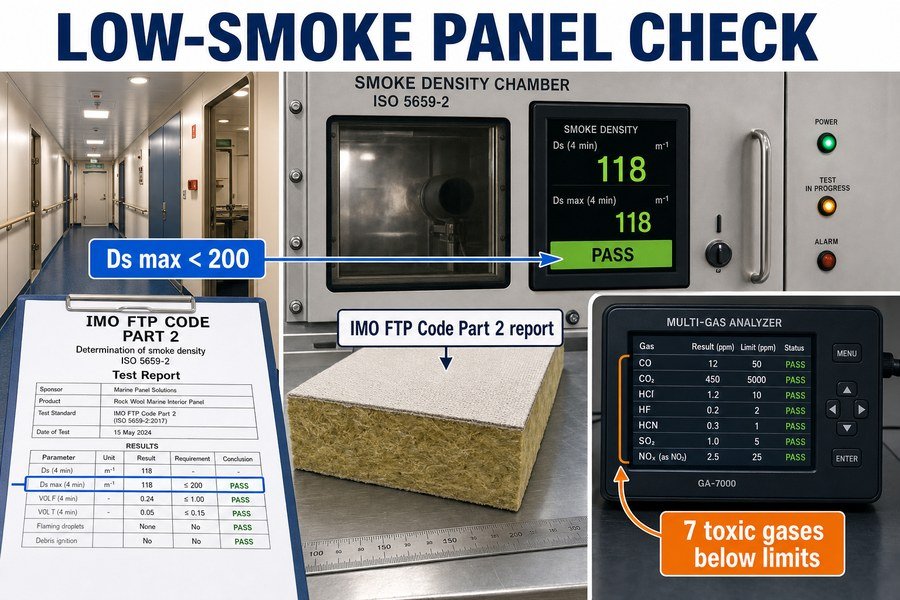
Let us look closer at the exact numbers you need to find on these lab reports to ensure your panels pass the shipyard's strict quality checks and keep your projects running smoothly.
What Data Proves a Marine Interior Panel Is Truly Low-Smoke?
Fake low-smoke claims can ruin your marine decoration project. If the data is wrong, the shipyard rejects the panels. Here is the exact data you need to prove compliance.
True low-smoke marine panels are proven by IMO FTP Code Part 2 reports showing maximum specific optical density (Ds max) under 200 for surface materials, and toxicity limits for seven gases: CO (≤1450ppm), HCl (≤600ppm), HF (≤600ppm), NOx (≤350ppm), HBr (≤600ppm), HCN (≤140ppm), and SO2 (≤120ppm).
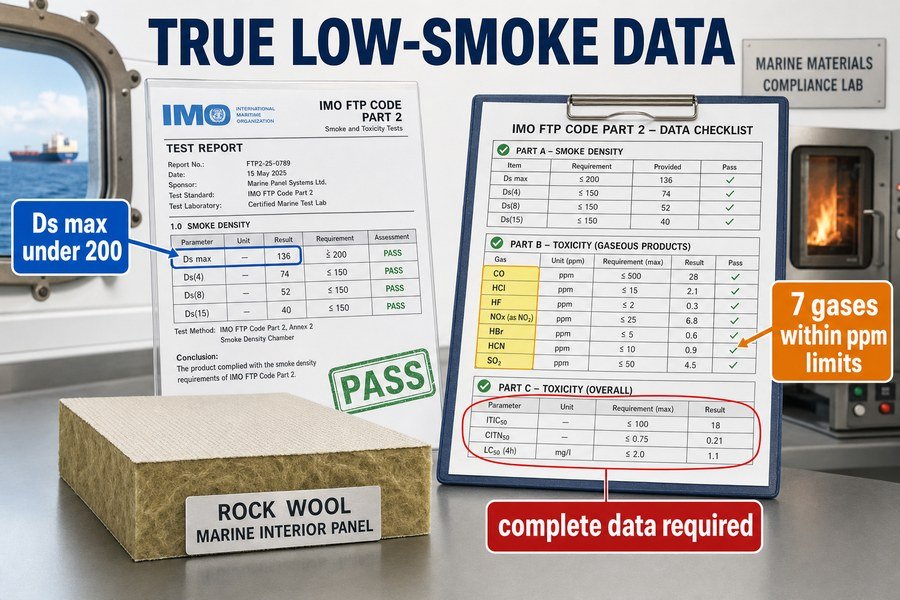
To properly prove that a marine interior panel is truly low-smoke, you cannot rely on a supplier's marketing brochure. You need raw data from an authorized testing laboratory like DNV or Lloyd's Register1. In my daily work at Magellan Marine, I always look for two specific data sets governed by the IMO FTP Code Part 2.
Analyzing Maximum Specific Optical Density (Ds max) Data
The first critical data point is the maximum specific optical density, known as Ds max. This measures how thick the smoke gets during a fire. For marine bulkheads, wall linings, and ceiling panels, the IMO strict limit is 2002. If the number goes over 200, the smoke is too thick. Crew members would not be able to see emergency exit signs. I once dealt with a factory that tried to show me the "average" density. Do not accept this. The inspector only cares about the absolute maximum density reached during the test.
Verifying the Seven Toxic Gas Emission Limits
The second data set involves toxic gas emissions. Thick smoke blinds people, but toxic smoke kills them. The IMO requires testing for exactly seven gases.3 The data must show Carbon Monoxide (CO) at or below 1450 ppm. It must show Hydrogen Chloride (HCl) and Hydrogen Fluoride (HF) at or below 600 ppm. Nitrogen Oxides (NOx) must not exceed 350 ppm. Hydrogen Bromide (HBr) must stay under 600 ppm. Hydrogen Cyanide (HCN), which is highly lethal, is strictly limited to 140 ppm. Finally, Sulfur Dioxide (SO2) must remain under 120 ppm. You must find the data for all seven gases to prove the panel is safe.
| Gas Type | Chemical Formula | IMO FTP Code Part 2 Maximum Limit (ppm) |
|---|---|---|
| Carbon Monoxide | CO | ≤ 1450 |
| Hydrogen Chloride | HCl | ≤ 600 |
| Hydrogen Fluoride | HF | ≤ 600 |
| Nitrogen Oxides | NOx | ≤ 350 |
| Hydrogen Bromide | HBr | ≤ 600 |
| Hydrogen Cyanide | HCN | ≤ 140 |
| Sulfur Dioxide | SO2 | ≤ 120 |
Knowing these limits is the first step, but some suppliers try to hide bad results by leaving data out of their reports entirely.
How Can Missing Toxicity Values Be Spotted in Marine Interior Panel Data?
Incomplete test reports are a common trick. Missing one toxic gas value can cause a failed marine survey. Here is how to spot missing toxicity values quickly.
You can spot missing toxicity values in marine interior panel data by cross-referencing the report against the mandatory seven-gas checklist (CO, HCl, HF, NOx, HBr, HCN, SO2), checking for blank fields in both flaming and non-flaming test modes, and ensuring the sampling time exactly matches the peak smoke density.
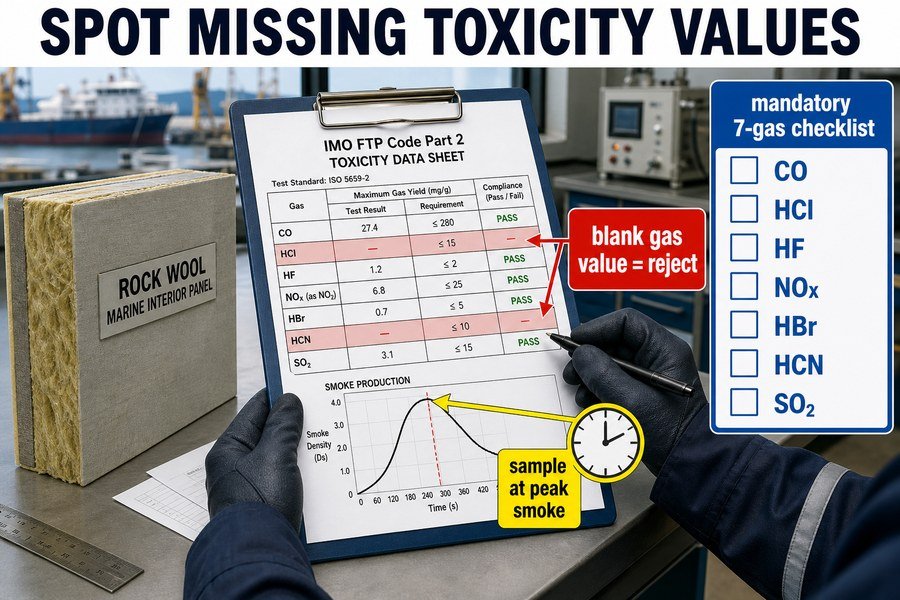
Finding missing data requires a sharp eye. Many buyers just look for a "Pass" stamp on the front page. But as a procurement officer, you must dig into the data tables. Suppliers sometimes use cheap surface films that fail the toxicity test, so they simply delete that specific gas result from the PDF.
Cross-Referencing the Mandatory Seven-Gas Checklist
The easiest way to spot missing data is to use the IMO seven-gas checklist. Every valid report must list CO, HCl, HF, NOx, HBr, HCN, and SO2.4 Count them. If you only see five or six gases, the report is incomplete. Very often, suppliers hide HCN or HCl values because cheap PVC finishes release massive amounts of these gases5. I always print the checklist and physically tick off each gas as I read the supplier's lab report.
Checking Blank Fields in Both Test Modes
Another trick is hiding data in one of the test modes. The IMO requires testing in two modes: flaming and non-flaming.6 A supplier might show you all seven gases for the flaming test, but leave the non-flaming table completely blank. You must check both tables. If any field says "N/A" or is left blank, you must reject the report.
Matching Sampling Time to Peak Smoke Density
Finally, you must check when the lab took the gas sample. The rules say toxicity must be measured when the smoke is thickest (peak smoke density)7. If the report shows the peak smoke happened at minute 10, but the gas sample was taken at minute 2, the data is invalid. The supplier is showing you early, clean air instead of the toxic smoke at the peak of the fire.
| Inspection Step | What to Look For in the Lab Report | Reason for Immediate Rejection |
|---|---|---|
| Seven-Gas Checklist | Count the specific gases listed in the toxicity table. | Report lists fewer than 7 gases (e.g., HCN is missing). |
| Dual Mode Check | Look at both flaming and non-flaming data tables. | One table has blank fields or missing toxicity rows. |
| Time Match Check | Compare peak smoke time with gas sampling time. | Gas sample was taken long before the smoke density peaked. |
Once you know all data is present and nothing is hidden, you must know which specific numbers will cause an immediate rejection from the surveyor.
Which Smoke Parameters Disqualify Marine Interior Panels for Accommodation Areas?
Installing the wrong panels in accommodation areas risks lives. A single bad parameter will disqualify your materials instantly. Watch out for these specific disqualifying numbers.
Marine interior panels are disqualified for accommodation areas if their maximum specific optical density (Ds max) exceeds 200, if Carbon Monoxide (CO) exceeds 1450 ppm, if Hydrogen Cyanide (HCN) exceeds 140 ppm, or if acidic gases like Hydrogen Chloride (HCl) or Hydrogen Fluoride (HF) exceed 600 ppm.
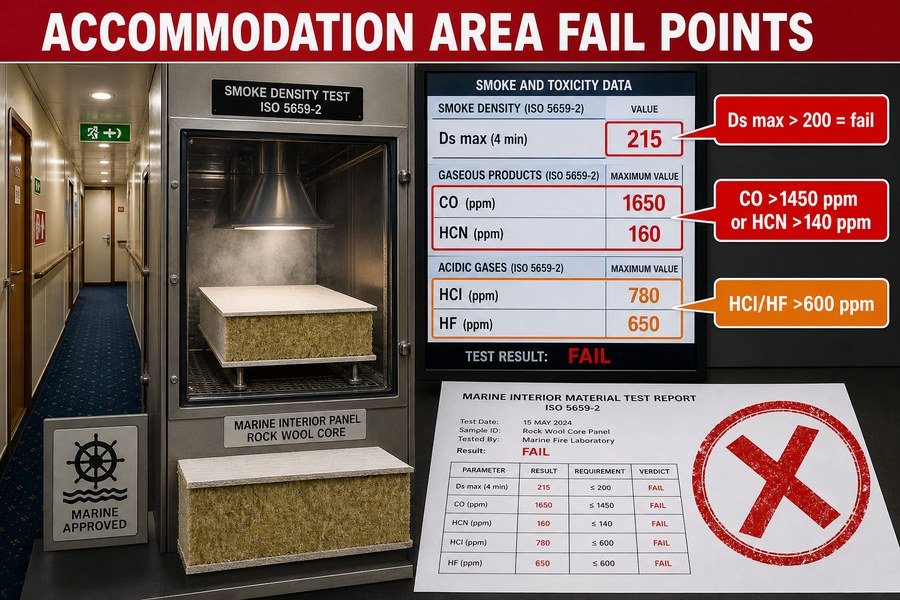
Accommodation areas are where the ship's crew sleeps and lives. These areas have the strictest fire safety rules. If a fire breaks out here, the panels must not release blinding or deadly smoke. When I review panel specifications for Magellan Marine's clients, I look for four specific parameters that cause automatic disqualification.
Disqualification Due to High Optical Density (Ds max > 200)
The first disqualifying parameter is a Ds max above 200. This is a hard limit set by the IMO. The optical density measures how much light the smoke blocks. If the Ds max is 201, the panel fails. Thick smoke causes panic. In an accommodation area, crew members must be able to see the floor lighting and the exit doors. A panel with a Ds max of 300 will plunge the corridor into total darkness in minutes.
Disqualification Due to Lethal Carbon Monoxide and Cyanide Levels
The next parameters involve fast-acting lethal gases. If the Carbon Monoxide (CO) goes above 1450 ppm, the panel is disqualified. Even more dangerous is Hydrogen Cyanide (HCN). If HCN exceeds 140 ppm, you cannot use the panel. Cyanide gas is deadly even in small doses. Since crew members might be sleeping when a fire starts, panels in accommodation areas must never exceed these strict lethal gas limits.
Disqualification from Corrosive Acidic Gases (HCl and HF)
Finally, the panels are disqualified if acidic gases like Hydrogen Chloride (HCl) or Hydrogen Fluoride (HF) exceed 600 ppm8. These gases are created when halogens in cheap plastics burn. When a sailor breathes in HCl, it mixes with the water in their lungs and creates hydrochloric acid. Furthermore, these gases destroy the ship's sensitive navigation electronics9. Any panel exceeding 600 ppm for these acids is banned from use.
| Parameter | Disqualifying Value | Primary Danger in Accommodation Areas |
|---|---|---|
| Specific Optical Density (Ds max) | > 200 | Blocks vision, prevents crew from finding emergency exits. |
| Carbon Monoxide (CO) | > 1450 ppm | Causes rapid unconsciousness and death via oxygen starvation. |
| Hydrogen Cyanide (HCN) | > 140 ppm | Highly toxic, causes immediate respiratory failure. |
| Hydrogen Chloride (HCl) / HF | > 600 ppm | Burns lung tissue and severely corrodes ship electronics. |
Knowing these failure points is crucial, but you also need to make sure the panel was tested under the right fire conditions to begin with.
How Can Marine Interior Panel Data Be Checked for Both Flaming Modes?
Fires behave differently with or without an open flame. Checking only one mode leaves a huge safety gap. Here is how to check both modes on the report.
To check marine interior panel data for both flaming modes, you must locate the two separate test tables in the IMO report: one for the 25 kW/m² irradiance non-flaming mode (smoldering fire) and one for the 25 kW/m² irradiance flaming mode (open flame), ensuring both pass all limits.
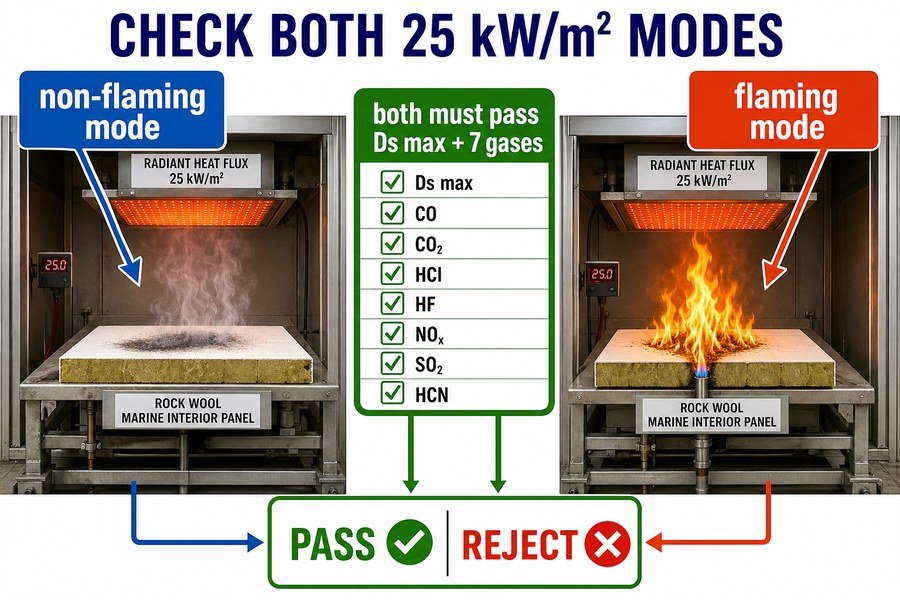
When a fire happens on a ship, materials react in two ways. Sometimes they smolder and smoke heavily without catching fire. Other times, they burn with an open flame. The IMO FTP Code Part 2 requires testing for both situations10. A common mistake buyers make is only looking at one test mode.
Identifying the 25 kW/m² Non-Flaming Mode Data
You must first find the table marked "Non-Flaming Mode" or "Without Pilot Flame." This test uses a heat source of 25 kW/m² to heat the panel until it smokes. This simulates a smoldering fire, like an electrical fault inside a wall. Many synthetic materials produce much more toxic smoke when they smolder than when they burn. You must check that the Ds max and the seven toxic gases all pass the limits under this specific non-flaming condition.
Identifying the 25 kW/m² Flaming Mode Data
Next, you must find the second table marked "Flaming Mode" or "With Pilot Flame." This test also uses 25 kW/m² of heat, but adds a direct flame to the panel. This simulates a fully developed room fire. Some adhesives and rockwool binders will only release certain toxic gases when exposed to direct fire.
Ensuring Both Modes Pass All Regulatory Limits
You must check both tables side-by-side. The panel does not get an "average" score. If the panel passes the non-flaming mode perfectly, but fails the Carbon Monoxide limit in the flaming mode, the panel is rejected. Both modes must independently pass the Ds max limit of 200 and all seven gas limits.11
| Test Mode | Heat Irradiance | Simulates | Pass Criteria Required |
|---|---|---|---|
| Non-Flaming Mode | 25 kW/m² (No pilot flame) | Smoldering electrical fire behind walls. | Ds max ≤ 200 AND all 7 toxic gases under IMO limits. |
| Flaming Mode | 25 kW/m² (With pilot flame) | Fully developed open cabin fire. | Ds max ≤ 200 AND all 7 toxic gases under IMO limits. |
When you review these two tables carefully, talking to the supplier can uncover even more details about their true quality control.
What Questions Reveal Weak Marine Interior Panel Smoke Control?
Bad suppliers often hide poor smoke control behind confusing talk. Asking the right questions forces them to tell the truth. Ask these questions directly to protect yourself.
To reveal weak marine interior panel smoke control, you must ask the supplier four questions: What is your exact Ds max value? Are all seven toxic gases tested? Do you use halogen-free decorative films? and Can you provide the full, unedited IMO FTP Code Part 2 laboratory test report?
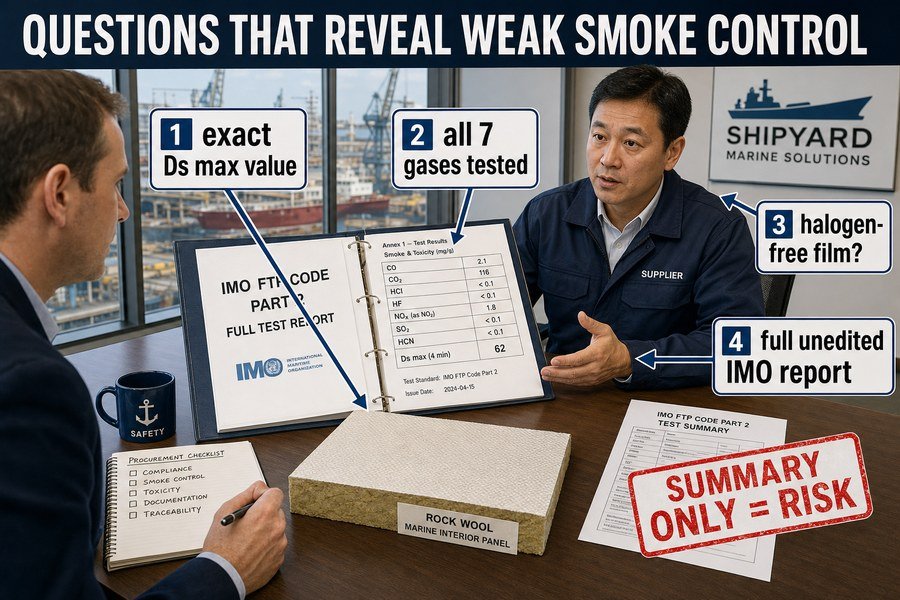
When communicating with suppliers in Asia, you must be direct. Vague questions get vague answers. If you ask, "Is your panel low-smoke?" they will always say yes. You need technical questions that a bad supplier cannot answer easily. Over my years of outfitting procurement, I developed a strict set of questions.
Asking About Exact Ds Max Values
Never ask if a panel "passed" the smoke test. Ask, "What is your exact Ds max value?" A good supplier will immediately say a number, like "Our Ds max is 45." A weak supplier will hesitate or just repeat that they have a certificate. If their Ds max is 195, it barely passed the 200 limit. This means any slight factory defect during mass production will push the panels over the limit and cause a shipyard rejection.
Asking About the Seven Toxic Gases and Halogen-Free Films
You must ask, "Are all seven toxic gases tested12?" and follow up with, "Do you use halogen-free decorative films13?" Standard PVC films contain halogens14. When burned, they create heavy smoke and deadly HCl gas. High-quality marine panels use PET or specialized halogen-free films. If the supplier does not know what a halogen-free film is, they have weak smoke control.
Asking for the Full, Unedited IMO Test Report
Finally, ask, "Can you provide the full, unedited IMO FTP Code Part 2 laboratory test report?" Weak suppliers often send a one-page summary or a heavily cropped PDF. You need the full 10-to-15-page document from a recognized lab. If they refuse to send the full report, they are hiding failed toxicity numbers.
| Critical Question to Ask Supplier | Good Supplier Response | Weak Supplier Response |
|---|---|---|
| What is your exact Ds max value? | Provides a specific number well below 200 (e.g., 60). | "It passed the test, do not worry." |
| Are all 7 toxic gases tested? | "Yes, including HCN and SO2." | "We tested the main ones like CO." |
| Do you use halogen-free films? | "Yes, we use PET/halogen-free materials." | "We use standard marine PVC." |
| Can I see the full unedited report? | Sends the complete 15-page lab PDF. | Sends a 1-page summary certificate. |
After getting the right answers and the full report, you just need to know how to compare their numbers against the global rules.
How Are Smoke Values Compared Against Marine Interior Panel Thresholds?
Staring at a complex lab report can be very confusing. But comparing the numbers does not have to be hard. Here is how to do it simply and quickly.
To compare smoke values against marine interior panel thresholds, you must place the panel's Ds max next to the 200 limit, list the tested parts-per-million for the seven gases beside the IMO maximums (like CO at 1450ppm), and confirm every single tested value is lower than its corresponding threshold.
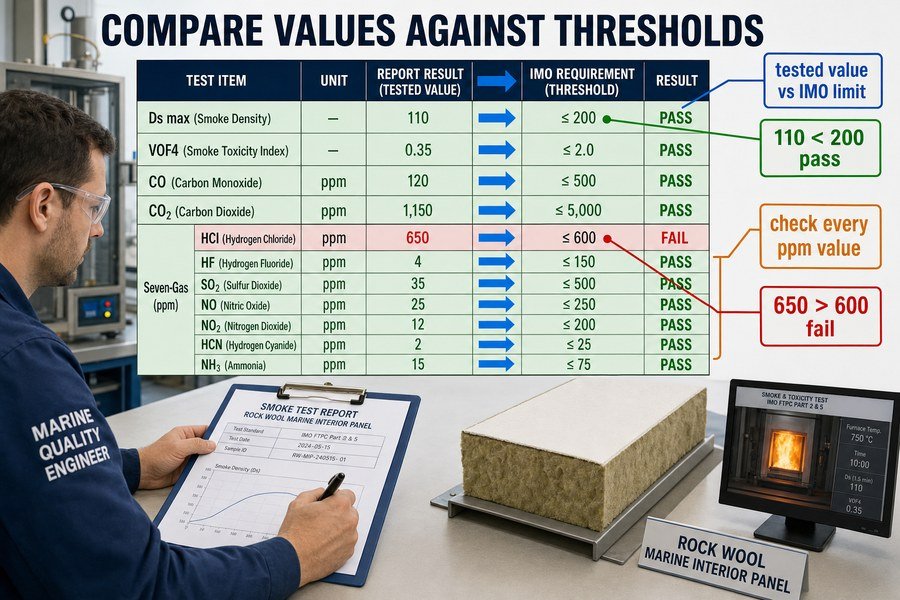
Comparing data is about organization. When I get a test report, I do not just read it; I build a comparison checklist. This guarantees that I do not miss a single critical value. You must create a one-to-one comparison between the lab results and the IMO rules.
Placing the Panel's Ds Max Next to the 200 Limit
First, locate the Maximum Specific Optical Density in the report. Put this number right next to the IMO limit of 20015. For example, if the report says the Ds max is 85, write down "85 < 200 (Pass)." Remember to do this twice: once for the flaming mode and once for the non-flaming mode.
Listing the Tested Parts-Per-Million Beside IMO Maximums
Second, make a list of the seven gases. Write the IMO maximum limit next to each gas. Then, copy the tested parts-per-million (ppm) from the lab report next to those limits. For Carbon Monoxide, write the tested value next to 1450. For Hydrogen Cyanide, write the tested value next to 140. Do this for all seven gases, for both flaming and non-flaming test modes.
Confirming Every Single Value is Lower Than the Threshold
Finally, you must confirm every single value. Read down your list. Every tested value must be strictly lower than the IMO threshold16. There is no flexibility here. If six gases are very low, but HCl is 610 ppm (above the 600 limit), the panel fails completely. You must reject it.
| IMO Parameter | IMO Maximum Limit | Example Lab Result | Comparison Result |
|---|---|---|---|
| Ds max | ≤ 200 | 110 | Pass (110 < 200) |
| Carbon Monoxide (CO) | ≤ 1450 ppm | 320 ppm | Pass (320 < 1450) |
| Hydrogen Cyanide (HCN) | ≤ 140 ppm | 15 ppm | Pass (15 < 140) |
| Hydrogen Chloride (HCl) | ≤ 600 ppm | 650 ppm | FAIL (650 > 600) |
Conclusion
Verifying marine interior panel low-smoke performance requires checking the exact Ds max and all seven toxic gas limits across both flaming and non-flaming modes on the IMO FTP Code report.
-
"How Does the IMO FTP Code Govern Fire Testing Procedures ...", https://magellanmarinetech.com/how-does-imo-ftp-code-govern-fire-testing-procedures-for-marine-panels/. Classification societies and recognized organizations such as DNV and Lloyd’s Register operate within maritime type-approval and certification frameworks, supporting the need to verify fire-test results through formally recognized testing or approval bodies rather than supplier literature. Evidence role: general_support; source type: institution. Supports: Marine interior panel low-smoke claims should be verified using raw data from an authorized or recognized testing laboratory rather than relying on supplier marketing materials.. Scope note: This supports the general need for recognized third-party testing or approval; it does not prove that any specific DNV or Lloyd’s Register laboratory is authorized for a particular panel or test campaign. ↩
-
"What Is the Purpose and Scope of the IMO FTP Code?", https://magellanmarinetech.com/what-purpose-scope-of-imo-ftp-code/. The 2010 IMO FTP Code, Annex 1, Part 2, sets smoke-generation acceptance criteria for specified shipboard surface materials, including a maximum specific optical density threshold of 200 for relevant applications such as bulkheads, linings, and ceilings. Evidence role: case_reference; source type: institution. Supports: For marine bulkheads, wall linings, and ceiling panels covered by the IMO FTP Code Part 2 criteria, Ds max must not exceed 200.. Scope note: The exact applicability depends on the material category and installation context defined in the Code. ↩
-
"Toxicity Test Requirements and Performance Criteria for ...", https://railroads.dot.gov/sites/fra.dot.gov/files/2021-02/Toxicity%20Test%20and%20Performance%20Criteria.pdf. The IMO FTP Code Part 2 toxicity criteria specify measurement limits for seven combustion gases—CO, HCl, HF, NOx, HBr, HCN, and SO2—providing the regulatory basis for the listed ppm thresholds. Evidence role: case_reference; source type: institution. Supports: IMO FTP Code Part 2 requires toxicity assessment against seven specified gas emission limits.. Scope note: This supports the Code’s specified gas list and limits; it does not establish that a given product passed unless its laboratory report includes compliant measured values. ↩
-
"What Is the Purpose and Scope of the IMO FTP Code?", https://magellanmarinetech.com/what-purpose-scope-of-imo-ftp-code/. IMO FTP Code smoke-and-toxicity test procedures identify carbon monoxide, hydrogen chloride, hydrogen fluoride, nitrogen oxides, hydrogen bromide, hydrogen cyanide, and sulfur dioxide among the toxic gases to be measured for qualifying materials used on ships. Evidence role: definition; source type: institution. Supports: A valid IMO smoke-toxicity report should include results for CO, HCl, HF, NOx, HBr, HCN, and SO2.. Scope note: The source supports the required gases within the IMO FTP Code context; acceptance criteria may vary by material category and flag-state implementation. ↩
-
"Toxicity of the Pyrolysis and Combustion Products of Poly ...", https://www.nist.gov/publications/toxicity-pyrolysis-and-combustion-products-polyvinyl-chlorides-literature-assessment. Combustion and thermal decomposition studies of polyvinyl chloride report substantial hydrogen chloride formation because PVC contains chlorine; any inference about a particular finish releasing high quantities depends on its formulation, additives, and fire conditions. Evidence role: mechanism; source type: paper. Supports: PVC-based finishes can release toxic gases, especially hydrogen chloride, during fire or thermal decomposition.. Scope note: This supports the chemical plausibility for PVC-derived HCl emissions, not the article’s broader claim about all cheap PVC finishes or specific supplier behavior. ↩
-
"RESOLUTION MSC.307(88) (adopted on 3 December ...", https://wwwcdn.imo.org/localresources/en/KnowledgeCentre/IndexofIMOResolutions/MSCResolutions/MSC.307(88).pdf. The IMO FTP Code smoke-generation procedure includes both flaming and non-flaming exposure conditions for assessing smoke production and related gas measurements in shipboard material testing. Evidence role: definition; source type: institution. Supports: IMO smoke-and-toxicity testing includes both flaming and non-flaming test modes.. Scope note: The citation establishes the two prescribed test conditions; it does not by itself prove that every blank field requires procurement rejection under every contract. ↩
-
"Toxicity Test Requirements and Performance Criteria for ...", https://railroads.dot.gov/sites/fra.dot.gov/files/2021-02/Toxicity%20Test%20and%20Performance%20Criteria.pdf. IMO FTP Code Part 2 procedures tie gas sampling for toxicity assessment to the smoke-density test sequence, including sampling at or around the maximum specific optical density condition; this supports checking whether gas sampling corresponds to the peak smoke interval. Evidence role: mechanism; source type: institution. Supports: Toxic gas sampling in the IMO smoke-toxicity test should correspond to the peak smoke-density condition rather than an arbitrary early time.. Scope note: The exact timing rule should be verified against the applicable edition of the FTP Code and laboratory method, since wording and sampling windows may be procedure-specific. ↩
-
"What Is the Purpose and Scope of the IMO FTP Code?", https://magellanmarinetech.com/what-purpose-scope-of-imo-ftp-code/. The IMO FTP Code smoke and toxicity acceptance criteria include maximum concentration limits for acid gases such as hydrogen chloride and hydrogen fluoride in fire effluents from tested materials. Evidence role: statistic; source type: institution. Supports: Panels are disqualified if hydrogen chloride or hydrogen fluoride exceeds 600 ppm.. Scope note: The citation would verify the regulatory test threshold, not independently prove the real-fire concentration produced by any specific commercial panel. ↩
-
"A Literature Review of the Effects of Fire Smoke on Electrical Equipment", https://www.nist.gov/publications/literature-review-effects-fire-smoke-electrical-equipment. Fire-corrosion studies and standards on smoke corrosivity document that halogen acid gases, including hydrogen chloride and hydrogen fluoride, can corrode metals and damage electronic assemblies after fire exposure. Evidence role: mechanism; source type: paper. Supports: Acidic gases from burning materials can damage or destroy sensitive shipboard electronics.. Scope note: Such sources support the corrosion mechanism generally; the degree of damage to ship navigation electronics depends on exposure concentration, humidity, duration, and equipment protection. ↩
-
"What Is the Purpose and Scope of the IMO FTP Code?", https://magellanmarinetech.com/what-purpose-scope-of-imo-ftp-code/. The IMO 2010 FTP Code, Part 2, specifies smoke and toxicity testing under both non-flaming and flaming exposure conditions for applicable surface materials. Evidence role: expert_consensus; source type: institution. Supports: The IMO FTP Code Part 2 requires testing in both non-flaming and flaming modes.. ↩
-
"Toxicity Test Requirements and Performance Criteria for ...", https://railroads.dot.gov/sites/fra.dot.gov/files/2021-02/Toxicity%20Test%20and%20Performance%20Criteria.pdf. The IMO FTP Code Part 2 sets acceptance criteria for smoke density and gas concentrations, including a maximum specific optical density criterion and limits for specified toxic gases, to be applied to the required test conditions. Evidence role: expert_consensus; source type: institution. Supports: A product must satisfy the smoke-density and toxic-gas limits in each required mode rather than relying on an averaged result.. Scope note: A citation to the code verifies the regulatory criteria; interpretation of a specific product’s pass/fail status still depends on its certified test report. ↩
-
"What Smoke Toxicity and Density Limits Must Marine Wall and Ceiling ...", https://magellanmarinetech.com/what-smoke-toxicity-density-limits-must-marine-wall-ceiling-panels-meet/. The IMO FTP Code Part 2 smoke and toxicity procedure lists toxic gas measurements for specified combustion products, including carbon monoxide, hydrogen chloride, hydrogen fluoride, nitrogen oxides, hydrogen bromide, hydrogen cyanide, and sulfur dioxide; this supports the statement that the test covers seven gases. Evidence role: definition; source type: institution. Supports: IMO smoke/toxicity testing requires attention to seven specified toxic gases.. Scope note: The citation supports the gases included in the IMO test method, not whether any particular supplier actually performed the complete test. ↩
-
"USE OF LOW SMOKE AND HALOGEN FREE CABLES FOR ...", https://upcommons.upc.edu/bitstreams/097b72f0-7e8a-449c-b1a6-17841c50f393/download. Fire-safety literature distinguishes halogenated polymers from halogen-free materials because halogenated products can emit acid gases during combustion; this provides contextual support for asking whether decorative films are halogen-free in smoke-toxicity control. Evidence role: mechanism; source type: paper. Supports: Using halogen-free films is relevant to smoke and toxicity control in marine panel materials.. Scope note: This evidence explains the rationale for halogen-free materials generally, but it does not prove that PET or any named film will pass IMO FTP Code Part 2 without product-specific testing. ↩
-
"Polyvinyl chloride", https://en.wikipedia.org/wiki/Polyvinyl_chloride. Polyvinyl chloride is a chlorine-containing polymer, and technical references describe hydrogen chloride as a principal decomposition or combustion product; this supports the statement that PVC is halogen-containing and can release HCl under fire conditions. Evidence role: mechanism; source type: encyclopedia. Supports: PVC films contain halogens and can generate hydrogen chloride when burned.. Scope note: The source would support the chemistry of PVC combustion generally, not the composition or fire performance of every decorative film sold as marine-grade PVC. ↩
-
"Toxicity Test Requirements and Performance Criteria for ...", https://railroads.dot.gov/sites/fra.dot.gov/files/2021-02/Toxicity%20Test%20and%20Performance%20Criteria.pdf. The IMO FTP Code Part 2 smoke and toxicity test sets a maximum specific optical density criterion of Ds max not exceeding 200 for materials evaluated under the specified test conditions. Evidence role: general_support; source type: institution. Supports: The Maximum Specific Optical Density should be compared against an IMO limit of 200.. Scope note: This supports the regulatory threshold, but the exact applicability depends on the material category and the edition/amendments of the FTP Code used by the testing laboratory. ↩
-
"Technical Report Documentation Page", https://rosap.ntl.bts.gov/view/dot/21263/dot_21263_DS1.pdf. The IMO FTP Code Part 2 acceptance criteria specify maximum permitted concentrations for smoke toxicity gases, including carbon monoxide at 1450 ppm, hydrogen cyanide at 140 ppm, and hydrogen chloride at 600 ppm, with exceedance of a listed limit indicating non-compliance. Evidence role: general_support; source type: institution. Supports: Each tested gas concentration must be checked against the IMO maximum threshold, and values above the threshold cause failure.. Scope note: The Code is generally framed as values not exceeding maximum limits; this supports rejecting values above the thresholds, but not necessarily the article’s stricter wording that equality with a limit must fail. ↩