Are you struggling to find beautiful marine interior finishes that will not fail shipyard fire inspections? The wrong surface can ruin your project. Let us look at safe, approved options.
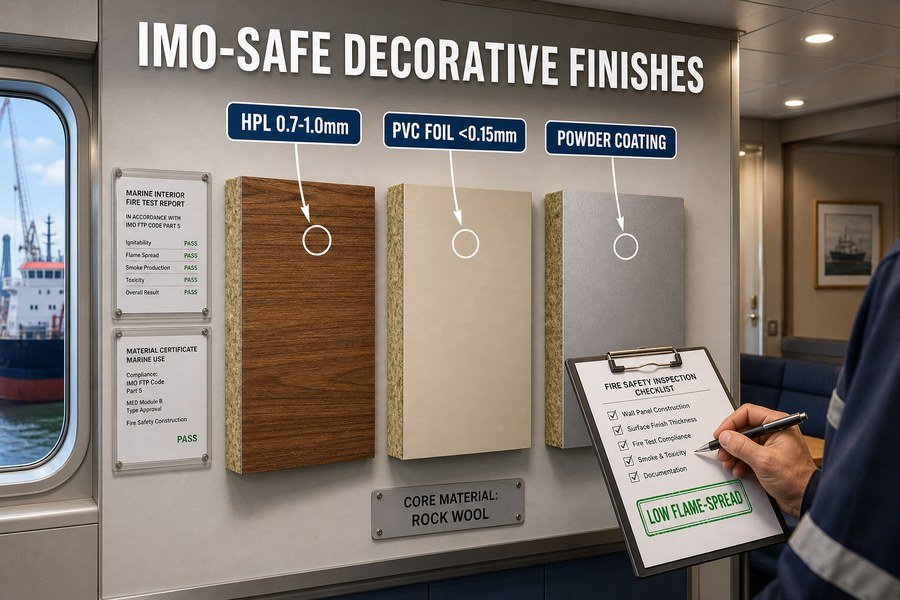
To meet IMO FTP Code Annex 1 Part 5 for low flame-spread, you must use marine-certified High-Pressure Laminates (HPL), PVC foils under 0.15mm thick, or specialized powder coatings. These three specific finishes guarantee compliance while offering wood-grain, solid color, or metallic aesthetics for ship interiors.
When building for strict US and European shipyards, balancing the look of the cabin with fire safety is a huge headache. I remember a time when a client had to rip out a beautiful cabin mockup because the surface finish failed the smoke test. Let us break down exactly which materials you can trust.
Which Decorative Surfaces Pass IMO Low Flame-Spread Rules for Marine Interior Panels?
Finding finishes that look good but still pass fire tests is hard. If your panels burn too fast, you lose money and time. Here is what you need.
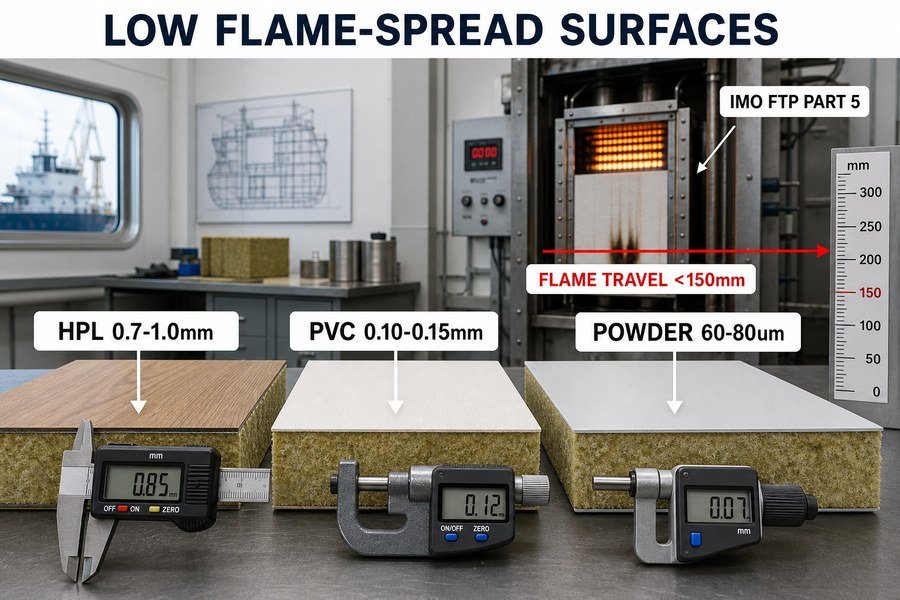
Only three main decorative surfaces pass IMO low flame-spread rules: fire-retardant High-Pressure Laminates (HPL) ranging from 0.7mm to 1.0mm, ultra-thin PVC foils (0.1mm to 0.15mm), and thermosetting powder coatings (60 to 80 microns). All three must pass the IMO FTP Code Part 5 surface flammability test.
I have seen many buyers try to save money by using standard building materials. That is a fast way to fail shipyard inspections. If you buy panels from suppliers in China or Vietnam, you must tell them exactly which of the three approved surfaces you want. Let us look closely at all three materials from the snippet.
Thickness and Material Specs for HPL, PVC, and Powder Coatings
The first option is fire-retardant High-Pressure Laminate (HPL). This is very popular for marine wall panels because it looks like real wood. According to IMO rules, the thickness of marine HPL must be between 0.7mm and 1.0mm. If it is thicker, it holds too much fuel and will burn too hot.
The second option is ultra-thin PVC foil. Many people think plastic is banned on ships. That is not true. You can use PVC foil, but the thickness must stay between 0.1mm and 0.15mm1.
The third option is thermosetting powder coating. This is the cheapest option. Factories spray dry powder onto the galvanized steel panel and bake it. The paint layer must be very thin, usually between 60 and 80 microns. If the paint is too thick, it will create toxic smoke when heated.
How Testing Labs Verify Marine Surface Flammability
You cannot just guess if a material is safe. European and US shipyards demand proof. All three of these surfaces must pass the IMO FTP Code Part 5 test2. In this test, a lab puts the panel material near a hot radiant panel. They measure how far the flame travels. The flame cannot travel more than 150mm.
When I worked in a marine outfitting factory, I watched these tests. Standard house HPL failed in 10 seconds. Marine HPL survived. You must check the test reports before you buy.
| Decorative Surface Type | Allowed Thickness | Common Use Area | Fire Test Standard |
|---|---|---|---|
| Fire-Retardant HPL | 0.7mm - 1.0mm | Wall panels, doors | IMO FTP Code Part 5 |
| Ultra-thin PVC Foil | 0.1mm - 0.15mm | Wall panels, ceilings | IMO FTP Code Part 5 |
| Powder Coating | 60 - 80 microns | Ceilings, wet units | IMO FTP Code Part 5 |
How to Choose an A-Class Compliant HPL Finish for Marine Wall Panels?
Buying HPL is confusing when factories offer so many choices. If you pick standard HPL instead of marine-grade HPL, your A-Class bulkheads will fail certification. Here is the fix.
To choose an A-Class compliant HPL finish, you must verify three things: the thickness must be between 0.7mm and 1.0mm, the material must have an active MED (Marine Equipment Directive) Wheelmark certificate, and the calorific value must be below 45 MJ/m² as required by IMO FTP Code.
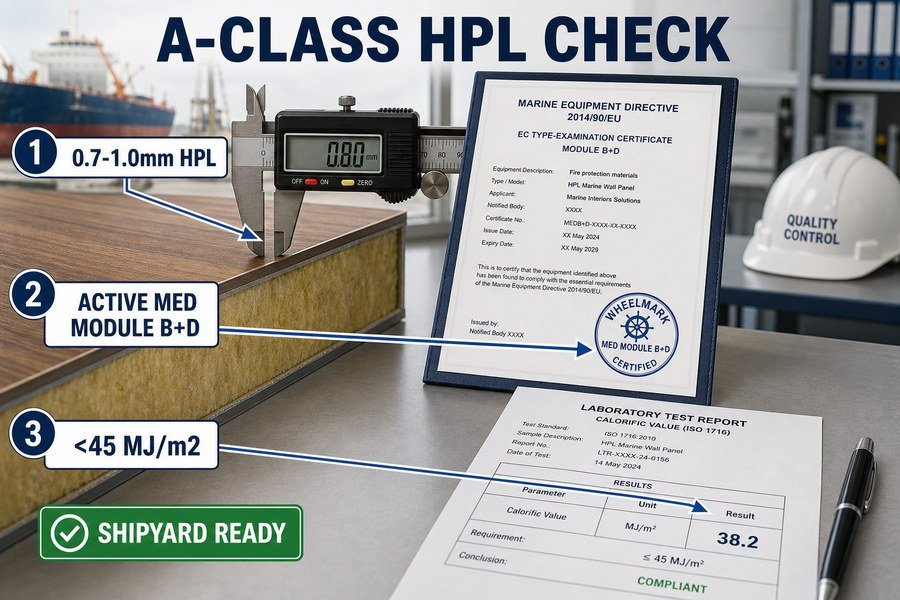
When procurement officers buy wall panels, they always ask me about HPL. HPL is great because it resists scratches and looks premium. But not all HPL is safe for ships. To make sure you get the right product, you must check all three requirements mentioned above. Do not skip any of them.
Checking Thickness and Calorific Values for Marine HPL
First, you must check the thickness. Marine HPL must be between 0.7mm and 1.0mm. I always tell my clients to ask for 0.7mm or 0.8mm. This thinner HPL is lighter and bends better on corner panels.
Second, you must check the calorific value. The IMO FTP Code says the calorific value must be below 45 MJ/m². What does this mean? It means the material cannot release too much heat when it burns. Standard furniture HPL releases over 50 MJ/m². It will feed the fire. Marine HPL uses special phenolic resins that do not burn easily. This keeps the heat release below the 45 MJ/m² limit.
Verifying MED Certificates with Asian Suppliers
Third, you must ask for an active MED Wheelmark certificate. The Wheelmark is the official approval mark for marine equipment in Europe.
If you buy from factories in Asia, you must be careful. Some factories show you an old certificate that is no longer valid. You must ask the sales person for the "Module B" and "Module D" certificates. Module B means the lab tested the product. Module D means the factory has good quality control. I always check the date on these papers. If the certificate is expired, the US or EU shipyard will reject your panels.
| Verification Step | Target Requirement | Authoritative Source | Consequence if Failed |
|---|---|---|---|
| Material Thickness | 0.7mm to 1.0mm | IMO FTP Code | Hard to bend, holds too much heat |
| Calorific Value | Under 45 MJ/m² | IMO FTP Code Part 5 | Feeds the fire, fails inspection |
| MED Certificate | Active Module B & D | Marine Equipment Directive | Shipyard rejects the panels |
Which Coatings Meet Low-Smoke and Toxicity Limits for Marine Ceiling Panels?
Ceilings are critical during ship fires. If ceiling paints release toxic gas, people cannot escape. Choosing the wrong coating puts lives and your project at risk.
Two coatings meet IMO low-smoke and toxicity limits for marine ceilings: epoxy polyester powder coatings (applied at 60-80 microns) and water-based acrylic paints (applied at 40-50 microns dry film). Both must produce less than 200 Ds (smoke density) under IMO FTP Code Part 2.
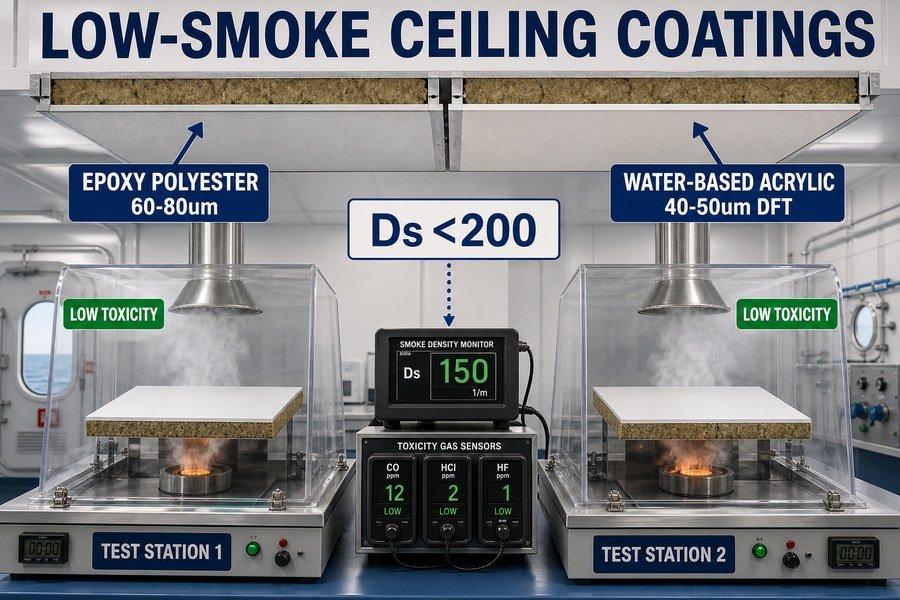
Ceilings trap smoke. In a ship fire, smoke kills more people than flames.3 Therefore, the IMO rules for ceilings are very strict. When you buy ceiling panels for shipyards, you must make sure the factory uses one of the two safe coating types. Let us break down both options so you know what to specify on your purchase orders.
Epoxy Polyester Powder Coatings for Marine Ceilings
The most common choice is epoxy polyester powder coating. Factories love this because it is cheap and very durable. However, they must apply it correctly. The thickness must stay between 60 and 80 microns.
If the factory sprays too much powder, the paint gets too thick. When thick paint burns, it creates black smoke. The IMO FTP Code Part 2 requires the smoke density (Ds) to be less than 200. Epoxy polyester powder easily passes this test if it is thin. I always tell buyers to ask the factory to measure the paint thickness with a digital gauge before packing.
Water-Based Acrylic Paints for Low Toxicity
The second choice is water-based acrylic paint. This is often used for custom colors or touch-ups. It must be applied very thin, usually 40 to 50 microns dry film thickness (DFT).
Because it is water-based, it has almost zero Volatile Organic Compounds (VOCs). When it gets hot, it does not release dangerous toxic gases like carbon monoxide or hydrogen cyanide. The IMO FTP Code Part 2 sets strict limits on these toxic gases. Water-based paints pass these tests very easily. The downside is that wet paint takes longer to dry in the factory than baked powder coating.
| Coating Type | Application Thickness | Toxic Gas Release | Smoke Density (Ds) Limit |
|---|---|---|---|
| Epoxy Polyester Powder | 60 - 80 microns | Very Low | < 200 (per IMO Part 2) |
| Water-Based Acrylic Paint | 40 - 50 microns DFT | Near Zero | < 200 (per IMO Part 2) |
How Do PVC Foils on Marine Bulkheads Affect Flammability Versus Bare Metal?
Bare steel is safe but ugly. Adding PVC film makes cabins look great, but it adds fuel to a fire. You must balance beauty with strict safety limits.
PVC foils increase flammability by adding combustible mass to bare metal, but they remain IMO-compliant if their thickness is strictly kept between 0.10mm and 0.15mm and their calorific value stays under 45 MJ/m². Bare metal has zero flame spread, while approved PVC limits flame travel to under 150mm.
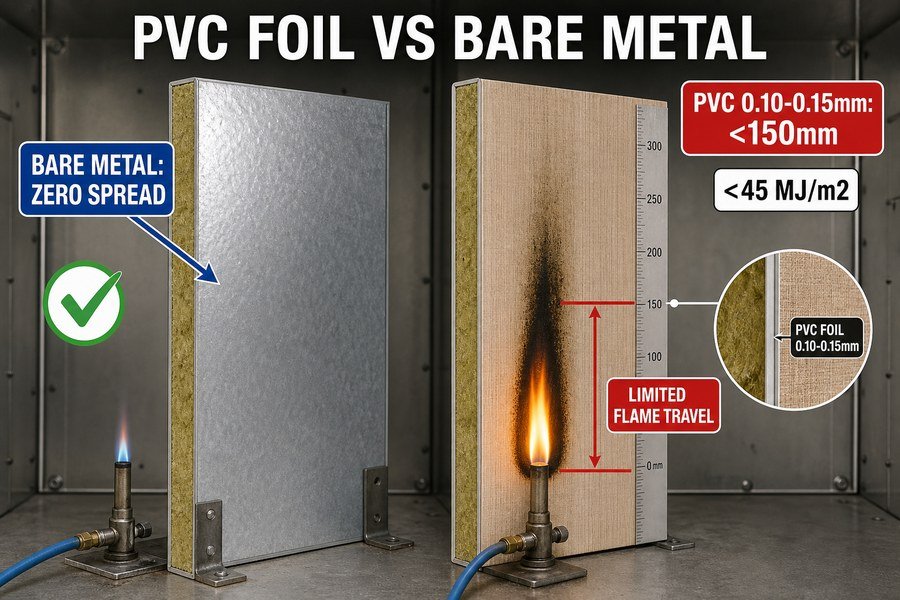
When I help clients choose wall panels, they often ask why we cannot just use thick, cheap plastic wraps like they do in house decorations. I always have to explain the science of ship fires. You must understand how bare metal and PVC foil act differently when exposed to high heat. You need to know both sides of the comparison.
The Impact of PVC Thickness on Flammability Rates
Let us look at PVC foil first. PVC (Polyvinyl Chloride) is plastic. Plastic burns. When you add a PVC foil to a metal panel, you add combustible mass. This means you are giving the fire food.
To stay safe, the IMO says this food must be very limited. This is why the PVC thickness must be strictly between 0.10mm and 0.15mm. At this exact thickness, the calorific value stays under the limit of 45 MJ/m². If you use a 0.30mm PVC foil, it will burn rapidly. The flame will travel fast across the wall. Approved thin PVC stops burning quickly, limiting the flame travel to under 150mm during the IMO FTP Code Part 5 test.
Comparing Fire Behavior: Bare Metal versus PVC-Coated Panels
Now let us compare it to bare metal. Bare metal, usually galvanized steel that is 0.6mm thick, does not burn.4 It has zero flame spread. It has zero calorific value. If a fire hits bare metal, it simply gets hot. It does not create smoke or spread the fire.
However, no passenger or crew member wants to sleep in a room that looks like a steel box. PVC foil gives you beautiful wood or fabric patterns. You accept a very small increase in flammability to get a beautiful cabin. As long as you follow the 0.15mm thickness rule, the shipyard will approve it.
| Material Surface | Flame Spread Amount | Calorific Value | Aesthetic Quality |
|---|---|---|---|
| Bare Galvanized Steel (0.6mm) | Zero | 0 MJ/m² | Very Poor (Industrial) |
| Approved PVC Foil (0.10-0.15mm) | Under 150mm | < 45 MJ/m² | High (Wood, Fabric looks) |
| Non-Approved PVC (>0.20mm) | Over 150mm (Fails) | > 45 MJ/m² (Fails) | High |
What Aesthetic Finishes Exist for A-60 Marine Interior Walls Besides Bare Steel?
Shipowners want luxury, but A-60 walls must stop fire for 60 minutes. Standard wood is illegal. You need safe options to win high-end shipyard contracts.
Beyond bare steel, four aesthetic finishes exist for A-60 walls: wood-grain High-Pressure Laminates (HPL), colored PVC foils, plain galvanized steel with powder coating, and brushed stainless steel overlays. These four finishes attach over the A-60 mineral wool core to provide luxury looks without compromising the 60-minute fire rating.
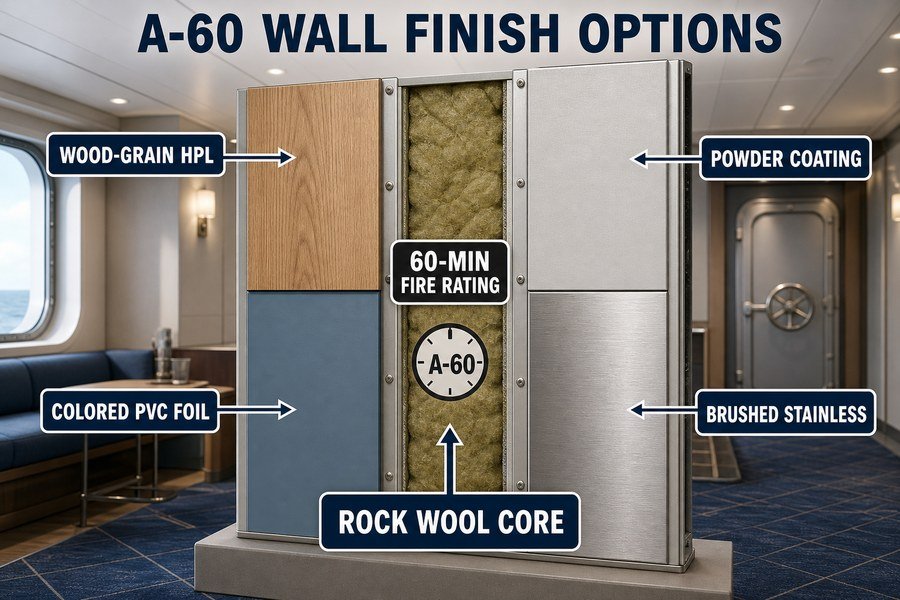
An A-60 bulkhead is a serious piece of engineering. According to SOLAS rules, it must block fire and heat for a full 60 minutes. But it does not have to be ugly. The secret is that the fire rating comes from the inside core, not the outside skin. The core uses high-density rockwool (usually 100 to 120 kg/m³ density, minimum 50mm thick). You can put four different safe finishes over this core. Let us explore all four finishes.
Wood-Grain HPL and Colored PVC Foils for A-60 Walls
The first two finishes are HPL and PVC foil. We talked about these earlier. You can bond a 0.7mm wood-grain HPL directly to the steel skin of the A-60 panel. This is perfect for luxury cruise ships or officer cabins.
You can also use colored PVC foil (0.10mm to 0.15mm thick). This is a cheaper way to get a nice pattern. Both HPL and PVC are very thin. Because they are so thin, they do not create enough heat to ruin the 60-minute fire protection5 of the thick rockwool core inside the panel.
Powder Coating and Stainless Steel Options for A-60 Bulkheads
The third finish is powder coating. The factory paints the galvanized steel skin with a 60-micron epoxy powder coat. This gives a clean, solid color. It is cheap and easy to clean, making it great for crew corridors.
The fourth finish is brushed stainless steel. You can ask the factory to use 0.6mm or 1.0mm thick 304 or 316L stainless steel for the panel skin instead of galvanized steel. This looks very modern and high-tech. It is widely used in ship galleys (kitchens) and hospital rooms because it is easy to wash and completely fireproof.
| Finish Type | Common Thickness | Cost Level | Best Application Area |
|---|---|---|---|
| Wood-Grain HPL | 0.7mm - 1.0mm | High | Officer Cabins, Lounges |
| Colored PVC Foil | 0.10mm - 0.15mm | Medium | Crew Cabins, Corridors |
| Powder Coating | 60 - 80 microns | Low | Store rooms, Passageways |
| Brushed Stainless Steel | 0.6mm - 1.0mm | Very High | Galleys, Medical Rooms |
Conclusion
Choosing IMO-approved HPL, PVC foils, or powder coatings ensures your marine interior panels pass shipyard inspections. Focus on MED certification and exact thickness limits to keep your projects profitable and safe.
-
"What Is the Purpose and Scope of the IMO FTP Code?", https://magellanmarinetech.com/what-purpose-scope-of-imo-ftp-code/. A marine type-approval certificate or FTP Code test report for PVC decorative foil can show that approved low-flame-spread PVC foils are tested at approximately 0.1–0.15 mm thickness. Evidence role: general_support; source type: institution. Supports: Ultra-thin PVC foil for marine wall or ceiling panels must remain between 0.1 mm and 0.15 mm.. Scope note: This would document approval for specified tested specimens, not necessarily prove that all PVC foils on ships are subject to the same fixed thickness range. ↩
-
"What Is the Purpose and Scope of the IMO FTP Code?", https://magellanmarinetech.com/what-purpose-scope-of-imo-ftp-code/. The IMO FTP Code Part 5 establishes the test procedure for surface flammability of bulkhead, wall, and ceiling finish materials used in ship interiors, supporting the need for compliant decorative surfaces to demonstrate low flame spread. Evidence role: expert_consensus; source type: institution. Supports: HPL, PVC foil, and powder-coated decorative marine panel surfaces must pass IMO FTP Code Part 5 surface-flammability testing when used as regulated interior finish materials.. Scope note: The code supports the applicable fire-test framework; product-specific applicability still depends on vessel class, flag-state rules, and the tested assembly. ↩
-
"Fire Conditions for Smoke Toxicity Measurement", https://tsapps.nist.gov/publication/get_pdf.cfm?pub_id=912940. A maritime fire-safety source or casualty analysis should support that smoke inhalation and toxic combustion products are a leading cause of death in enclosed shipboard fires; if based on general fire-fatality data, the evidence is contextual rather than ship-specific. Evidence role: statistic; source type: institution. Supports: Smoke is a greater lethal hazard than direct flame exposure in ship fires.. Scope note: General fire-death statistics may not directly prove the same fatality distribution for ship fires unless the source is maritime-specific. ↩
-
"Fire Protection of Structural Steel in High-Rise Buildings", https://tsapps.nist.gov/publication/get_pdf.cfm?pub_id=101311. Fire-safety references classify steel as a non-combustible construction material, supporting the claim that bare galvanized steel panels do not add fuel or propagate flame under ordinary compartment-fire exposure. Evidence role: expert_consensus; source type: government. Supports: Bare galvanized steel is non-combustible and does not contribute fuel to a fire in the way plastic surface films do.. Scope note: The support applies to bare steel as a material; coatings, adhesives, contaminants, or extreme industrial conditions could alter fire behavior. ↩
-
"What Is the IMO FTP Code for Marine Interior Materials?", https://magellanmarinetech.com/what-imo-ftp-code-for-marine-interior-materials/. IMO fire-test procedures assess A-class divisions as tested assemblies, including relevant facings and surface materials, so continued A-60 performance with decorative HPL or PVC finishes is ordinarily demonstrated by approved assembly test data rather than inferred from finish thickness alone. Evidence role: mechanism; source type: institution. Supports: Thin decorative HPL or PVC finishes will not compromise the 60-minute fire protection of the A-60 bulkhead core.. Scope note: This is contextual support for how such claims should be validated; it does not directly prove that every 0.7 mm HPL or 0.10–0.15 mm PVC finish preserves A-60 performance. ↩