Struggling to pass marine fire tests' A wrong finish can ruin your expensive interior panels. Here is exactly how surface finishes change fire safety and how to fix it.
Surface finishes alter marine panel fire performance by directly impacting flame spread speed, smoke density generation, and toxic gas release. Under IMO FTP Code Part 5 and Part 2, finishes dictate whether a panel passes or fails the mandatory low flame-spread and non-toxic safety criteria for shipbuilding.
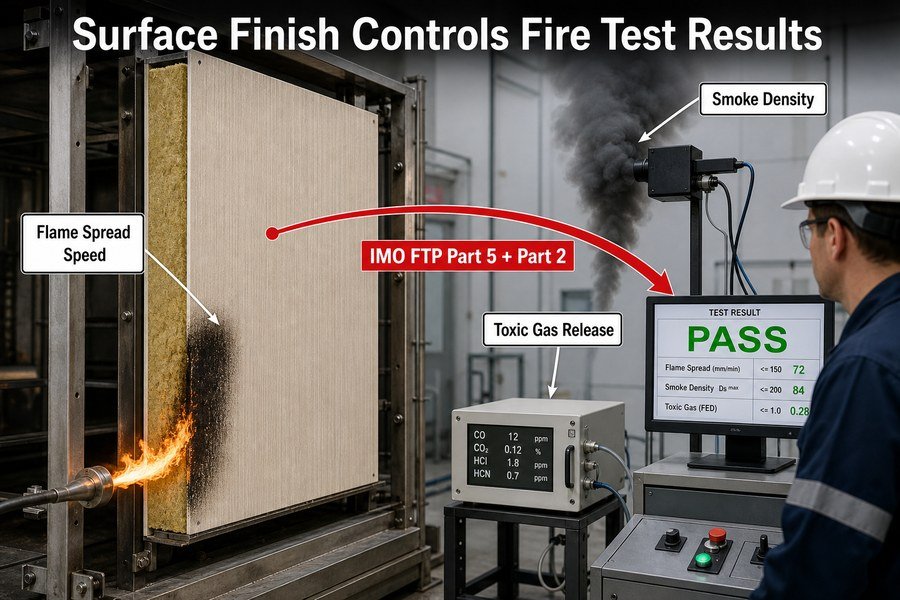
As a marine outfitting specialist, I often see buyers spend money on premium cores, only to fail certifications because of the surface finish. Let us look at how this happens and how you can avoid these costly mistakes.
Do Thicker Laminates Lower the Flame-Spread Rating of Marine Bulkheads?
Worried that thicker finishes will ruin your safety rating' Thick laminates often catch fire faster. I will show you the safe thickness limits for marine panels.
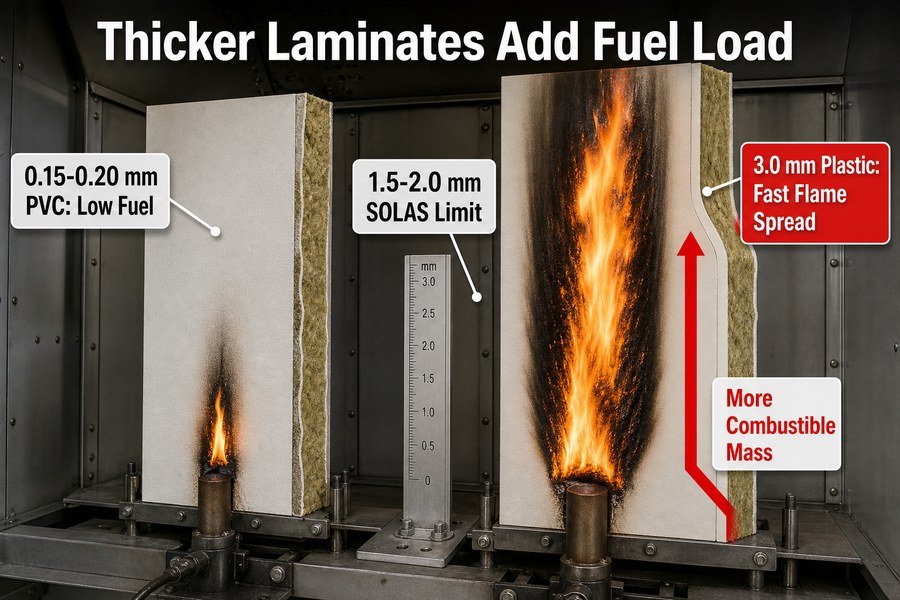
Yes, thicker laminates generally lower the flame-spread rating of marine bulkheads. According to SOLAS rules, combustible finishes must not exceed 2.0 mm in thickness for corridors and 1.5 mm for cabins, because added thickness increases the total fuel load and accelerates flame spread across the surface.
Understanding the Fuel Load of Thick Marine Laminates
Many buyers think a thicker finish means better quality. This is true for scratch resistance, but it is bad for fire safety. The flame-spread rating depends heavily on how much fuel the fire can burn. When you add a thicker combustible laminate to a marine bulkhead, you add more fuel.1 This causes the flame to spread faster across the wall panel.
The International Convention for the Safety of Life at Sea (SOLAS) Chapter II-2 has very clear rules about this. You must not use combustible finishes thicker than 2.0 mm for corridors, stairway enclosures, and control stations. For accommodation spaces like passenger cabins, the limit is 1.5 mm2. I always tell my clients to strictly follow these two limits. If you use a 3.0 mm plastic laminate, the fire will travel very quickly, and the panel will fail the safety test. You must control the fuel load to keep the flame-spread rating high.
Balancing Laminate Thickness and Marine Fire Safety
To pass the IMO FTP Code Part 5 test for low flame-spread, you must carefully balance the thickness. This test measures how fast a fire moves across your panel surface.3 Thicker PVC films or thick melamine laminates store more heat energy. When a fire starts, they release this energy quickly.
In my factory experience, we always keep the PVC film thickness around 0.15 mm to 0.20 mm. This thickness provides good color and texture but keeps the fuel load very low. If a client asks for a 1.2 mm thick Formica laminate, we must use a special fire-retardant grade. Otherwise, the thick material will catch fire and spread the flames too fast. By keeping the laminate thin, you limit the total combustible mass.
| Finish Material Type | Typical Thickness | Estimated Fuel Load Level | IMO Flame-Spread Test Result |
|---|---|---|---|
| Standard PVC Film | 0.15 mm | Very Low | Pass (Safe for Cabins & Corridors) |
| Fire-Retardant PVC | 0.60 mm | Low | Pass (Safe for Cabins & Corridors) |
| Standard Formica | 1.20 mm | High | Fail (Spreads flame too fast) |
| Heavy Plastic Laminate | 2.50 mm | Very High | Fail (Violates SOLAS 2.0 mm limit) |
How Does Marine Wall Panel Finish Affect Smoke Density in IMO Tests?
Failing the smoke density test' Dark, thick smoke traps passengers. Here is how your panel finish directly creates this smoke and how to control it.
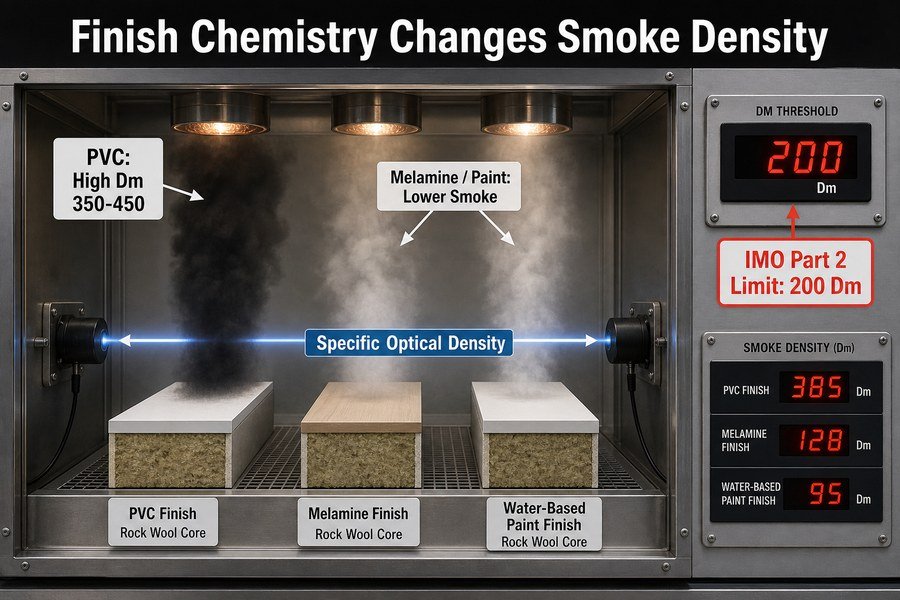
Marine wall panel finishes affect smoke density by reacting to heat and releasing particulate matter. Under IMO FTP Code Part 2, PVC finishes generate higher maximum specific optical density (Dm) values than melamine or painted finishes, requiring strict formulation control to stay below the 200 Dm safety limit.
The Role of Chemical Composition in Smoke Density Generation
When a fire happens on a ship, smoke is the biggest danger. The smoke comes directly from the surface finish reacting to heat. The heat burns the finish and releases particulate matter into the air. This matter blocks the light and makes it hard to see. Different materials react to heat in different ways.
According to the IMO FTP Code Part 2, we measure this using a value called maximum specific optical density (Dm). The safety limit for marine wall panels is a Dm of 200. Standard PVC finishes have a big problem here. PVC contains chemicals that create very thick, dark smoke when they burn. Because of this, standard PVC finishes often generate Dm values much higher than 2004. On the other hand, melamine finishes and water-based painted finishes produce much less particulate matter. They easily stay below the 200 Dm limit. You must use specially formulated fire-retardant PVC to pass this test.
How Heat Exposure Changes Surface Finish Smoke Output
The IMO smoke test uses two different heat conditions. It tests the panel in a flaming mode with an open fire, and a non-flaming mode using radiant heat. The radiant heat level is set at 25 kW/m². The surface finish must pass both conditions.
I have seen many cheap panels fail the non-flaming test. The radiant heat bakes the finish, and the finish slowly releases a huge amount of thick smoke. To fix this, you must control the chemical formulation of the finish. You need a finish that does not break down into heavy soot when exposed to high heat.
| Surface Finish Type | Reaction to Heat | Average Dm Value | IMO FTP Part 2 Compliance |
|---|---|---|---|
| Standard PVC Film | Heavy particulate matter | 350 - 450 | Fail (> 200 Dm limit) |
| Fire-Retardant PVC | Moderate particulate matter | 150 - 180 | Pass |
| Melamine Laminate | Light smoke | 80 - 120 | Pass |
| Water-Based Paint | Very light smoke | 40 - 70 | Pass |
Can a Non-Compliant Finish Fail an A-Class Marine Wall Panel?
Did your A-Class panel fail the lab test' The core might be perfect, but a bad finish will fail the whole system. Let us see why.
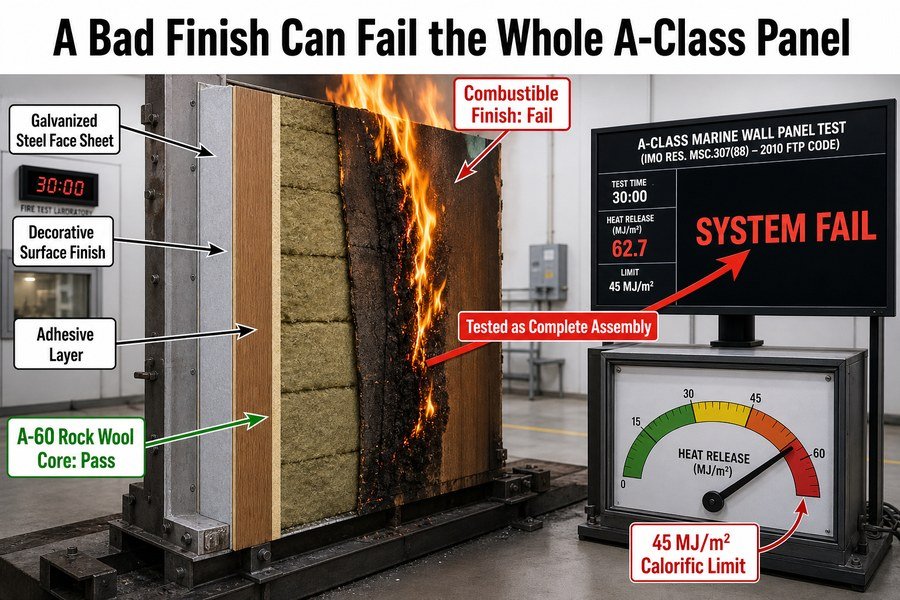
Yes, a non-compliant finish will fail an A-Class marine wall panel. Even if the rockwool core meets A-60 standards, a combustible surface finish that fails the IMO low flame-spread test or exceeds the maximum calorific value of 45 MJ/m² will result in a complete system certification failure.
Why A-Class Marine Panel Certification Relies on Surface Finishes
A marine wall panel is a complete system. It is not just one part. Many buyers buy a high-quality rockwool core that easily meets A-60 standards. They think the A-60 core guarantees a safe panel. But the certification body tests the entire panel, including the surface.5
If you put a non-compliant finish on a perfect core, the panel will fail the test. The finish must pass the IMO low flame-spread test (FTP Code Part 5). If the fire spreads too fast on the surface, the whole A-Class panel fails, even if the rockwool core stops the fire from going through the wall. This is a very common mistake. You must ensure every single layer of the panel passes the marine safety rules.
The 45 MJ/m² Calorific Value Limit for Marine Finishes
There is another strict rule you must know. SOLAS and the IMO FTP Code state that the combustible materials on the panel must have a maximum calorific value of 45 MJ/m². The calorific value measures how much total heat energy the finish and the glue will release when they burn.
If you use a thick plastic finish and a lot of chemical glue, the combined heat energy will easily exceed 45 MJ/m². When this happens, it does not matter how thick your rockwool core is. The system certification fails immediately. In my work, I calculate the calorific value of the steel sheet, the glue, and the PVC film together. We keep the total under 40 MJ/m² to ensure a safe pass.
| Panel Component | Status | Combined Calorific Value | System Certification Result |
|---|---|---|---|
| A-60 Core + Compliant PVC | Both Pass | 35 MJ/m² | Pass A-Class System |
| A-60 Core + Non-Compliant PVC | Core Pass, Finish Fails | 60 MJ/m² | Fail A-Class System |
| A-60 Core + Thick Glue Layer | Core Pass, Glue Fails | 50 MJ/m² | Fail A-Class System |
| A-60 Core + Painted Steel | Both Pass | 15 MJ/m² | Pass A-Class System |
Which Marine Interior Panel Finishes Release Toxic Gases During Fires?
Are your panels secretly toxic' Toxic gas causes more deaths than fire. Learn which finishes release deadly chemicals and how to select safe materials.
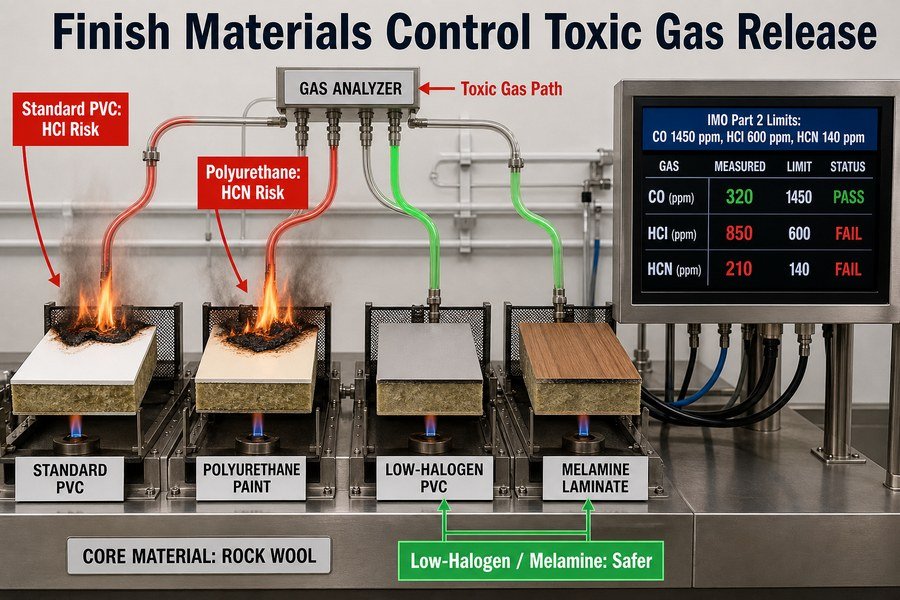
Marine interior panel finishes like standard PVC, halogenated plastics, and polyurethane paints release toxic gases during fires. Under IMO FTP Code Part 2, these materials can emit dangerous levels of Carbon Monoxide (CO), Hydrogen Chloride (HCl), and Hydrogen Cyanide (HCN), making low-halogen or melamine alternatives the safer choice.
Identifying Toxic Gas Emissions from PVC and Polyurethane Finishes
When interior panels burn, the fire is not the only danger. The gases released by the burning surface finish can kill people very quickly. Standard PVC is a very popular finish because it is cheap. However, standard PVC is a halogenated plastic. When halogenated plastics burn, they release Hydrogen Chloride (HCl) gas. This gas is highly toxic and burns the lungs.6
Polyurethane paints are also dangerous. When they burn, they can release Hydrogen Cyanide (HCN). Also, almost all combustible finishes release Carbon Monoxide (CO). The IMO FTP Code Part 2 sets strict limits for these toxic gases. The maximum limit for CO is 1450 ppm. The maximum limit for HCl is 600 ppm. The maximum limit for HCN is 140 ppm. Standard PVC and polyurethane paints often exceed these limits and fail the test.
Safer Alternative Finishes for Marine Interior Decoration
Because of these strict toxic gas limits, you must choose safer alternatives. I always advise my clients to stop using standard PVC for high-risk projects. Instead, you should use low-halogen PVC films. These special films are treated to release much less HCl when they burn.
Another excellent choice is melamine. Melamine alternatives do not contain halogens. When melamine burns, it releases very low levels of toxic gas, keeping well below the IMO limits. Using these safer materials protects the passengers and ensures you pass the mandatory certifications without any problems.
| Surface Finish Type | Released Toxic Gases | Typical Test Result vs IMO Limits | Safety Level |
|---|---|---|---|
| Standard PVC Film | CO, HCl | Exceeds 600 ppm HCl limit | Dangerous |
| Polyurethane Paint | CO, HCN | Exceeds 140 ppm HCN limit | Dangerous |
| Low-Halogen PVC | CO, minor HCl | Passes all IMO gas limits | Safe |
| Melamine Laminate | CO | Passes all IMO gas limits | Very Safe |
How to Design Beautiful Marine Walls Within Low Flame-Spread Limits?
Think safe panels must look ugly' Your clients want luxury, but inspectors want safety. Here is how to achieve beautiful designs without breaking fire rules.
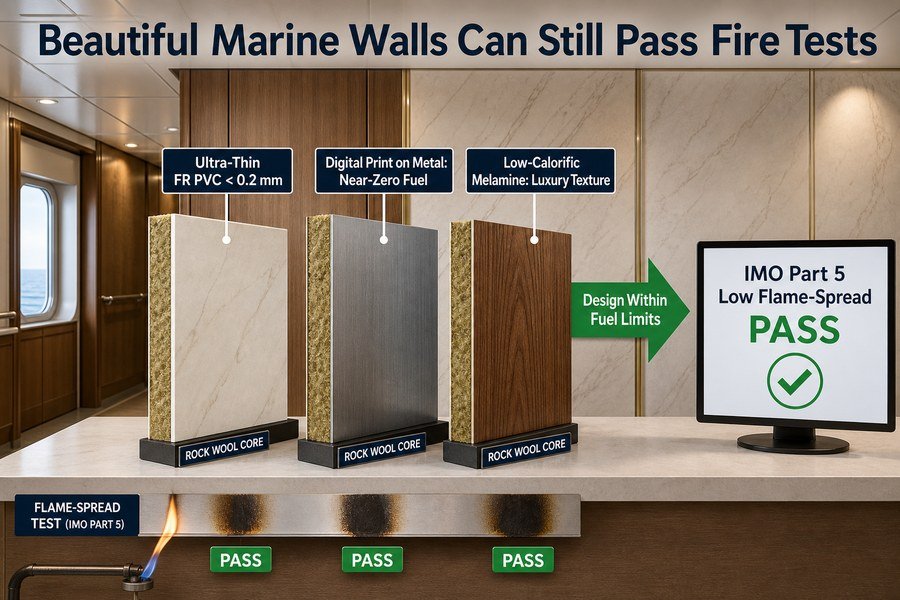
To design beautiful marine walls within low flame-spread limits, use ultra-thin fire-retardant PVC films under 0.2mm, apply direct digital printing on metal, or use low-calorific melamine laminates. These 3 methods provide wood or marble aesthetics while easily passing the strict IMO FTP Code Part 5 fire tests.
Method 1 and 2: Using Ultra-Thin Fire-Retardant PVC and Digital Printing
You do not have to choose between beauty and safety. You can have both if you use the right methods. The first method is using ultra-thin fire-retardant PVC films. These films are kept under 0.2 mm thick. Because they are so thin, they have a very low fuel load. We print beautiful wood grain or marble patterns on them. They look like high-end materials but easily pass the IMO FTP Code Part 5 test7. The cost is usually low, around $10 to $15 per square meter of panel.
The second method is direct digital printing on metal. This is a very new and smart technology. Instead of gluing a plastic film to the steel plate, we print the wood or stone image directly onto the galvanized steel. We cover it with a very thin clear coat. Because there is almost no plastic or glue, the total fuel load is basically zero. This method easily passes the lowest flame-spread limits.
Method 3: Utilizing Low-Calorific Melamine Laminates for Luxury Finishes
The third method is using low-calorific melamine laminates. Melamine is fantastic for luxury ship interiors. It gives a deep, rich texture that feels exactly like real wood. However, standard melamine can be too thick and have a high calorific value8.
To solve this, we use specially made low-calorific melamine laminates. These laminates are engineered to release very little heat energy when exposed to fire. They pass the IMO fire tests without any issues. They cost a bit more, usually adding $5 to $10 per square meter compared to thin PVC, but they offer the highest quality look for luxury cruise ships and high-end ferries. By using these 3 methods, you will always deliver beautiful and fully compliant marine interiors.
| Design Method | Visual Aesthetic Options | Fire Safety Compliance | Estimated Cost Impact |
|---|---|---|---|
| Ultra-thin PVC (< 0.2mm) | Wood grain, marble, solid colors | Passes IMO Part 5 | Low ($10-$15/sqm) |
| Digital Printing on Metal | Custom images, high-res stone | Passes IMO Part 5 (Zero fuel) | Medium ($18-$25/sqm) |
| Low-Calorific Melamine | Deep texture real wood feel | Passes IMO Part 5 | High ($20-$30/sqm) |
| Standard Thick PVC (> 0.5mm) | Deep texture | Fails IMO Part 5 | N/A (Cannot use) |
Conclusion
Surface finishes define marine panel fire safety. By controlling laminate thickness, choosing low-smoke materials, and following IMO limits, you can buy safe, beautiful panels and avoid costly certification failures.
-
"Flammability Hazard of Materials", https://tsapps.nist.gov/publication/get_pdf.cfm'pub_id=900091. Fire-safety literature on compartment fuel load and surface linings supports that increasing the mass of combustible finish material increases the available fuel and can affect heat release and flame spread under comparable exposure conditions. Evidence role: mechanism; source type: government. Supports: A thicker combustible laminate adds fuel load to a marine bulkhead and can worsen flame-spread behavior.. Scope note: This supports the general fire-dynamics mechanism, not the performance of every laminate formulation or marine panel assembly. ↩
-
"When Does a Ship Refurbishment Trigger SOLAS Marine Panel ...", https://magellanmarinetech.com/when-ship-refurbishment-trigger-solas-marine-panel-compliance/. SOLAS Chapter II-2 specifies a 1.5 mm maximum thickness for combustible veneers or finishes in relevant accommodation and service spaces where low-flame-spread surface requirements apply. Evidence role: definition; source type: institution. Supports: Accommodation spaces such as passenger cabins are subject to a 1.5 mm limit for combustible finishes under SOLAS fire-safety requirements.. Scope note: The cited rule establishes the regulatory limit, but compliance may also depend on the exact space classification, vessel category, and approved material assembly. ↩
-
"What Is the Purpose and Scope of the IMO FTP Code'", https://magellanmarinetech.com/what-purpose-scope-of-imo-ftp-code/. The IMO 2010 FTP Code, Part 5, defines the surface flammability test used for low-flame-spread bulkhead, ceiling, and deck finish materials and includes measured flame propagation and heat-release criteria for classification. Evidence role: definition; source type: institution. Supports: IMO FTP Code Part 5 evaluates low flame-spread behavior by measuring surface flammability characteristics of panel finish materials.. Scope note: The test method explains what is measured, but it does not prove that a particular laminate passes or fails unless that exact material assembly has been tested. ↩
-
"Toxicity of the Pyrolysis and Combustion Products of Poly(Vinyl ...", https://www.nist.gov/publications/toxicity-pyrolysis-and-combustion-products-polyvinyl-chlorides-literature-assessment. Fire-safety studies of polyvinyl chloride report that PVC can produce dense smoke and high optical smoke-density measurements during combustion or thermal decomposition, supporting the concern that unmodified PVC finishes may exceed stringent marine smoke limits. Evidence role: general_support; source type: paper. Supports: Standard PVC finishes can generate smoke densities above the Dm 200 limit unless formulated for fire-retardant, low-smoke performance.. Scope note: This evidence is material-level and contextual; actual Dm values depend on the PVC formulation, additives, substrate, thickness, and the specific IMO test conditions. ↩
-
"What Is the Purpose and Scope of the IMO FTP Code'", https://magellanmarinetech.com/what-purpose-scope-of-imo-ftp-code/. IMO fire-test procedures for A-class divisions and surface-flammability requirements treat the approved construction as an assembly and include exposed surface materials in the applicable test regime; this supports the need to assess the panel surface as part of compliance, although the precise approval workflow may vary by flag state or recognized organization. Evidence role: mechanism; source type: institution. Supports: A-Class marine panel certification depends on testing the complete panel assembly, including the surface finish.. Scope note: The source may establish the regulatory testing framework rather than documenting the internal procedures of every certification body. ↩
-
"Hydrogen chloride - NIOSH Pocket Guide to Chemical Hazards", https://www.cdc.gov/niosh/npg/npgd0332.html. Combustion and thermal decomposition studies of chlorinated polymers such as PVC identify hydrogen chloride as a principal acid gas product, and occupational health sources describe hydrogen chloride as a corrosive respiratory irritant capable of causing serious pulmonary injury after inhalation. Evidence role: mechanism; source type: research. Supports: Burning halogenated plastics such as PVC can release hydrogen chloride gas, which is hazardous to the respiratory tract.. Scope note: The quantity of HCl released depends on the polymer formulation, additives, fire temperature, ventilation, and test method. ↩
-
"What Is the IMO FTP Code for Marine Interior Materials'", https://magellanmarinetech.com/what-imo-ftp-code-for-marine-interior-materials/. The IMO 2010 FTP Code Part 5 specifies the surface flammability test method and acceptance criteria used for bulkhead, ceiling, and deck finish materials on ships, providing context for why decorative surface finishes must be evaluated under this standard. Evidence role: definition; source type: institution. Supports: Decorative marine interior surface finishes are evaluated against the IMO FTP Code Part 5 surface flammability test.. Scope note: The standard explains the test framework; it does not verify that the specific PVC products described in the article pass the test. ↩
-
"The Evaluation of Torrefied Wood Using a Cone Calorimeter - PMC", https://pmc.ncbi.nlm.nih.gov/articles/PMC8199449/. Studies of high-pressure laminates and melamine-based decorative laminates using calorimetry show that heat release and calorific value depend on resin, paper content, thickness, and flame-retardant formulation, supporting the need to distinguish standard laminates from low-calorific formulations. Evidence role: mechanism; source type: paper. Supports: Standard melamine laminates may present fire-performance concerns because laminate composition and thickness affect calorific value and heat release.. Scope note: The evidence would support the general material-performance issue, not the article’s implied conclusion that all standard melamine laminates are unsuitable or that all low-calorific versions pass IMO tests. ↩