Are you losing shipyard contracts because your marine panels fail noise tests? Poor acoustic documentation delays projects and costs money. Here is exactly what proves your panel's Sound Transmission Loss.
To verify Sound Transmission Loss (STL) claims, you need three complete documents: an ISO 10140-2 laboratory acoustic test report, a classification society Type Approval certificate, and a factory material declaration. Together, these documents prove the panel achieves the claimed Sound Reduction Index (Rw) across all required frequency bands.
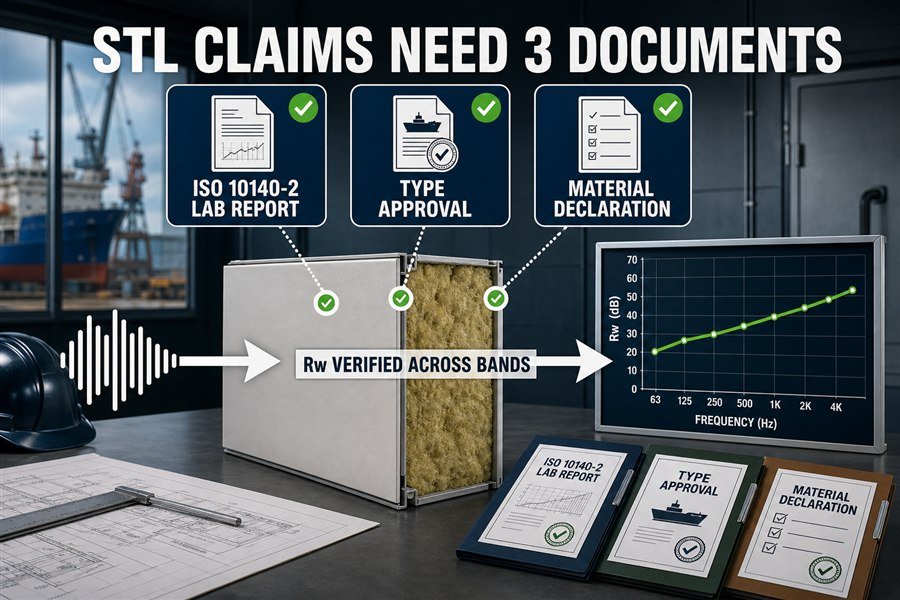
Navigating the sea of compliance papers is hard, but it is necessary to secure large interior decoration projects. Let me break down exactly what you must look for in these acoustic documents to keep your shipyard clients happy and your projects on track.
What Acoustic Documents Must a Marine Interior Panel Supplier Provide Before Ordering?
Do suppliers send you confusing product brochures instead of real proof? Guessing a panel's acoustic performance risks your whole project. Demand the right paperwork before you send any deposit.
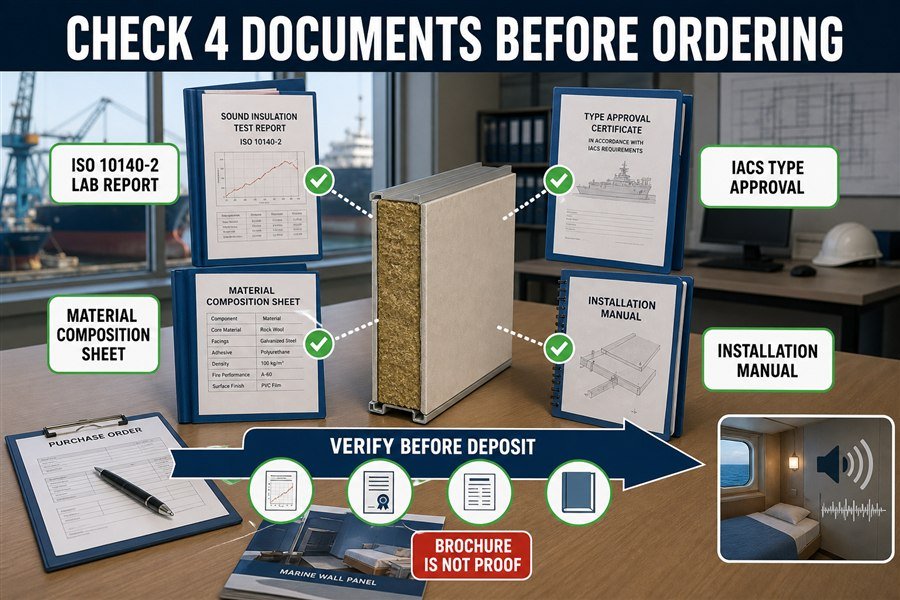
Before ordering, suppliers must provide four documents: an accredited independent lab test report (ISO 10140-2), a Type Approval Certificate from an IACS member, a detailed material composition sheet, and an installation manual. These four documents guarantee the panel meets shipyard noise reduction requirements.
Mandatory Independent Laboratory Acoustic Test Reports
As a marine outfitting specialist, I often see buyers accept factory-made datasheets. This is a big mistake. You must ask for a formal acoustic test report from an independent laboratory. The test must follow the ISO 10140-2 standard1. This standard dictates how labs measure airborne sound insulation. For example, a 50mm rockwool core marine wall panel usually achieves a Sound Reduction Index (Rw) of 30 dB to 44 dB. The report must show the exact testing frequency range, typically from 100 Hz to 3150 Hz. If the supplier only gives you a single number without the frequency curve, do not buy it. A real lab test costs the factory around $800 to $1,500. A good supplier in China or Vietnam will always have this ready to prove their quality.
IACS Type Approval Certificates and Technical Manuals
Next, you must check the Type Approval Certificate issued by a member of the International Association of Classification Societies (IACS), such as DNV, Lloyd's Register, or ABS. This certificate proves the panel is approved for marine use. But an acoustic rating is only valid if you install the panel correctly. Therefore, you also need the factory material composition sheet and the installation manual. If the manual requires a 2mm gap filled with acoustic sealant, you must do it. If you skip this, the actual sound transmission loss drops by 3 dB to 5 dB2 on the ship.
| Required Document | Issuing Authority | Key Value to Check | Why You Need It |
|---|---|---|---|
| Lab Test Report | ISO 17025 Accredited Lab | Rw value (e.g., 40 dB) | Proves actual sound insulation. |
| Type Approval | IACS Member (e.g., DNV, ABS) | Product limitations | Proves marine application safety. |
| Material Sheet | Panel Manufacturer | Density (e.g., 120 kg/m3) | Ensures material matches the test. |
| Installation Manual | Panel Manufacturer | Joint sealing methods | Ensures correct shipyard installation. |
How to Verify the Authenticity of a Marine Interior Panel Lab STL Report?
Have you ever worried that a supplier's test report is fake? Using a forged document will ruin your company's reputation with European shipyards. Here is how you verify it.
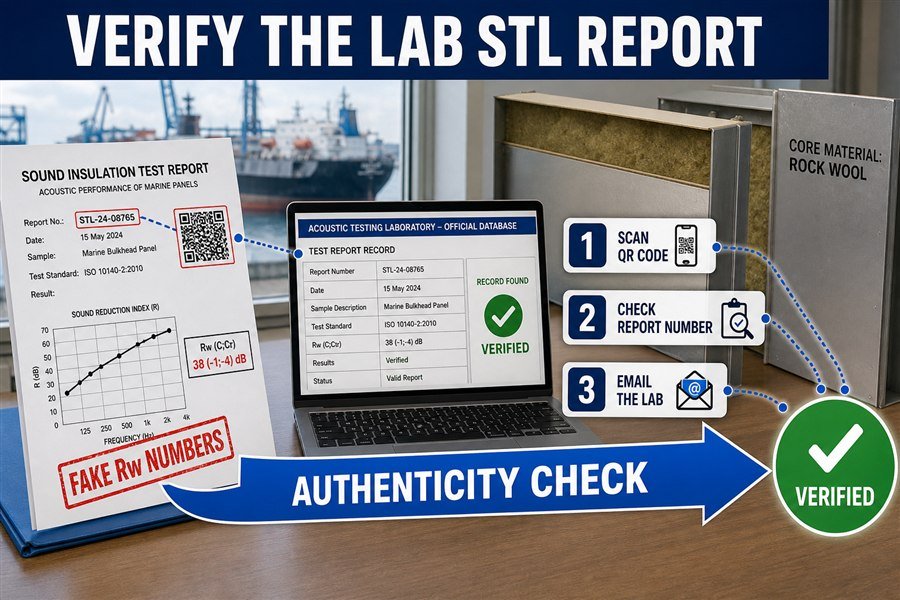
You can verify a lab report's authenticity through three steps: scanning the document's QR code, cross-referencing the report number on the issuing laboratory's official online database, and emailing the lab directly with the PDF attached. These three steps expose edited numbers or fake certificates immediately.
Step 1: Checking the Laboratory Accreditation and Online Database
I remember a time when a new supplier sent me a beautiful test report. The Rw value was an amazing 48 dB for a standard 25mm panel. I knew this was impossible. According to basic physics, a standard 25mm honeycomb panel usually sits around 25 dB to 28 dB3. I immediately checked the laboratory. Every real testing facility must have an ISO/IEC 17025 accreditation4. You can find this accreditation number on the front page. You must go to the national accreditation board website and type in that number. If the lab does not exist, the report is fake. Most modern reports from labs like Intertek or SGS also have a QR code. Scan it with your phone. It should take you directly to the lab's official website, showing the exact same report.
Step 2: Contacting the Lab to Confirm Report Details
Sometimes, bad suppliers take a real report and use PDF software to change the numbers. They might change a 35 dB result to a 45 dB result. To catch this, you must contact the lab directly. Find the lab's official email address on Google, not the email address printed on the report. Send them the PDF file. Ask them, "Can you confirm this report number 12345-A is genuine and unaltered?" Testing labs usually reply within 2 to 3 working days. I do this for every new supplier in developing countries. It costs you nothing but saves you from losing thousands of dollars on a rejected interior decoration project.
| Verification Method | Time Required | Reliability | Action to Take |
|---|---|---|---|
| QR Code Scan | 1 Minute | High | Compare digital file to PDF. |
| Online Database Check | 5 Minutes | Very High | Enter report ID on lab website. |
| Direct Email to Lab | 2-3 Days | 100% Accurate | Send PDF and ask for confirmation. |
| Check ISO 17025 Status | 5 Minutes | High | Verify lab is legally allowed to test. |
Which Fields on a Marine Interior Panel Acoustic Test Report Require Strict Scrutiny?
Are you just looking at the final acoustic rating and ignoring the rest? A high rating on a different panel setup is useless. You must check the specific test conditions.
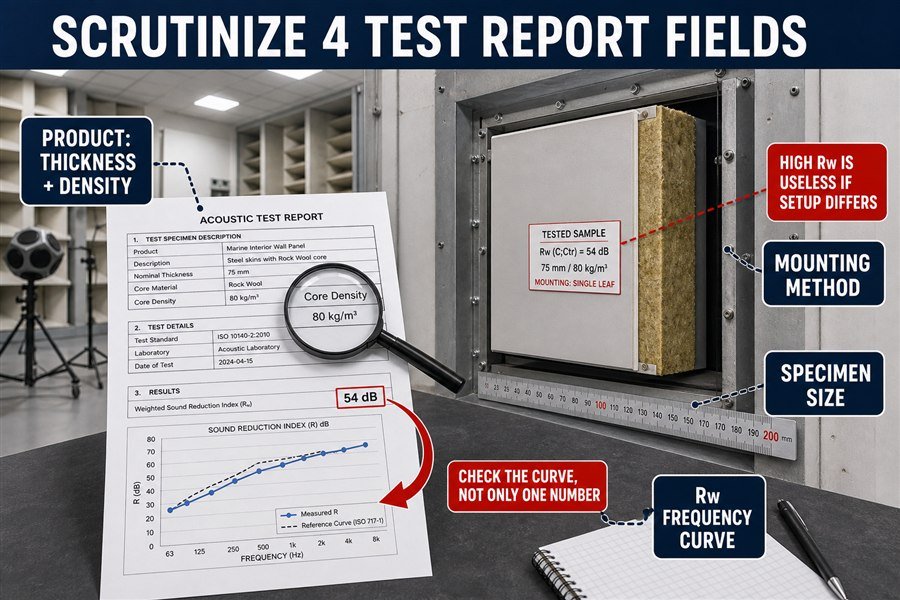
You must strictly scrutinize four fields: the exact product description (thickness and core density), the mounting method during the test, the test specimen size, and the Sound Reduction Index (Rw) frequency curve. These four fields ensure the tested panel exactly matches the product you are buying.
Scrutinizing the Panel Core Density and Physical Dimensions
When I review a test report for Magellan Marine, the first thing I look at is the exact product description. A factory might sell you a panel with a rockwool density of 100 kg/m3, but they tested a panel with a density of 150 kg/m3. The 150 kg/m3 panel will easily perform 2 dB to 4 dB better.5 The report must state the exact thickness, material, and density. For a standard marine fire door or wall panel, the test specimen size also matters. ISO 10140-2 requires a specific sample size, usually around 10 square meters for walls.6 If the test used a tiny 1 square meter sample, the acoustic data will not match the real-world performance on a large shipyard deck.
Evaluating the Mounting Method and Frequency Curve
The mounting method is the biggest trick in the industry. Some factories test their panels by sealing every single edge with heavy acoustic caulk and rubber blocks. But in your real interior decoration project, you use standard metal profiles. If the test mounting method does not match your shipyard installation method, the Rw value is useless.7 Finally, you must look at the frequency curve chart, not just the single Rw number. A panel might have an Rw of 40 dB, but it might fail completely at low frequencies like 100 Hz or 250 Hz. Ship engine noise is mostly low frequency.8 You need to read the table of values at each 1/3 octave band to make sure it blocks the specific noise your shipyard client cares about.
| Report Field | What to Look For | Why It Matters for Procurement |
|---|---|---|
| Core Density | Must match your order (e.g., 120 kg/m3). | Higher density gives fake better results. |
| Panel Thickness | Must match your order (e.g., 50mm). | Thicker panels block more noise. |
| Mounting Method | Must use standard marine profiles. | Heavy lab sealing does not match reality. |
| Frequency Curve | Good performance at 100 Hz - 250 Hz. | Engine noise requires low-frequency blocking. |
How to Spot a Marine Interior Panel Rw Copied from Another Product?
Is your supplier claiming high acoustic performance without their own data? Some factories simply copy Sound Reduction Index (Rw) numbers from larger competitors. This puts your shipyard project in danger.
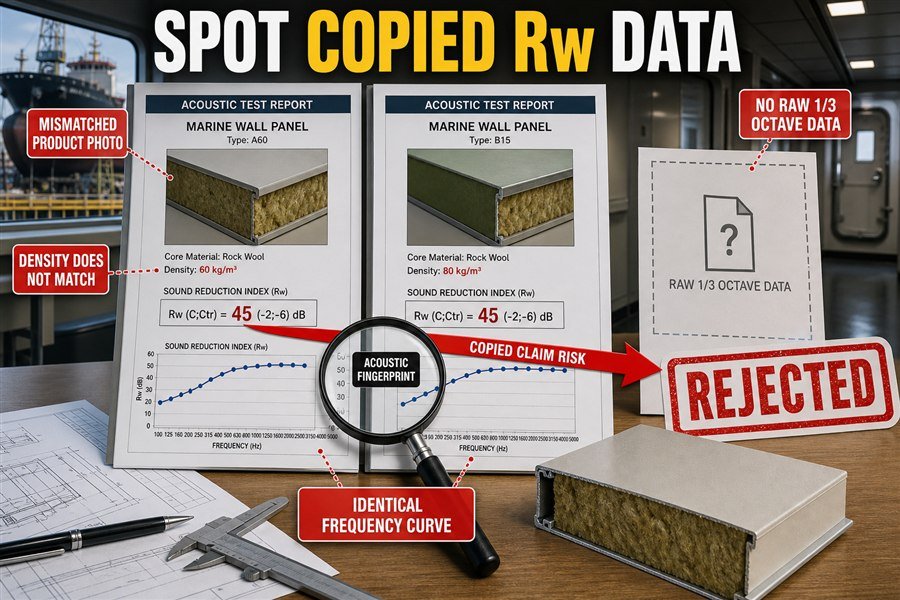
You can spot a copied Rw value by checking three things: mismatched product photos in the lab report, missing specific gravity or density values that match the supplier's actual datasheet, and identical frequency curve graphs that perfectly match a famous brand's technical manual. Copied data lacks specific testing details.
Identifying Mismatched Product Photos and Generic Data
In the ship interior outfitting business, I often see small factories try to save the $1,500 testing fee. They just look at a famous European brand, see an Rw of 42 dB, and print "Rw = 42 dB" on their own brochure. The easiest way to spot this is to look for the laboratory test photos. A real ISO 10140 lab report always includes photos of the specific panel being installed in the test chamber. If the supplier cannot provide a report with photos, or if the panel in the photo has a different surface finish than what they sell, they probably copied the number. You must also compare the test report's material density with the supplier's factory datasheet.9 If the factory sheet says the steel skin is 0.6mm, but the test report says 0.8mm, the data belongs to another product.
Analyzing Identical Frequency Curves and Missing Raw Data
Another clear sign of a copied Rw value is the frequency curve graph. Acoustic testing creates a very unique curve across 16 different frequency bands from 100 Hz to 3150 Hz10. It is like a fingerprint. If you compare a cheap supplier's graph with a premium brand's graph and the lines are 100% identical at every single frequency point, one of them copied the other. It is statistically impossible for two different factories to build a panel that performs exactly the same at 125 Hz, 250 Hz, and 500 Hz. Real acoustic testing also produces pages of raw data, showing reverberation times and background noise corrections11. A supplier who just copied an Rw number will only give you a one-page summary, because they do not have the raw data pages from the actual lab.
| Sign of Copied Data | How to Check | What It Means |
|---|---|---|
| No Lab Photos | Ask for the full 15-page test report. | Supplier did not actually test the panel. |
| Density Mismatch | Compare report density to factory datasheet. | Supplier is using another company's test. |
| Identical Curve | Compare graph to famous brand catalogs. | Supplier stole the acoustic fingerprint. |
| Missing Raw Data | Look for 1/3 octave band value tables. | Supplier only has a marketing summary. |
Why Do Shipyards Need Batch-Consistent Acoustic Documents for Marine Interior Panels?
Did your first panel order pass inspection, but the second batch failed? Inconsistent materials destroy noise reduction ratings. Shipyards demand batch-consistent documentation to ensure every single cabin stays quiet.
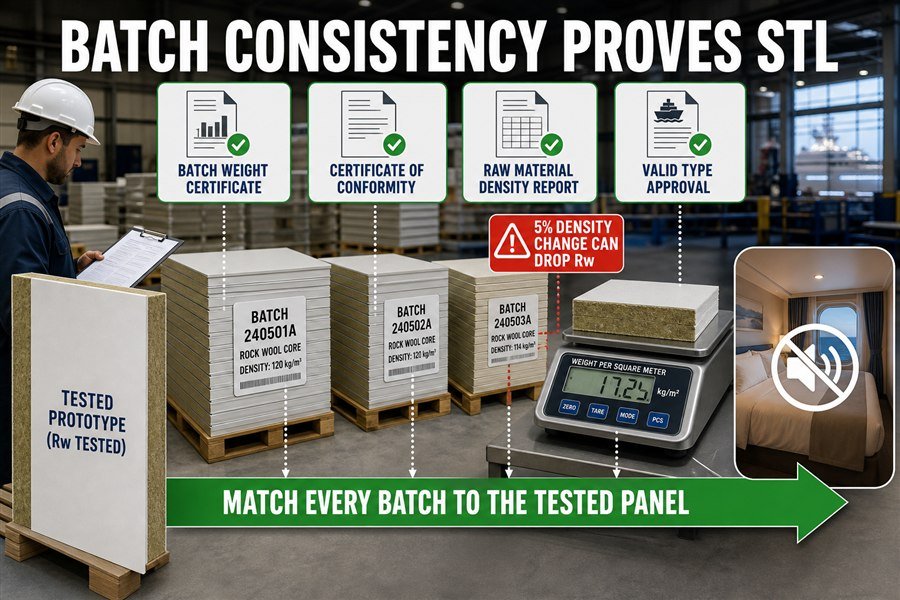
Shipyards need batch-consistent documents to ensure continuous quality control, comply with SOLAS noise regulations, and guarantee passenger comfort. Because a 5% change in core density drops the acoustic rating by 3 dB, shipyards require proof that every production batch matches the original tested prototype exactly.
Complying with SOLAS Noise Code Regulations
When you do interior decoration for large shipyards in Europe or the United States, you must follow the strict rules of the IMO noise code under SOLAS. The shipyard must prove to the owner that the cabins are quiet. For example, a passenger cabin must not exceed a noise limit of 55 dB(A). To achieve this, the shipyard relies on your marine wall panels and marine ceiling panels. If you buy a first batch of panels that provides 40 dB of sound reduction, the shipyard designs the rooms based on that number. If your second batch of panels is made with cheaper, lighter rockwool, the sound reduction might drop to 36 dB12. The cabin will fail the final noise test. This is why shipyards demand documents that prove consistency.
Guaranteeing Quality Control Through Batch Certificates
To prevent acoustic failures, shipyards require batch-consistent acoustic documents. This means the factory cannot just test one perfect panel in 2020 and sell you different panels for the next six years. They must provide a Factory Acceptance Test (FAT) or a Certificate of Conformity (CoC) for your specific order batch. This document must state the measured weight and density of the panels currently sitting on the shipping pallets. A good marine outfitting supplier will weigh a random sample from your batch. If a standard 50mm panel should weigh 18.5 kg per square meter, and the batch sample weighs 18.4 kg, it proves the acoustic mass is consistent. You must send these batch weight records and material certificates to the shipyard to prove the acoustic performance has not changed.
| Reason for Batch Consistency | Consequence of Inconsistency | Document Required |
|---|---|---|
| SOLAS Noise Compliance | Ship fails final inspection. | Valid Type Approval. |
| Maintain Acoustic Mass | Rw drops by 3 to 5 dB. | Batch Weight Certificate. |
| Quality Control | You lose the decoration contract. | Certificate of Conformity (CoC). |
| Passenger Comfort | Poor reviews for cruise ships. | Raw Material Density Report. |
What Acoustic Traceability Records Complete a Marine Interior Panel Compliance File?
Is your compliance file missing crucial documents? A simple test report is never enough for final handover. You need a full chain of acoustic traceability to get paid by shipyards.
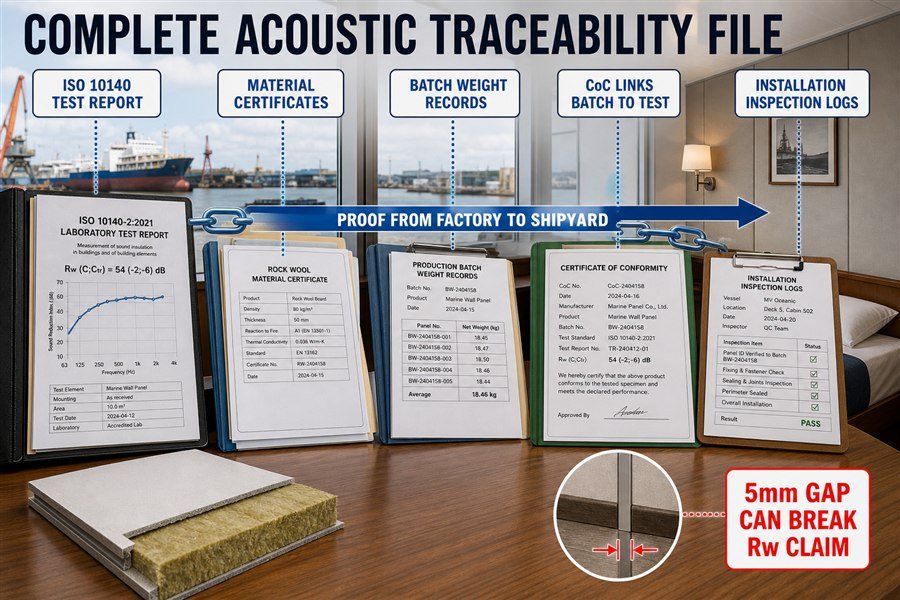
A complete acoustic traceability file requires five records: the original ISO 10140 laboratory test report, raw material purchase certificates, production batch weight records, the Certificate of Conformity (CoC), and the final installation inspection logs. These five records provide full proof from factory production to final shipyard installation.
Gathering Raw Material and Production Records
To build a solid compliance file, you must track the product from the very beginning. As a procurement officer, you need to ask your supplier in China or Vietnam for the raw material purchase certificates. If the acoustic test used a specific brand of 120 kg/m3 ceramic fiber, the factory must show the purchase invoice for that exact material for your batch. Next, you need the production batch weight records. Mass law states that heavier panels block more sound.13 The factory quality team must record the weight of at least 5 panels per 100 panels produced. This production log proves the factory did not secretly make the steel skins thinner or use a cheaper, lighter core material to save money.
Finalizing the Certificate of Conformity and Installation Logs
The last part of the traceability file connects the factory to the shipyard. The factory must issue a Certificate of Conformity (CoC)14 that links your specific invoice number to the original ISO 10140 acoustic test report15. This piece of paper legally binds the factory to the performance claim. Finally, because you are doing the interior decoration, you must provide the installation inspection logs. Even a panel with a 45 dB Rw rating will fail if you leave a 5mm gap at the floor.16 Your site team must fill out a log showing they used the correct acoustic sealants and marine profiles as required by the factory manual. When you combine the factory CoC with your installation logs, you give the shipyard a complete, undeniable acoustic compliance file.
| Traceability Record | Who Provides It | Purpose in the Compliance File |
|---|---|---|
| ISO Lab Test Report | Panel Supplier | Sets the baseline acoustic Rw value. |
| Material Certificates | Panel Supplier | Proves the correct core was used. |
| Batch Weight Records | Panel Supplier | Proves the acoustic mass is correct. |
| Certificate of Conformity | Panel Supplier | Legally links your batch to the lab test. |
| Installation Inspection Log | Your Decoration Team | Proves gaps were sealed correctly on site. |
Conclusion
Securing accurate acoustic documentation from suppliers protects your shipyard contracts. By strictly verifying lab reports, batch records, and physical densities, you ensure top-quality marine interior outfitting for every project.
-
"Sound insulation dataset of 30 wooden and 8 concrete floors ...", https://pmc.ncbi.nlm.nih.gov/articles/PMC10365936/. ISO 10140-2 specifies laboratory procedures for measuring airborne sound insulation of building elements under controlled conditions, supporting the statement that the cited standard governs this type of acoustic test. Evidence role: definition; source type: institution. Supports: The ISO 10140-2 standard dictates how laboratories measure airborne sound insulation.. Scope note: The standard’s scope supports the testing method, but not the article’s broader purchasing advice. ↩
-
"[PDF] Acoustical and thermal performance of exterior residential walls ...", https://nvlpubs.nist.gov/nistpubs/Legacy/BSS/nbsbuildingscience77.pdf. Acoustics research on sound insulation and leakage shows that gaps, joints, and poor sealing can reduce the measured sound transmission loss of partition assemblies; this supports the installation-sensitivity mechanism, although it may not directly establish the exact 3–5 dB reduction for this marine panel system. Evidence role: mechanism; source type: paper. Supports: Skipping the specified acoustic sealant gap can reduce the actual sound transmission loss on the ship by 3 dB to 5 dB.. Scope note: Support is likely contextual unless a study tests the same panel type, joint detail, and shipboard installation conditions. ↩
-
"[PDF] optimizing sandwich panels with graded tubular cell core for ... - arXiv", https://arxiv.org/pdf/2401.11412. Published acoustics research on honeycomb sandwich panels reports sound-transmission behavior governed by panel construction, mass, stiffness, and frequency range, providing contextual support that unusually high single-number ratings for thin lightweight panels require scrutiny. Evidence role: general_support; source type: paper. Supports: A standard 25 mm honeycomb panel usually has an Rw value around 25 dB to 28 dB, making a reported 48 dB result suspect.. Scope note: A source may support typical ranges only for specific materials, test methods, and panel constructions; it may not directly prove the exact 25–28 dB range for every 25 mm honeycomb panel. ↩
-
"National Voluntary Laboratory Accreditation Program (NVLAP)", https://www-s.nist.gov/niws/index.cfm?event=directory.search. ISO/IEC 17025 is the international standard specifying general requirements for the competence, impartiality, and consistent operation of testing and calibration laboratories, and accreditation bodies commonly publish searchable scopes of accredited laboratories. Evidence role: definition; source type: institution. Supports: Real or credible testing laboratories should have verifiable ISO/IEC 17025 accreditation for the relevant testing scope.. Scope note: This supports ISO/IEC 17025 as a recognized competence framework for accredited laboratories, but it does not establish that every legitimate testing facility in every jurisdiction must hold accreditation. ↩
-
"Airborne sound insulation performance of lightweight double ...", https://pmc.ncbi.nlm.nih.gov/articles/PMC11666719/. Research on porous and mineral-fiber building elements reports that changes in material density can alter sound transmission loss, supporting the premise that a denser tested core may not be acoustically equivalent to a lower-density ordered core. Evidence role: mechanism; source type: paper. Supports: A higher-density rockwool panel may achieve better acoustic test results than a lower-density panel of otherwise similar construction.. Scope note: The cited source may support the direction of the effect rather than the exact 2–4 dB improvement for this specific marine panel construction. ↩
-
"Sound insulation dataset of 30 wooden and 8 concrete floors ...", https://pmc.ncbi.nlm.nih.gov/articles/PMC10365936/. ISO 10140-2 and related laboratory acoustic-testing guidance specify controlled laboratory arrangements for measuring airborne sound insulation of building elements, including requirements for test openings and specimen installation. Evidence role: definition; source type: institution. Supports: ISO 10140-2 laboratory sound-insulation testing uses prescribed specimen and test-opening conditions rather than arbitrary small samples.. Scope note: Public summaries may confirm the scope of the standard but may not reproduce the exact specimen dimensions; the precise area should be verified from the purchased ISO standard or an accredited-laboratory guide quoting it. ↩
-
"Sound insulation dataset of 30 wooden and 8 concrete floors ...", https://pmc.ncbi.nlm.nih.gov/articles/PMC10365936/. Laboratory sound-insulation standards and acoustic studies emphasize that specimen mounting, edge conditions, and installation details affect measured airborne sound reduction, so reported Rw values are installation-dependent. Evidence role: mechanism; source type: paper. Supports: Differences between laboratory mounting and real installation can make an Rw rating poorly representative of field performance.. Scope note: Such evidence supports the need to compare mounting conditions, but the term “useless” is stronger than the technical literature usually states. ↩
-
"[PDF] Vessel-Generated Underwater Radiated Noise Comparison Study ...", https://www.maritime.dot.gov/sites/marad.dot.gov/files/2024-11/NCE%20REPORT%202024-079%20MARAD%20Vessel-Generated%20Underwater%20Radiated%20Noise%20Comparison%20Study%20%28Tugs%29%20Rev%200.pdf. Maritime-noise research characterizes ship machinery and propulsion noise as having substantial low-frequency components, providing context for evaluating insulation performance at octave or one-third-octave bands such as 100–250 Hz. Evidence role: general_support; source type: research. Supports: Ship engine or machinery noise commonly contains significant low-frequency energy.. Scope note: Frequency content varies with vessel type, engine speed, propulsion system, and measurement location, so the source supports a general pattern rather than every shipboard case. ↩
-
"Airborne sound insulation performance of lightweight double ...", https://pmc.ncbi.nlm.nih.gov/articles/PMC11666719/. Acoustic literature on the mass law of sound insulation shows that the surface mass or density of a panel is a material parameter that affects airborne sound reduction, making density consistency relevant when comparing a tested specimen with a marketed product. Evidence role: mechanism; source type: paper. Supports: Comparing the density in a test report with the supplier’s datasheet is a meaningful way to check whether the tested specimen matches the sold product.. Scope note: Mass law provides contextual support for checking density; it does not by itself prove that any specific supplier copied another product’s test data. ↩
-
"Understanding Correction Terms (like Ctr, C, etc) in ...", https://ateliercrescendo.ac/understanding-correction-terms-like-ctr-c-etc-in-building-acoustics/. ISO 717-1 describes single-number ratings for airborne sound insulation using one-third-octave-band sound reduction data over the reference range from 100 Hz to 3150 Hz. Evidence role: definition; source type: institution. Supports: Rw evaluation is based on frequency-band acoustic data from 100 Hz to 3150 Hz.. Scope note: This supports the frequency-band basis for Rw evaluation, not the article’s broader claim that each curve is uniquely identifying like a fingerprint. ↩
-
"Evaluated Uncertainties for Measurements of Airborne ...", https://www.academia.edu/136885185/Evaluated_Uncertainties_for_Measurements_of_Airborne_Sound_Attenuation_between_Rooms_in_Buildings. ISO 10140 laboratory methods for airborne sound insulation measurements include procedures involving source-room and receiving-room measurements, background-noise correction, and reverberation-time measurement for calculating sound reduction indices. Evidence role: mechanism; source type: institution. Supports: Real acoustic testing generates underlying measurement data such as reverberation-time values and background-noise corrections.. Scope note: This supports that such measurement data are part of the testing method; it does not establish that every customer-facing report must disclose all raw calculation pages. ↩
-
"Airborne sound insulation performance of lightweight double ...", https://pmc.ncbi.nlm.nih.gov/articles/PMC11666719/. Acoustics literature on airborne sound insulation shows that panel mass, density, and layer construction are key determinants of transmission loss, so changes to mineral-wool or panel composition can change measured Rw values. Evidence role: mechanism; source type: paper. Supports: Using lighter or materially different infill in marine panels can reduce the panels’ sound-reduction performance.. Scope note: General acoustic principles support the direction of risk, but a drop from 40 dB to 36 dB would require test data for the specific panel assembly. ↩
-
"[PDF] Ultrasonic, Normal-Incidence Insertion Loss through Common ...", https://physics.byu.edu/docs/thesis/269. A standard acoustics source should support that, for limp or single-leaf barriers under idealized conditions, transmission loss generally increases with surface mass according to the mass law. Evidence role: mechanism; source type: education. Supports: Mass law states that heavier panels block more sound.. Scope note: The mass law is an idealized acoustic model and does not by itself prove the performance of a specific composite marine panel, especially near resonances or where flanking paths exist. ↩
-
"[PDF] ABC's of Conformity Assessment - NIST Technical Series Publications", https://nvlpubs.nist.gov/nistpubs/SpecialPublications/NIST.SP.2000-01.pdf. A conformity-assessment source should support that a certificate or declaration of conformity is used to identify a product and attest that it conforms to specified standards or test criteria. Evidence role: definition; source type: institution. Supports: A Certificate of Conformity can link a supplied product or batch to stated compliance criteria such as an acoustic test report.. Scope note: The legal effect of a CoC depends on the governing contract, jurisdiction, and certification scheme; a general source cannot prove enforceability for a particular supplier transaction. ↩
-
"Sound insulation dataset of 30 wooden and 8 concrete floors ...", https://pmc.ncbi.nlm.nih.gov/articles/PMC10365936/. The cited standard should establish that ISO 10140 specifies laboratory methods for measuring the sound insulation of building elements and can provide a reported basis for airborne sound insulation performance. Evidence role: definition; source type: institution. Supports: An ISO 10140 acoustic test report can serve as the baseline laboratory evidence for the acoustic Rw value of the panel.. Scope note: ISO 10140 defines laboratory measurement procedures; it does not automatically verify that a production batch or installation matches the tested specimen. ↩
-
"[PDF] HIGH-FREQUENCY SOUND ABSORPTION CHARACTERIZATION ...", https://hammer.purdue.edu/articles/thesis/High-Frequency_Sound_Absorption_Characterization_of_Mock_Energetic_Materials/14842254/1/files/30718358.pdf. A building-acoustics reference should support that small unsealed openings and flanking paths can substantially reduce the effective sound insulation of an otherwise high-rated partition. Evidence role: mechanism; source type: research. Supports: Unsealed gaps can cause an installed acoustic panel to underperform despite a high laboratory Rw rating.. Scope note: The source may support the general effect of gaps on sound insulation rather than the exact numerical example of a 45 dB Rw panel with a 5 mm floor gap. ↩