
Ship noise ruins passenger sleep and causes failed shipyard inspections. I have seen buyers lose thousands replacing wrong panels. This guide shows you how to choose right.
Cabin noise limits dictate that bulkhead and ceiling panels must collectively achieve a specific sound reduction index (Rw). The total acoustic strategy relies on three main factors: IMO regulatory limits (like 55 dB for crew), source noise location (adjacent rooms vs. overhead decks), and combined material sound-blocking properties.
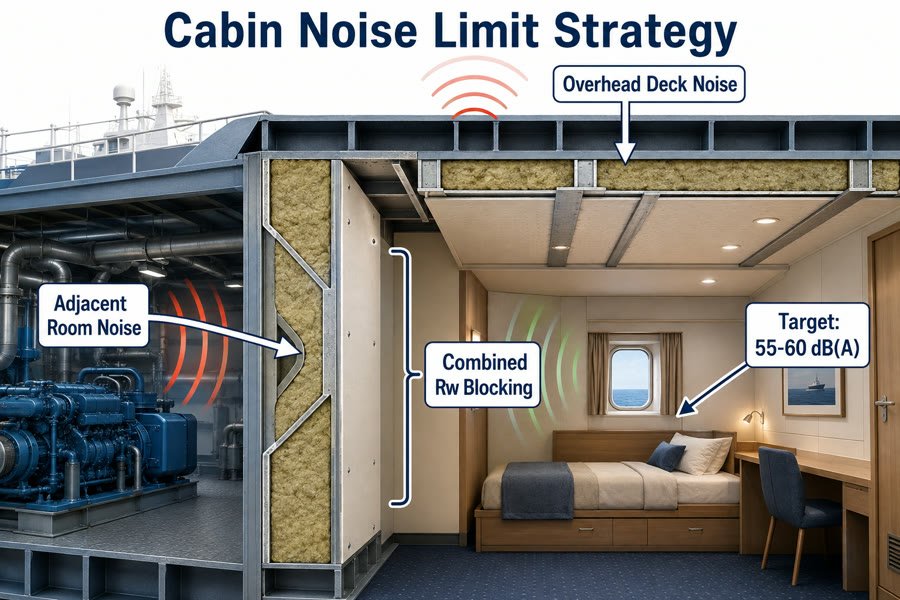
When you buy interior materials in Asia for European shipyards, you need to know exactly how cabin noise limits shape your choices. This helps you save costs, control your budget, and pass the strict tests. Let us break down the rules.
How Do Cabin Noise Limits Affect Marine Bulkhead Panel Acoustic Selection?
Are engine vibrations bleeding through your cabin walls? Picking the wrong bulkhead panel guarantees failed sea trials. I will show you how to block noise dead.
Cabin noise limits directly determine a bulkhead panel's required Sound Reduction Index (Rw), typically ranging from 30 dB to 45 dB. Selection depends on three rules: the IMO MSC.337(91) target limit, the noise level of the adjacent space, and the panel's internal rockwool density and steel sheet thickness.
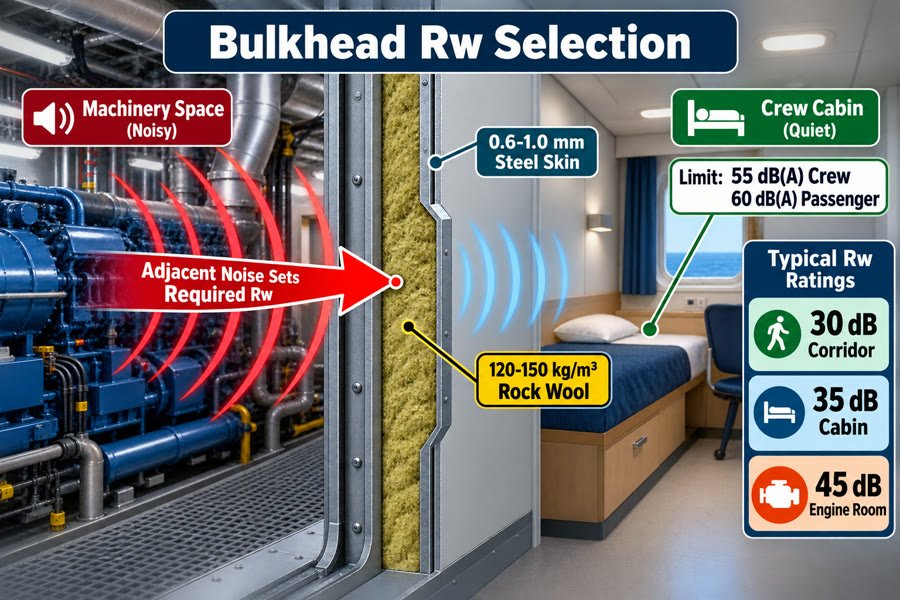
I started out cutting rockwool in the factory, so I know exactly how panel structure changes sound. When you buy panels for a quiet cabin, you must look at the three specific rules I just mentioned. First, the IMO MSC.337(91) target limit sets your baseline. The IMO Code on noise levels says crew cabins must not exceed 55 dB(A) and passenger cabins must stay under 60 dB(A). You must memorize this target before you buy anything.
Evaluating the IMO MSC.337(91) Target Limit and Adjacent Space Noise
Second, you must check the noise level of the adjacent space. You cannot use the same bulkhead panel for every wall. If a passenger cabin with a 60 dB target is next to a loud machinery room producing 100 dB, your bulkhead must block at least 40 dB. If the cabin is next to a quiet corridor producing 65 dB, a standard 30 dB panel is more than enough. Using a heavy panel for a quiet wall wastes your budget. I always tell my clients to map the loud rooms first before they negotiate prices with me.
Choosing Bulkhead Panel Rockwool Density and Steel Thickness
Third, you meet these dB targets by changing the panel's internal rockwool density and steel sheet thickness1. A standard 50mm marine bulkhead panel uses 120 kg/m³ rockwool and a 0.6mm galvanized steel skin. This gives an Rw of about 30 dB2. To block 45 dB, you need a 100mm panel with 150 kg/m³ rockwool, a 1.0mm steel skin, and a central air gap. This changes your price a lot. A standard 50mm panel costs about $18 per square meter in China. A high-acoustic 45 dB double-skin panel costs $35 to $45 per square meter.
| Bulkhead Panel Type | Rockwool Density | Steel Thickness | Acoustic Rating (Rw) | Estimated Cost (per m²) | Best Use Location |
|---|---|---|---|---|---|
| Standard 50mm Panel | 120 kg/m³ | 0.6mm | ~30 dB | $18 - $22 | Cabin to Corridor |
| High-Acoustic 50mm | 150 kg/m³ | 0.8mm | ~35 dB | $26 - $30 | Cabin to Cabin |
| Double Skin 100mm | 150 kg/m³ | 1.0mm | ~45 dB | $35 - $45 | Cabin to Engine Room |
How Do Cabin Noise Targets Influence Marine Ceiling Panel Acoustic Requirements?
Footsteps from the deck above can ruin a luxury cruise. Weak ceiling panels cause major noise complaints. I will explain how to stop overhead sound completely.
Cabin noise targets dictate ceiling panel requirements by mandating impact noise isolation and airborne sound absorption. You must evaluate two main aspects: the acoustic transmission loss (ranging from 25 dB to 40 dB) and the ceiling's suspension system type, which prevents structure-borne vibrations from entering the room.
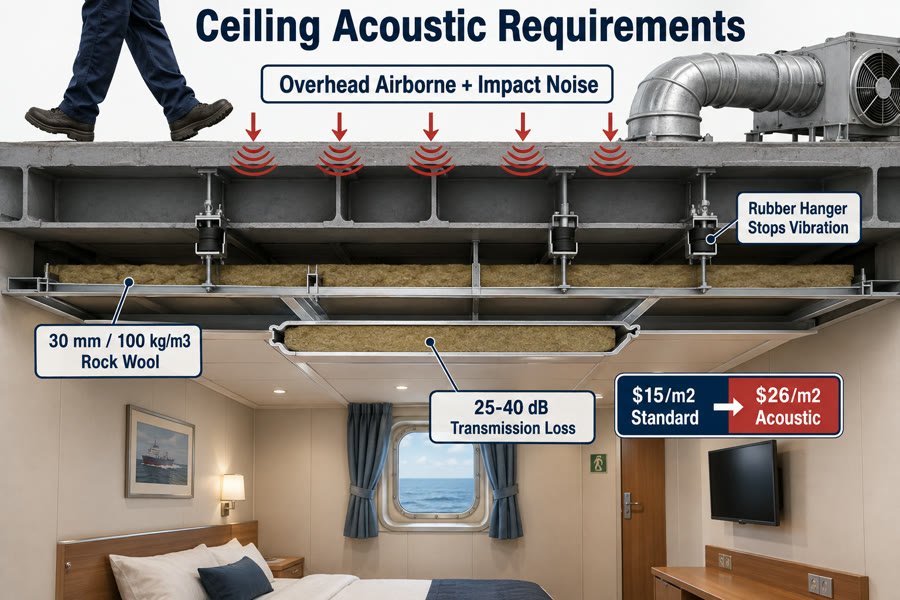
Ceiling panels have a different job than bulkhead panels. I remember fixing a project where a buyer bought expensive 45 dB bulkheads but used cheap ceilings. The cabin failed the test because noise came from the deck above. To fix this, you must look at the two main aspects from my summary.
Determining Acoustic Transmission Loss in Marine Ceiling Panels
The first aspect is the acoustic transmission loss. Airborne sound from upper decks, like exhaust pipes or ventilation fans, hits the ceiling first. A standard 25mm PVC-coated steel ceiling panel provides about 25 dB of sound reduction3. If your target limit is 55 dB and the deck above makes 85 dB of noise, a 25 dB panel fails. You need a 35 dB to 40 dB ceiling panel. We achieve this by adding a 30mm thick layer of 100 kg/m³ acoustic rockwool glued to the back of the metal ceiling pan. This upgrades the price from $15 per square meter to about $26 per square meter, but it stops airborne sound.
Selecting the Right Ceiling Suspension System Type
The second aspect is the ceiling's suspension system type. The steel structure of the ship carries vibration easily. If you bolt the ceiling grid directly to the steel deck, the vibration turns into noise inside the cabin. You must use anti-vibration hangers. A standard rigid steel hanger costs $0.50 each, but it transmits noise directly. A rubber acoustic hanger costs $2.50 each, but it stops structure-borne noise completely. You need both good panels and good rubber hangers to pass the test.
| Ceiling Component | Standard Option | Cost | High-Acoustic Option | Cost | Noise Stopped |
|---|---|---|---|---|---|
| Metal Panel | 25mm thick, hollow | $15/m² | 25mm panel + 30mm rockwool | $26/m² | Airborne Noise |
| Hanger System | Rigid steel bracket | $0.50/pc | Rubber anti-vibration hanger | $2.50/pc | Structure-borne Noise |
| Edge Trim | Direct metal contact | $2/m | Foam acoustic tape edge | $4/m | Flanking Noise |
Why Must Both Marine Bulkhead and Ceiling Panels Meet the Cabin's Noise Limit?
Sound acts like water leaking through the weakest point. Buying one great panel and one bad panel wastes money completely. I will explain why combined performance matters.
Both bulkhead and ceiling panels must meet the noise limit to prevent "flanking transmission," where sound bypasses a heavy wall through a weak ceiling. You must manage two critical noise pathways: the direct path through the shared partition, and the indirect path traveling through structural joints and gaps.
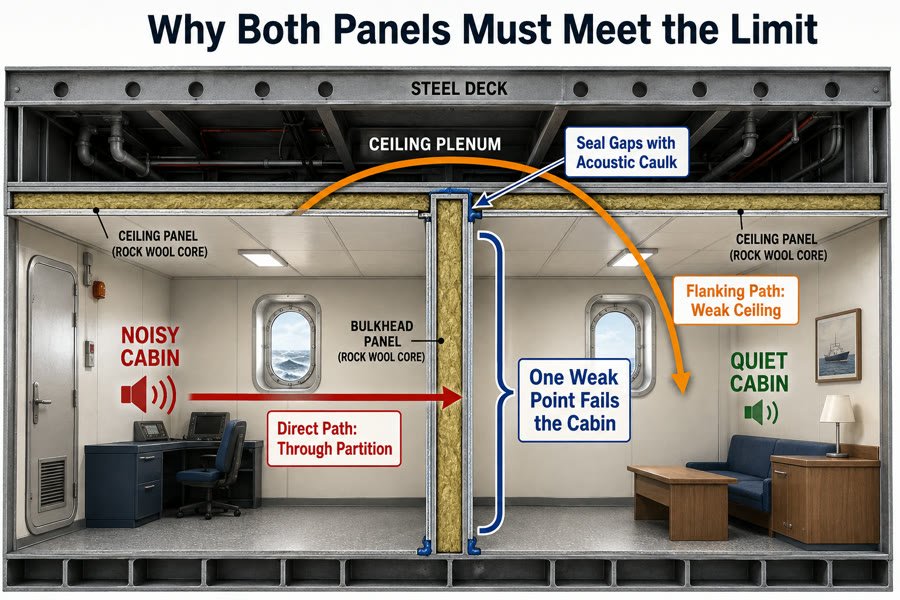
I often see buyers spend heavily on thick bulkheads to block engine noise but forget the ceiling entirely. This leads to failure. Both parts must work together. To understand why this happens, you must understand the two critical noise pathways I just mentioned: the direct path and the indirect path.
The direct path is simple. This is when sound goes straight through the bulkhead from the next room, or straight through the ceiling from the deck above. If you have a 60 dB target in a passenger room, and a 95 dB engine room next door, you install a 40 dB bulkhead. The direct path is blocked because 95 minus 40 equals 55 dB, which passes the 60 dB rule. But what if the ceiling above the bulkhead is only rated for 20 dB? The sound will find another way.
Stopping the Indirect Path Through Structural Joints and Gaps
This brings us to the indirect path, also called flanking transmission4. Sound will travel up the steel deck, travel over the top of the 40 dB bulkhead, and come down through the weak 20 dB ceiling panel. All that money spent on the expensive bulkhead is wasted. To stop the indirect path, you must seal structural joints. You must use acoustic caulking at the edges where the ceiling meets the bulkhead. A standard tube of marine fire-sealant costs about $6, while acoustic-rated sealant costs $12 per tube. You must use strong ceilings, strong bulkheads, and acoustic sealants to stop both pathways.
| Noise Pathway | How Sound Travels | The Weak Point | The Required Solution |
|---|---|---|---|
| Direct Path | Straight through the wall | Thin rockwool core | Increase panel Rw rating |
| Indirect Path (Flanking) | Over the wall, through ceiling | Empty space above ceiling | Upgrade ceiling Rw rating |
| Structural Path | Through metal joints | Hard metal connections | Use acoustic sealants |
How to Balance Marine Bulkhead and Ceiling Acoustic Ratings for One Cabin Target?
Buying maximum acoustic ratings for every surface destroys your budget. You need a smart balance to pass inspections while keeping costs low. I will show you the exact math.
You balance acoustic ratings by matching material investments to the loudest adjacent noise source. This requires three steps: mapping the highest noise risk (sides vs. above), calculating the required acoustic deficit, and selecting asymmetric panel ratings (e.g., a 45 dB ceiling with a 30 dB bulkhead).
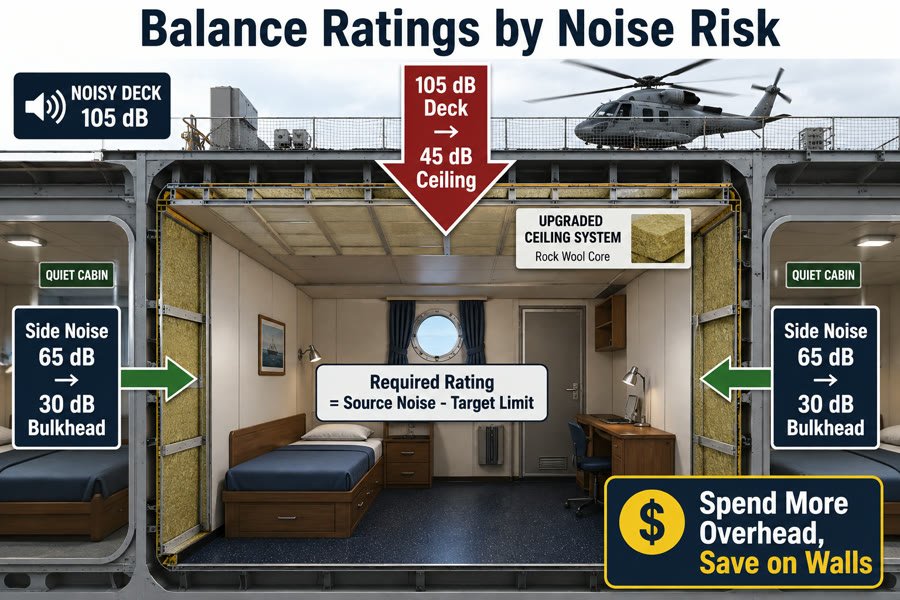
When you buy materials from China for European shipyards, you want high quality but you also need a low price. You do not need the most expensive panels on every single wall. You just need a smart balance. To do this correctly, you must follow the three steps I listed.
Step 1 and 2: Mapping High Noise Risk and Calculating the Deficit
First, you map the highest noise risk. Look at the ship's general arrangement plan. Is the loud noise coming from the sides or from above? Second, you calculate the required acoustic deficit5. For example, your target is 60 dB. The room above is a helicopter deck making 105 dB. The room next door is another cabin making 65 dB. The overhead deficit is huge, showing a 45 dB difference. The side deficit is tiny, showing only a 5 dB difference.
Step 3: Selecting Asymmetric Panel Ratings to Save Costs
Third, you select asymmetric panel ratings based on your math. Because the side noise is very low, you buy a standard 30 dB bulkhead panel for the walls. This costs $18 per square meter. Because the overhead noise is huge, you spend your money on a high-acoustic 45 dB ceiling panel system. This costs $35 per square meter. If you put 45 dB panels on the walls and the ceiling, you spend $35 per square meter for the whole room and waste thousands of dollars. By balancing them asymmetrically, you save a lot of money, but the cabin still meets the overall IMO limits perfectly. I help my clients calculate this balance all the time.
| Surface Type | Adjacent Noise | Target Limit | Required Rating | Selected Material Cost |
|---|---|---|---|---|
| Left Bulkhead | 65 dB (Cabin) | 60 dB | Minimum 5 dB | 30 dB Standard ($18/m²) |
| Ceiling | 105 dB (Deck) | 60 dB | Minimum 45 dB | 45 dB Upgraded ($35/m²) |
| Right Bulkhead | 65 dB (Cabin) | 60 dB | Minimum 5 dB | 30 dB Standard ($18/m²) |
How Does an Upper-Deck Marine Cabin's Noise Limit Change Ceiling Panel Requirements?
Upper-deck cabins face direct weather, radar vibrations, and open-deck footsteps. Standard ceiling panels will fail here. You must upgrade your ceilings to handle these unique top-deck threats.
An upper-deck cabin requires upgraded ceiling panels to combat three unique external noise sources: structure-borne weather impacts, open-deck foot traffic, and rooftop machinery vibration. To meet limits, you must add constrained layer damping (CLD) materials and increase the ceiling rockwool air gap from 50mm to at least 100mm.
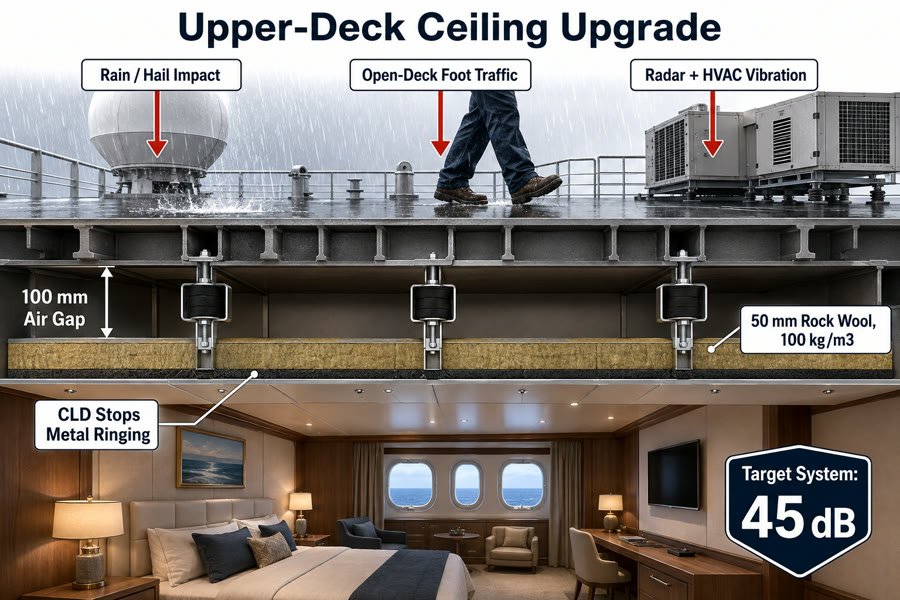
The highest deck on a ship is a very difficult place for noise control. When a shipyard gives you a contract for upper-deck cabins, you cannot use normal ceiling designs. You must address the three unique external noise sources and apply the two specific structural solutions I mentioned above.
Handling Weather Impacts, Foot Traffic, and Machinery Vibration
The main problems are weather impacts, foot traffic, and machinery vibration. Heavy rain and hail hit the steel roof directly. Passengers walk on the sun deck right above the cabin. The ship's radar and HVAC chillers vibrate on the roof constantly. All these noises are structure-borne6. They enter the cabin straight through the steel. A normal 25 dB ceiling panel will not stop the loud thumping sounds from a dance party on the open deck. You must take action.
Adding Constrained Layer Damping and Increasing the Air Gap
To meet the IMO noise limits in these upper rooms, you must use two upgrades. First, you add constrained layer damping (CLD) materials to the ceiling. This is a special heavy rubber paste applied to the back of the ceiling metal. It stops the metal from ringing like a bell. CLD adds about $10 per square meter to your cost. Second, you must increase the ceiling rockwool air gap from 50mm to at least 100mm. A larger air gap breaks the low-frequency sound waves from foot traffic. You install 50mm of rockwool (100 kg/m³) and leave 50mm of empty air space before the metal ceiling. This combination easily achieves a 45 dB rating7 and keeps the upper-deck luxury cabins perfectly quiet.
| Upper Deck Threat | Effect on Standard Ceiling | The Required Upgrade | Additional Cost |
|---|---|---|---|
| Heavy Rain/Hail | Metal panel rings loudly | Add Constrained Layer Damping (CLD) | + $10/m² |
| Foot Traffic | Low frequency thumps pass | Increase air gap to 100mm | + $5/m² (bracket cost) |
| Radar Vibration | Grid shakes and rattles | Use heavy-duty rubber hangers | + $2.50/pc |
Conclusion
Meeting cabin noise limits means matching bulkhead Rw ratings with correct ceiling suspension systems. Balance your acoustic investments to block all noise pathways, pass IMO inspections, and reduce purchasing costs.
-
"[PDF] optimizing sandwich panels with graded tubular cell core for ... - arXiv", https://arxiv.org/pdf/2401.11412. Building- and materials-acoustics literature explains that multilayer partition sound insulation depends on surface mass, cavity design, and porous absorptive infill, supporting the claim that steel skin thickness and mineral-wool core properties influence acoustic performance. Evidence role: mechanism; source type: paper. Supports: Marine bulkhead panels can be tuned acoustically by changing steel sheet thickness and rockwool core properties.. Scope note: General acoustics principles support the mechanism, but they do not verify the performance of any specific marine bulkhead panel without laboratory test data. ↩
-
"How to Confirm a Marine Panel Proposal Covers the Right ...", https://magellanmarinetech.com/how-confirm-marine-panel-proposal-covers-right-noise-path/. Laboratory studies and classification references for lightweight sandwich or steel-faced mineral-wool partitions report weighted sound reduction values in the approximate 30 dB range for some thin panel assemblies, giving contextual support for the stated order of magnitude. Evidence role: general_support; source type: research. Supports: A standard 50 mm steel-skinned mineral-wool bulkhead panel can have an Rw of roughly 30 dB.. Scope note: The value is assembly-specific; Rw depends on test standard, joints, mounting details, panel manufacturer, and exact material properties, so a source on similar panels is not direct proof of this exact product specification. ↩
-
"[PDF] ACOUSTICAL TESTING SERVICES TEST METHOD SELECTION LIST", https://www.reginfo.gov/public/do/DownloadDocument?objectID=14477801. Laboratory sound-insulation data for metal ceiling and panel assemblies report transmission-loss values in decibels and show that performance varies substantially with panel construction, cavity depth, and added absorption; such data can contextualize an approximate 25 dB reduction for a lightweight ceiling panel rather than prove this exact product value. Evidence role: general_support; source type: research. Supports: A standard 25mm PVC-coated steel ceiling panel provides about 25 dB of sound reduction.. Scope note: Support is likely contextual unless the source tests the same 25 mm PVC-coated steel marine ceiling panel under the same standard. ↩
-
"Flanking transmission", https://en.wikipedia.org/wiki/Flanking_transmission. An acoustics reference defines flanking transmission as sound reaching a receiving space by paths other than the direct separating partition, such as through connected floors, ceilings, or structural junctions; this supports the terminology and bypass mechanism, though not the specific vessel assembly described here. Evidence role: definition; source type: encyclopedia. Supports: The indirect noise path described in the article is known as flanking transmission.. Scope note: Contextual support for the acoustic concept rather than direct proof of this particular marine layout. ↩
-
"[PDF] Ultrasonic, Normal-Incidence Insertion Loss through Common ...", https://physics.byu.edu/docs/thesis/269. Architectural-acoustics references describe sound insulation design as comparing source-room sound levels with allowable receiving-room levels, while accounting for partition transmission loss, room absorption, surface area, frequency content, and flanking paths. Evidence role: mechanism; source type: education. Supports: The required acoustic rating for a surface can be estimated by comparing the adjacent noise level with the target noise limit.. Scope note: This supports the general calculation principle, not the simplified arithmetic example or the exact panel ratings used in the article. ↩
-
"How to Match a Marine Accommodation Panel System to the ...", https://magellanmarinetech.com/how-match-marine-accommodation-panel-system-to-the-correct-noise-path/. A marine acoustics source should document that impact and equipment vibration on ship structures can transmit as structure-borne sound through decks and bulkheads into accommodation spaces. Evidence role: mechanism; source type: paper. Supports: Weather impacts, foot traffic, and machinery vibration on the upper deck are structure-borne noise sources that can enter cabins through the ship's steel structure.. Scope note: Such a source would support the transmission mechanism generally, but may not quantify the relative contribution of rain, foot traffic, radar, or HVAC equipment for this specific cabin design. ↩
-
"How to Match a Marine Accommodation Panel System to the ...", https://magellanmarinetech.com/how-match-marine-accommodation-panel-system-to-the-correct-noise-path/. Laboratory or peer-reviewed measurements of comparable damped steel-panel, mineral-wool, and air-cavity assemblies can show whether sound reduction indices around 45 dB are achievable under controlled conditions. Evidence role: statistic; source type: paper. Supports: The specified combination of constrained layer damping and a 100 mm ceiling cavity can achieve approximately a 45 dB acoustic rating.. Scope note: Comparable assembly data would be contextual unless the tested construction exactly matches the stated CLD material, 50 mm rockwool density, 50 mm air space, ceiling grid, and marine installation details. ↩