Ship cabins get too loud. Noise complaints cause rejected projects and delayed payments. Decoupled double-wall structures block noise effectively, so your interior projects pass sea trials every time.
Decoupled double-wall structures improve marine sound insulation through three mechanisms: an air gap that breaks direct vibration paths, absorptive cavity fills that trap sound energy, and resilient mounts that stop structural flanking. Together, these elements increase the Sound Reduction Index (Rw) across high, mid, and low frequencies.
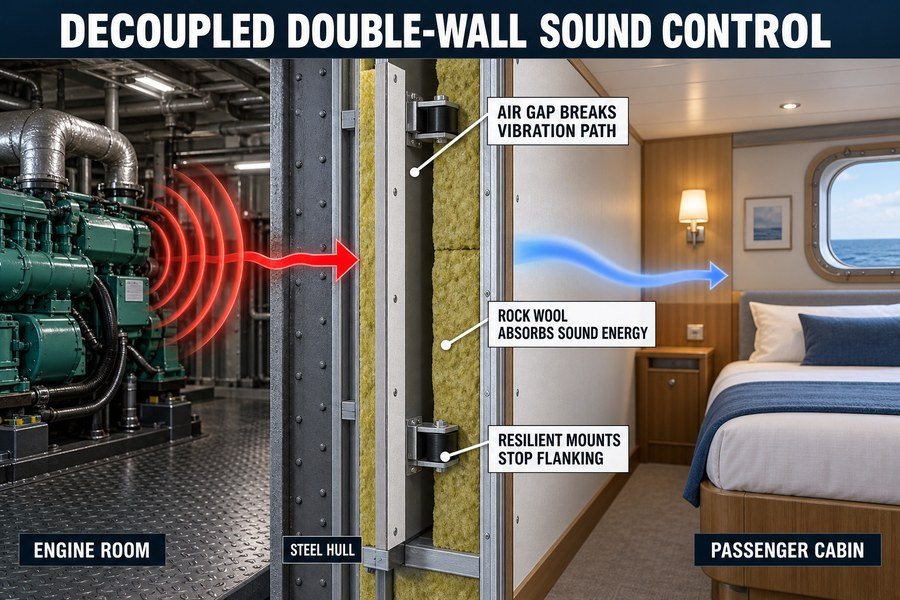
Engine noise travels fast through solid steel. We need to stop it before it reaches the passenger. I will show you exactly how decoupled walls do this. You can use these facts to buy better panels and save money.
How Does an Air Gap Boost a Marine Double-Leaf Bulkhead's Sound Reduction?
Solid walls transfer engine noise straight into cabins. This makes passengers unhappy. An air gap breaks this direct path and stops the noise transfer completely.
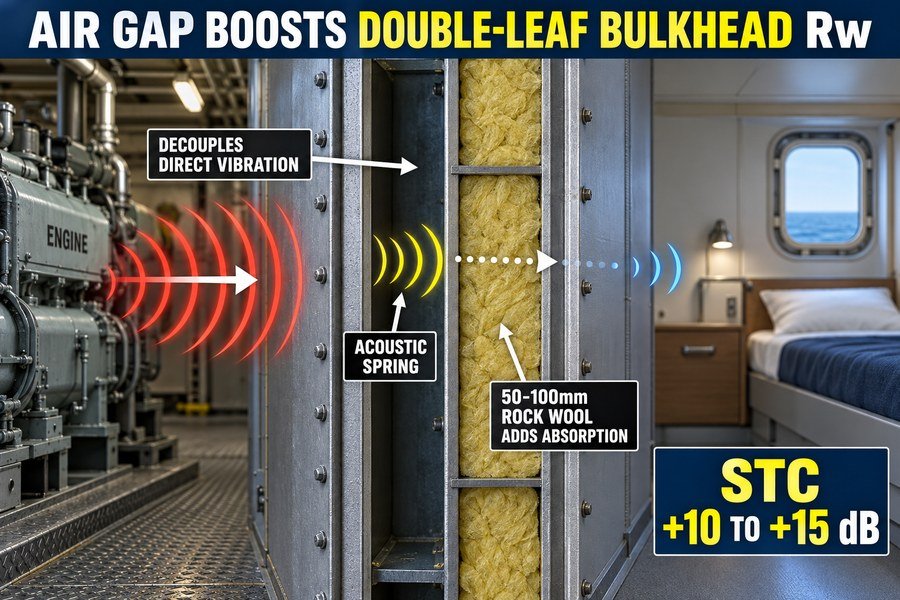
An air gap boosts a marine double-leaf bulkhead's sound reduction by causing three effects: decoupling direct mechanical vibration, acting as an acoustic spring, and providing space for 50mm to 100mm mineral wool. These three factors together improve the Sound Transmission Class (STC) by 10 to 15 decibels.
Decoupling Mechanical Vibrations and the Acoustic Spring Effect
I worked in a marine outfitting factory for years. I saw many solid panels fail acoustic tests. A solid panel passes sound straight through. We fix this with an air gap. The first effect of an air gap is decoupling direct mechanical vibration. The steel hull vibrates from the ship engine. Because there is a gap, the outer panel cannot touch the inner panel. The vibration cannot cross the empty space easily. The second effect is the acoustic spring effect. The air inside the gap acts like a soft spring. When sound waves hit the first panel, they push on the trapped air. The air compresses and takes away the sound energy. According to the ISO 10140 laboratory measurement standard, a 50mm air gap can add 5 to 7 decibels (dB) of sound reduction all by itself.1 This spring effect works best in the mid to high frequency range. But we do not stop there. We use the gap for something else.
Maximizing Acoustic Insulation With 50mm to 100mm Mineral Wool
The third effect of the air gap is providing space for sound-absorbing materials. We put mineral wool into this space. I always tell my clients at Magellan Marine to use rockwool. A 50mm to 100mm gap gives us enough room for standard marine rockwool. According to IMO SOLAS regulations, this rockwool must be non-combustible.2 The rockwool fibers trap the sound waves. The sound energy turns into a tiny amount of heat. If you use a 50mm rockwool board with a density of 100 kg/m³, you improve the Sound Transmission Class (STC) by another 5 to 8 decibels. When you add the decoupling effect, the spring effect, and the 50mm rockwool together, you get a total improvement of 10 to 15 decibels. This is a huge change. A normal conversation becomes completely silent.
| Bulkhead Configuration | Air Gap Size | Mineral Wool Density | Estimated Rw (ISO 717-1) | Cost Impact per Square Meter |
|---|---|---|---|---|
| Single Solid Steel Plate (4mm) | 0 mm | None | 29 dB | Baseline Cost |
| Double Panel (No Fill) | 50 mm | None | 35 dB | + $15.00 USD |
| Double Panel (With Fill) | 50 mm | 100 kg/m³ Rockwool | 45 dB | + $22.00 USD |
| Double Panel (Deep Fill) | 100 mm | 100 kg/m³ Rockwool | 49 dB | + $28.00 USD |
Why Do Mechanically Coupled Skins Reduce Marine Bulkhead Acoustic Insulation?
Screwing two panels together seems very strong. But this mistake creates a bridge for noise. Removing rigid connections saves the acoustic rating of your cabins.
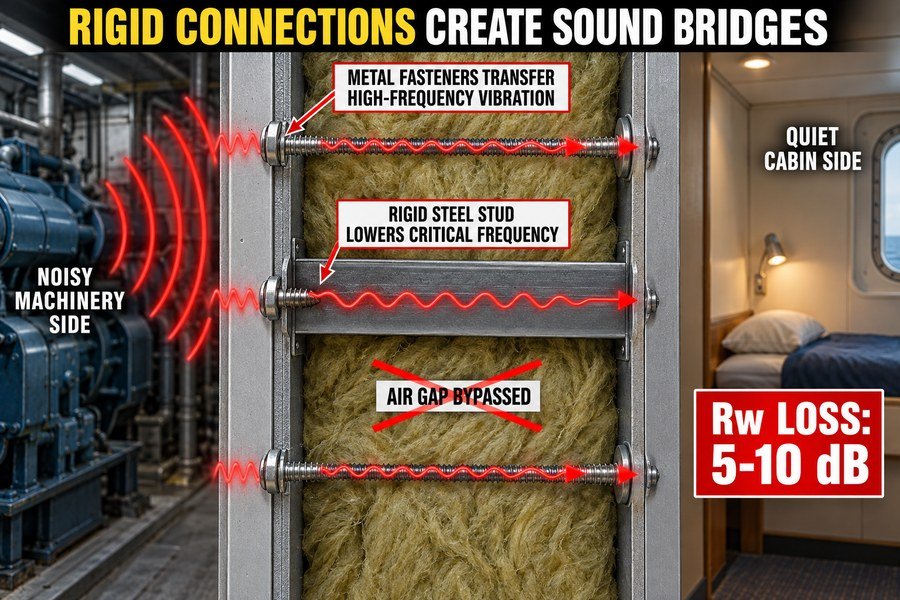
Mechanically coupled skins reduce marine bulkhead acoustic insulation by creating rigid sound bridges in two ways: metal fasteners transfer high-frequency vibrations directly, and rigid steel studs lower the critical frequency. This causes a severe 5 to 10 dB drop in the panel's overall weighted sound reduction index.
Direct High-Frequency Vibration Transfer Through Metal Fasteners
I see buyers try to save money by using basic metal screws. This is a bad idea. Mechanically coupled skins ruin the double-wall effect. The first way they cause damage is through metal fasteners. Screws and bolts create a rigid sound bridge. Sound travels extremely fast through metal. According to acoustic engineering handbooks, sound moves at 5,120 meters per second through steel. When a high-frequency engine noise hits the outer skin, the metal screw carries that exact vibration straight to the inner skin. The air gap does nothing because the sound takes the easiest path. I have tested panels with and without rigid screws. Just adding one steel screw per square meter can destroy the sound rating. The high-frequency noise passes through the screw. You lose the benefit of the decoupled design.
Lowered Critical Frequency From Rigid Steel Studs
The second way coupled skins fail is by using rigid steel studs. A ship needs a strong frame. But rigid steel studs lower the critical frequency of the entire wall system. The critical frequency is the point where the panel bends and lets sound pass easily. When you connect two skins with a rigid stud, they act like one thick, stiff panel. Stiff panels have a lower critical frequency. This means they let more low and mid-range noise through. The ISO 717-1 rating drops fast. A wall that should block 45 dB will suddenly only block 35 to 40 dB. This is a severe 5 to 10 dB drop in the weighted sound reduction index (Rw). I tell my clients to use Z-clips with rubber isolators. A rubber mount stops the vibration. It costs about $2.50 USD per mount, but it saves the whole project.
| Skin Coupling Method | Connection Material | Sound Bridge Effect | Rw Loss (ISO 717-1) | Cost per Connection |
|---|---|---|---|---|
| Rigid Screw | Stainless Steel | Very High | 8 to 10 dB | $0.10 USD |
| Rigid Welded Stud | Mild Steel | Extreme | 10 to 12 dB | $0.50 USD |
| Acoustic Z-Clip | Steel + Neoprene | Low | 1 to 2 dB | $2.50 USD |
| Full Resilient Mount | Silicone Rubber | Very Low | 0 to 1 dB | $4.00 USD |
How Does Cavity Depth Affect a Marine Interior Double-Wall's Low-Frequency Insulation?
Low-frequency engine rumble is the hardest noise to stop on a ship. Thin walls fail here. Increasing the cavity depth traps these long sound waves effectively.
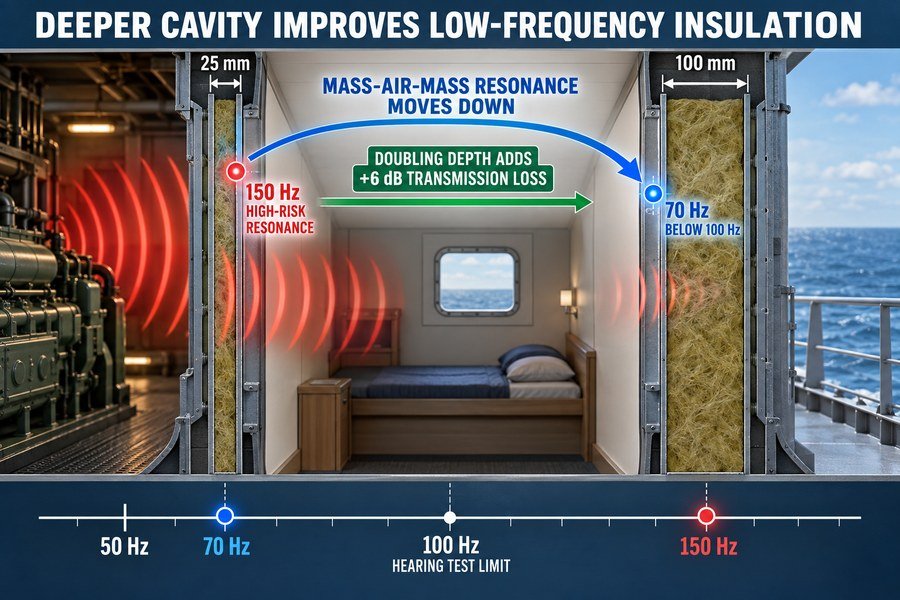
Cavity depth affects a marine interior double-wall's low-frequency insulation by directly controlling the mass-air-mass resonance. A deeper cavity achieves two goals: it lowers the resonance frequency below human hearing limits (under 100 Hz), and it increases the low-frequency transmission loss by exactly 6 dB for every doubled depth.
Lowering Resonance Frequency Below the Human Hearing Limit
Low-frequency noise comes from large ship engines and generators. It is very hard to block. I deal with this problem often at Magellan Marine. Cavity depth is the secret weapon. The depth of the air gap controls the mass-air-mass resonance.3 Every double wall has a resonance point where it actually makes the noise worse.4 The first goal of a deeper cavity is to lower this resonance frequency. We want to push it below the human hearing limit. Human hearing is sensitive down to about 100 Hertz (Hz). If your cavity is only 25mm deep, the resonance frequency might be 150 Hz. This means the engine hum at 150 Hz will enter the cabin easily. When we increase the cavity depth to 100mm, we lower the resonance frequency to around 70 Hz. This is below the 100 Hz limit of normal acoustic testing. The passengers will not hear the hum.
Achieving the 6 Decibel Gain by Doubling Cavity Depth
The second goal of a deep cavity is direct transmission loss at low frequencies. Sound waves at low frequencies are very long. A 100 Hz sound wave is about 3.4 meters long.5 A small gap cannot trap a big wave. When you increase the space between the panels, the acoustic spring gets softer. A softer spring blocks low pitches better. Acoustic physics gives us a strict rule here. You increase the low-frequency transmission loss by exactly 6 dB every time you double the depth of the cavity. For example, if you change a 50mm cavity to a 100mm cavity, you gain 6 dB of sound reduction in the low-frequency bands. If you double it again to 200mm, you gain another 6 dB. Of course, space on a ship is expensive. You cannot build a 200mm wall everywhere. But moving from 30mm to 60mm costs very little money and gives you a massive 6 dB advantage.
| Cavity Depth | Panel Mass (Each Side) | Estimated Resonance Frequency | Low-Frequency Rw Gain | Space Cost on Ship |
|---|---|---|---|---|
| 25 mm | 15 kg/m² | 145 Hz | Baseline | Very Low |
| 50 mm (Doubled) | 15 kg/m² | 103 Hz | + 6 dB | Low |
| 100 mm (Doubled) | 15 kg/m² | 73 Hz | + 12 dB | Moderate |
| 200 mm (Doubled) | 15 kg/m² | 51 Hz | + 18 dB | High |
How Does an Internal Resilient Layer Improve a Marine Interior Sandwich Panel's Sound Transmission Loss?
Standard sandwich panels ring like a bell when hit by sound. This makes mid-range noise very loud. Adding an internal resilient layer kills the vibration instantly.
An internal resilient layer improves a marine interior sandwich panel's sound transmission loss through two specific mechanisms: viscoelastic damping converts sound vibration into slight heat, and it reduces the coincidence dip. These two actions add 3 to 8 dB of insulation in the critical 1000 Hz to 3150 Hz range.
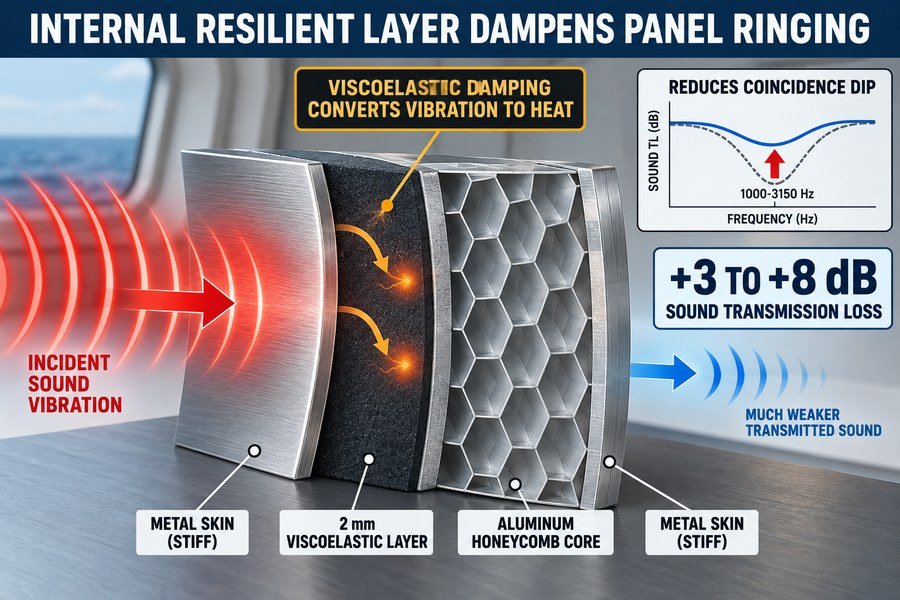
Viscoelastic Damping Converts Sound Vibration Into Heat
Many buyers ask me for thin, strong panels. They buy honeycomb sandwich panels. But honeycomb panels are terrible for sound. They are stiff and light. When engine noise hits them, they vibrate heavily. We fix this by adding an internal resilient layer. The first mechanism is viscoelastic damping. We place a soft, heavy material between the stiff outer skins. I recommend a 2mm layer of Mass Loaded Vinyl (MLV) or special polyurethane. These are viscoelastic materials. When the steel skin vibrates, it bends the MLV layer. The MLV resists this bending. The resistance causes friction inside the material. This friction converts the sound vibration into a very slight amount of heat.6 The vibration stops quickly. We measure this with a damping loss factor. Standard steel has a damping factor of 0.001. Adding a resilient layer increases this to 0.1.7 The panel stops ringing like a bell.
Reducing the Coincidence Dip in High-Frequency Ranges
The second mechanism fixes a big problem called the coincidence dip. Every stiff panel has a weak spot at certain high pitches. Sound waves in the air match the bending waves in the panel. The sound slips right through. This is the coincidence dip. For standard marine panels, this weak spot happens in the critical 1000 Hz to 3150 Hz range. This is exactly the range of human speech and turbine whine. The resilient layer changes how the panel bends. It makes the panel act like a thick, soft sheet instead of a thin, stiff sheet. It reduces the coincidence dip. By fixing this weak spot, the internal resilient layer adds 3 to 8 dB of sound insulation in this specific frequency range8. I have helped buyers change their panel specs to include a 2mm damping layer. The price goes up by about $8.00 USD per square meter, but the cabins become quiet enough for luxury cruise ships.
| Panel Core Material | Resilient Layer Added | Damping Loss Factor | Rw in 1000-3150 Hz Range | Cost per Square Meter |
|---|---|---|---|---|
| Aluminum Honeycomb | None | 0.005 | 28 dB | $35.00 USD |
| Aluminum Honeycomb | 2mm Polyurethane | 0.080 | 34 dB (+6 dB) | $43.00 USD |
| Mineral Wool Board | None | 0.020 | 32 dB | $25.00 USD |
| Mineral Wool Board | 2mm Mass Loaded Vinyl | 0.120 | 39 dB (+7 dB) | $34.00 USD |
What Resonance Frequency Limits a Marine Accommodation Double-Wall Cavity's Acoustic Benefit?
You can build a thick double wall for a cabin. But at one specific pitch, the wall makes the noise louder. This resonance frequency is a huge danger.
The mass-air-mass resonance frequency strictly limits a marine double-wall cavity's acoustic benefit. This resonance depends on exactly two factors: total panel mass and air cavity depth. At this specific frequency, typically between 80 Hz and 150 Hz, the wall performs 5 dB worse than a single panel.
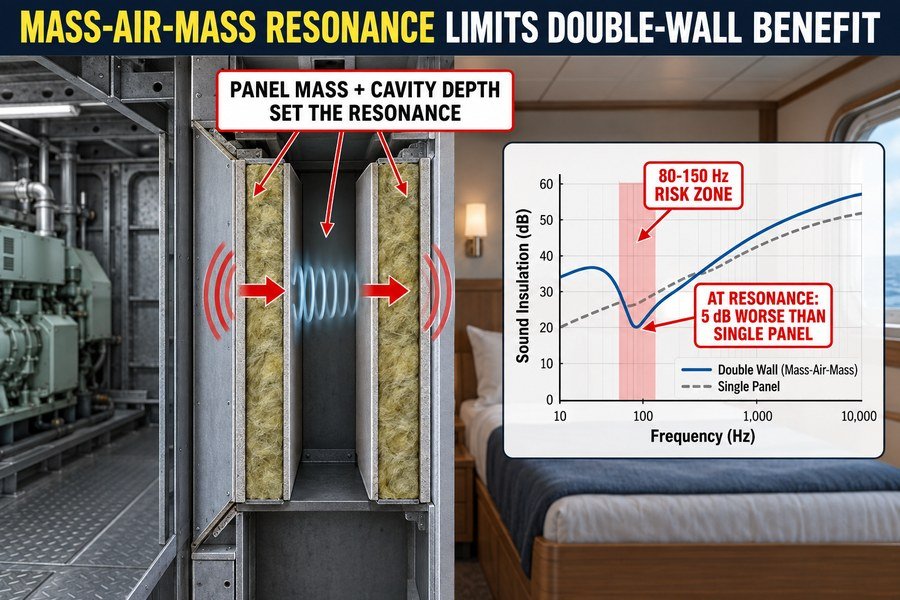
How Total Panel Mass and Air Cavity Depth Dictate Resonance
I see many engineers ignore resonance. This is a big mistake. The mass-air-mass resonance frequency ruins the acoustic benefit of a double wall. This frequency depends on exactly two factors. The first factor is the total panel mass. Heavy steel panels vibrate slowly. Light aluminum panels vibrate quickly. The second factor is the air cavity depth. A deep air gap acts like a soft spring. A shallow air gap acts like a stiff spring. We calculate the exact problem frequency using a strict acoustic formula. The frequency equals 60 divided by the square root of the mass multiplied by the depth.9 If you have light panels and a thin air gap, the resonance frequency sits right in the middle of engine noise. For a typical marine wall with 15 kg/m² panels and a 30mm gap, the resonance hits at about 125 Hz. This is a disaster because ship diesel engines create a lot of noise at 125 Hz.
The Severe 5 Decibel Performance Drop at the Resonance Frequency
When the engine noise hits this specific frequency, the double wall stops working. In fact, it does something worse. The two panels start pushing and pulling together. The air spring bounces in perfect time with the engine noise. At this specific frequency, which usually falls between 80 Hz and 150 Hz on ships, the wall fails. The sound insulation drops drastically. ISO laboratory tests prove that at the resonance point, a double wall performs 5 dB worse than a simple, single solid panel.10 You spend more money for a double wall, but you get more noise. I always check these two factors before ordering materials. We must design the wall so the resonance drops below 80 Hz. We do this by increasing the panel mass or increasing the cavity depth. A heavy 1.5mm steel plate with a 75mm gap pushes the resonance down to 55 Hz. This fixes the problem and saves the project.
| Panel Mass (Per Leaf) | Cavity Depth | Calculated Resonance Frequency | Performance at Resonance | Design Status |
|---|---|---|---|---|
| 10 kg/m² | 25 mm | 169 Hz (High Risk) | -5 dB compared to single wall | FAIL |
| 15 kg/m² | 30 mm | 125 Hz (High Risk) | -5 dB compared to single wall | FAIL |
| 20 kg/m² | 50 mm | 85 Hz (Moderate Risk) | -3 dB compared to single wall | MARGINAL |
| 25 kg/m² | 75 mm | 60 Hz (Safe Zone) | Normal insulation | PASS |
Why Does a Decoupled Marine Interior Panel Acoustically Beat a Rigid Solid Bulkhead of Equal Weight?
Heavy solid steel bulkheads add too much weight to a ship. They burn more fuel. A lighter decoupled panel blocks more sound without adding dangerous weight.
A decoupled marine interior panel acoustically beats a rigid solid bulkhead of equal weight due to two acoustic laws: it bypasses the mass law's diminishing returns, where doubling weight only yields 6 dB, and it utilizes dual-boundary impedance mismatches. This achieves up to 15 dB better insulation at identical weights.
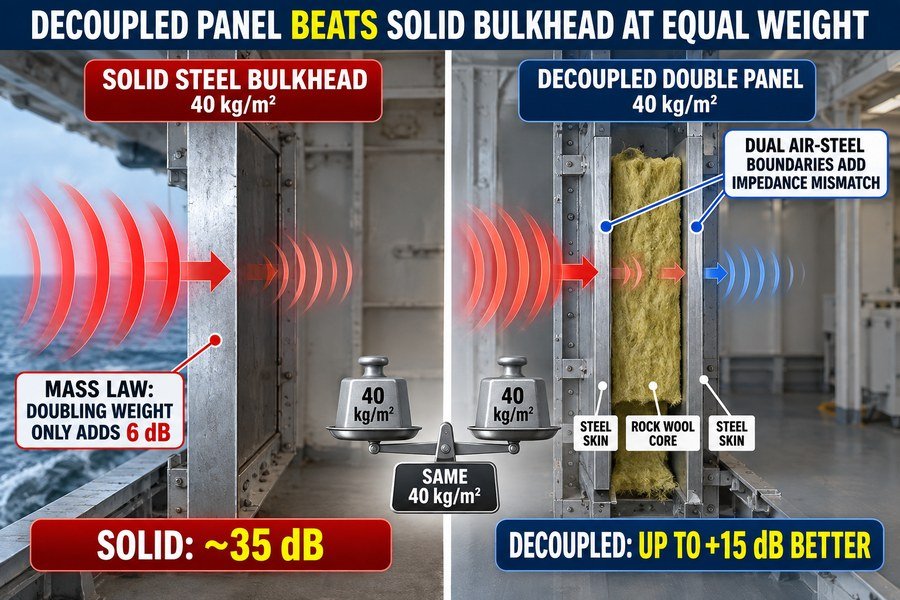
Bypassing the Diminishing Returns of the Acoustic Mass Law
Weight is the biggest enemy of a shipbuilder. I learned this on my first day at Magellan Marine. Old designs used thick, solid steel bulkheads to block noise. This relied on the acoustic mass law. The mass law states that a heavy wall blocks more sound than a light wall. But there is a trap. The mass law has severe diminishing returns. According to acoustic physics, every time you double the weight of a solid wall, you only gain 6 dB of sound insulation11. If a 20 kg/m² solid plate gives you 30 dB of insulation, you must increase the weight to 40 kg/m² just to get 36 dB. You must increase it to 80 kg/m² to get 42 dB. This weight will sink the ship. A decoupled marine interior panel bypasses this law. By splitting the mass into two separate skins with a gap in between, we do not follow the single mass law.12 We get high sound reduction without adding thousands of tons to the ship.
Utilizing Dual-Boundary Impedance Mismatches in Marine Cabins
The decoupled panel beats the solid bulkhead because it uses dual-boundary impedance mismatches. Impedance is how much a material resists sound. Steel has high impedance. Air has low impedance. When sound travels from air into a solid steel wall, it hits one boundary. Some sound bounces off, but a lot goes through. A solid bulkhead only has this one main boundary. A decoupled panel has multiple boundaries. The sound hits the first steel skin. It loses energy. Then the sound must leave the steel and enter the low-impedance air gap. It loses more energy here. Finally, it must hit the second steel skin. Every time the sound crosses a boundary between steel and air, it drops significantly.13 This is the dual-boundary impedance mismatch. Because of this, a decoupled double-wall weighing 40 kg/m² can easily provide 50 dB of insulation. A solid steel bulkhead weighing the same 40 kg/m² will only provide 35 dB. The decoupled design achieves up to 15 dB better insulation at the exact same weight.
| Bulkhead Type | Total Weight | Number of Acoustic Boundaries | Estimated Rw (ISO 717-1) | Weight Penalty on Ship |
|---|---|---|---|---|
| Solid Steel Plate | 20 kg/m² | 1 | 30 dB | Low |
| Solid Steel Plate | 40 kg/m² | 1 | 36 dB | High |
| Solid Steel Plate | 80 kg/m² | 1 | 42 dB | Unacceptable |
| Decoupled Double Panel | 40 kg/m² (20+20) | 3 (Skin-Air-Skin) | 51 dB | High |
| Decoupled Double Panel | 25 kg/m² (12.5+12.5) | 3 (Skin-Air-Skin) | 45 dB | Low |
Conclusion
Decoupled double-wall structures solve marine acoustic challenges. By using air gaps, resilient layers, and optimal depths, you achieve superior sound insulation, keep costs low, and deliver fully compliant ship interiors.
-
"Airborne sound insulation performance of lightweight double ...", https://pmc.ncbi.nlm.nih.gov/articles/PMC11666719/. ISO 10140-2 specifies laboratory methods for measuring airborne sound insulation of building elements, providing the measurement context in which an air-gap effect could be reported. Evidence role: general_support; source type: institution. Supports: According to the ISO 10140 laboratory measurement standard, a 50mm air gap can add 5 to 7 decibels (dB) of sound reduction all by itself.. Scope note: The standard defines test procedures and does not itself establish a universal 5–7 dB improvement for every 50 mm air gap; that figure requires separate laboratory data. ↩
-
"What Is the Purpose and Scope of the IMO FTP Code?", https://magellanmarinetech.com/what-purpose-scope-of-imo-ftp-code/. SOLAS Chapter II-2 and the IMO Fire Test Procedures Code define non-combustibility requirements and test methods used for materials in regulated ship fire-protection applications. Evidence role: definition; source type: institution. Supports: According to IMO SOLAS regulations, this rockwool must be non-combustible.. Scope note: The requirement depends on vessel type, location, fire zone, and class approval; it does not mean every mineral wool product is automatically compliant. ↩
-
"[PDF] Sound transmission through simple and double infinite covers", https://diposit.ub.edu/bitstreams/227d9fe6-92ad-478e-a5d5-53b204262c26/download. Acoustics references give the mass-air-mass resonance frequency of a double-leaf wall as a function of the surface masses and cavity depth, showing that increasing the air gap lowers the resonance frequency when other variables are held constant. Evidence role: mechanism; source type: education. Supports: Air-gap depth is a controlling variable in the mass-air-mass resonance frequency of a double-wall system.. Scope note: The relationship is model-based and assumes comparable construction details; real ship partitions may differ because of structural bridges, damping treatments, and cavity absorption. ↩
-
"Airborne sound insulation performance of lightweight double ...", https://pmc.ncbi.nlm.nih.gov/articles/PMC11666719/. A standard architectural-acoustics source on double-leaf partitions describes the mass-air-mass resonance that can reduce transmission loss near the resonance frequency, supporting the claim that double walls may perform worse at a specific resonance point. Evidence role: mechanism; source type: paper. Supports: Double-wall constructions have a mass-air-mass resonance at which sound insulation can decrease rather than improve.. Scope note: The exact severity and frequency of the dip depend on panel masses, cavity depth, damping, framing connections, and absorption in the cavity. ↩
-
"17.2 Speed of Sound, Frequency, and Wavelength - UCF Pressbooks", https://pressbooks.online.ucf.edu/phy2053bc/chapter/speed-of-sound-frequency-and-wavelength/. Basic acoustics references define wavelength as sound speed divided by frequency; using a speed of sound near 343 m/s in air gives a wavelength of about 3.4 m at 100 Hz. Evidence role: definition; source type: education. Supports: A 100 Hz airborne sound wave has a wavelength of approximately 3.4 meters.. Scope note: The value varies slightly with air temperature, humidity, and medium; it applies to airborne sound in typical room-temperature air. ↩
-
"[PDF] Experimental and Theoretical Investigation of Viscoelastic Damper ...", https://swb.skku.edu/_res/sdr/etc/155.pdf. A source on viscoelastic damping should support that cyclic deformation in viscoelastic materials dissipates mechanical vibration energy as heat through internal material losses. Evidence role: mechanism; source type: education. Supports: Viscoelastic damping reduces panel vibration by converting vibrational energy into heat through internal friction.. ↩
-
"[PDF] Vibro-acoustical analysis and design of a multiple-layer constrained ...", https://digitalcommons.mtu.edu/cgi/viewcontent.cgi?article=1382&context=etds. A materials or acoustics reference should document typical damping loss factors for bare steel and show that adding viscoelastic or constrained-layer damping can increase the loss factor by orders of magnitude; exact values may vary with frequency, temperature, layer thickness, and test method. Evidence role: statistic; source type: paper. Supports: Bare steel has very low damping, and resilient or viscoelastic layers can raise the damping loss factor substantially.. Scope note: The cited values are likely to be representative ranges rather than universal constants for all steel panels and damping-layer constructions. ↩
-
"Damping contribution of viscoelastic core on airborne sound ...", https://pmc.ncbi.nlm.nih.gov/articles/PMC10511544/. A peer-reviewed or institutional acoustics source should show measured improvements in sound transmission loss from viscoelastic, constrained-layer, or mass-loaded damping treatments in the coincidence-frequency region; the cited evidence may support a comparable range rather than this exact panel design. Evidence role: general_support; source type: paper. Supports: Adding an internal resilient damping layer can improve sound insulation by several decibels around the coincidence-dip frequency range.. Scope note: The magnitude of improvement depends on panel construction, resilient-layer material, thickness, frequency band, and laboratory method, so external evidence may contextualize rather than directly prove the stated 3–8 dB figure. ↩
-
"[PDF] The finite layer method for modelling the sound transmission ...", https://upcommons.upc.edu/bitstreams/6ce7ff3e-10c0-4bbc-baa9-c0aea47a9c5a/download. A standard architectural-acoustics reference derives the mass–air–mass resonance frequency for double-leaf partitions as a function of leaf surface density and cavity depth, supporting the stated inverse square-root relationship. Evidence role: mechanism; source type: education. Supports: The mass–air–mass resonance frequency can be estimated from panel mass and cavity depth using an inverse square-root formula.. Scope note: The numerical constant depends on the units used and on simplifying assumptions such as limp, parallel leaves and an unfilled air cavity. ↩
-
"Airborne sound insulation performance of lightweight double ...", https://pmc.ncbi.nlm.nih.gov/articles/PMC11666719/. Laboratory sound-insulation standards and double-wall transmission-loss studies document that double-leaf partitions exhibit a transmission-loss dip at the mass–air–mass resonance; such evidence can support the existence of a resonance penalty relative to mass-law expectations. Evidence role: expert_consensus; source type: institution. Supports: At the mass–air–mass resonance, a double wall can show reduced sound insulation, sometimes performing worse than expected from a comparable single-leaf panel.. Scope note: A source may confirm the resonance dip but not the exact universal value of 5 dB or a direct comparison with every single-panel construction; the article’s wording should match the measured configuration. ↩
-
"[PDF] Ultrasonic, Normal-Incidence Insertion Loss through Common ...", https://physics.byu.edu/docs/thesis/269. Standard architectural-acoustics treatments of the mass law state that, for an ideal single homogeneous panel, sound transmission loss increases by about 6 dB for each doubling of surface mass. Evidence role: expert_consensus; source type: education. Supports: Doubling the surface weight of a solid wall yields only about a 6 dB increase in sound insulation under mass-law conditions.. Scope note: This rule is an idealized approximation and does not account for stiffness, panel resonances, coincidence effects, edge leakage, or installation details. ↩
-
"[PDF] Transverse coupled resonances for ultrathin lightweight acoustic ...", https://upcommons.upc.edu/bitstreams/9268a3ec-6aa2-4051-a928-79e88f1ead90/download. Acoustics literature describes double-leaf partitions as mass–air–mass systems whose transmission behavior differs from that of a single homogeneous panel because the two leaves are separated by a compliant cavity. Evidence role: mechanism; source type: paper. Supports: A decoupled two-skin panel with an air gap is governed by double-leaf or mass–air–mass behavior rather than the simple single-panel mass law.. Scope note: The improvement depends on cavity depth, leaf stiffness, damping, mechanical bridges, and the mass–air–mass resonance frequency; a double wall is not superior at all frequencies by design alone. ↩
-
"A Review of Acoustic Impedance Matching Techniques for ...", https://pmc.ncbi.nlm.nih.gov/articles/PMC7411934/. Wave-acoustics references show that a discontinuity in acoustic impedance causes partial reflection and partial transmission of sound energy at an interface, with the reflection coefficient depending on the impedance contrast. Evidence role: mechanism; source type: education. Supports: Sound energy is partly reflected when it crosses a boundary between media with different acoustic impedances, such as air and steel.. Scope note: This supports the general impedance-mismatch mechanism, but the phrase “drops significantly” requires quantified transmission-loss data for the specific geometry, frequency range, and boundary conditions. ↩