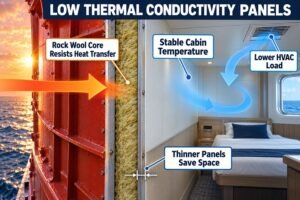
You buy expensive marine panels, but ship cabins still get hot or freezing. Poor thermal control ruins passenger comfort and spikes energy costs. Understanding heat flow solves this problem permanently.
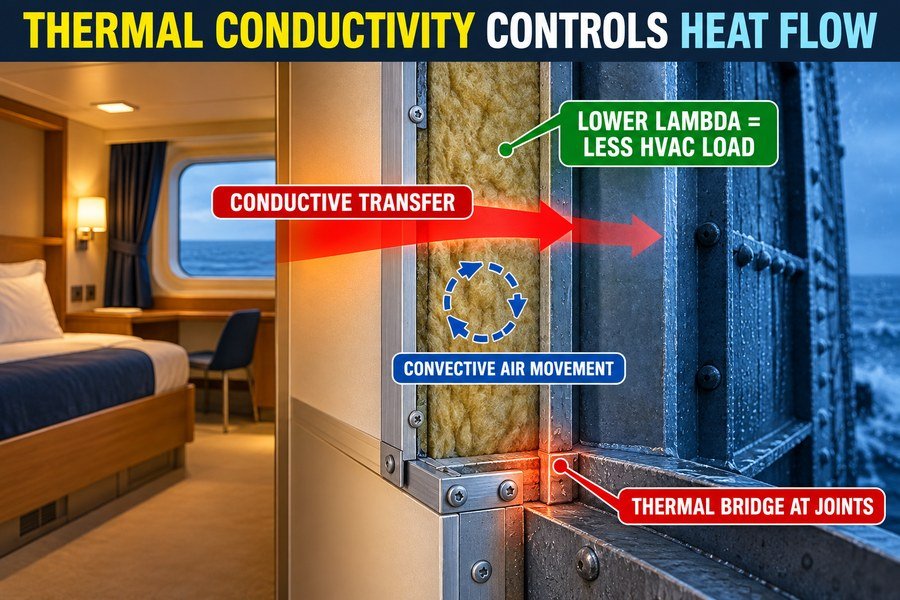
Thermal conductivity controls heat flow in marine accommodation panels through three mechanisms: conductive transfer through the core, convective air movement within fibers, and thermal bridging at joints. Lower thermal conductivity (lambda) values directly block heat, ensuring consistent cabin temperatures and reducing HVAC power consumption by up to 30%.
You might think buying the thickest panel is enough, but that wastes money and space. If you stop reading now, you will keep losing bids to smarter suppliers who understand the real science behind marine outfitting.
How Does Lambda Value Drive Heat Transfer in Marine Interior Panels?
You select a panel, but it fails the shipyard insulation test. High heat transfer ruins your hard work. The lambda value is the hidden rule you must master.
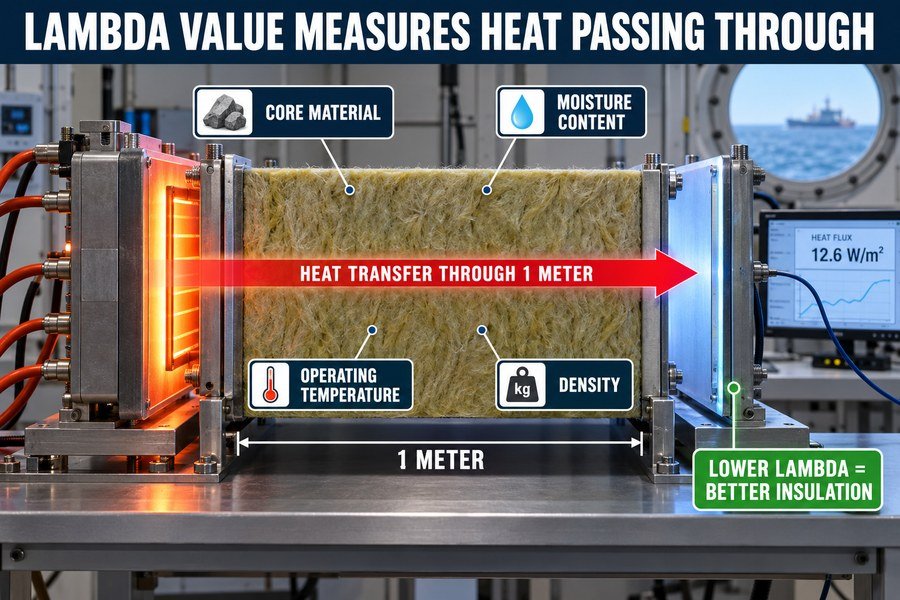
The lambda value (λ) drives heat transfer in marine interior panels by measuring exactly how much heat passes through a 1-meter thickness of material. It depends on four factors: core material type, moisture content, operating temperature, and density. Lower lambda means less heat transfer and better cabin insulation.
Core Material Type and Moisture Content Effects on Lambda
I see many buyers ignore the core material type. Different materials have different lambda values. For example, standard glass wool has a lambda of about 0.040 W/m·K1. Marine-grade rock wool has a lambda of about 0.034 W/m·K. This small number makes a big difference in a ship. I always tell my clients to check the material type first. According to SOLAS guidelines, marine panels must use non-combustible materials. Rock wool is the most common choice for marine accommodation panels.
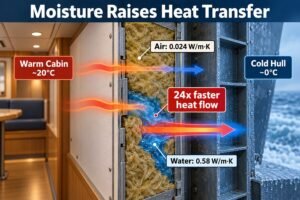
Next, we must look at moisture content. Water conducts heat very well. The thermal conductivity of water is 0.58 W/m·K. Air has a thermal conductivity of only 0.024 W/m·K.2 If your rock wool gets wet during shipping from Asia, water replaces the air inside the panel. The lambda value shoots up immediately. Your panel loses its insulation power. You will face complaints from the shipyard. You must demand waterproof packaging from your suppliers. A wet panel is a useless panel.
Operating Temperature and Density Impacts on Marine Panels
We also need to consider the operating temperature. A panel behaves differently in a hot engine room versus a cold passenger cabin. As the temperature rises, the air inside the panel moves faster. This movement increases the lambda value. Manufacturer data from European insulation boards shows that lambda increases by about 10% when the temperature goes from 20°C to 50°C. You must know where the shipyard will install the panel.
Finally, density plays a huge role in the lambda value. Density means how much rock wool is packed into one cubic meter. We measure it in kg/m³. If the density is too low, air flows too easily through the panel. If the density is too high, the solid rock fibers conduct too much heat. You need the perfect balance. This balance directly controls the lambda value. When you negotiate with suppliers, you must ask for the test reports. Do not just accept a low price. You must check these four factors on the official certificates.
| Factor | Condition | Typical Lambda Value (W/m·K) | Impact on Heat Transfer |
|---|---|---|---|
| Material Type | Standard Glass Wool | 0.040 | Moderate heat transfer |
| Material Type | Marine Rock Wool | 0.034 | Low heat transfer |
| Moisture Content | Dry Rock Wool | 0.034 | Normal insulation |
| Moisture Content | 5% Moisture Ingress | 0.055 | High heat transfer (Fails test) |
| Operating Temp | 20°C Cabin | 0.034 | Stable insulation |
| Operating Temp | 50°C Engine Room | 0.038 | Slightly higher heat transfer |
Why Do High Lambda Cores Lose More Heat Through Marine Lining Panels?
Your clients complain about cold cabins near the hull. You lose money on rework and penalties. High lambda cores let heat escape too easily. We must fix this core issue.
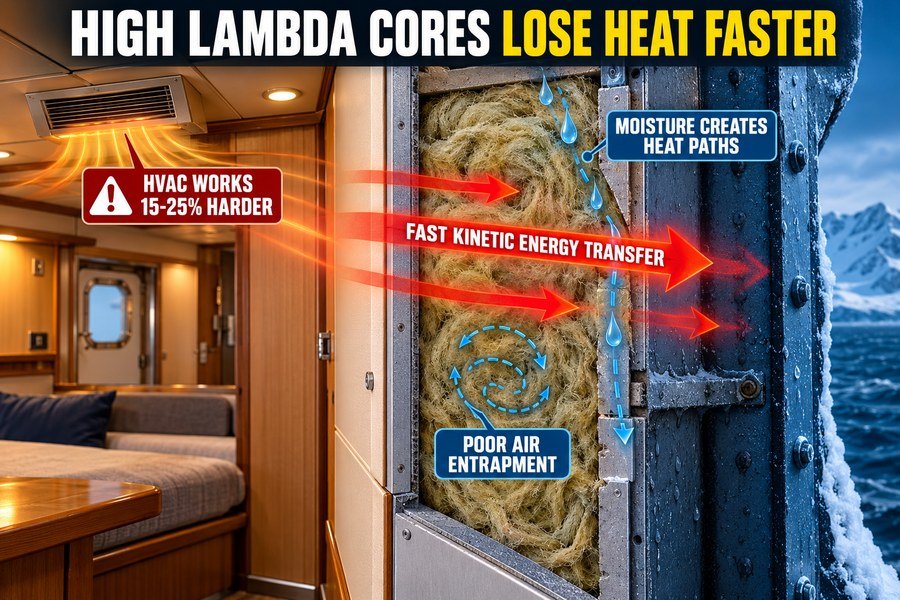
High lambda cores lose more heat through marine lining panels because their molecular structure allows rapid kinetic energy transfer, poor air entrapment, and higher moisture absorption. These three physical flaws create fast pathways for heat to escape, forcing ship HVAC systems to work 15% to 25% harder.
Rapid Kinetic Energy Transfer in Solid Panel Materials
High lambda cores have a dense molecular structure. Heat is simply kinetic energy moving between molecules.3 When a material has high thermal conductivity, its molecules vibrate and bump into each other very fast. This rapid kinetic energy transfer pushes heat straight through the marine lining panel. For example, a cheap solid calcium silicate board has a lambda of about 0.11 W/m·K4. The heat from a warm cabin hits the panel. The molecules transfer this heat to the cold steel hull in seconds. I saw this happen on an offshore vessel project in 2018. The buyer saved $5 per square meter on cheap cores. The shipyard had to add extra heaters in every cabin because the panels lost heat too fast. You must avoid cores that transfer kinetic energy rapidly.
Poor Air Entrapment and Moisture Absorption in Marine Cores
Good insulation relies on trapped air. Air is a terrible conductor of heat. High lambda cores suffer from poor air entrapment. Their internal fibers or structures are either too far apart or too solid. They cannot hold tiny pockets of still air. Without these air pockets, convective air currents form inside the panel. These currents carry heat away from the cabin.
Furthermore, high lambda cores often have higher moisture absorption rates. Standard commercial foams or cheap mineral wool soak up water vapor from the humid sea air. As I mentioned before, water conducts heat 24 times faster than air5. Once the core absorbs moisture, it creates liquid pathways for heat to escape. Ship HVAC systems must then run constantly to replace the lost heat. According to marine HVAC engineers, this forces the system to work 15% to 25% harder. This burns more diesel fuel and costs the ship owner money every day. You must buy panels with tight fiber structures and hydrophobic (water-repelling) treatments.
| Core Material Flaw | Physical Mechanism | Resulting Heat Loss Effect | Impact on Ship HVAC |
|---|---|---|---|
| Rapid Kinetic Energy Transfer | Fast molecular vibration | Heat escapes through solids quickly | Increases heating demand by 10% |
| Poor Air Entrapment | Internal convective currents | Heat moves away via internal air flow | Increases heating demand by 5% |
| Higher Moisture Absorption | Water replaces trapped air | Heat travels through liquid bridges | Increases heating demand by 10% |
How Does Rock Wool Density Alter Marine Bulkhead Panel Lambda Values?
You buy cheap, low-density rock wool to save money. The bulkhead fails SOLAS fire and thermal tests. Density directly changes the panel's lambda value.
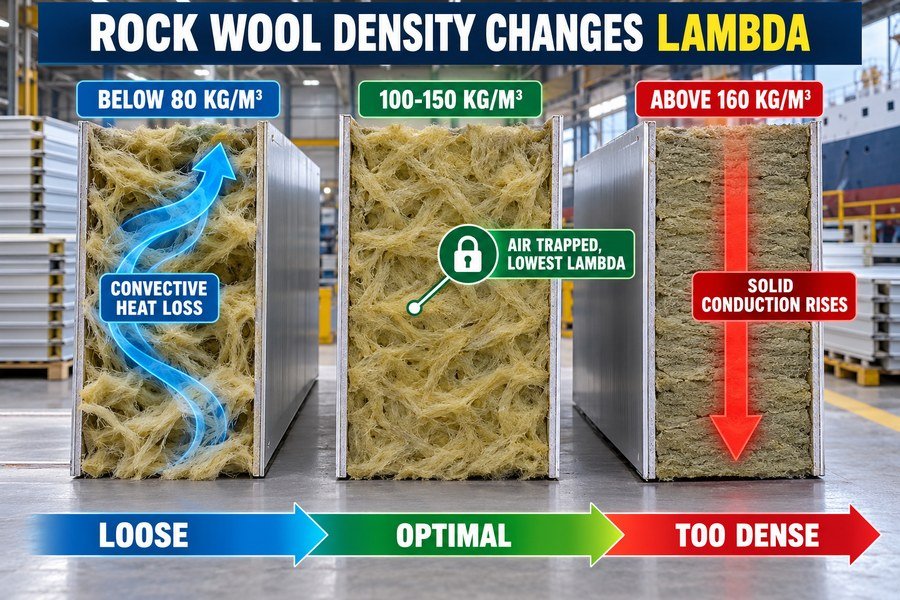
Rock wool density alters marine bulkhead panel lambda values through three stages: under-density (below 80 kg/m³) increases convective heat loss, optimal density (100-150 kg/m³) traps air perfectly for the lowest lambda of 0.034 W/m·K, and over-density (above 160 kg/m³) increases solid conduction, raising the lambda value again.
Convective Heat Loss in Under-Density Rock Wool Panels (Below 80 kg/m³)
Many buyers try to cut costs by ordering panels with 60 kg/m³ or 80 kg/m³ rock wool. This is a big mistake. This is the under-density stage. In this stage, the rock wool fibers are too far apart. They cannot trap small pockets of air. Because the air is not trapped, it moves around inside the panel. This movement creates convective heat loss.6 The heat simply flows through the loose fibers. A 60 kg/m³ panel might have a lambda value of 0.045 W/m·K.7 This fails the strict requirements of many European shipyards. I once helped a client who bought 3,000 square meters of 80 kg/m³ panels from Vietnam. The shipyard rejected the entire batch because the panels let too much heat through the bulkheads. The client lost over $40,000. You cannot use under-density rock wool for serious marine accommodation projects.
Achieving Optimal Air Trapping and Managing Over-Density Conduction (100-160+ kg/m³)
The secret is finding the optimal density. According to major marine material testing labs, the optimal density for rock wool in marine panels is between 100 kg/m³ and 150 kg/m³. In this range, the fibers are packed tightly enough to stop air movement. They trap air perfectly. This gives you the lowest possible lambda value, usually around 0.034 W/m·K. Most B-15 and A-60 class fire doors and panels use 120 kg/m³ rock wool.
However, more density is not always better. This leads to the over-density stage. If you push the density above 160 kg/m³, you introduce a new problem. There are too many solid rock fibers and not enough air pockets. Solid rock conducts heat better than air. So, over-density actually increases solid conduction. A 200 kg/m³ panel might have a lambda value of 0.040 W/m·K. It is also much heavier. Extra weight increases fuel consumption for the ship. You pay more for material, you pay more for shipping, and you get worse insulation. You must stick to the 100-150 kg/m³ sweet spot.
| Density Stage | Density Range (kg/m³) | Primary Heat Transfer Issue | Average Lambda (W/m·K) |
|---|---|---|---|
| Under-density | Below 80 | Convective heat loss (air moves) | 0.042 - 0.048 |
| Optimal density | 100 - 150 | Perfect air trapping | 0.034 - 0.036 |
| Over-density | Above 160 | Solid conduction (too much rock) | 0.038 - 0.042 |
How Does Hull Thermal Bridging Affect Marine Lining Panel Thermal Conductivity?
You install great panels on the steel hull. Condensation still forms everywhere. Thermal bridging bypasses your panel's thermal conductivity entirely. You must block these bridges.
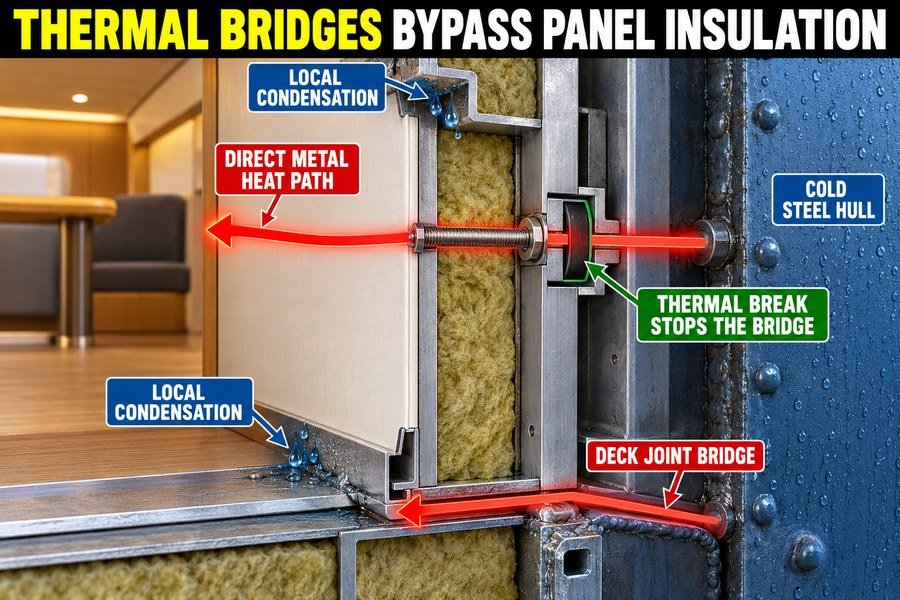
Hull thermal bridging affects marine lining panel systems by creating direct metal-to-metal heat pathways, bypassing the panel's core insulation, causing localized condensation, and increasing overall heat transfer by 20% to 30%. These four issues occur at steel frames, deck joints, uninsulated mounting profiles, and metal fasteners.
Direct Metal Pathways and Core Insulation Bypassing at Frames and Fasteners
Even if you buy a panel with a perfect lambda value, thermal bridging can ruin the system. A thermal bridge is a direct metal-to-metal heat pathway. Ships are made of steel. Steel has a thermal conductivity of about 45 W/m·K. That is over 1,000 times higher than rock wool.8 When workers install marine lining panels, they use steel frames and metal fasteners. These metal parts connect the cold hull directly to the warm cabin interior. The heat acts like water. It takes the easiest path. The heat bypasses the panel's core insulation entirely. It flows straight through the metal screws and steel studs. I see this error on many shipyard visits. A procurement officer buys top-quality A-60 panels but ignores the installation accessories. The overall heat transfer of the wall increases by 20% to 30% just because of these metal fasteners and uninsulated frames. You must buy thermal break tapes or rubber isolators to put between the panel and the steel frame.
Localized Condensation and Overall Heat Transfer Increases at Deck Joints and Profiles
Thermal bridging causes another huge problem: localized condensation. This mostly happens at deck joints and uninsulated mounting profiles. The floor (deck) and the ceiling profiles often touch the bare steel of the ship. In cold waters, the steel hull gets very cold. The cold transfers through the deck joints and mounting profiles right into the cabin. The warm, humid air inside the cabin hits these freezing metal profiles. The air drops its moisture. Water droplets form on the ceiling edges and floor corners. This is localized condensation. It ruins carpets, rusts the interior steel, and causes mold. Shipowners hate mold.
To solve this, you cannot just look at the panel's individual lambda value. You must look at the whole system. You must ensure your factory supplies insulated U-profiles and thermal barrier strips for all deck joints. When you block these four thermal bridge locations (frames, joints, profiles, and fasteners), you stop condensation and keep the heat transfer low.
| Thermal Bridge Location | Mechanism of Failure | Consequence in the Cabin | Solution |
|---|---|---|---|
| Steel Frames | Direct metal-to-metal heat pathway | Bypasses core insulation | Use rubber thermal isolators |
| Metal Fasteners | Direct metal-to-metal heat pathway | Increases heat transfer by 20%+ | Use specialized insulated screws |
| Deck Joints | Cold transfers from hull to floor | Localized condensation at floor | Install thermal barrier strips |
| Mounting Profiles | Cold transfers to ceiling edges | Localized condensation at ceiling | Use insulated U-profiles |
How Do Core Lambda Values Impact Marine Ceiling Panel U-Values?
You confuse lambda with U-value on the spec sheet. The shipyard rejects your ceiling panels. Core lambda directly builds the final U-value.
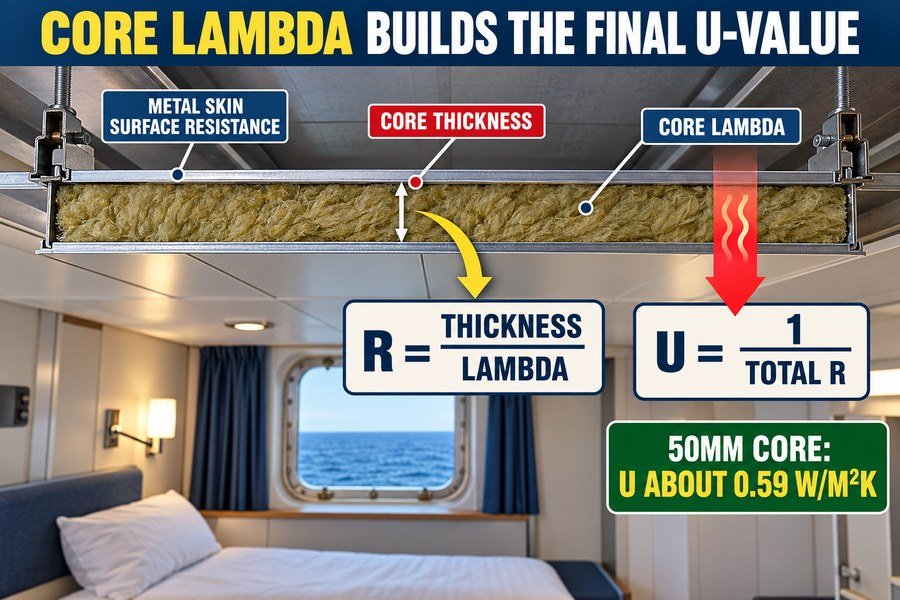
Core lambda values impact marine ceiling panel U-values directly because the U-value calculates total heat loss through the entire panel assembly. The final U-value is determined by three elements: the core lambda value, the core thickness, and the surface resistance of the metal skins.
The Role of Core Lambda Value and Core Thickness in U-Value Calculation
Buyers often mix up lambda (λ) and U-value. You must understand the difference to negotiate properly. Lambda measures the material itself. U-value measures the whole finished panel.9 The core lambda value is the starting point. To find the thermal resistance (R) of the core, you divide the thickness (in meters) by the lambda value10. For example, let us take a standard marine ceiling panel. It uses rock wool with a lambda of 0.034 W/m·K11. If the core thickness is 50mm (0.05 meters), the thermal resistance is 0.05 / 0.034 = 1.47 m²·K/W.
If you use a thinner panel, say 25mm, the thermal resistance drops in half. The core thickness is just as important as the core lambda value. A shipyard might demand a ceiling U-value of less than 0.60 W/m²·K. If you buy a 25mm panel, you will fail the requirement, even if the lambda is excellent. I always ask shipyards for their target U-value first. Then, I calculate the exact core thickness I need to order from the factory. This prevents buying panels that are too thin and fail inspections.
The Influence of Metal Skin Surface Resistance on Total Panel U-Value
The U-value calculation does not stop at the core. A marine ceiling panel is a sandwich. It has metal skins on the top and bottom. Usually, this is 0.6mm galvanized steel or aluminum. We must include the surface resistance of these metal skins. When air touches the metal skin, a tiny microscopic layer of still air forms on the surface. This creates surface film resistance. We have inner surface resistance (Rsi) and outer surface resistance (Rse). For typical indoor marine ceilings, Rsi and Rse add about 0.20 m²·K/W to the total resistance.
To get the final U-value, you take the total thermal resistance (Core Resistance + Rsi + Rse) and divide 1 by that total number. So, 1 / (1.47 + 0.20) gives a U-value of 0.59 W/m²·K. This calculation proves that the core lambda value, the core thickness, and the surface resistance of the metal skins all work together. If any of these three elements are wrong, the U-value fails. You must ask your suppliers for full U-value calculation sheets, not just the raw rock wool lambda.
| Panel Component | Parameter | Calculation Value | Contribution to U-Value |
|---|---|---|---|
| Rock Wool Core | Lambda = 0.034, Thickness = 50mm | R = 1.47 m²·K/W | Provides 88% of insulation |
| Rock Wool Core | Lambda = 0.034, Thickness = 25mm | R = 0.73 m²·K/W | Provides only 78% of insulation |
| Metal Skins | Surface Film Resistance (Rsi + Rse) | R = 0.20 m²·K/W | Provides 12% of insulation |
| Complete 50mm Panel | Total Assembly Heat Loss | U = 0.59 W/m²·K | Meets typical shipyard specs |
Thermal Conductivity vs. R-Value in Marine Accommodation Panels: What Differs?
You submit R-values to a European shipyard. They demand thermal conductivity instead. Mixing these terms delays your project. They measure different things entirely.
Thermal conductivity (lambda) and R-value differ in marine accommodation panels in three distinct ways: lambda measures the material's innate heat transfer regardless of size, while R-value measures the specific thickness's thermal resistance. Furthermore, European shipyards mandate lambda (W/m·K), whereas US shipyards often request R-value (ft²·°F·hr/BTU).
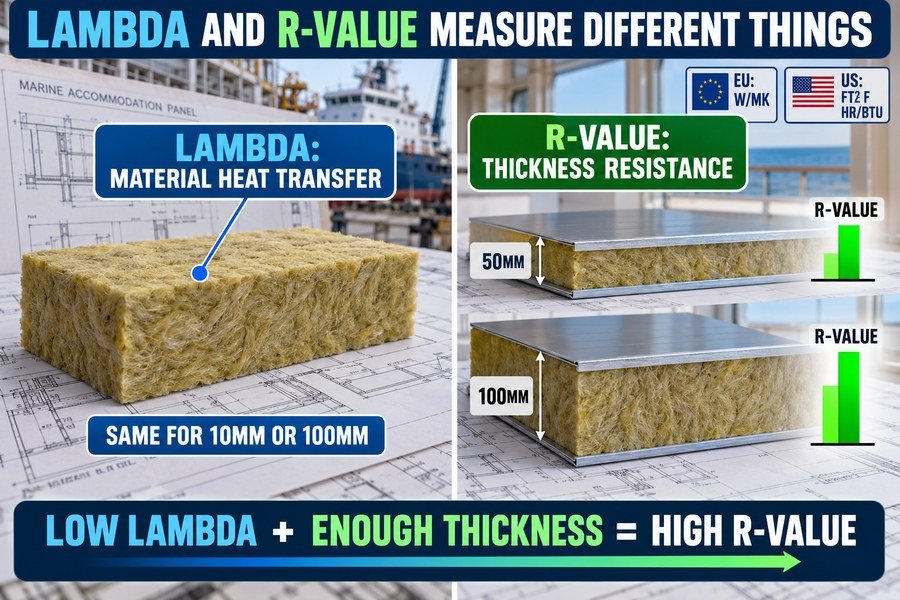
Material Innate Heat Transfer (Lambda) vs Specific Thickness Resistance (R-value)
You must use the right vocabulary when talking to shipyards. Thermal conductivity (lambda) is an innate property of the raw material12. It does not care about size or shape. A 10mm piece of rock wool and a 100mm piece of rock wool have the exact same lambda value (e.g., 0.034 W/m·K). Lambda tells you how good the material is at conducting heat.
R-value is completely different. R-value measures thermal resistance for a specific thickness. It cares very much about size. You get the R-value by dividing the thickness by the lambda value13. Therefore, a 100mm panel has a much higher R-value than a 50mm panel, even though they use the same rock wool. When you buy marine accommodation panels, you use lambda to check the quality of the core material. You use R-value to prove that the final panel is thick enough to keep the cabin warm. I see many buyers get confused and ask factories for "a high lambda panel". That is wrong. You want a low lambda and a high R-value.
European Shipyard Mandates (W/m·K) vs US Shipyard Requirements (R-value)
The biggest difference you will face is regional standards. This affects your daily business. European shipyards operate on the metric system. They follow strict ISO standards. They mandate thermal conductivity in Watts per meter-Kelvin (W/m·K) or U-value in W/m²·K14. If you submit a quotation to a German or Norwegian shipyard using R-value, they will reject your document. They do not have time to convert your numbers.
US shipyards are different. They use the Imperial system. They often request the R-value in ft²·°F·hr/BTU. In the US, a standard R-value for a wall might be R-11 or R-13. If you buy panels from China or Vietnam, the factory will give you a metric test report. You must convert these metric numbers into Imperial R-values before you sell them to a US shipyard. To convert a metric R-value to a US R-value, you multiply the metric number by 5.67815. I use this conversion trick every week. You must know your customer's location and provide the exact metrics they demand.
| Metric Type | What It Measures | Depends on Thickness? | Common Unit | Target Market |
|---|---|---|---|---|
| Thermal Conductivity (Lambda) | Innate heat transfer of material | No | W/m·K | Europe, Asia |
| Metric R-Value | Thermal resistance of a panel | Yes | m²·K/W | Europe, Asia |
| Imperial R-Value | Thermal resistance of a panel | Yes | ft²·°F·hr/BTU | United States |
Conclusion
Thermal conductivity controls your marine panel performance entirely. You must master lambda values, optimal core density, thermal bridging, and R-value conversions to buy the right panels, satisfy strict shipyard requirements, and secure your profits smoothly.
-
"Determination of Thermal Properties of Mineral Wool ... - PMC", https://pmc.ncbi.nlm.nih.gov/articles/PMC10488771/. A technical or reference source on building insulation materials should document typical thermal conductivity ranges for glass wool near 0.040 W/m·K under standard test conditions. Evidence role: statistic; source type: institution. Supports: Standard glass wool has a lambda of about 0.040 W/m·K. Scope note: Reported lambda values vary by product density, mean test temperature, facing, and certification method, so the source would support the approximate range rather than every glass wool panel. ↩
-
"Standard Reference Data for the Thermal Conductivity of ...", https://www.nist.gov/document/jpcrd493pdf. Standard thermophysical-property references list liquid water thermal conductivity at roughly 0.6 W/m·K and still air near 0.024–0.026 W/m·K around room temperature, supporting the comparison used to explain moisture-related heat transfer. Evidence role: statistic; source type: government. Supports: Water has much higher thermal conductivity than air, with approximate values of 0.58 W/m·K for water and 0.024 W/m·K for air. Scope note: Exact values depend on temperature, pressure, and measurement conditions; the citation supports approximate room-temperature values. ↩
-
"13 Atoms, Molecules, and Thermal Energy", https://web.phys.ksu.edu/fascination/Chapter13.pdf. A thermodynamics or heat-transfer reference explains heat conduction in solids as energy transfer associated with molecular, atomic, or lattice vibrations, supporting the physical basis of the statement. Evidence role: definition; source type: education. Supports: Heat transfer through solid materials can be understood as kinetic energy transfer at the molecular or lattice level. Scope note: This supports the general mechanism of conductive heat transfer, but it does not quantify heat flow in any specific marine panel. ↩
-
"Microporous calcium silicate thermal insulator", http://www.acsu.buffalo.edu/~ddlchung/Microporous%20calcium%20silicate%20thermal%20insulator.pdf. Published material-property tables report calcium silicate insulation or board thermal conductivity values in the approximate range of 0.05–0.12 W/m·K depending on density, temperature, and formulation, providing contextual support for the stated lambda value. Evidence role: statistic; source type: research. Supports: Calcium silicate board can have a thermal conductivity around 0.11 W/m·K. Scope note: The exact value varies by product grade, density, moisture content, and test temperature, so the citation should not be read as proof for every calcium silicate board. ↩
-
"Standard Reference Data for the Thermal Conductivity of ...", https://www.nist.gov/document/jpcrd493pdf. Standard thermal-property references list liquid water thermal conductivity near 0.6 W/m·K and air near 0.025 W/m·K at room temperature, which yields a ratio of roughly 24 to 1. Evidence role: statistic; source type: government. Supports: Liquid water has approximately 24 times the thermal conductivity of air under common reference conditions. Scope note: The ratio depends on temperature, pressure, and whether still air or moving air is considered. ↩
-
"Comparison of Models for Heat Transfer in High-Density ...", https://pmc.ncbi.nlm.nih.gov/articles/PMC7339548/. A heat-transfer source on fibrous or porous insulation should support that insufficiently restrained air in low-density insulation can permit natural convection, increasing apparent thermal conductivity. Evidence role: mechanism; source type: paper. Supports: Low-density rock wool can allow internal air movement, causing convective heat loss. Scope note: This would support the physical mechanism generally, but may not prove the article's specific density threshold for marine rock wool panels. ↩
-
"Determination of Thermal Properties of Mineral Wool ... - PMC", https://pmc.ncbi.nlm.nih.gov/articles/PMC10488771/. A materials dataset, technical standard, or experimental paper should document typical thermal conductivity values for mineral wool at about 60 kg/m³, supporting the stated order of magnitude for lambda. Evidence role: statistic; source type: research. Supports: A 60 kg/m³ rock wool panel can have a thermal conductivity near 0.045 W/m·K. Scope note: Published values may vary by product formulation, temperature, moisture content, and test method, so the source may support a plausible range rather than this exact value. ↩
-
"Determination of Thermal Properties of Mineral Wool ... - PMC", https://pmc.ncbi.nlm.nih.gov/articles/PMC10488771/. Engineering reference data list carbon steel thermal conductivity in the range of roughly 45 W/m·K and mineral/rock wool insulation around hundredths of a W/m·K, supporting the stated order-of-magnitude contrast between steel and rock wool. Evidence role: statistic; source type: education. Supports: Steel conducts heat at about 45 W/m·K, more than 1,000 times higher than rock wool insulation. Scope note: Exact values vary with alloy, temperature, density, and product formulation, so the comparison is best treated as approximate. ↩
-
"thermal transmittance Research Papers", https://www.academia.edu/Documents/in/thermal_transmittance. A building-physics reference defines thermal conductivity (λ) as a material property and thermal transmittance (U-value) as heat transfer through a building element or assembly per unit area and temperature difference, supporting the distinction between material and panel-level performance. Evidence role: definition; source type: education. Supports: Lambda is a material property, while U-value describes the thermal performance of the whole finished panel. Scope note: The source supports the general heat-transfer terminology, not the performance of any particular marine ceiling panel. ↩
-
"Thermal conductivity values for laminated strand lumber and ...", https://bioresources.cnr.ncsu.edu/resources/thermal-conductivity-values-for-laminated-strand-lumber-and-spruce-for-use-in-hybrid-cross-laminated-timber-panels/. Heat-transfer teaching materials state that the thermal resistance of a homogeneous layer is calculated as thickness divided by thermal conductivity, R = d/λ, which supports the calculation method used for the panel core. Evidence role: mechanism; source type: education. Supports: The thermal resistance of the core can be calculated by dividing its thickness in meters by the lambda value. Scope note: This formula applies to a homogeneous layer and does not account for joints, fasteners, thermal bridges, or non-uniform panel construction. ↩
-
"Determination of Thermal Properties of Mineral Wool ... - PMC", https://pmc.ncbi.nlm.nih.gov/articles/PMC10488771/. Published insulation references commonly report mineral wool or rock wool thermal conductivity values in the approximate range of 0.03–0.04 W/m·K, placing λ = 0.034 W/m·K within a typical published range. Evidence role: general_support; source type: government. Supports: Rock wool can have a lambda value around 0.034 W/m·K. Scope note: The source would support the plausibility of the stated value for rock wool generally, but it would not certify the lambda value of a specific marine panel product or batch. ↩
-
"Thermal Conductivity and the Wiedemann-Franz Law", http://hyperphysics.phy-astr.gsu.edu/hbase/thermo/thercond.html. A heat-transfer reference defines thermal conductivity as a material property relating heat flux to a temperature gradient, supporting the distinction between material conductivity and assembly-level thermal resistance. Evidence role: definition; source type: education. Supports: Thermal conductivity/lambda is a property of the material rather than of a specific panel thickness or shape. Scope note: Conductivity values can vary with temperature, moisture content, density, and test method, so a single lambda value is not universal for all conditions. ↩
-
"16.4 Thermal Resistance Circuits", https://web.mit.edu/16.unified/www/FALL/thermodynamics/notes/node118.html. Heat-transfer references give the thermal resistance of a homogeneous plane layer as thickness divided by thermal conductivity, which supports the stated relationship between panel thickness, lambda, and R-value. Evidence role: mechanism; source type: education. Supports: For a homogeneous material layer, R-value equals thickness divided by thermal conductivity. Scope note: The formula applies directly to homogeneous layers under steady one-dimensional conduction; multilayer panels, air films, joints, and thermal bridges require additional resistance terms or testing. ↩
-
"Thermal transmittance - Wikipedia", https://en.wikipedia.org/wiki/Thermal_transmittance. International and European thermal-performance standards commonly express thermal conductivity in W/m·K and thermal transmittance, or U-value, in W/m²·K, supporting the article's description of metric reporting conventions for European specifications. Evidence role: definition; source type: institution. Supports: European or ISO-style specifications commonly use W/m·K for thermal conductivity and W/m²·K for U-value. Scope note: This supports the unit convention used in European and ISO-style documentation, but it does not prove that every individual European shipyard will reject R-value submissions. ↩
-
"NIST Guide to the SI, Appendix B.8: Factors for Units Listed ...", https://www.nist.gov/pml/special-publication-811/nist-guide-si-appendix-b-conversion-factors/nist-guide-si-appendix-b8. Unit-conversion references from standards or metrology sources show that 1 m²·K/W equals approximately 5.678 ft²·°F·hr/Btu, supporting the stated conversion from metric to U.S. customary R-value. Evidence role: mechanism; source type: government. Supports: A metric R-value in m²·K/W is converted to a U.S. customary R-value by multiplying by about 5.678. Scope note: The conversion is a unit conversion only; it does not validate that the underlying test method, boundary conditions, or panel construction are equivalent between reports. ↩