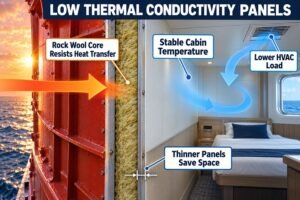
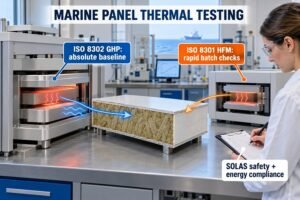
You look at panel spec sheets and see confusing numbers. If you buy the wrong panels, your shipyard rejects them. Here is how to read the lambda value correctly.
Thermal conductivity (lambda value) on marine panel specs measures heat transfer. To read it correctly, check the specific value (usually 0.034 to 0.045 W/mK for rockwool), the reference temperature (typically 10°C or 24°C), and the test standard (like EN 12667 or ISO 8301) to ensure fair supplier comparisons.
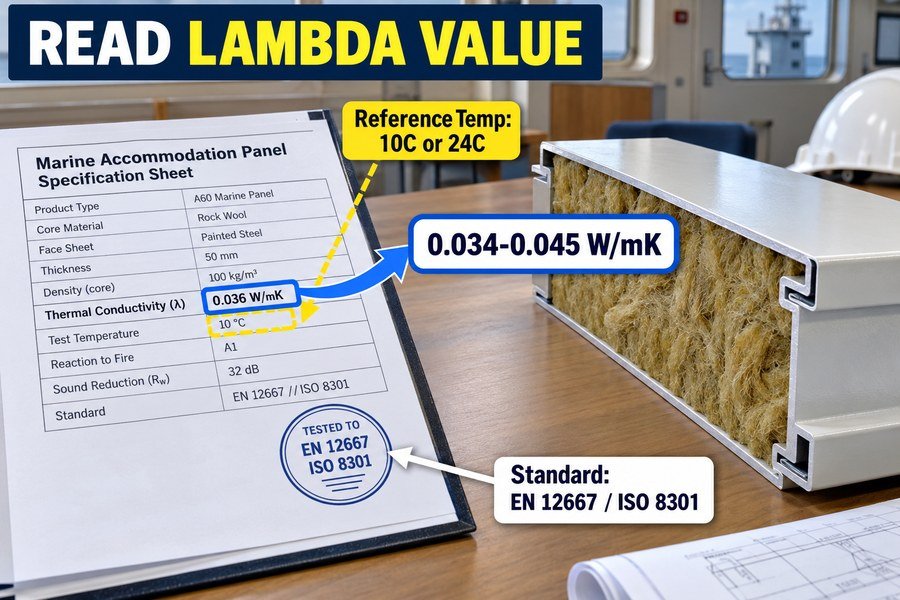
If you do not know how to read these numbers, suppliers can easily trick you.
Declared vs. Tested Thermal Conductivity in Marine Interior Panels: What Differs?
Some suppliers show a tested value on their quotes. Other suppliers show a declared value. If you do not know the difference, you might buy the wrong marine panels.
Declared thermal conductivity (lambda-D) is a statistically guaranteed worst-case value over 25 years of service, while tested thermal conductivity represents a single factory sample result. Buyers must always use the declared value, as it accounts for aging and production variations, ensuring panels meet shipyard safety and insulation requirements.
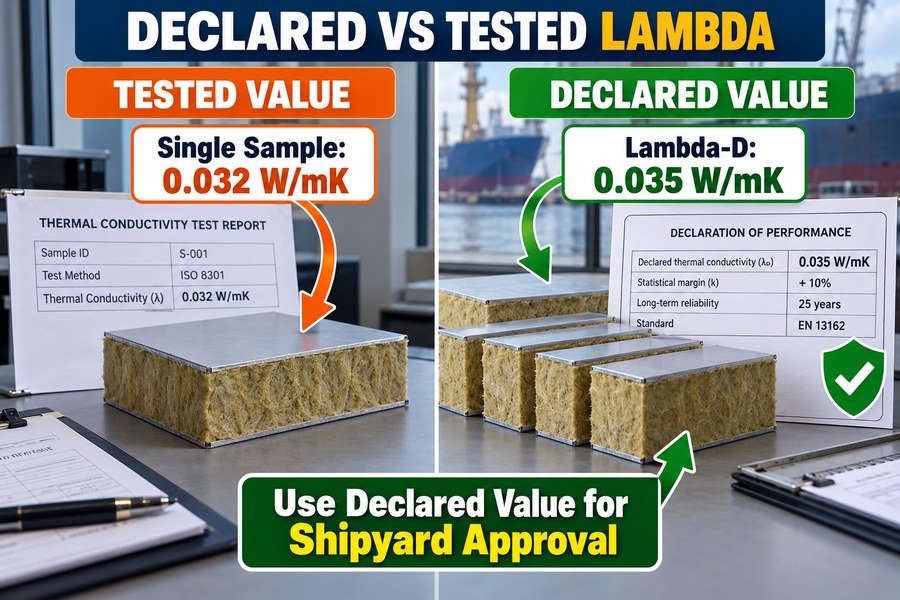
I see many procurement officers make mistakes here. They want the lowest price and the best performance. They look at a Chinese supplier's spec sheet. The sheet shows a tested thermal conductivity of 0.032 W/mK. This looks amazing. But this number is dangerous.
Understanding Tested Thermal Conductivity for Single Panel Samples
Tested thermal conductivity comes from just one single piece of material. A factory takes one piece of 50mm marine rockwool wall panel. They send it to a lab. The lab tests it once. The machine shows 0.032 W/mK. The factory prints this number on their brochure. I tell my clients at Magellan Marine to ignore this number. Production has variations.1 One batch has a density of 120 kg/m3. The next batch has a density of 115 kg/m3. The tested value does not represent the whole order. You cannot use a single sample result to build a large passenger ship. If you do, the HVAC system will fail2.
Why Declared Thermal Conductivity (Lambda-D) Guarantees Long-Term Marine Performance
European and American shipyards demand the declared thermal conductivity (Lambda-D). According to standard EN 13162, the factory must test many samples over time. They must add a statistical penalty to the results. This covers 90% of production with a 90% confidence level. If the average tested value is 0.032 W/mK, the declared value becomes 0.035 W/mK. It looks worse on paper, but it is real. It includes safety margins for aging. When you buy interior outfitting products from Asia, you must force the supplier to provide the Lambda-D value.
| Feature | Tested Thermal Conductivity | Declared Thermal Conductivity (Lambda-D) |
|---|---|---|
| Sample Size | Only 1 single panel | Multiple panels over a long time |
| Statistical Penalty | No penalty added | Adds penalty for 90% confidence |
| Real-World Reliability | Very low | Very high (used by EU/US shipyards) |
| Typical Value (Rockwool) | 0.032 W/mK | 0.035 W/mK |
You must ask the local sales rep direct questions about this. They often lack technical expertise. You must verify the test reports yourself.
What Reference Temperature Must Marine Accommodation Panel Lambda Values Specify?
Heat changes how insulation works. If you read a lambda value without checking the reference temperature, you are comparing apples to oranges.
Marine panel lambda values must specify a reference temperature, typically 10°C for European standards or 24°C for US standards. Thermal conductivity increases by approximately 0.001 W/mK for every 10°C rise. Comparing a panel tested at 10°C to one tested at 24°C without adjusting values causes incorrect purchasing decisions.
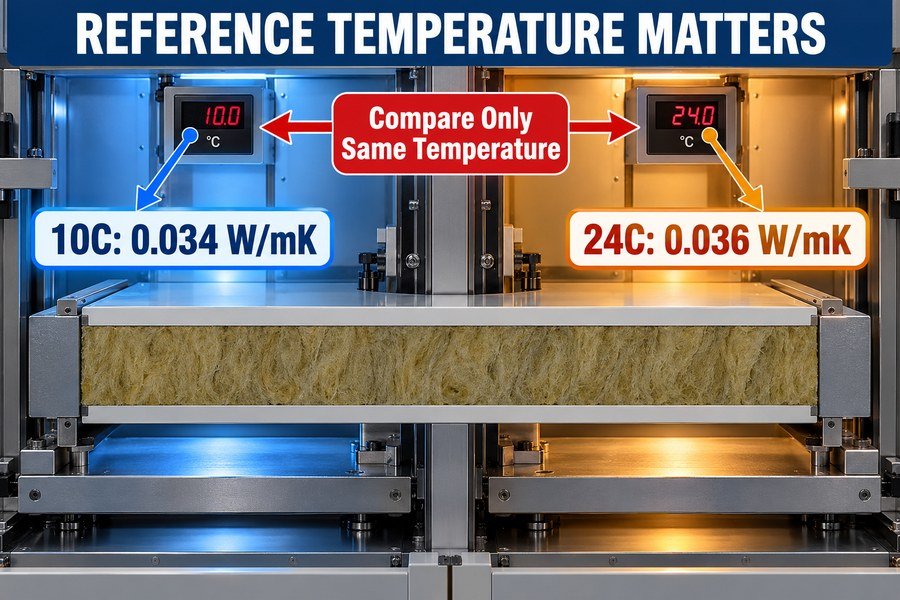
I review hundreds of quotations for marine wall panels and ceiling panels every year. The biggest trick I see relates to the reference temperature. A lambda value is not a fixed number. It changes based on the temperature of the testing room.
The European Standard: 10°C Reference Temperature in Marine Panels
In Europe, most labs test marine insulation at a mean temperature of 10°C (50°F). Because the testing environment is cool, the thermal conductivity value looks very good. A standard rockwool core panel might show 0.034 W/mK at 10°C. If your end customer is a European shipyard, this is the exact number they want to see on your documents. The EN standards require this 10°C baseline for CE marking.
The US Standard: 24°C Reference Temperature in Marine Panels
In the United States, labs test materials at a mean temperature of 24°C (75°F) or sometimes 23.9°C. Because the testing environment is warmer, heat moves faster through the panel. That same rockwool panel will show 0.035 W/mK or 0.036 W/mK at 24°C. The panel did not get worse. The test simply changed. I helped a client who bought panels from Vietnam. They saw a value of 0.034 W/mK. They submitted it to a US shipyard. The US shipyard rejected the panels. The shipyard needed 0.035 W/mK at 24°C. The Vietnamese factory tested at 10°C. When we converted the math, the actual value at 24°C was 0.036 W/mK. The panel failed the spec.
| Reference Temperature | Standard Region | Typical Rockwool Lambda Value | Application Goal |
|---|---|---|---|
| 10°C (50°F) | Europe (EN / ISO) | 0.034 W/mK | European shipyard CE marking |
| 24°C (75°F) | United States (ASTM) | 0.035 - 0.036 W/mK | US Coast Guard compliance |
| 50°C (122°F) | Engine Room Tests | 0.040 W/mK | High-heat bulkhead boundaries |
Always check the small print at the bottom of the data sheet. If the temperature is missing, ask for the full lab report.
Why Does Marine Interior Panel Thermal Conductivity Vary Across ISO/EN Standards?
Different countries use different test machines. This causes the final numbers to look different on the paper. You must know which standard applies.
Marine panel thermal conductivity varies because ISO 8301 uses general heat flow meters, EN 12667 tests high thermal resistance products, and ASTM C518 relies on specific US calibration methods. These three distinct testing standards create slight value variations, meaning buyers must ensure competing panels use the exact same standard.
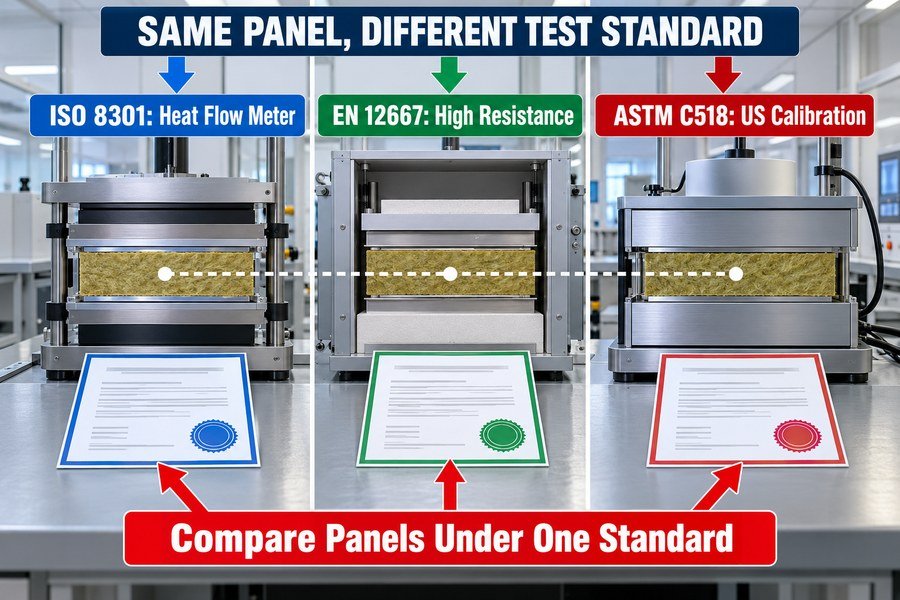
You cannot compare quotes if the factories use different testing rules. You will make a bad purchasing decision. You must understand the three main standards used in the shipbuilding industry.
ISO 8301 Heat Flow Meter Method for Marine Panels
Many factories in Asia use the ISO 8301 standard. This standard uses a heat flow meter to measure heat transfer. It is a very reliable global standard. I often see this on test reports from Chinese suppliers. It is accurate to within 3%. If a factory gives you an ISO 8301 report, you can generally trust the data for basic commercial ships.
EN 12667 Testing for High Thermal Resistance Marine Accommodation Panels
European shipyards prefer the EN 12667 standard. This standard is very strict. It is designed for thick products with high thermal resistance. It dictates exactly how the lab must prepare the marine wall panels before testing. The lab must condition the panels at specific humidity levels. This makes the final value slightly higher than a basic ISO test. If you undertake interior decoration projects in Europe, you must demand EN 12667.
ASTM C5183 Calibration Differences in Marine Panel Testing
US shipyards require ASTM C518. This method also uses a heat flow meter. But the calibration rules are different. The US labs use different reference materials to zero their machines. This causes the final lambda value to vary slightly from the EN standard. If you buy a B-15 marine fire door from China to install on an American vessel, you must ask the factory to test it under ASTM C518. If they only have the Chinese GB/T standard, you must pay a lab like SGS about $1,500 to run the ASTM test.
| Test Standard | Primary Region | Best Used For | Key Characteristic |
|---|---|---|---|
| ISO 8301 | Global / Asia | General marine outfitting | Uses standard heat flow meter |
| EN 12667 | Europe | High-spec passenger ships | Strict panel conditioning rules |
| ASTM C518 | United States | US Coast Guard vessels | Specific US calibration methods |
If your two suppliers use different standards, tell them to stop. Make them provide data using the exact same standard.
How to Spot Missing Test Conditions in Marine Accommodation Panel Lambda Values?
Sales quotes often hide things. A low lambda value looks great until you realize half the test conditions are missing.
To spot missing test conditions, check the spec sheet for four mandatory elements: the exact lambda value, the reference mean temperature (e.g., 10°C), the aging status (fresh vs. aged), and the specific test standard (e.g., ISO 8301). Missing any of these four indicates an incomplete and risky supplier specification.

A good procurement officer must act like a detective. You must look for what is missing on the paper. At Magellan Marine, I train my team to reject any spec sheet that does not show all the facts.
Identifying the Exact Lambda Value and Reference Mean Temperature
You must look for the first two elements immediately. First, find the exact lambda value. Do not accept a range. If a supplier says "0.034 to 0.040 W/mK", reject it. You need an exact declared number like 0.036 W/mK. Second, look for the reference mean temperature. As we discussed, a number without a temperature is useless. The document must explicitly state "at 10°C" or "at 24°C". If you do not see this, the factory is probably hiding a bad test result.
Verifying Aging Status and Specific Test Standards on Spec Sheets
Next, look for the last two elements. Third, check the aging status. The sheet must tell you if the test was done on a fresh panel or an aged panel. You want the aged value to ensure long-term safety. Fourth, look for the specific test standard. It must say ISO 8301, EN 12667, or ASTM C518. Many low-quality factories only write "Tested by Lab". They do not name the standard. This means they used an internal, unofficial testing method. Do not buy marine ceiling panels from these suppliers. Your shipyard client will audit your paperwork and block your payment.
| Mandatory Element | Correct Example | Incorrect / Risky Example |
|---|---|---|
| Exact Lambda Value | 0.035 W/mK | < 0.040 W/mK |
| Reference Temperature | At 10°C mean temp | (Blank / No mention) |
| Aging Status | Declared value (25 years) | Initial value |
| Specific Test Standard | EN 12667 | Factory Lab Method |
Print this checklist. Keep it on your desk. Check every single quotation against these four rules.
What Does Aged Thermal Conductivity Mean for Marine Interior Panels?
Ships stay in the water for 25 years. Your marine panels will degrade. You cannot just look at the day-one performance.
Aged thermal conductivity reflects a marine panel's insulation performance after 25 years of use, factoring in moisture absorption, structural settling, and gas diffusion. For marine rockwool panels, the aged lambda value typically increases by 0.002 to 0.004 W/mK compared to fresh panels, representing the true lifetime performance.
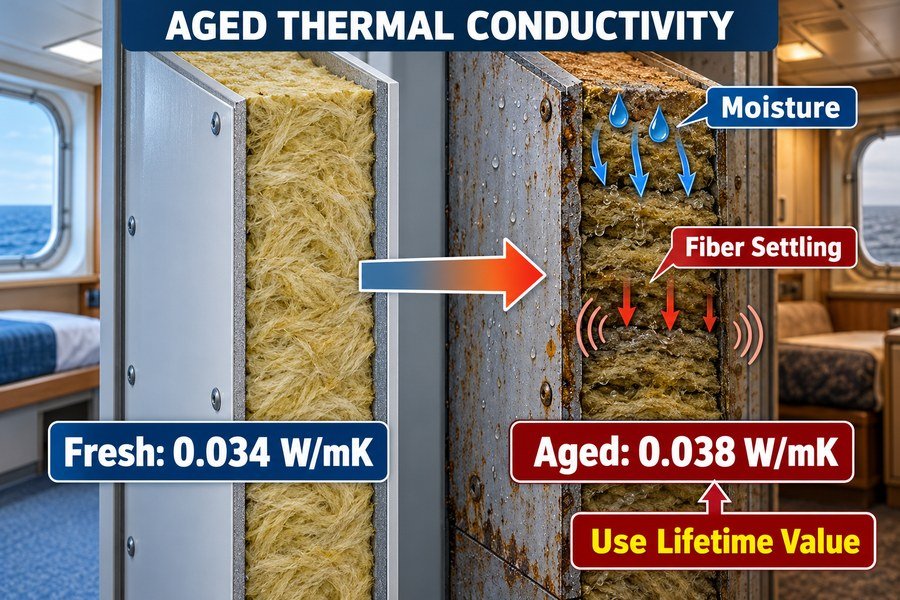
Ship interior decoration is not like building a house on land. The ocean is a terrible environment. Things break down faster. You must buy products that still work decades later.
How Moisture and Settling Impact Aged Thermal Conductivity
Three things happen to a marine panel over 25 years. First, moisture absorption. Sea air is extremely wet. Even behind steel bulkheads, humidity enters the cabin. Rockwool absorbs tiny amounts of water over the years. Water conducts heat very well. Second, structural settling. The ship engine vibrates constantly. Ocean waves hit the hull. The rockwool fibers inside the wall panel shake. Over time, they settle. The density at the top of the panel decreases. The density at the bottom increases. Third, gas diffusion. This mainly affects foam panels, but it matters. All these factors make the panel worse at blocking heat.4
Calculating the 25-Year Performance Shift in Marine Rockwool Panels
You must calculate this shift. A fresh A-60 marine wall panel might have a lambda value of 0.034 W/mK on the first day. After 25 years at sea, the moisture and settling increase the value. It becomes 0.038 W/mK. This is an increase of 0.004 W/mK. If you design the ship's air conditioning system using the fresh value, the ship will become too hot 10 years later. The shipyard will blame you. You must ask the supplier for the aged thermal conductivity. Standard EN 13162 provides strict mathematical formulas to calculate this aging.
| Material Type | Fresh Lambda Value | Aged Lambda Value (25 Years) | Performance Loss Factor |
|---|---|---|---|
| Marine Rockwool | 0.034 W/mK | 0.038 W/mK | Moisture and fiber settling |
| Glass Wool | 0.032 W/mK | 0.037 W/mK | High moisture sensitivity |
| PUR Foam (Cold Rooms) | 0.022 W/mK | 0.028 W/mK | Blowing gas diffusion |
Always buy based on the aged number. It protects your profit and your reputation.
Which Test Standards Must Accompany a Marine Accommodation Panel's Lambda Value?
A number means nothing without the rulebook. You must demand the correct test standard on the certificate before paying the deposit.
A marine panel's lambda value must be accompanied by one of three primary test standards: ISO 8301 for general heat resistance, EN 12667 for high thermal resistance materials, or ASTM C518 for US-compliant heat flow meter testing. Procuring panels without these three specific standards risks failing shipyard inspections.

You buy high-quality ship interior outfitting products from developing countries. The prices are good. But the local certifications are not enough for large shipyards in Europe and the United States. You must check the exact test standard printed next to the lambda value.
ISO 83015 Standard for General Heat Resistance Testing
You must look for ISO 8301. This is the global baseline. If you buy a marine ceiling panel from Vietnam, the factory must at least provide an ISO 8301 report. This proves they used a proper heat flow meter. However, some very strict European shipyards might ask for more. But ISO 8301 is a safe starting point for general commercial vessels like bulk carriers.
EN 12667 Standard for High Thermal Resistance Marine Materials
You must demand EN 12667 for European projects. When you undertake interior decoration for a luxury cruise ship built in Italy or Germany, the shipyard inspector will check this. EN 12667 is specifically designed for thick, high thermal resistance materials. It is part of the European CE marking system. If your Chinese supplier only has a local GB/T standard, you cannot use it.
ASTM C518 Compliance for US Shipyard Requirements
You must require ASTM C518 for the American market. If the ship sails in US waters, the US Coast Guard controls the rules. ASTM C518 uses specific calibration methods. I always advise my clients: do not try to submit an EN 12667 report to an American shipyard. They will reject it. You must pay an international lab to test the panel again under ASTM C518.
| Required Standard | Target Market | Testing Focus | Acceptance Level |
|---|---|---|---|
| ISO 8301 | Global Commercial | General heat transfer | Medium to High |
| EN 12667 | European Union | Thick marine panels | Very High (Required for CE) |
| ASTM C518 | United States | US calibration matching | Very High (Required by USCG) |
Always secure the correct test report before you load the shipping container.
Conclusion
Reading thermal conductivity correctly saves your shipyard projects from rejection. Always verify the declared values, check the reference temperatures, and match the testing standards before placing your final order.
-
"Determination of Thermal Properties of Mineral Wool ... - PMC", https://pmc.ncbi.nlm.nih.gov/articles/PMC10488771/. Research on mineral-wool and fibrous insulation reports that thermal conductivity varies with material parameters such as density, porosity, and fiber structure, supporting the general point that production variation can affect measured lambda values. Evidence role: mechanism; source type: paper. Supports: Production variation in rockwool panels can change the thermal conductivity measured from batch to batch.. Scope note: Such studies support the physical mechanism but do not verify the specific batch densities or quality variation of any named supplier. ↩
-
"EnergyPlus Articles from the Building Energy Simulation User ...", https://simulationresearch.lbl.gov/dirpubs/un_articleEP02.pdf. ASHRAE and building-physics references describe HVAC design loads as depending on heat transfer through assemblies, where U-values and thermal resistance are derived from material conductivity; this supports the mechanism by which underestimated insulation conductivity can lead to undersized heating or cooling capacity, but it does not prove inevitable system failure in every ship project. Evidence role: mechanism; source type: institution. Supports: Using an unrealistically low thermal-conductivity value can cause HVAC loads to be underestimated, risking inadequate system performance.. Scope note: The evidence is contextual because HVAC failure also depends on safety factors, operating conditions, ventilation loads, and design margins. ↩
-
"National Bureau of Standards", https://tsapps.nist.gov/srmext/certificates/1452.pdf. ASTM C518 specifies the measurement of steady-state thermal transmission properties by means of heat-flow-meter apparatus, establishing that the method is technically comparable to other heat-flow-meter standards while governed by ASTM-specific procedures. Evidence role: definition; source type: institution. Supports: ASTM C518 is a heat-flow-meter test method with its own procedural and calibration requirements.. Scope note: This supports the nature of the ASTM method but does not by itself prove that all U.S. shipyards require it for every marine panel application. ↩
-
"Transient Thermal Conductivity Minimum in Phenolic Foam ...", https://pmc.ncbi.nlm.nih.gov/articles/PMC13468618/. Studies of insulation heat transfer report that absorbed moisture increases the effective thermal conductivity of fibrous insulation, while closed-cell foams can age as blowing agents diffuse out and air diffuses in; this supports the stated degradation mechanisms but does not quantify performance loss for a specific A-60 marine panel. Evidence role: mechanism; source type: paper. Supports: Moisture absorption, fiber settling, and gas diffusion can reduce a panel’s long-term insulating performance.. Scope note: Contextual support only; the source may not address marine wall panels or 25-year service life directly. ↩
-
"Line Heat-Source Guarded Hot Plate", https://www.nist.gov/laboratories/tools-instruments/line-heat-source-guarded-hot-plate. ISO 8301 specifies the use of a heat-flow-meter apparatus for determining steady-state thermal resistance and related thermal transmission properties of thermal insulation materials. Evidence role: definition; source type: institution. Supports: ISO 8301 is a standard for heat-flow-meter testing of thermal resistance.. Scope note: This supports the test-method description, but not the broader claim that ISO 8301 is accepted by all commercial shipyards or vessel classes. ↩