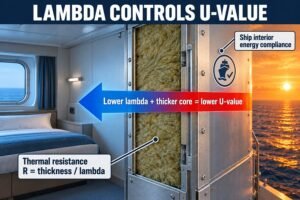
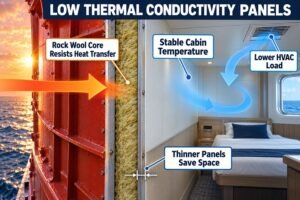
High thermal conductivity ruins ship HVAC efficiency. You lose money and fail European shipyard standards. I will show you exactly how to verify real lambda values today.
You can verify authentic marine interior panel thermal conductivity by checking DNV or CCS type approval certificates, reviewing ISO 8301 or ASTM C518 lab test reports, inspecting physical material density, and cross-referencing supplier data against established rockwool baselines (typically 0.034 to 0.045 W/m·K).

Do not read the rest of this guide if you are happy trusting unverified supplier claims and paying for high energy losses on your marine projects.
Which Lab Tests Determine Marine Accommodation Panel Thermal Conductivity?
Unverified panels lead to failed shipyard inspections. You cannot afford rejected materials. Here are the exact lab tests you must look for when buying panels.
The three primary lab tests determining marine panel thermal conductivity are the ISO 8301 Heat Flow Meter method, the ASTM C518 Standard Test Method, and the EN 12667 standard. These tests measure heat transfer through materials like rockwool, yielding the critical lambda value (W/m·K) required by maritime regulations.
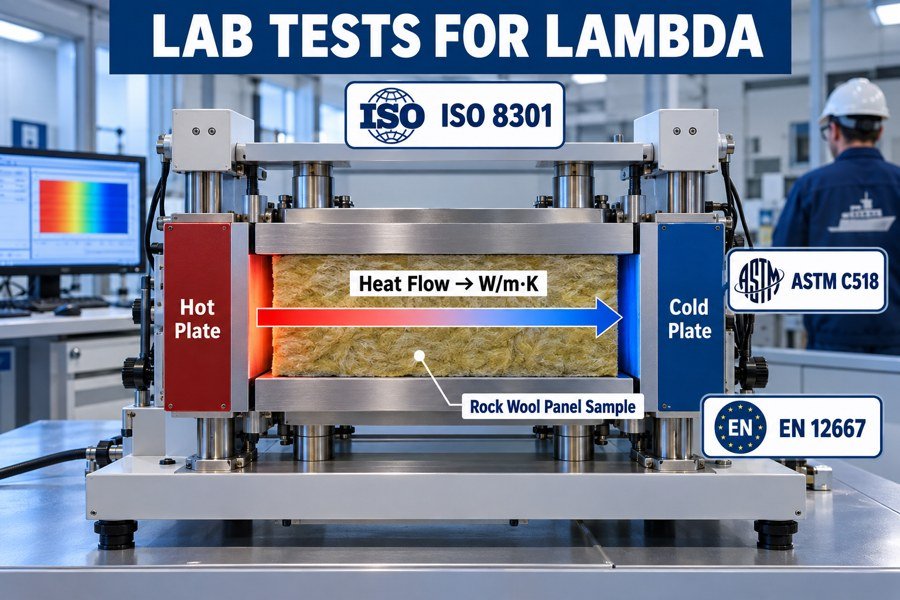
The ISO 8301 Heat Flow Meter Method Process
I see many buyers get confused by test names. You need to know the three main tests. The first test is ISO 8301. The International Organization for Standardization (ISO) created this method. It uses a heat flow meter to test flat materials. For marine rockwool panels, the lab places the panel between a hot plate and a cold plate. The temperature difference is usually around 10°C to 20°C. The machine measures how much heat moves through the panel. A good marine wall panel with 120 kg/m3 rockwool usually scores around 0.040 W/m·K in this test. This test takes a few hours to complete. The lab gives a formal report at the end. You must ask your Asian suppliers if they use this exact ISO test.
ASTM C518 and EN 12667 Testing Standards for Marine Panels
The second test is ASTM C518. The American Society for Testing and Materials (ASTM) uses this standard. It is very popular in the United States market. It is very similar to ISO 8301. If you sell your decorated interiors to US shipyards, they want to see ASTM C518 reports. The test measures steady-state thermal transmission. The third test is EN 12667. This is the European standard. European shipyards always ask for this specific test. It measures high and medium thermal resistance. The lab tests the panel at a mean temperature of 10°C. If a supplier shows you a lambda value of 0.034 W/m·K, you must ask which of these three tests they used. Without these three tests, the numbers mean nothing.
| Test Standard | Region/Market Focus | Test Method Mechanism | Typical Test Temperature |
|---|---|---|---|
| ISO 8301 | Global / International | Heat Flow Meter Apparatus | 10°C to 20°C difference |
| ASTM C518 | United States | Steady-State Thermal Transmission | 10°C to 24°C difference |
| EN 12667 | Europe | High/Medium Thermal Resistance | 10°C mean temperature |
How to Verify Marine Interior Panel Lambda Values via DNV/CCS Reports?
Fake certificates cost you projects. You lose big shipyard contracts. Let me show you how to read DNV and CCS reports properly to protect your business.
You verify marine panel lambda values via DNV/CCS reports by matching the product name exactly, checking the certificate validity date, confirming the specified rockwool density (typically 100-150 kg/m3), and ensuring the thermal conductivity value (W/m·K) matches the attached third-party laboratory test report referenced in the certificate.
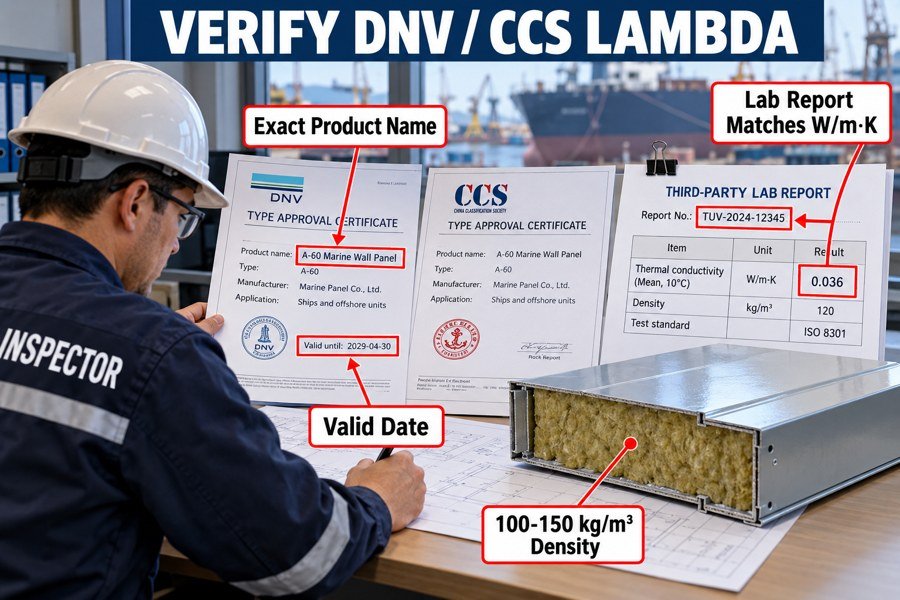
Matching Product Names and Validity Dates on Certificates
I have seen many buyers fail because they do not read the certificates. You must verify four specific details on DNV or China Classification Society (CCS) reports. First, check the product name. The name on the DNV certificate must exactly match your purchase order. If the certificate says "Type A Fire Wall 50mm" and you buy "Type B Fire Wall 50mm," the certificate is invalid for your goods. You cannot use it. Second, check the validity date. DNV certificates usually last for five years. Never accept an expired document. Shipyards will reject expired certificates immediately. Always look at the top right corner of the document for the expiration date.
Confirming Density and Laboratory Test References in DNV/CCS Reports
Third, you must confirm the rockwool density. Density directly controls the lambda value. According to DNV standards, marine rockwool density usually ranges from 100 kg/m3 to 150 kg/m3. If the certificate states 120 kg/m3, your actual panel must have 120 kg/m3 rockwool. Fourth, find the third-party lab report reference. The DNV or CCS certificate is just a summary page. It will list a specific lab report number at the bottom. You must ask the supplier for that exact lab report. The lambda value on the lab report must match the value the supplier promises you. If the lab report says 0.042 W/m·K, but the supplier claims 0.035 W/m·K, they are lying to you.
| Verification Step | Target Detail on Certificate | Why It Matters for Your Project |
|---|---|---|
| Product Name | Exact match with purchase order | Prevents suppliers from switching products |
| Validity Date | Expiration date within 5 years | Ensures compliance with current marine laws |
| Rockwool Density | 100 kg/m3 to 150 kg/m3 | Confirms the physical mass needed for insulation |
| Lab Reference | Matching third-party report number | Proves the thermal value is tested, not guessed |
Which Test Reports Prove Marine Accommodation Panel Thermal Conductivity?
Not all reports are valid. Useless papers waste your time. I will show you the four specific reports that actually prove thermal performance for marine projects.
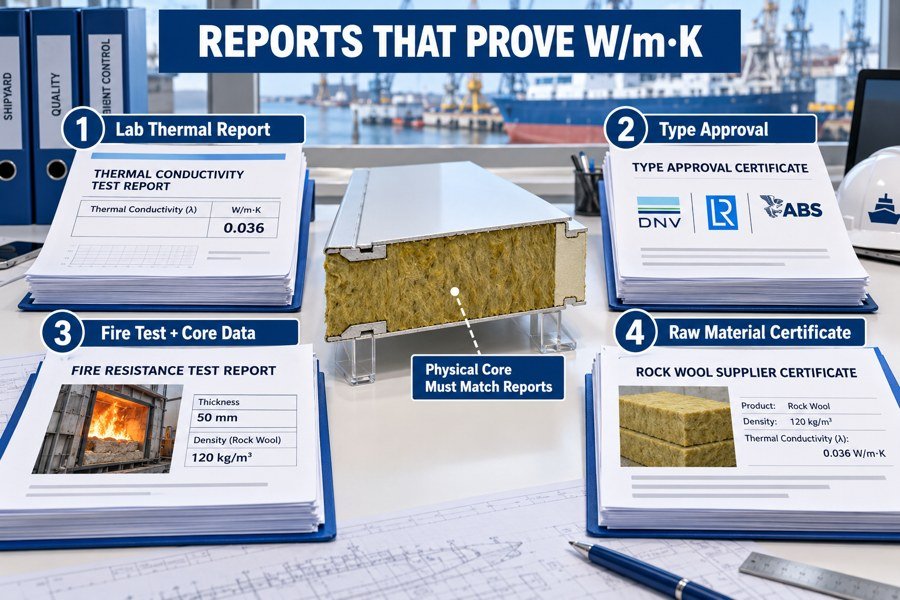
The four test reports that prove marine panel thermal conductivity are independent laboratory thermal testing reports (ISO/ASTM), Classification Society Type Approval certificates (DNV, LR, ABS), fire test reports (IMO FTP Code Part 3) which contain core material data, and the raw material manufacturer's original quality inspection certificates.
Independent Laboratory and Classification Society Approval Reports
When you buy from Asian factories for European projects, you need solid proof. You must collect four specific documents. First, you need the independent laboratory thermal testing report. As I mentioned before, this must be an ISO 8301 or ASTM C518 report1 from a recognized lab like SGS or Intertek. It shows the exact W/m·K value. Do not accept internal factory reports. Second, you need the Classification Society Type Approval certificate. Major shipyards trust DNV, Lloyd's Register (LR), or the American Bureau of Shipping (ABS). This document proves the marine wall panel meets global marine standards. Without this type approval, the panel is just a piece of metal and rockwool.
Fire Test Reports and Raw Material Manufacturer Certificates
Third, you must look at the fire test report. Marine panels must pass the IMO FTP Code Part 3 fire test2. Why does this matter for thermal conductivity? The fire test report always lists the exact details of the core material. It will state the rockwool thickness (e.g., 50mm) and density (e.g., 120 kg/m3). You can use this physical data to calculate if the thermal claims make sense. Fourth, ask for the raw material manufacturer's original certificate. The panel factory buys rockwool from someone else. Companies like Rockwool or Paroc provide batch quality certificates. These certificates list the factory-tested lambda value, usually between 0.034 and 0.045 W/m·K3. If you have all four reports, your European shipyard client will accept your panels.
| Required Document Type | Issuing Authority | Key Thermal Data Provided |
|---|---|---|
| Independent Lab Report | SGS, Intertek, TUV | Exact W/m·K value (e.g., 0.040) |
| Type Approval Certificate | DNV, LR, ABS, CCS | Official approval of material specs |
| Fire Test Report | IMO Approved Fire Lab | Verified core thickness and density |
| Raw Material Certificate | Rockwool Manufacturer | Original baseline lambda value |
How to Detect Overstated Lambda Values in Marine Interior Panels?
Fake data causes HVAC failure. You pay the penalty for bad insulation. Here are three ways to spot fake numbers instantly and protect your money.
You can detect overstated lambda values by comparing the claimed value against standard physics (values below 0.034 W/m·K for standard rockwool are suspicious), weighing the panel to verify the declared core density, and checking if the thermal conductivity changes realistically with different panel thicknesses.

Comparing Claimed Lambda Values Against Standard Rockwool Physics
Many sales people will tell you what you want to hear. You must protect yourself by using three detection methods. First, compare their number against basic physics. Most marine interior panels use mineral wool or rockwool as the core. According to major classification societies, high-quality marine rockwool has a thermal conductivity between 0.034 W/m·K and 0.045 W/m·K at 10°C4. If a supplier from China or Vietnam promises a value of 0.020 W/m·K for a standard rockwool panel, they are lying. That number is only possible for polyurethane foam. Polyurethane foam is not used for A-Class fire doors or A-Class panels because it burns easily.
Weighing Panels and Checking Thickness Ratios for Accuracy
Second, weigh the panel yourself. Thermal conductivity is deeply tied to density. If the test report says the panel uses 120 kg/m3 rockwool to achieve 0.040 W/m·K, the physical panel must reflect this weight. A standard 50mm thick, 600mm wide, and 2400mm high marine wall panel should weigh around 19 to 21 kilograms. If it weighs 15 kilograms, they used cheaper, lower-density rockwool. Lower density means worse thermal performance. Third, check the thickness correlation. A 25mm panel and a 50mm panel do not have the same thermal resistance (R-value). If the supplier copies and pastes the exact same thermal test data for every thickness on their quotation, they did not actually test the products.
| Detection Method | What to Measure or Check | Normal Expected Result |
|---|---|---|
| Physics Check | Claimed W/m·K value | Must be between 0.034 and 0.045 W/m·K |
| Weight Verification | Weight of a 50x600x2400mm panel | Should weigh approximately 19 to 21 kg |
| Thickness Logic | R-values across different thicknesses | Values must change as thickness changes |
How to Request Valid Thermal Conductivity Data for Marine Accommodation Panels?
Bad communication leads to wrong documents. You waste weeks waiting for the right files. Here is the exact way to ask for the data.
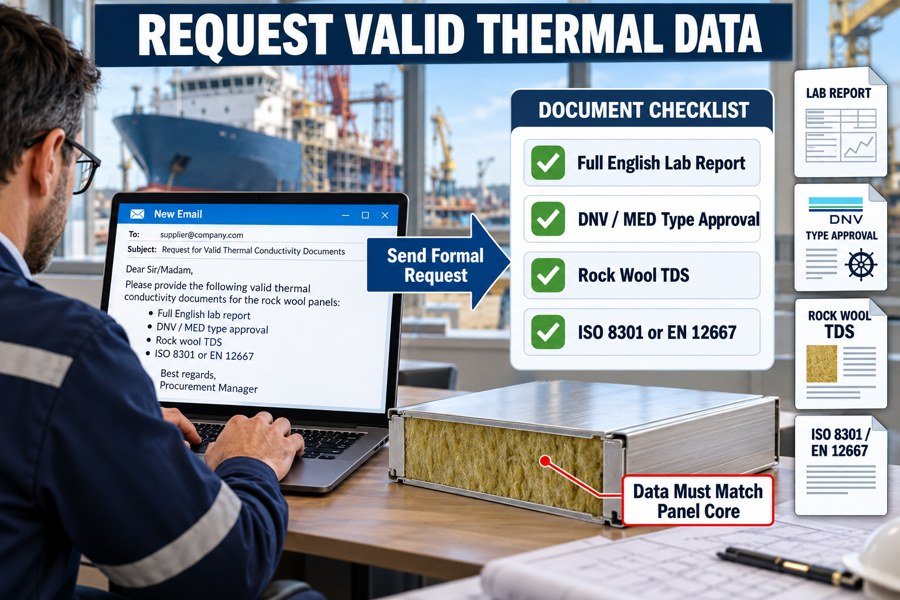
To request valid thermal conductivity data, you must send a formal email asking for the full third-party test report in English, demand the Classification Society Type Approval, request the raw material manufacturer's technical data sheet, and specify the exact test standard required (like ISO 8301) for your project.
Demanding Full English Test Reports and Type Approvals
You must be very clear when you talk to Asian suppliers. If you just ask, "Is your thermal insulation good?" they will just say "Yes." You need a strict four-step process. First, demand the full third-party test report in English. Do not accept a one-page summary. You need the complete document from the laboratory. It is usually 10 to 15 pages long. It must be in English because your European shipyards cannot read local languages. Second, ask for the Classification Society Type Approval. Tell them exactly which one you need. If your project is in the US, ask for USCG or ABS. If it is in Europe, ask for DNV or MED (Marine Equipment Directive) certificates.
Requesting Raw Material Data Sheets and Specifying Test Standards
Third, request the raw material manufacturer's technical data sheet (TDS). The panel factory buys rockwool from a bigger supplier. You want the TDS of that raw rockwool. This document will show the true baseline thermal conductivity before the factory makes the panel. Fourth, specify the exact test standard your project requires. Do not let them guess. Write in your email: "Please provide the thermal conductivity test report according to ISO 8301 or EN 12667." When you give them these four clear instructions, professional factories will send the right files in one day. Bad factories will stop replying. This saves you so much time.
| Request Step | Specific Document to Ask For | Email Phrasing Example |
|---|---|---|
| Step 1 | Full Third-Party Lab Report | "Send the complete 10+ page lab report in English." |
| Step 2 | Type Approval Certificate | "Provide the current DNV or MED type approval." |
| Step 3 | Raw Material TDS | "Attach the technical data sheet for the core rockwool." |
| Step 4 | Exact Test Standard | "Confirm testing was done via ISO 8301 or EN 12667." |
What Red Flags Reveal Fake Lambda Values in Marine Interior Panels?
Forged documents destroy your business reputation. You lose your shipyard clients forever. You must learn to spot these three major red flags.
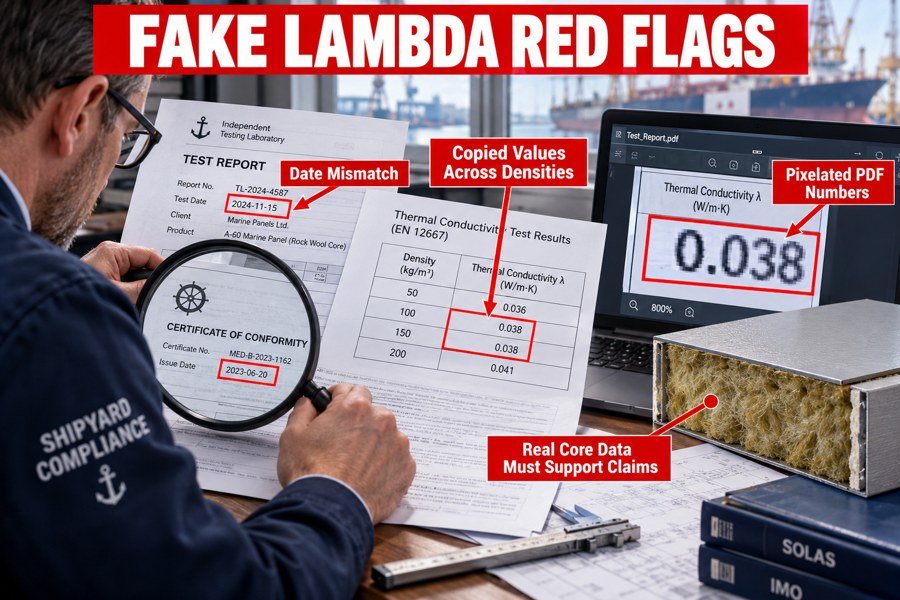
The three red flags revealing fake lambda values are mismatched dates between the laboratory report and the classification certificate, identical test values copied across different material densities, and blurred or heavily compressed text on PDF documents indicating digital manipulation using software like Photoshop.
Spotting Mismatched Dates and Copied Values Across Densities
I have reviewed thousands of documents in my career. I always look for three specific red flags. First, I check for mismatched dates. A classification certificate relies on the lab test report. Therefore, the lab test date must be older than the DNV or CCS certificate date. If the lab report is dated January 2024, but the DNV certificate is dated November 2023, the document is 100% fake. The timeline is logically impossible. Second, I look for identical test values copied across different densities. Physics dictates that 100 kg/m3 rockwool and 150 kg/m3 rockwool have different thermal conductivity values. If a supplier gives you a catalog where every single panel thickness and density has the exact same 0.038 W/m·K value, they are lying. They tested one panel and copied the number.
Identifying Digitally Manipulated PDF Test Documents
Third, I examine the PDF quality. This is the easiest red flag to spot. A real SGS or Intertek report is a clean, native PDF file. You can highlight the text with your mouse. If the supplier sends you a file where the numbers are blurry, pixelated, or look like a bad scan, be very careful. Scammers use Photoshop to erase a bad lambda value like 0.048 W/m·K and type in 0.034 W/m·K. If the font of the lambda number looks slightly different from the text next to it, stop doing business with them immediately. Your reputation with European shipyards is worth more than a cheap panel.
| Red Flag Indicator | What You Will See on the Document | What It Actually Means |
|---|---|---|
| Date Mismatch | Lab date is newer than DNV approval date | The certificate is forged or stolen |
| Copied Values | 100 kg/m3 and 150 kg/m3 show identical lambda | Supplier did not test all products |
| Pixelated Text | Lambda numbers are blurry or cannot be highlighted | Image manipulation software was used |
Conclusion
Verifying marine panel thermal conductivity means checking specific lab tests, demanding original DNV certificates, and spotting fake documents. Always trust hard data over cheap prices to satisfy your shipyard clients.
-
"Thermtest GHFM-01 | AMSEC | Western Washington University", https://amsec.wwu.edu/thermtest-ghfm-01. ISO 8301 and ASTM C518 specify guarded heat-flow-meter methods for determining steady-state thermal transmission properties of insulation materials, including thermal conductivity values commonly expressed in W/m·K. Evidence role: definition; source type: institution. Supports: An ISO 8301 or ASTM C518 report is an appropriate external laboratory document for substantiating a panel's thermal conductivity value. Scope note: These standards support the measurement method, but they do not verify that a particular laboratory report is accredited or valid. ↩
-
"How Does the IMO FTP Code Connect with Other Marine Fire ...", https://magellanmarinetech.com/how-imo-ftp-code-connect-with-other-marine-fire-safety-frameworks/. The IMO Fire Test Procedures Code includes Part 3 procedures for testing "A", "B", and "F" class divisions used in ship construction, providing the regulatory context for fire testing of marine wall and bulkhead panels. Evidence role: historical_context; source type: institution. Supports: Marine panels used as fire-rated divisions may need testing under IMO FTP Code Part 3. Scope note: The source establishes the applicable test framework; whether a particular panel must pass Part 3 depends on its intended shipboard use and regulatory classification. ↩
-
"Determination of Thermal Properties of Mineral Wool ... - PMC", https://pmc.ncbi.nlm.nih.gov/articles/PMC10488771/. Published technical literature on mineral-wool insulation reports thermal conductivity values in the approximate range of 0.03-0.05 W/m·K, which is consistent with the stated lambda range for rockwool products. Evidence role: general_support; source type: paper. Supports: Rockwool or mineral-wool certificates commonly list lambda values around 0.034-0.045 W/m·K. Scope note: This provides contextual support for typical mineral-wool values; batch certificates and product-specific tests are still needed to verify a particular shipment. ↩
-
"Determination of Thermal Properties of Mineral Wool ... - PMC", https://pmc.ncbi.nlm.nih.gov/articles/PMC10488771/. A neutral technical source should document typical declared thermal conductivity values for mineral wool/rockwool insulation measured at or near 10°C, supporting the stated conductivity range as a material-property benchmark rather than proving the quality of any specific marine panel. Evidence role: statistic; source type: institution. Supports: High-quality marine rockwool typically has thermal conductivity in the range of 0.034-0.045 W/m·K at 10°C. Scope note: The source may describe mineral wool insulation generally or building-grade rockwool; it may not directly certify every marine panel product or supplier claim. ↩