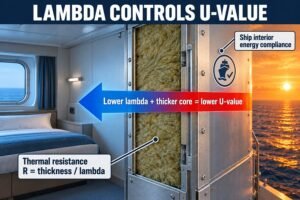
You see a low lambda value on a data sheet and think the panel is great. But your ship still wastes energy. Let me show you why these numbers trick you.
Comparing thermal conductivity (lambda) is misleading because it only measures the raw core material. It ignores panel thickness, metal facings, adhesives, installation joints, and testing temperatures. You must compare the overall heat transfer coefficient (U-value) of the fully assembled panel to know the true insulation performance.
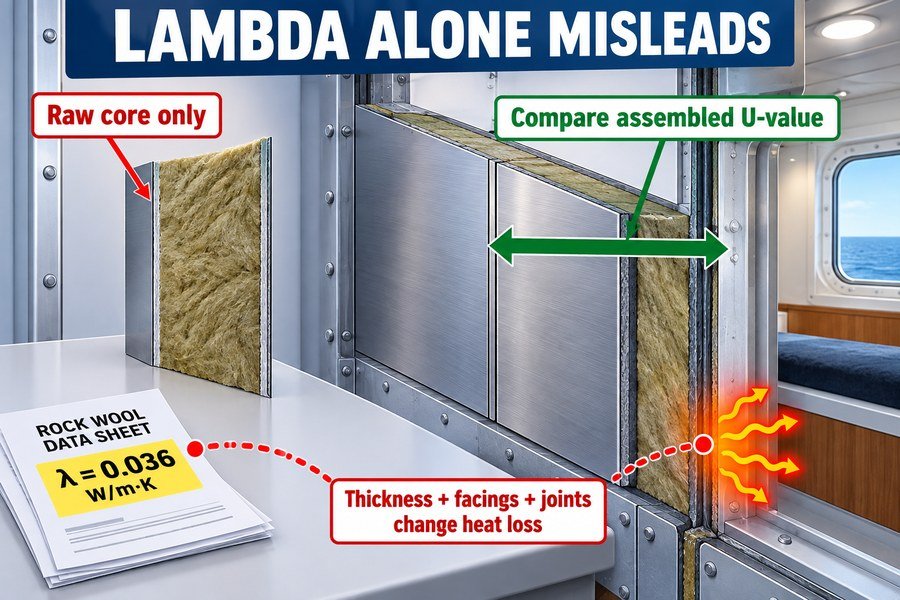
When I worked at the marine outfitting factory, I saw many buyers choose panels based on lambda alone, only to fail shipyard inspections later. This mistake costs a lot of money and time. Keep reading to avoid this costly trap and buy the right products for your projects.
Why Can Identical Lambda Values Yield Different Marine Accommodation Panel U-Values?
Two panels have the exact same rock wool core. You buy the cheaper one. Then, the cabin gets too hot because the U-values are completely different.
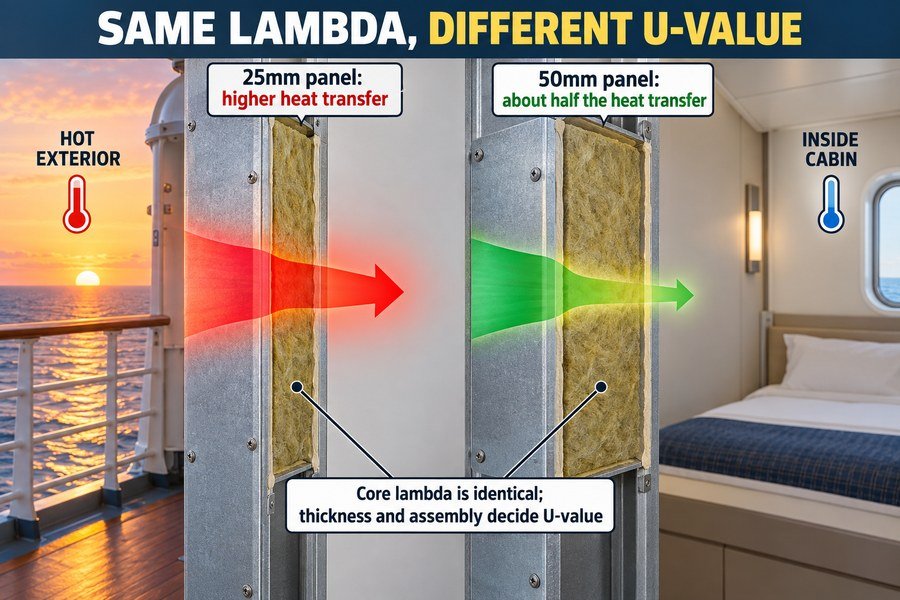
Identical lambda values yield different U-values because U-value depends on total thickness, density, and assembly layers. A 50mm panel and a 25mm panel share the same core lambda, but the 50mm panel cuts heat transfer in half. Adhesives and surface profiles also change the final U-value.
The Mathematical Relationship Between Lambda and Thickness
Many people confuse lambda and U-value. Lambda ($\lambda$) is a property of the raw material. It measures how much heat passes through one meter of that material. According to standard ISO 10456, a good marine rock wool has a lambda value around 0.034 to 0.040 W/(m·K)1. However, we do not use one-meter-thick panels on ships. We usually buy 50mm or 25mm panels for ship cabins.
To find the real heat loss, you must look at the thickness. The formula for U-value of a single layer is U = Lambda / Thickness (in meters). If your rock wool has a lambda of 0.034 W/(m·K), a 50mm (0.05m) thick core gives you a U-value of 0.68 W/(m²·K). If you buy a 25mm (0.025m) panel with the same core, the U-value jumps to 1.36 W/(m²·K). The lambda is identical, but the thin panel lets twice as much heat pass through. I always tell my clients to focus on the final U-value of the thickness they actually buy.
How Density and Assembly Layers Alter Thermal Performance
Beyond thickness, density changes how heat moves. A 100 kg/m³ rock wool acts differently than a 120 kg/m³ rock wool. Higher density often traps smaller air pockets, which lowers the lambda slightly.
Also, a marine panel is not just raw rock wool. The factory uses heavy adhesives to glue the metal skins to the core. These glue layers, or assembly layers, act as small thermal barriers or bridges. They change the final heat transfer rate. You cannot just use the math formula above for the final product. You need the tested U-value of the whole assembly.
| Panel Component | Typical Lambda Value (W/m·K) | Impact on Final U-Value |
|---|---|---|
| Rock Wool Core (120 kg/m³) | 0.034 - 0.040 | Primary insulation layer |
| Two-Component Glue | 0.20 - 0.30 | Minor effect, but adds to total resistance |
| 50mm Total Thickness | N/A | Halves heat transfer compared to 25mm |
| 25mm Total Thickness | N/A | Doubles heat transfer compared to 50mm |
Why Do Test Temperatures Make Marine Interior Panel Lambda Values Non-Comparable?
You compare two supplier datasheets. One looks 15% better. But the test conditions hide a secret, and you might buy a worse product.
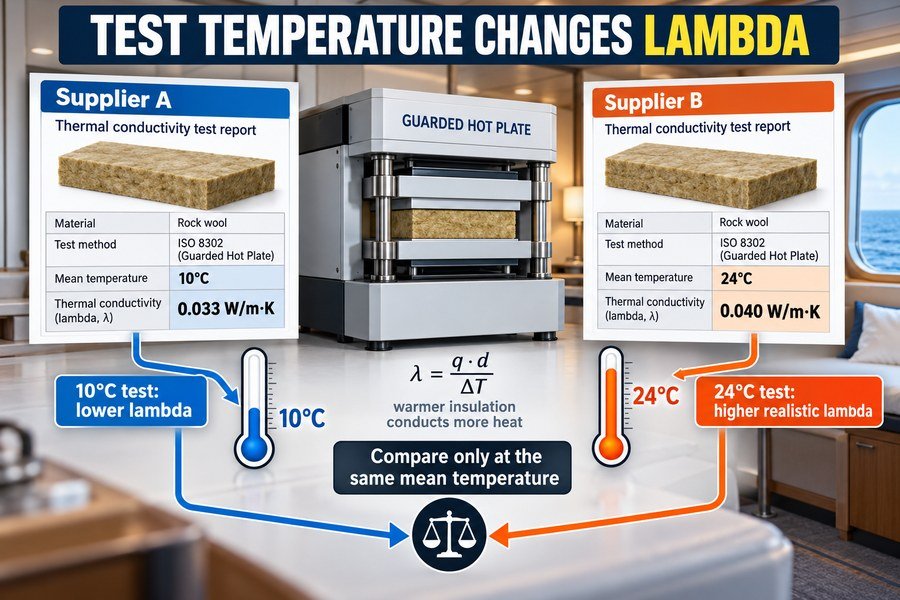
Test temperatures make lambda values non-comparable because materials conduct more heat as they get warmer. Supplier A tests at 10°C (yielding a lower, better lambda), while Supplier B tests at 24°C (yielding a higher, realistic lambda). You must align the mean testing temperatures to compare them fairly.
The Effect of Mean Temperature on Insulation Materials
Heat makes molecules move faster. When a material gets warmer, it transfers heat more easily. This is a basic rule of physics. Therefore, the lambda value of a material is not a fixed number. It changes based on the temperature during the laboratory test.
I once helped a buyer compare two rock wool cores. Supplier A showed a lambda of 0.034 W/(m·K). Supplier B showed a lambda of 0.038 W/(m·K). The buyer wanted to choose Supplier A. But I checked the small print on the lab reports. Supplier A tested their material at a mean temperature of 10°C. Supplier B tested theirs at 24°C. According to EN 12667 test standards, rock wool lambda increases by about 0.001 W/(m·K) for every 5°C rise2. If Supplier A tested at 24°C, their real lambda would be 0.037 or 0.038 W/(m·K). They were exactly the same product.
Aligning Test Standards for Fair Factory Comparisons
European standards often ask for tests at 10°C for basic CE marking. But ship cabins in the summer or near engine rooms are much hotter than 10°C. A 24°C mean temperature is much more realistic for a working vessel.
If you do not check the test temperature, you compare apples to oranges. You might reject a very honest factory just because they used a realistic test temperature. Always ask the sales person: "At what mean temperature was this lambda tested?" If they do not know, you cannot trust the number.
| Supplier Data | Test Temperature | Stated Lambda W/(m·K) | Real Lambda at 24°C |
|---|---|---|---|
| Supplier A | 10°C | 0.034 | ~0.037 |
| Supplier B | 24°C | 0.038 | 0.038 |
| Supplier C | 0°C | 0.032 | ~0.037 |
Why Does Comparing Lambda Values Ignore Marine Accommodation Panel Metal Facings?
You buy panels with the best core insulation. Yet, heat still leaks into the cabin. You forgot the metal skins, and they ruin your thermal plan.
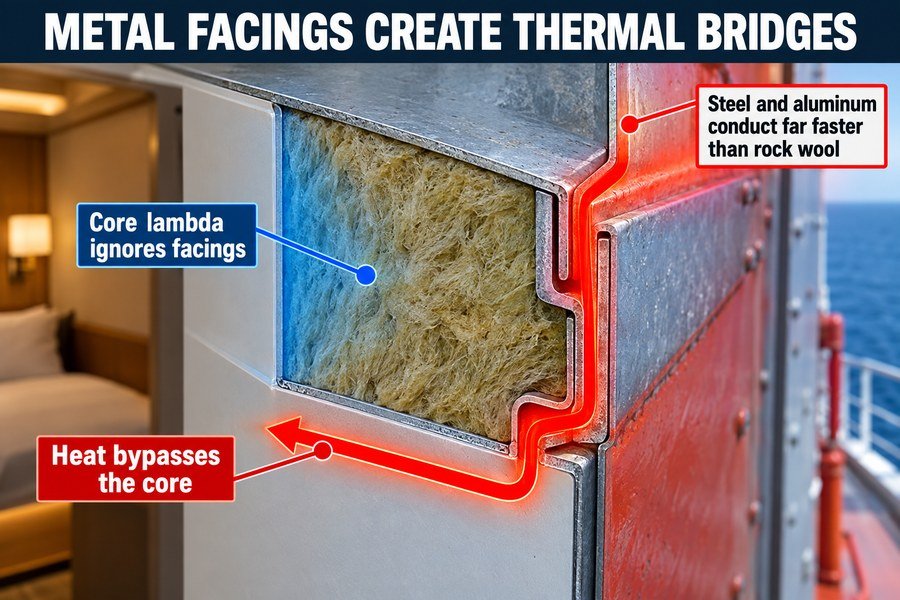
Comparing lambda values ignores metal facings because lambda only measures the inner core, like rock wool or honeycomb. It completely ignores the galvanized steel or aluminum skins and edge joints. These metal parts act as thermal bridges, transferring heat rapidly and reducing the actual insulation value of the panel.
Thermal Bridging Caused by Galvanized Steel and Aluminum Skins
A marine interior panel is a sandwich. It has a soft core and hard metal skins. The lambda value on a quotation usually only talks about the rock wool or aluminum honeycomb core. But the core does not stand alone. It is wrapped in metal.
Metals are excellent heat conductors. According to the ASHRAE Handbook, galvanized steel has a lambda of about 45 to 50 W/(m·K). Aluminum skins are even worse for insulation, with a lambda of about 237 W/(m·K). Compare this to rock wool at 0.035 W/(m·K).3 Steel conducts heat over 1,200 times faster than the core material. Even though the steel skin is very thin, usually 0.6mm or 0.7mm, it covers the entire surface of the panel. When the sun heats the outside of a deckhouse, the metal skin pulls that heat across the surface instantly.
How Edge Joints Bypass Core Insulation Materials
The biggest problem happens at the edges. Marine panels connect to each other using joints, like a tongue and groove system. At these joints, the metal skin folds inward. This creates a direct metal path from the hot side of the panel to the cold side. We call this a thermal bridge.
The heat completely bypasses the rock wool core. It travels straight through the metal edge joint into the cabin. If you only compare the lambda of the core, you completely ignore this massive heat leak. A panel with a slightly worse core lambda but a very smart, thermally-broken joint design will always perform better on the ship.
| Material Type | Lambda Value W/(m·K) | Heat Conduction Speed vs Rock Wool |
|---|---|---|
| Rock Wool Core | 0.035 | 1x (Baseline) |
| Aluminum Honeycomb Core | ~1.5 - 2.5 | 50x faster |
| Galvanized Steel Skin | 50.0 | 1,428x faster |
| Aluminum Skin | 237.0 | 6,771x faster |
How to Fairly Compare Thermal Conductivity Between Competing Marine Interior Panels?
Choosing between suppliers from Asia and Europe is hard. Their data sheets use different metrics. You need a simple way to find the real winner.
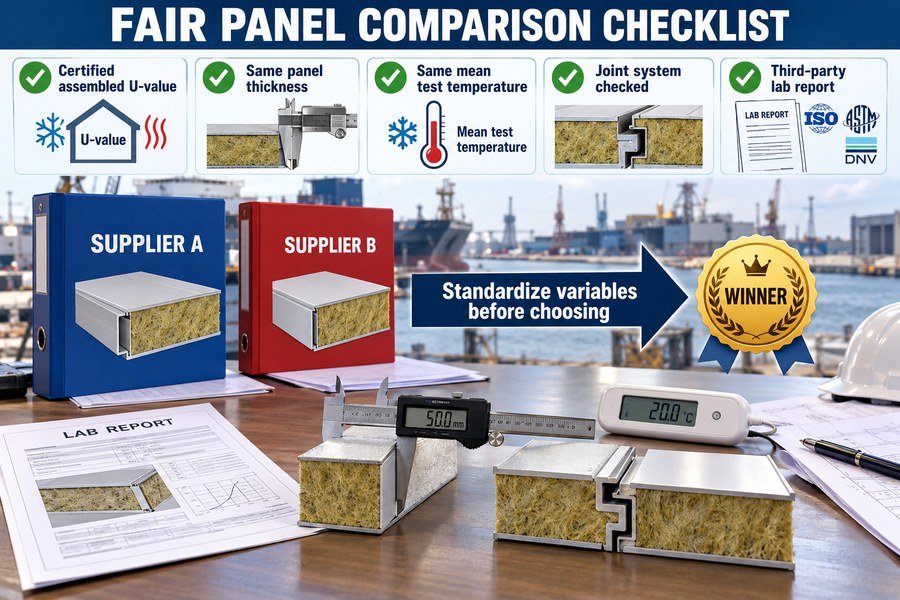
To fairly compare competing panels, you must request certified U-values for the fully assembled panel, ensure all tests use the same mean temperature (like 24°C), verify identical panel thicknesses, and check the joint systems. Always ask for third-party lab reports rather than relying on in-house marketing sheets.
Requesting Certified U-Values for Fully Assembled Panels
Do not ask suppliers for lambda values anymore. Ask them for the U-value of the final product. The U-value tests the whole system together. It includes the rock wool, the glue, the galvanized steel skin, and the paint.
When you ask for a U-value, you force the supplier to show the real performance. If a Chinese factory offers a panel for $20 per square meter, and a European factory offers one for $25 per square meter, you must look at the U-values. If the cheap panel leaks heat, the shipyard will spend thousands of dollars on extra HVAC equipment and fuel. The cheap panel becomes the expensive panel.
Standardizing the Variables for Fair Evaluation
When you put two quotations on your desk, you must standardize the variables. First, check the panel thicknesses. You cannot compare a 25mm panel to a 50mm panel. Second, check the mean temperature on the lab report. Make sure both reports say 10°C or both say 24°C.
Third, look at the joint systems. Does the supplier provide a standard C-joint or a special joint that stops heat transfer? Finally, never trust an in-house marketing sheet. Any factory can print a low number on a piece of paper. You must ask for a formal third-party lab report. Look for stamps from DNV, Lloyd's Register, or testing labs using ISO 8301 or ASTM C518 standards. If they cannot provide these reports, remove them from your supplier list.
| Verification Step | What to Check | Why It Matters |
|---|---|---|
| Metric Used | Is it U-value or Lambda? | U-value measures the whole panel system. |
| Thickness | Are both panels 50mm? | Thicker panels naturally insulate better. |
| Test Temperature | Are both tested at 24°C? | Colder tests give fake, better numbers. |
| Documents | Third-party lab report? | Factory marketing sheets often lie. |
| Joint Systems | Does the edge have metal contact? | Metal edges cause thermal bridges. |
What Hides Behind "Low Lambda" Marketing Claims for Marine Accommodation Panels?
Salesmen love to push "ultra-low lambda" panels. You pay a premium price. Later, the panels absorb moisture, and the insulation fails completely.
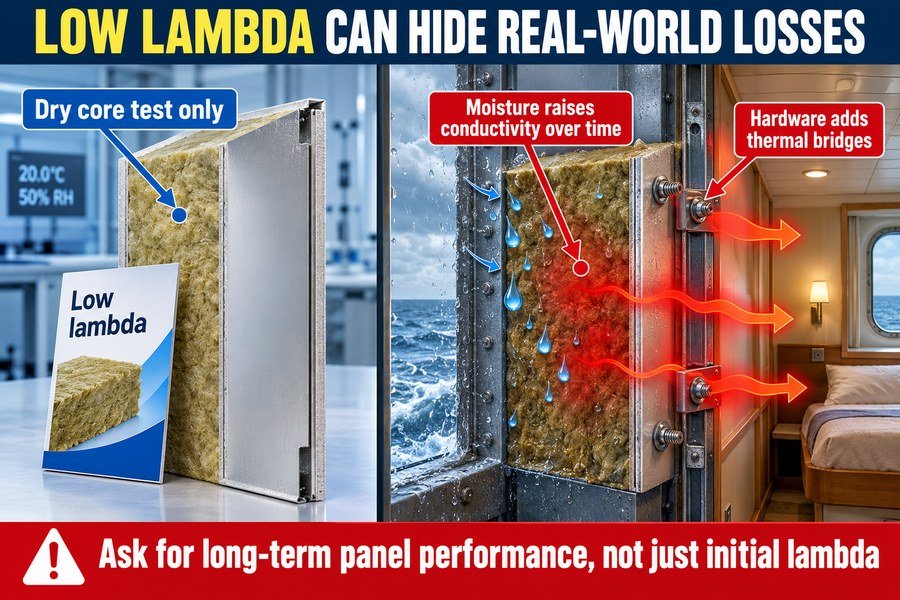
"Low lambda" marketing claims often hide three major flaws: tests conducted only on the dry core material, ignorance of long-term moisture absorption, and exclusion of installation hardware. A low initial lambda means nothing if the marine environment causes the core to dampen and lose its insulation properties over time.
The Danger of Testing Only Dry Core Materials
A factory wants to sell panels. To get the best numbers, they test their core material in a perfect, climate-controlled laboratory. They make sure the rock wool is 100% bone dry. Dry air is a great insulator. This gives them a beautiful, "ultra-low lambda" number for their brochure.
But a ship is not a dry laboratory. A ship floats on the ocean. The air is full of salt and water. Ships have high humidity. The "dry core material" number is a fantasy. It does not exist in the real world of marine outfitting.
How Moisture Absorption Destroys Long-Term Insulation
When humidity enters a panel, the rock wool absorbs water. Water is a terrible insulator. The lambda of liquid water is about 0.6 W/(m·K) at room temperature.4 This is almost 20 times worse than dry rock wool.
According to ASHRAE guidelines, just a 1% increase in moisture content can increase the thermal conductivity of insulation by 5% to 8%5. If your panel gets damp over five years on a ship, that "low lambda" panel will perform worse than a cheaper panel that stays dry. Also, marketing claims exclude installation hardware. The steel screws, profiles, and tracks you use to install the panel create more heat paths. You must buy panels with good moisture resistance and smart installation profiles, not just a low lambda score on a dry piece of paper.
| Condition | Core Material State | Real Thermal Performance |
|---|---|---|
| Laboratory Test | 100% Dry Rock Wool | Excellent (Matches Brochure) |
| 1 Year at Sea | 1% Moisture Content | Drops by 5% to 8% |
| 5 Years at Sea | 3% Moisture Content | Drops by 15% to 24% |
| Installed Panel | Added Steel Screws/Tracks | Drops due to new thermal bridges |
Conclusion
To buy the right marine panels, ignore the raw lambda value. Focus on the assembled panel U-value, check lab test temperatures, and account for the metal skins. This ensures real thermal performance.
-
"Determination of Thermal Properties of Mineral Wool ... - PMC", https://pmc.ncbi.nlm.nih.gov/articles/PMC10488771/. ISO 10456 and related thermal-design references list declared/design thermal conductivity procedures and typical values for mineral-wool insulation in the approximate 0.03-0.04 W/(m·K) range, supporting the order of magnitude used here. Evidence role: general_support; source type: institution. Supports: A good marine rock wool has a lambda value around 0.034 to 0.040 W/(m·K).. Scope note: This would support typical mineral-wool conductivity values, but not necessarily prove the performance of a specific marine rock-wool product without its tested declaration. ↩
-
"Determination of Thermal Properties of Mineral Wool ... - PMC", https://pmc.ncbi.nlm.nih.gov/articles/PMC10488771/. Experimental measurements of mineral wool insulation show that apparent thermal conductivity increases with mean temperature, with reported temperature coefficients in the same order of magnitude as 0.001 W/(m·K) per 5°C for typical rock wool products. Evidence role: statistic; source type: paper. Supports: Rock wool lambda increases by about 0.001 W/(m·K) for every 5°C rise.. Scope note: The exact coefficient varies by density, binder, fibre structure, moisture content, and test method, so the source would support the adjustment as an approximate rule rather than a universal EN 12667 value. ↩
-
"Material Properties References", https://trc.nist.gov/cryogenics/materials/references.htm. Reference data on thermal conductivity support the order-of-magnitude contrast between mineral wool insulation, carbon/galvanized steel, and aluminum, showing that metals conduct heat far more readily than fibrous insulation materials. Evidence role: statistic; source type: institution. Supports: Typical thermal conductivity values for galvanized steel, aluminum, and rock wool differ by several orders of magnitude.. Scope note: Values vary with alloy, density, temperature, moisture content, and test method, so the citation supports typical ranges rather than exact values for every marine panel product. ↩
-
"Standard Reference Data for the Thermal Conductivity of ...", https://www.nist.gov/document/jpcrd493pdf. NIST reference data for water report a thermal conductivity of approximately 0.6 W/(m·K) near room temperature, supporting the stated order of magnitude for liquid water's lambda; the comparison with rock wool depends on the specific insulation product, density, and test conditions. Evidence role: statistic; source type: government. Supports: Liquid water has a thermal conductivity of about 0.6 W/(m·K) at room temperature, making moisture detrimental to insulation performance.. Scope note: Supports the thermal conductivity value for liquid water directly, but only contextualizes the comparison with dry rock wool. ↩
-
"ASHRAE: Fundamentals", https://www.aspen.gov/DocumentCenter/View/124/ASHRAE-Fundamentals-Handbook-PDF?bidId=. ASHRAE technical guidance describes moisture as increasing the effective thermal conductivity of insulation and gives approximate percentage increases under defined assumptions; such figures should be read as material- and condition-dependent rather than a universal rule for all marine panels. Evidence role: expert_consensus; source type: institution. Supports: A small increase in insulation moisture content can measurably increase thermal conductivity, with cited guidance indicating a 5% to 8% increase per 1% moisture content.. Scope note: The statistic is likely guidance-based and may vary by insulation type, moisture distribution, temperature, and test method. ↩