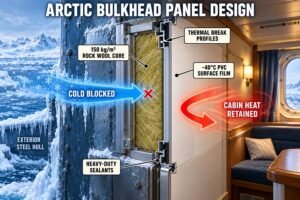
Shipyards demand strict thermal insulation specs for their vessels. Bad panel data causes failed inspections and costly project delays. Here is exactly how labs measure thermal conductivity to keep your projects safe.
Labs measure marine interior panel thermal conductivity using two primary absolute and comparative methods: the Guarded Hot Plate (ISO 8302) for absolute baseline accuracy, and the Heat Flow Meter (ISO 8301) for rapid batch testing, ensuring panels meet strict SOLAS energy efficiency and fire safety codes.
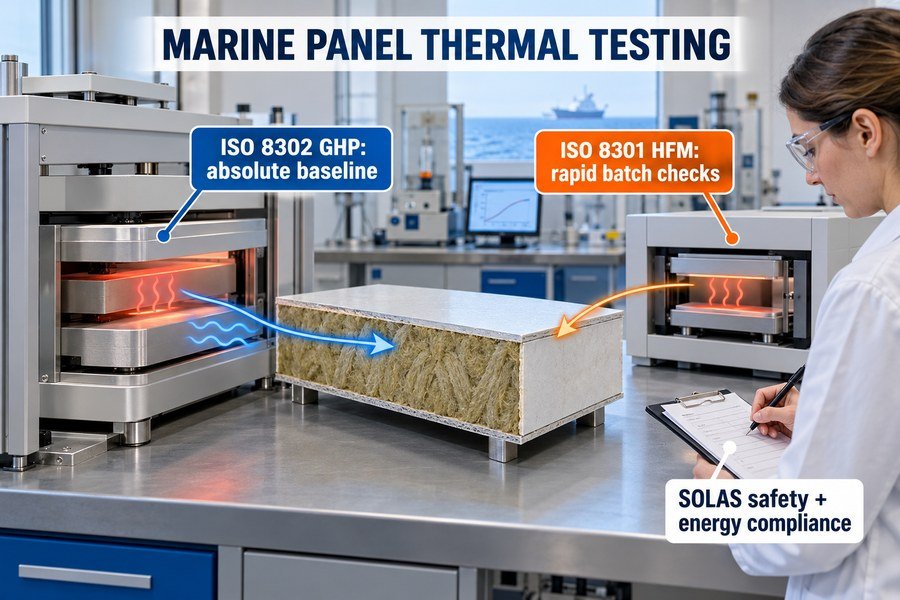
Knowing how these lab tests work helps you spot fake certificates and buy better panels from Asian suppliers. Let us break down the exact methods labs use to prove these values, so you can control your supply chain and satisfy your Western shipyard clients.
How Do Guarded Hot Plates Test Marine Interior Panel Thermal Conductivity?
You need absolute proof of insulation performance. Guessing leads to rejected shipments at the destination port. The guarded hot plate method gives you the undeniable truth about your panels.
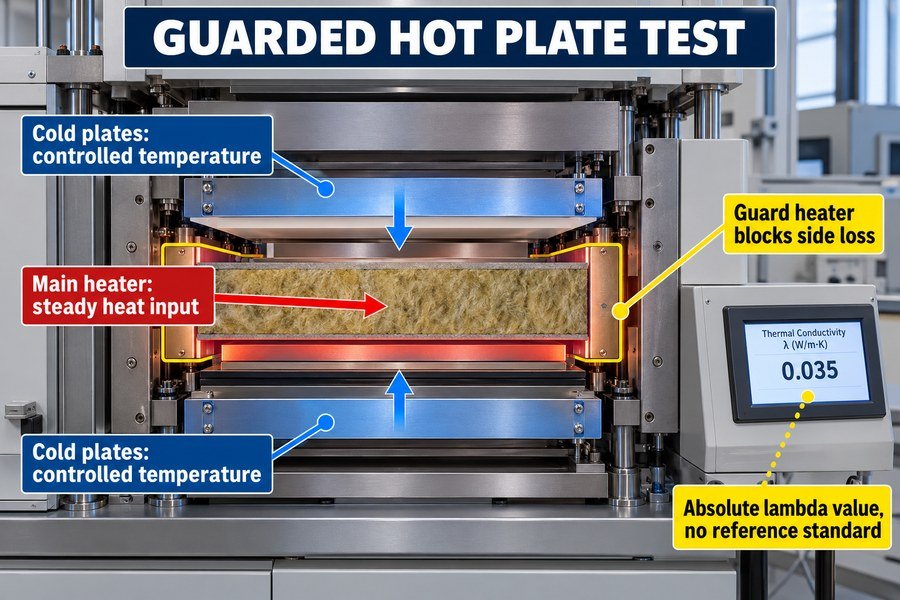
The Guarded Hot Plate (GHP) method tests marine panel thermal conductivity by placing a flat panel sample between a main electrical heater and two cold plates. It measures the steady-state heat transfer through the 50mm to 100mm thick sample, providing absolute values without needing reference calibration standards.
The Core Mechanism of the Guarded Hot Plate Test
The Guarded Hot Plate (GHP) is the most accurate test available for marine insulation.1 As a buyer sourcing from developing countries, you will see test reports based on the ISO 8302 standard. In this test, the lab places a square sample of your marine wall panel between two temperature-controlled metal plates. The main heater plate sits in the middle. Two cold plates sit on the outside.
The machine heats the main electrical heater to a specific temperature, usually around 30°C. The cold plates are kept cooler, often at 10°C. The machine then waits until the heat flow reaches a "steady-state." Steady-state means the temperature is stable and heat moves through the panel at a constant rate. The machine measures exactly how much electrical power the main heater uses to maintain its temperature. Because energy cannot disappear, the electrical power used equals the heat transferring through your panel.
I always tell my clients at Magellan Marine to look for GHP test reports when qualifying a new supplier. This method forces the heat to flow in one straight line through the sample. A "guard heater" surrounds the main heater to stop heat from escaping out the sides. This ensures the heat transfer measurement is highly precise.
Why GHP Provides Absolute Values for Marine Panels
The biggest advantage of the Guarded Hot Plate is that it provides absolute values. The machine does not need to be calibrated against a known reference standard.2 It uses basic physics—measuring electricity and temperature differences—to find the thermal conductivity (often called the Lambda value, measured in W/m·K).
When you buy panels with thicknesses ranging from 50mm to 100mm, the GHP machine can test them directly. This is crucial when European shipyards demand undisputed proof of quality. They trust ISO 8302 GHP data because the margin of error is extremely low. If an Asian supplier provides a GHP test report from a recognized lab like SGS or DNV, you can trust that the data is real.
| Guarded Hot Plate Testing Parameters | Typical Values for Marine Panels | Source / Standard |
|---|---|---|
| Hot Plate Temperature | 30°C (86°F) | ISO 8302 |
| Cold Plate Temperature | 10°C (50°F) | ISO 8302 |
| Target Mean Temperature | 20°C (68°F) | EN 12667 |
| Sample Thickness Tested | 50mm to 100mm | Lab Equipment Limits |
| Measurement Accuracy | ± 2% to ± 5% | ASTM C177 |
How Do Heat Flow Meters Measure Marine Accommodation Panel Lambda Values?
Waiting weeks for GHP tests hurts your project lead time. You need a faster way to check panel batches before shipping. Heat flow meters solve this speed problem.
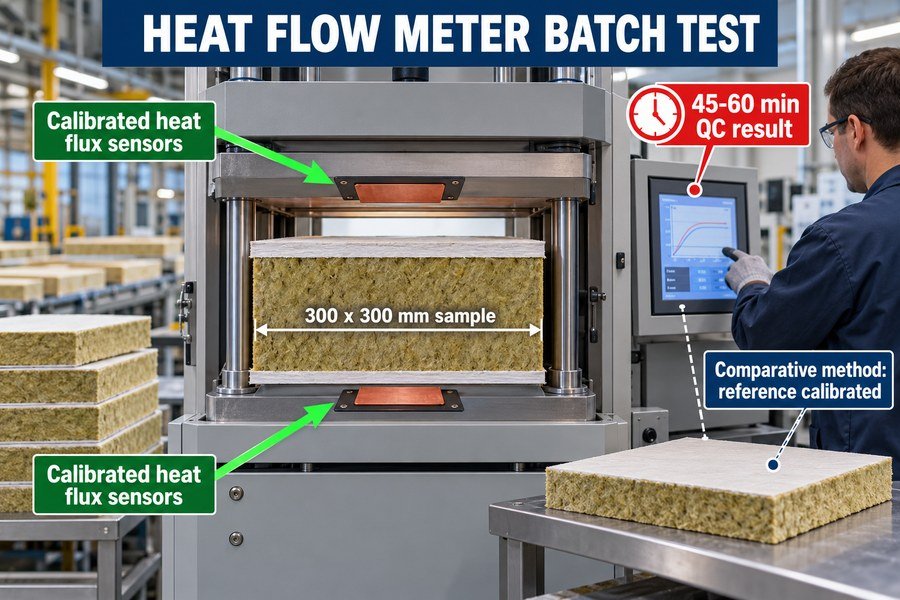
Heat Flow Meters (HFM) measure marine accommodation panel lambda values by sandwiching a sample between hot and cold plates equipped with calibrated heat flux sensors. This comparative method tests standard 300mm by 300mm samples in under 60 minutes, offering rapid, reliable quality control for continuous production batches.
Operation of Calibrated Heat Flux Sensors in HFM
While the Guarded Hot Plate is the absolute standard3, it is too slow and expensive for everyday factory use. This is where the Heat Flow Meter (HFM) method comes in. Based on the ISO 8301 standard, this machine also sandwiches your panel sample between a hot plate and a cold plate. However, it does not measure raw electrical power. Instead, it uses calibrated heat flux sensors built directly into the plates4.
These sensors measure how much heat flows through the panel sample. Because it is a comparative method, the lab must first calibrate the HFM machine using a known reference material. Labs usually use reference boards provided by institutes like the National Institute of Standards and Technology (NIST), such as NIST SRM 1450c. The machine tests your 300mm by 300mm marine panel sample and compares the sensor readings to the reference board data. This calculates the Lambda value of your panels. In my work, I find this method perfectly adequate for factory quality control.
Using HFM for Rapid Batch Testing of Accommodation Panels
The main reason factories in China and Vietnam use Heat Flow Meters is speed. As a procurement officer, you need to control lead times. A Guarded Hot Plate test can take 4 to 6 hours to stabilize and finish. A Heat Flow Meter test usually finishes in under 60 minutes.5
This speed allows factories to test multiple batches of panels during continuous production. If you are ordering 5,000 square meters of marine wall panels, the factory can pull a sample from the line every morning and run an HFM test. This rapid batch testing catches manufacturing mistakes early. It ensures the rock wool core density is consistent. When I audit Asian suppliers, I always check their in-house HFM records. If they test regularly, it proves they care about quality. You get good panels without delaying your shipping schedule.
| Test Method Comparison | Heat Flow Meter (HFM) | Guarded Hot Plate (GHP) |
|---|---|---|
| Standard | ISO 8301 / ASTM C518 | ISO 8302 / ASTM C177 |
| Method Type | Comparative (Needs Calibration) | Absolute (Direct Measurement) |
| Average Test Time | 45 to 60 minutes | 4 to 6 hours |
| Typical Cost Per Test | $150 - $250 USD | $500 - $800 USD |
| Best Use Case | Daily factory batch testing | Certification and dispute resolution |
What Sample Conditioning Precedes Marine Interior Panel Thermal Conductivity Tests?
Wet panels give false thermal readings. Sending unconditioned panels to a lab wastes your money and time. Proper sample conditioning fixes this issue completely.
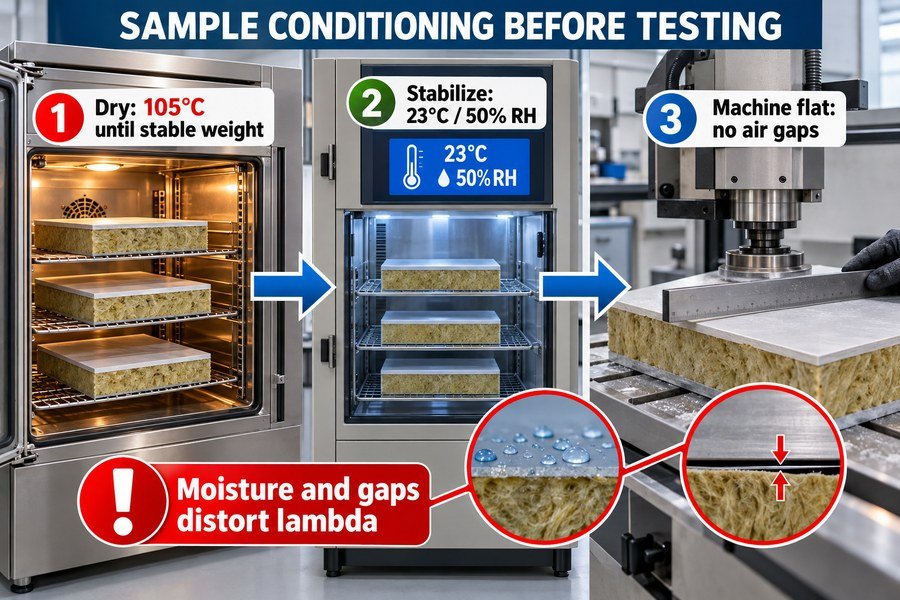
Sample conditioning before marine interior panel thermal conductivity tests involves three critical steps: drying panels in a ventilated oven at 105°C, stabilizing them in a climate chamber at 23°C and 50% relative humidity, and machining the surfaces perfectly flat to ensure zero air gaps during testing.
Drying and Stabilizing Marine Panel Test Samples
If a supplier tests a panel right off the production line in a humid Asian summer, the test will fail. Water conducts heat roughly 25 times faster than still air.6 According to ASHRAE Fundamentals, the thermal conductivity of water is about 0.60 W/m·K, while air is only 0.024 W/m·K. If the rock wool core inside your marine interior panel holds any moisture, the Lambda value will look terrible on the test report.
To prevent this, labs perform strict sample conditioning. First, they put the panel sample in a ventilated drying oven set to 105°C. They leave it there until the weight stops changing, which proves all free moisture has evaporated. After drying, the sample is too hot and dry for testing. The lab must then move the sample into a climate-controlled stabilization chamber. According to standards like ISO 291, this chamber is strictly kept at 23°C and 50% relative humidity. The panel stays there for at least 24 hours. This conditioning ensures every panel is tested under the exact same baseline environment, giving you fair and accurate data.
Machining Panel Surfaces for Zero Air Gaps
Moisture is not the only problem. The physical shape of the panel sample is also critical. The test plates in the GHP or HFM machines are perfectly flat steel. If your marine panel has bumps, waves, or uneven PVC film on the surface, it will not sit flush against the machine plates.
This creates tiny air gaps between the panel and the machine. Because air is a great insulator, these air gaps will block heat transfer during the test7. The machine will record a false reading, making the panel seem like a better insulator than it actually is. To stop this, labs must machine the surfaces of the test sample perfectly flat. The flatness tolerance is usually very tight, often required to be within 0.025 mm. If the supplier sends a rough, unmachined sample to the lab, the lab will either reject it or the test results will be invalid.
| Sample Conditioning Step | Equipment Used | Required Condition | Purpose of Step |
|---|---|---|---|
| 1. Drying | Ventilated Lab Oven | 105°C until weight is stable | Removes internal moisture from rock wool |
| 2. Stabilizing | Climate Chamber | 23°C and 50% Relative Humidity | Brings sample to a standard baseline state |
| 3. Machining | Precision Milling Tool | Flatness within 0.025 mm | Removes air gaps between sample and test plates |
Why Do Test Standards Mandate Mean Temperatures for Marine Accommodation Panel Lambda Values?
Panel insulation changes depending on the room temperature. Using random test temperatures creates chaos in purchasing. Standardized mean temperatures solve this confusion.
Test standards mandate mean temperatures for marine accommodation panel lambda values because thermal conductivity increases as material temperature rises. Standards require evaluating panels at specific mean temperatures—typically 10°C, 20°C, or 24°C—to ensure fair comparisons between different suppliers and accurate real-world ship HVAC load calculations.
The Relationship Between Temperature and Thermal Conductivity
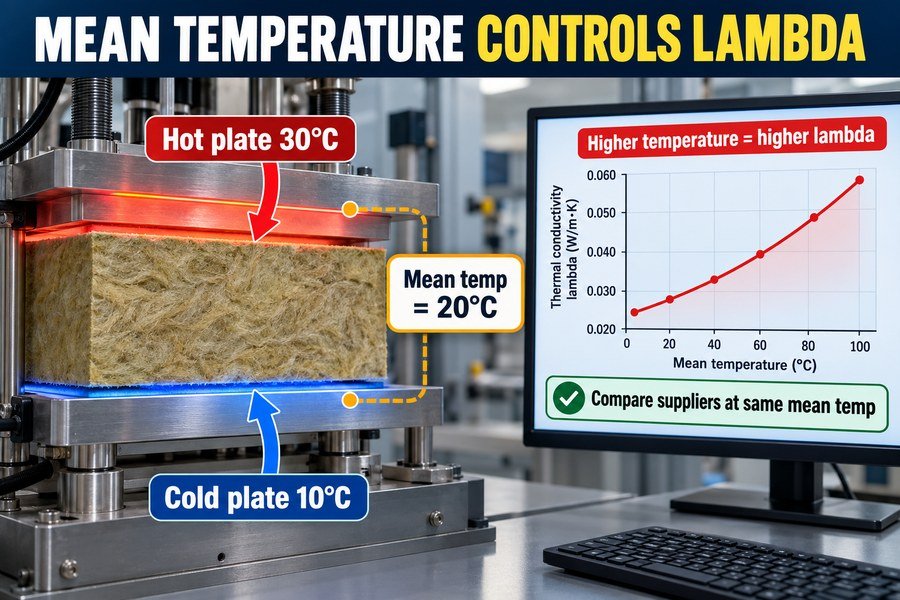
Heat transfer does not behave exactly the same at all temperatures. In insulation materials like rock wool or glass wool, the thermal conductivity (Lambda value) increases as the material gets hotter. Hotter air inside the panel moves faster, and heat radiation between the internal fibers increases.
If you take a marine accommodation panel and test it in a freezing room, it will show a very low (excellent) Lambda value. If you test that exact same panel in a hot room, it will show a higher (worse) Lambda value. Because of this natural physical law, test standards like EN 12667 and ISO 10456 mandate that labs must report the "mean temperature" during the test. The mean temperature is the average of the hot plate and the cold plate. For example, if the hot plate is 30°C and the cold plate is 10°C, the mean temperature is 20°C.
Standard Mean Temperatures Ensure Fair Supplier Comparisons and HVAC Accuracy
Without standard mean temperatures, bad suppliers will trick you. An untrustworthy factory might set their test machine to a mean temperature of 0°C. Their report will show a fantastic Lambda value of 0.032 W/m·K. Another honest factory might test at the standard 20°C mean temperature and show a value of 0.036 W/m·K. If you do not check the mean temperature on the report, you might buy the panel from the dishonest factory, thinking it is better.
Standardized mean temperatures—typically 10°C, 20°C, or 24°C—ensure you are comparing apples to apples. This is also vital for the shipyard's engineering team. The ship's HVAC designers use these Lambda values to calculate the size of the air conditioning units for the vessel. If you provide them with test data taken at 0°C, but the ship will operate in the Caribbean at 30°C, their calculations will be totally wrong. The cabins will be too hot. Always check the mean temperature on the lab report before you buy.
| Mean Test Temperature | Typical Rock Wool Lambda Value | Application / Standard Notes |
|---|---|---|
| 10°C (50°F) | 0.034 W/m·K | Common standard in European building codes |
| 20°C (68°F) | 0.036 W/m·K | Standard for most international marine tests (EN 12667) |
| 24°C (75°F) | 0.037 W/m·K | Often used in North American ASTM standards |
How Does Specimen Thickness Affect Measured Marine Interior Panel Thermal Conductivity?
Thin samples often show different thermal performance than thick ones. This trick can mislead your shipyard clients. Understanding the thickness effect protects your reputation.
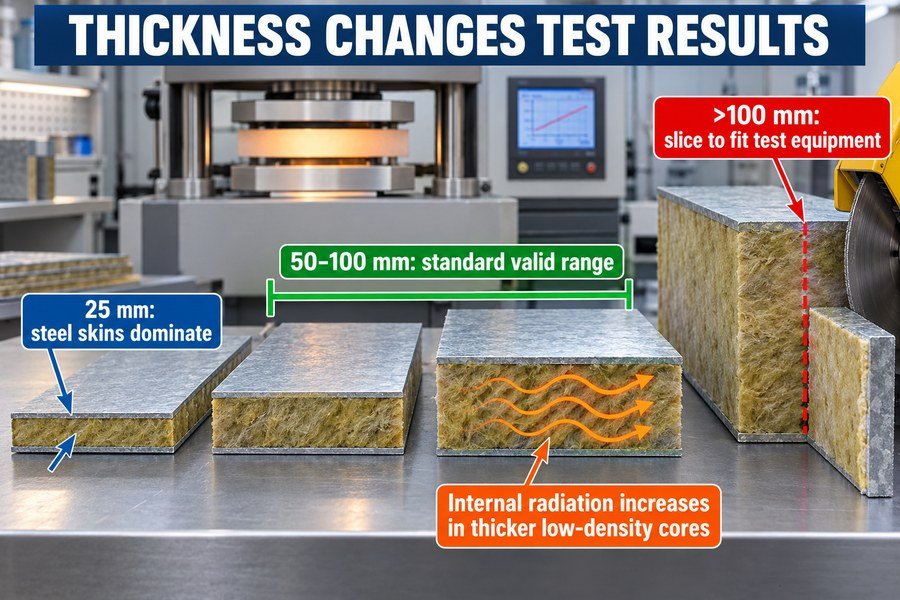
Specimen thickness affects measured marine interior panel thermal conductivity through three factors: the "thickness effect" where thicker low-density panels allow more internal radiation, the ratio of core material to surface steel, and the limits of test equipment which require 25mm to 100mm samples for valid ISO compliance.
Internal Radiation and Core-to-Steel Ratio in Marine Panels
You cannot just test a 25mm thick panel and assume a 100mm thick panel will perform exactly four times better. Physics does not work that way. This is called the "thickness effect." In low-density insulation materials, heat moves not just by conduction, but also by internal radiation. A thicker panel gives thermal radiation more physical distance to travel and scatter. Because of this, a 100mm thick panel might actually have a slightly higher (worse) Lambda value per millimeter than a 25mm panel8.
Furthermore, marine panels are composite products. They consist of a rock wool core covered by galvanized steel sheets on both sides. The steel conducts heat extremely well9. In a thin 25mm panel, the steel skins make up a larger percentage of the total product mass compared to a 100mm panel. This core-to-steel ratio changes the overall heat transfer dynamics. When I buy for Magellan Marine, I always demand test reports that match the exact thickness I am purchasing.
Equipment Limits for Testing 25mm to 100mm Panel Thicknesses
The physical limits of the lab equipment also dictate how thickness affects the test. Most standard Heat Flow Meters and Guarded Hot Plates are built to handle samples between 25mm and 100mm thick10.
If you try to test a panel thinner than 25mm, the temperature difference between the hot and cold plates becomes too hard for the sensors to measure accurately. The heat shoots through too fast. If you try to test a panel thicker than 100mm, the heat starts leaking out the sides of the sample, ruining the steady-state measurement required for ISO compliance. If a supplier tries to sell you a 150mm thick heavy-duty bulkhead panel, the lab cannot test it whole. The lab must slice the core down to a 100mm thickness to fit the machine. You must know these limits so you understand what the lab report is actually showing.
| Panel Thickness | Testing Strategy | Internal Radiation Risk |
|---|---|---|
| Less than 25mm | Usually too thin for standard HFM/GHP | Very Low |
| 25mm to 50mm | Standard direct testing (Optimal size) | Low |
| 50mm to 100mm | Standard direct testing (Slower test time) | Moderate (Increases with lower density) |
| Over 100mm | Must be sliced to fit test machines | High |
Conclusion
Lab testing for marine interior panel thermal conductivity relies on strict methods like Guarded Hot Plates and Heat Flow Meters. Knowing how conditioning, mean temperatures, and thickness impact these tests helps you buy reliable products confidently.
-
"Early Guarded-Hot-Plate Apparatus", https://www.nist.gov/el/beed/guarded-hot-plate-apparatus-nist/early-guarded-hot-plate-apparatus. ISO 8302 and ASTM C177 describe the guarded hot plate as a primary steady-state method for determining thermal resistance and thermal conductivity of insulating materials, supporting its status as a high-accuracy reference method for insulation testing. Evidence role: expert_consensus; source type: institution. Supports: The Guarded Hot Plate is a highly accurate reference method for testing insulation materials, including panels used in marine applications.. Scope note: The standards support GHP as a primary or reference method for insulation materials generally, but they do not establish that it is uniquely the most accurate method for all marine insulation products. ↩
-
"History of Other NIST Thermal Conductivity Equipment", https://www.nist.gov/el/beed/guarded-hot-plate-apparatus-nist/history-other-nist-thermal-conductivity-equipment. ASTM C177 describes the guarded hot plate as an absolute measurement method in which heat flow is determined from measured electrical power and temperature difference rather than by calibration against a reference specimen. Evidence role: mechanism; source type: institution. Supports: The guarded hot plate can provide absolute thermal-property measurements because it derives heat flow from electrical power and measured temperature differences rather than comparison with a reference material.. Scope note: The method is absolute in principle, but instruments still require calibration or verification of sensors, dimensions, and electrical measurements to control uncertainty. ↩
-
"Early Guarded-Hot-Plate Apparatus", https://www.nist.gov/el/beed/guarded-hot-plate-apparatus-nist/early-guarded-hot-plate-apparatus. Standards and metrology literature describe the guarded hot plate as an absolute steady-state method for measuring thermal transmission properties of insulation materials, supporting its role as a reference method for thermal conductivity testing. Evidence role: expert_consensus; source type: institution. Supports: The Guarded Hot Plate method is treated as an absolute/reference method for thermal conductivity measurement.. Scope note: The phrase “absolute standard” is stronger than most technical sources, which usually call it an absolute or reference method rather than the only standard. ↩
-
"Heat flux sensor", https://en.wikipedia.org/wiki/Heat_flux_sensor. ISO 8301 and ASTM C518 describe heat flow meter apparatuses that use calibrated heat-flux transducers with temperature-controlled plates to determine steady-state thermal transmission properties. Evidence role: mechanism; source type: institution. Supports: Heat Flow Meter instruments measure heat flow through specimens using calibrated heat-flux sensors/transducers associated with controlled plates.. Scope note: This supports the general measurement mechanism of HFM instruments, not the construction details of every commercial machine. ↩
-
"NIST-NPL Bilateral Comparison of Guarded-Hot-Plate ...", https://nvlpubs.nist.gov/nistpubs/TechnicalNotes/NIST.TN.2059.pdf. Technical comparisons of steady-state thermal conductivity methods commonly note that guarded hot plate testing requires longer equilibration times than heat flow meter testing, while reported durations depend on specimen thickness, temperature difference, and stability criteria. Evidence role: general_support; source type: paper. Supports: GHP testing generally takes longer to reach steady-state conditions than HFM testing, which is often used for faster routine measurements.. Scope note: The exact 4–6 hour and under-60-minute figures are likely apparatus- and sample-specific, so a source may support the relative speed difference more directly than the precise times. ↩
-
"List of thermal conductivities", https://en.wikipedia.org/wiki/List_of_thermal_conductivities. Reference tabulations of thermal conductivity list liquid water near 0.6 W/m·K and air near 0.024–0.026 W/m·K at room temperature, supporting the order-of-magnitude comparison used here. Evidence role: statistic; source type: encyclopedia. Supports: Water conducts heat roughly 25 times faster than still air.. Scope note: Values vary with temperature and pressure, so the ratio is approximate rather than a fixed material constant. ↩
-
"Error analysis for the National Bureau of Standards 1016 ...", https://www.govinfo.gov/content/pkg/GOVPUB-C13-4f92184832da0d0651b541d4fd3c9910/pdf/GOVPUB-C13-4f92184832da0d0651b541d4fd3c9910.pdf. Guidance and studies on guarded hot plate and heat-flow-meter measurements describe specimen contact resistance and interfacial air gaps as sources of error in apparent thermal-conductivity measurements, supporting the need for flat specimen contact surfaces. Evidence role: mechanism; source type: paper. Supports: Air gaps between a panel sample and the test plates can distort GHP or HFM thermal-conductivity measurements.. Scope note: The direction and magnitude of the bias depend on apparatus design, clamping pressure, surface roughness, and whether contact resistance is corrected or minimized in the test method. ↩
-
"Design of a Guarded Hot Plate for Measuring Thin Specimens ...", https://docs.lib.purdue.edu/cgi/viewcontent.cgi?article=1019&context=thermal. Experimental studies on fibrous insulation report that measured apparent thermal conductivity can vary with specimen thickness because radiative transfer and boundary effects affect the apparent value; this supports the plausibility of a thickness effect but does not prove the exact 25 mm versus 100 mm behavior for this panel product. Evidence role: general_support; source type: paper. Supports: A thicker low-density insulation panel can show a different, potentially worse, apparent lambda value per millimeter than a thinner panel.. Scope note: The source would support the phenomenon generally; product-specific lambda values require matching test reports for the exact panel construction and thickness. ↩
-
"Thermal bridging and its mitigation in bamboo panel ...", https://bioresources.cnr.ncsu.edu/resources/thermal-bridging-and-its-mitigation-in-bamboo-panel-construction-with-steel-frameworks-and-mineral-wool-insulation/. Engineering reference data for thermal conductivity show that carbon and galvanized steel have thermal conductivities far higher than mineral wool insulation, supporting the claim that steel facings can materially affect heat-transfer paths in composite panels. Evidence role: statistic; source type: education. Supports: Galvanized steel skins conduct heat much more readily than a rock wool core and can affect composite panel heat transfer.. Scope note: The comparison supports the material-property contrast; the actual panel-level effect depends on skin thickness, edge details, fasteners, and test configuration. ↩
-
"Design of a Guarded Hot Plate for Measuring Thin Specimens ...", https://docs.lib.purdue.edu/cgi/viewcontent.cgi?article=1019&context=thermal. Standards and laboratory guidance for heat-flow-meter and guarded-hot-plate methods specify specimen-size requirements and discuss limits related to thickness, heat flow, and edge losses; this supports the need to verify apparatus capacity rather than assuming any panel thickness can be tested intact. Evidence role: definition; source type: institution. Supports: Standard HFM and GHP testing equipment has practical specimen-thickness limits, commonly requiring test specimens to fit within defined apparatus dimensions.. Scope note: The exact allowable thickness range is apparatus- and standard-specific, so a source may support typical constraints without confirming that all standard machines are limited to 25–100 mm. ↩