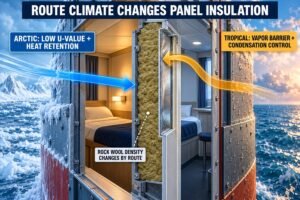
Your ships sail into tropical zones, and suddenly cabins turn into ovens. Standard ceilings fail. You need ceiling panels that handle extreme solar heat to keep crews comfortable and costs low.
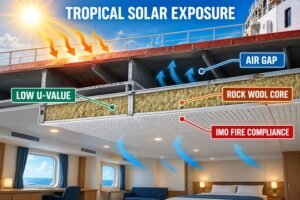
Solar exposure on tropical routes changes marine ceiling panel priorities by demanding ultra-low U-values, high-density rockwool cores, specific air-gap structures, and strict IMO fire compliance. You must balance thermal resistance, structural integrity, weight limits, and cost across these four critical factors to ensure ship safety and comfort.
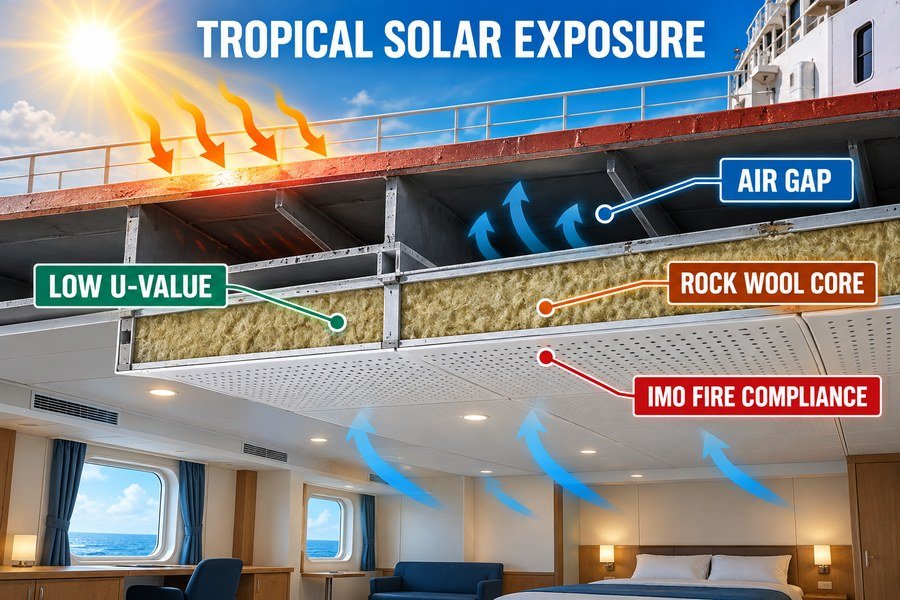
Let me show you exactly how intense sun changes what you should buy for your next shipyard interior decoration project.
How Does Solar Heat Dictate U-Values for Top-Deck Marine Ceiling Panels?
High solar heat loads stress top-deck cabins every single day. If your panels have the wrong U-value, AC systems overwork, and energy bills skyrocket. We need exact numbers.
Solar heat dictates that top-deck marine ceiling panels must achieve U-values between 0.30 and 0.45 W/(m²·K). Lower U-values block more heat transfer from the sun-baked steel deck. This requires selecting panels with 50mm to 100mm thickness and high-performance insulation to maintain internal temperatures below 24°C.
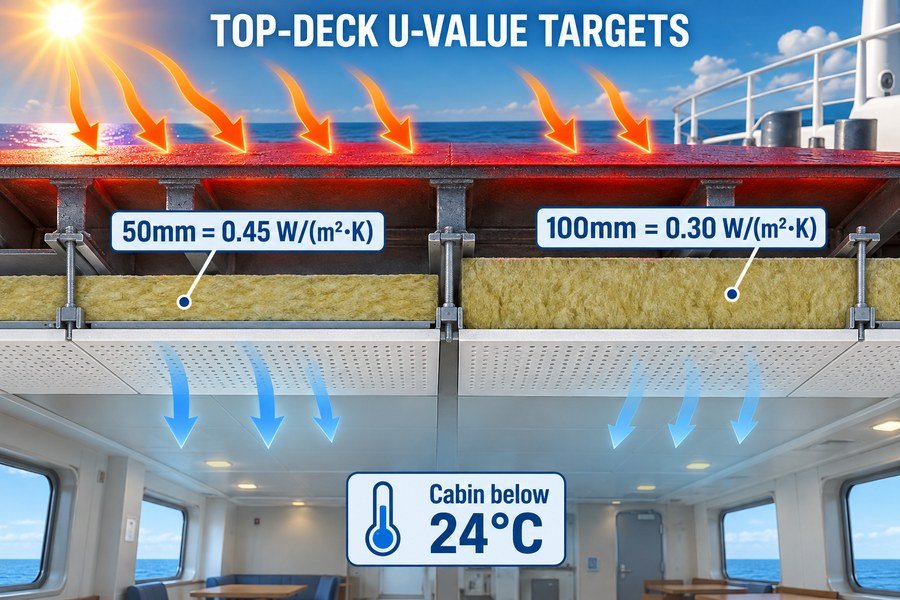
Here is how you calculate and choose the right U-values to meet shipyard demands without overpaying for extra material.
Understanding U-Value Requirements for Top-Deck Marine Panels
The U-value measures how much heat passes through a material. A lower number is always better. According to ASHRAE Marine guidelines, the steel top deck of a ship can reach 70°C in tropical sun. If you use a standard ceiling panel with a U-value of 0.60 W/(m²·K), too much heat will pass through. The cabin will get too hot. The crew will complain. To stop this, you must demand panels with U-values between 0.30 and 0.45 W/(m²·K).
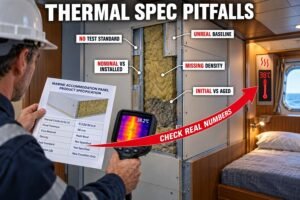
When I worked at the marine outfitting factory, I saw buyers try to save money by ignoring these numbers. They failed the sea trials. The HVAC system could not keep the room below the required 24°C. You must check the supplier's test reports. Make sure the U-value matches this specific range before you place a large order.
Balancing Panel Thickness to Achieve Target U-Values
To get those low U-values, you have to increase the panel thickness. I always suggest looking at 50mm and 100mm thickness options. A 50mm panel gives you a U-value around 0.45 W/(m²·K). A 100mm panel drops the U-value to 0.30 W/(m²·K).
You must balance this choice. A 100mm panel offers the best heat protection. However, it costs more and takes up more cabin ceiling space. If your project is for a ship that stays near the equator all year, pay for the 100mm thickness. If the ship moves between warm and cool areas, 50mm is usually a good compromise. You must work with the shipyard engineers to find the right balance between cost, cabin height, and heat protection.
| Panel Thickness | Typical U-Value (W/(m²·K)) | Heat Blocking Performance | Best Application | Cost Impact |
|---|---|---|---|---|
| 25mm (Standard) | 0.65 | Poor | Internal lower decks only | Low |
| 50mm | 0.45 | Good | Tropical routes, mixed weather | Medium |
| 100mm | 0.30 | Excellent | Direct sun, top deck, equator | High |
Why Do Tropical Sun-Facing Marine Lining Panels Need Higher Thermal Resistance?
Tropical sun beats down on ship exteriors from dawn to dusk. Weak lining panels let heat pour into the cabin space. This ruins crew rest and angers the shipyard.
Tropical sun-facing marine lining panels need higher thermal resistance (R-value) to stop conductive heat, convective heat, and radiant heat. You must use panels with R-values exceeding 2.0 m²·K/W, incorporating aluminum foil backing and specialized rockwool to stop all three heat transfer types and reduce HVAC loads.
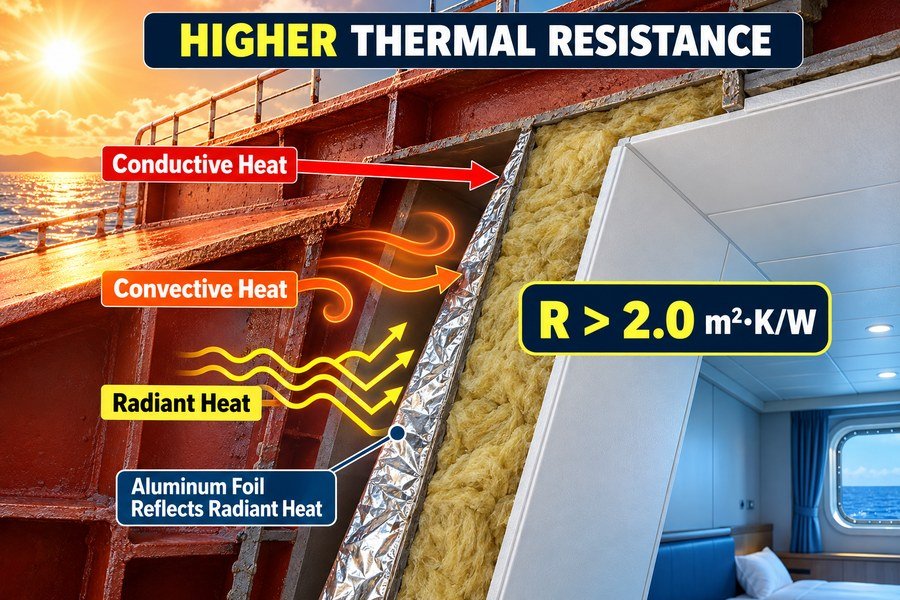
Let me break down these three types of heat and explain how high thermal resistance solves the problem.
Blocking Conductive, Convective, and Radiant Heat in Marine Cabins
Heat moves into a ship cabin in three ways1. First, conductive heat travels directly through the hot steel hull and metal frames. Second, convective heat happens when trapped air inside the wall cavity gets hot and circulates. Third, radiant heat transfers invisible energy waves from the hot steel to the panel.
Standard panels only block conductive heat. Tropical sun requires you to stop all three. To do this, you need a high R-value. The R-value measures thermal resistance. Higher is better. Based on ISO 7547 standards for shipbuilding HVAC, you must use panels with an R-value greater than 2.0 m²·K/W for tropical sun-facing walls. If you do not meet this standard, the cooling system will fail.
Using Aluminum Foil and Specialized Rockwool for Maximum Thermal Resistance
How do you get an R-value over 2.0 m²·K/W? You need two specific materials. First, you need specialized rockwool. Rockwool traps tiny pockets of air2. This stops both conduction and convection. Second, you must use an aluminum foil backing on the hidden side of the panel. The shiny foil reflects radiant heat away from the cabin.
When I help clients at Magellan Marine, I always tell them to check the factory specs. Many cheap suppliers in Asia leave out the aluminum foil to save a few dollars. Do not buy those. Without the foil, radiant heat will pass right through the rockwool. Your HVAC loads will remain too high. The foil backing is a small cost that makes a massive difference in thermal resistance.
| Heat Transfer Type | How It Enters the Cabin | Panel Material Solution | Required R-Value Target |
|---|---|---|---|
| Conductive Heat | Through steel frames | High-density Rockwool | > 2.0 m²·K/W |
| Convective Heat | Hot air in wall cavity | Tight Rockwool fibers | > 2.0 m²·K/W |
| Radiant Heat | Invisible energy waves | Aluminum Foil Backing | N/A (Reflection) |
How Does Radiant Heat Determine Core Density for Top-Deck Marine Ceiling Panels?
Radiant heat easily penetrates low-density insulation cores. If you buy cheap panels with loose cores, the cabins will bake in the sun. You must specify the right density to protect the ship.
Radiant heat determines core density by forcing the use of high-density mineral wool, specifically between 120 kg/m³ and 150 kg/m³. These three density options (100 kg/m³, 120 kg/m³, 150 kg/m³) dictate the panel's ability to absorb radiant energy, maintain structural shape under heat, and provide proper acoustic insulation.
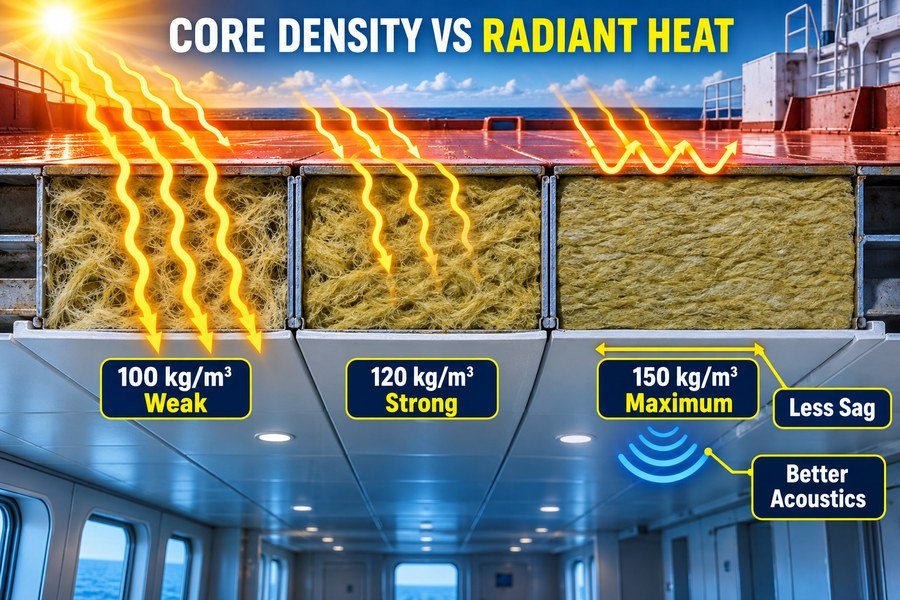
Choosing the right rockwool density is the secret to beating radiant heat without adding too much weight to the ship.
Choosing Between 100 kg/m³, 120 kg/m³, and 150 kg/m³ Panel Core Densities
When you order marine ceiling panels, the factory will ask you to choose a core density. You usually have three main options: 100 kg/m³, 120 kg/m³, and 150 kg/m³. For standard lower decks away from the sun, 100 kg/m³ is perfectly fine.
However, radiant heat on the top deck is brutal. A 100 kg/m³ core is too loose. Radiant heat passes right through the gaps in the fibers.3 For tropical routes, you must upgrade to 120 kg/m³ or 150 kg/m³4. These higher densities pack the mineral wool fibers tightly together. This tight packing blocks radiant energy from reaching the inside of the cabin. Yes, the panels weigh more, but the heat protection is mandatory for top-deck rooms.
How Panel Core Density Affects Structural Shape and Acoustic Insulation
Density does a lot more than just block radiant heat. Extreme tropical heat causes cheap, low-density panels to warp and sag. A 150 kg/m³ density panel maintains its flat structural shape even when the steel deck above it reaches 70°C5. Your ceilings will look perfect for years.
Furthermore, high density gives you much better acoustic insulation. A tight 120 kg/m³ panel can reduce noise by up to 45 decibels, depending on the test conditions. This is a great selling point for shipyards. You give them heat protection and a quiet cabin at the same time. You just need to check if the shipyard can handle the slight increase in panel weight.
| Core Density Option | Radiant Heat Blocking | Structural Shape Stability | Acoustic Insulation | Best Use Location |
|---|---|---|---|---|
| 100 kg/m³ | Weak | Sags under extreme heat | Average (30-35 dB) | Lower decks, interior |
| 120 kg/m³ | Strong | Good stability | Very Good (40-45 dB) | Standard top decks |
| 150 kg/m³ | Maximum | Excellent, no warping | Excellent (> 45 dB) | Tropical top decks |
What Marine Deckhead Panel Air-Gaps Prevent Tropical Cabin Overheating?
Insulation alone cannot stop all tropical heat. If you install panels directly against the steel, heat transfers instantly. You need a proper empty space to break the heat bridge.
To prevent tropical cabin overheating, marine deckhead panels require air-gaps of 50mm, 100mm, or 150mm between the steel deck and the panel. These three specific air-gap sizes create a ventilation zone, prevent direct conductive thermal bridging, and allow space for mandatory HVAC ducting to extract hot trapped air.
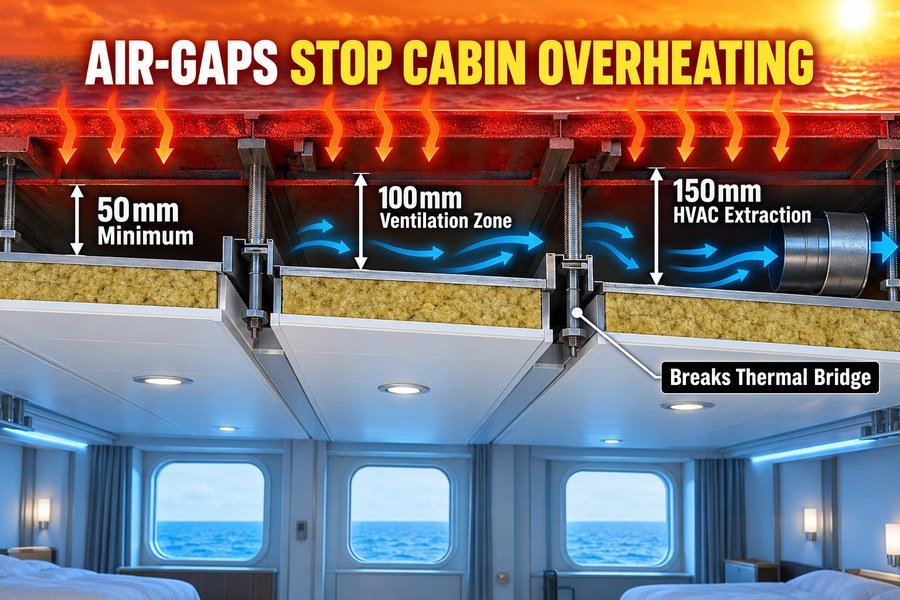
You cannot just hang a ceiling panel anywhere. Let us look at how the empty space above the panel keeps the cabin cool.
Implementing 50mm, 100mm, and 150mm Air-Gaps for Marine Deckhead Panels
The empty space between the steel ceiling and the top of the marine panel is called the air-gap. In my outfitting projects, we look at three main gap sizes: 50mm, 100mm, and 150mm.
A 50mm gap is the absolute minimum allowed. It breaks direct physical contact, which prevents conductive thermal bridging6. But in the tropics, 50mm is often not enough. The small pocket of trapped air gets very hot and stays there. A 100mm or 150mm air-gap is much better. This larger space creates a proper ventilation zone. Air can move around, cooling the back of the ceiling panel. When you buy installation profiles, make sure they have long hangers to support these deeper drops.
Utilizing Deckhead Air-Gaps for HVAC Ducting and Heat Extraction
A larger air-gap does more than just hold empty air. It gives you room for ship cooling systems. A 150mm gap allows enough space for mandatory HVAC ducting. Shipbuilders can install small exhaust vents inside this empty space.
These vents extract the hot trapped air before it ever reaches the ceiling panel. This greatly reduces the load on the cabin cooling system7. When you negotiate with shipyards in Europe or America, they will always ask about ceiling installation space. You must assure them that your panel suspension system can adjust to create these 100mm or 150mm gaps easily. It shows you understand modern shipbuilding cooling requirements.
| Air-Gap Size | Thermal Bridging Prevention | Ventilation Zone Quality | Space for HVAC Ducting | Shipyard Rating |
|---|---|---|---|---|
| 50mm | Yes | Poor (Air traps heat) | None | Minimum |
| 100mm | Yes | Good (Air moves freely) | Small pipes only | Standard |
| 150mm | Yes | Excellent | Full HVAC extraction | Premium |
How Does Solar Exposure Impact IMO Compliance for Marine Ceiling Panels?
You found a panel that blocks heat, but does it pass safety rules? Tropical heat degrades materials over time. This can cause panels to fail mandatory fire tests.
Solar exposure impacts IMO compliance for marine ceiling panels by testing material stability under prolonged heat. You must ensure panels maintain their A-Class or B-Class fire ratings, preserve non-combustible core certification, and pass the IMO FTP Code Part 2 smoke and toxicity tests even after years of high-temperature degradation.
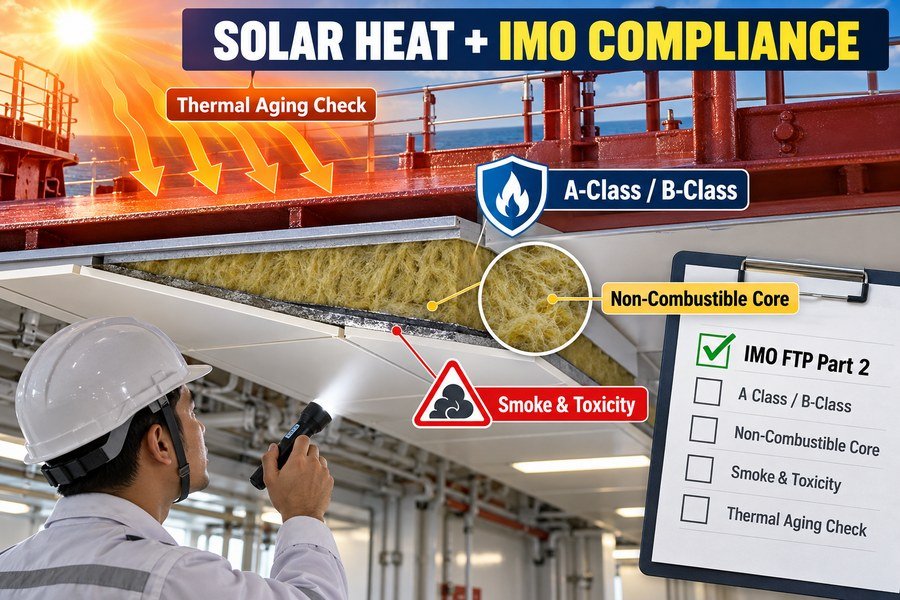
Shipyards will immediately reject your products if they lose fire compliance. Here is how solar heat changes the safety rules for your purchases.
Maintaining A-Class and B-Class Fire Ratings Under Prolonged Solar Heat
The International Maritime Organization (IMO) has strict fire rules. Marine ceiling panels must carry an A-Class or B-Class fire rating. A-Class doors and panels, like A-60, are for high-risk areas and must block fire for 60 minutes.8 B-Class items, like B-15, are for standard cabin partitions and block fire for 15 minutes.
Solar exposure heats the ship's steel deck to 70°C every single day. Over several years, this daily baking can dry out the chemical binders inside cheap rockwool. If a fire starts, a heat-degraded panel will fall apart. It will fail the 60-minute or 15-minute fire test. You must buy panels from suppliers whose materials are proven to resist this specific heat degradation over time.
Ensuring Non-Combustible Core Certification and Passing IMO FTP Code Part 2 Tests
A ceiling panel is not just made of rockwool. It also has adhesives, glues, and PVC surface finishes. The rockwool core must always keep its non-combustible certification. Furthermore, the surface film and glue must pass the IMO FTP Code Part 2 tests for smoke and toxicity9.
Cheap glues break down quickly in tropical heat. When they degrade, they lose their grip. Worse, if a fire happens, degraded glues release highly toxic gases. I always check the factory certificates closely. Make sure the testing lab verified the panel's safety even after thermal aging. Ask your factory in Asia for the latest MED (Marine Equipment Directive) wheelmark certificate to prove they pass Part 2 tests.
| IMO Compliance Requirement | Why Solar Heat Threatens It | How to Ensure Compliance | Certificate to Verify |
|---|---|---|---|
| A-Class / B-Class Fire Rating | Heat dries out rockwool binders | Buy heat-stable mineral wool | IMO FTP Code Part 3 |
| Non-Combustible Core | Heat weakens panel structure | Demand high-density cores | IMO FTP Code Part 1 |
| Smoke and Toxicity Rules | Heat degrades cheap panel glues | Use high-temperature adhesives | IMO FTP Code Part 2 / MED |
Conclusion
Tropical solar exposure demands ceiling panels with low U-values, high-density cores, proper air-gaps, and strict IMO certifications. Balance these factors to deliver safe shipyard outfitting at competitive prices.
-
"Conduction, Convection, Radiation • Combined-Mode Heat ...", https://www.purdue.edu/freeform/me418/wp-content/uploads/sites/30/2025/09/ME-418-Lec-67-Heat-Transfer.pdf. A heat-transfer textbook or educational source can support that heat transfer is conventionally classified into conduction, convection, and radiation, providing the physical framework used to describe heat entering an enclosed cabin. Evidence role: definition; source type: education. Supports: Heat moves into a ship cabin through conductive, convective, and radiant heat transfer.. Scope note: This supports the general physics classification, not the magnitude of each heat-transfer path in a specific marine cabin. ↩
-
"2.2.3 Insulation materials and their properties | OpenLearn", https://www.open.edu/openlearn/nature-environment/energy-buildings/content-section-3.2.3. Technical and educational sources on mineral wool insulation describe its fibrous structure as containing air voids that reduce heat transfer, supporting the mechanism by which rockwool provides thermal resistance. Evidence role: mechanism; source type: research. Supports: Rockwool traps air in its fibrous structure, reducing conductive and convective heat transfer.. Scope note: This supports the general insulating mechanism of mineral wool; actual R-value depends on density, thickness, installation quality, and moisture conditions. ↩
-
"Comparison of Models for Heat Transfer in High-Density ...", https://pmc.ncbi.nlm.nih.gov/articles/PMC7339548/. Studies of fibrous insulation describe heat transfer as a combination of solid conduction, gas conduction, convection, and radiation, with fiber geometry and bulk density affecting the radiative component by changing optical thickness and scattering within the material. Evidence role: mechanism; source type: paper. Supports: Lower-density mineral wool can allow more radiative heat transfer through its fiber structure than denser fibrous insulation.. Scope note: This supports the physical mechanism in mineral/fibrous insulation generally, but it does not by itself prove the specific performance of a 100 kg/m³ marine ceiling panel. ↩
-
"Determination of Thermal Properties of Mineral Wool ... - PMC", https://pmc.ncbi.nlm.nih.gov/articles/PMC10488771/. Research and technical literature on mineral wool insulation shows that density influences thermal conductivity and mechanical behavior, although the optimal density depends on fiber type, binder, orientation, temperature, and test method. Evidence role: general_support; source type: paper. Supports: Higher-density rockwool cores may be selected for more demanding thermal exposure, such as top-deck marine applications.. Scope note: This would provide contextual support for considering higher densities in demanding thermal applications, not a universal rule that all tropical marine top decks must use exactly 120 or 150 kg/m³ cores. ↩
-
"Historical Estimates of Surface Marine Temperatures", https://rainbow.ldeo.columbia.edu/~alexeyk/Papers/KentKennedy2021.pdf. Measurements and building-physics studies of sun-exposed metal or roof surfaces report that surface temperatures can rise far above ambient air temperature under high solar radiation, sometimes approaching or exceeding 70°C depending on color, material, wind, and climate. Evidence role: statistic; source type: paper. Supports: A sun-exposed steel deck in hot climates can plausibly reach about 70°C.. Scope note: Most available evidence is likely from roofs or exposed metal surfaces rather than ship decks specifically, so it supports plausibility rather than a measured value for every vessel. ↩
-
"Thermal bridge", https://en.wikipedia.org/wiki/Thermal_bridge. A heat-transfer or building-science source should support that thermal bridges arise where conductive materials create a continuous heat-flow path, and that interrupting direct contact can reduce conductive heat transfer. Evidence role: mechanism; source type: education. Supports: Breaking direct physical contact between the steel ceiling and the marine panel prevents conductive thermal bridging.. Scope note: This supports the physical mechanism generally; it does not by itself establish that a 50 mm marine deckhead gap is sufficient or code-compliant in all vessel classes. ↩
-
"Thermal performance analysis for roofs with heat mitigation ...", https://pmc.ncbi.nlm.nih.gov/articles/PMC11840041/. A peer-reviewed or institutional source on ventilated cavities should support that removing heated air from an enclosed roof or ceiling plenum can reduce heat flux to the conditioned space and thereby lower cooling demand. Evidence role: mechanism; source type: paper. Supports: Exhausting hot trapped air from the deckhead air-gap can reduce the load on the cabin cooling system.. Scope note: The evidence would be contextual unless it tests the same marine deckhead construction, air-gap depth, climate, and ventilation rate described in the article. ↩
-
"What Is the Purpose and Scope of the IMO FTP Code?", https://magellanmarinetech.com/what-purpose-scope-of-imo-ftp-code/. The IMO FTP Code and SOLAS fire-test framework define A-class divisions by their ability to prevent passage of smoke and flame for a one-hour standard fire test, with A-60 indicating insulation performance for 60 minutes under the specified test conditions. Evidence role: definition; source type: institution. Supports: A-Class doors and panels, including A-60, are maritime fire-rated divisions that must meet a 60-minute fire-resistance criterion under IMO/SOLAS testing.. Scope note: The source supports the formal meaning of A-class/A-60 ratings, but area-risk assignment depends on vessel type and arrangement rules. ↩
-
"What Is the IMO FTP Code for Marine Interior Materials?", https://magellanmarinetech.com/what-imo-ftp-code-for-marine-interior-materials/. The IMO FTP Code identifies Part 2 as the test method for smoke and toxicity, used to assess smoke generation and toxic combustion products from materials used in ship construction and outfitting. Evidence role: definition; source type: institution. Supports: Surface films and glues used in marine ceiling panels may need to satisfy IMO FTP Code Part 2 smoke and toxicity testing where applicable.. Scope note: The source supports the scope of the Part 2 test, but it does not by itself show that a specific adhesive, PVC film, or finished panel has passed the test. ↩