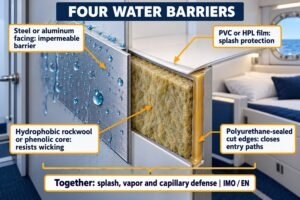
Are your new ship cabins sweating or losing heat? Thermal bridging ruins expensive interiors and drives up energy costs. I see this problem often in shipyard projects.
You can avoid thermal bridging in marine interiors by completely blocking the four main paths of heat transfer: metal-to-metal panel contacts, compressed insulation, uninsulated fastener penetrations, and gaps at the steel deck interfaces. Proper isolation materials and strict installation guidelines stop heat loss entirely.
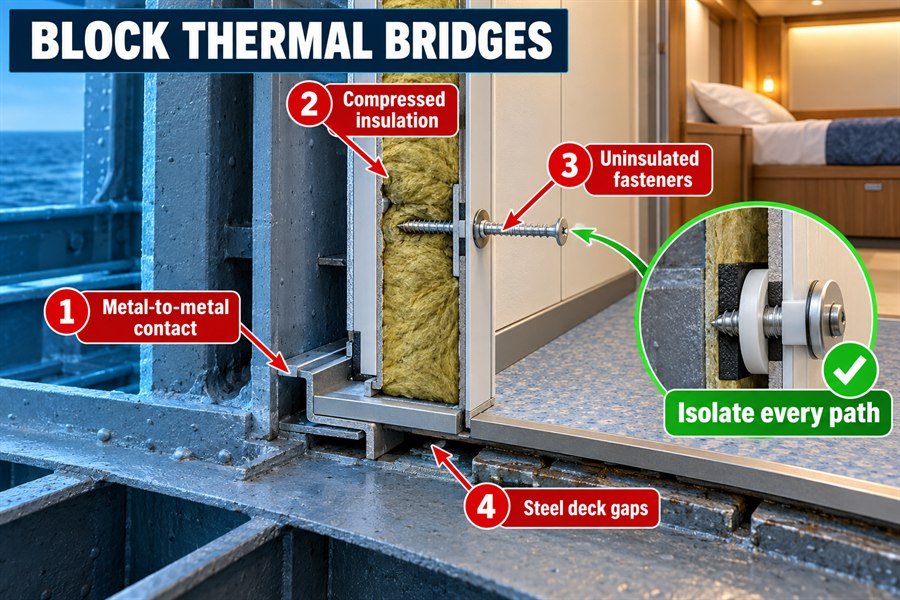
I want to share my factory and site experience to help you control these installation details. Let us look at the specific mistakes and how to fix them so you can deliver better projects to the shipyards.
What Installation Errors Cause Thermal Bridges in Marine Accommodation Panels?
You buy top-quality panels, but the cabin still feels cold. A few bad installation habits can ruin the whole thermal barrier of the room.
Three common installation errors cause thermal bridges in marine panels: omitting isolation tape between metal profiles, leaving gaps wider than 2mm between panel joints, and using continuous steel screws instead of thermal-break fasteners. These three mistakes bypass the insulation completely and allow heat to escape.
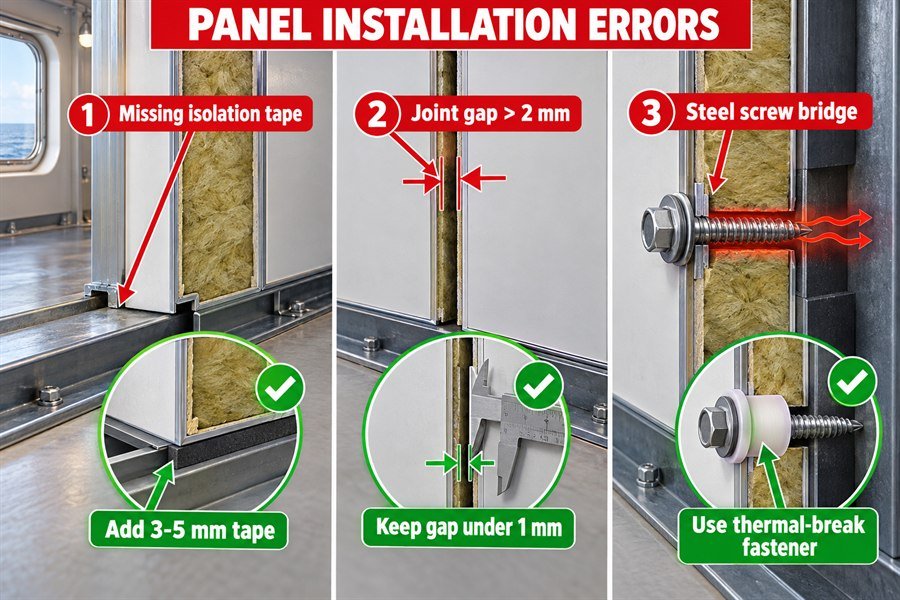
To build a high-quality ship interior, we must control the installation process. I often help my clients inspect their job sites. I see the same three errors repeatedly. Let us break down these three specific mistakes.
Error 1: Omitting Isolation Tape Between Panel Profiles
The first major error is forgetting to put isolation tape between the bottom steel profiles and the metal panel skins. Installers often skip this step to save time. Steel is an excellent conductor of heat. When the steel panel touches the bare steel floor track, the cold from the ship hull travels straight up the wall. According to ISO 7547 standards for marine air conditioning and ventilation, you must break this metal path. We use a 3mm to 5mm thick PVC or ceramic fiber isolation tape. This tape costs about $0.50 per meter, but it saves hundreds of dollars in energy loss.
Error 2: Leaving Wide Gaps Between Panel Joints
The second error involves the vertical joints between two wall panels. Sometimes, the deck is not flat. The installers struggle to push the panels tightly together. If they leave a gap wider than 2mm, the rockwool core cannot touch the next panel's core. Cold air flows right through this open crack. A solid A-60 fire-rated bulkhead loses its thermal rating instantly if there is a 3mm air gap.1 I always tell my clients to use a laser level and proper shims to keep gaps under 1mm.
Error 3: Using Continuous Steel Screws Without Thermal Breaks
The third mistake is using standard steel screws to fasten panels. A standard steel screw goes from the warm room, through the panel, and into the cold steel structure. Each screw acts as a tiny bridge for the cold. If a room has 100 screws, you have 100 cold spots. You should use thermal-break fasteners. These screws have a small nylon head or a plastic washer. The nylon stops the heat transfer. A box of 1000 nylon-headed screws costs around $45, which is a very cheap way to stop thermal bridging.
| Installation Error | Heat Transfer Path | Solution | Material Cost |
|---|---|---|---|
| No Isolation Tape | Bottom track to panel skin | 3mm PVC or Ceramic Tape | $0.50 / meter |
| Panel Joint Gaps > 2mm | Air flow between panels | Laser leveling and shims | Labor time only |
| Standard Steel Screws | Screw body to steel structure | Nylon thermal-break screws | $45.00 / 1000 pcs |
How Do Misaligned Rockwool Cores Cause Heat Loss in Marine Bulkheads?
Rockwool is a great insulator, but only if it stays in the right shape. When installers handle panels roughly, the core gets crushed or shifted.
Misaligned rockwool cores cause heat loss in two main ways: air pockets form where the rockwool pulls away from the panel edge, and the insulation loses its R-value when it gets crushed tightly against connecting profiles. Both issues let heat easily pass through the bulkhead.
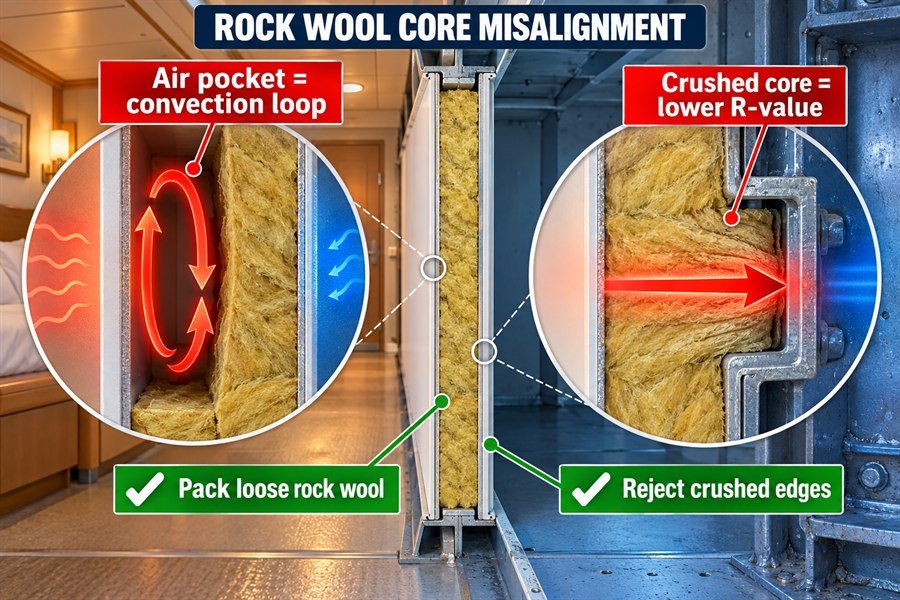
Marine wall panels rely on their rockwool core to stop heat and fire. The standard density for marine bulkhead rockwool is 120 kg/m3 to 150 kg/m32. The factory cuts this rockwool exactly to fit the metal skins. But things go wrong during installation. Let us look at the two ways a bad core position ruins the thermal barrier.
The Impact of Air Pockets in Marine Bulkhead Insulation
The first way heat escapes is through empty air pockets. When installers cut panels on site to fit around pipes, they often pull out too much rockwool. They leave a hollow space near the cut edge. Rockwool stops heat because it traps tiny pockets of still air inside its fibers.3 A large, empty air pocket does the opposite. Warm air hits the cold steel skin inside the empty pocket, cools down, and creates a fast convection loop. This loop pulls heat directly out of the cabin. To fix this, installers must pack loose rockwool back into any empty spaces tightly. A 10kg bag of loose marine-grade rockwool costs about $15 and can fill dozens of these dangerous air pockets.
The Danger of Crushed Rockwool Core in Marine Panels
The second issue is crushed rockwool. Sometimes installers use heavy hammers to force panels into a tight space. This crushes the rockwool core at the edges. When you crush rockwool, you squeeze all the trapped air out of it. The density changes from a healthy 150 kg/m3 to over 250 kg/m3 in that crushed spot. At this high density, the rockwool fibers act like a solid bridge. The thermal conductivity increases sharply. The R-value drops. The crushed edge becomes a cold line running from the ceiling to the floor. I advise supervisors to reject any panels that installers have hit too hard with a mallet.
| Rockwool Condition | Density Estimate | Thermal Performance | Common Cause |
|---|---|---|---|
| Normal / Factory | 150 kg/m3 | Excellent (Low heat transfer) | Proper handling |
| Hollow Air Pocket | 0 kg/m3 | Poor (Fast heat convection) | Bad site cutting |
| Crushed Core | 250+ kg/m3 | Poor (Solid heat conduction) | Forcing panels with hammers |
How Does Over-Fastening Increase Thermal Bridging in Marine Ceilings?
Installers often think more screws make a ceiling safer and stronger. But driving too many screws too tight creates a fast highway for cold temperatures.
Over-fastening increases thermal bridging through three mechanisms: excess screws add more direct metal paths to the cold steel deck, high torque crushes the ceiling panel insulation around the screw hole, and overtightened clips break the PVC thermal barrier strips. You must control screw count and torque.
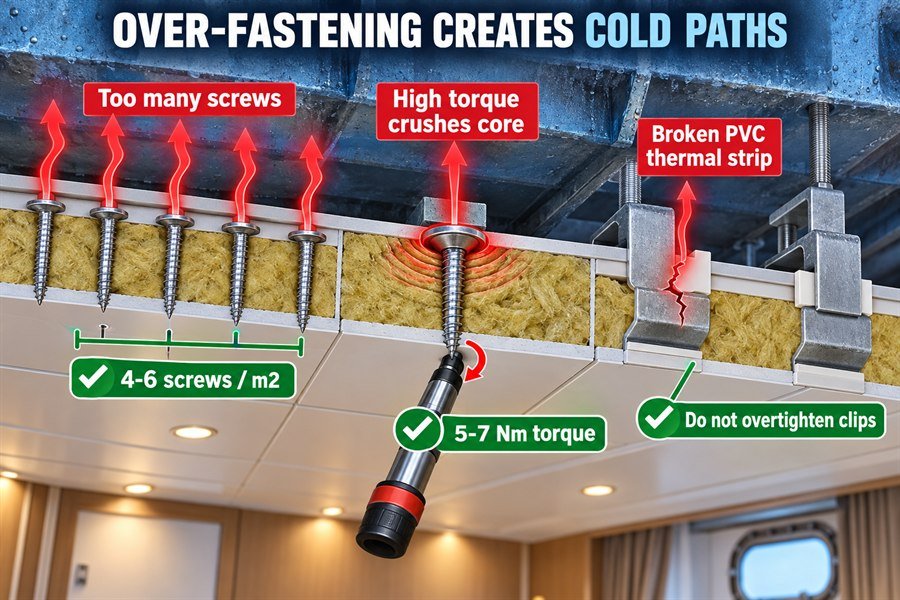
Shipyard vibration makes people worry about ceilings falling down. So, installers often use twice as many screws as they actually need. They also use heavy impact drills that push the screws in too hard. This is a very bad practice. We need to look closely at these three mechanisms of over-fastening.
Mechanism 1: Adding Unnecessary Metal Paths to the Steel Deck
The first mechanism is the simple math of metal paths. Every steel screw is a conductor. The manufacturer's manual usually states you need 4 to 6 screws per square meter for standard 50mm marine ceiling panels. I have seen sites where installers use 12 screws per square meter. If a cabin is 10 square meters, that is 60 extra holes and 60 extra metal bridges to the cold deck. These extra screws do not add much strength, but they easily increase the heat loss of the ceiling by 15%. Installers must follow the exact screw count from the factory drawings.
Mechanism 2: High Torque Crushing Ceiling Panel Insulation
The second mechanism is high torque. When an installer uses an impact drill, they often drive the screw head deep into the panel face. This crushes the 50mm rockwool core down to maybe 30mm around the screw. As we discussed earlier, crushed rockwool loses its ability to stop heat. The cold travels down the screw and spreads through the crushed rockwool. I always tell contractors to set their drill torque limits to 5 Nm to 7 Nm. This holds the panel firmly without crushing the inside materials.
Mechanism 3: Breaking the PVC Thermal Barrier Strips
The third mechanism involves the suspension clips. Marine ceilings hang from the steel deck using metal clips. Good systems include a 3mm PVC thermal strip between the clip and the panel. If you tighten the bolt too much, the sharp metal edges slice right through the soft PVC strip. Once the PVC breaks, the steel clip touches the panel directly. The thermal break is gone. A replacement PVC strip costs only $0.10, but the labor to go back and fix a cold, sweating ceiling costs hundreds of dollars per room.
| Fastening Issue | Rule to Follow | Result of Mistake |
|---|---|---|
| Too Many Screws | Use 4-6 screws per sq meter | 15% increase in heat loss |
| High Screw Torque | Limit drill torque to 5-7 Nm | Crushed core, cold spots |
| Broken PVC Strips | Do not overtighten suspension clips | Direct metal contact, sweating |
What Mistakes Leave Conductive Gaps at Marine Lining-to-Steel Interfaces?
The place where the decorative wall meets the bare steel hull is highly risky. Small mistakes at this interface let freezing temperatures straight into the room.
Conductive gaps at lining-to-steel interfaces happen due to three mistakes: failing to use Z-profile thermal separators, leaving the bottom U-channel in direct contact with the wet deck, and missing spray insulation on the steel behind the lining. These three areas must be sealed.
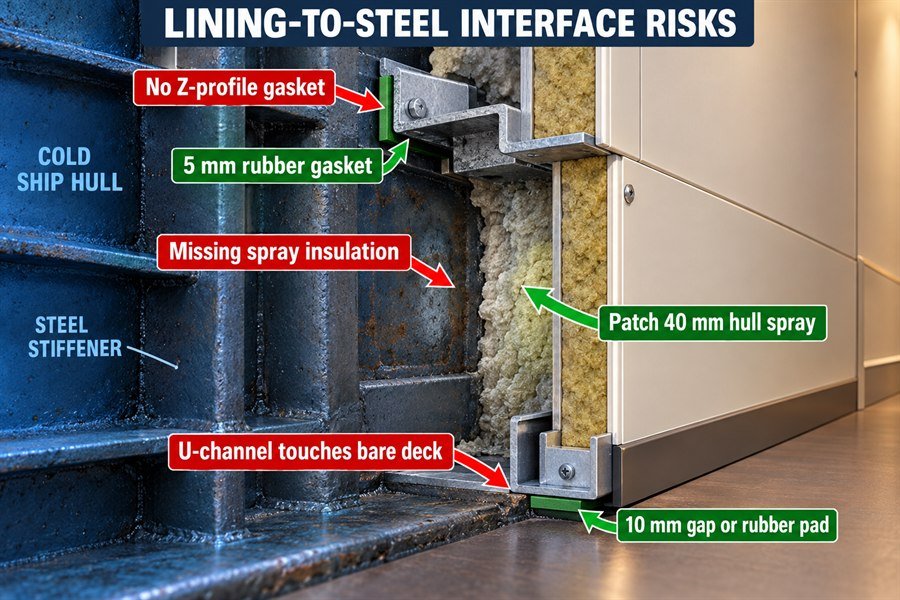
The ship's hull is constantly sitting in cold seawater. The steel hull is freezing. When we install a decorative lining panel next to this hull, we have to create a perfect barrier. If we fail, the cold jumps from the hull to the panel. Let us examine the three mistakes that cause these gaps.
Mistake 1: Failing to Use Z-Profile Thermal Separators
The first mistake is attaching the panel directly to the hull stiffeners. We must use a stand-off bracket, usually called a Z-profile. Good Z-profiles have a 5mm thick rubber or neoprene gasket4 on the side that touches the hull. Often, buyers buy cheap Z-profiles without this rubber gasket to save $1 per piece. This leaves a direct conductive gap5. The cold moves from the hull, into the Z-profile, and straight into the room side panel. Always buy brackets with pre-installed thermal gaskets.
Mistake 2: Leaving Bottom Channels Touching the Bare Deck
The second mistake happens on the floor. Installers lay the bottom steel U-channel directly onto the bare steel deck before the floating floor goes in. The steel deck conducts the cold sea temperature6 perfectly. Moisture also collects here. If the U-channel touches the deck, the bottom 100mm of the wall panel becomes a cold thermal bridge. The correct way is to leave a 10mm gap or place a heavy rubber base pad under the U-channel. This rubber pad costs about $2 per meter but it completely stops the cold from climbing up the wall.
Mistake 3: Missing Spray Insulation on the Backing Steel
The third mistake is ignoring the bare steel behind the panel. Even if you use good brackets, the air space between the hull and the lining gets very cold. According to SOLAS rules7, shipyards must spray A-60 or A-30 fire insulation on the bare steel. This is usually a 40mm thick layer of mineral wool spray or pins. Sometimes, the shipyard misses a spot behind a pipe. The lining installer puts the panel up anyway. That uninsulated steel spot radiates severe cold across the air gap into the lining. We must always check the hull spray before closing the wall.
| Interface Mistake | Where It Happens | Prevention Method | Estimated Cost of Fix |
|---|---|---|---|
| No Z-Profile Gasket | Wall stand-off brackets | Buy brackets with 5mm rubber | $1.00 extra per bracket |
| Channel Touching Deck | Floor track installation | Use rubber base pads or 10mm gap | $2.00 per meter |
| Missing Spray Insulation | Bare hull behind panels | Inspect and patch 40mm hull spray | Varies by shipyard |
How to Avoid Metal-to-Metal Contact When Installing Marine Interior Panels?
Metal conducts heat very fast. If you let the steel panel skins touch the ship structure directly, the expensive insulation inside the panel does nothing.
You avoid metal-to-metal contact by using three physical barriers: 3mm to 5mm thick silicone or ceramic fiber isolation tapes on all mounting profiles, nylon insulating washers on every fastening screw, and plastic connection splines between panel joints instead of solid steel tongues.
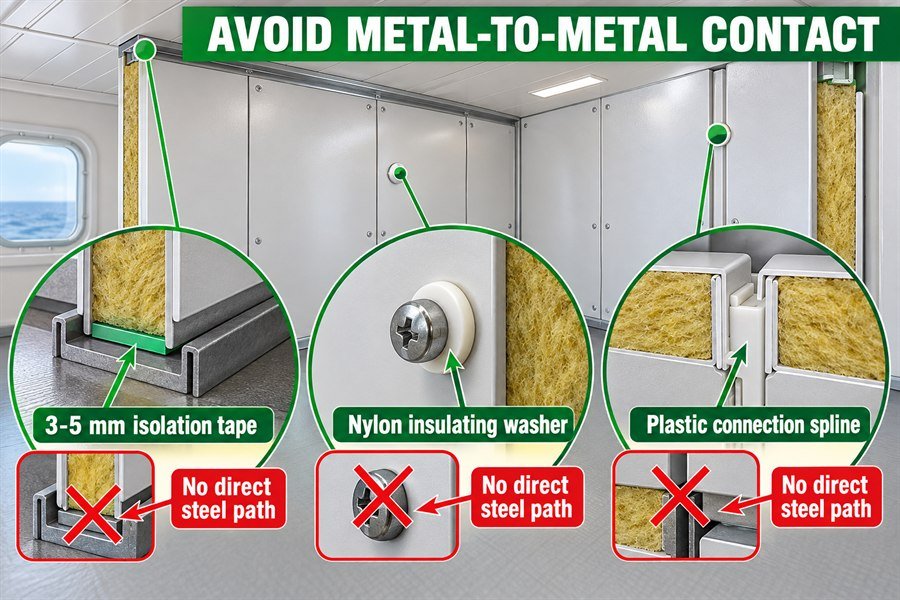
When I train new shipyard workers, I always tell them to pretend metal is poison. You cannot let the room-side metal touch the hull-side metal. If they touch, the heat runs away.8 We use specific materials to build a physical block. Here are the three main barriers you need to buy and use.
Barrier 1: Applying Silicone or Ceramic Fiber Isolation Tapes
The first physical barrier is isolation tape. You place this tape on every floor track, ceiling track, and wall bracket. We usually use silicone rubber tapes or ceramic fiber tapes. These tapes must be 3mm to 5mm thick. If they are too thin, the weight of the panel crushes them, and the metals touch. Ceramic fiber is excellent because it also resists fire up to 1000°C, helping with the A-Class fire rating. A good roll of 5mm ceramic tape costs about $15 for 10 meters. It is a small price to pay to stop the metal parts from kissing.
Barrier 2: Using Nylon Insulating Washers on Fasteners
The second barrier is the nylon insulating washer. We talked about screws being thermal bridges earlier. If you must use a standard metal screw, you have to separate the screw head from the panel surface. You slip a 2mm thick nylon washer onto the screw before you drive it in. Nylon has a very low thermal conductivity.9 It stops the heat from the room from entering the cold steel screw. A bag of 500 nylon washers costs around $5. This is the cheapest and fastest way to fix metal-to-metal fastener contact.
Barrier 3: Choosing Plastic Connection Splines for Panel Joints
The third barrier is at the panel joints. Many marine panels connect using a tongue and groove system. Older designs use a steel tongue or a steel spline to lock the two panels together. This piece of steel connects the cold side of the panel to the warm side of the panel. Modern, high-quality panels use a hard plastic or PVC spline instead. The PVC spline holds the panels together tightly but blocks the heat transfer completely. When you buy marine panels, always check the technical drawings to ensure the connection spline is plastic, not steel.
| Physical Barrier | Application Area | Recommended Material | Thickness |
|---|---|---|---|
| Isolation Tape | Floor/Ceiling Tracks | Silicone or Ceramic Fiber | 3mm to 5mm |
| Insulating Washers | Screw heads | Nylon | 2mm |
| Connection Splines | Panel-to-panel joints | Hard Plastic / PVC | Varies by panel type |
Which Overlooked Junctions Cause the Most "Sweating" in Marine Interior Panels?
Condensation, or sweating, ruins beautiful marine interiors and causes bad rust. This sweating happens at specific hidden spots where cold air heavily meets warm room air.
The most overlooked junctions that cause sweating are the window box returns connecting to the hull, the recessed lighting fixtures in ceiling panels, and the corners where wet unit pods meet the main cabin bulkheads. You must add extra insulation to these three specific points.
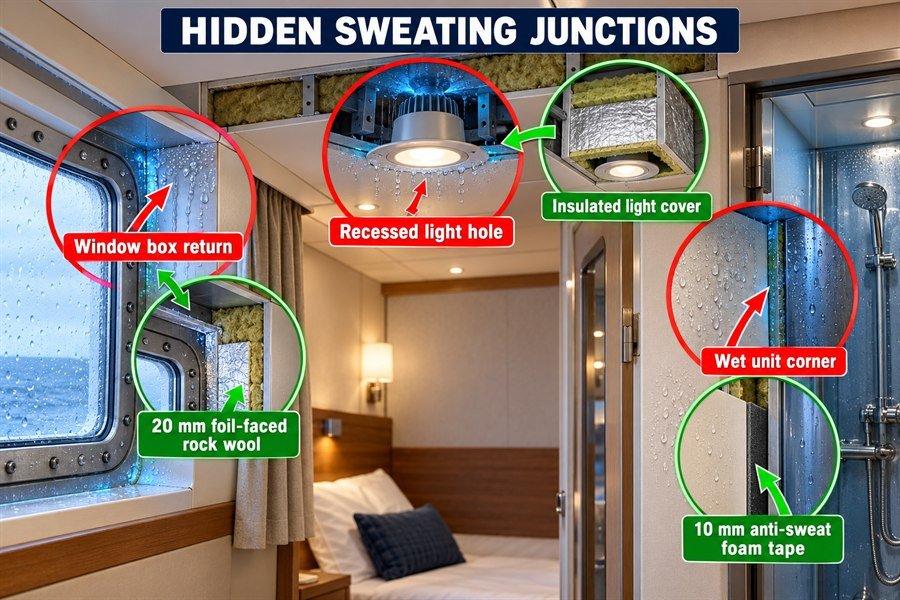
Water drops running down a new wall panel make the shipyard very angry. They will refuse to pay you. The air in a ship cabin is warm and full of moisture from people breathing and showering. When this warm air hits a cold spot on the wall or ceiling, it turns into liquid water.10 I see three specific junctions that installers always forget to insulate properly.
Junction 1: Window Box Returns Connecting to the Hull
The first bad spot is the window box. Ship windows are cut into the thick steel hull. The installer has to build a box frame to connect the decorative wall panel to the glass window frame. Usually, they use aluminum or steel plates for this return box. The metal window frame is freezing cold from the outside wind. The cold travels into the return box.11 If you do not insulate the back of this box, the inside surface gets cold and sweats heavily. We must wrap the outside of the window box with at least 20mm of foil-faced rockwool. This costs about $8 per window but saves the wall from water damage.
Junction 2: Recessed Lighting Fixtures in Ceiling Panels
The second hidden junction is the ceiling light fixture. Installers cut a big hole in the 50mm ceiling panel to push a recessed LED light inside. This hole removes the protective rockwool core.12 Also, the steel body of the light fixture goes up into the cold void space above the ceiling. The cold drops down through the metal light body into the warm room. Water drops form on the light and drip onto the floor. You must buy special insulated cover boxes to put over the lights in the ceiling void. An insulated light cover costs around $12.
Junction 3: Corners Where Wet Unit Pods Meet Cabin Bulkheads
The third overlooked spot is the bathroom, or wet unit. Many ships use prefabricated steel wet units. The steel walls of the wet unit are full of cold water pipes. The metal gets very cold. When the standard cabin wall panel touches the corner of this steel wet unit, a thermal bridge forms. The warm cabin air hits that cold corner, and water forms on the cabin wall. Installers must apply a 10mm anti-sweat rubber foam tape along the corner where the wet unit meets the cabin panel. This simple foam tape breaks the cold transfer and keeps the corner dry.
| Overlooked Junction | Cause of Sweating | Required Fix | Fix Cost Estimate |
|---|---|---|---|
| Window Box Returns | Cold transfers from hull window frame | 20mm foil-faced rockwool wrap | $8.00 per window |
| Recessed Lights | Core is cut, light body is exposed to cold void | Insulated cover boxes for fixtures | $12.00 per light |
| Wet Unit Corners | Cold steel bathroom pod chills cabin wall | 10mm anti-sweat rubber foam tape | $3.00 per corner |
Conclusion
Proper marine panel installation stops thermal bridges and sweating completely. By controlling panel joints, using isolation tapes, and avoiding over-fastening, you ensure high-quality, warm, and dry cabins for the shipyards.
-
"What Is the Purpose and Scope of the IMO FTP Code?", https://magellanmarinetech.com/what-purpose-scope-of-imo-ftp-code/. IMO/SOLAS fire-test criteria for A-class divisions define integrity and insulation performance for tested assemblies over specified time periods, supporting the importance of maintaining joints and seals; this does not by itself prove that every 3 mm gap causes an instantaneous loss of rating. Evidence role: definition; source type: institution. Supports: A-60 fire ratings depend on tested assembly integrity, and unsealed gaps can compromise the rated performance.. Scope note: The source would support A-60 rating criteria and the assembly-based nature of fire resistance, but the exact 3 mm and “instantly” wording would require a specific test report or installation standard. ↩
-
"How to choose the right marine wall panels for marine interior ...", https://magellanmarinetech.com/how-choose-right-marine-wall-panels-for-marine-interior-projects/. A marine insulation specification, classification document, or type-approval record can show that mineral-wool cores for fire-rated marine bulkheads are commonly specified in the approximate 120–150 kg/m³ density range. Evidence role: statistic; source type: institution. Supports: The standard density for marine bulkhead rockwool is 120 kg/m³ to 150 kg/m³.. Scope note: This would establish a common specification range rather than a universal standard, because required density varies by fire rating, panel construction, and certification system. ↩
-
"Comparison of Models for Heat Transfer in High-Density ...", https://pmc.ncbi.nlm.nih.gov/articles/PMC7339548/. A building-physics or materials-science source can support that mineral wool has low thermal conductivity partly because its fibrous structure immobilizes air and reduces convective heat transfer within the insulation. Evidence role: mechanism; source type: education. Supports: Rockwool reduces heat transfer because its fibrous structure traps small pockets of still air.. Scope note: The source would explain the general insulation mechanism of mineral wool, not the exact thermal performance of this specific marine panel. ↩
-
"Measured Behavior and Thermal Gradients in Innovative ...", https://library.ctr.utexas.edu/digitized/texasarchive/phase2/1404-1.pdf. A materials-property source should document that neoprene/rubber has much lower thermal conductivity than steel, supporting its use as a thermal break between metal components. Evidence role: mechanism; source type: education. Supports: A rubber or neoprene gasket in a Z-profile reduces direct conductive heat transfer from the steel hull to the interior lining support.. Scope note: This supports the heat-transfer mechanism, but it does not verify the article’s specific 5 mm gasket dimension or bracket design. ↩
-
"Multiphysics Modeling of the Steel Continuous Casting Process", https://ccc.illinois.edu/PDF%20Files/Reports14/Mold%20Heat%20Transfer%20and%20Distortion/HIBBELER-L%20Multiphysics%20Modeling%20of%20Steel%20CC%20-%20PhD%20Thesis%202014%20lores.pdf. A building-physics or heat-transfer reference should explain that continuous metal connections create thermal bridges because metals conduct heat efficiently across assemblies. Evidence role: mechanism; source type: education. Supports: A metal bracket directly connecting hull stiffeners to lining panels can act as a conductive thermal bridge.. Scope note: The source would provide general thermal-bridge principles rather than ship-specific test data for this exact bracket configuration. ↩
-
"Thermal Conductivity", http://hyperphysics.phy-astr.gsu.edu/hbase/Tables/thrcn.html. A materials or marine-engineering source should show that steel has high thermal conductivity and that steel structures exposed to cold seawater can transmit low temperatures to connected interior metal elements. Evidence role: mechanism; source type: education. Supports: A bare steel deck in contact with cold marine conditions can conduct heat away from a connected steel U-channel, creating a cold lower wall area.. Scope note: This would support the plausibility of conductive cooling, but not the article’s absolute wording that the deck conducts temperature “perfectly.” ↩
-
"What Do A-Class, B-Class, and C-Class Divisions Mean in Marine ...", https://magellanmarinetech.com/what-a-class-b-class-c-class-divisions-mean-in-marine-wall-ceiling-panels/. The SOLAS/IMO fire-safety provisions define A-class divisions such as A-30 and A-60 by their fire-resistance performance and insulation-temperature limits, supporting the regulatory context for fire insulation on ship divisions. Evidence role: definition; source type: institution. Supports: A-60 and A-30 are SOLAS-recognized fire-resistance classifications relevant to insulation of ship structural divisions.. Scope note: SOLAS establishes performance requirements for fire-rated divisions; it may not require every bare hull area behind decorative lining to receive a specific sprayed 40 mm mineral-wool treatment. ↩
-
"Incorporating Thick Layers of Exterior Rigid Insulation on ...", https://docs.nrel.gov/docs/fy15osti/63337.pdf. Building-physics sources describe metal fasteners and framing elements that bypass insulation as thermal bridges because metals conduct heat much more readily than surrounding insulating materials. Evidence role: mechanism; source type: government. Supports: Direct metal-to-metal contact between room-side and hull-side components can create a thermal bridge that increases heat transfer.. Scope note: This supports the general heat-transfer mechanism; it does not quantify heat loss for this specific shipyard panel assembly. ↩
-
"Electrically and thermally conductive nylon 6,6", https://digitalcommons.mtu.edu/michigantech-p/3808/. Materials-property references list nylon thermal conductivity at roughly a few tenths of a watt per meter-kelvin, far below that of common steels, supporting its role as an insulating washer material. Evidence role: statistic; source type: education. Supports: Nylon has much lower thermal conductivity than steel and can reduce conductive heat flow at fastener contacts.. Scope note: Thermal conductivity varies by nylon formulation, moisture content, fillers, and temperature; the comparison supports the general material choice rather than a specific washer product. ↩
-
"Making Do with Dew Points | METEO 101 - EMS Online Courses", https://courses.ems.psu.edu/meteo101/node/1947. A building-science or educational source on dew point and surface condensation supports that moist indoor air condenses into liquid water when it contacts a surface at or below its dew-point temperature. Evidence role: mechanism; source type: education. Supports: Warm, moisture-laden cabin air can condense into liquid water on cold wall or ceiling surfaces.. ↩
-
"instructions for editing and coordination", https://www.fcps.edu/sites/default/files/media/pdf/Division-8-Doors-and-Windows_0.pdf. A source on thermal bridging supports that highly conductive metal components around openings can transmit heat across an insulated assembly, lowering interior surface temperatures and increasing condensation risk. Evidence role: mechanism; source type: research. Supports: Metal window return boxes connected to cold exterior frames can conduct cold inward and create condensation-prone surfaces.. Scope note: Most available sources discuss buildings rather than ship cabins, so the evidence is contextual for the same heat-transfer mechanism in marine window returns. ↩
-
"Job Aid 2-5: Seal Insulation-Contact Rated Recessed Lights", https://www.energy.gov/sites/default/files/2022-06/job-aid-2-5_seal-insulation-contact-rated-recessed-lights.pdf. A government or building-energy source on recessed luminaires and ceiling penetrations supports that cutting openings through insulated ceiling assemblies interrupts insulation continuity and can reduce local thermal performance. Evidence role: mechanism; source type: government. Supports: Cutting a hole for a recessed light interrupts the insulated rockwool core of a ceiling panel and weakens local thermal protection.. Scope note: Such sources may address residential or commercial ceilings rather than ship panels, so they support the insulation-continuity principle rather than the exact marine installation detail. ↩