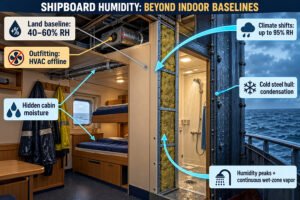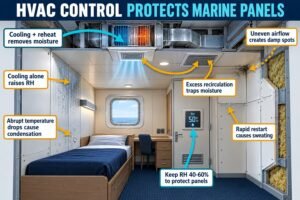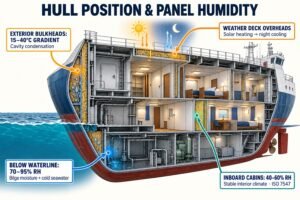
Moisture ruins ship interiors fast. Blistered PVC films and rusted steel cores trigger expensive shipyard warranty claims. Understanding wet-space humidity sources helps you buy the right panels first.
Galleys, laundries, and wet spaces raise marine panel humidity to 80%–100% RH through four mechanisms: high-temperature steam release (60°C–100°C), direct liquid splashing, continuous vapor pressure differentials (up to 3.5 kPa), and negative-pressure exhaust failures that push moisture into wall cores and ceiling plenums.
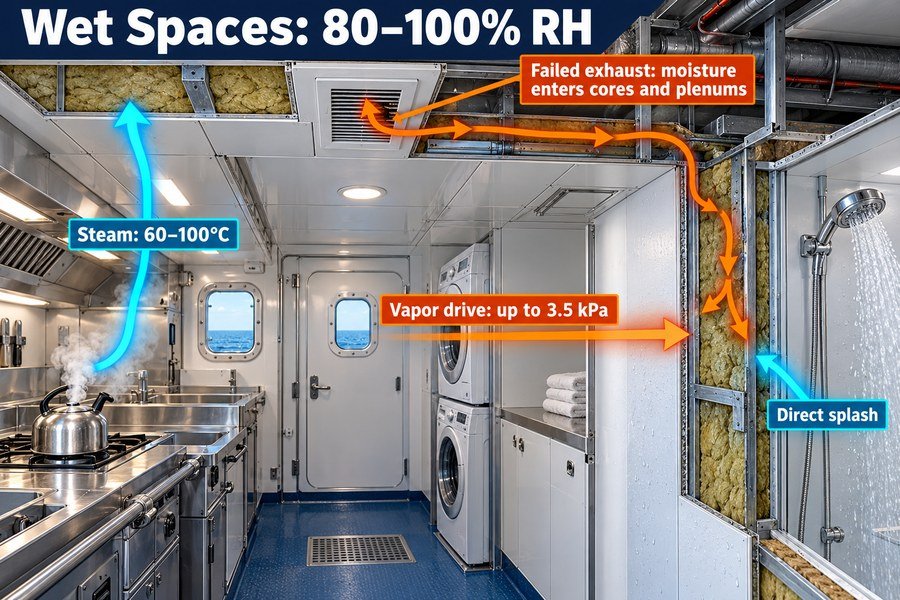
I have seen many procurement managers lose profits because standard cabin panels rotted inside wet zones within twelve months. Below, I break down the exact steam loads, airflow failures, and specification rules so you can select moisture-proof marine panels with confidence.
What Humidity and Steam Loads Hit Marine Interior Panels in Ship Galleys?
Galley panels peel and corrode faster than any other ship area. Unchecked cooking steam destroys standard rockwool cores in months. Knowing exact galley moisture loads prevents costly replacements.
Marine interior panels in ship galleys face three primary moisture loads under ISO 7547 and USPHS guidelines: continuous ambient relative humidity of 70%–95% RH, peak thermal steam spikes of 85°C–100°C from boiling kettles and combi-ovens, and high-pressure washdown spray at 2 to 6 bar.
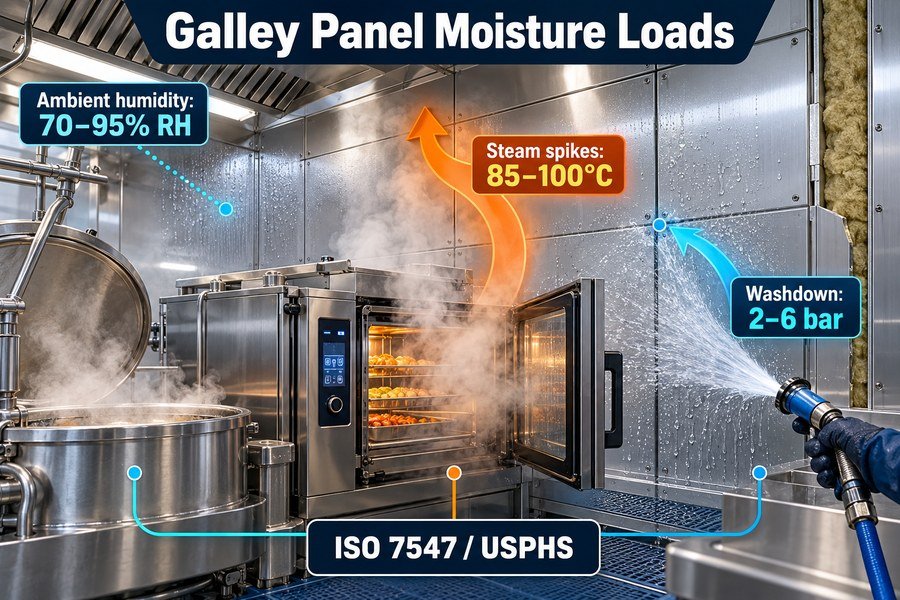
Continuous Ambient Relative Humidity and Thermal Steam Spikes in Ship Galleys
When I worked at a marine outfitting factory, I inspected a ferry galley where the wall panels bulged out by 15 mm after six months. The buyer had ordered standard galvanized steel panels with PVC film to save $12 per square meter. That decision cost her company $45,000 in replacement labor at a European shipyard. Ship galleys generate extreme moisture that standard cabin materials cannot handle.
First, marine interior panels face continuous ambient relative humidity between 70% and 95% RH during 12-hour to 16-hour daily cooking shifts1. According to ISO 7547 cabin design standards, normal accommodation spaces stay between 40% and 60% RH. In a busy galley, dishwashing machines and scullery sinks release constant water vapor into the room. This high ambient humidity creates a vapor pressure of 2.5 to 4.2 kPa.2 The moisture pushes through tiny pinholes in standard PVC decorative films and loosens the polyurethane glue holding the steel skin to the rockwool core.
Second, galley panels suffer peak thermal steam spikes of 85°C to 100°C. When kitchen crew open industrial combi-ovens, tilting braising pans, or 100-liter soup kettles, superheated steam blasts directly against nearby bulkheads and linings. Under IMO FTP Code Part 1 and Part 5 fire standards, panel adhesives must stay stable under heat, but standard adhesives soften when wet steam hits 90°C repeatedly. The sudden temperature jump from 25°C room air to 95°C steam causes thermal expansion in the metal skin. Because steel expands faster than mineral wool, the panel surface delaminates and forms ugly air pockets3.
High-Pressure Washdown Spray Loads and Stainless Steel Panel Protection
Third, galley wall panels must survive high-pressure washdown spray at 2 to 6 bar (29 to 87 psi). Under United States Public Health Service (USPHS) Vessel Sanitation Program (VSP) rules, crew members wash down galley walls daily using hot water at 60°C to 70°C mixed with alkaline degreasers. Standard tongue-and-groove panel joints let water shoot straight into the mineral wool core at pressures above 1.5 bar.
Once water enters the core, the rockwool absorbs liquid and sinks to the bottom of the panel. To stop these three loads, I always tell buyers to specify 0.6 mm to 0.8 mm SUS 304 or SUS 316L stainless steel sheets (meeting ASTM A240 standards) with hydrophobic rockwool cores that have a water absorption rate below 1.0 kg/m² under EN 1609 testing.
| Galley Moisture Load Type | Operating Value Range | Authoritative Standard | Panel Failure Mode | Recommended Panel Specification |
|---|---|---|---|---|
| Continuous Ambient Humidity | 70%–95% RH (12–16 hrs/day) | ISO 7547 / ASHRAE | Adhesive softening and core dampness | Hydrophobic rockwool (density ≥ 120 kg/m³) |
| Peak Thermal Steam Spikes | 85°C–100°C surface hits | IMO FTP Code Part 5 | PVC film blistering and skin delamination | Two-component polyurethane adhesive + SUS 304 skin |
| High-Pressure Washdown Spray | 2–6 bar at 60°C–70°C | USPHS / VSP Guidelines | Joint water ingress and bottom track rust | Coaming weld base + silicone-sealed H-profiles |
How Does Rising Galley and Laundry Steam Affect Marine Ceiling Panels?
Overhead ceiling panels often sag and drip rusty water onto clean laundry and food tables. Rising steam attacks hidden ceiling voids silently. You must stop condensation before corrosion starts.
Rising galley and laundry steam damages marine ceiling panels in three ways: thermal buoyancy traps 50°C–75°C vapor against cold steel deckheads to cause hidden plenum condensation, moisture saturates rockwool insulation above 3% weight gain, and dampness corrodes galvanized joints within 6 to 18 months.
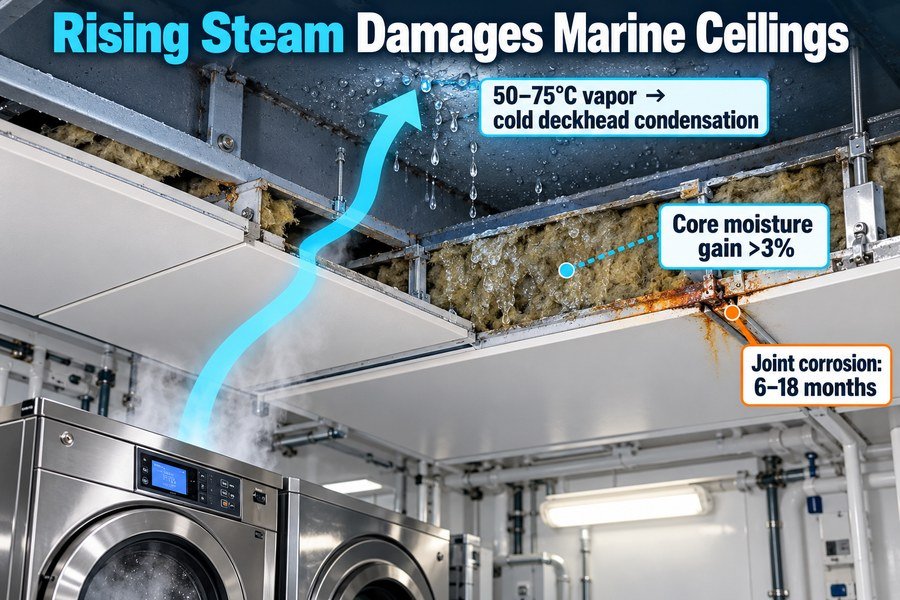
Thermal Buoyancy and Hidden Plenum Condensation Above Marine Ceiling Panels
Many buyers focus all their budget on wall panels and try to save money on ceiling panels. Two years ago, I helped a client fix an offshore support vessel where brown water dripped from the laundry ceiling onto clean crew uniforms. The problem started with thermal buoyancy. Hot steam from industrial tumble dryers and galley kettles rises at a speed of 0.5 to 1.2 meters per second4. This rising plume creates a hot air layer of 50°C to 75°C directly beneath the B-0 or B-15 marine ceiling panels.
Marine ceiling panels have gaps around recessed LED light fixtures, fire sprinklers, and ventilation diffusers. Because hot steam has high vapor pressure, it pushes upward through these 1 mm to 3 mm gaps into the hidden ceiling plenum space. Above the ceiling panels sits the structural steel deckhead. If the room above the galley is an air-conditioned cabin kept at 21°C (per ISO 7547), the structural steel deckhead stays near 18°C to 20°C. When 60°C wet air hits a 20°C steel deckhead, it crosses the dew point immediately. This contact creates severe hidden plenum condensation, producing 0.3 to 0.8 liters of liquid water per square meter every day. That water drips straight down onto the unprotected back side of your marine ceiling panels.
Rockwool Insulation Saturation and Galvanized Joint Corrosion in Damp Ceilings
The second damage mechanism is rockwool insulation saturation. Standard ceiling panels use mineral wool cores with a thickness of 25 mm to 50 mm and a density of 80 to 100 kg/m³. Most factories leave the top side of the ceiling panel open or cover it only with a thin 0.05 mm aluminum foil vapor barrier. When plenum condensation drips onto the back of the panel, the mineral wool acts like a sponge. Under EN 1609 testing, untreated rockwool can absorb over 10% of its weight in water. Once moisture saturates the rockwool above a 3% weight gain threshold, the ceiling panel gains 4 to 8 kg per square meter. This extra weight causes the 0.5 mm steel ceiling span to sag downward by 5 mm to 12 mm in the middle. Furthermore, wet rockwool loses 40% to 60% of its thermal and fire insulation value5 under SOLAS Chapter II-2 requirements.
The third mechanism is rapid joint corrosion. Standard marine ceiling panels use electro-galvanized or hot-dip galvanized steel with a zinc coating of only 60 to 100 g/m² (Z100 under EN 10346). In a warm, wet laundry ceiling plenum, this thin zinc layer oxidizes into white rust within 3 months and red iron rust within 6 to 18 months. For galleys and laundries, I always advise installing cassette-type SUS 304 stainless steel ceiling panels with sealed neoprene gaskets and a 0.4 mm galvanized steel back-sheet to lock moisture out of the core.
| Ceiling Damage Mechanism | Physical Metric / Threshold | Reference Standard | Structural Consequence | Engineering Prevention Solution |
|---|---|---|---|---|
| Thermal Buoyancy & Condensation | 50°C–75°C vapor hitting 20°C deckhead | ISO 7547 / Psychrometrics | 0.3–0.8 L/m²/day water dripping on panel backs | Insulate structural deckhead with 50 mm closed-cell foam |
| Rockwool Core Saturation | Moisture weight gain above 3% | EN 1609 / SOLAS II-2 | Panel weight rises 4–8 kg/m²; span sags 5–12 mm | Use double-skin ceiling panels with sealed steel backing |
| Galvanized Joint Corrosion | Zinc loss at >80% RH and 40°C | EN 10346 / ISO 9223 | Red rust stains and joint failure in 6–18 months | Upgrade to 0.6 mm SUS 304 skin with silicone gaskets |
Why Do Washrooms and Showers Expose Marine Wall Panels to Constant Moisture?
Crew washroom walls bubble and smell like mold after just one sea voyage. Constant shower water finds every tiny joint gap. Understanding wet-room exposure helps you buy watertight panels.
Washrooms and showers expose marine wall panels to constant moisture because of three operational factors: crew shift rotations create 16 to 20 hours of daily wet surface contact, warm 40°C shower spray drives 95%–100% RH vapor pressure, and ship hull vibration cracks silicone bottom seals.
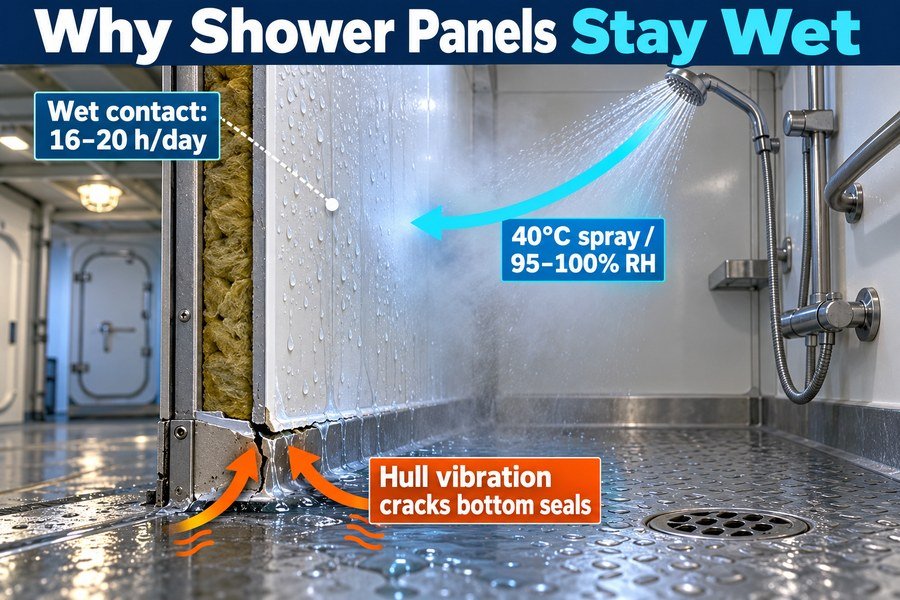
Continuous Crew Shift Usage and High Vapor Pressure in Ship Showers
In a home bathroom, the walls get wet for thirty minutes and then have twenty-three hours to dry out completely. Ship washrooms do not get a drying break. Last year, I reviewed a panel specification for a 200-person accommodation barge. The procurement officer wanted to use standard 0.6 mm PVC-laminated panels in the communal washrooms because the price was $18 per square meter instead of $28 for wet-unit panels. I showed her the math on crew rotations, and she changed the order immediately.
First, crew shift rotations create 16 to 20 hours of daily wet surface contact. On merchant ships, cruise vessels, and offshore rigs, workers operate on 4-hour watches or 12-hour shifts6. As soon as one group finishes showering, the next shift enters the washroom. Because the wall panels stay coated in a liquid water film for up to 20 hours a day, the panel joints never reach equilibrium with dry air. Capillary action pulls liquid water into any vertical M-profile or tongue-and-groove joint narrower than 2 mm at a rate of 15 to 30 mm per hour.
Second, warm 40°C shower spray drives 95% to 100% RH vapor pressure inside the washroom cubicle. According to standard steam tables and ISO 15382 sanitary space guidelines, water heated to 38°C–42°C atomizes through shower nozzles into fine mist droplets measuring 10 to 50 microns. This mist saturates the air to 100% RH within three minutes. The warm mist creates a vapor pressure differential of 3.0 to 5.0 kPa7 between the inside of the shower stall and the cooler rockwool core inside the B-15 wall panel. This pressure forces water vapor straight through micro-pores in standard decorative laminates.
Hull Vibration and Bottom Track Seal Failures in Sanitary Bulkheads
Third, ship hull vibration cracks silicone bottom seals and lets floor water wick up into the panels. Under ISO 20283-5 marine vibration guidelines, ship superstructures experience continuous low-frequency vibration between 5 Hz and 80 Hz8 from the main engine and propeller shaft, alongside hull flexing in heavy seas. This constant movement causes a 0.5 mm to 2.0 mm shear deflection between the steel floor deck and the vertical marine wall panels.
If the installer uses cheap acetoxy silicone sealant at the bottom C-channel track, the joint cracks open within 90 days. Once the seal cracks, soapy shower water pools inside the bottom U-profile. From there, water wicks upward into the rockwool core by 100 mm to 250 mm, rotting the steel skin from the inside out. To prevent this failure, I always recommend welding a 100 mm high stainless steel flat-bar coaming to the deck and sealing the panel bottom with high-modulus polyurethane marine sealant (such as Sikaflex-291i, meeting IMO FTP Code standards) that stretches up to 300% without tearing.
| Sanitary Exposure Factor | Operational Metric | Authoritative Standard | Effect on B-15 Wall Panel | Long-Term Engineering Fix |
|---|---|---|---|---|
| Crew Shift Rotations | 16–20 hours/day wet contact | ILO MLC 2006 Sanitary Rules | Zero drying time; capillary joint seepage | Use factory-prefabricated wet units with welded corners |
| Warm Shower Mist Spray | 38°C–42°C water; 95%–100% RH | ISO 15382 / ASHRAE | 3.0–5.0 kPa vapor drive blisters standard PVC film | Specify 150-micron PVDF film or GRP/Enamel skins |
| Hull & Engine Vibration | 5–80 Hz frequency; 0.5–2.0 mm shift | ISO 20283-5 Vibration | Bottom silicone cracks; water wicks up 250 mm | Install 100 mm welded steel base coaming + PU sealant |
How Does Failed Wet-Space Exhaust Humidify Marine Accommodation Panels in Adjacent Cabins?
You buy expensive wet-room panels, but standard panels in the next cabin still warp. Failed exhaust fans push wet air sideways. Fixing air pressure saves your entire cabin budget.
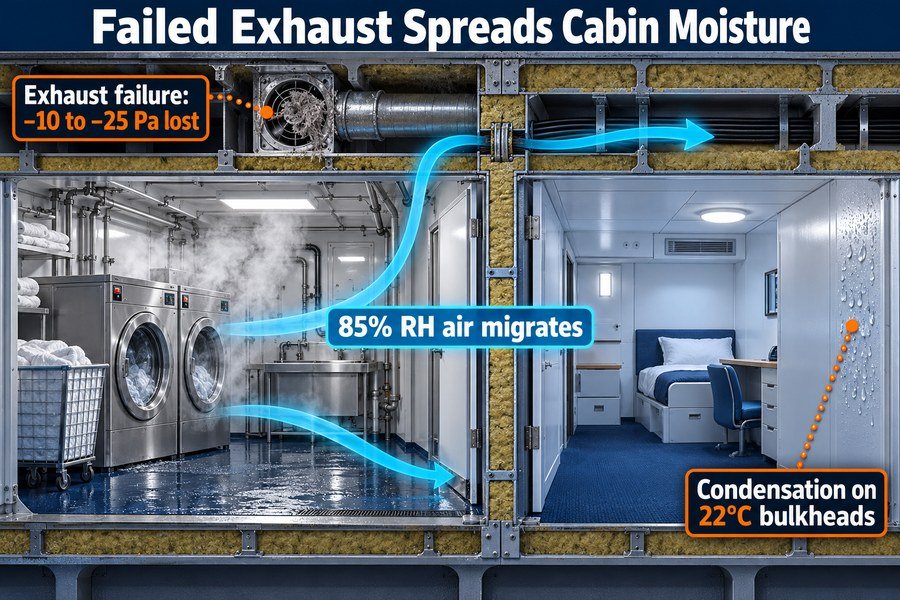
Failed wet-space exhaust humidifies adjacent cabin panels through three stages: blocked extraction fans lose their required -10 Pa to -25 Pa negative pressure, positive pressure pushes 85% RH air through cable penetrations and B-15 door undercuts, and moisture condenses on 22°C cabin bulkheads.
Loss of Negative Pressure in Wet-Space HVAC Extraction Systems
You might wonder why a standard dry-zone wall panel in a captain's bedroom or a hallway starts rusting when there is no water pipe inside that wall. I solved this exact mystery on a bulk carrier refit project three years ago. The shipyard blamed my factory's B-15 cabin panels for peeling, but my pocket manometer proved that the ship's exhaust fan was the real culprit.
In the first stage, blocked extraction fans lose their required -10 Pa to -25 Pa negative pressure. Under ISO 7547 (Ships and marine technology — Air-conditioning and ventilation of accommodation spaces), ship HVAC engineers design galleys, laundries, and sanitary spaces with mechanical exhaust rates of 10 to 15 air changes per hour (ACH) for washrooms and 20 to 40 ACH for galleys9. This high extraction rate keeps the wet room at a negative static pressure of -10 Pa to -25 Pa relative to the adjacent cabin or corridor. Because air always flows from high pressure to low pressure, dry cabin air normally flows into the bathroom. However, when laundry lint clogs the exhaust grille, grease blocks the galley fire damper, or an exhaust fan belt snaps, extraction drops below 3 ACH. When crew members run hot water, thermal expansion raises the room pressure to +5 Pa to +15 Pa positive pressure.
Moisture Migration Through Door Undercuts and Condensation on Cool Cabin Walls
In the second stage, positive pressure pushes 85% RH air through cable penetrations and B-15 door undercuts into adjacent dry zones. Marine wet-space doors and B-15 cabin fire doors usually have a bottom ventilation undercut of 10 mm to 15 mm or a lower transfer louver of 200 cm² to 400 cm² to allow return airflow. Also, above the ceiling panels, electricians run cable trays and pipes through bulkhead cutouts that are often loosely stuffed with mineral wool. When the wet space becomes positively pressurized at +10 Pa, it acts like a pump. It blows 35°C air loaded with 85% RH moisture out through the door louver and through overhead bulkhead gaps at a velocity of 1.0 to 2.5 m/s directly into the neighboring cabin.
In the third stage, this escaped moisture condenses on 22°C cabin bulkheads. Under ISO 7547 summer cooling rules, cabin air-conditioning units cool the sleeping quarters to 20°C–22°C. Air at 35°C and 85% RH has a dew point of 32.1°C10. As soon as this wet air touches the cool 22°C cabin wall panels and metal door frames, liquid water droplets form across the PVC surface and inside the unsealed back joints of the dry-zone panels. Within months, the standard Z100 galvanized cabin panels rust and blister. You can prevent this cross-contamination by specifying airflow balancing checks during commissioning and sealing all top-of-wall cable penetrations with IMO-approved firestop silicone elastomer.
| Airflow Failure Stage | Pressure / Humidity Value | Authoritative Standard | Leakage Pathway | Impact on Adjacent Cabin Panels |
|---|---|---|---|---|
| 1. Negative Pressure Loss | Drops from -20 Pa to +10 Pa (<3 ACH) | ISO 7547 HVAC Rules | Clogged exhaust grilles or fan failure | Wet air stops exhausting to the outside deck |
| 2. Positive Pressure Migration | 35°C air at 85% RH flows at 1.0–2.5 m/s | SOLAS II-2 Door Louvers | 15 mm door undercuts & unsealed cable trays | Wet vapor floods cabin ceiling voids and corridors |
| 3. Cabin Wall Condensation | 32.1°C dew point air hits 22°C wall | ASHRAE Psychrometric Chart | Cold PVC surfaces & hidden panel back joints | Dry-zone Z100 panels rust and peel within 6 months |
What Moisture Loads Hit Marine Interior Panels in High-Use Wet Spaces?
Underestimating water volume in communal ship laundries and locker rooms leads to rusted bulkheads. Heavy crew traffic multiplies water accumulation every hour. Accurate load data protects your project margins.
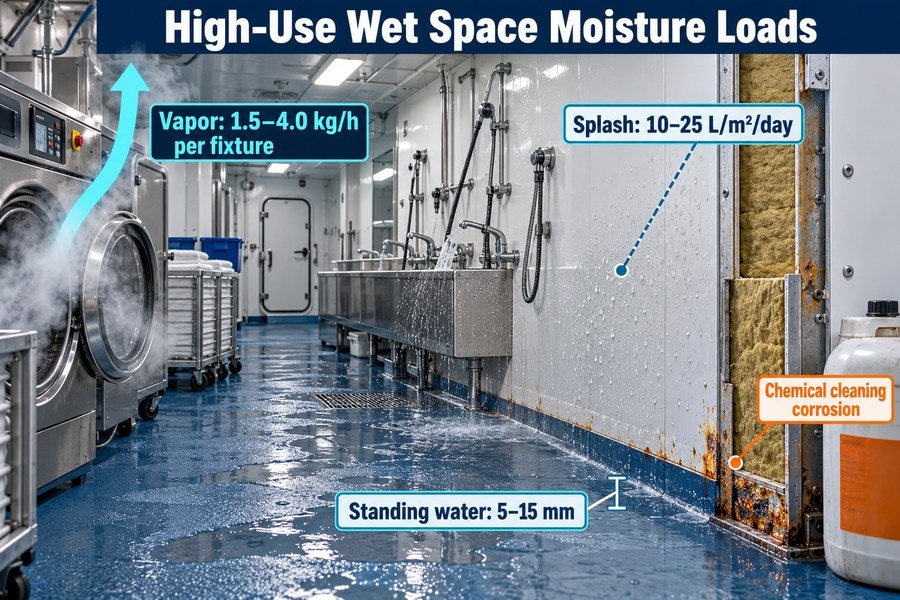
High-use marine wet spaces subject interior panels to four quantifiable moisture loads: airborne vapor generation of 1.5 to 4.0 kg/hour per fixture, direct splash water of 10 to 25 liters per square meter daily, standing floor water of 5 to 15 mm, and chemical cleaning corrosion.
Airborne Vapor Generation and Direct Splash Water Volumes in Communal Wet Spaces
When you purchase marine panels for a cargo ship with 20 crew members, moisture loads are moderate. When you supply a passenger ferry, a military troop vessel, or a 300-bed offshore accommodation rig, communal wet spaces face industrial-scale water loads. I once helped a procurement manager calculate the exact moisture volume for a rig laundry room after her client rejected standard painted steel bulkheads. Giving the shipyard engineer hard numbers won her the variation order immediately.
The first quantifiable load is airborne vapor generation of 1.5 to 4.0 kg/hour per fixture. According to ASHRAE HVAC Applications and VDI 2089 building physics data, a single commercial marine shower head running at 10 liters per minute releases 1.5 to 2.2 kg of airborne water vapor per hour11. In a communal washroom with six showers, the air absorbs up to 13 kg (13 liters) of pure water vapor every hour. Similarly, an unvented or leaky marine laundry dryer drum or steam press releases 2.5 to 4.0 kg of water vapor per hour. This massive vapor load keeps the room air saturated at 25 to 35 grams of water per kilogram of dry air12, forcing moisture into every microscopic panel joint.
The second load is direct splash water of 10 to 25 liters per square meter daily on the lower 1.5 meters of the wall panels. In communal changing rooms, sculleries, and multi-stall washrooms, water bounces off bodies, sinks, and washing machines onto the bulkheads. Standard vertical panel joints sealed only with foam tape fail under 25 L/m² of daily water runoff, allowing 50 to 200 milliliters of water to seep into the mineral wool core every week.
Standing Floor Water Depth and Chemical Cleaning Corrosion on Lower Panel Edges
The third load is standing floor water of 5 to 15 mm depth. Ships roll between 5 degrees and 22.5 degrees in rough seas (per IMO Intact Stability Code). When a ship lists to port or starboard, floor water moves away from the floor scupper drains and pools against the base of the marine wall panels at a depth of 5 to 15 mm for hours at a time. If your bottom C-profile sits flush on the deck without a raised welded coaming, the bottom edge of the panel sits submerged in dirty water.
The fourth load is chemical cleaning corrosion. Ship crews sanitize high-use wet spaces daily using sodium hypochlorite (bleach) at 500 to 5,000 ppm (per WHO and USPHS sanitation guides) or quaternary ammonium compounds with a pH of 10 to 12. Chloride ions from bleach plus saltwater tracked in on crew boots create a C4 to C5-M corrosive environment under ISO 12944. Standard galvanized steel and standard 120-micron PVC film crack, yellow, and pit within 12 months under chlorine attack. For high-use wet spaces, you must specify SUS 316L stainless steel bottom tracks and panels coated with 150-micron chemical-resistant PVDF film or 304 stainless steel skins.
| High-Use Moisture Load | Quantifiable Value Range | Authoritative Source | Vulnerable Panel Zone | Required Material Upgrade |
|---|---|---|---|---|
| Airborne Vapor Generation | 1.5–4.0 kg/hour per fixture | ASHRAE / VDI 2089 | Upper wall joints & ceiling plenums | Vapor-tight silicone joint gaskets + 15 ACH exhaust |
| Direct Splash Water Volume | 10–25 Liters/m² per day | ISO 15382 Sanitary Design | Lower 1.5 m vertical panel joints | Overlapping H-profile or flush welded unit wall |
| Standing Floor Water Depth | 5–15 mm pooling during ship roll | IMO Stability Code | Bottom C-channel track and panel cut edge | 100–150 mm welded SUS 316L base coaming |
| Chemical Cleaning Corrosion | 500–5,000 ppm chlorine (pH 10–12) | USPHS / ISO 12944 (C5-M) | Decorative film surface and metal skin | SUS 304/316L skin or 150 μm PVDF chemical film |
How Do Marine Interior Panel Specifications Define Wet and Semi-Wet Humidity Zones?
Ordering one panel type for the whole ship wastes money or ruins quality. Shipyard specs split rooms by humidity levels. Knowing zone definitions helps you balance cost and durability.
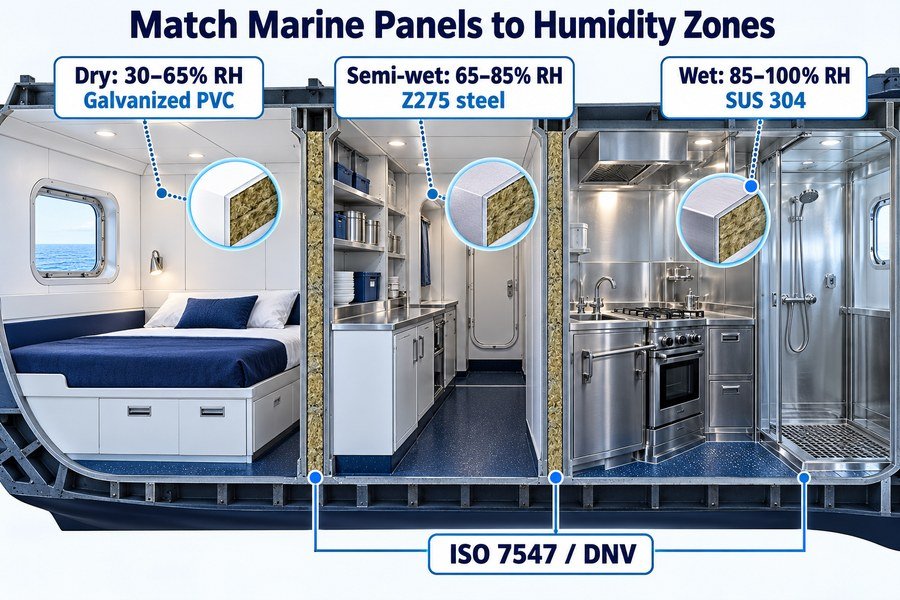
Marine specifications define three humidity zones under ISO 7547 and DNV rules: Dry Zones (cabins at 30%–65% RH using galvanized PVC panels), Semi-Wet Zones (pantries at 65%–85% RH requiring Z275 galvanized steel), and Wet Zones (galleys and showers at 85%–100% RH requiring SUS 304 stainless steel).
Dry Zone and Semi-Wet Zone Panel Specifications for Ship Accommodations
As a buyer, your biggest challenge is keeping your material budget low enough to win the shipyard tender while meeting European and American quality standards. If you buy stainless steel panels for the whole ship, you will lose the bid on price. If you buy standard dry panels for wet areas, you will lose money on warranty claims. Shipyards and classification societies like DNV, Lloyd's Register, and ABS divide vessel interiors into three clear humidity zones based on ISO 7547 and NORSOK C-001 standards13.
First, Dry Zones cover sleeping cabins, wheelhouses, offices, dayrooms, and dry corridors where relative humidity stays between 30% and 65% RH14. In Dry Zones, there is no liquid splash water and condensation risk is low. Here, you can safely purchase standard B-15 or B-0 composite panels made with 0.5 mm to 0.6 mm hot-dip galvanized steel skins carrying a zinc coating of 100 to 140 g/m² (Z100 to Z140 per EN 10346), laminated with a 120-micron to 150-micron flame-retardant PVC film (certified to IMO FTP Code Part 5 and Part 2). In China and Vietnam, these standard dry panels typically cost $16 to $24 per square meter FOB, giving you the best price competitiveness.
Second, Semi-Wet Zones cover crew mess rooms, dry provisions stores, changing rooms, hospital wards, and utility corridors adjacent to laundries where humidity fluctuates between 65% and 85% RH. These spaces experience occasional damp mopping, wet rain gear, and intermittent steam drafts, but no continuous hose washdowns. For Semi-Wet Zones, standard Z100 steel will rust at the cut edges within two years. You should specify heavy-duty galvanized steel with a zinc coating of 200 to 275 g/m² (Z275 per EN 10346) and 0.6 mm to 0.7 mm steel thickness, paired with moisture-resistant polyurethane glue and a 30 mm high stainless steel kicking strip at the floor. Semi-Wet panels cost roughly $22 to $30 per square meter FOB—only about 20% more than dry panels, saving you from buying full stainless steel.
Wet Zone Stainless Steel and Hydrophobic Core Requirements for Galleys and Showers
Third, Wet Zones cover ship galleys, sculleries, communal laundries, drying rooms, and sanitary shower cubicles where relative humidity sits at 85% to 100% RH with constant liquid water splashing. Under NORSOK C-001 and USPHS rules, standard galvanized PVC panels are strictly unsuitable here.
For Wet Zones, you must specify 0.6 mm to 0.8 mm SUS 304 stainless steel skins (or SUS 316L for chlorinated or salt-water washdown zones) with a brushed hairline or food-grade PVC protective film, or steel coated with 200-micron anti-bacterial PVDF/enamel for crew showers. Furthermore, the mineral wool core must be hydrophobic rockwool with a density of 120 to 150 kg/m³ and a water absorption rate under 1.0 kg/m² (per EN 1609)15. While Wet Zone stainless steel panels cost $35 to $55 per square meter FOB from Asian factories, using them strictly in designated 85%–100% RH spaces guarantees zero rust claims and smooth shipyard inspections.
| Humidity Zone Classification | Relative Humidity Range | Typical Ship Spaces | Steel Skin & Coating Specification (EN 10346 / ASTM A240) | Core Spec & Water Absorption (EN 1609) | Typical Factory FOB Price ($/m²) |
|---|---|---|---|---|---|
| Dry Zone | 30%–65% RH | Cabins, offices, bridge, dry corridors | 0.5–0.6 mm Galvanized Steel (Z100–Z140) + 120 μm PVC film | Standard rockwool (100 kg/m³); standard absorption | $16–$24 / m² |
| Semi-Wet Zone | 65%–85% RH | Mess rooms, pantries, locker rooms | 0.6–0.7 mm Heavy Galvanized (Z200–Z275) + 150 μm PVC/PET film | Water-repellent rockwool (120 kg/m³); < 2.0 kg/m² | $22–$30 / m² |
| Wet Zone | 85%–100% RH | Galleys, sculleries, laundries, showers | 0.6–0.8 mm SUS 304 / SUS 316L Stainless Steel or PVDF skin | Hydrophobic rockwool (120–150 kg/m³); < 1.0 kg/m² | $35–$55 / m² |
Conclusion
Controlling steam, splash loads, and exhaust pressure protects ship interiors. Match your marine wall and ceiling panels to exact wet-zone humidity ratings to prevent corrosion and save procurement budgets.
-
"Air Quality and Thermal Comfort in Kitchen Environments", https://cbe.berkeley.edu/research/air-quality-comfort-kitchen-environments/. Studies and ventilation guidance for commercial kitchens report high internal moisture generation from cooking and dishwashing processes, supporting the plausibility that galley environments can experience sustained elevated relative humidity during service periods. Evidence role: general_support; source type: research. Supports: Ship galley panels may be exposed to sustained high relative humidity during long cooking shifts.. Scope note: The source is likely to document commercial-kitchen or shipboard moisture conditions generally rather than this exact 70%–95% range and 12–16 hour schedule. ↩
-
"Chapter 10b: The Psychrometric Chart (Updated 7/22/2014)", https://people.ohio.edu/urieli/thermo/Applied/Chapt.7_11/Chapter10b.html. Psychrometric data for water vapor show that vapor pressure depends on temperature and relative humidity; at typical warm indoor temperatures, 70%–95% RH can correspond to partial vapor pressures in the low-kPa range. Evidence role: mechanism; source type: education. Supports: High relative humidity in a warm galley can produce water-vapor partial pressures around 2.5 to 4.2 kPa.. Scope note: The cited psychrometric source would support the calculation method and approximate range, but the exact 2.5–4.2 kPa values depend on the assumed air temperature. ↩
-
"Development of Composite Sandwich Bonded ...", https://ntrs.nasa.gov/api/citations/20200002411/downloads/20200002411.pdf. Engineering references on sandwich panels and bonded laminates describe how differential thermal expansion and cyclic thermal loading can generate interfacial stresses that contribute to debonding or delamination. Evidence role: mechanism; source type: paper. Supports: Repeated steam-heating cycles can contribute to delamination where bonded panel materials expand at different rates.. Scope note: The source would support the physical mechanism of thermally induced delamination, but it may not directly address ship galley panels or mineral-wool-cored stainless panels. ↩
-
"Lavelle -- Buoyancy-driven plumes", https://www.pmel.noaa.gov/pubs/outstand/lave1687/lave1687.shtml. Fluid-mechanics and indoor-air studies of buoyant thermal plumes report centerline velocities on the order of tenths to about one meter per second above localized heat sources, supporting the plausibility of the stated plume-speed range; the cited data are contextual because plume velocity varies with heat release rate, source geometry, and measurement height. Evidence role: mechanism; source type: paper. Supports: Hot steam from industrial tumble dryers and galley kettles can rise at approximately 0.5 to 1.2 meters per second.. Scope note: Support is likely to be for buoyant plumes from comparable heat sources rather than the exact dryers and kettles described. ↩
-
"Determination of Thermal Properties of Mineral Wool ... - PMC", https://pmc.ncbi.nlm.nih.gov/articles/PMC10488771/. Building-physics research shows that moisture in fibrous insulation increases effective thermal conductivity and degrades insulating performance, supporting the claim that wet rockwool performs worse than dry material; the exact 40–60% loss and fire-resistance implication require scenario-specific testing under the relevant marine assembly standard. Evidence role: mechanism; source type: paper. Supports: Moisture saturation can substantially reduce the insulation performance of rockwool or mineral-wool cores.. Scope note: The evidence may support moisture-related degradation generally, but not the precise percentage loss or SOLAS fire-rating loss for this exact ceiling-panel assembly. ↩
-
"Effects of Shift and Night Work in the Offshore Petroleum Industry", https://pmc.ncbi.nlm.nih.gov/articles/PMC4202738/. Maritime labor and offshore-work sources document that shipboard watchkeeping and offshore operations commonly use rotating watch systems, including four-hour watches and twelve-hour shift patterns, which supports the premise of staggered sanitary-space use. Evidence role: general_support; source type: institution. Supports: Workers on merchant ships, cruise vessels, and offshore rigs commonly operate on 4-hour watches or 12-hour shifts.. Scope note: Such sources establish common shift patterns, but they may not quantify shower timing or continuous wet-surface duration for a specific vessel. ↩
-
"Water", https://webbook.nist.gov/cgi/cbook.cgi?ID=C7732185&Mask=4&Type=ANTOINE&Plot=on. Psychrometric references and water-vapor pressure tables show that saturated air at approximately 38–42°C has substantially higher water-vapor pressure than cooler air or cooler hygroscopic materials, supporting the existence of a vapor-pressure gradient across a cooler wall panel. Evidence role: mechanism; source type: government. Supports: Warm saturated shower air can create a vapor pressure differential of about 3.0 to 5.0 kPa relative to a cooler wall-panel core.. Scope note: Tables can substantiate the thermodynamic range only if paired with assumed inside and core temperatures; they do not by themselves prove vapor flow through a specific laminate or panel assembly. ↩
-
"Operational Vibration Analysis of Naval Platforms for ...", https://publications.sto.nato.int/publications/STO%20Meeting%20Proceedings/RTO-MP-AVT-110/MP-AVT-110-21.pdf. Marine vibration standards and ship-structure studies identify machinery, propeller excitation, and hull response as sources of low-frequency vibration in ships, supporting the relevance of the 5–80 Hz range to shipboard structural vibration assessment. Evidence role: general_support; source type: institution. Supports: Ship superstructures experience continuous low-frequency vibration between 5 Hz and 80 Hz from machinery, propeller-shaft effects, and hull motion.. Scope note: Such sources support the frequency range and vibration sources in general; they may not establish the article’s downstream claims about seal cracking or a particular deflection amplitude without additional material-testing evidence. ↩
-
"How Much Ventilation Is Enough?", https://www.cdc.gov/niosh/ventilation/prevention/Aim-for-5.html. ISO 7547 or a recognized marine HVAC design reference can be cited to document prescribed ventilation-rate ranges for ship accommodation spaces, including sanitary spaces and galleys; if the source gives design rates rather than fault-condition behavior, it supports the baseline requirement rather than the later failure sequence. Evidence role: definition; source type: institution. Supports: Marine HVAC design standards specify relatively high exhaust ventilation rates for wet spaces such as washrooms and galleys.. Scope note: Supports the stated design ventilation-rate ranges, not the article’s specific failure measurements. ↩
-
"Psychrometric Calculator", https://people.tamu.edu/~i-choudhury/psych.html. A psychrometric chart, calculator based on recognized thermodynamic equations, or ASHRAE psychrometric reference can support that air at 35°C and 85% relative humidity has a dew point near 32°C; minor variation may occur depending on the formula and atmospheric pressure assumed. Evidence role: mechanism; source type: research. Supports: Air at 35°C and 85% relative humidity has a dew point of approximately 32.1°C.. Scope note: The exact decimal value can vary slightly by psychrometric formula and barometric pressure. ↩
-
"Interior Moisture Design Loads for Residences", https://research.fs.usda.gov/download/treesearch/25691.pdf. ASHRAE/VDI guidance on evaporative moisture loads from wet facilities can support the order of magnitude of water vapor released by running showers, though the cited range depends on assumptions about water temperature, air conditions, exposure area, and exhaust rate. Evidence role: mechanism; source type: institution. Supports: A commercial marine shower operating at about 10 L/min can generate roughly 1.5–2.2 kg/h of airborne water vapor.. Scope note: Contextual support rather than direct proof for this exact marine shower configuration. ↩
-
"Chapter 10b: The Psychrometric Chart (Updated 7/22/2014)", https://people.ohio.edu/urieli/thermo/Applied/Chapt.7_11/Chapter10b.html. Psychrometric references show that saturated or near-saturated air at warm indoor temperatures can contain water vapor in the range of tens of grams per kilogram of dry air, with the exact humidity ratio determined by dry-bulb temperature and pressure. Evidence role: definition; source type: education. Supports: Room air in high-moisture wet spaces may reach humidity ratios around 25–35 g/kg dry air under warm, saturated conditions.. Scope note: Supports the psychrometric plausibility of the range, not the actual measured humidity in the described rooms. ↩
-
"Evaluation of Protective Coatings for High-Corrosivity ... - PMC", https://pmc.ncbi.nlm.nih.gov/articles/PMC6515464/. Relevant marine accommodation and surface-treatment standards can document how vessel spaces are categorized by environmental exposure and design conditions, but they should be cited only to show the standards basis for humidity or exposure classification, not to prove that all classification societies use the identical three-zone scheme described here. Evidence role: expert_consensus; source type: institution. Supports: Ship accommodation interiors are classified by humidity or environmental exposure using standards such as ISO 7547 and NORSOK C-001.. Scope note: The article’s exact three-zone framework may be an applied purchasing classification rather than a verbatim classification used in ISO 7547, NORSOK C-001, DNV, Lloyd’s Register, and ABS documents. ↩
-
"How Does Condensation Risk Differ for Marine ...", https://magellanmarinetech.com/how-condensation-risk-differ-for-marine-accommodation-panels-by-route/. A ship accommodation HVAC standard or class guideline can support typical design humidity limits for dry accommodation spaces; if the source gives general indoor comfort or ventilation design values rather than space-by-space marine limits, it should be treated as contextual support. Evidence role: statistic; source type: institution. Supports: Dry accommodation spaces such as cabins, offices, and dry corridors are expected to operate within a moderate relative-humidity range.. Scope note: The precise 30%–65% range may vary by vessel type, climate notation, and HVAC design standard. ↩
-
"Which Mechanical Properties of Rock Wool Core Matter Most ...", https://magellanmarinetech.com/which-mechanical-properties-rock-wool-core-matter-most-marine-accommodation-panels/. EN 1609 specifies a method for determining short-term water absorption by partial immersion for thermal-insulation products, supporting the use of kg/m² water-absorption values for hydrophobic mineral-wool cores; it does not by itself set the article’s proposed 1.0 kg/m² acceptance threshold. Evidence role: definition; source type: institution. Supports: EN 1609 is an applicable test method for reporting water absorption of insulation products in kg/m².. Scope note: The cited standard defines the test method, while the <1.0 kg/m² limit requires a product specification, classification requirement, or project standard for direct support. ↩