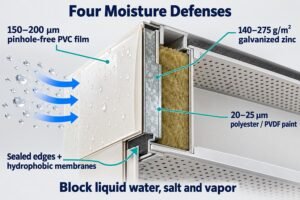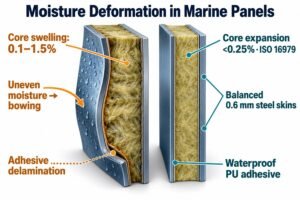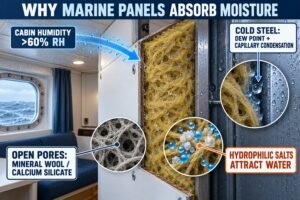
Specifying marine panels with standard indoor humidity rules causes peeling PVC films and rusted steel cores. You risk paying massive warranty claims to demanding foreign shipyards.
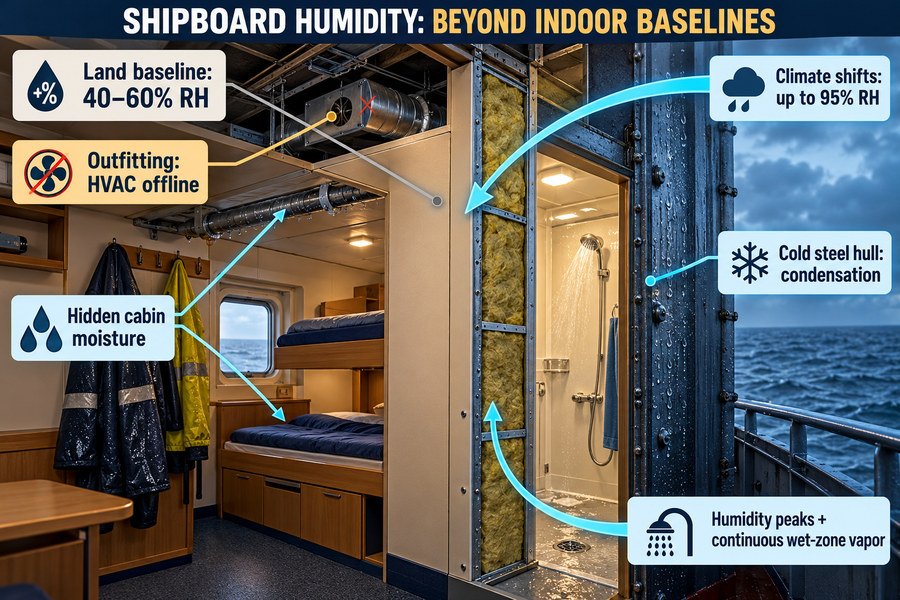
Shipboard humidity is underestimated because buyers use static land baselines (40%–60% RH) instead of marine realities: 95% RH climate shifts, cold steel hull condensation, HVAC downtime during outfitting, hidden cabin moisture sources, extreme humidity spikes, and continuous wet-zone vapor pressure defined under ISO 7547 and DNV rules.
Many procurement officers buy certified B-15 wall panels and ceiling panels from Asian factories at a competitive price, but they still face angry shipyard owners six months later. I started my career at a marine outfitting factory, and I now work at Magellan Marine helping interior contractors solve these exact problems. I have seen brand-new cabin panels blister before the vessel even leaves the dock because the buyer copied a standard indoor specification. Read on to learn how you can write accurate humidity specifications, control your supplier quality in China or Vietnam, and avoid costly replacements in European and American shipyards.
What Shipboard Humidity Conditions Are Commonly Overlooked in Marine Accommodation Panel Specifications?
Standard panel datasheets rarely mention extreme moisture stages during shipbuilding. When you ignore these hidden humidity phases, your newly installed cabin panels warp before the vessel delivery date.
Four shipboard humidity conditions are commonly overlooked in specifications: unconditioned shipyard outfitting humidity (85%–95% RH), tropical route saturation (over 90% RH), HVAC lay-up downtime, and negative-pressure moist air infiltration, which all exceed standard ISO 7547 indoor design baselines of 30% to 70% RH.
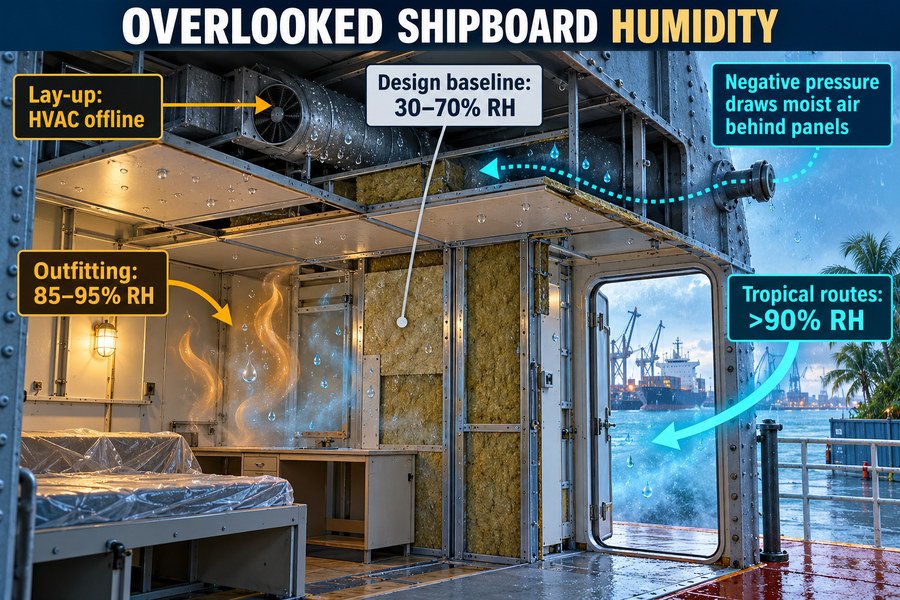
Unconditioned Shipyard Outfitting Humidity and Tropical Route Saturation on Marine Panels
Most procurement teams specify marine wall panels based on ISO 7547 indoor design rules. ISO 7547 assumes the ship air conditioning system keeps cabins at 22°C to 27°C with a relative humidity (RH) between 30% and 70%. However, the ship does not have working air conditioning during the interior outfitting stage. First, unconditioned shipyard outfitting humidity hits the panels for 3 to 6 months while the vessel sits at the quayside. During summer outfitting in Asian or US Gulf shipyards, ambient humidity inside the steel hull reaches 85% to 95% RH at 35°C1, according to IACS Recommendation No. 47 shipbuilding environment records. I once helped a contractor who bought 3,000 square meters of B-15 rockwool panels from a factory in Jiangsu. The panels sat in an unventilated hull for four months without temporary dehumidifiers, and the exposed rockwool edges absorbed 1.8 kg/m² of water. This exceeded the EN 1609 short-term water absorption limit of 1.0 kg/m². Second, tropical route saturation happens when a vessel sails through Southeast Asia or the Red Sea. Outside air holds over 90% RH at 32°C2, and every open exterior door pushes wet air straight into the accommodation corridors.
HVAC Lay-Up Downtime and Negative-Pressure Moist Air Infiltration in Ship Cabins
Third, buyers overlook HVAC lay-up downtime during dry-docking, crew changes, or port stays. When engineers shut down the main chillers for 7 to 30 days, cabin humidity rises from 50% RH to 85% RH within 12 hours. Standard galvanized steel sheets with a thin 60 g/m² zinc layer start forming white rust during a single two-week shutdown. Fourth, negative-pressure moist air infiltration pulls raw sea air behind the ceiling panels. Sanitary exhaust fans in cabin bathrooms remove 50 to 75 m³/h of air per bathroom under ISO 7547 rules. If the main air handling unit supplies 5% less air than the exhaust fans remove, the cabin develops a negative pressure of 5 to 15 Pascals. This vacuum sucks unconditioned, wet outside air through deck cable penetrations and into the ceiling void.
| Overlooked Humidity Condition | Typical Relative Humidity (RH) | Exposure Duration | Direct Impact on Marine Interior Panels | Authoritative Standard / Reference |
|---|---|---|---|---|
| Unconditioned Shipyard Outfitting | 85% – 95% RH at 32°C – 38°C | 3 to 6 months | Exposed mineral wool edges absorb water and swell | IACS Rec. 47 / EN 1609 (Max 1.0 kg/m²) |
| Tropical Route Saturation | 90% – 98% RH at 30°C – 35°C | Continuous on route | Corridor PVC film edges soften and peel back | ISO 7547 Marine HVAC Design Baseline |
| HVAC Lay-Up Downtime | 80% – 90% RH (Uncontrolled) | 7 to 30 days per year | White rust forms on low-grade galvanized steel skins | EN 10346 Galvanized Steel Coating Rules |
| Negative-Pressure Infiltration | 75% – 90% RH in ceiling voids | Daily operation | Unfiltered moist air condenses on top of B-15 ceilings | ISO 7547 Sanitary Exhaust Balance Rules |
Why Do Land-Building Humidity Assumptions Fail When Specifying Marine Interior Panels?
Using commercial hotel specifications for ship interiors is a costly mistake. Land-based moisture rules cannot stop marine panels from delaminating inside a sealed steel hull at sea.
Land-building humidity assumptions fail at sea because of four factors: sealed steel hull vapor traps, extreme thermal bridging (40°C temperature drops), constant 5–100 Hz hull vibration opening panel joints, and corrosive salt-laden air (3.5% salinity) accelerating galvanized steel corrosion under ASTM B117 standards.
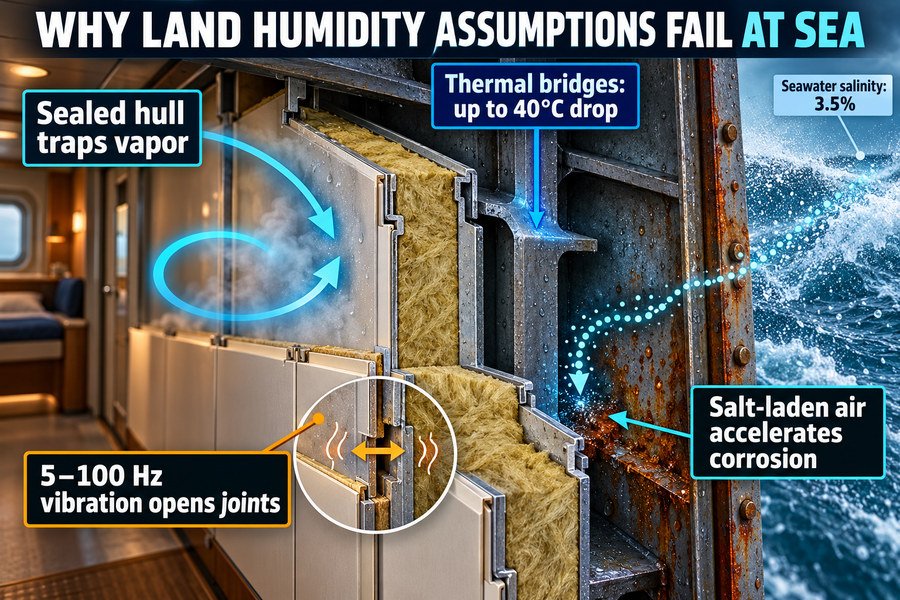
Sealed Steel Hull Vapor Traps and Extreme Thermal Bridging Across Marine Bulkheads
Many buyers treat a cruise ship or offshore vessel like a floating hotel. They apply ASHRAE Standard 55 land-building assumptions, which expect walls to breathe slowly through brick, concrete, or gypsum board. First, a ship has a sealed steel hull vapor trap. A welded 12 mm steel hull plate has a water vapor permeability of zero. Concrete walls on land have a thermal conductivity of about 1.4 W/m·K and allow trace moisture to diffuse outward. Ship steel has a high thermal conductivity of 50 W/m·K, per ISO 10456 building material data3, and it traps 100% of internal moisture inside the hull envelope. Second, extreme thermal bridging happens across steel stiffeners and bulkheads. A ship sailing in the North Sea or Alaska has a seawater and outer hull temperature of -15°C to +2°C, while the cabin sits at +22°C. That creates a 20°C to 37°C temperature drop across a narrow 50 mm to 100 mm space. If a steel stiffener touches or comes within 15 mm of the back of a B-15 wall panel, cold energy jumps straight to the panel skin and turns cabin humidity into liquid water.
Constant Hull Vibration and Salt-Laden Air Corrosion in Marine Wall Panels
Third, land buildings sit still, but ships experience constant hull vibration between 5 Hz and 100 Hz from main engines and propellers4, as measured by ISO 20283-5 marine vibration standards. In my factory testing days, I saw how continuous 25 Hz vibration loosens standard tongue-and-groove (T&G) panel joints by 0.5 mm to 1.2 mm over six months. Once those micro-gaps open, warm humid cabin air flows freely behind the panel assembly. Fourth, marine air carries corrosive salt aerosol from seawater with an average salinity of 3.5% (35 grams of salt per liter). Under ASTM B117 neutral salt spray testing, salty humidity corrodes galvanized steel 5 to 8 times faster than fresh inland moisture. A land-grade Z80 galvanized sheet (80 g/m² zinc coating) shows red rust in less than 96 hours under ASTM B117 testing, while marine environments require at least Z180 to Z275 (180 to 275 g/m²) or specialized polymer coatings to survive.
| Environmental Factor | Land Building Assumption (ASHRAE 55) | Shipboard Reality (ISO 7547 / Marine) | Why Land Panel Specifications Fail at Sea |
|---|---|---|---|
| Wall Envelope Permeability | Breathable concrete/masonry (1.4 W/m·K) | Sealed welded steel hull (50 W/m·K) | Zero outward vapor escape traps 100% of moisture inside the cavity |
| Thermal Bridging Gradient | Gradual temperature shift across thick walls | 20°C to 40°C drop across steel stiffeners | Cold steel frames drop panel backing below the dew point instantly |
| Structural Vibration | Static structure (0 Hz) | Constant 5 – 100 Hz (ISO 20283-5) | Micro-movement opens tongue-and-groove joints for vapor entry |
| Airborne Salinity | Low inland salt content | 3.5% seawater salinity aerosol | Salt ions break down thin zinc coatings 5x–8x faster (ASTM B117) |
How Does Ignoring Back-Cavity Condensation Cause Premature Marine Interior Panel Failure?
A marine wall panel can look perfect from the cabin side while rotting from behind. Hidden back-cavity condensation quietly destroys your insulation core and rusts the steel sheet.
Ignoring back-cavity condensation causes premature panel failure through four progressive stages: cold hull dew-point condensation (0.15–0.30 L/m² daily), rockwool core waterlogging (losing 60% thermal resistance), polyurethane adhesive hydrolysis, and backing steel oxidation that creates visible surface blisters within 12 to 18 months.
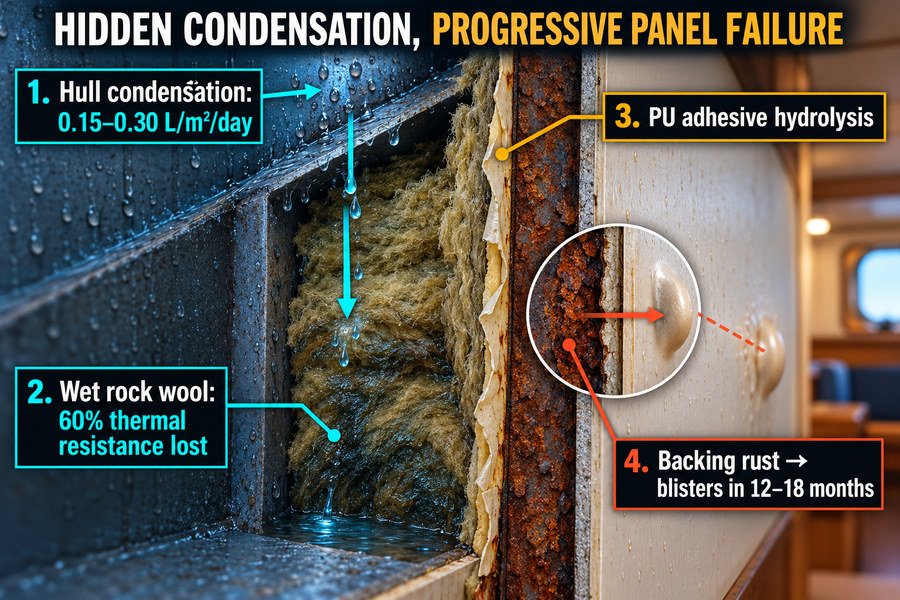
Cold Hull Dew-Point Condensation and Rockwool Core Waterlogging Behind Marine Panels
When I inspect failed cabin linings in European repair yards, the damage almost always starts inside the 50 mm to 150 mm air gap between the outer hull insulation and the B-15 lining panel. First, cold hull dew-point condensation begins when cabin air at 24°C and 65% RH leaks through electrical socket cutouts or ceiling joints into the back cavity. According to ISO 13788 hygrothermal calculation tables, air at 24°C and 65% RH has a dew point of 16.9°C5. Whenever the hull insulation pins or the back of the panel drops below 16.9°C, water condenses at a rate of 0.15 to 0.30 liters per square meter every day6. Second, rockwool core waterlogging occurs when this condensate drips into the panel joints. Marine B-15 panels use high-density rockwool of 140 kg/m³ to 150 kg/m³ certified under IMO 2010 FTP Code Part 1. Dry rockwool has a low thermal conductivity of 0.038 W/m·K7. However, once water soaks into the fibers and increases moisture content by just 5% by volume, the thermal conductivity jumps to 0.095 W/m·K8. The wet core loses 60% of its insulating value, which makes the front cabin steel sheet cold too.
Polyurethane Adhesive Hydrolysis and Backing Steel Oxidation in Marine Composite Panels
Third, polyurethane adhesive hydrolysis attacks the glue layer holding the steel sheet to the rockwool core. Most Chinese and Vietnamese factories apply 120 g/m² to 180 g/m² of one-component or two-component polyurethane (PU) glue. If liquid water sits inside the panel at temperatures between 25°C and 40°C, ester groups in low-grade PU adhesive react with water molecules and break down9. The tensile bond strength drops from 0.12 MPa (required by EN 14509 for sandwich panels) to less than 0.03 MPa, and the steel skin separates from the core. Fourth, backing steel oxidation finishes the destruction. Most 25 mm lining panels use a 0.6 mm front galvanized sheet with a 150 µm PVC film, and a bare 0.5 mm galvanized backing sheet. Once trapped water eats through the zinc backing, red iron oxide expands to 6 times the volume of the original steel10, pushing the front sheet outward and creating ugly surface blisters within 12 to 18 months.
| Failure Stage | Timeline from Installation | Key Physical Metric Change | Visible Symptom on Cabin Side | Technical Prevention Specification |
|---|---|---|---|---|
| 1. Dew-Point Condensation | Month 1 – 3 | Cavity temp drops below 16.9°C dew point (ISO 13788) | None; 0.15–0.30 L/m²/day water pools behind panel | Seal socket boxes; maintain 50 mm ventilated air cavity |
| 2. Rockwool Waterlogging | Month 3 – 6 | Thermal conductivity worsens from 0.038 to 0.095 W/m·K | Cold spots appear on cabin walls; condensation on front | Specify hydrophobic rockwool (at least 98% per EN 1609) |
| 3. PU Adhesive Hydrolysis | Month 6 – 12 | Bond strength drops from 0.12 MPa to under 0.03 MPa (EN 14509) | Panel feels hollow and spongy when pressed by hand | Require moisture-cured two-component marine PU glue (160 g/m²) |
| 4. Backing Steel Oxidation | Month 12 – 18 | Zinc layer depleted; rust expands 600% in volume | Large surface blisters, warped joints, and brown rust stains | Specify Z275 galvanization + 15 µm epoxy back coat (EN 10346) |
Which Hidden Shipboard Moisture Sources Are Missed When Specifying Marine Interior Panels?
You always check bathroom and galley moisture, but invisible internal water sources still ruin standard cabin panels. Missing these hidden moisture leaks leads to surprise warranty bills.
Four hidden shipboard moisture sources are frequently missed when specifying marine panels: chilled water pipe sweating above B-15 ceilings, crew metabolic perspiration in small cabins (1.5–2.5 L/day), wet workwear drying in corridors, and bilge or ballast tank vapor migration through deck penetrations.
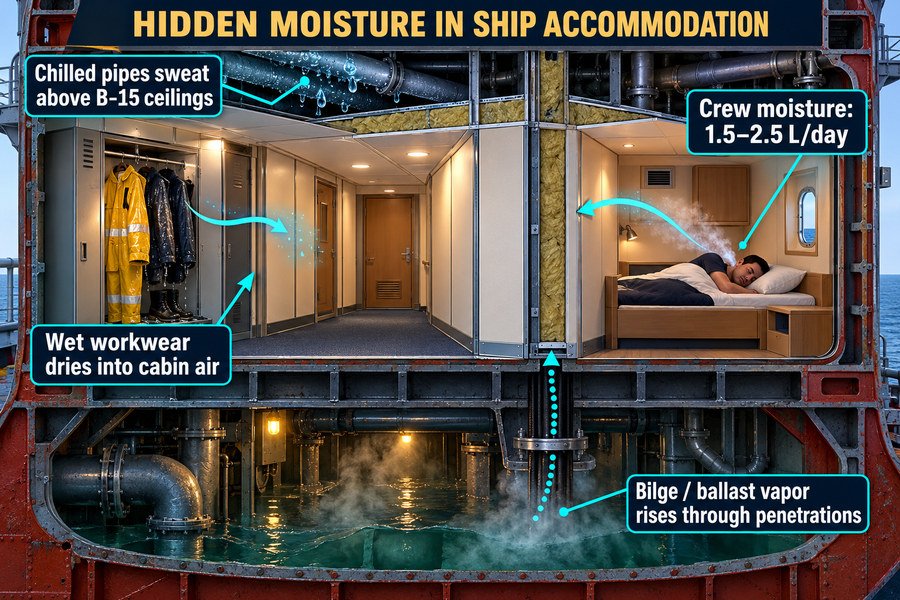
Chilled Water Pipe Sweating and Crew Metabolic Perspiration in Ship Cabins
When buyers prepare a bill of quantities (BOQ), they divide spaces into simple "dry cabins" and "wet bathrooms." In reality, dry cabins face heavy hidden moisture. First, chilled water pipe sweating happens directly above B-15 and B-0 marine ceiling panels. Ship HVAC systems pump chilled water at 6°C to 12°C through overhead piping in the ceiling void, per ISO 7547 guidelines. If a shipyard worker leaves a 10 mm gap in the closed-cell nitrile rubber pipe insulation, or if a valve flange sits uninsulated, that cold pipe drips 0.5 to 1.2 liters of condensate per day straight onto the mineral wool backing of your ceiling panel.11 I solved a case for a client outfitting an offshore support vessel in Europe where 40 corridor ceiling panels sagged by 15 mm because of sweating fan-coil valves. Second, crew metabolic perspiration loads tiny sleeping spaces with vapor. Under Maritime Labour Convention (MLC 2006) rules, a standard single crew cabin has a floor area of only 4.5 m² to 7.5 m².12 According to ISO 7547 and ASHRAE physiological data, one person releases 60 to 100 grams of moisture per hour through breathing and sweat, totaling 1.5 to 2.5 liters per day inside a tiny 10 m³ air volume.13
Wet Workwear Drying in Corridors and Bilge Vapor Migration Through Deck Penetrations
Third, wet workwear and survival suit drying in corridors or cabin lockers releases massive water spikes. On offshore wind service vessels, tugs, and commercial ships, crew members hang soaked immersion suits and rain gear in changing rooms or cabin alcoves. Each wet work suit holds 0.8 kg to 1.2 kg of seawater.14 When ten crew members hang wet gear in a locker room lined with standard 0.6 mm PVC-laminated panels, 8 to 12 liters of salty water evaporate directly against the panel joints over 8 hours. Fourth, bilge and ballast tank vapor migration creeps upward from lower decks. Double-bottom ballast tanks and engine room bilges sit right below the lower accommodation deck. Warm engine room air (35°C to 45°C at 80% RH) pushes moisture upward through unsealed MCT (multi-cable transit) frames and pipe sleeves that lack full SOLAS II-2 Regulation 9 smoke and vapor tightening, feeding constant dampness into the bottom tracks of lower-deck cabin panels.
| Hidden Moisture Source | Daily Moisture Output | Primary Affected Panel Area | Recommended Specification Upgrade | Extra Upfront Cost ($/m²) |
|---|---|---|---|---|
| Chilled Water Pipe Sweating | 0.5 – 1.2 L/day per valve | B-0 / B-15 Ceiling Panels (Top side) | Add aluminum foil vapor barrier or 0.4 mm galvanized top sheet on ceilings | +$2.50 – $4.00 /m² |
| Crew Metabolic Perspiration | 1.5 – 2.5 L/day per crew | Small MLC 2006 Single Cabins (4.5 m²) | Upgrade from 120 µm PVC to 150 µm anti-fungal marine PVC film | +$1.00 – $1.80 /m² |
| Wet Workwear & Suit Drying | 8.0 – 12.0 L/day per 10 suits | Changing Rooms, Lockers, Corridors | Use Z275 steel skin + stainless steel 304 bottom U-profiles | +$3.50 – $5.50 /m² |
| Bilge & Tank Vapor Migration | 1.0 – 3.0 L/day per penetration | Lower Deck Bulkhead Linings | Seal deck coamings with marine fire-stop silicone + epoxy-backed panels | +$2.00 – $3.00 /m² |
Why Is Peak Humidity More Critical Than Averages for Marine Interior Panels?
Relying on a comfortable 55% annual average humidity hides destructive moisture spikes. A single 48-hour peak humidity event can permanently ruin your marine ceiling and wall panels.
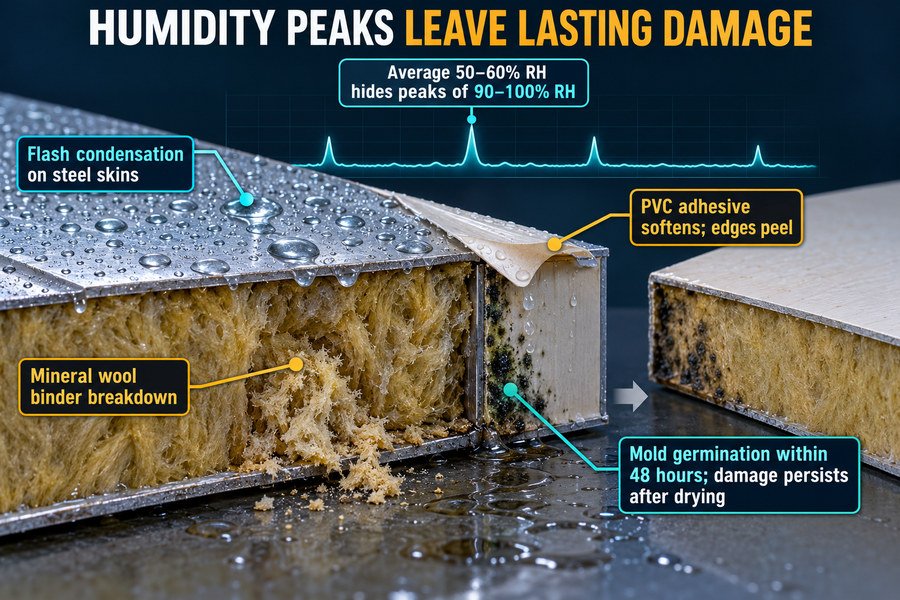
Peak humidity (90%–100% RH) is more critical than averages (50%–60% RH) because short extreme spikes trigger four irreversible damages: flash dew-point condensation on steel skins, mineral wool binder breakdown, rapid PVC film adhesive softening, and permanent 48-hour mold spore germination under WHO hygiene thresholds.
Flash Dew-Point Condensation and Mineral Wool Binder Breakdown During Humidity Spikes
When a shipyard engineer tells you the cabin average humidity is 55% RH, do not relax. Average numbers hide the 90% to 100% RH spikes that happen when galley steam vents fail, laundry exhausts back up, or exterior doors stay open during rainy port loading. These spikes cause damage that does not reverse when the air dries back to 55% RH. First, flash dew-point condensation coats the steel skins with liquid water inside the panel. At 22°C and 55% RH, the dew point is 12.5°C, so a panel at 19°C stays bone dry. If a 6-hour humidity spike pushes the air to 92% RH at 22°C, the dew point jumps to 20.6°C (per ISO 13788 psychrometric tables). The entire 19°C steel panel surface instantly sweats liquid water, which runs down into the bottom C-channel where airflow cannot dry it out. Second, mineral wool binder breakdown permanently weakens the insulation core. Under IMO 2010 FTP Code Part 1 for non-combustibility, marine rockwool contains 2.5% to 4.0% organic phenolic resin binder to hold the stone fibers together. When peak humidity above 90% RH combines with warm temperatures of 35°C to 45°C, hydrolysis breaks down the silane coupling agent in cheap phenolic binders15. Even after the panel dries out, the rockwool loses 30% to 45% of its compressive strength and turns powdery.
Rapid PVC Film Adhesive Softening and 48-Hour Mold Spore Germination on Marine Panels
Third, rapid PVC film adhesive softening occurs along the bent edges of the steel sheet. Standard marine wall panels wrap a 120 µm to 150 µm decorative PVC film around the 90-degree edges of the galvanized steel sheet. Under ISO 8510-2 180-degree peel testing, a good marine film bond measures at least 15 N/25mm. However, if a water-based acrylic glue was used by a budget supplier instead of a solvent-based or reactive polyurethane hot-melt adhesive, a 95% RH steam spike softens the edge glue to less than 5 N/25mm. The stretched PVC corner shrinks back by 1 mm to 2 mm, and it never re-sticks when humidity drops. Fourth, permanent 48-hour mold spore germination starts during brief humidity spikes. According to World Health Organization (WHO) Indoor Air Quality Guidelines and ASTM D3273 mold resistance standards, dormant fungal spores on dust or organic residues germinate permanently once relative humidity stays above 80% to 90% RH for just 48 hours16. Returning the cabin to 50% RH later does not kill the established mycelium network inside the panel joints.
| Damage Mechanism | Behavior at Average Humidity (50%–60% RH) | Behavior at Peak Humidity Spike (90%–100% RH) | Why the Damage Is Irreversible After Drying | Authoritative Standard |
|---|---|---|---|---|
| Flash Dew-Point Sweating | Dry surface (Dew point is 12.5°C at 22°C) | Instant condensation (Dew point hits 20.6°C) | Runoff water stays trapped inside bottom C-profile tracks | ISO 13788 Psychrometric Rules |
| Mineral Wool Binder Decay | Phenolic resin binder stays stable (2.5%–4.0%) | Silane coupling agent hydrolyzes in wet heat | Rockwool loses 30%–45% compressive strength permanently | IMO 2010 FTP Code Part 1 |
| PVC Film Edge Softening | Peel strength holds above 15 N/25mm | Cheap acrylic glue drops below 5 N/25mm | Stretched PVC edges curl back 1–2 mm and stay detached | ISO 8510-2 Peel Test |
| Mold Spore Germination | Spores remain dormant below 75% RH | Active fungal growth triggers within 48 hours | Established mold roots survive dry cycles and stain PVC | WHO IAQ / ASTM D3273 |
How Does Misjudging Wet-Zone and Hull-Side Humidity Shorten Marine Interior Panel Lifespan?
Installing standard dry-cabin wall panels in shower zones or against outer hulls cuts panel life by 75%. You will pay double for dismantling, air freight, and reinstallation.
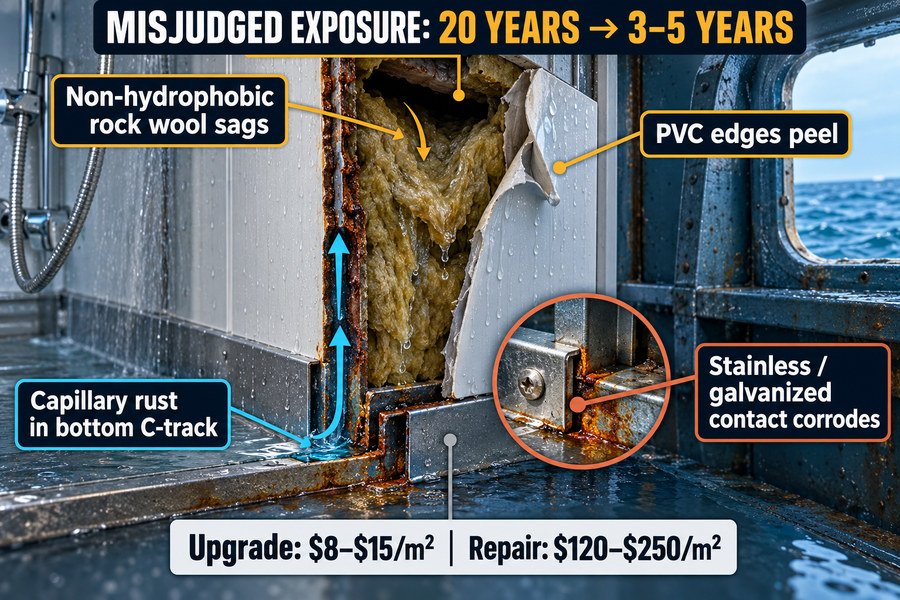
Misjudging wet-zone and hull-side humidity shortens marine panel lifespan from 20 years to 3–5 years through four failures: bottom C-profile capillary rusting, non-hydrophobic rockwool sagging, standard PVC edge peeling, and galvanic corrosion at stainless-to-galvanized joints, costing $120–$250/m² in repairs versus $8–$15/m² upfront.
Bottom C-Profile Capillary Rusting and Non-Hydrophobic Rockwool Sagging in Wet Zones
At Magellan Marine, I frequently review inquiry sheets where a buyer specifies the exact same 50 mm B-15 galvanized PVC panel for dry bedrooms, hull-side linings, communal showers, and laundry rooms to save money. A well-specified marine panel lasts 20 to 25 years under DNV and Lloyd's Register hull lifecycle expectations. Misjudging wet zones cuts that lifespan to 3 to 5 years. First, bottom C-profile capillary rusting destroys the base of the wall within 36 months. Standard dry cabins use a 0.8 mm or 1.0 mm galvanized steel bottom C-channel welded or bolted to the deck. When washdown water or hull condensation touches the bottom slot, capillary suction pulls water 15 mm to 30 mm up into the cut steel edge17 of the panel. Because the factory sheared the steel sheet after galvanizing, the raw bottom edge has zero zinc protection and rusts right up the wall face. Second, non-hydrophobic rockwool sagging ruins hull-side linings. Standard rockwool absorbs moisture vapor, grows heavy, and slumps inside the vertical cavity18, leaving the top 100 mm of the panel hollow and non-compliant with SOLAS B-15 fire integrity rules. You must specify rockwool with a hydrophobic rate of at least 98% tested under EN 1609 or GB/T 10299.
Standard PVC Edge Peeling and Galvanic Corrosion at Hull-Side Panel Joints
Third, standard PVC edge peeling happens in wet zones when high vapor pressure attacks standard 120 µm decorative films. For wet rooms, laundries, and galleys, you should upgrade to a 0.7 mm High-Pressure Laminate (HPL) surface complying with EN 438, or use a 304 stainless steel sheet (0.6 mm thickness). Fourth, galvanic corrosion at stainless-to-galvanized joints eats away the panel skin when contractors try to save money by putting a 304 stainless steel bottom track under a standard galvanized steel wall panel in a wet room. In the presence of salty moisture, stainless steel (noble metal) and zinc/carbon steel (active metal) have an electrochemical potential difference of about 0.50 to 0.75 volts under ASTM G82 galvanic series data. The galvanized panel bottom acts as a sacrificial anode and corrodes twice as fast unless you separate them with a 2 mm EPDM rubber gasket or PVC isolation strip. Looking at the commercial numbers, a standard B-15 50 mm dry cabin panel from China or Vietnam costs $18 to $24 per square meter FOB. Upgrading to a wet-zone specification (98% hydrophobic rockwool, Z275 galvanized skin with 20 µm epoxy back coat, 0.7 mm HPL or 304 stainless base with EPDM isolation) adds only $8 to $15 per square meter upfront (totaling $26 to $39/m²). In contrast, replacing rusted panels at a European or US shipyard costs $120 to $250 per square meter once you pay $65 to $95 per hour for marine carpenter labor, air freight, and hot-work permits.
| Failure Mode in Wet / Hull Zones | Standard Dry-Cabin Spec ($18–$24/m²) | Upgraded Wet / Hull Spec ($26–$39/m²) | Expected Service Life | Shipyard Repair Cost ($/m²) |
|---|---|---|---|---|
| Bottom C-Profile Rusting | 0.8 mm galvanized C-track, raw cut panel bottom | 1.0 mm SS304/316L track + PU-sealed bottom edge | 3 yrs vs. 20+ yrs | $120 – $160 /m² |
| Rockwool Core Sagging | Standard rockwool (85%–90% hydrophobic) | Marine hydrophobic rockwool (at least 98% per EN 1609) | 4 yrs vs. 20+ yrs | $140 – $190 /m² |
| Surface Edge Peeling | 120 µm PVC film with water-based acrylic glue | 0.7 mm MED HPL (EN 438) or 150 µm PVC + 2K PU glue | 3 yrs vs. 20+ yrs | $130 – $180 /m² |
| Bimetallic Galvanic Corrosion | Direct contact between SS304 track and GI sheet | 2 mm EPDM rubber isolation strip (ASTM G82 compliant) | 2 yrs vs. 20+ yrs | $180 – $250 /m² |
Conclusion
Specifying marine panels for peak humidity, back-cavity condensation, and wet zones costs $8–$15/m² extra upfront, but it protects your 20-year panel lifespan and prevents $250/m² shipyard claims.
-
"47. Relative humidity over the oceans", https://www.gfdl.noaa.gov/blog_held/47-relative-humidity-over-the-oceans/. Guidance on shipbuilding environmental control and coating work recognizes high humidity and temperature as critical conditions inside enclosed steel structures; climate records for Gulf or Asian coastal yards can substantiate that ambient outdoor conditions can approach these values, but such sources would be contextual unless they directly measure humidity inside hulls during outfitting. Evidence role: general_support; source type: institution. Supports: Unconditioned steel hulls in hot, humid shipyard regions can experience very high relative humidity, on the order of 85% to 95% RH at elevated temperatures.. Scope note: Regional climate or environmental-control guidance may not directly prove measured humidity inside a specific unventilated hull. ↩
-
"Climate Data Online (CDO)", https://www.ncei.noaa.gov/cdo-web/. Meteorological datasets for tropical maritime regions show that coastal Southeast Asian and Red Sea ports can have high temperatures with high relative humidity, supporting the plausibility of air near 32°C exceeding 90% RH; this is regional climatological support and not proof of conditions during every voyage or door-opening event. Evidence role: statistic; source type: government. Supports: Tropical maritime routes can expose ships to outside air near 32°C with relative humidity above 90%.. Scope note: Port or regional climate data cannot establish the humidity at every ship doorway or corridor during transit. ↩
-
"Thermal conductivity of selected materials", https://nvlpubs.nist.gov/nistpubs/legacy/nsrds/nbsnsrds8.pdf. Standard thermal-property tables list ordinary concrete at roughly 1–2 W/m·K and carbon steel near 50 W/m·K, supporting the claimed order-of-magnitude contrast in heat conduction; exact values vary with density, alloy, moisture content, and temperature. Evidence role: definition; source type: institution. Supports: Concrete has much lower thermal conductivity than steel, making steel hull structures stronger thermal bridges.. Scope note: The values support representative material properties rather than a precise value for every concrete mix or marine steel grade. ↩
-
"Underwater noise radiated by ships, their propulsion and ...", https://www.academia.edu/79330940/Underwater_noise_radiated_by_ships_their_propulsion_and_auxiliary_machinery_and_propellers. Ship-vibration standards and marine engineering references identify propulsion machinery and propellers as important sources of hull and structural vibration across low-frequency bands; the cited range is contextual because actual frequencies and amplitudes depend on vessel design, machinery speed, sea state, and measurement location. Evidence role: general_support; source type: institution. Supports: Ships experience hull vibration generated by engines and propellers, with relevant measurement bands overlapping roughly 5–100 Hz.. Scope note: A source may support typical vibration sources and measurement ranges without proving continuous 5–100 Hz vibration on every ship. ↩
-
"Temperature, Dewpoint, and Relative Humidity Calculator", https://bmcnoldy.earth.miami.edu/Humidity.html. Psychrometric relationships between dry-bulb temperature, relative humidity, and dew point support a dew-point temperature of about 16.9°C for air at 24°C and 65% relative humidity. Evidence role: mechanism; source type: education. Supports: Cabin air at 24°C and 65% RH has a dew point of approximately 16.9°C.. Scope note: The cited value may vary slightly depending on the psychrometric formula, pressure assumption, or table rounding used. ↩
-
"HAMT extension for EnergyPlus encompasses moisture ...", https://www.osti.gov/servlets/purl/1494004. Interstitial condensation guidance and hygrothermal models describe how vapor leakage into cold cavities can be converted into surface condensate when local temperatures fall below the dew point; such sources can contextualize daily area-based condensation estimates. Evidence role: general_support; source type: institution. Supports: Cold hull cavities can accumulate measurable daily condensate when moist cabin air leaks into spaces below its dew point.. Scope note: A general hygrothermal source would support the mechanism and calculation approach, but the exact 0.15–0.30 L/m²/day rate depends on vessel-specific leakage, ventilation, temperature profile, and exposure conditions. ↩
-
"Thermal conductivity and resistivity", https://en.wikipedia.org/wiki/Thermal_conductivity_and_resistivity. Reference data for mineral wool insulation report thermal conductivity values in the approximate range of 0.03–0.04 W/m·K, which is consistent with a stated dry rockwool value of 0.038 W/m·K. Evidence role: statistic; source type: encyclopedia. Supports: Dry rockwool commonly has thermal conductivity near 0.038 W/m·K.. Scope note: Published values vary by product density, binder, temperature, and test standard, so the source would support the order of magnitude rather than a universal value for all marine rockwool cores. ↩
-
"Influence of moisture on thermal conductivity of mineral ...", https://vb.ktu.edu/KTU:ELABAPDB90966769&prefLang=en_US. Experimental studies of mineral wool and fibrous insulation show that increasing moisture content raises effective thermal conductivity because water and displaced air alter heat-transfer pathways within the pore structure. Evidence role: mechanism; source type: paper. Supports: Moisture uptake can substantially increase the thermal conductivity of rockwool insulation.. Scope note: A general experimental study may support the direction and magnitude of moisture effects, but the exact increase to 0.095 W/m·K at 5% volumetric moisture must match the tested material density and measurement conditions. ↩
-
"Hydrolysis of poly(ester urethane): In-depth mechanistic ...", https://www.osti.gov/biblio/2477458. Polyurethane chemistry literature describes hydrolytic degradation of ester-containing polyurethane segments, in which water cleaves hydrolysable bonds and reduces polymer integrity under warm, wet conditions. Evidence role: mechanism; source type: paper. Supports: Water can hydrolyze ester-containing polyurethane adhesives, weakening the polymer network.. Scope note: The source would support the chemical mechanism of hydrolysis, but not necessarily the performance of a particular marine-panel adhesive formulation unless that formulation is tested. ↩
-
"Improved Corrosion-Resistant Steel for Highway Bridge ...", https://www.fhwa.dot.gov/publications/research/infrastructure/structures/bridge/11061/index.cfm. Corrosion engineering references report that iron corrosion products occupy several times the volume of the original iron or steel, with expansion factors commonly cited up to about six depending on the oxide or hydroxide species formed. Evidence role: mechanism; source type: government. Supports: Rust products can expand to several times the volume of the steel consumed, creating expansive pressure and blistering.. Scope note: The exact expansion factor depends on the specific corrosion product, hydration state, and environmental conditions; a general source supports the plausibility of volumetric expansion rather than a fixed value for every panel. ↩
-
"[PDF] Moisture Control Guidance for Building Design, Construction ... - EPA", https://www.epa.gov/sites/default/files/2014-08/documents/moisture-control.pdf. Building-physics or HVAC condensation literature explains that pipe surfaces below the ambient-air dew point accumulate condensate and that discontinuities in vapor-impermeable insulation can localize dripping; this supports the condensation mechanism, while the stated daily condensate volume depends on local humidity, air movement, pipe temperature, and exposed surface area. Evidence role: mechanism; source type: paper. Supports: Gaps in insulation or uninsulated cold pipe fittings can cause condensate formation and dripping onto adjacent materials.. Scope note: Contextual support for the mechanism; the 0.5–1.2 L/day figure would require a calculation, test, or case measurement for the stated conditions. ↩
-
"Martin Luther College – The WELS College of Ministry", https://mlc-wels.edu/. ILO Maritime Labour Convention, 2006, Standard A3.1 specifies minimum floor areas for single-berth seafarer sleeping rooms by ship size, including values around 4.5 m² to 7.0 m²; this supports the small-cabin area claim, though the upper value may vary by vessel category and national implementation. Evidence role: definition; source type: institution. Supports: MLC 2006 sets minimum single crew sleeping-room floor areas in the approximate 4.5 m² to 7.5 m² range.. Scope note: Directly supports MLC minimum floor-area ranges, but exact applicability depends on ship tonnage, build date, exemptions, and flag-state implementation. ↩
-
"Humidity Implications for Meeting Residential Ventilation ...", https://web.ornl.gov/sci/buildings/conf-archive/2007%20B10%20papers/197_Walker.pdf. ASHRAE thermal-comfort and ventilation references report latent heat or moisture generation rates for occupants that can be converted to tens of grams of water vapor per hour for sedentary to light activity; this supports the order of magnitude, but the exact 60–100 g/h and 24-hour total depend on activity level, clothing, sleep state, and ventilation. Evidence role: statistic; source type: institution. Supports: A person can release roughly 60 to 100 grams of moisture per hour through respiration and perspiration, producing approximately 1.5 to 2.5 liters over a day.. Scope note: Supports a plausible physiological range, not a fixed per-person emission rate in all crew cabins. ↩
-
"Quick-Drying Materials and Moisture Management in Water ...", https://pressbooks.cuny.edu/sportsrecreationgear/chapter/quick-drying-materials-water-sports/. Textile and protective-clothing drying studies show that garments can retain substantial liquid water after wetting and release it to indoor air during drying; this supports the physical basis of moisture spikes, but the specific 0.8–1.2 kg seawater value depends on garment material, size, drainage time, and whether the suit is immersion-rated or rainwear. Evidence role: statistic; source type: paper. Supports: Wet offshore workwear or survival suits can retain around kilogram-scale quantities of water that later evaporate indoors.. Scope note: Contextual support only unless the source directly tests offshore work suits or immersion suits under comparable wetting and drainage conditions. ↩
-
"Chemistry of Silanes: Interfaces in Dental Polymers and ...", https://tsapps.nist.gov/publication/get_pdf.cfm?pub_id=852197. Materials-science literature on silane coupling agents supports that siloxane or silane-derived interfacial bonds can hydrolyze under moisture and heat, reducing adhesion between inorganic fibres and organic polymer binders. Evidence role: mechanism; source type: paper. Supports: High humidity and heat can hydrolyze silane coupling chemistry in fibre-reinforced or mineral-filled polymer systems, weakening binder-fibre adhesion.. Scope note: Such sources would support the chemical mechanism generally; they may not directly test the specific marine panel binder formulation described as “cheap phenolic.” ↩
-
"WHO guidelines for indoor air quality : dampness and mould", https://www.who.int/publications/i/item/9789289041683. Indoor-air and building-microbiology guidance supports that mould growth risk increases substantially when surfaces or indoor materials remain damp or at high relative humidity, with many fungi able to germinate within one to two days under favourable conditions. Evidence role: expert_consensus; source type: institution. Supports: Fungal spores can begin germinating on suitable indoor materials after sustained high humidity, commonly around or above 80%–90% RH, over roughly 48 hours.. Scope note: The source may support the humidity threshold and short germination times in general terms, but “permanently” and the exact 48-hour threshold can vary by species, substrate, temperature, and nutrient availability. ↩
-
"Electrochemical Corrosion Behaviour of X70 Steel under the ...", https://pmc.ncbi.nlm.nih.gov/articles/PMC9143290/. Research on capillary rise and crevice wetting in narrow metal gaps can support the mechanism by which water is retained and drawn into joints; any cited source is likely to support the physical mechanism rather than the exact 15–30 mm rise in this particular panel geometry. Evidence role: mechanism; source type: paper. Supports: When washdown water or hull condensation touches the bottom slot, capillary suction pulls water 15 mm to 30 mm up into the cut steel edge of the panel.. Scope note: The exact capillary height depends on slot width, surface energy, contamination, vibration, and installation geometry, so a general capillarity source would not directly verify the stated range. ↩
-
"Settling of Loose-Fill Thermal Insulation .. ...", https://web.ornl.gov/sci/buildings/conf-archive/1992%20B5%20papers/053.pdf. Studies of mineral wool hygrothermal behavior can show that moisture uptake increases mass and degrades insulation performance; such evidence would provide contextual support for sagging risk but may not directly demonstrate slumping in marine B-15 wall panels. Evidence role: mechanism; source type: paper. Supports: Standard rockwool absorbs moisture vapor, grows heavy, and slumps inside the vertical cavity.. Scope note: Moisture uptake and settlement behavior vary by mineral wool density, binder, facing, orientation, and vibration exposure. ↩