Struggling to make ship cabins look modern while meeting strict fire safety rules? Ugly metal walls ruin good designs. Here is how you balance stunning looks with marine safety.
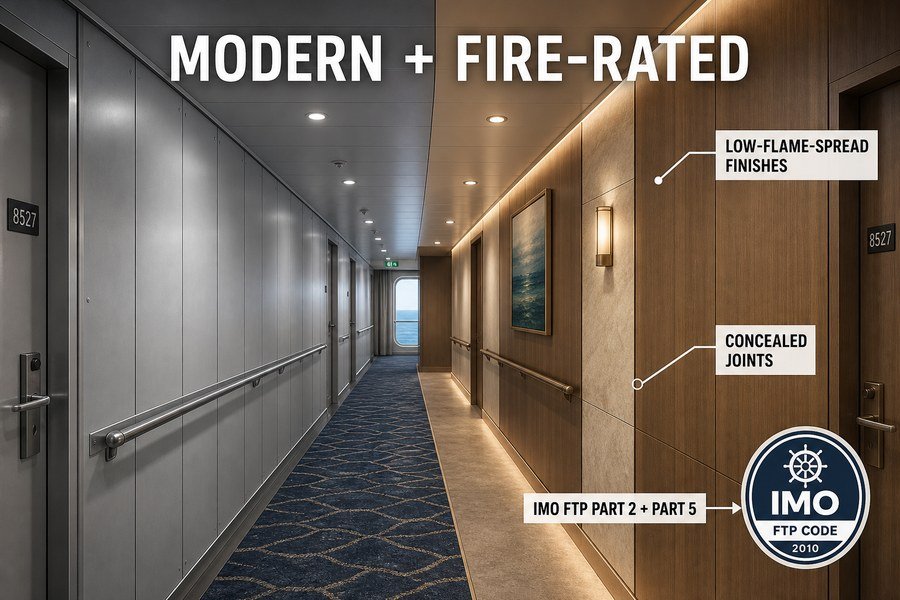
Achieving modern aesthetics on high fire-rated marine walls requires using low-flame-spread decorative laminates, PVC films, digital printing technologies, and concealed joint systems. These solutions cover the complete range of finishes—wood, stone, and solid colors—while fully complying with IMO FTP Code Part 2 and Part 5 regulations.
Finding this balance is tough, but understanding the materials will save your project. Let us look at the details.
Why Do Many A-60 Marine Interior Panels Use Metal Instead of Decorative Facings?
Clients often hate the cold look of bare metal walls in cabins. The problem is strict fire testing. Metal passes easily, but it looks terrible.
A-60 marine interior panels use metal facings like galvanized steel (0.6mm to 1.0mm) or aluminum because they are non-combustible, pass the IMO FTP Code Part 1 tests easily, cost 15% to 30% less than laminated options, and provide superior structural integrity against physical impact and severe fire exposure.
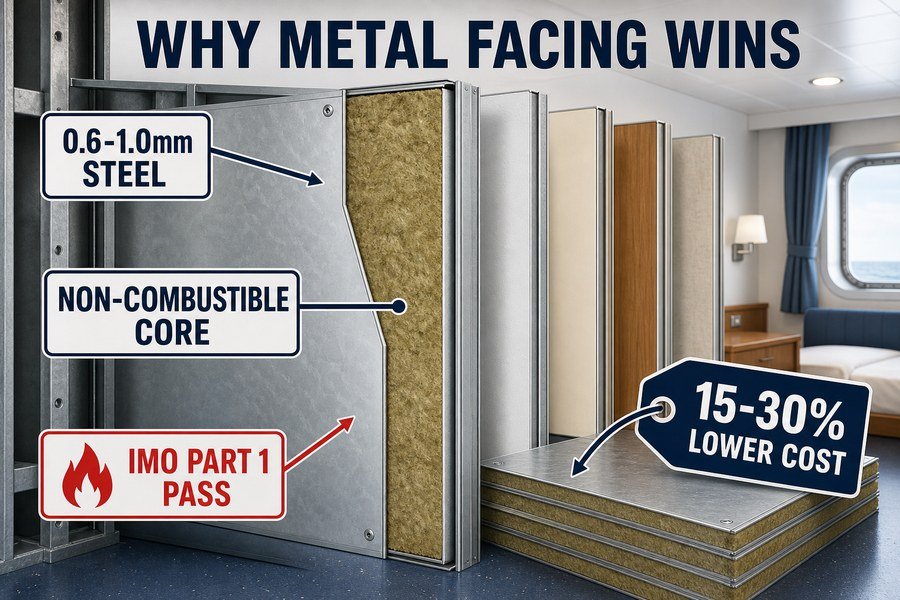
When I worked at the marine outfitting factory, I saw many buyers ask why we could not just use standard commercial wood panels for ships. The answer always comes down to safety rules and raw material costs. To fully understand this, we must look at the specific materials used in A-60 panels. We use galvanized steel, usually with a thickness of 0.6mm to 1.0mm. Some projects require aluminum for weight savings. These metals are entirely non-combustible. This means they do not burn.
Because they do not burn, they easily pass the IMO FTP Code Part 1 test for non-combustibility1. This is the basic requirement for high fire-rated bulkheads under SOLAS regulations2.
Fire Testing Regulations for Metal Marine Panels
Safety always comes first in the shipbuilding industry. The IMO FTP Code Part 1 strictly tests materials to ensure they do not catch fire or release heat. Bare galvanized steel and aluminum pass this test without any extra effort. If a factory adds a decorative facing, the panel must undergo additional, more complex tests3. Sticking to bare metal keeps the certification process simple. It reduces risks for the factory and ensures the shipyard faces no problems during vessel inspection.
Cost and Structural Advantages of Steel and Aluminum Facings
Besides fire safety, money is a huge factor. Bare metal panels cost about 15% to 30% less than panels covered with decorative films or laminates. For a large ship, this price difference adds up quickly. Also, 0.6mm to 1.0mm galvanized steel provides great structural integrity. It resists physical impacts from luggage carts or tools better than soft wood. The metal also holds its shape during severe fire exposure, which prevents flames from spreading to other rooms.
| Feature | Bare Galvanized Steel (0.6mm - 1.0mm) | Laminated Marine Panel |
|---|---|---|
| Combustibility | Non-combustible (IMO Part 1) | Requires Low-Flame Spread Test (IMO Part 5) |
| Material Cost | Base price | 15% to 30% higher |
| Structural Integrity | High impact resistance | Good, but surface can scratch |
| Aesthetics | Industrial, basic | High-end, customizable |
How to Give A-Class Marine Wall Panels Compliant Wood or Stone Finishes?
You want high-end wood or stone walls for cruise ships, but real wood burns. Failing fire inspections ruins delivery times. You need compliant alternatives.
To achieve wood or stone finishes on A-Class panels, factories apply IMO-certified low-flame-spread PVC films (typically 150 to 200 microns thick), high-pressure laminates (HPL, 0.7mm to 1.0mm), or direct digital printing onto the metal surface, ensuring they pass the IMO FTP Code Part 5 test for surface flammability.
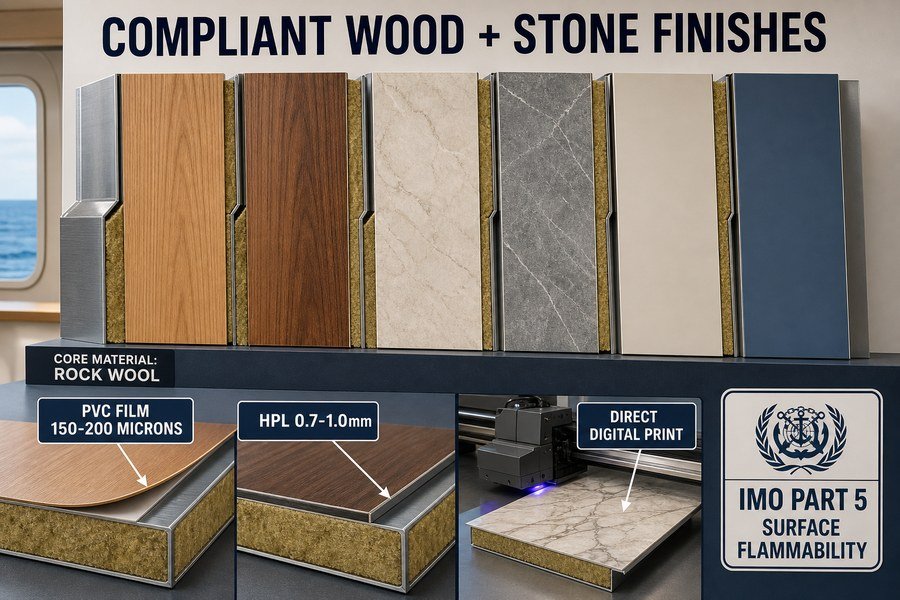
You do not have to settle for plain metal walls. Over my years at Magellan Marine, I have helped many interior decoration companies upgrade their cabin designs without failing fire safety rules. You must use the right surface materials. We use three main methods to create wood or stone looks on A-Class panels. First, we use low-flame-spread PVC films. These films are usually 150 to 200 microns thick. Second, we use High-Pressure Laminates, known as HPL. HPL is thicker, usually 0.7mm to 1.0mm. Third, we use direct digital printing technology.
All three methods share one strict requirement. They must pass the IMO FTP Code Part 5 test. This test checks surface flammability. It ensures the decorative layer will not spread flames quickly if a fire starts in the cabin.
Applying PVC Films and HPL on A-Class Marine Panels
PVC films are very popular. We apply the 150 to 200-micron thick PVC film to the galvanized steel using a hot lamination process. This creates a strong bond. The PVC can look exactly like oak, walnut, or marble. HPL is another great option. At 0.7mm to 1.0mm thick, HPL offers a harder surface than PVC. It resists scratches better. Both materials are specially treated with fire retardants at the chemical level. Because of this, they pass the IMO Part 5 test easily and earn the required MED (Marine Equipment Directive) certificates4.
Utilizing Direct Digital Printing for Marine Wall Textures
Direct digital printing is a newer technology. Instead of gluing a film or laminate, large printers apply special fire-resistant ink directly onto the metal panel. This method creates zero extra fuel load. It easily passes all surface flammability tests. It is perfect for custom designs, like printing a large mural or a specific stone pattern across multiple wall panels.
| Finish Method | Typical Thickness | Scratch Resistance | IMO Testing Requirement |
|---|---|---|---|
| PVC Film | 150 - 200 microns | Medium | IMO FTP Code Part 5 |
| High-Pressure Laminate (HPL) | 0.7mm - 1.0mm | High | IMO FTP Code Part 5 |
| Digital Printing | Ink layer only | Medium | IMO FTP Code Part 5 |
What Architectural Limits Apply to High Fire-Rated Marine Bulkheads?
Designing ship interiors is frustrating when fire bulkheads restrict your ideas. Weight limits and thickness rules block creative layouts. You must know these rules first.
High fire-rated marine bulkheads are limited by strict weight constraints (typically 18 to 22 kg/m² for A-60 panels), maximum total thickness (usually 50mm or 100mm depending on the insulation core), and strict prohibitions on using combustible materials that exceed a maximum calorific value of 45 MJ/m² per IMO rules.
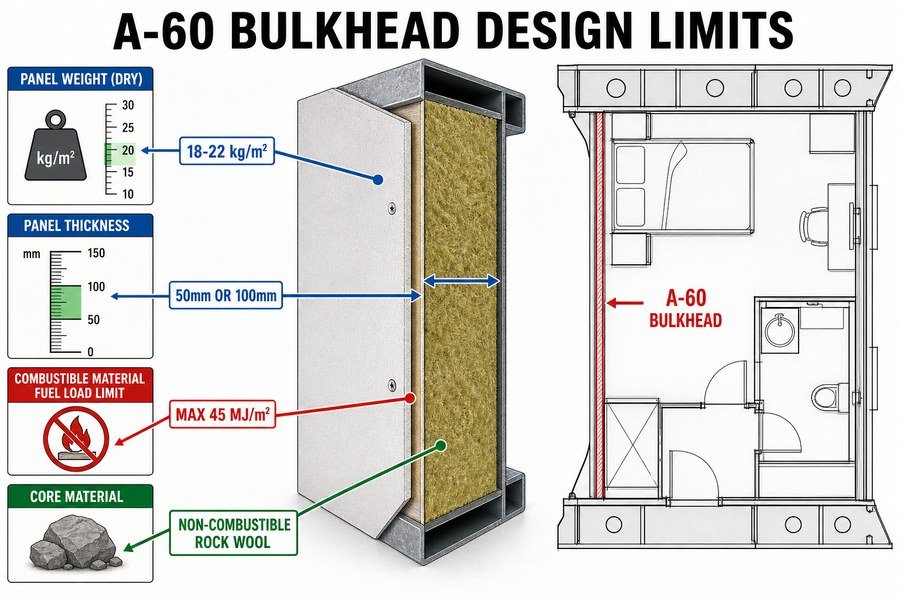
Many designers draw beautiful cabin plans but forget the reality of ship construction. Ships are very different from land buildings. I always remind my clients about the hard physical limits of marine bulkheads. These limits protect the ship and the passengers. We must look at three major architectural limits. First, we have weight constraints. An A-60 panel usually weighs between 18 and 22 kg/m².5 Second, we have thickness limits. The standard thickness is 50mm, but some high-noise-reduction panels reach 100mm.6 Third, we have limits on combustible materials.
The IMO rules state that the calorific value of combustible materials on the panel must not exceed 45 MJ/m². This means you cannot just glue thick layers of plastic or wood to the panel. It will contain too much energy and burn too hot during a fire.
Weight and Thickness Constraints for A-60 Bulkhead Panels
Weight is the enemy of any ship. Too much weight on the upper decks makes the ship unstable.7 This is why A-60 panels are engineered to stay between 18 and 22 kg/m². Designers must calculate the total wall weight for the entire cabin block. Also, thickness matters. A standard 50mm thick panel eats up floor space. If you upgrade to a 100mm panel for better sound insulation, the room becomes smaller. You must plan the cabin layout around these strict dimensions.
Combustibility and Calorific Value Limits for Marine Materials
You cannot ignore the 45 MJ/m² calorific limit. This rule stops builders from using cheap, highly flammable glues and thick decorative covers. The core of the A-60 panel is usually dense rock wool. Rock wool is completely non-combustible. But the glue and the thin PVC or HPL face add to the calorific value. The factory must test the exact combination of steel, glue, and finish to prove the total energy stays below 45 MJ/m².
| Limitation Category | Standard Limit for A-60 Panels | Impact on Cabin Design |
|---|---|---|
| Weight | 18 to 22 kg/m² | Restricts heavy decorative additions |
| Thickness | 50mm or 100mm | Reduces available interior floor space |
| Calorific Value | Maximum 45 MJ/m² | Prevents use of thick combustible covers |
Can Marine Interior Panels Mimic Natural Textures and Pass IMO Tests?
Modern ships demand natural looks. But flat, shiny panels look cheap. You need deep textures, but deep grooves can trap fire or fail tests.
Marine interior panels can mimic natural textures by using embossed PVC foils with depths under 0.2mm, micro-textured HPL laminates, and low-gloss topcoats. These three methods create realistic wood grains and stone rough surfaces while keeping the fuel load low enough to pass the IMO FTP Code smoke and toxicity tests.
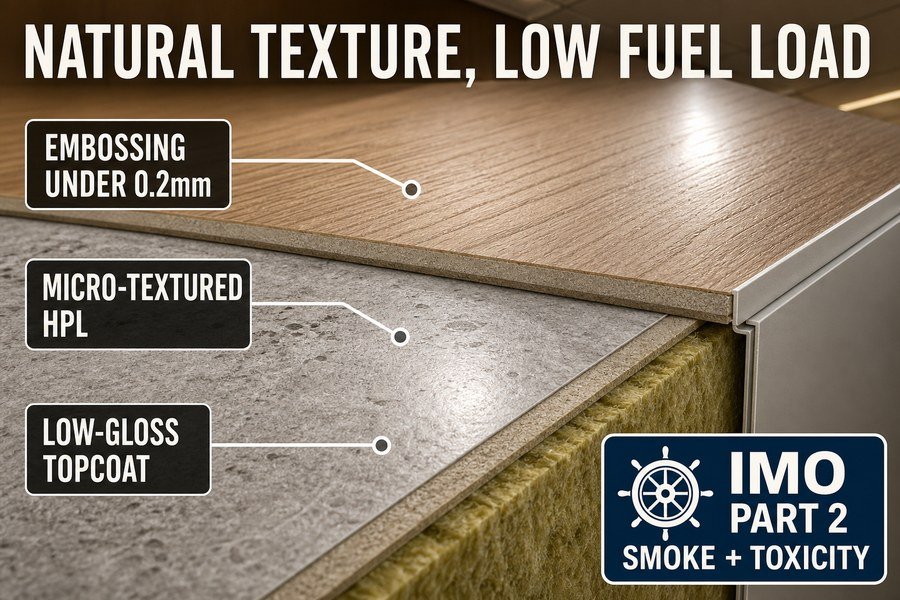
Buyers often tell me that flat walls feel artificial. They want passengers to feel the grain of the wood or the bump of the stone. Achieving this texture on a marine panel is a technical challenge. If a texture is too deep, it requires a thicker film. Thicker films create more smoke when they burn. We solve this by using three specific methods. We use embossed PVC foils with very shallow depths, strictly under 0.2mm. We also use micro-textured HPL laminates. Finally, we use low-gloss topcoats to change how light hits the panel.
These methods give you the natural look you want. Most importantly, they keep the material volume small. This low fuel load allows the panels to pass the IMO FTP Code Part 2 test. This specific test checks for smoke generation and toxic gas emissions.
Creating Depth with Embossed PVC Foils and Micro-Textured HPL
Embossing means pressing a pattern into the surface. For marine panels, we use embossed PVC foils. We keep the embossing depth under 0.2mm. This shallow depth tricks the eye into seeing real wood grain, but it does not add extra plastic mass. Micro-textured HPL works the same way. The pressing plates at the factory create tiny bumps and lines on the laminate surface. You can feel the texture with your hand, but it stays thin enough to meet strict fire codes.
Utilizing Low-Gloss Topcoats for Realistic Marine Wall Finishes
A high-gloss wall looks like cheap plastic. Real wood and natural stone have a matte finish. We use low-gloss topcoats over the PVC or digital print. This removes the unnatural shine. The matte finish absorbs light, making the subtle textures look much deeper than they really are. Because these topcoats are formulated for marine use, they do not release dangerous toxic gases during the IMO Part 2 testing.
| Texture Method | Maximum Depth | Visual Effect | IMO Compliance Focus |
|---|---|---|---|
| Embossed PVC Foil | Under 0.2mm | Realistic wood grain feel | Passes Smoke & Toxicity Test |
| Micro-Textured HPL | Surface level | Rough stone or matte wood | Passes Smoke & Toxicity Test |
| Low-Gloss Topcoat | None | Removes plastic shine | Low toxic gas emission |
How Do Joint Profiles on A-60 Marine Wall Panels Affect Cabin Aesthetics?
Ugly joint lines destroy a beautiful wall design. Traditional H-profiles look very industrial. You need smooth walls to impress your shipyard clients.
Joint profiles affect cabin aesthetics by determining the visible gaps between panels. Marine panels use three main joint types: traditional visible H-profiles (exposing 10mm to 15mm of metal), flush joints with internal splines (leaving a 1mm to 2mm shadow line), and seamless taped joints, which create continuous monolithic surfaces.
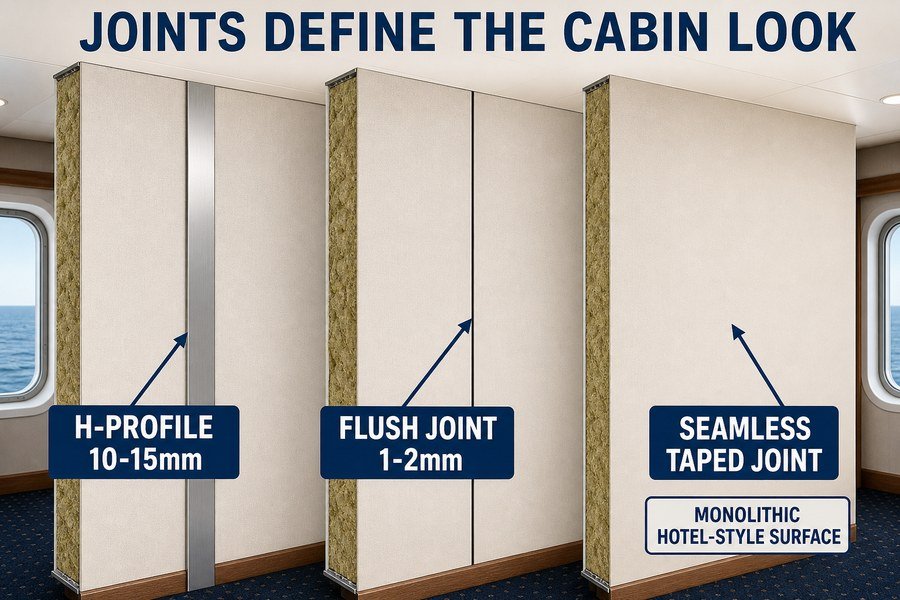
I see many interior design plans that look perfect on paper. But when the panels are installed, thick metal lines break the design. The joints between the panels are just as important as the panels themselves. The joint profile you choose changes the whole feel of the room.8 We offer three main joint types for A-60 marine walls9. We have the traditional visible H-profiles, which expose 10mm to 15mm of metal. We have flush joints that use internal splines to leave a tiny 1mm to 2mm shadow line. We also have seamless taped joints.
Each joint type has a different aesthetic impact. You must choose the right one based on the level of luxury your client expects.
The Impact of Traditional Visible H-Profiles on Marine Aesthetics
Traditional H-profiles are the oldest and most common joint type.10 The profile looks like the letter "H". The edges of two panels slide into the sides. This method is very fast to install and very strong. However, it leaves a visible metal band that is 10mm to 15mm wide between every single panel. This breaks the pattern of wood or stone. It gives the cabin an industrial, utilitarian look. It is fine for crew quarters, but luxury cruise lines usually reject this look.
Achieving Continuous Walls with Flush and Seamless Taped Joints
For a high-end look, we use flush joints. The panels are manufactured with special male-female edges or a gap for an internal spline. When pushed together, the surface is flat. You only see a small 1mm to 2mm gap, called a shadow line. This looks very clean and modern. For the ultimate luxury look, we use seamless taped joints. The panels are installed, and the small gap is filled, taped, and sometimes covered with a continuous vinyl sheet. This creates a monolithic, unbroken wall that looks exactly like a high-end hotel room.
| Joint Profile Type | Visible Gap Size | Aesthetic Result | Best Application |
|---|---|---|---|
| Traditional H-Profile | 10mm to 15mm | Industrial, broken pattern | Crew cabins, utility rooms |
| Flush Joint (Spline) | 1mm to 2mm | Clean, modern shadow line | Passenger cabins, corridors |
| Seamless Taped Joint | None (0mm) | Monolithic, hotel-style wall | Luxury suites, public spaces |
Conclusion
Achieving modern marine aesthetics requires balancing IMO fire rules with smart materials. By using approved PVC, HPL, and flush joints, you can build stunning, safe, and cost-effective cabins.
-
"What Is the Purpose and Scope of the IMO FTP Code?", https://magellanmarinetech.com/what-purpose-scope-of-imo-ftp-code/. The IMO Fire Test Procedures Code identifies Part 1 as the non-combustibility test used to assess whether materials contribute fuel or heat in regulated marine fire-safety applications. Evidence role: definition; source type: institution. Supports: The IMO FTP Code Part 1 is the relevant non-combustibility test for materials used in fire-rated marine panels.. Scope note: This supports the regulatory test category, but not the pass result for any specific manufacturer’s panel without a product test certificate. ↩
-
"What Is the Purpose and Scope of the IMO FTP Code?", https://magellanmarinetech.com/what-purpose-scope-of-imo-ftp-code/. SOLAS Chapter II-2 and the FTP Code establish fire-test requirements for ship construction materials and A-class divisions, including non-combustible construction and fire-resistance performance for bulkheads and decks. Evidence role: expert_consensus; source type: institution. Supports: High fire-rated marine bulkheads are regulated under SOLAS and the IMO FTP Code, with non-combustibility forming part of the fire-safety requirements.. Scope note: This supports the regulatory framework for A-class fire divisions generally; exact approval requirements depend on vessel type, flag administration, and the tested panel assembly. ↩
-
"What Is the Purpose and Scope of the IMO FTP Code?", https://magellanmarinetech.com/what-purpose-scope-of-imo-ftp-code/. The IMO FTP Code includes separate procedures for surface flammability, smoke, and toxicity of exposed finishes, so decorative facings can introduce additional compliance tests beyond the non-combustibility of the base material. Evidence role: mechanism; source type: institution. Supports: Adding a decorative facing can require additional IMO FTP Code testing beyond the base metal’s non-combustibility assessment.. Scope note: This supports the need for further testing when combustible or coated surfaces are exposed, but the exact test program depends on the facing material, installation location, and flag-state approval route. ↩
-
"Directive 96/98/EC", https://en.wikipedia.org/wiki/Directive_96/98/EC. The EU Marine Equipment Directive 2014/90/EU establishes conformity-assessment and marking requirements for specified marine equipment placed on EU ships, including fire-protection equipment categories, supporting the article’s reference to MED certification for regulated marine materials. Evidence role: historical_context; source type: government. Supports: Marine fire-safety materials may require MED certification when used on ships subject to EU marine equipment rules.. Scope note: This supports the certification framework generally; whether a particular decorative panel finish requires MED certification depends on its listed equipment category and tested configuration. ↩
-
"comdtpub p16700.4", https://rosap.ntl.bts.gov/view/dot/63887/dot_63887_DS1.pdf. Published type-approval or technical data for A-60 marine bulkhead panels can document that common lightweight steel-faced A-60 panels have surface masses in the approximate 18–22 kg/m² range. Evidence role: statistic; source type: institution. Supports: A-60 panels commonly weigh around 18 to 22 kg/m².. Scope note: Panel mass is product-specific and varies with steel thickness, core density, facings, and acoustic options, so the source should be used as evidence of a typical range rather than a universal IMO requirement. ↩
-
"How to choose the right marine wall panels for marine interior ...", https://magellanmarinetech.com/how-choose-right-marine-wall-panels-for-marine-interior-projects/. Marine panel approval documents and technical specifications commonly list 50 mm A-60 bulkhead constructions and thicker acoustic variants, including panels around 100 mm, showing that fire-rated bulkheads may impose materially different space requirements. Evidence role: general_support; source type: institution. Supports: A-60 bulkhead panels are often about 50 mm thick, while higher acoustic-performance versions can be about 100 mm thick.. Scope note: Thickness is not fixed by the A-60 fire rating alone; it depends on the approved construction and any additional acoustic-performance target. ↩
-
"COURSE OBJECTIVES CHAPTER 4 4. STABILITY", https://www.usna.edu/NAOE/_files/documents/Courses/EN400/02.04%20Chapter%204.pdf. Naval-architecture stability guidance explains that adding weight high in a vessel raises the center of gravity and can reduce metacentric height, thereby reducing initial stability. Evidence role: mechanism; source type: education. Supports: Too much weight on the upper decks can make a ship unstable.. Scope note: This supports the general stability mechanism; the acceptable amount of upper-deck weight depends on the vessel’s full stability calculation. ↩
-
"Environmental Psychology and Interior Design: The Influence ...", https://www.ied.edu/news/environmental-psychology-and-interior-design-the-influence-of-space. Research in environmental psychology and interior design indicates that surface continuity, visual complexity, and material transitions can influence perceived spatial quality and aesthetic evaluation. Evidence role: general_support; source type: paper. Supports: Joint profiles can materially affect the perceived aesthetic character of an interior space.. Scope note: Such studies provide contextual support for the aesthetic importance of joints, rather than direct evidence about A-60 marine wall profiles specifically. ↩
-
"What Is the Purpose and Scope of the IMO FTP Code?", https://magellanmarinetech.com/what-purpose-scope-of-imo-ftp-code/. IMO/SOLAS fire-test standards define A-class divisions, including A-60, by their ability to resist flame and smoke passage and limit temperature rise for a specified period in ship construction. Evidence role: definition; source type: institution. Supports: The article is discussing A-60 fire-rated marine wall systems.. Scope note: This supports the fire-rating context of A-60 walls, but it does not address the aesthetic performance of different joint profiles. ↩
-
"What are Marine Wall Panels?", https://magellanmarinetech.com/what-are-marine-wall-panels/. Technical descriptions of modular ship accommodation panels commonly show exposed H-section joining profiles as a standard method for connecting adjacent wall panels. Evidence role: historical_context; source type: institution. Supports: Traditional visible H-profiles are a long-established and commonly used method for joining marine wall panels.. Scope note: Available sources may demonstrate common use of H-profiles but may not conclusively establish that they are the oldest joint type across all marine wall systems. ↩