
Struggling to fit bulky acoustic panels into tight ship cabins during retrofits? You are not alone. Failing to balance noise reduction and space can ruin your project timeline and budget.
Balancing acoustic insulation and structural thickness requires a strategic mix of high-density core materials, composite panel structures, and vibration-damping layers. By upgrading from standard 50mm rock wool to 25mm aluminum honeycomb with sound-deadening vinyl, you achieve IMO-compliant noise reduction while maximizing cabin space and controlling project costs.
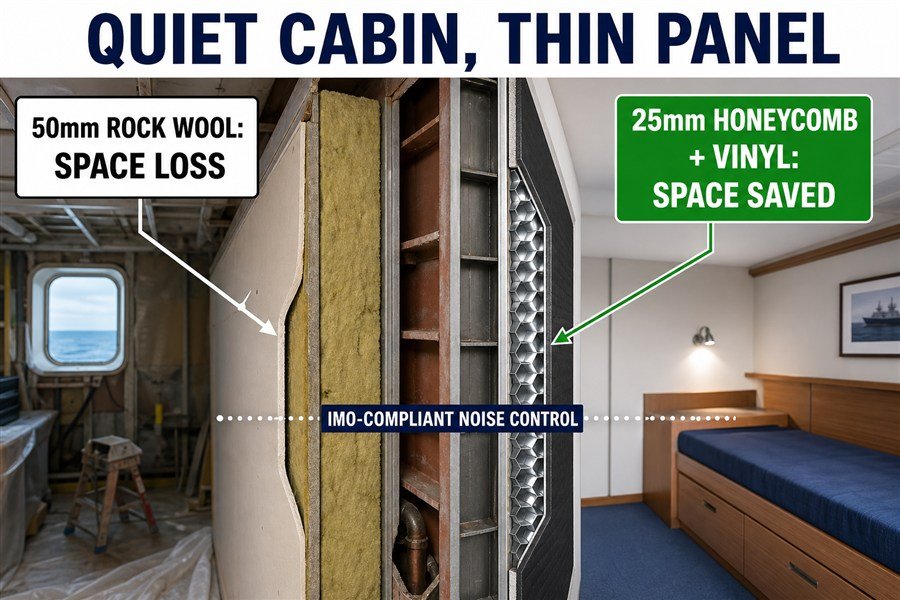
As a marine outfitting specialist, I often see shipyards struggle with this space versus silence trade-off. Let us look closely at the specific challenges and practical solutions for your upcoming ship interior projects.
Why Do Acoustic Marine Wall Panels Require Greater Thickness in Retrofits?
Do your retrofit cabins fail noise tests because the panels are too thin? Old ship frames limit space, but ignoring acoustic mass laws leads to failed IMO inspections.
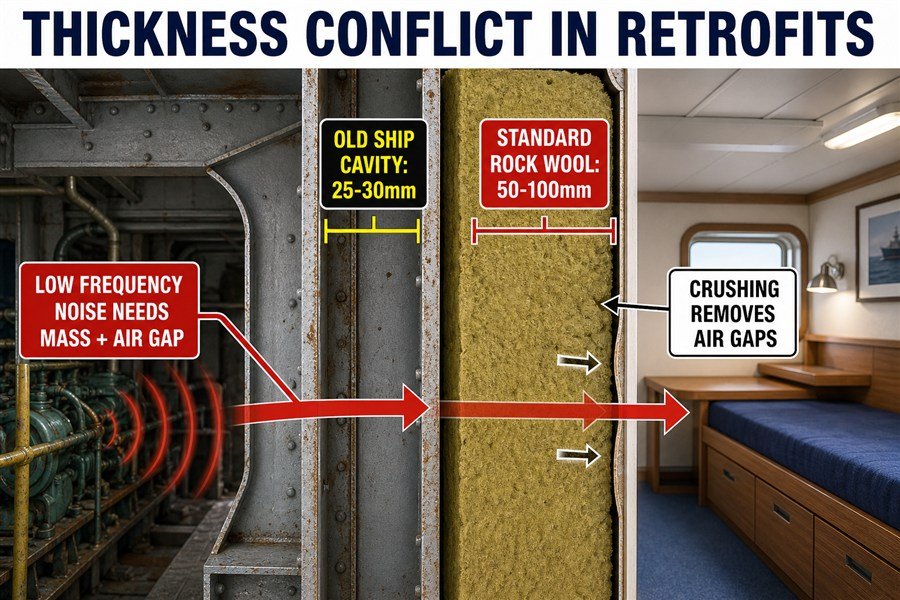
Acoustic marine wall panels require greater thickness in retrofits because low-frequency engine noise needs physical mass and air gaps to dissipate energy. Achieving a 45dB reduction typically demands 50mm to 100mm of standard rock wool insulation, directly clashing with the limited 25mm to 30mm cavities found in older ship bulkheads.
The Physics of Sound Mass in Marine Panel Retrofits
When I worked on the factory floor, I learned quickly that sound reduction relies on mass and space. Physical mass blocks noise, and air gaps trap sound waves. Low-frequency engine vibrations are very strong. They pass right through thin walls. To stop these deep sounds, standard marine acoustic panels use heavy rock wool. The rock wool needs to be thick to provide enough physical mass and air gaps to dissipate the energy. According to the International Maritime Organization (IMO) standards, achieving a 45dB sound reduction index (Rw) is a common goal for cabin walls. To hit this 45dB target using basic materials, you usually need 50mm to 100mm of standard rock wool insulation. There is no shortcut when using traditional materials.
Dimensional Conflicts Between Modern Rules and Old Ship Designs
The real problem starts when you take these thick panels onto an old ship. Older vessels were not built with modern IMO MSC.337(91) noise codes1 in mind. Their structural frames usually leave very small spaces for new walls. You will often find limited 25mm to 30mm cavities between the steel bulkhead and the new cabin line. This creates a direct physical clash. You cannot fit a 50mm rock wool panel into a 25mm space. If you crush the rock wool to make it fit, you remove the air gaps. Without the air gaps, the acoustic performance drops sharply2, and the panel fails the noise test.
| Material Type | Required Thickness | Expected Acoustic Reduction (Rw) | Cavity Fit for Old Ships |
|---|---|---|---|
| Standard Rock Wool Panel | 50mm - 100mm | 45dB | Poor (Too thick) |
| Crushed Rock Wool Panel | 25mm | < 30dB | Good (But fails noise test) |
| Solid Steel Plate | 10mm | 35dB | Good (But too heavy) |
How to Achieve Required dB Ratings Within Limited Retrofit Wall Cavities?
Limited cavity space making IMO noise compliance feel impossible? Using standard materials in tight spaces causes failed noise tests. You must use advanced composite materials to win this battle.
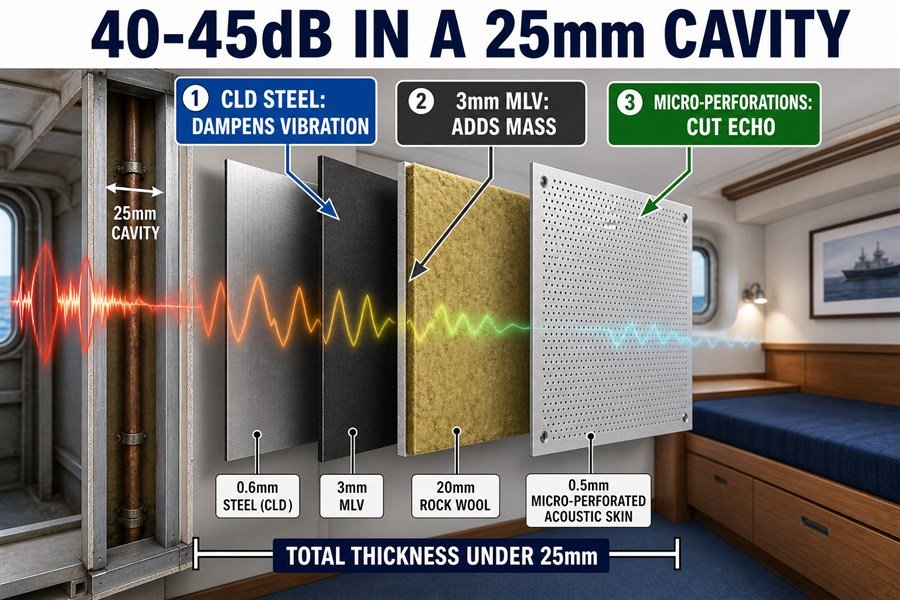
To achieve required dB ratings within limited 25mm retrofit cavities, you must replace standard rock wool with composite solutions: constrained layer dampening (CLD) steel sheets, mass loaded vinyl (MLV) barriers, and micro-perforated acoustic skins. These three technologies combined provide a 40dB to 45dB reduction without adding extra structural thickness.
Implementing Constrained Layer Dampening (CLD) Steel Sheets
When standard rock wool is too thick for a 25mm cavity, we must use smarter materials. The first key component is constrained layer dampening (CLD) steel sheets. A CLD sheet places a thin layer of viscoelastic polymer between two steel skins. When engine noise hits the wall, the steel panels flex slightly. The polymer core absorbs this movement and turns the sound energy into tiny amounts of heat.3 This stops low-frequency noise from passing through the wall. You get the sound-blocking power of thick steel, but the panel remains thin and light.
Adding Mass Loaded Vinyl (MLV) Barriers in Tight Spaces
The second piece of the solution is mass loaded vinyl (MLV). MLV is a dense, heavy rubber-like material. It is very thin, usually only 2mm to 4mm thick. However, it adds a massive amount of weight to the panel structure. In acoustics, mass blocks sound.4 By bonding a 3mm layer of MLV inside your 25mm retrofit cavity panel, you instantly boost the sound transmission loss. MLV barriers are especially effective against airborne noise like human voices and ventilation systems.
Utilizing Micro-Perforated Acoustic Skins for High Frequencies
The final step addresses high-frequency noises. For this, we use micro-perforated acoustic skins on the outside of the panel. These metal skins have hundreds of tiny holes. When high-pitched sound waves hit these holes, they enter the panel and break apart.5 When you combine CLD steel sheets, MLV barriers, and micro-perforated skins, you build a powerful system. These three technologies combined provide a 40dB to 45dB reduction6. More importantly, they do this while keeping the total panel thickness under 25mm.
| Composite Technology | Thickness Added | Target Noise Type | Contribution to Total dB Reduction |
|---|---|---|---|
| CLD Steel Sheets | 1.5mm - 2mm | Low-frequency vibration | High |
| MLV Barriers | 2mm - 4mm | Airborne mid-frequency | Very High |
| Micro-Perforated Skins | 0.6mm - 1mm | High-frequency echo | Medium |
| Total System | < 25mm (with core) | Full Spectrum | 40dB - 45dB |
Does Using Lightweight Core Panels Instead of Rock Wool Compromise Retrofit Acoustic Performance?
Worried that switching to lightweight panels will make the cabin too noisy? Choosing the wrong light core ruins your soundproofing, leaving you with unhappy ship owners and rework costs.
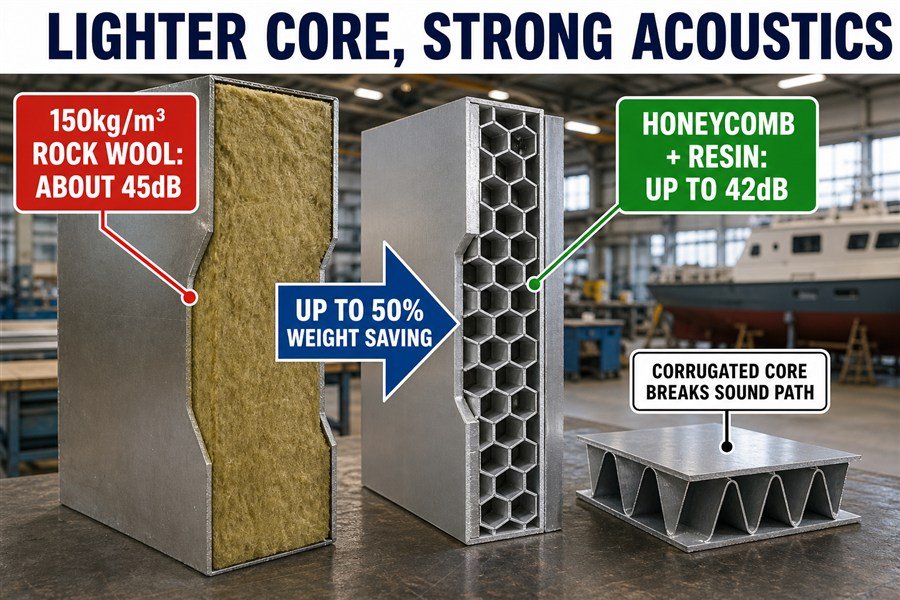
Using lightweight core panels does not compromise retrofit acoustic performance if you select structural aluminum honeycomb or corrugated steel cores integrated with sound-absorbing resins. While standard 150kg/m³ rock wool offers excellent 45dB sound deadening, engineered lightweight panels provide up to 42dB reduction while saving up to 50% in weight.
Comparing Standard Rock Wool with Aluminum Honeycomb Cores
In marine outfitting, weight is just as important as thickness. Many procurement officers ask me if moving away from heavy rock wool is a mistake. The answer depends on the exact materials you buy. Standard 150kg/m³ rock wool offers excellent 45dB sound deadening.7 It works very well, but it is heavy. If you replace it with cheap, empty honeycomb panels, the acoustic performance will drop terribly. However, using lightweight core panels does not compromise retrofit acoustic performance if you buy structural aluminum honeycomb correctly. Modern aluminum honeycomb cores have tiny cell structures. When sound hits these hexagonal cells, the sound waves get trapped and bounce around until they lose energy.8
The Role of Corrugated Steel and Sound-Absorbing Resins
Another excellent option is using corrugated steel cores. A corrugated steel core acts like a spring. It breaks the direct path of the sound wave. To make these lightweight cores even better, factories now fill the empty spaces with sound-absorbing resins. These resins coat the inside of the aluminum honeycomb or corrugated steel. They add a small amount of mass but a large amount of damping power.9 When you use structural aluminum honeycomb or corrugated steel cores integrated with sound-absorbing resins, the results are very impressive. Engineered lightweight panels provide up to 42dB reduction. This is very close to the 45dB of heavy rock wool. At the same time, these advanced core materials save up to 50% in weight. This makes installation faster and saves fuel for the ship.10
| Core Material | Density / Weight | Sound Reduction (Rw) | Best Application |
|---|---|---|---|
| 150kg/m³ Rock Wool | Very Heavy | ~45dB | Standard bulkheads |
| Basic Aluminum Honeycomb | Very Light | ~25dB | Dry areas, no noise limits |
| Honeycomb + Acoustic Resins | Light (50% saving) | ~40dB - 42dB | Weight-critical retrofits |
| Corrugated Steel Core | Medium | ~42dB | High-strength retrofit walls |
How to Select Retrofit Marine Wall Panels Meeting Both Noise Limits and Thickness Constraints?
Overwhelmed by panel options that only solve half your problem? Buying cheap panels that fail acoustic tests wastes money. You need a strict selection checklist to protect your profits.
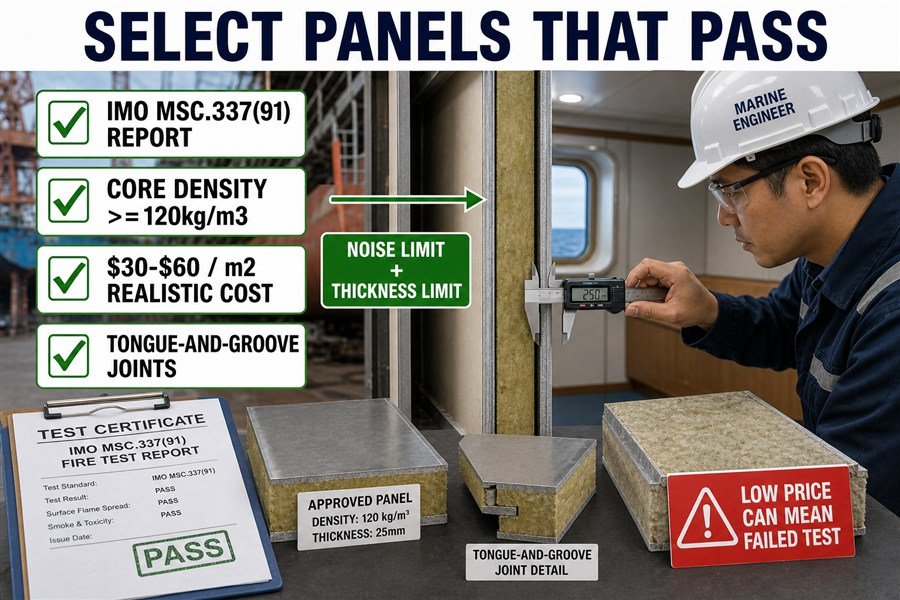
To select retrofit marine wall panels meeting both noise and thickness constraints, you must evaluate four factors: IMO MSC.337(91) compliance, panel core density (minimum 120kg/m³ for thin profiles), material cost ($30-$60 per square meter), and installation joint types. Balancing these ensures passing inspections within strict spatial limits.
Verifying IMO MSC.337(91) Compliance and Core Density Requirements
When I help clients choose products, I always start with the rules. You must first evaluate IMO MSC.337(91) compliance11. This rule dictates the exact noise levels allowed in passenger and crew cabins. If your supplier cannot provide a certified test report showing compliance with this specific IMO code, do not buy the panel. Next, look at the inside of the panel. For retrofit projects where panels must be thin (like 25mm), you cannot use soft materials. You must check the panel core density. I recommend a minimum 120kg/m³ for thin profiles12. If the density is lower than 120kg/m³, a thin panel will not block enough sound, and you will fail the final ship inspection.
Analyzing Material Costs and Managing Installation Joint Types
Quality comes with a price, but you must stay on budget. The third factor is material cost. In today's market, a high-quality thin acoustic panel will run between $30 and $60 per square meter13. If a supplier quotes you $15 per square meter for a thin panel claiming 45dB reduction, they are likely lying about the test results. Good composite materials cost money. Finally, you must evaluate installation joint types. Even the best panel will leak sound if the edges do not fit together perfectly.14 Look for tongue-and-groove joints or specialized overlapping acoustic joints. These lock together tightly and stop noise from slipping through the cracks. Balancing these four factors ensures passing inspections within strict spatial limits while keeping your decoration project profitable.
| Selection Factor | Recommended Standard | Why It Matters for Retrofits |
|---|---|---|
| Regulatory Code | IMO MSC.337(91) | Ensures legal compliance for noise limits. |
| Minimum Core Density | 120kg/m³ | Provides necessary mass for thin 25mm cavities. |
| Material Cost Range | $30 - $60 per square meter | Realistic budget for composite acoustic materials. |
| Installation Joint | Tongue-and-groove | Prevents sound leaks between panel gaps. |
What Acoustic Bridging Issues Occur When Fitting Retrofit Wall Panels to Existing Profiles?
Did you buy the best acoustic panels but still fail the noise test? Hard mechanical connections bypass your expensive insulation. You must break these sound bridges immediately.
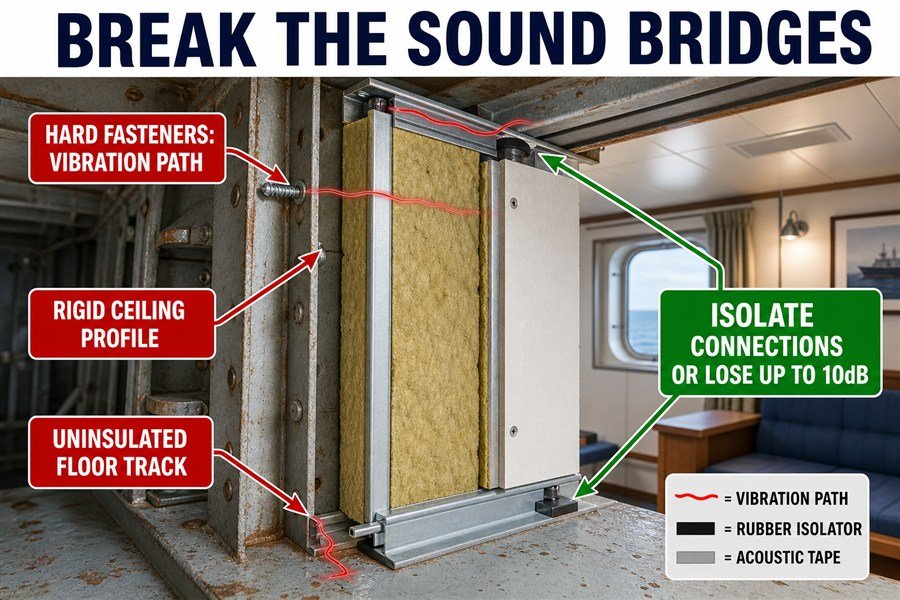
Acoustic bridging issues occur during retrofits when hard metal fasteners, uninsulated floor tracks, and rigid ceiling profiles physically connect the new panels to the vibrating ship steel. These three structural bridges transfer low-frequency engine vibrations directly into the cabin, reducing the panel's acoustic performance by up to 10dB.
How Hard Metal Fasteners Transfer Engine Vibrations
Even a perfect acoustic panel will fail if installed poorly. Sound travels much faster through solid steel than through air.15 When you install new panels in an old ship, acoustic bridging issues occur. A sound bridge is a direct solid path for noise to travel. The first major problem comes from hard metal fasteners. If your installation team uses standard steel screws or bolts to attach the new panel directly to the ship's structural frame, they create a perfect sound bridge16. The low-frequency engine vibrations will travel up the ship steel, straight through the metal fasteners, and into the face of the new panel. The panel will then act like a speaker, broadcasting noise into the cabin. You must use rubber vibration isolators between the fasteners and the panel.17
The Impact of Uninsulated Floor Tracks on Cabin Noise
The second point of failure involves the floor. Marine panels sit inside tracks. If you use uninsulated floor tracks, the vibration from the ship's deck goes right into the bottom of the wall panel. This is a very common mistake in retrofit projects. To fix this, you must place high-density acoustic tape or rubber pads underneath the steel floor tracks before you bolt them down. This soft layer breaks the structural bridge.
Managing Rigid Ceiling Profiles to Prevent 10dB Acoustic Losses
The third issue is at the top of the wall. When rigid ceiling profiles physically connect the new panels to the vibrating ship steel above, the sound transfers downwards. Old ships flex and vibrate constantly. If the top track is completely rigid, every movement makes noise. You need flexible top connections that hold the panel safely but allow tiny movements. These three structural bridges—fasteners, floor tracks, and ceiling profiles—transfer low-frequency engine vibrations directly into the cabin. If you ignore them, this bridging reduces the panel's acoustic performance by up to 10dB18. Losing 10dB means your 45dB panel only performs at 35dB, and the whole project fails.
| Bridging Source | How Sound Travels | The Practical Solution | Potential dB Loss if Ignored |
|---|---|---|---|
| Hard Metal Fasteners | Direct metal-to-metal contact. | Use rubber vibration isolation mounts. | Up to 4dB |
| Uninsulated Floor Tracks | Deck vibration enters panel base. | Install acoustic foam tape under tracks. | Up to 3dB |
| Rigid Ceiling Profiles | Overhead deck vibration transfers down. | Use floating or flexible top-track systems. | Up to 3dB |
Conclusion
Balancing acoustic insulation and panel thickness in marine retrofits demands smart choices. By upgrading to dense composites and breaking structural sound bridges, you deliver compliant, quiet cabins while protecting your project budget.
-
"[PDF] MSC.337(91) (adopted on 30 November 2012) CODE ON NOISE ...", https://wwwcdn.imo.org/localresources/en/KnowledgeCentre/IndexofIMOResolutions/MSCResolutions/MSC.337(91).pdf. The IMO Maritime Safety Committee adopted Resolution MSC.337(91), the Code on Noise Levels on Board Ships, to set noise-level limits and related requirements for ships; this supports the article’s reference to a modern regulatory framework for onboard noise, though it does not by itself prove the design constraints of any specific older vessel. Evidence role: historical_context; source type: institution. Supports: Older vessels were not built with modern IMO MSC.337(91) noise codes in mind.. Scope note: Contextual support only; vessel-specific retrofit constraints would require ship plans or survey data. ↩
-
"Providing an optimal porous absorbent pattern to reduce mid to low ...", https://pmc.ncbi.nlm.nih.gov/articles/PMC6277340/. Research on porous sound absorbers shows that acoustic absorption depends on material thickness, porosity, airflow resistivity, and the presence of air cavities; compression can alter these properties and reduce low-frequency performance. This supports the mechanism described, although it may not verify the article’s specific decibel values for a given marine panel assembly. Evidence role: mechanism; source type: paper. Supports: Crushing rock wool removes effective air gaps and can sharply reduce acoustic performance.. Scope note: Supports the acoustic mechanism generally, not the exact performance drop or pass/fail result for a specific product or test configuration. ↩
-
"[PDF] Passive Viscoelastic Constrained Layer Damping Application for a ...", https://vtechworks.lib.vt.edu/bitstream/handle/10919/35350/Thesis_CraigGallimore_Rev1.pdf. A technical source on constrained-layer damping supports that a viscoelastic layer between stiff face sheets dissipates vibrational energy through shear deformation and hysteretic losses, converting part of the mechanical energy into heat. Evidence role: mechanism; source type: paper. Supports: A CLD sheet dissipates panel vibration by using a viscoelastic polymer layer between steel skins to convert mechanical motion into heat.. Scope note: This supports the damping mechanism generally; it does not by itself quantify sound transmission loss for the specific panel described. ↩
-
"[PDF] Sound transmission loss characteristics of sandwich panel ...", https://bulldog2.redlands.edu/fac/julie_rathbun/physclasses/sound.pdf. Acoustics references on the mass law of sound insulation support that, for limp or single-leaf barriers over much of the mid-frequency range, increasing surface mass generally increases transmission loss. Evidence role: expert_consensus; source type: education. Supports: Greater surface mass in a barrier generally improves airborne sound isolation.. Scope note: The mass law is an idealized relationship and may not predict performance near resonances, coincidence frequencies, flanking paths, or poorly sealed installations. ↩
-
"Sound absorber based on a sonic black hole and multi-layer micro ...", https://ui.adsabs.harvard.edu/abs/2024PhyS...99f5960L/abstract. Research on micro-perforated panel absorbers supports that sound entering sub-millimetre perforations is attenuated primarily through viscous and thermal losses in the holes and the backing air cavity. Evidence role: mechanism; source type: paper. Supports: Micro-perforated skins can absorb higher-frequency sound through dissipative losses in small perforations and associated cavities.. Scope note: The source would support absorption by micro-perforated panels, but the phrase “break apart” is informal and should be interpreted as dissipative absorption rather than literal fragmentation of sound waves. ↩
-
"Sound insulation dataset of 30 wooden and 8 concrete floors tested ...", https://pmc.ncbi.nlm.nih.gov/articles/PMC10365936/. A laboratory test report or peer-reviewed study on a comparable thin multilayer acoustic panel would be needed to support a reported 40–45 dB sound reduction, because transmission loss ratings depend on the full assembly, frequency range, mounting conditions, and test standard. Evidence role: statistic; source type: paper. Supports: The combined CLD, MLV, and micro-perforated panel system provides a 40 dB to 45 dB reduction while remaining under 25 mm thick.. Scope note: Contextual sources may show that similar multilayer barriers can reach this range, but they would not directly prove the stated value unless the tested construction matches the article’s CLD–MLV–micro-perforated assembly under a recognized standard such as ASTM E90 or ISO 10140. ↩
-
"[PDF] Acoustic Performance of a Double-leaf Micro Perforated Panel", https://docs.lib.purdue.edu/cgi/viewcontent.cgi?filename=2&article=1567&context=surf&type=additional. Laboratory sound-insulation data for mineral-wool-filled partitions can support that dense mineral wool is commonly used to improve airborne sound reduction, with ratings in the 40 dB range depending on the full wall or panel assembly tested. Evidence role: statistic; source type: paper. Supports: Standard 150kg/m³ rock wool offers excellent 45dB sound deadening.. Scope note: The 45 dB figure is assembly-specific and cannot be attributed to rock wool density alone without the exact test configuration and standard. ↩
-
"Triangular reentrant honeycomb metamaterial structure for ... - PMC", https://pmc.ncbi.nlm.nih.gov/articles/PMC12540689/. Research on honeycomb and cellular acoustic materials describes sound attenuation through repeated reflections, viscous and thermal losses, and structural damping within cell-like cavities, supporting the proposed mechanism in general terms. Evidence role: mechanism; source type: paper. Supports: Modern aluminum honeycomb cores can dissipate sound energy through interactions with hexagonal cell structures.. Scope note: The mechanism is context-dependent; plain, unperforated aluminum honeycomb may not provide high acoustic absorption without facings, perforations, damping layers, or other treatments. ↩
-
"[PDF] Viscoelastic Damping of Hexagonal Honeycomb Sandwich Panels", https://open.clemson.edu/context/all_theses/article/2217/viewcontent/Seera_clemson_0050M_11396.pdf. Studies of viscoelastic resins and damping layers in sandwich panels show that polymeric fillers or coatings can increase structural damping and reduce vibration or sound transmission with relatively modest added mass. Evidence role: mechanism; source type: paper. Supports: Sound-absorbing resins used in honeycomb or corrugated cores can add damping without large mass increases.. Scope note: The magnitude of damping depends on the resin formulation, temperature, frequency range, and panel construction; the source may support the principle rather than the exact performance claimed here. ↩
-
"Improving the energy efficiency of ships", https://www.imo.org/en/ourwork/environment/pages/improving%20the%20energy%20efficiency%20of%20ships.aspx. Marine energy-efficiency literature and IMO guidance identify lightweighting and reduced displacement as contributors to lower propulsion energy demand and fuel consumption, supporting the link between weight reduction and fuel savings in ships. Evidence role: general_support; source type: institution. Supports: Reducing ship outfitting weight can contribute to fuel savings.. Scope note: The source would not prove that a specific outfitting panel saves fuel; actual savings depend on vessel type, operating profile, total weight reduction, and speed. ↩
-
"[PDF] MSC.337(91) (adopted on 30 November 2012) CODE ON NOISE ...", https://wwwcdn.imo.org/localresources/en/KnowledgeCentre/IndexofIMOResolutions/MSCResolutions/MSC.337(91).pdf. IMO Resolution MSC.337(91), adopting the Code on Noise Levels on Board Ships, sets maximum permissible noise levels for specified shipboard spaces, including accommodation areas such as cabins. Evidence role: definition; source type: institution. Supports: IMO MSC.337(91) is the relevant rule for evaluating permitted noise levels in passenger and crew cabins.. ↩
-
"[PDF] optimizing sandwich panels with graded tubular cell core for ... - arXiv", https://arxiv.org/pdf/2401.11412. Acoustics references on sound transmission loss describe surface mass and material density as important contributors to airborne sound insulation, especially where panel thickness is constrained; this supports the density rationale but does not independently establish 120 kg/m³ as a universal minimum. Evidence role: mechanism; source type: paper. Supports: Thin acoustic panels require sufficiently dense cores because density and surface mass affect sound-blocking performance.. Scope note: The source is expected to support the acoustic mechanism linking density, mass, and sound reduction, not necessarily the article’s exact 120 kg/m³ threshold for every panel design. ↩
-
"[PDF] project cost - UCF Planning, Design and Construction", https://fp.ucf.edu/wp-content/uploads/projects/costs/14099008%20Psychology%20Acoustic%20Panels.pdf. Construction cost references or market surveys can provide contextual benchmarks for acoustic wall or ceiling panel pricing per square metre; such data would contextualize the stated range but may vary by region, specification, certification, and purchase volume. Evidence role: statistic; source type: other. Supports: A high-quality thin acoustic panel commonly falls within a stated per-square-metre budget range.. Scope note: Pricing evidence is likely contextual rather than direct proof for marine-certified thin acoustic panels in all markets. ↩
-
"Airborne sound insulation performance of lightweight double leaf ...", https://pmc.ncbi.nlm.nih.gov/articles/PMC11666719/. Building-acoustics literature identifies gaps, joints, and flanking paths as causes of reduced sound insulation in partitions, supporting the mechanism that imperfect edge sealing can compromise panel performance. Evidence role: mechanism; source type: education. Supports: Poorly fitted panel edges and joints can reduce sound insulation by allowing acoustic leakage.. Scope note: The evidence would support the general acoustic principle of leakage through gaps, not necessarily the performance of a specific marine panel joint design. ↩
-
"Speed of sound - Wikipedia", https://en.wikipedia.org/wiki/Speed_of_sound. Reference data on longitudinal wave speeds show that sound propagates at roughly 343 m/s in air at room temperature and several thousand m/s in steel, supporting the contrast between airborne and structure-borne transmission. Evidence role: general_support; source type: encyclopedia. Supports: Sound travels much faster through solid steel than through air.. Scope note: The exact speed in steel varies with alloy, temperature, and wave mode, so the source supports the general comparison rather than a project-specific value. ↩
-
"Airborne sound insulation performance of lightweight double leaf ...", https://pmc.ncbi.nlm.nih.gov/articles/PMC11666719/. Building-acoustics literature describes rigid mechanical connections as flanking or structural transmission paths that can bypass the intended acoustic barrier, supporting the characterization of direct steel fasteners as sound bridges. Evidence role: mechanism; source type: institution. Supports: Direct steel screws or bolts can create a solid-borne sound bridge between the ship frame and an acoustic panel.. Scope note: Most published guidance discusses buildings rather than ship cabins, so the source supports the acoustic mechanism by analogy rather than a vessel-specific test result. ↩
-
"[PDF] Vibration isolation: use and characterization", https://nvlpubs.nist.gov/nistpubs/Legacy/hb/nbshandbook128.pdf. Vibration-isolation references explain that compliant rubber or elastomeric elements can reduce transmitted vibration by adding resilience between a vibrating source and a receiving structure, supporting the use of isolators at fastening points. Evidence role: mechanism; source type: education. Supports: Rubber vibration isolators between fasteners and panels can reduce structure-borne vibration transfer.. Scope note: The source would establish the general isolation principle; actual performance depends on isolator stiffness, loading, frequency range, and installation details. ↩
-
"Airborne sound insulation performance of lightweight double leaf ...", https://pmc.ncbi.nlm.nih.gov/articles/PMC11666719/. Studies and guidance on flanking transmission report that sound-insulation ratings can be substantially reduced when rigid structural paths bypass separating elements, providing contextual support for a possible multi-decibel loss from acoustic bridging. Evidence role: general_support; source type: paper. Supports: Ignoring structural bridges can reduce the installed acoustic performance of a panel by as much as 10 dB.. Scope note: A source may support the plausibility of significant losses from flanking paths, but the specific 'up to 10 dB' figure requires test data for the same panel, vessel structure, and installation conditions. ↩