Heavy ship panels waste expensive fuel and ruin project schedules. Choosing the correct core solves this problem easily. Let us look at how core selection balances fire safety and weight perfectly.
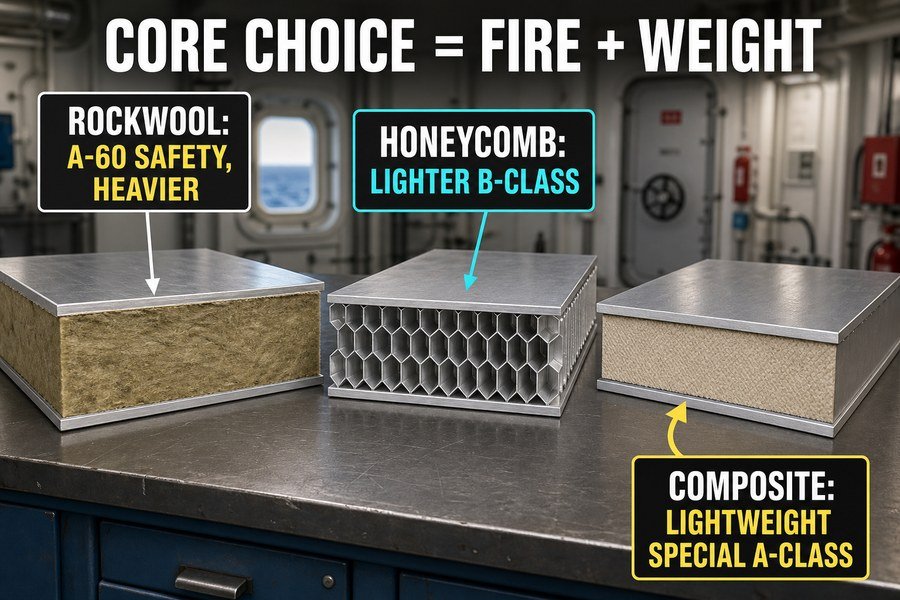
Core selection directly dictates panel weight and fire rating. The three main cores—rockwool, aluminum honeycomb, and composite materials—offer different ratios. Rockwool provides maximum A-60 fire safety at higher weights, while aluminum honeycomb and composites drastically cut weight for B-Class or specialized A-Class panels while meeting SOLAS requirements.
Finding the right balance between fire safety and panel weight is a daily struggle for shipyards. Let us break down the specific choices you must make to keep your interior outfitting projects light, safe, and on budget.
Which Cores Maximize the Fire-to-Weight Ratio for A-Class Marine Bulkheads?
You need A-Class safety, but heavy bulkheads increase fuel costs. If you pick the wrong core, the ship becomes too heavy. Let us find the best high-ratio cores.
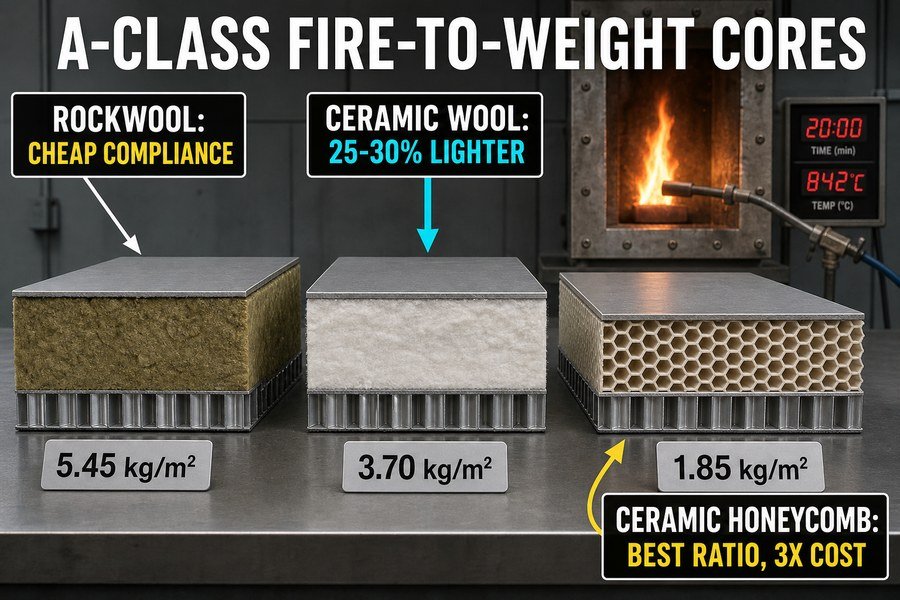
The three cores that maximize the fire-to-weight ratio for A-Class bulkheads are ceramic wool, high-density rockwool, and ceramic-composite honeycomb. Ceramic wool saves 30% weight over rockwool. Rockwool offers the cheapest compliance. Ceramic-composite honeycomb provides the absolute best ratio but costs three times more than standard rockwool.
When I help clients buy bulkheads for European shipyards, weight is always a huge issue. If the panels are too heavy, the ship consumes more fuel.1 But they must pass International Maritime Organization (IMO) FTP Code testing for A-Class2. You have three main options here: traditional high-density rockwool, ceramic wool, and ceramic-composite honeycomb. I will explain each one clearly.
Traditional High-Density Rockwool for A-Class Compliance
Let me start with traditional high-density rockwool. This is the most common core you will find in Asian factories. To pass A-60 fire tests, manufacturers usually use rockwool with a density of 120 kg/m3 to 150 kg/m3. When you press this into a standard 50mm thick galvanized steel panel, the final weight is about 18 to 20 kg/m2. It is heavy, but it is very cheap. You usually pay around $30 to $40 per square meter for these panels.
Ceramic Wool and Composite Alternatives for Weight Savings
Next is ceramic wool. If you need to cut weight, this is a great step up. Ceramic fibers resist heat much better than stone wool. This means you only need a density of about 96 kg/m3 to achieve the exact same A-60 rating. This drops your total panel weight down to 14 or 15 kg/m2. You save about 25% to 30% in weight. The price increases to about $60 per square meter, but the logistics and installation become much easier.
Finally, we have ceramic-composite honeycomb. This is the premium choice for luxury cruise ships. It uses an aluminum honeycomb structure filled with lightweight ceramic foam. This core drops the A-60 panel weight down to just 10 to 12 kg/m2. However, it is very expensive. Expect to pay between $150 and $200 per square meter.
| Core Type | Density Needed for A-60 | Final Panel Weight | Estimated Cost (per m2) | Best Application |
|---|---|---|---|---|
| High-Density Rockwool | 120 - 150 kg/m3 | 18 - 20 kg/m2 | $30 - $40 | Cargo ships, budget projects |
| Ceramic Wool | 96 kg/m3 | 14 - 15 kg/m2 | $60 - $70 | Offshore platforms, ferries |
| Ceramic-Composite Honeycomb | N/A (Structural) | 10 - 12 kg/m2 | $150 - $200 | Luxury cruise ships, yachts |
How Does Rockwool Density Affect Marine Bulkhead Insulation and Weight?
Paying for high-density rockwool when you do not need it wastes money. Using low-density rockwool risks failing safety tests. You must know the exact density rules for marine panels.
Rockwool density directly controls weight and fire insulation. Low-density (60-80 kg/m3) works for B-15 panels, keeping weight under 15 kg/m2. Medium-density (100-120 kg/m3) fits A-30 ratings. High-density (140-160 kg/m3) is mandatory for A-60 panels, pushing weight to 20 kg/m2 to block heat transfer for 60 minutes.
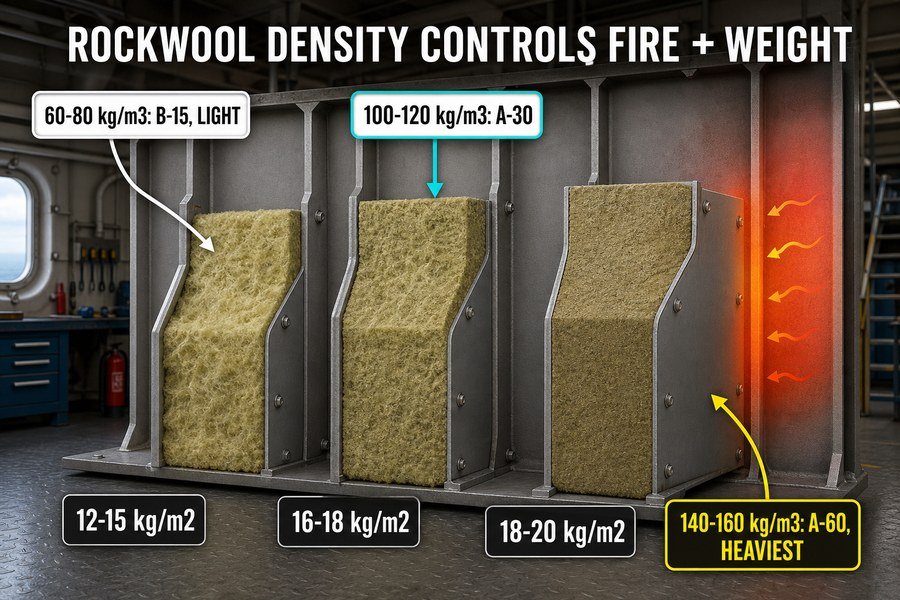
I often see purchasing officers make a big mistake. They try to buy one type of rockwool panel for the whole ship to get a better price. But rockwool density changes everything. It changes your fire rating, your panel weight, and your unit price. There are three main density levels you must know: low-density, medium-density, and high-density. I will break down exactly how each one works.
Low-Density Rockwool for B-Class Cabin Partitions
Let us look at low-density rockwool first. This ranges from 60 kg/m3 to 80 kg/m3. We use this exclusively for B-Class partitions, like B-15 cabin walls. Because there is less material inside, a standard 50mm panel weighs only 12 to 15 kg/m2. It stops fire for 15 minutes. It is very cheap. It usually costs between $15 and $25 per square meter in China. You should use this wherever strict A-Class rules do not apply.
Medium and High-Density Rockwool for A-Class Bulkheads
Then we move to medium-density rockwool. This sits around 100 kg/m3 to 120 kg/m3. This is the minimum density you need to pass an A-30 fire test. The extra fibers slow down the heat transfer.3 The weight increases to about 16 to 18 kg/m2.
Finally, you have high-density rockwool. This ranges from 140 kg/m3 to 160 kg/m3. If you want an A-60 rating, you must use this. The IMO FTP Code says the unexposed side of the panel cannot rise more than 140°C above the starting temperature after 60 minutes of fire. Only high-density rockwool can pack enough fibers to block that heat. But this pushes your panel weight up to 20 kg/m2. You must make sure the ship's deck can handle this heavy load.
| Rockwool Density | Fire Rating Achieved | Panel Weight (50mm thick) | Typical Cost (per m2) |
|---|---|---|---|
| 60 - 80 kg/m3 | B-15 | 12 - 15 kg/m2 | $15 - $25 |
| 100 - 120 kg/m3 | A-30 | 16 - 18 kg/m2 | $25 - $30 |
| 140 - 160 kg/m3 | A-60 | 18 - 20 kg/m2 | $30 - $40 |
What Core Thickness Balances A-60 Insulation With Slim Marine Interior Walls?
Thick A-60 walls eat up valuable cabin space. But making walls too thin means failing SOLAS fire tests. Let us find the exact thickness you need for your ship.
To balance A-60 insulation with slim walls, you must use specific thickness pairings. Standard rockwool requires a 50mm thickness. High-performance ceramic wool allows a 30mm thickness. Advanced microporous aerogel panels can achieve A-60 at just 20mm, offering the slimmest possible profile while maximizing cabin space and safety.
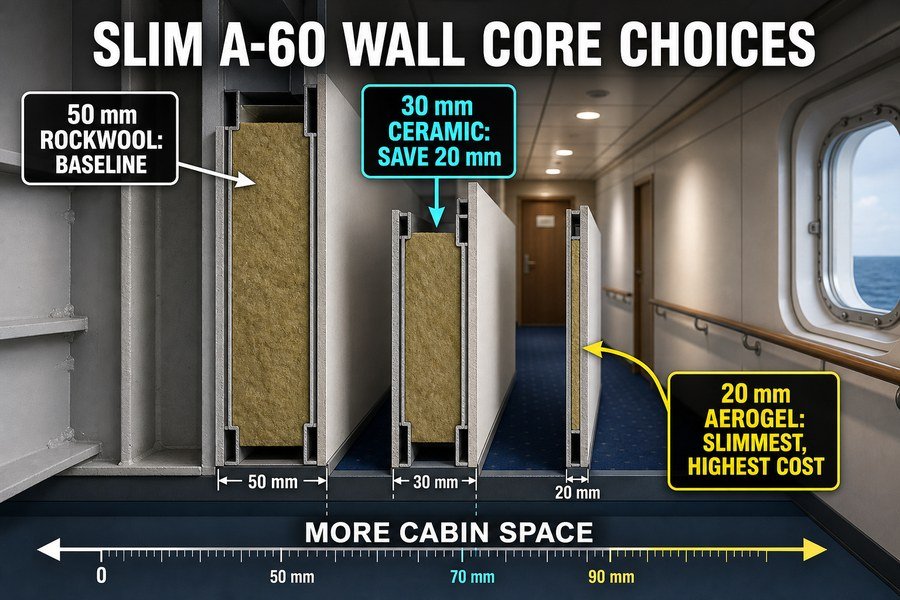
Space on a ship equals money. Every millimeter you save on wall thickness gives the crew or passengers more room. But you cannot simply make the core thinner, or you will fail the A-60 fire test4. To balance A-60 insulation with a slim profile, you have three thickness options: 50mm standard rockwool, 30mm high-performance ceramic, and 20mm aerogel panels. I will show you how to choose between them.
Standard 50mm Rockwool Panels for Typical A-60 Walls
First, the 50mm standard rockwool panel is the baseline for A-60 walls. Almost every marine outfitting factory in Vietnam and China produces this type of panel. It uses 140 kg/m3 density rockwool. It is reliable and cheap. However, a 50mm wall takes up a lot of deck space. When you build long corridors, losing 50mm on each side makes the area feel very cramped. I only recommend this when space is not your primary concern.
Slimmer 30mm Ceramic and 20mm Aerogel Cores for Premium Spaces
If you need a slimmer wall, you can upgrade to a 30mm high-performance ceramic wool core. Because ceramic fibers handle heat better than rockwool, a 30mm thick panel can still pass the 60-minute fire test. This saves 20mm of space per wall. The cost is higher, but it is a very common upgrade for European shipyards building tight crew quarters.
Finally, for the ultimate slim wall, you can use 20mm microporous aerogel panels. Aerogel is the best insulation material in the world.5 A 20mm aerogel core easily passes the A-60 test. This gives you the slimmest possible interior wall. But aerogel is extremely expensive. It can cost over $250 per square meter. I only recommend this when cabin space is absolutely critical, like on luxury yachts.
| Core Material | Required Thickness for A-60 | Space Saved (vs Standard) | Cost Impact |
|---|---|---|---|
| Traditional Rockwool | 50 mm | 0 mm (Baseline) | Low ($30-$40/m2) |
| Ceramic Wool | 30 mm | 20 mm | Medium ($60-$80/m2) |
| Microporous Aerogel | 20 mm | 30 mm | Very High ($250+/m2) |
How to Design Lightweight Marine Ceiling Panels Without Losing Fire Integrity?
Heavy ceilings are hard to install and stress the deck structure above. But weak ceilings fail during ship fires. You must design them light and safe at the same time.
Designing lightweight marine ceilings without losing fire integrity involves three strategies. First, switch from steel to aluminum surface sheets to cut weight. Second, use lightweight aluminum honeycomb cores for B-0 ratings. Third, use low-density mineral wool (60 kg/m3) mixed with calcium silicate boards for strict B-15 ceiling requirements.
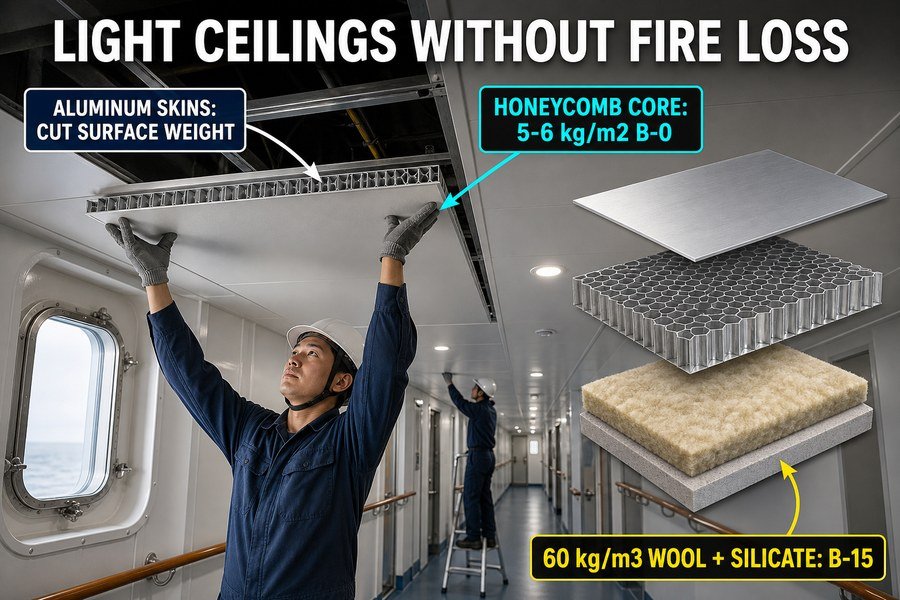
Ceiling panels are very different from wall panels. Workers must lift them over their heads to install them. If a ceiling panel weighs 20 kg/m2, installation is slow and dangerous. To design lightweight marine ceiling panels without losing fire integrity, you must use three specific strategies: aluminum surface sheets, aluminum honeycomb cores, and a mix of low-density wool with calcium silicate.
Using Aluminum Skins and Honeycomb Cores for B-0 Ceilings
The first strategy is to stop using galvanized steel skins. A standard 0.6mm steel skin is heavy. If you switch to a 0.7mm aluminum skin, you cut the surface weight in half. Aluminum melts faster than steel, but for low fire-risk areas, it is perfectly safe and approved by classification societies.
The second strategy is for B-0 rated ceilings. You should use a lightweight aluminum honeycomb core. An aluminum honeycomb ceiling panel with aluminum skins weighs only 5 to 6 kg/m2. This is incredibly light. Workers can install these panels very quickly. This saves you a lot of labor costs. I highly recommend this for public areas on the ship.
Combining Low-Density Wool and Calcium Silicate for B-15 Ceilings
The third strategy is for strict B-15 ceiling requirements. Aluminum honeycomb cannot pass a B-15 fire test alone6. Instead, you should use a low-density mineral wool core, usually around 60 kg/m3. To make up for the low density, you bond a thin 3mm calcium silicate board inside the panel. The calcium silicate blocks the fire, and the light wool provides sound insulation. This composite design keeps the total ceiling weight around 10 to 12 kg/m2, which is much better than a solid heavy ceiling.
| Ceiling Design Strategy | Fire Rating | Core Material | Average Weight (per m2) | Best For |
|---|---|---|---|---|
| Standard Steel + Heavy Wool | B-15 | 120 kg/m3 Rockwool | 16 - 18 kg | High fire risk areas |
| Aluminum Skin + Honeycomb | B-0 | Aluminum Honeycomb | 5 - 6 kg | Public spaces, low risk |
| Light Wool + Calcium Silicate | B-15 | 60 kg/m3 Wool + Silicate | 10 - 12 kg | Cabins, corridors |
Why Choose Lightweight Composite Cores Over Mineral Wool for Marine Interior Panels?
Traditional mineral wool absorbs water, sags over time, and creates heavy panels. This leads to replacement costs. Lightweight composite cores fix all these terrible problems permanently. Let us see why.
You should choose lightweight composite cores over mineral wool for four key reasons. Composites offer a 50% weight reduction. They provide total moisture resistance without sagging. They deliver superior acoustic damping for passenger comfort. Finally, composite panels offer higher structural rigidity, preventing the dents common in wool panels.
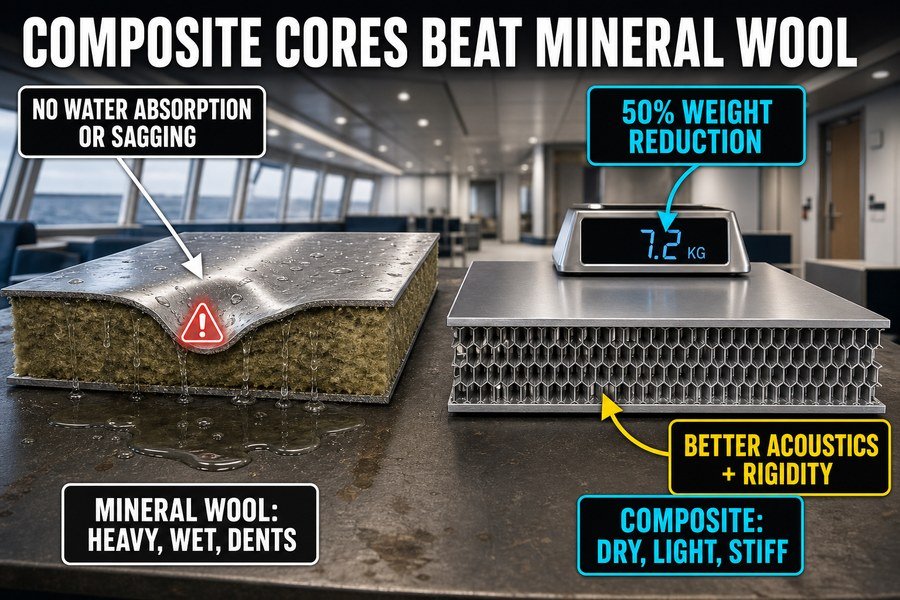
I know that rockwool is the standard for most commercial ships. But when you are outfitting luxury vessels or fast ferries, rockwool causes serious problems. You should choose lightweight composite cores over mineral wool for four key reasons: weight reduction, moisture resistance, acoustic damping, and structural rigidity. I will explain each benefit in detail.
Significant Weight Reduction and Total Moisture Resistance
The first reason is the 50% weight reduction. A standard composite core, like Nomex honeycomb or an aramid fiber composite, weighs half as much as standard mineral wool7. This massive weight saving increases the ship's speed and cuts fuel consumption drastically.
The second reason is total moisture resistance. Mineral wool acts like a sponge. If a pipe leaks inside the ceiling, the wool absorbs the water. It becomes very heavy, sags, and causes the steel skin to rust from the inside. Composite cores do not absorb water. They stay completely dry, meaning they last much longer in wet marine environments. This reduces your replacement costs over the life of the ship.
Superior Acoustic Damping and High Structural Rigidity
The third reason is superior acoustic damping. Engine vibrations travel through the ship's steel structure. Mineral wool stops some noise, but advanced composite cores are specifically designed to absorb low-frequency vibrations8. This provides much better comfort for passengers.
The fourth reason is higher structural rigidity. A rockwool panel is basically soft dirt pressed between two thin metal sheets. If someone kicks it, it dents immediately. A composite honeycomb panel acts like a solid structural beam9. It will not bend or dent easily. While composite panels cost over $100 per square meter compared to rockwool's $30, the long-term savings in maintenance and fuel make them the better choice for high-end projects.
| Feature | Traditional Mineral Wool Core | Lightweight Composite Core |
|---|---|---|
| Weight (50mm panel) | 15 - 20 kg/m2 | 6 - 10 kg/m2 |
| Moisture Resistance | Poor (Absorbs water, sags) | Excellent (Waterproof, rigid) |
| Structural Rigidity | Low (Dents easily) | High (Resists impact) |
| Initial Cost | Very Low ($15 - $40/m2) | High ($100 - $150/m2) |
Conclusion
Selecting the right marine panel core is an exact science. By balancing rockwool, ceramic, and composite materials, you can meet strict safety rules while perfectly controlling your ship's weight.
-
"(PDF) An Overall Ship Propulsion Model for Fuel Efficiency Study", https://www.academia.edu/169502768/An_Overall_Ship_Propulsion_Model_for_Fuel_Efficiency_Study. Naval-architecture literature explains that greater vessel displacement generally increases required propulsive power and fuel consumption at a given operating profile, supporting the article’s causal link between heavier outfitting materials and fuel use. Evidence role: mechanism; source type: paper. Supports: Heavier bulkhead panels can increase ship fuel consumption.. Scope note: The magnitude of the fuel penalty depends on vessel type, speed, loading condition, hull form, and operating profile. ↩
-
"What Is the Purpose and Scope of the IMO FTP Code?", https://magellanmarinetech.com/what-purpose-scope-of-imo-ftp-code/. The IMO FTP Code and SOLAS fire-safety framework define A-class divisions and prescribe standard fire-test procedures for bulkheads and decks, establishing the regulatory basis for A-Class marine panel compliance. Evidence role: definition; source type: institution. Supports: Marine bulkheads intended for A-Class use must be evaluated under IMO FTP Code fire-test requirements.. ↩
-
"Determination of Thermal Properties of Mineral Wool Required for ... - PMC", https://pmc.ncbi.nlm.nih.gov/articles/PMC10488771/. Research on mineral wool insulation describes how bulk density and fiber structure influence effective thermal conductivity through solid conduction, gas conduction, and radiative transfer, supporting the mechanism that density can affect heat-transfer performance; this does not by itself prove a specific A-30 or A-60 rating for a given panel assembly. Evidence role: mechanism; source type: paper. Supports: Increasing or changing rockwool density can affect heat transfer through the insulation because fiber structure influences thermal conductivity mechanisms.. Scope note: Thermal performance depends on the full tested assembly, temperature range, binders, facings, joints, and installation, so density alone is not direct proof of a fire rating. ↩
-
"What Is the Purpose and Scope of the IMO FTP Code?", https://magellanmarinetech.com/what-purpose-scope-of-imo-ftp-code/. The IMO fire-test framework for A-class divisions defines A-60 performance by exposure to a standard fire test for 60 minutes while limiting temperature rise on the unexposed face, which supports the article’s point that A-60 compliance is a tested assembly requirement rather than a simple matter of reducing thickness. Evidence role: definition; source type: institution. Supports: Marine wall panels must satisfy the A-60 fire-test requirement, so reducing insulation thickness can jeopardize compliance unless the full assembly is tested and approved.. Scope note: This source establishes the regulatory test criteria; it does not verify that any specific rockwool, ceramic, or aerogel panel construction passes A-60. ↩
-
"Study on Thermal Insulation Performance of Silica Aerogel ...", https://pmc.ncbi.nlm.nih.gov/articles/PMC11593504/. Reviews of silica aerogels describe their extremely low density and very low thermal conductivity compared with conventional insulation materials, supporting their use as high-performance thermal insulation in space-constrained applications. Evidence role: expert_consensus; source type: paper. Supports: Aerogel has exceptionally high insulating performance relative to many conventional insulation materials.. Scope note: The evidence supports aerogel’s exceptional insulating performance, but it does not prove that aerogel is universally the “best” material across cost, durability, fire approval, or marine installation constraints. ↩
-
"Study of the Heat Transfer Performance of Laminated Paper ...", https://pmc.ncbi.nlm.nih.gov/articles/PMC9944516/. Fire-test standards for B-15 divisions require limited temperature rise on the unexposed face for 15 minutes, while materials literature describes aluminium honeycomb as lightweight and thermally conductive; together these sources support why additional insulation is normally required for B-15 performance. Evidence role: mechanism; source type: paper. Supports: An aluminium honeycomb core by itself is unlikely to satisfy B-15 insulation requirements.. Scope note: Unless the source reports tests on the exact panel construction, the evidence is contextual rather than proof that every aluminium honeycomb panel fails B-15. ↩
-
"Aluminum Honeycomb vs Rock Wool Core for Marine Accommodation ...", https://magellanmarinetech.com/aluminum-honeycomb-rock-wool-core-marine-accommodation-panels-how-compare/. Comparative materials data on marine sandwich-panel cores and mineral-wool insulation can support that aramid/Nomex honeycomb or similar lightweight cores may have substantially lower areal mass than mineral-wool cores at comparable thicknesses. Evidence role: statistic; source type: paper. Supports: A standard composite core, such as Nomex honeycomb or aramid fiber composite, can weigh about half as much as a standard mineral-wool core.. Scope note: The exact percentage depends on panel thickness, facings, density grade, fire rating, and installation system; a source may support a typical range rather than a universal 50% reduction. ↩
-
"Vibrational characteristics of sandwich panels in a reduced- ...", https://ntrs.nasa.gov/api/citations/19660024166/downloads/19660024166.pdf. Research on sandwich composite panels with engineered cores can support that core geometry and material selection influence vibration damping and sound transmission, including low-frequency behavior in some designs. Evidence role: mechanism; source type: paper. Supports: Some advanced composite cores can be engineered to improve damping of low-frequency vibration and acoustic transmission.. Scope note: This supports the engineering mechanism, not the broader claim that every lightweight composite core outperforms mineral wool acoustically in all vessel installations. ↩
-
"Mechanical Properties Characterization of Composite ...", https://ntrs.nasa.gov/api/citations/19880000739/downloads/19880000739.pdf. Textbook or review literature on sandwich-structured composites explains that a lightweight core separates stiff face sheets, increasing bending stiffness and strength-to-weight in a beam-like manner. Evidence role: mechanism; source type: education. Supports: Composite honeycomb panels can provide high bending rigidity because the core stabilizes and separates the load-bearing skins.. Scope note: This supports the general structural principle of honeycomb sandwich panels, but impact dent resistance depends on face-sheet material, core density, adhesive bonding, and loading conditions. ↩