Are your ship interior panels failing fire safety inspections? Uncontrolled smoke kills faster than fire, so understanding how we test marine panel smoke density can save your project timeline.
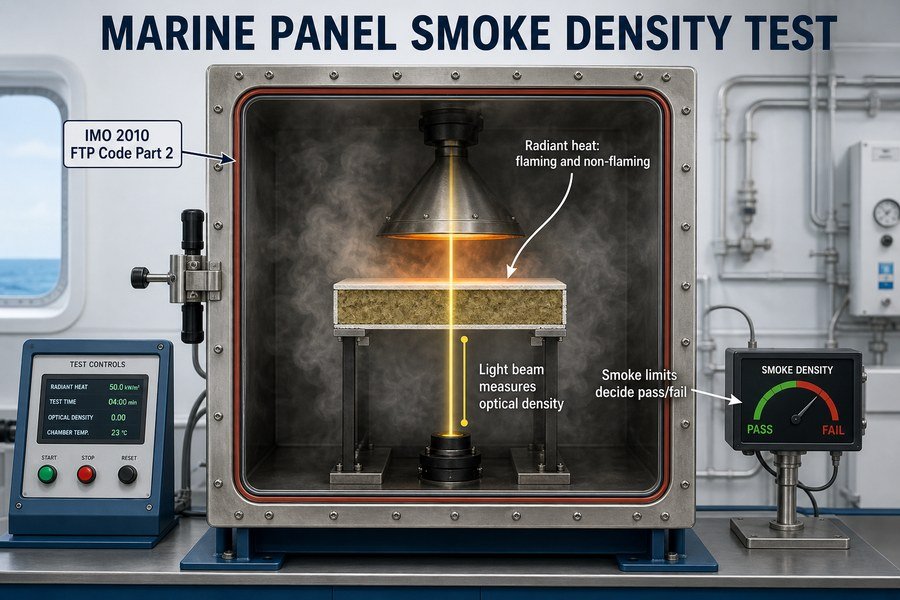
Marine interior panel smoke density is tested using a sealed smoke chamber following IMO 2010 FTP Code Part 2. The panel is exposed to radiant heat under flaming and non-flaming conditions, while a light beam measures the optical density (light obscuration) to ensure specific limits are not exceeded.
You might think any fireproof panel is safe, but smoke generation is a hidden danger. Let us break down the exact testing methods so you can buy the right materials without wasting money, keeping your outfitting projects moving forward without costly shipyard rejections.
What Is the Marine Interior Panel Smoke Density Chamber Test?
Are you confused about how laboratories test smoke? Failing this test means your panels cannot go on ships, delaying your entire outfitting project.
The marine interior panel smoke density chamber test is a standardized method using a 0.51 cubic meter sealed box. According to ISO 5659-2, a 75mm x 75mm panel sample is burned using a radiant cone heater at 25 kW/m² or 50 kW/m² to capture and measure all generated smoke.
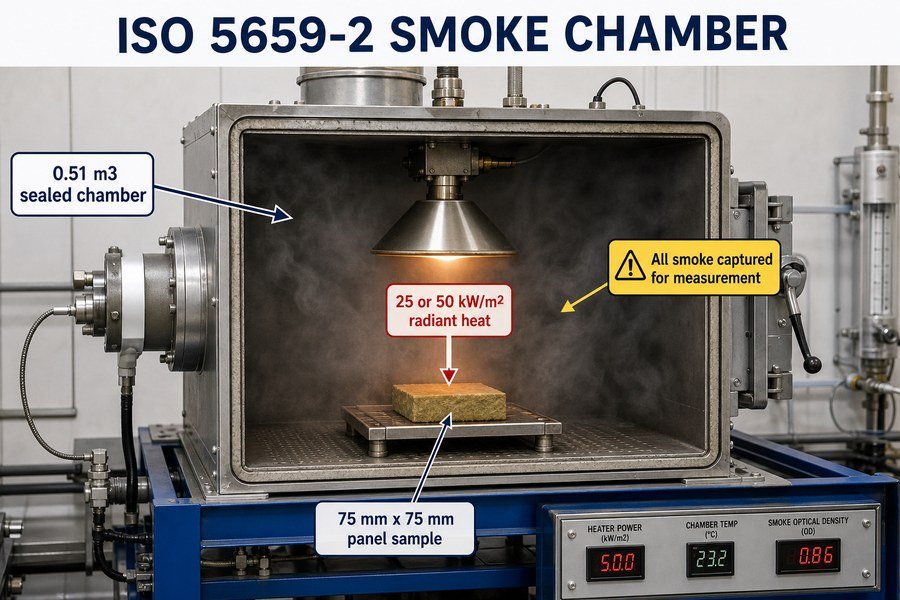
Setting Up the ISO 5659-2 Smoke Density Chamber
When we test marine wall and ceiling panels, we do not just burn them in an open room. We use a highly controlled environment. The ISO 5659-2 standard requires a specific sealed metal box. This box has an exact internal volume of 0.51 cubic meters1. I have watched many of these tests during my time at Magellan Marine. The laboratory cuts the marine panel into a small square sample. This sample measures exactly 75mm by 75mm2. The technician places this sample inside the sealed box. The box must be perfectly sealed so no smoke escapes. If smoke leaks out, the test results will be wrong, and your panels might pass when they should fail. A sealed 0.51 cubic meter chamber ensures that all the smoke stays inside. This allows the testing equipment to measure the true volume and thickness of the smoke produced by the panel surface.
Applying Heat with the Radiant Cone Heater
Once the 75mm by 75mm sample is inside the box, we must heat it up. The test uses a radiant cone heater. This heater sits above the sample. The IMO 2010 FTP Code requires us to test the panel at different heat levels. We call this heat flux. First, we test the sample at 25 kW/m² (kilowatts per square meter). This simulates a fire that is starting to grow. Then, we do another test at 50 kW/m². This simulates a very intense fire condition. The cone heater applies this heat evenly across the surface of the small panel sample. When the heat hits the panel, the surface material starts to break down and release smoke. By using both 25 kW/m² and 50 kW/m² heat levels3, we can see exactly how the marine panel behaves in different fire situations.
| Test Parameter | Required Specification | Source Standard |
|---|---|---|
| Chamber Volume | 0.51 cubic meters | ISO 5659-2 |
| Sample Size | 75mm x 75mm | ISO 5659-2 |
| Heat Flux Level 1 | 25 kW/m² | IMO 2010 FTP Code |
| Heat Flux Level 2 | 50 kW/m² | IMO 2010 FTP Code |
| Test Duration | 10 minutes | IMO 2010 FTP Code |
How Is Optical Density Measured in Marine Interior Panel Tests?
Do you know how thick smoke is actually calculated? Guessing is not an option when shipyard safety inspectors demand hard data.
Optical density in marine interior panel tests is measured using a photometric system. A light beam passes vertically through the smoke chamber to a photomultiplier tube receiver. As smoke fills the box, it blocks the light; the reduction in light transmission calculates the specific optical density (Ds).
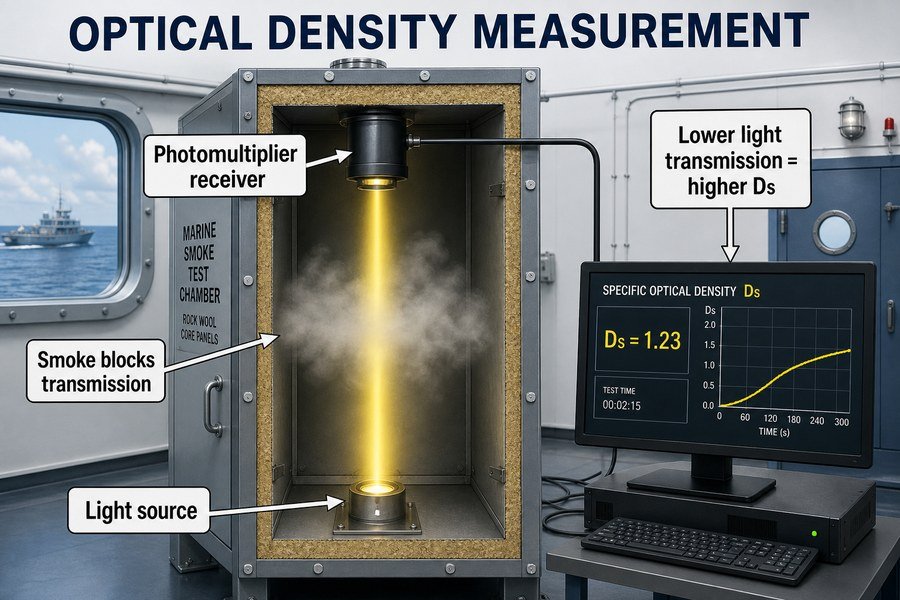
The Role of the Photometric Light System in Smoke Tests
You cannot measure smoke thickness with just your eyes. We need precise machines. Inside the 0.51 cubic meter smoke chamber4, there is a photometric system. This is basically a very accurate light beam and a sensor. The light source sits at the bottom of the chamber. It shines a beam of light straight up to the top. At the top of the chamber, there is a receiver called a photomultiplier tube5. Before the test begins, the air is clean. The light beam travels to the top, and the receiver reads 100% light transmission. As the marine panel sample burns, smoke fills the sealed box. This smoke gets in the way of the light beam. The receiver at the top measures exactly how much light gets blocked by the smoke. I always check these light transmission records because they show the exact moment the smoke becomes dangerous for humans6.
Calculating Specific Optical Density (Ds) from Light Transmission
The drop in light transmission gives us the data we need. We use this data to calculate the Specific Optical Density. We call this value "Ds". The formula takes the light transmission percentage and converts it into a number. If the smoke blocks 90% of the light, only 10% reaches the receiver. This low transmission percentage turns into a high Ds number. The machine continuously records the Ds value over the 10-minute test period. We are looking for the maximum peak of this value during the test. This maximum peak is very important. By watching the light transmission drop and calculating the Ds, we get a true scientific measurement of the smoke. This stops arguments with shipyard inspectors because the numbers come from a calibrated photometric system, not a personal opinion.
| Light Transmission (%) | Specific Optical Density (Ds) | Visibility Level |
|---|---|---|
| 100% | 0 | Perfect clear air |
| 50% | ~45 | Light smoke, good visibility |
| 10% | ~132 | Moderate smoke, reduced visibility |
| 1% | ~264 | Heavy smoke, very poor visibility |
| 0.1% | ~395 | Dense smoke, complete blindness |
What Dm Value Indicates Acceptable Marine Ceiling Panel Smoke Density?
Are your ceiling panels producing too much smoke? Buying cheap panels might result in a high Dm value, getting your materials rejected.
An acceptable marine ceiling panel smoke density requires a maximum specific optical density (Dm) of 200. According to the IMO 2010 FTP Code Part 2, surface materials for bulkheads and ceilings must not exceed a Dm of 200, while floor coverings are allowed a maximum Dm of 500.
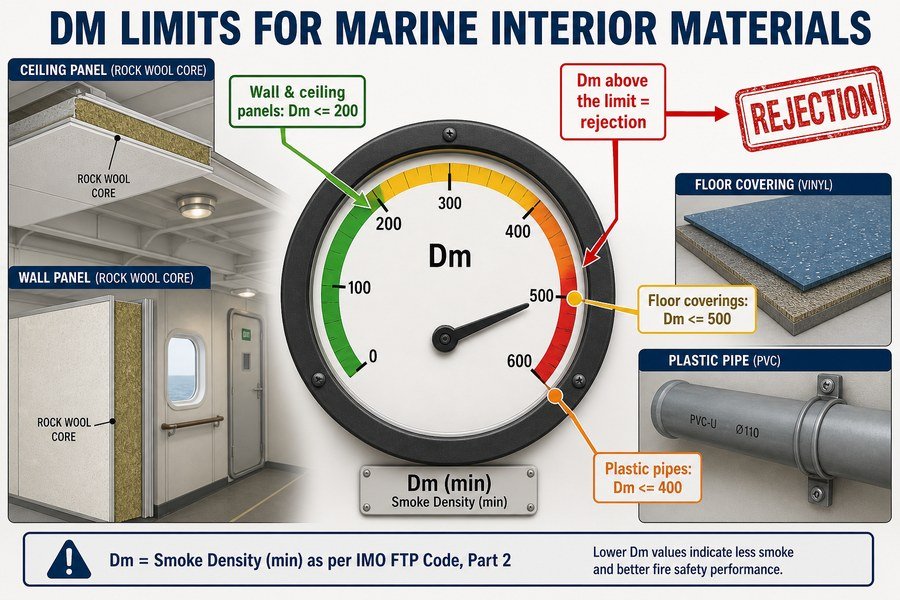
IMO 2010 FTP Code Part 2 Limits for Maximum Optical Density (Dm)
During the test, the machine calculates the Specific Optical Density (Ds) many times. The highest Ds value recorded during the entire 10-minute test is called the maximum specific optical density. We write this as "Dm". The IMO 2010 FTP Code Part 2 sets strict legal limits for this Dm value. Different materials have different rules. For marine wall panels (bulkheads) and marine ceiling panels, the Dm value must not go over 2007. If your ceiling panel gets a Dm of 201, it fails the test. You cannot use it on a commercial ship. However, floor coverings have a different limit. Floor coverings can reach a maximum Dm of 500.8 This is because smoke rises.9 Floor materials do not block vision as quickly as ceiling materials. I always remind my clients to check the Dm value on their certificates before they buy.
Why Dm 200 is the Hard Limit for Ceiling Panels
The Dm 200 limit for ceiling panels is there for a very good reason. Ceilings are above the passengers. When a ceiling panel burns, the smoke immediately gathers at the top of the corridor. It then pushes down toward the floor. If a ceiling panel produces a Dm higher than 200, the smoke becomes too thick too fast. The corridor goes completely dark. Passengers will not be able to see the exit signs.10 They will become trapped. I have seen cheap ceiling panels fail this test badly. They might look nice, but their PVC surface films create massive amounts of dark smoke. By keeping the limit at Dm 200, the IMO ensures that even if the ceiling panel burns, the smoke will not blind people immediately. This gives everyone enough time to escape the ship safely.
| Marine Material Type | Maximum Allowed Dm Value | IMO Regulation Source |
|---|---|---|
| Marine Wall Panels (Bulkheads) | 200 | IMO FTP Code Part 2 |
| Marine Ceiling Panels | 200 | IMO FTP Code Part 2 |
| Floor Coverings (Primary deck) | 500 | IMO FTP Code Part 2 |
| Plastic Pipes | 400 | IMO FTP Code Part 2 |
How Do Flaming vs. Non-Flaming Tests Affect Marine Interior Panel Smoke Density?
Did you know panels burn differently with or without a flame? Missing one test condition can leave a dangerous gap in your safety certification.
Flaming tests use a pilot flame to ignite gases, typically burning faster with less dense smoke. Non-flaming tests rely only on radiant heat to smolder the panel, which often produces thicker, darker smoke. Marine panels must pass both conditions under IMO rules to ensure complete safety.
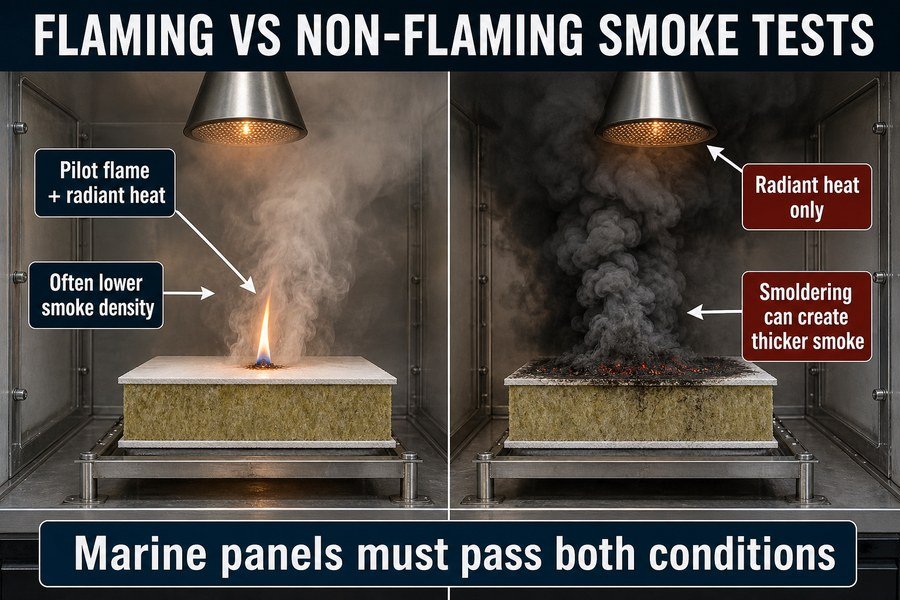
The Dynamics of the Flaming Smoke Test Condition
When we test marine panels, we must test them in two different ways. The first way is the flaming test. In this test, we turn on the radiant cone heater, but we also introduce a small pilot flame near the panel sample. As the panel gets hot, it releases flammable gases. The pilot flame ignites these gases. The panel catches fire and burns with open flames. Usually, when a panel burns with a flame, it consumes the gases quickly. This means the flaming test often produces smoke that is less dense. The fire eats up the particles that would normally make the smoke thick and black. Even though there is a fire, the light beam in the chamber might actually read a lower Dm value during the flaming test. But we cannot rely on just this one test. Real fires are not always open flames.
The Hidden Dangers in Non-Flaming Smoldering Tests
The second way we test is the non-flaming test. In this condition, we use the radiant cone heater, but we do not use the pilot flame. The heat hits the panel, and the panel gets very hot, but it does not catch fire. Instead, it smolders. It slowly melts and roasts. This is the most dangerous condition for smoke. Without an open flame to burn up the gases, the panel releases thick, heavy, dark smoke11. In my experience with Asian suppliers, many cheap decorative films pass the flaming test but fail the non-flaming test miserably. The smoldering creates a dense cloud that completely blocks the light beam. Under IMO rules, marine wall and ceiling panels must pass both the flaming and non-flaming tests.12 If a panel passes one but fails the other, it cannot be used on a ship.
| Test Condition | Ignition Source | Burn Type | Typical Smoke Density Result |
|---|---|---|---|
| Flaming Test | Radiant Heater + Pilot Flame | Open fire | Usually lighter, lower Dm value |
| Non-Flaming Test | Radiant Heater Only | Smoldering | Usually thicker, higher Dm value |
Why Is Specific Optical Density Critical for Marine Interior Panels?
Why do we care so much about light transmission? High smoke density blocks escape routes, trapping passengers and crew during a ship fire.
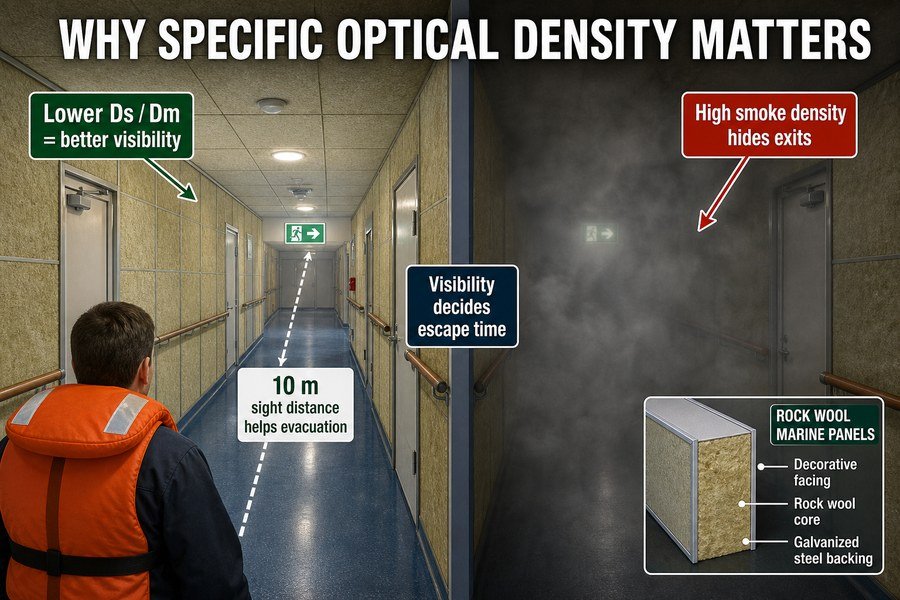
Specific optical density is critical for marine interior panels because it directly dictates passenger visibility, escape time, and rescue operations. A lower density means passengers can see exit signs at a minimum distance of 10 meters, preventing panic and saving lives during critical emergency evacuations at sea.
Ensuring Passenger Visibility During Ship Evacuations
Specific optical density is not just a random number for laboratory scientists. It represents human life. When a fire breaks out on a ship, the ship corridors fill with smoke. The specific optical density tells us exactly how far a human eye can see through that smoke.13 If the optical density is too high, visibility drops to zero. Passengers will not be able to find the doors. They will not see the glowing exit signs. I have worked on projects where we mapped out escape routes. According to marine safety guidelines, people need to see at least 10 meters ahead of them to evacuate without panicking.14 A low specific optical density ensures this 10-meter visibility. If you buy panels with low Dm values, you guarantee that if a fire happens, the people on board can actually see where they are running.
Meeting Safety Regulations to Avoid Costly Rework
Besides saving lives, keeping the specific optical density low protects your business. As a procurement officer, you buy materials for large shipyards in Europe and the United States. These shipyards have strict safety inspectors. When the panels arrive at the shipyard, the inspectors will check your certificates. If your marine interior panels do not have a Dm value of 200 or less15, they will stop the project. They will force you to tear out all the installed panels. I have seen companies lose hundreds of thousands of dollars because they bought panels with bad smoke density ratings. Understanding this critical Dm number means you can speak confidently with your suppliers. You can demand the right test reports before you pay for the order, saving you from disastrous delays and ruined profits.
| Dm Value (Ceilings/Walls) | Impact on Human Visibility | Shipyard Inspector Action |
|---|---|---|
| Dm < 100 | Excellent (Clear sight lines) | Pass easily, no issues |
| Dm 100 - 150 | Good (Can see exit signs clearly) | Pass easily, accepted |
| Dm 151 - 200 | Acceptable (Borderline visibility) | Pass, but monitored |
| Dm > 200 | Dangerous (Cannot see exits) | Immediate Rejection and Rework |
How Do Marine Wall and Ceiling Panel Smoke Density Limits Differ?
Do wall and ceiling panels have the same rules? Mixing up these standards can ruin your budget and cause compliance failures.
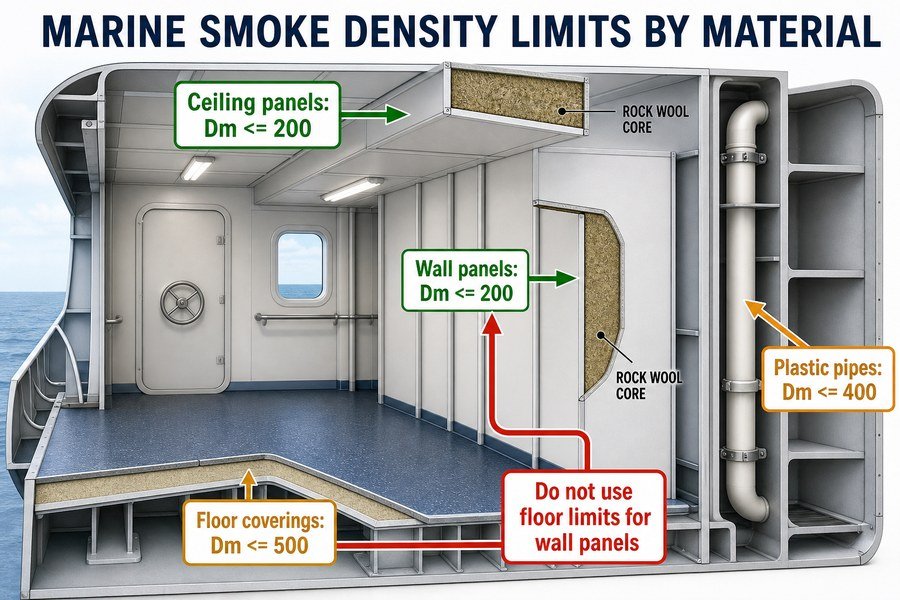
Marine wall panels, ceiling panels, and primary deck coverings have different smoke density limits. According to IMO rules, both wall and ceiling panels share a maximum Dm limit of 200. However, floor coverings can have a higher limit of 500, while plastic pipes allow up to 400.
Examining IMO Smoke Limits for Wall and Ceiling Panels
When you are buying interior outfitting materials, you must organize them by their rule limits. Wall panels and ceiling panels are treated exactly the same by the IMO 2010 FTP Code. They both cover large vertical and overhead spaces in the cabin. Because they are at eye level and above, their smoke immediately blocks human vision. Therefore, both marine wall panels and marine ceiling panels share the strict maximum Dm limit of 200. You do not need to look for different numbers for these two items. Whether you are buying a rockwool core wall panel or an aluminum honeycomb ceiling panel, the target is exactly the same. Dm 200 is your absolute ceiling. I always tell buyers to group these two items together when sending requirements to suppliers in China or Vietnam.
Comparing Panel Limits to Floor Coverings and Piping
The rules change when you look at the floor. Primary deck coverings and floor materials sit below eye level. When they burn, the smoke has to travel all the way up to block vision. Because of this distance, the IMO allows floor coverings to produce more smoke. The maximum Dm limit for primary deck coverings is 500. This is more than double the limit for wall and ceiling panels. Plastic pipes used inside the cabins also have their own limit, which is a maximum Dm of 400. You must keep these numbers straight. If a supplier tries to sell you a wall panel that has a Dm of 300, and they say "It is okay, the limit is 500," they are lying. They are confusing the floor limit with the wall limit. Knowing these exact differences gives you the power to control product quality.
| Ship Interior Product | Installation Location | Maximum Allowed Dm Limit |
|---|---|---|
| Marine Ceiling Panels | Overhead | 200 |
| Marine Wall Panels | Vertical Bulkheads | 200 |
| Plastic Piping | Various | 400 |
| Primary Deck Coverings | Floor | 500 |
Conclusion
Testing smoke density ensures your marine panels meet IMO safety rules. Passing these optical density tests guarantees visibility, keeps crews safe, and keeps your interior outfitting projects on schedule and profitable.
-
"Toxicity Test Requirements and Performance Criteria for ...", https://railroads.dot.gov/sites/fra.dot.gov/files/2021-02/Toxicity%20Test%20and%20Performance%20Criteria.pdf. Technical descriptions of the ISO 5659-2 smoke-density apparatus identify the test chamber volume as approximately 0.51 m³, supporting the stated chamber size used for the method. Evidence role: definition; source type: institution. Supports: The ISO 5659-2 smoke chamber has an internal volume of 0.51 cubic meters.. Scope note: This supports the ISO 5659-2 apparatus specification; tolerances and construction requirements should be verified against the full standard. ↩
-
"Toxicity Test Requirements and Performance Criteria for ...", https://railroads.dot.gov/sites/fra.dot.gov/files/2021-02/Toxicity%20Test%20and%20Performance%20Criteria.pdf. Published summaries of ISO 5659-2 describe the specimen geometry for the smoke-density test as a square sample of 75 mm by 75 mm, supporting the stated test specimen size. Evidence role: definition; source type: institution. Supports: The ISO 5659-2 smoke-density test uses a 75 mm by 75 mm specimen.. Scope note: The citation establishes the standard specimen dimensions, but full preparation and conditioning rules may vary by material and are specified in the complete standard. ↩
-
"What Smoke Toxicity and Density Limits Must Marine Wall and ...", https://magellanmarinetech.com/what-smoke-toxicity-density-limits-must-marine-wall-ceiling-panels-meet/. The IMO 2010 FTP Code uses ISO 5659-2 smoke and toxicity testing for marine materials and specifies irradiance conditions including 25 kW/m² and 50 kW/m² for relevant evaluations. Evidence role: definition; source type: government. Supports: The IMO 2010 FTP Code requires marine panel smoke testing at 25 kW/m² and 50 kW/m² heat flux levels.. Scope note: This supports the heat-flux conditions in the marine fire-test context; the exact applicability can depend on the material category and test part within the FTP Code. ↩
-
"Variability of smoke particulate concentrations in the NBS ...", https://www.fpl.fs.usda.gov/documnts/pdf1986/levan86a.pdf. Standard smoke-density chamber methods describe a closed test chamber of about 0.51 m³ used with an optical measuring system to quantify smoke obscuration during material burning tests. Evidence role: definition; source type: institution. Supports: Smoke testing can use a 0.51 cubic meter chamber equipped with a photometric system.. Scope note: This supports the chamber type and scale used in recognized smoke-density tests, but individual laboratories may use standard-specific configurations. ↩
-
"Interlaboratory evaluation of smoke density chamber", https://nvlpubs.nist.gov/nistpubs/Legacy/TN/nbstechnicalnote708.pdf. Descriptions of smoke-density chamber instrumentation identify a light source and photometric receiver, often a photomultiplier tube, for measuring attenuation of a light beam by smoke. Evidence role: mechanism; source type: government. Supports: A photomultiplier tube can serve as the receiver in a photometric smoke-density measurement system.. Scope note: The source may describe the general instrument design; exact placement of the tube can vary by apparatus design and standard. ↩
-
"Improving Smoke Alarm Performance", https://nvlpubs.nist.gov/nistpubs/TechnicalNotes/NIST.TN.1837.pdf. Fire-safety research links smoke optical density and reduced visibility to impaired escape and tenability, indicating that increasing smoke obscuration can create hazardous conditions for occupants. Evidence role: general_support; source type: government. Supports: Light-transmission records help identify when smoke conditions may become hazardous for humans.. Scope note: Optical-density data indicate visibility-related hazard but do not by themselves determine all human danger, because toxicity, irritants, heat, and exposure duration also affect tenability. ↩
-
"What Smoke Toxicity and Density Limits Must Marine Wall and ...", https://magellanmarinetech.com/what-smoke-toxicity-density-limits-must-marine-wall-ceiling-panels-meet/. The IMO 2010 FTP Code, Part 2, specifies maximum specific optical density criteria for smoke generation tests, including a Dm limit of 200 for certain bulkhead and ceiling surface materials. Evidence role: general_support; source type: institution. Supports: Marine wall panels and ceiling panels subject to IMO FTP Code Part 2 must not exceed a Dm value of 200.. Scope note: The source establishes the regulatory threshold but does not by itself explain the fire-safety rationale behind the numerical value. ↩
-
"What Is the Purpose and Scope of the IMO FTP Code?", https://magellanmarinetech.com/what-purpose-scope-of-imo-ftp-code/. The IMO 2010 FTP Code, Part 2, lists a higher maximum specific optical density criterion for primary deck coverings, commonly cited as Dm 500 in the smoke generation test. Evidence role: general_support; source type: institution. Supports: Floor coverings regulated under IMO FTP Code Part 2 may have a maximum Dm value of 500.. Scope note: The citation supports the stated limit for the regulated material category, but applicability depends on the precise classification of the product being tested. ↩
-
"[PDF] Smoke movement in rooms of fire involvement and adjacent spaces", https://www.govinfo.gov/content/pkg/GOVPUB-C13-95a823d86434ed2a941f71759f4cfcd7/pdf/GOVPUB-C13-95a823d86434ed2a941f71759f4cfcd7.pdf. Fire dynamics literature explains that hot combustion products are buoyant and tend to rise and form an upper smoke layer in enclosed spaces, providing physical context for why overhead materials can affect visibility early in a fire. Evidence role: mechanism; source type: government. Supports: Smoke from burning materials tends to rise and collect above occupants before descending as the smoke layer deepens.. Scope note: This supports the general smoke-movement mechanism, not the IMO’s specific numerical distinction between ceiling and floor limits. ↩
-
"Evaluation of exit signs in clear and smoke conditions", https://nvlpubs.nist.gov/nistpubs/Legacy/IR/nistir4399.pdf. Research on smoke optical density and evacuation visibility shows that increasing smoke density reduces the visible range of signs and route markers, which can impair wayfinding during escape. Evidence role: mechanism; source type: paper. Supports: Dense smoke can reduce visibility enough to prevent passengers from seeing exit signs during evacuation.. Scope note: The evidence supports the relationship between smoke density and visibility, but it does not prove that every material above Dm 200 will make a corridor completely dark in all ship layouts. ↩
-
"Toxicity of Fresh and Aged Anthropogenic Smoke Particles ...", https://pmc.ncbi.nlm.nih.gov/articles/PMC12131020/. Fire science literature reports that non-flaming pyrolysis or smoldering can generate substantial particulate smoke because volatile products are not fully oxidized in a flame; this supports the mechanism described here, although actual smoke density varies by material composition, heat flux, oxygen availability, and test geometry. Evidence role: mechanism; source type: paper. Supports: Without an open flame to burn up the gases, the panel releases thick, heavy, dark smoke.. Scope note: The source would support the general combustion mechanism rather than prove that every marine panel produces denser smoke in the non-flaming condition. ↩
-
"What Is the Purpose and Scope of the IMO FTP Code?", https://magellanmarinetech.com/what-purpose-scope-of-imo-ftp-code/. The IMO Fire Test Procedures Code describes smoke and toxicity testing for ship materials using specified flaming and non-flaming exposure conditions and sets acceptance criteria for applicable interior surface materials; this supports the regulatory basis for requiring both test modes, although applicability depends on the vessel, material classification, and flag-state implementation. Evidence role: general_support; source type: institution. Supports: Under IMO rules, marine wall and ceiling panels must pass both the flaming and non-flaming tests.. Scope note: The source would establish the IMO test framework, but the exact pass/fail obligation may depend on the specific product category and regulatory context. ↩
-
"mounted light extinction measurement devices", https://nvlpubs.nist.gov/nistpubs/Legacy/IR/nistir6215.pdf. Smoke-visibility research defines optical density or extinction as a measure of light attenuation by smoke and relates it to visibility distance through empirical visibility criteria. Evidence role: mechanism; source type: paper. Supports: Specific optical density can be used to estimate how smoke reduces human visibility.. Scope note: Such sources support a relationship between optical density and visibility, but not an exact one-to-one prediction for every ship corridor, lighting condition, or observer. ↩
-
"A waypoint based approach to visibility in performance ...", https://arxiv.org/html/2404.11439v1. Fire-safety engineering guidance commonly treats visibility distance in smoke as a key tenability factor for evacuation and uses approximate visibility thresholds, often in the range of several meters to about 10 m, for wayfinding and movement. Evidence role: expert_consensus; source type: institution. Supports: A visibility distance of about 10 m is used in evacuation-safety guidance for movement through smoke.. Scope note: The source would support 10 m as a design or guidance value for visibility, but it would not directly prove that panic is avoided at that distance. ↩
-
"What Smoke Toxicity and Density Limits Must Marine Wall and ...", https://magellanmarinetech.com/what-smoke-toxicity-density-limits-must-marine-wall-ceiling-panels-meet/. The IMO Fire Test Procedures Code includes smoke-generation criteria for shipboard materials tested by optical density methods and specifies maximum Dm values for particular material categories and locations. Evidence role: definition; source type: institution. Supports: A Dm limit of 200 or less can be a relevant regulatory threshold for certain marine interior surface materials.. Scope note: The applicable Dm threshold depends on the material type, installation location, and regulatory category, so a single value may not apply to every marine interior panel. ↩