Buying cheap panels often leads to massive failures during shipyard inspections. I will show you how to separate real marine panels from fake building materials to save your project.
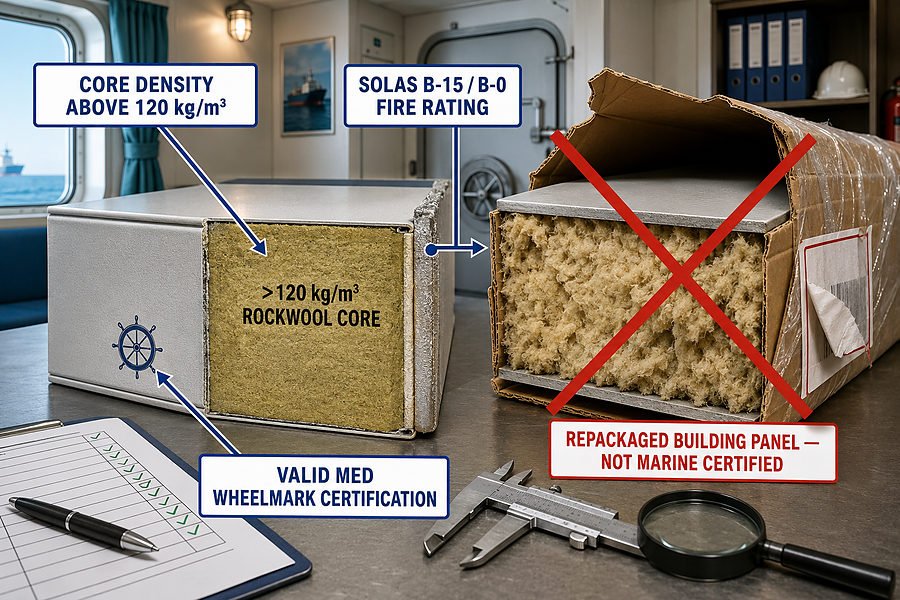
Marine accommodation panels differ from building panels in three complete ways: core density above 120 kg/m³ rockwool, continuous B-15 or B-0 fire ratings under SOLAS regulations, and valid Marine Equipment Directive (MED) Wheelmark certification. Regular building panels lack these strict fire, weight, and vibration requirements.
You cannot afford to guess when outfitting a ship. Let us look closely at the exact methods to spot the fakes and secure the right materials for your vessels.
What Red Flags Expose Building Panels Falsely Sold As Marine Accommodation Grade?
Fake panels look good but fail fast at sea. If you ignore the hidden signs, you will buy useless materials. Here are the clear warnings to watch for.
Four red flags expose fake marine panels: rockwool density below 120 kg/m³, PVC film thickness under 150 microns, lack of edge interlocking profiles, and steel sheet thickness below 0.6mm. These four defects mean the panel cannot handle ship vibration, salt air, or SOLAS fire tests.
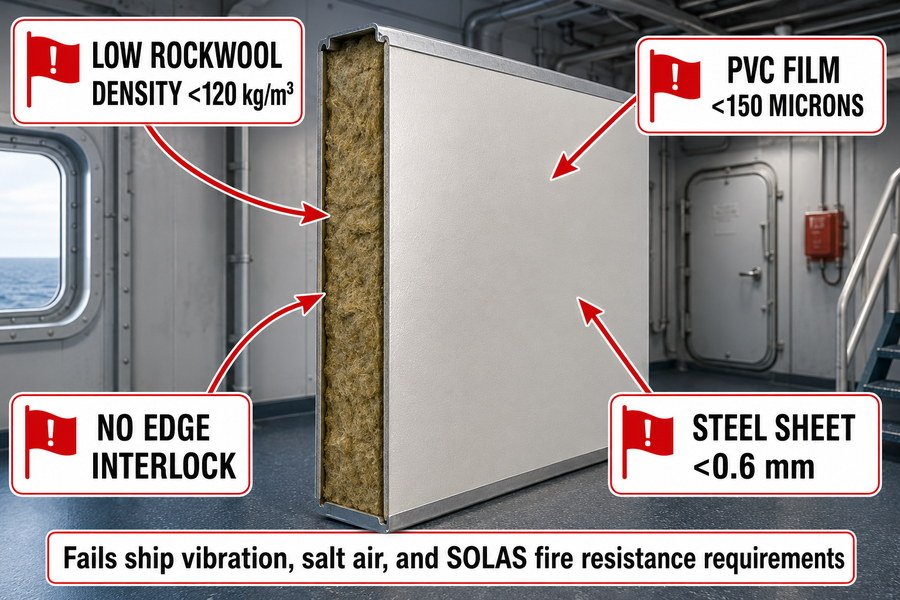
Checking Rockwool Density and Steel Thickness for Marine Use
I remember a client who bought cheap panels from a new factory. The panels arrived at the shipyard. The rockwool density was only 80 kg/m³. This is like standard house insulation. According to the SOLAS Chapter II-2 regulations1, marine B-15 class panels need a very dense rockwool core. The standard is typically 120 kg/m³ to 150 kg/m³. This high density stops fire for 15 minutes.
You must also check the steel thickness. The steel sheet on fake panels is often only 0.4mm thick. Real marine panels use 0.6mm thick hot-dip galvanized steel. This 0.6mm standard comes from shipbuilders' vibration testing requirements. Ships shake all the time. The 0.6mm steel stops the metal from tearing near the floor tracks. If you see thin steel and light rockwool, you are looking at a building panel.
Inspecting PVC Film and Edge Profiles on Marine Panels
Next, you must look at the surface and the edges. Normal building panels use very thin 80-micron PVC film. This thin film peels off easily in salty sea air. Genuine marine panels use at least 150-micron PVC film. This thicker film resists scratches during the rough installation process.
Finally, check the side edges of the panel. Building panels often use simple flat edges. Marine panels use a specific tongue-and-groove interlocking edge profile2. This lock is mandatory. It stops fire and hot smoke from passing through the panel joints during a real emergency. If the panel does not have this special lock, it is absolutely not a marine panel.
| Feature | Fake Building Panel | Genuine Marine Panel | Result on Ship |
|---|---|---|---|
| Rockwool Density | 80 kg/m³ | 120 - 150 kg/m³ | Fails fire test |
| Steel Thickness | 0.4 mm | 0.6 mm | Tears from vibration |
| PVC Film | 80 microns | 150+ microns | Peels off quickly |
| Edge Profile | Flat edge | Tongue-and-groove | Leaks smoke and fire |
Which Certificates Prove A Panel Is Marine Accommodation Compliant?
Without the right papers, the classification society will stop your project. Missing documents will cause massive delays. Here are the exact certificates you must demand.
A genuine marine accommodation panel requires three specific certificates: the EC Type Examination Certificate (Module B), the Production Quality Assurance Certificate (Module D), and a valid Classification Society Type Approval like DNV or ABS. Standard ISO 9001 marks for land buildings are completely insufficient.
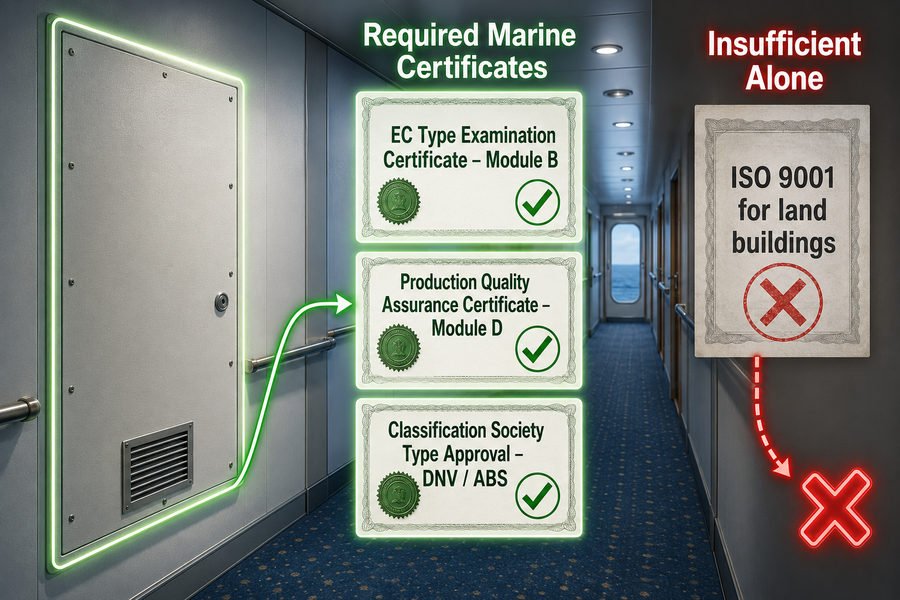
Understanding Module B and Module D Certificates for Marine Panels
I often see suppliers show an ISO 9001 paper and say the panel is marine-grade. This is not true.3 You must ask for the MED Wheelmark certificates. According to the European Marine Equipment Directive (MED) 2014/90/EU, you need two distinct parts.4 First is the Module B certificate. This EC Type Examination paper proves the specific panel design passed the fire test at an approved government lab.
Second is the Module D certificate. This is the Production Quality Assurance paper. It proves the factory's production line is audited every single year.5 The audit ensures the factory makes the exact same panel today that they tested years ago. You need both Module B and Module D to print the Wheelmark logo on the panel. A building panel factory will never have these two documents.
The Importance of Classification Society Approval for Accommodation Outfitting
Besides the Wheelmark, you also need specific Classification Society Approval. Major shipowners use societies like DNV (Norway), ABS (USA), or Lloyd's Register (UK) to inspect their ships. If your project ship is classed by DNV, you must have a DNV Type Approval certificate for the wall panels.6
This paper confirms the panel meets DNV rule Pt.4 Ch.1 for fire protection. The class society issues this certificate after they review the Module B tests. If you buy panels with only a local Chinese fire test report, the DNV surveyor on the ship will reject the cargo. You must match the certificate to the ship's classification society.
| Certificate Name | Issuing Authority | What It Proves | Mandatory for Europe? |
|---|---|---|---|
| Module B (EC Type) | Notified Body | Design passes IMO fire tests | Yes |
| Module D (Quality) | Notified Body | Factory production is consistent | Yes |
| Class Type Approval | DNV, ABS, LR, etc. | Meets specific class rules | Yes (Depends on Ship) |
| ISO 9001 | Local Agency | General business management | No |
How To Audit A Marine Accommodation Panel Manufacturer's Documents Before Ordering?
You cannot trust a PDF file sent by a new supplier. Fake certificates will destroy your project budget. You must verify the documents yourself using these steps.
You must audit panel documents using three strict steps: verify the certificate number directly on the issuing classification society's online database, check the expiration dates on both Module B and Module D certificates, and confirm the factory name on the certificate matches your actual supplier's bank account name.
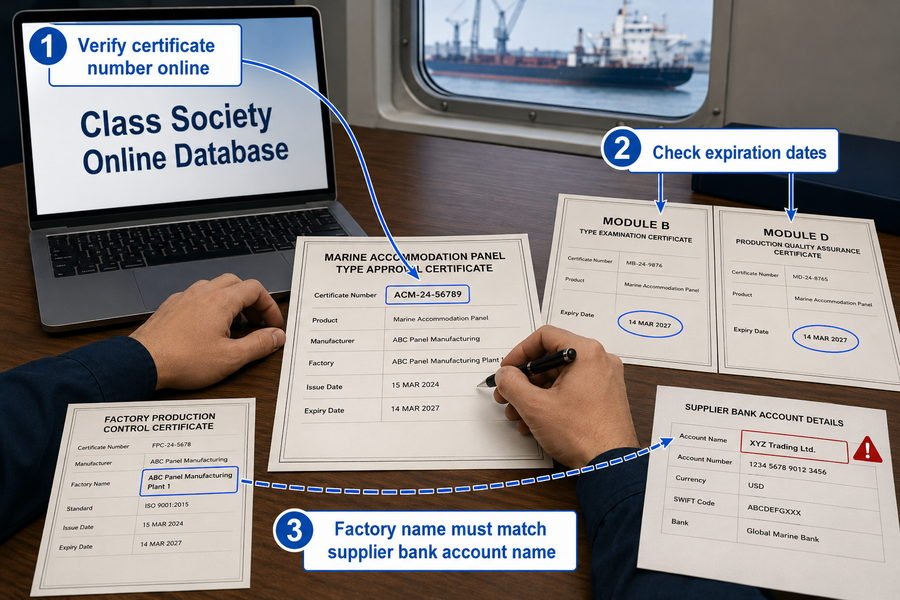
Verifying Certificate Numbers on Classification Society Databases
I have seen many buyers lose money to trading companies pretending to be factories. Some people even use Photoshop to make fake certificates. To stop this, you must do a direct document audit. First, take the certificate number. Go to the classification society website. For example, if it is a DNV certificate, go to the DNV Approval Finder tool online.
Type the number into the search box. The database will show you the real certificate. If the database says "No results found," the certificate is a fake PDF. You must never pay a deposit if the number does not exist on the official website. This 5-minute check saves you thousands of dollars.
Checking Certificate Validity Dates and Manufacturer Account Names
Second, look closely at the expiration dates. According to MED rules, a Module B certificate is usually valid for exactly 5 years. A Module D certificate is valid for 3 years7. If the date is expired, the shipyard will reject the panels. Suppliers sometimes send old certificates and promise to "update them soon." Do not accept this.
Third, check the company name. The manufacturer name on the Module D certificate must exactly match the company name on your proforma invoice and bank payment details.8 If the certificate says "Factory A" but you are paying "Company B", you are buying from a middleman. Middlemen cannot control the production quality. You will likely receive building-grade panels packed in marine boxes.
| Audit Step | Action Required | Red Flag | Action to Take |
|---|---|---|---|
| Check Database | Search number on Class website | "No results found" error | Cancel the order immediately |
| Check Dates | Read the "Valid Until" section | Date is in the past | Request current certificate |
| Check Names | Compare Certificate to Invoice | Names are totally different | You are dealing with a broker |
Which Procurement Mistakes Lead To Non-Compliant Accommodation Panels Onboard?
Buying panels based only on the lowest price is a trap. This mistake will cost you ten times more later. Here are the common errors you must avoid.
Three main procurement mistakes lead to non-compliant panels: prioritizing price over rockwool density to save money but failing fire tests, mixing B-15 marine panels with standard C-class building profiles, and accepting generic lab test reports instead of specific project-approved certificates from the designated classification society.
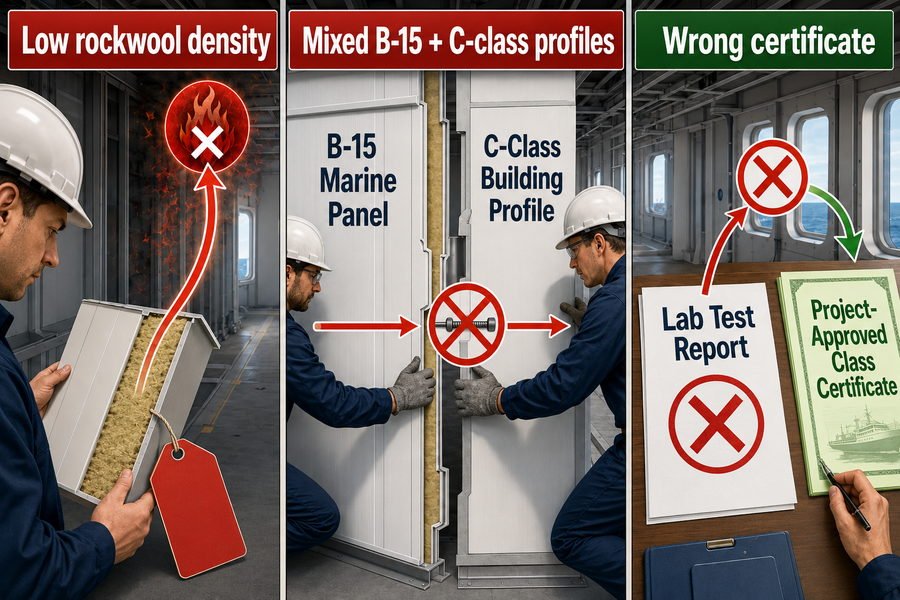
The Danger of Choosing Low Price Over Correct Rockwool Density
In my experience, I often see buyers trying to get the absolute lowest price from Asia. A genuine 50mm thick, B-15 rated panel with 120 kg/m³ rockwool usually costs around $25 to $30 per square meter (FOB China). This price depends heavily on the steel surface finish.
If a supplier offers you $18 per square meter, they are making a dangerous change. They are reducing the rockwool density down to 80 kg/m³. You save $7 per square meter on the purchase. However, the panel will definitely fail the 15-minute fire test. The shipyard will find out. You will have to buy new panels, pay for double shipping, and pay penalties for delaying the ship.
Mixing Marine B-15 Panels with Standard C-class Building Profiles
The second mistake is mixing different materials. Many buyers buy excellent B-15 marine panels. Then, they buy cheap C-class floor tracks and top ceiling profiles from a building material market. According to SOLAS regulations, the B-15 fire rating applies to the whole wall system9. It does not apply to just the board.
If the floor profile melts in 5 minutes during a fire, the whole heavy wall falls down. Always buy the panels and the profiles together as a tested system. The third mistake is accepting a simple fire test report. A lab report from an unknown local test center is not enough. The shipyard surveyor will only look for the official Class certificate10. Generic lab reports are useless on a ship.
| Procurement Mistake | False Benefit | True Consequence | Rectification Cost |
|---|---|---|---|
| Low Density Core | Save $7 per m² | Fails fire inspection | $50+ per m² to replace |
| Mixed Profiles | Save $2 per meter | Whole wall system fails | Total tear down of cabin |
| Generic Lab Reports | Faster supplier choice | Class surveyor rejects cargo | Buying new certified cargo |
Why Do Building-Grade Panels Cause Rework During Classification Inspection?
Installing the wrong panels will destroy your delivery schedule. The surveyor will find the flaws and force you to tear everything down. Here is why building panels fail.
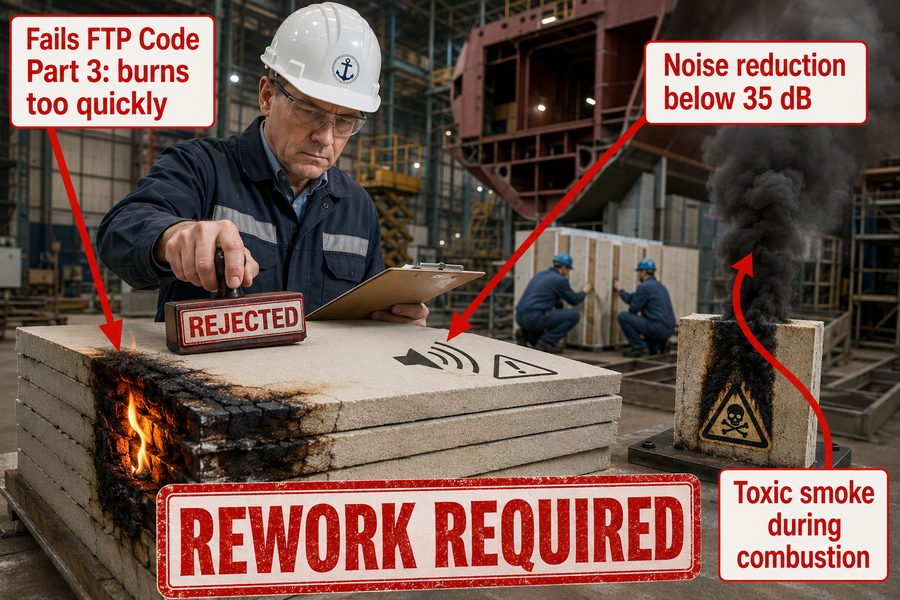
Building-grade panels cause rework for three specific reasons: they fail the standard FTP Code Part 3 fire test by burning too quickly, they lack noise reduction ratings by falling below 35 dB, and they emit toxic smoke during combustion. Surveyors immediately reject panels showing these three severe safety failures.
Failing the FTP Code Part 3 Fire Test for Marine Applications
When the ship is nearly ready, the surveyor from DNV or ABS comes on board to inspect. If you used building panels, you will have a massive problem. First, building panels fail the international fire test. Marine panels must pass the IMO 2010 FTP Code Part 3 test.
A B-15 panel must stop flames. It must also keep the unexposed side temperature below 140°C above the starting temperature for a full 15 minutes.11 Building panels use cheap glue and low-density cores. They burn through in 3 minutes. The unexposed side gets too hot. The surveyor will see the wrong labels, reject the wall, and order you to remove every single panel.
Missing Noise Reduction Targets and Toxic Smoke Emission Standards
Second, building panels fail the strict marine noise rules. The IMO standard (Resolution MSC.337(91)) requires cabin walls to have a sound reduction index (Rw) of at least 35 dB.12 Building panels have empty spaces and light cores. Their sound reduction is usually only 25 dB to 28 dB. The surveyor will use a sound meter to test the noise. The room will fail the test.
Third, the cheap glue and thin PVC on building panels create very toxic black smoke when they get hot. Marine panels must pass the IMO FTP Code Part 2. This part tests for low smoke and low toxicity. If the panel creates poison gas during a small cabin fire, people cannot escape. Surveyors check your certificates specifically for these smoke and toxicity results.
| Inspection Standard | Marine Requirement | Building Panel Result | Consequence of Failure |
|---|---|---|---|
| IMO FTP Code Part 3 | Hold fire for 15 mins | Burns in 3 mins | Mandatory panel removal |
| IMO Noise Res. MSC.337 | ≥ 35 dB reduction | 25 - 28 dB reduction | Cabin fails privacy test |
| IMO FTP Code Part 2 | Low smoke / non-toxic | Heavy toxic black smoke | Life safety hazard |
How To Evaluate Marine Accommodation Panel Samples Against Shipboard Service Conditions?
You must test samples before you place a massive order. Physical tests in your office can reveal the truth quickly. Here is exactly how to test panel samples.
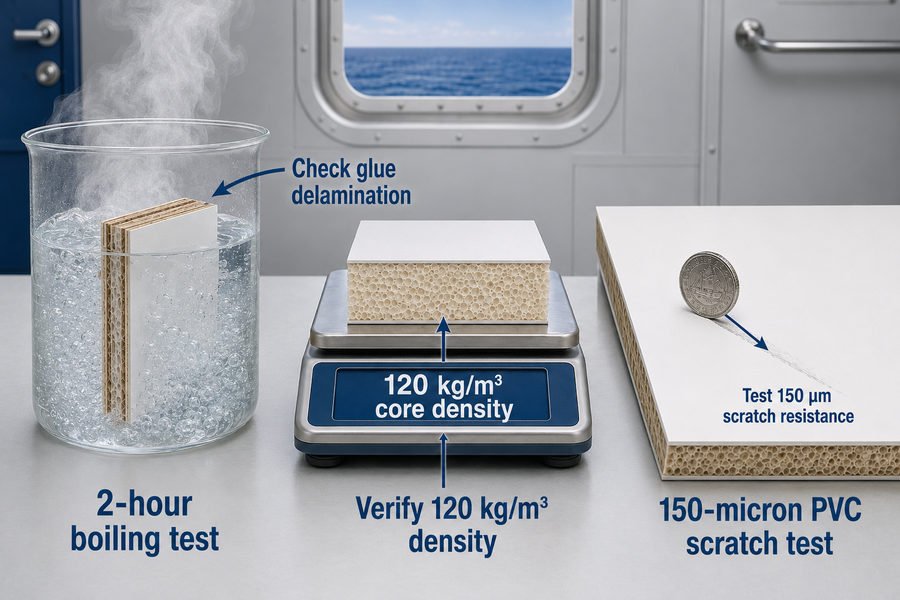
You can evaluate panel samples through three practical methods: boil the panel section in water for two hours to test marine glue delamination, weigh the sample to verify the 120 kg/m³ core density, and scratch the PVC surface with a coin to test the 150-micron scratch resistance.
Performing the Boiling Test for Marine Glue Delamination
I always tell my clients to ask for a small 300mm x 300mm sample before paying any deposit. You do not need a lab to test it. First, you must do the boiling test. Cut a small piece of the panel sample. Put it in a pot of boiling water for two full hours.
Marine panels use a special two-part polyurethane glue. According to marine manufacturing standards, this specific glue will not fail in hot water.13 If the steel sheet falls off the rockwool in the pot, the supplier used cheap building-grade glue. This cheap glue will peel and fail quickly in the hot, humid sea air on a ship. This simple test exposes bad factories instantly.
Verifying Core Density by Weight and Testing PVC Scratch Resistance
Second, test the physical weight. A standard 50mm thick B-15 panel sample measuring 300mm x 300mm should weigh around 1.5 kg to 1.7 kg14. Use a simple office scale. This weight proves the steel is 0.6mm thick and the rockwool is at least 120 kg/m³. If the sample feels very light or weighs less than 1.2 kg, the factory is cheating you on the raw materials.
Finally, take a metal coin from your pocket. Press hard and scratch the PVC surface of the panel. Real marine PVC film is 150 microns thick. It is very tough. The coin should slide off without cutting the plastic. If the coin tears the plastic and shows the raw steel underneath, the film is too thin for a rough ship environment.
| Sample Test Method | How To Do It | Good Marine Result | Bad Building Result |
|---|---|---|---|
| Boiling Test | Boil sample for 2 hours | Glue holds steel tightly | Steel falls off rockwool |
| Weight Test | Weigh 300x300mm piece | 1.5 kg to 1.7 kg | Under 1.2 kg |
| Coin Scratch Test | Scratch PVC with a coin | PVC stays intact | PVC rips easily |
Conclusion
To get genuine marine accommodation panels, you must check the core density, audit Wheelmark certificates, and test physical samples. Follow these steps to keep your ships safe and fully compliant.
-
"[PDF] recommendation for fire test procedures for “a” and “b” class ...", https://wwwcdn.imo.org/localresources/en/KnowledgeCentre/IndexofIMOResolutions/AssemblyDocuments/A.163(ES.IV).pdf. SOLAS Chapter II-2 and the IMO Fire Test Procedures Code define B-class fire divisions by performance in standardized fire tests, including insulation criteria for B-15 divisions, providing the regulatory basis for requiring tested fire-resistant panel assemblies. Evidence role: definition; source type: institution. Supports: Marine B-15 class panels are governed by SOLAS/IMO fire-safety requirements and must meet a 15-minute fire-resistance performance standard.. Scope note: These instruments support the B-15 fire-performance requirement but may not prescribe a universal rockwool density range; density should be verified through type-approval certificates or test reports for the specific panel system. ↩
-
"Are Marine Fire Divisions the Same as Marine Panel Ratings?", https://magellanmarinetech.com/are-marine-fire-divisions-same-as-marine-panel-ratings/. Fire-test standards for shipboard divisions assess the complete assembly, including joints, because integrity at seams is necessary to limit flame and hot-gas passage during the rated exposure. Evidence role: mechanism; source type: institution. Supports: Marine panel joint design is important for maintaining fire and smoke resistance, and joint details should be part of the tested assembly.. Scope note: Such sources can support the importance of tested joint construction, but may not establish that every approved marine panel must use a tongue-and-groove profile specifically. ↩
-
"Marine Equipment Directive enters into force in the EEA - Efta.Int", https://www.efta.int/media-resources/news/marine-equipment-directive-enters-force-eea. ISO 9001 specifies requirements for a quality management system, while marine equipment conformity in the EU is governed separately by the Marine Equipment Directive and applicable testing/approval procedures. Evidence role: definition; source type: institution. Supports: An ISO 9001 certificate alone does not prove that a panel is approved as marine-grade equipment.. Scope note: This supports the distinction between general quality-management certification and marine-equipment approval; it does not by itself assess any specific supplier certificate. ↩
-
"Factsheet - 32021L1206 | European Free Trade Association - Efta.Int", https://www.efta.int/eea-lex/32021l1206. Directive 2014/90/EU and its conformity-assessment framework require marine equipment covered by the directive to undergo specified assessment modules before the wheel mark may be affixed. Evidence role: general_support; source type: government. Supports: Marine equipment subject to the EU MED must follow specified conformity-assessment modules, commonly including separate type-examination and production-assurance elements.. Scope note: The directive establishes the legal framework; the exact module combination can depend on the equipment item listed in the applicable implementing regulation. ↩
-
"Conformity Assessment of Medical Devices: An Overview from a ...", https://pmc.ncbi.nlm.nih.gov/articles/PMC12821529/. Module D production-quality assurance under the MED is based on approval and surveillance of the manufacturer's quality system by a notified body, supporting the claim that production consistency is subject to continuing external oversight. Evidence role: mechanism; source type: government. Supports: A Module D certificate concerns production quality assurance and ongoing surveillance of the manufacturing process.. Scope note: The source should verify the surveillance requirement; the precise audit interval may be specified by notified-body procedures or implementing rules rather than the directive alone. ↩
-
"How Does Class Society Approval Work for Marine Accommodation ...", https://magellanmarinetech.com/how-class-society-approval-work-for-marine-accommodation-panels-outside-eu/. Classification-society rules and type-approval schemes document how materials and components used on classed vessels may require approval against society-specific rules, including fire-safety requirements for accommodation materials. Evidence role: expert_consensus; source type: institution. Supports: For a vessel classed by DNV, wall panels may need evidence of compliance with DNV rules or DNV type approval in addition to statutory MED documentation.. Scope note: This provides contextual support for class-specific approval; whether a DNV Type Approval certificate is mandatory depends on the vessel notation, flag requirements, contract specifications, and the item’s rule category. ↩
-
"How Long Is MED Certification Valid for Marine Accommodation ...", https://magellanmarinetech.com/how-long-med-certification-valid-for-marine-accommodation-panels/. EU Marine Equipment Directive guidance and notified-body certification rules describe Module B as type-examination certification and Module D as production-quality-assurance certification, with certificates commonly issued for fixed validity periods such as five years for Module B and three years for Module D. Evidence role: general_support; source type: government. Supports: Under MED certification practice, Module B certificates are generally valid for five years and Module D certificates for three years.. Scope note: The exact validity period may depend on the notified body, certificate conditions, amendments, and the applicable implementing regulation, so the source may support this as common MED practice rather than an immutable rule. ↩
-
"Conformity Assessment of Medical Devices: An Overview from a ...", https://pmc.ncbi.nlm.nih.gov/articles/PMC12821529/. EU conformity-assessment rules for Module D identify it as production quality assurance operated by the manufacturer and assessed by a notified body, supporting the need to verify that the certificate holder corresponds to the manufacturer responsible for production. Evidence role: mechanism; source type: government. Supports: Module D certification is tied to the manufacturer’s approved production quality system, so mismatched supplier and certificate-holder names create a compliance and due-diligence issue.. Scope note: The legal framework supports checking that Module D certification is tied to the named manufacturer, but it may not directly require an exact match with invoice or bank-account names in every commercial arrangement. ↩
-
"[PDF] RESOLUTION MSC.307(88) (adopted on 3 December 2010 ...", https://wwwcdn.imo.org/localresources/en/KnowledgeCentre/IndexofIMOResolutions/MSCResolutions/MSC.307(88).pdf. The IMO SOLAS/FTP Code fire-test framework classifies B-class divisions by the performance of the installed division, including construction, insulation, and temperature-rise criteria, supporting the statement that the rating belongs to the tested assembly rather than to an isolated board. Evidence role: definition; source type: institution. Supports: According to SOLAS regulations, the B-15 fire rating applies to the whole wall system, not just the board.. Scope note: The source establishes the regulatory testing framework; it may not address every possible panel-and-profile configuration used by suppliers. ↩
-
"What Does Class Society Type Approval Mean for Marine Wall and ...", https://magellanmarinetech.com/what-class-society-type-approval-mean-for-marine-wall-ceiling-panels/. Classification-society approval procedures for marine fire-protection materials require recognized documentation, such as type-approval or class certificates based on SOLAS/IMO FTP Code testing, supporting the need for class-recognized certification during ship survey. Evidence role: general_support; source type: institution. Supports: The shipyard surveyor will look for an official Class certificate rather than relying on generic local laboratory reports.. Scope note: This supports the general survey and approval requirement but does not prove that every shipyard will reject every local laboratory report in all circumstances. ↩
-
"[PDF] RESOLUTION MSC.307(88) (adopted on 3 December 2010 ...", https://wwwcdn.imo.org/localresources/en/KnowledgeCentre/IndexofIMOResolutions/MSCResolutions/MSC.307(88).pdf. The IMO FTP Code and SOLAS fire-test criteria define B-class divisions by flame-resistance and insulation performance, including a maximum average temperature rise of 140°C on the unexposed face, with B-15 divisions meeting the insulation criterion for 15 minutes. Evidence role: definition; source type: institution. Supports: A B-15 marine panel must resist flame passage and limit unexposed-side temperature rise to 140°C above the initial temperature for 15 minutes.. Scope note: The source supports the regulatory performance criteria for certified B-15 divisions; it does not by itself show that any particular building panel would fail those tests. ↩
-
"[PDF] MSC.337(91) (adopted on 30 November 2012) CODE ON NOISE ...", https://wwwcdn.imo.org/localresources/en/KnowledgeCentre/IndexofIMOResolutions/MSCResolutions/MSC.337(91).pdf. IMO Resolution MSC.337(91), the Code on Noise Levels on Board Ships, specifies airborne sound insulation requirements for accommodation spaces, including minimum weighted sound reduction index values for partitions between cabins. Evidence role: definition; source type: institution. Supports: IMO Resolution MSC.337(91) requires cabin wall partitions to meet a minimum Rw sound reduction index, including a 35 dB threshold for relevant cabin separations.. Scope note: The source supports the stated regulatory threshold for shipboard accommodation partitions; it does not establish how any specific building panel performs acoustically. ↩
-
"[PDF] RESOLUTION MSC.307(88) (adopted on 3 December 2010 ...", https://wwwcdn.imo.org/localresources/en/KnowledgeCentre/IndexofIMOResolutions/MSCResolutions/MSC.307(88).pdf. Recognized adhesive-durability test methods use boiling-water exposure to evaluate the water resistance of bonded assemblies, which supports using hot-water delamination as a screening indicator for bond durability. Evidence role: general_support; source type: institution. Supports: Marine-grade panel adhesive should resist hot-water exposure, and delamination during boiling indicates a weak or unsuitable bond.. Scope note: This supports boiling-water exposure as a recognized durability stress test, but it may not prove that all marine panel standards require this exact two-hour pot test or a specific two-part polyurethane adhesive. ↩
-
"Determination of Thermal Properties of Mineral Wool Required for ...", https://pmc.ncbi.nlm.nih.gov/articles/PMC10488771/. Engineering material data for steel density and mineral-wool density can be used to estimate the mass of a 300 mm × 300 mm × 50 mm panel with steel facings and a dense mineral-wool core, giving contextual support for the stated weight range. Evidence role: mechanism; source type: education. Supports: A 300 mm × 300 mm × 50 mm B-15-type panel sample with approximately 0.6 mm steel and high-density mineral wool would be expected to weigh roughly in the stated range.. Scope note: The calculation is indirect; actual sample weight also depends on facing thickness, number of steel skins, adhesive mass, PVC film, edge details, and the certified panel construction. ↩