Ship interior outfitting often faces tight schedules and high labor costs. You might wonder how to speed up cabin construction without losing quality. Prefabricated wet units are the answer.
Prefabricated wet units are complete, factory-built modular bathroom cabins designed for ships. They include wall panels, ceiling panels, flooring, plumbing, electrical fixtures, and sanitary fittings in one self-contained unit. This saves installation time, reduces onboard labor, and ensures high quality under strict marine regulations.
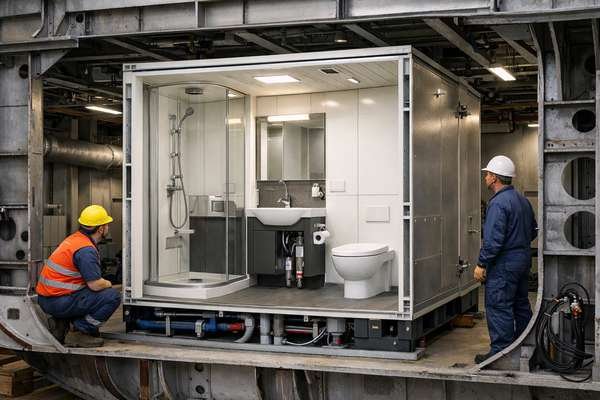
Let me show you exactly what these units are made of and how they can solve your procurement and installation headaches during a busy shipbuilding project.
What Are the Main Components of Marine Prefabricated Wet Units?
Buying individual bathroom parts from different suppliers causes missing pieces and assembly delays. It is a big headache for procurement. Understanding the complete module components solves this problem easily.
The main components of marine prefabricated wet units include the structural enclosure, sanitary fixtures, internal plumbing networks, electrical systems, and essential accessories. All these parts are fully integrated in the factory, creating a ready-to-use module that eliminates the need to source items from multiple suppliers.
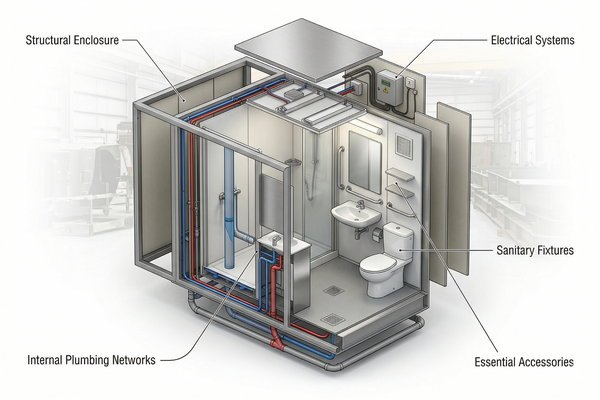
When I worked at the outfitting factory, I saw many buyers struggle to match a toilet from one supplier with a wall panel from another. The beauty of a wet unit is that it combines five distinct systems into one box.
Structural Enclosure of Modular Wet Units
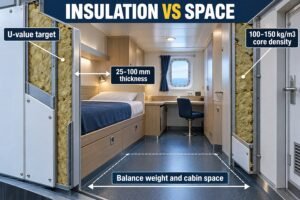
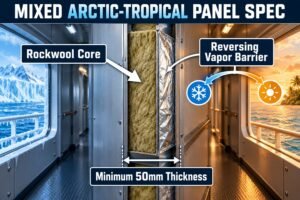
The first component is the structural enclosure. This forms the shell of the bathroom. It includes a bottom tray, which is usually stamped from a single piece of steel or aluminum. The thickness of this tray is normally between 3mm and 5mm to hold the weight of a person. It also includes the marine wall panels and ceiling panels. These panels are typically 50mm thick and filled with insulation material. They provide the physical room and act as a fire barrier.
Fixtures, Plumbing, Electrical, and Accessories in Wet Units
The remaining four components go inside the enclosure. First, we have the sanitary fixtures. This includes the toilet, washbasin, and shower base. A marine vacuum toilet1 uses only about 1.2 liters of water per flush, compared to 6 liters for a normal house toilet. Next is the internal plumbing network. The factory installs all hot water, cold water, and drainage pipes. We normally use stainless steel 316L2 or copper pipes to stop rust.
Then comes the electrical system. This covers the lighting, shaving sockets, and exhaust fans. All electrical parts must have a waterproof rating of at least IP443 to be safe in a wet room. They support standard marine voltages like 220V or 110V. Finally, the unit includes essential accessories. These are the mirrors, grab bars, toilet paper holders, and towel racks. You receive the unit with everything already bolted to the walls.
| Component Category | Key Items Included | Standard Material / Specification |
|---|---|---|
| Structural Enclosure | Floor tray, wall panels, ceiling panels | 3-5mm steel tray, 50mm composite panels |
| Sanitary Fixtures | Toilet, washbasin, shower cabin | Ceramic or stainless steel, vacuum flush |
| Internal Plumbing | Water supply pipes, drainage pipes | Stainless steel 316L or marine copper |
| Electrical Systems | Lights, sockets, ventilation fan | IP44 rated, 110V/220V standard |
| Accessories | Mirrors, grab bars, towel racks | Polished stainless steel 304 |
How Are Prefabricated Wet Units Manufactured for Shipbuilding Applications?
Inconsistent quality from local subcontractors can ruin a ship's interior. You need a process that guarantees perfection every time. Factory manufacturing of these units provides that strict reliability.
Manufacturing marine wet units follows a strict four-step process: base tray welding and waterproofing, structural panel assembly, internal outfitting with plumbing and electrical fixtures, and final factory acceptance testing. This controlled environment ensures zero leaks, exact dimensions, and compliance with maritime safety standards before shipping.
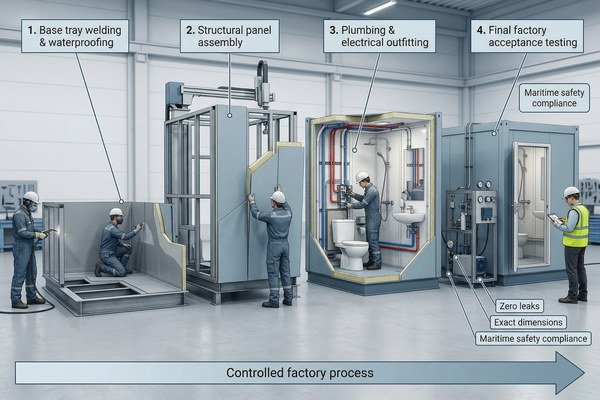
The manufacturing process is where a wet unit proves its value. Instead of ten workers trying to build a tiny bathroom on a moving ship, one expert team builds it on a clean factory floor. This four-step process is the key to high quality.
Base Tray Fabrication and Structural Panel Assembly for Wet Units
The first step is base tray welding and waterproofing. The factory cuts and bends a steel sheet into a pan shape. Welders seal the corners. Then, they apply a waterproof coating4 to the entire tray. The tray must hold water without leaking. After the tray is ready, the second step is structural panel assembly. Workers install the 50mm thick marine wall panels and the ceiling panels onto the tray. They use special profiles and marine glue to connect the panels tightly. The dimensional tolerance at this stage is very strict. According to factory standards, the total width and length can only have an error of plus or minus 2mm. If it is bigger, it will not fit through the ship's doors.
Internal Outfitting and Final Acceptance Testing for Marine Bathrooms
The third step is internal outfitting. Electricians and plumbers install the wiring, pipes, washbasin, toilet, and lights. Because they work from the outside of the box before the final back panel goes on, they can work very fast.
The fourth and most important step is the final factory acceptance testing, often called FAT. We test everything before the unit goes into a wooden box. We connect water pipes to a test machine and apply a pressure of 0.3 MPa to 0.5 MPa to check for pipe leaks. We plug in the power to make sure every light and fan works. This means when the shipyard receives the unit, they only need to connect one main water pipe, one drain pipe, and one power cable.
| Manufacturing Step | Main Actions Performed | Quality Control Standard |
|---|---|---|
| 1. Tray Welding | Cutting, bending, and sealing the floor | 100% waterproof, zero corner gaps |
| 2. Panel Assembly | Attaching walls and ceiling to the tray | Dimensions within +/- 2mm tolerance |
| 3. Internal Outfitting | Installing pipes, wires, and fixtures | Correct positioning, tight connections |
| 4. Final Testing (FAT) | Pressure testing pipes, checking power | Withstand 0.3-0.5 MPa water pressure |
What Types of Vessels Commonly Use Prefabricated Wet Units?
Choosing the wrong interior strategy for a specific ship type leads to wasted money. You need to know where these modular bathrooms fit best. Let us look at the applications.
Prefabricated wet units are extensively used across four main vessel types: cruise ships requiring thousands of identical luxury cabins, offshore accommodation platforms needing durable employee housing, commercial cargo vessels for standard crew quarters, and naval ships requiring highly functional, space-saving sanitary spaces.
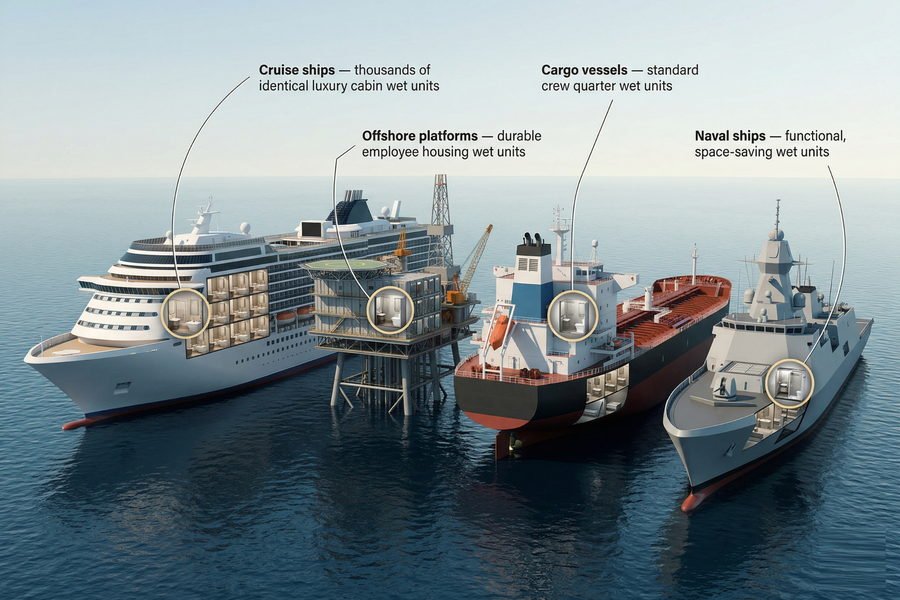
I often get calls from buyers asking if wet units are only for big passenger ships. The truth is, almost every modern ship uses them today. The reasons are different depending on the vessel type, but the four main categories all see huge benefits.
Wet Units for Cruise Ships and Offshore Accommodation Platforms
The first type is cruise ships. A modern cruise ship can have 1,000 to 5,000 passenger cabins. Building that many bathrooms by hand on the ship would take years. By using prefabricated wet units, a shipyard can install up to 50 bathrooms in a single day. The factory makes them all look exactly the same, which ensures a luxury feel for every guest.
The second type is offshore accommodation platforms. These are the living quarters for oil rig workers. These platforms need 50 to 500 units. The environment is very harsh, so the units must be tough. Prefabricated units are great here because they are built strong in the factory. They save a lot of money, too. Bringing skilled plumbers and tile layers to an offshore rig can cost over $1,000 per worker per day. Modular units remove that cost completely.
The third type is commercial cargo vessels, like oil tankers and container ships. These ships have a smaller crew, usually needing 15 to 30 bathrooms. Even for small numbers, shipyards prefer wet units because it speeds up the total ship delivery time by weeks.
The fourth type is naval ships. Military vessels have very little free space. They need highly functional, space-saving designs. Factory engineers design these specific wet units to fit into odd shapes around the ship's steel structure. They also use special lightweight materials to keep the ship fast. Across all these vessels, using a wet unit saves an average of $300 to $600 in labor costs per cabin compared to traditional building.
| Vessel Type | Typical Quantity Needed | Primary Benefit of Using Wet Units |
|---|---|---|
| Cruise Ships | 1,000 - 5,000 units | Extreme speed of installation, uniform quality |
| Offshore Platforms | 50 - 500 units | Eliminates high offshore labor costs, durability |
| Cargo Vessels | 15 - 30 units | Shortens total ship construction schedule |
| Naval Ships | 50 - 200 units | Custom space-saving designs, lightweight |
What Materials Are Used in Marine-Grade Prefabricated Wet Units?
Using cheap materials in marine environments leads to rust and fire hazards. This puts your shipyard contracts at risk. Selecting the right marine-grade materials is critical for your success.
Marine-grade prefabricated wet units utilize four primary materials: galvanized or stainless steel for the base tray, PVC-laminated composite steel plates for structural panels, high-density rockwool for core insulation, and marine-grade PVC or ceramic tiles for the flooring, ensuring durability and absolute fire safety.
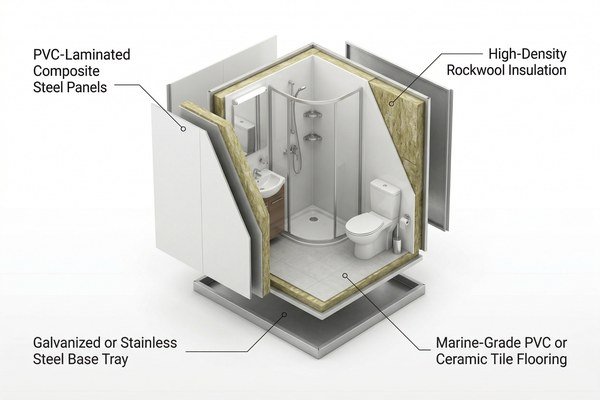
When I review a supplier's quote for a client, the first thing I check is the bill of materials. The sea is a terrible environment for normal house materials. You must use specific marine-grade items to pass safety inspections and stop rust. We look closely at four primary materials.
Base Tray and Structural Panel Materials for Marine Wet Units
The first material is for the base tray. Good factories use stainless steel 304 or 316L, or heavily galvanized steel. Stainless steel 316L is the best choice because it will never rust, even if saltwater touches it constantly. The tray metal is usually between 3mm and 5mm thick.
The second material is for the structural wall and ceiling panels. We use PVC-laminated composite steel plates. This means there is a thin layer of galvanized steel, usually 0.6mm thick, covered with a decorative PVC film. The steel provides strength, and the PVC film looks like wood, marble, or plain white color. This PVC film must be low-flame spread, meaning it will not catch fire easily.
Insulation Core and Flooring Materials in Ship Bathrooms
The third material is the high-density rockwool used inside the wall panels. This is the core insulation. According to marine rules, the rockwool must have a density between 120 kg/m3 and 150 kg/m3. Normal house insulation is only about 40 kg/m3. This heavy rockwool stops heat from a fire and blocks the sound of the flushing toilet from waking up people in the cabin.
The fourth material is the flooring. Over the steel tray, the factory applies a leveling compound. Then, they use marine-grade PVC flooring or epoxy resin with ceramic tiles. PVC flooring is about 2mm thick, very light, and easy to clean. Ceramic tiles look better for cruise ships but add about 30 kg of weight to the bathroom. Both materials use special waterproof marine glue to stop the floor from peeling up.
| Material Category | Specific Material Used | Typical Specifications / Dimensions |
|---|---|---|
| Base Tray | Stainless Steel 316L / Galvanized | 3.0mm to 5.0mm thickness |
| Wall/Ceiling Panels | PVC-laminated galvanized steel | 0.6mm steel skin, low-flame spread |
| Core Insulation | High-density Rockwool | 120 kg/m3 to 150 kg/m3 density |
| Floor Covering | Marine PVC floor or Ceramic tile | 2mm PVC thickness, waterproof glue |
What Fire-Resistant Properties Are Required for Marine Wet Units?
Ship fires are deadly. Failing a fire inspection means the ship cannot sail. You must ensure your bathroom cabins meet strict international maritime fire safety rules to protect lives.
Marine wet units must comply with SOLAS and IMO FTP Code fire-resistant properties, primarily achieving B-15 or B-0 class ratings for cabin partitions. The panels must prevent the passage of flame and limit the unexposed side's average temperature rise to 140°C for at least 15 minutes.
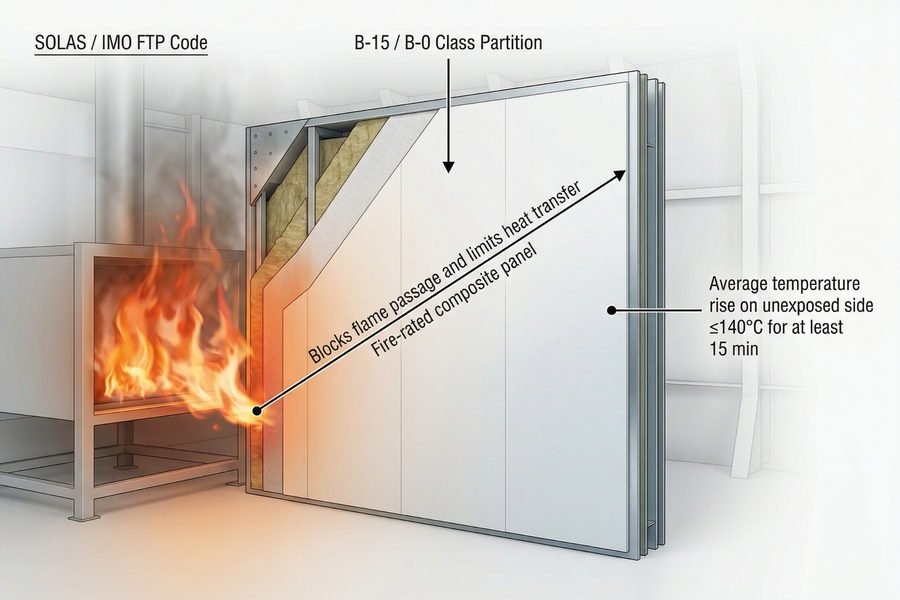
Fire safety is the most important topic in marine outfitting. You cannot just build a strong box; you must build a safe box. When you buy a wet unit, you must ask the supplier for their fire certificates. These rules are governed by international law.
SOLAS and IMO Fire Rating Requirements for Wet Units
Every commercial ship must follow the rules of SOLAS, which stands for Safety of Life at Sea. Under SOLAS, the International Maritime Organization (IMO) created the FTP Code (Fire Test Procedures). The FTP Code states exactly how materials must react to fire. For a wet unit, the materials must be certified as non-combustible. This means if you put a flame on the rockwool or the steel, it will not burn and will not create toxic smoke. Inspectors from classification societies, like DNV or Lloyd's Register, check these certificates carefully. If your wet unit does not have the IMO wheelmark stamp, you cannot install it on the ship.
Achieving B-15 and B-0 Fire Classifications in Modular Bathrooms
The specific fire ratings for wet units are usually B-Class. The walls of a bathroom act as a partition between the cabin and the corridor. The two most common ratings are B-15 and B-0.
A B-0 rating means the wall will stop flames and smoke from passing through for 30 minutes, but it does not control the heat very well. A B-15 rating is much stricter. It means the wall will stop flames for 30 minutes, and for the first 15 minutes, the temperature on the safe side of the wall will not rise more than an average of 140°C. The absolute maximum temperature rise at any single point cannot exceed 225°C. To achieve B-15, factories use the 150 kg/m3 dense rockwool I mentioned earlier. This heavy insulation blocks the heat, giving passengers time to escape the fire safely.
| Fire Class Rating | Flame Stopping Time | Temperature Limit on Safe Side |
|---|---|---|
| B-0 Class | 30 minutes | No specific temperature limit |
| B-15 Class | 30 minutes | Average 140°C rise limit for 15 mins |
| A-0 Class (Rare for wet units) | 60 minutes | No specific temperature limit |
| A-15 Class (Rare for wet units) | 60 minutes | Average 140°C rise limit for 15 mins |
How Do Prefabricated Wet Units Withstand Marine Environmental Conditions?
Constant vibrations, salty air, and high humidity can destroy a regular bathroom in months. Your clients expect long-lasting interiors. Here is how marine wet units survive the rough sea.
Prefabricated wet units withstand marine conditions through three key design features: anti-corrosion material treatments like hot-dip galvanizing, vibration-damping shock absorbers mounted beneath the tray to handle engine tremors, and specialized marine sealants that prevent moisture intrusion and mold growth in high-humidity environments.
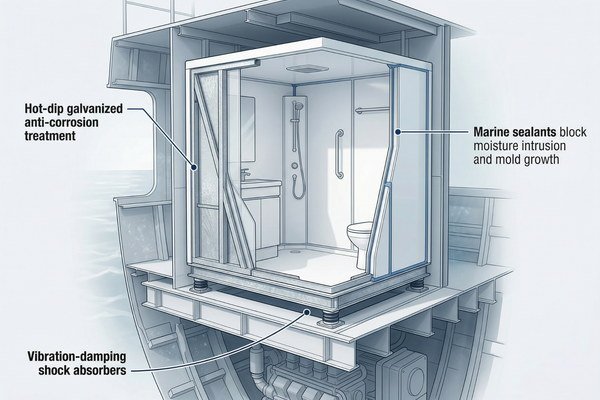
Ships are terrible places for buildings. A ship is a moving steel box in a salty ocean. If you put a house bathroom on a ship, the tiles would fall off in a week, and the pipes would break in a month. Marine wet units use three specific methods to fight the ocean environment.
Anti-Corrosion Treatments and Moisture Resistance in Marine Bathrooms
The first method is anti-corrosion treatments. Salty ocean air causes fast rusting. To stop this, the steel parts of the wet unit undergo hot-dip galvanizing5. This puts a thick layer of zinc over the steel. Good factory standards require a zinc coating thickness of at least 50 to 80 microns. Besides galvanizing, the third method involves specialized marine sealants. A bathroom on a ship has very high humidity. If water gets behind the wall panels, it causes mold and ruins the insulation. Workers use industrial-grade marine silicone to seal every joint, corner, and screw hole. These sealants remain flexible and do not crack, lasting more than 10 years even in wet conditions.
Vibration-Damping Systems for Shipboard Wet Units
The second, and perhaps most unique method, is the vibration-damping system. A large ship engine creates constant shaking. Normal vibration frequencies on a ship range from 5Hz to 50Hz. This constant shaking makes regular pipe connections loose and cracks normal cement floors.
To solve this, prefabricated wet units do not sit directly on the ship's steel deck. Instead, factories install heavy-duty rubber shock absorbers6 or spring dampers under the base tray. A standard wet unit uses four to six of these dampers. They absorb the engine tremors, keeping the inside of the bathroom completely still. Furthermore, all internal pipes use flexible hose connectors instead of rigid welded pipes. This allows the bathroom to flex slightly with the ship's movement without breaking any water lines.
| Environmental Challenge | Wet Unit Defense Feature | Technical Specification |
|---|---|---|
| Saltwater & Air Corrosion | Hot-dip galvanizing, 316L steel | 50 - 80 microns zinc coating thickness |
| High Humidity & Water | Marine silicone sealants | 10+ year lifespan, high elasticity |
| Engine Vibrations | Rubber shock absorbers under tray | Absorbs 5Hz to 50Hz ship frequencies |
| Structural Movement | Flexible pipe connectors | Prevents rigid pipe cracking |
Conclusion
Prefabricated wet units save time and labor while meeting strict SOLAS fire standards. By understanding their components, materials, and manufacturing, you can make smarter, more profitable procurement choices.
Dive Deeper into Marine Prefabrication
Now that you know the basics of prefabricated wet units and how they save time and labor, it's time to get into the details of sizing, compliance, and customization. Read my in-depth guides below:
Determine the exact sizes you need: What Are Standard Dimensions And Configurations For Ship Wet Units?
Master maritime rules and inspections: What IMO Regulations Apply to Prefabricated Wet Units on Commercial Vessels?
See how units differ by vessel type: How Are Prefabricated Wet Units Customized For Cruise Ships Versus Cargo Vessels?
-
Learn how vacuum toilets save water, installation needs, and suitability for modular wet units and marine environments. ↩
-
Explore material specs, corrosion resistance and best practices for using 316L in plumbing to ensure long-lasting wet unit systems. ↩
-
Understand IP44 protection, safe fixture selection, and compliance tips to prevent moisture-related electrical failures in wet rooms. ↩
-
Discover proven coating systems, surface preparation and application tips to prevent leaks and resist marine corrosion for long service life. ↩
-
Learn coating standards, corrosion resistance and best practices to extend steel life in salty marine conditions. ↩
-
Explore how rubber dampers absorb 5–50Hz engine vibrations to prevent leaks, loosening fittings, and structural cracks. ↩