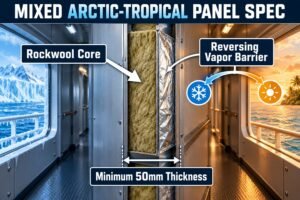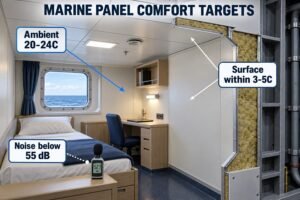
Sending incomplete RFQs wastes time and leads to wrong panel prices. Missing details can delay your whole interior project. Let me show you exactly what to include for accurate quotes.
A complete marine wall panel RFQ must specify dimensions (thickness, width, height), fire ratings, core materials, surface finishes, certifications, and exact quantities to ensure precise supplier pricing and compliance with SOLAS regulations.
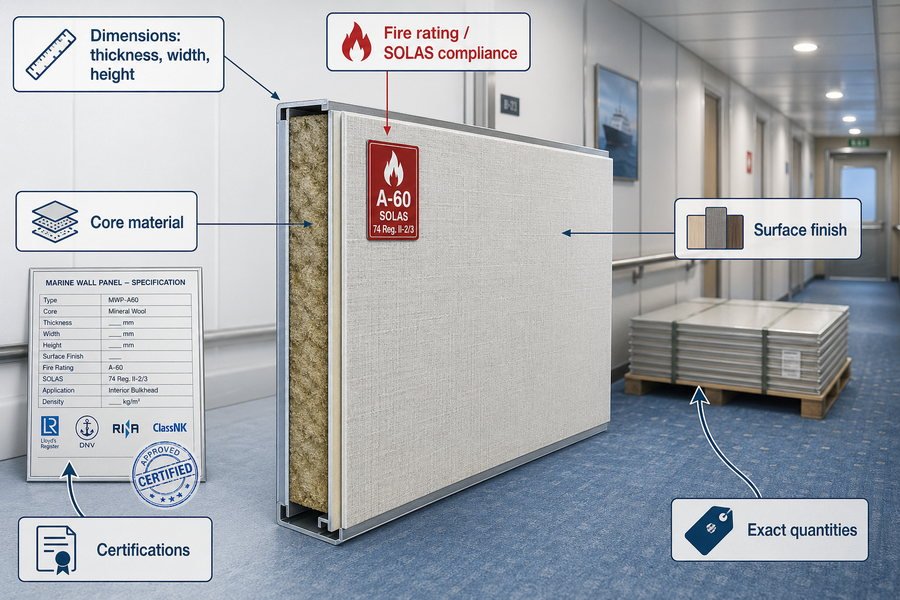
Let us break down these key requirements so you can get the right panels for your shipyard clients without endless back-and-forth emails.
How to specify marine wall panel thickness, width, and height in an RFQ?
Guessing panel sizes leads to installation failures and high waste rates. If your panels do not fit, your project stops. Here is how to define your exact dimension requirements.
Specify panel thickness (commonly 25mm, 50mm, or 100mm), standard widths (typically 550mm or 600mm for modular systems), and custom heights (ranging from 2000mm to 2400mm) based on deck-to-ceiling measurements, ensuring all dimensions match the general arrangement plan and standard marine profile systems.
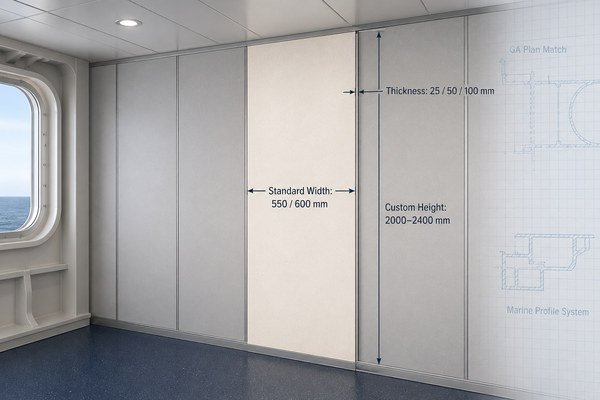
When you send an RFQ to a factory in Asia, you must be very clear about sizes. Do not let the supplier guess, or they will quote their standard sizes, which might not fit your European or US shipyard project. I remember a time when a buyer forgot to specify the height, and the factory shipped 2000mm panels when the cabin needed 2100mm. The whole batch was useless.
Specifying Standard Marine Wall Panel Thickness
The thickness of the panel is directly tied to the fire rating required by the Safety of Life at Sea (SOLAS) regulations.1 You must list all three dimensions clearly. For standard cabin partitions, a thickness of 50mm is the most common for B-15 fire class ratings. If you are fitting out a washroom or a minor partition, you might use 25mm panels, which usually carry a B-0 rating. For high-risk areas like engine room boundaries, you need A-60 rated panels, which are typically 100mm thick. The core material, usually rockwool, determines this thickness. According to standard marine manufacturing tolerances, the thickness should not vary by more than plus or minus 0.5mm.
Defining Marine Wall Panel Width and Custom Height
Width is critical because marine interior systems are modular. The standard width in the industry is 600mm, but 550mm is also very common depending on the profile system you use. If you choose the wrong width, your joining profiles will not line up with the floor tracks. Height is the most variable dimension. You need to measure from the steel deck to the ceiling level. Most cabins require panel heights between 2000mm and 2400mm. If your ship has a high ceiling, you might need panels up to 3000mm, but remember that panels longer than 2400mm are harder to pack in a standard shipping container and cost more to transport.2
| Dimension Type | Common Sizes | Typical Fire Rating | Primary Application on Ship |
|---|---|---|---|
| Thickness | 25mm | B-0 | Washroom walls, light partitions |
| Thickness | 50mm | B-15 | Standard cabin dividing walls |
| Thickness | 100mm | A-60 | Engine room bulkheads, galleys |
| Width | 550mm or 600mm | All Ratings | Modular wall assembly |
| Height | 2000mm to 2400mm | All Ratings | Deck-to-ceiling fitment |
What drawings should be provided when requesting a marine wall panel quotation?
Suppliers cannot quote accurately from a text email alone. Without clear drawings, you risk getting standard panels for custom spaces. Let us look at the exact drawings needed.
You must provide the General Arrangement (GA) plan, detailed cabin layout drawings, fire control plans, and precise ceiling and bulkhead connection node drawings. These four documents allow suppliers to calculate exact panel quantities, identify specific fire zones, and determine the correct joint profiles required.
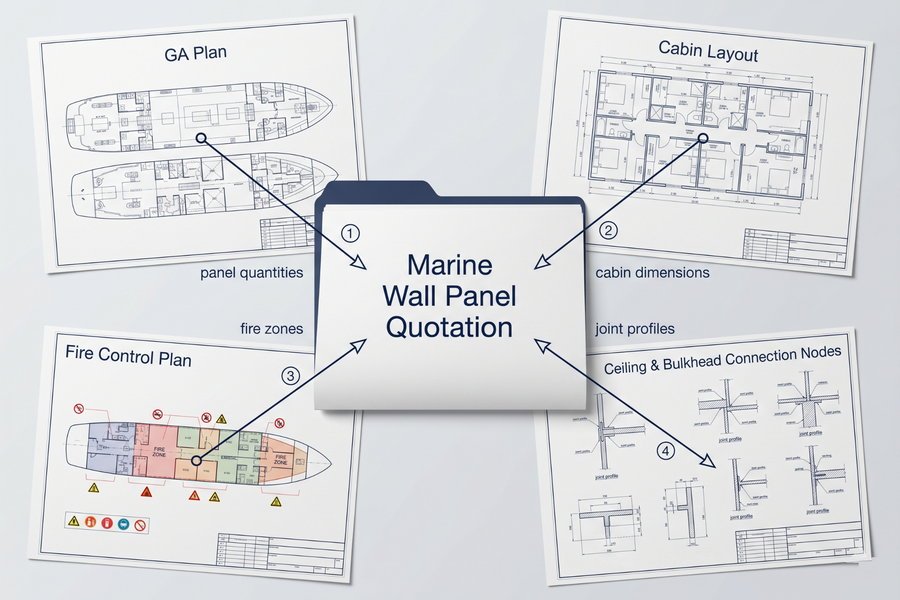
During my time at the factory, I saw many RFQs that only had a total square meter number. This is a big mistake. Without drawings, the factory cannot tell you how many corner profiles or door cutouts you need. To get an accurate price, you must provide the four key drawings mentioned above.
Importance of General Arrangement and Cabin Layout Drawings
The General Arrangement (GA) plan gives the supplier the big picture of the ship. It shows the shape of the decks and where the accommodation block is located. However, the GA plan is not enough on its own. You must also send the detailed cabin layout drawings. These drawings show the exact measurements of each room, the location of the doors, and where the wet units (bathrooms) are placed. With the cabin layout, the supplier's engineering team can calculate the exact number of 600mm wide panels needed and how many custom-cut panels are required to finish a wall. This reduces the waste you have to pay for.
Analyzing Fire Control Plans and Connection Node Drawings
The fire control plan is the most important drawing for safety. Under SOLAS Chapter II-2, different zones of the ship must have different fire boundaries.3 The fire control plan tells the supplier exactly which walls need B-15 panels and which walls need A-60 panels. If you do not provide this, the factory might quote cheaper B-0 panels, and your project will fail the class inspection. Finally, you must include connection node drawings. These show how the wall panel connects to the ceiling panel and the floor. This tells the supplier if you need standard H-profiles or custom U-profiles. Usually, these profiles are made of 1.2mm thick galvanized steel.
| Drawing Type | Main Purpose in RFQ | Key Detail Provided to Supplier |
|---|---|---|
| General Arrangement (GA) | Overall ship layout | General scope and deck shapes |
| Cabin Layout | Room specifics | Exact panel counts and cutouts |
| Fire Control Plan | Safety compliance | B-15 vs A-60 locations per SOLAS |
| Connection Nodes | Installation method | Type and count of steel profiles |
How to compare quotations from different marine wall panel suppliers?
Picking the cheapest quote often leads to hidden costs later. Comparing apples to oranges can ruin your project budget. Here is my method for evaluating supplier offers fairly.
Compare quotations by evaluating base unit prices per square meter, included accessories (profiles, baseboards), valid marine certifications (like DNV or ABS), estimated lead times (typically 15 to 45 days), and specified packaging methods to ensure you calculate the true total landed cost.
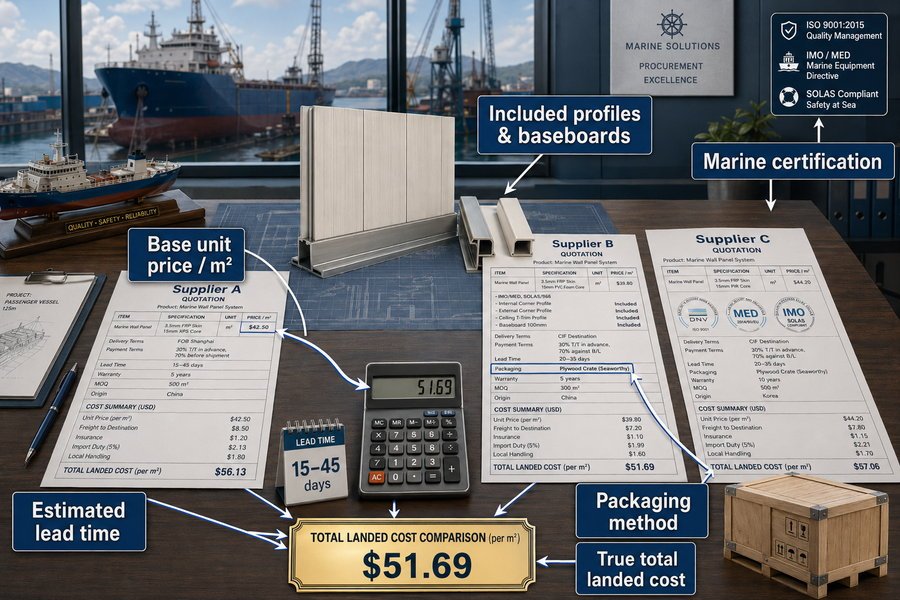
When you get three different quotes from factories in China or Vietnam, the bottom line price is never the whole story. I always tell my clients to break the quote apart. You must look at the five specific factors to understand what you are actually buying.
Comparing Base Unit Prices and Included Panel Accessories
First, look at the base unit price per square meter. For a standard 25mm rockwool panel with PVC film, a normal price is between $25 and $50 per square meter, depending on the current steel price. But you must ask: what is included in that price? Supplier A might quote $26 per square meter for just the panel. Supplier B might quote $30 per square meter, but their price includes all the necessary galvanized steel H-profiles, U-profiles, and baseboards. Buying profiles separately can add 10% to 15% to your total cost. Always make sure you are comparing the price of a complete wall system, not just the bare board.
Evaluating Marine Certifications, Lead Times, and Packaging Methods
Next, check the marine certifications. If your shipyard client is in Europe, the panels must have a valid MED (Marine Equipment Directive) Wheelmark certificate. A panel without this certificate is useless, even if it is very cheap. Make sure the certificate is issued by a recognized body like DNV or ABS and is currently valid. Then, look at the lead time. A normal production time for marine panels is 15 to 45 days. If a supplier promises 5 days, they might be rushing the glue curing process, which causes the PVC film to peel off later4. Finally, compare the packaging methods. Some suppliers pack panels in cheap wooden boxes. Others use steel pallets. Steel pallets cost about $30 to $50 each, but they stop the panels from getting crushed during the long ocean journey. Damaged panels cost you time and money.
| Comparison Factor | What to Look For | Cost Impact / Risk |
|---|---|---|
| Base Unit Price | Price per square meter ($25-$50 typical) | Direct impact on budget |
| Accessories | Are profiles and baseboards included? | Can add 10-15% to total cost |
| Certifications | Valid MED, DNV, ABS, or USCG | Rejection by ship surveyor if missing |
| Lead Time | 15 to 45 days is standard | Project delays or poor quality if rushed |
| Packaging | Wooden crate vs Steel pallet | Steel pallets reduce shipping damage5 |
How to avoid common mistakes when preparing a marine wall panel RFQ?
Simple copy-paste errors in your RFQ can cause huge delays. A wrong detail means the factory builds the wrong product. Avoid these specific traps.
To avoid common RFQ mistakes, you must clearly state the required fire rating standard, specify the exact surface film color code, mandate the core material density, define the target delivery port (Incoterms), and provide the ship classification society name to prevent non-compliant panel production.
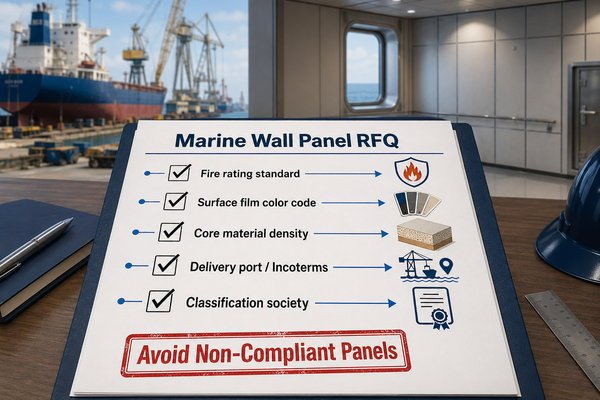
I have seen many experienced buyers make small mistakes in their emails that lead to disaster. When buying from overseas, you cannot assume the factory knows what you want. You must define all five of these details clearly to protect yourself.
Specifying Fire Rating Standards, Color Codes, and Material Density
The most dangerous mistake is being vague about the fire rating. Do not just say "fireproof panel." You must state the exact standard, such as "B-15 rating compliant with IMO 2010 FTP Code." If you do not state this, the factory might use cheap glue that creates toxic smoke in a fire6. Second, never use words like "white" or "light grey" for the surface color. Different factories have different ideas of white. You must provide a specific color code, like RAL 9010, or send a physical color sample to match. Third, specify the core material density. For a rockwool marine panel to pass a B-15 fire test, the rockwool density usually needs to be at least 120 kg/m3 or 140 kg/m37. Some bad suppliers will use 100 kg/m3 to save money, which weakens the panel and ruins the fire rating.
Defining Target Delivery Ports and Ship Classification Societies
Many buyers just ask for an "FOB price" without naming the port. China is huge. FOB Shanghai and FOB Guangzhou have different local trucking costs8. You must define the exact Incoterms and the target delivery port, such as "CIF Hamburg, Germany." This ensures the freight cost is calculated correctly. Also, you must tell the supplier which classification society will inspect the ship (for example, Lloyd's Register or Bureau Veritas). Different class societies sometimes have slightly different rules for document submission. If the factory knows it is an LR project, they will prepare the correct LR type approval certificates in advance, saving you weeks of paperwork.
| Common RFQ Mistake | Correct Action Required | Consequence of Mistake |
|---|---|---|
| Vague Fire Standard | State "IMO 2010 FTP Code B-15" | Panel fails safety inspection |
| Guessing Colors | Use standard codes (e.g., RAL 9010) | Cabin colors do not match |
| Ignoring Density | Specify "120 kg/m3 rockwool" | Weak panels, failed fire rating |
| Unclear Delivery | State specific port (e.g., CIF Hamburg) | Unexpected transport costs |
| Missing Class Info | Name the Class Society (e.g., DNV) | Delayed handover of documents |
What information should be included in a complete marine wall panel RFQ template?
Writing a new email every time you need prices is inefficient. A missing detail causes delays. Use a standard template to get quotes fast.
A complete RFQ template must include project background (ship type, owner), panel specifications (type, fire class, dimensions, core, finish), required profile systems, certification needs, logistics details (Incoterms, destination), and a strict deadline for the quotation submission to ensure timely and standardized supplier responses.
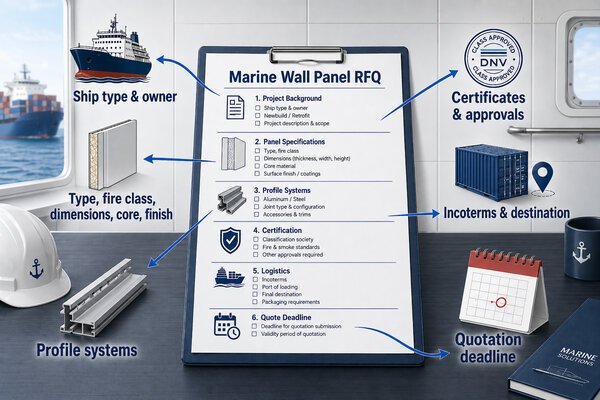
To make your job easier, you should build an Excel template. Every time you have a new project, you just fill in the blanks. This stops you from forgetting things and makes it very easy for the factory sales team to read. Your template must cover these six areas.
Project Background, Panel Specifications, and Required Profile Systems
Start the template with the project background. State the ship type (like Cruise Ship, Oil Tanker, or Ro-Ro) and the ship owner. Factories treat a cruise ship project with much more care than a simple cargo ship because the surface finish requirements are higher. Next, list the panel specifications in a clear grid. Include the panel type (flat panel, acoustic panel), fire class, dimensions (thickness, width, height), core material, and surface finish (0.6mm PVC coated galvanized steel). After the panels, you must list the required profile systems. Do not let the factory guess. Add a line in your template asking the supplier to list the price and thickness of the top U-profiles, bottom U-profiles, and joining H-profiles.
Certification Needs, Logistics Details, and Quotation Deadlines
The second half of your template is for rules and logistics. Have a section for certification needs. Check boxes for MED (Wheelmark), USCG, or specific class approvals. This instantly tells the factory if they are qualified to bid. Then, fill out the logistics details. State the Incoterms (like FOB or CIF), the final destination port, and the estimated shipping date. This helps the factory check sea freight rates. Finally, give a strict deadline for the quotation. Give the supplier 3 to 5 working days. If you do not give a deadline, the supplier might put your RFQ at the bottom of their pile. A template shows the supplier you are a professional buyer, and they will give you their best price faster.
| RFQ Template Section | Required Details to Fill In | Purpose in the Quotation Process |
|---|---|---|
| Project Background | Ship type, owner, shipyard location | Sets quality expectations |
| Panel Specs | Dimensions, fire class, core, finish | Drives the base material cost |
| Profile Systems | Type (U/H), thickness, quantity | Ensures full system compatibility |
| Certifications | MED, USCG, DNV, ABS, etc. | Proves regulatory compliance |
| Logistics & Rules | Incoterms, port, quote deadline | Finalizes landed cost and timeline |
Conclusion
A detailed RFQ ensures accurate prices and high-quality marine wall panels. By specifying dimensions, drawings, and certifications clearly, you reduce risks and guarantee a successful ship outfitting project.
-
"Summary of SOLAS chapter II-2 - International Maritime Organization", https://www.imo.org/en/ourwork/safety/pages/summaryofsolaschapterii-2-default.aspx. IMO SOLAS Chapter II-2 and related guidance define fire-resistance performance classes used in ship construction (commonly expressed as A-0, A-60, B-15, etc.) and set regulatory requirements for which boundaries must meet which class; SOLAS specifies performance criteria rather than prescribing a single material thickness, which is determined by panel construction and demonstrated by fire testing or classification society approval. Evidence role: definition; source type: institution. Supports: The thickness of the panel is directly tied to the fire rating required by the Safety of Life at Sea (SOLAS) regulations.. Scope note: SOLAS defines performance classes and required ratings for spaces, but it does not mandate a specific panel thickness — thickness depends on materials and construction and is validated by tests or classification society rules. ↩
-
"ISO 668 - Wikipedia", https://en.wikipedia.org/wiki/ISO_668. International container standards and container dimension references show typical internal widths/heights of standard 20ft and 40ft containers are on the order of ~2.33–2.35 m (i.e., less than or close to 2400 mm), so long rigid panels (>2400 mm) cannot always be laid flat across the cross‑section and require special orientation or fewer units per load; this increases packing complexity and can raise transport costs depending on logistics. Evidence role: mechanism; source type: institution. Supports: panels longer than 2400mm are harder to pack in a standard shipping container and cost more to transport.. Scope note: Container internal dimensions vary by container type and shipping practice; the statement supports packing difficulty and potential cost impact as a general logistical mechanism, not a fixed cost rule. ↩
-
"Summary of SOLAS chapter II-2 - International Maritime Organization", https://www.imo.org/en/ourwork/safety/pages/summaryofsolaschapterii-2-default.aspx. An IMO or flag-state source on SOLAS Chapter II-2 can be cited to support that the convention regulates structural fire protection and fire-resisting divisions on ships, including requirements that vary by space and fire-risk area. Evidence role: expert_consensus; source type: institution. Supports: Under SOLAS Chapter II-2, different zones of the ship must have different fire boundaries.. Scope note: The source would establish the regulatory basis for fire boundaries, but the exact A-60 or B-15 requirement for a given wall depends on vessel type, space category, and approved design details. ↩
-
"[PDF] Durability of the adhesive bond in cross-laminated northern ...", https://www.fpl.fs.usda.gov/documnts/pdf2021/fpl_2021_musah001.pdf. Adhesive-bonding literature describes curing time and cure conditions as factors that determine bond strength and durability, which supports the mechanism that insufficient curing can contribute to later delamination or peeling of laminated films. Evidence role: mechanism; source type: paper. Supports: Insufficient adhesive curing can weaken PVC-film bonding and increase the risk of later peeling or delamination.. Scope note: This evidence would support the bonding mechanism generally; it may not prove that a specific five-day production schedule is inadequate for every marine panel process. ↩
-
"IMO/ILO/UNECE Code of Practice for Packing of Cargo Transport ...", https://www.imo.org/en/ourwork/safety/pages/ctu-code.aspx. International cargo-transport guidance emphasizes that suitable packaging, unitization, and load support reduce the risk of cargo movement and damage during transport, providing contextual support for using stronger pallet systems to protect heavy or fragile panel shipments. Evidence role: general_support; source type: institution. Supports: Stronger palletized packaging can reduce the risk of panel damage during ocean transport.. Scope note: Such guidance supports the general packaging principle but may not directly compare steel pallets with wooden crates for this exact panel product. ↩
-
"[PDF] RESOLUTION MSC.307(88) (adopted on 3 December 2010 ...", https://wwwcdn.imo.org/localresources/en/KnowledgeCentre/IndexofIMOResolutions/MSCResolutions/MSC.307(88).pdf. The IMO FTP Code includes smoke and toxicity testing for certain shipboard materials, supporting the concern that material choices in marine interiors can affect smoke generation and toxic gas exposure during fire conditions. Evidence role: mechanism; source type: institution. Supports: Unsuitable adhesives or materials in marine panels may contribute to toxic smoke hazards during a fire.. Scope note: This supports the general hazard of smoke and toxicity from materials in fires, not the specific claim that any particular glue used by a factory will be toxic. ↩
-
"[PDF] TYPE APPROVAL CERTIFICATE", https://www.bn-bip.com/make_img/sub03_pdf/Wall%20Panel/W-351(B-15)/BV_-W351_-B15_-140326.pdf. Representative marine type-approval certificates and fire-test documentation for B-15 insulated panels commonly specify mineral wool core densities around 120–140 kg/m³, indicating that core density is a documented parameter in approved panel constructions. Evidence role: general_support; source type: institution. Supports: B-15 marine panel constructions often use rockwool or mineral wool cores with densities in the 120–140 kg/m³ range.. Scope note: Such certificates show common approved constructions rather than a universal minimum; B-15 compliance depends on the full tested assembly, not density alone. ↩
-
"Know Your Incoterms - International Trade Administration", https://www.trade.gov/know-your-incoterms. Incoterms guidance treats FOB and CIF terms as port-specific trade terms, so the named port or place is part of the cost and delivery-risk allocation; this supports the need to identify the exact port when requesting freight-inclusive or port-based pricing. Evidence role: definition; source type: institution. Supports: FOB pricing should name the port because port choice affects the seller’s delivery obligations and local cost calculation.. Scope note: The source explains the function of named ports under Incoterms; it does not quantify the trucking-cost difference between Shanghai and Guangzhou. ↩