You found cheap marine panels in Asia, but are the certificates real? Fake or expired papers mean port delays and huge fines. Let us fix this problem today.
Overseas buyers must verify marine panel compliance by checking the Type Approval Certificate (TAC) validity on classification society databases, requesting the Declaration of Conformity (DoC), confirming MED Wheelmark stamping for European projects, and matching the factory test reports exactly with the shipped batch numbers.
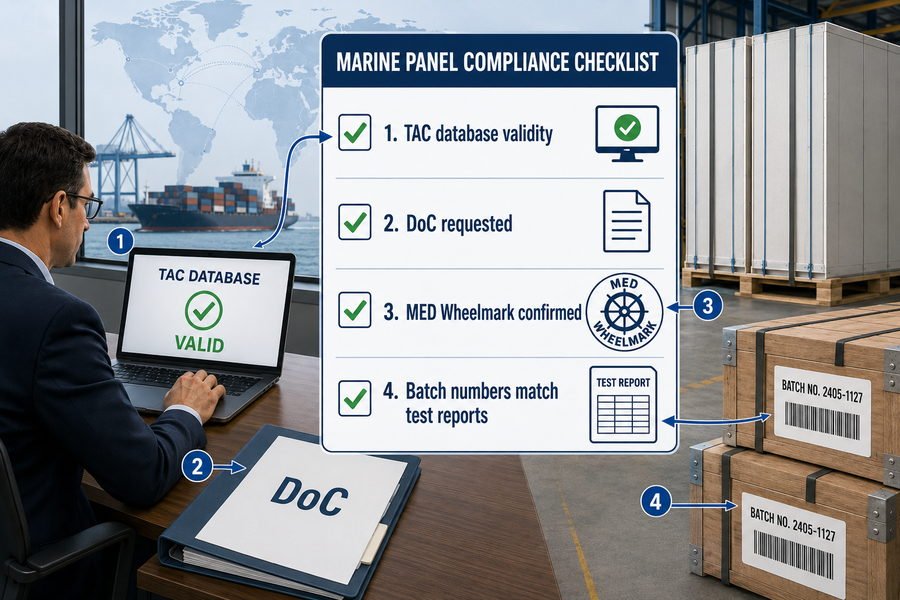
When you buy from suppliers in developing countries, checking documents can feel like a maze. But if you know what to look for, you can keep your shipyard clients in the US and Europe happy and safe.
What Compliance Questions Should Buyers Ask Marine Panel Suppliers?
Asking the wrong questions wastes time and hides bad suppliers. Are you tired of slow answers that dodge the real issue? Let us ask the right things.
Buyers must ask suppliers four critical questions: Do you hold active MED B and D certificates? Can you provide the original lab fire test report? Which classification societies (like DNV or ABS) approve your factory? And do you have third-party quality system audits like ISO 9001?
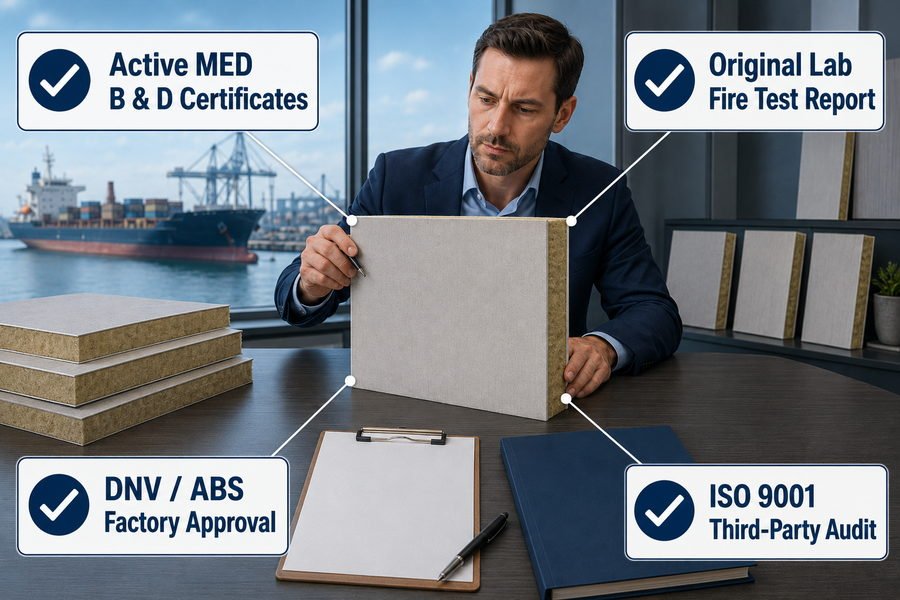
1. Inquiring About Active MED B and D Certificates for Marine Panels
I remember a time when a buyer lost a big contract because they only asked for "a certificate." You must be specific. You need to ask, "Do you hold active Marine Equipment Directive (MED) Module B and Module D certificates?" The Module B covers the product design, and Module D covers the factory production control. According to the European Maritime Safety Agency (EMSA), a valid MED D certificate must show an audit date within the last 12 months. If the supplier says yes, ask for the exact expiry date. If they hesitate, walk away.
2. Requesting the Original Lab Fire Test Report for Marine Wall Panels
Next, ask: "Can you provide the original lab fire test report?" This is where many Asian suppliers fail. The test report must match the IMO 2010 FTP Code Parts 1 and 3 for non-combustibility and fire resistance1. The report should show the exact core density, which is usually around 100 kg/m³ to 120 kg/m³ for standard A-Class panels. Ask them to send the PDF. If the test is older than 5 years, some classification societies will not accept it for new ship builds.
3. Confirming Classification Society Approvals Like DNV or ABS
Your third question must be: "Which classification societies approve your factory?" If your final shipyard is in the US, you need United States Coast Guard (USCG) approval or ABS (American Bureau of Shipping). If it is in Europe, DNV, Lloyd's Register (LR), or Bureau Veritas (BV) are common. Ask them for the specific Type Approval Certificate (TAC) number so you can check it online.
4. Checking Third-Party Quality System Audits Such as ISO 9001
Finally, ask: "Do you have third-party quality system audits like ISO 9001?" This shows if they can keep the quality stable. A factory might make one good sample for the fire test, but can they make 10,000 panels exactly the same? ISO 9001 from a real auditor like SGS or TUV proves they can.
| Question Focus | Document Required | Key Value to Check | Verification Source |
|---|---|---|---|
| European Law | MED B and D Certificates | Expiry date within 12 months | EMSA Database |
| Fire Safety | Lab Test Report | 100-120 kg/m³ core density | IMO 2010 FTP Code |
| Commercial Trust | DNV/ABS Type Approval | Certificate Number matches factory | DNV/ABS online portals |
| Mass Production | ISO 9001 Audit | Third-party issuer (SGS/TUV) | Certification Body Website |
How Can Buyers Spot Compliance Gaps in Marine Panel Documents?
Fake documents look very real today. If you miss a small error on a certificate, your whole container could get rejected at the port.
To spot compliance gaps in marine panel documents, buyers must check for expired validity dates, verify that the product thickness matches the fire test report exactly, cross-reference the manufacturer name against the classification society database, and ensure the USCG mutual recognition agreement applies to the specific panel type.
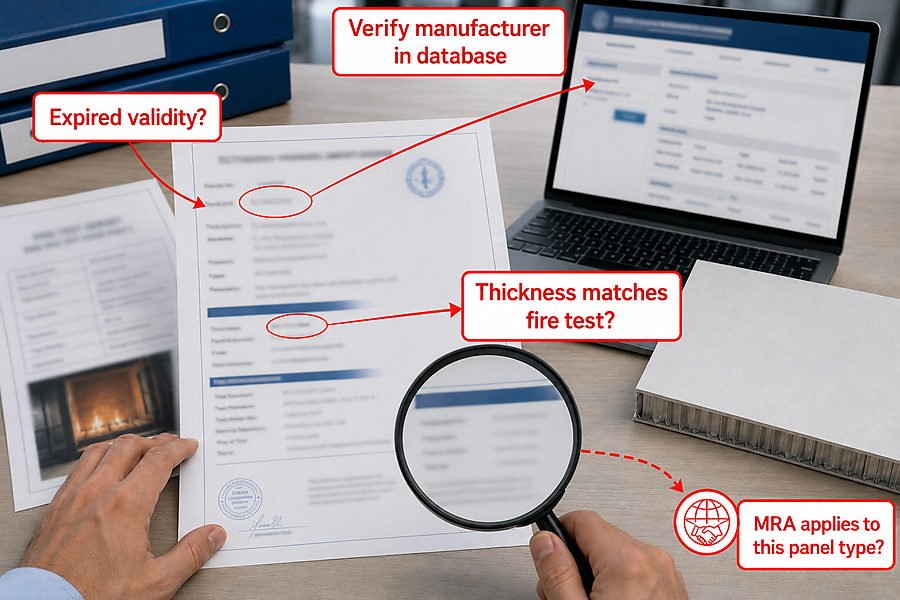
1. Checking for Expired Validity Dates on Marine Certifications
I always tell my clients to look at the dates first. To spot compliance gaps, buyers must check for expired validity dates. A Type Approval Certificate (TAC) is normally valid for exactly 5 years from the date of issue.2 Look at the "Valid Until" box. Some suppliers will use software to change a "2023" to a "2026". You can spot this by checking the font pixels, but the best way is to input the certificate number into the DNV or ABS online approval finder.
2. Verifying Marine Panel Thickness Matches the Fire Test Report
Second, you must verify that the product thickness matches the fire test report exactly. If the supplier gives you an A-60 class fire certificate that tested a 50mm thick panel with a 120 kg/m³ rockwool core, but they are selling you a 30mm panel, that certificate is invalid for your order. According to IMO regulations, you cannot use a thinner panel than what was tested.3 I saw a buyer lose $40,000 because they missed this thickness gap.
3. Cross-Referencing the Manufacturer Name in Classification Databases
Third, cross-reference the manufacturer name against the classification society database. Sometimes a trading company will show you a certificate, but their name is not on it. The name on the TAC must match the name on your commercial invoice and the factory name. If it does not, you need an "OEM authorization letter," or the inspector will not clear the goods.
4. Ensuring USCG Mutual Recognition Agreement (MRA) Applicability
Finally, ensure the USCG mutual recognition agreement applies to the specific panel type. If you buy for a US shipyard, a European MED Wheelmark is only okay if the USCG-EU MRA covers that exact product category4, like "164.108 for non-combustible materials." Always look for the USCG approval number printed right next to the Wheelmark on the document.
| Compliance Gap Type | Where to Look | Expected Standard | Cost of Missing It |
|---|---|---|---|
| Expired Dates | "Valid Until" box on TAC | Maximum 5 years from issue | Full container rejection |
| Thickness Mismatch | Test Report vs Invoice | Ordered thickness >= Tested thickness | $15,000+ new fire test |
| Name Mismatch | Supplier name vs TAC name | Exact match or OEM letter | Customs export hold |
| USCG Gap | Beside the MED Wheelmark | Number format: 164.XXX/XXXX/XXXX | Port State Control rejection |
Which Marine Panel Certificates Matter Most for Multi-Region Export?
Buying for projects in both Europe and the US is hard. Do you want to pay for double testing? Let us pick the certificates that work everywhere.
For multi-region export, the most critical marine panel certificates are the MED Wheelmark (Module B+D) for European compliance, the USCG Approval number for United States waters, the IMO FTP Code 2010 test reports as the global baseline, and a DNV or ABS Type Approval Certificate for commercial trust.
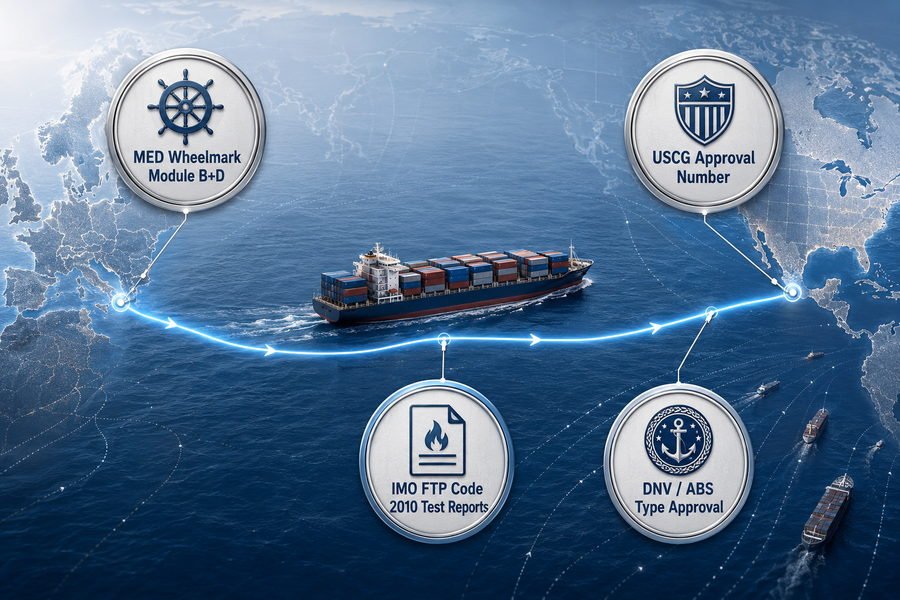
1. The Importance of MED Wheelmark (Module B+D) for European Marine Markets
If you want to supply shipyards in Europe, you must have the MED Wheelmark5. The MED Wheelmark (Module B+D) is the absolute law for European compliance. Module B proves the panel design passes the IMO fire tests. Module D proves the factory quality system is audited every year6. Without both, you cannot put the ship under a European flag. The cost of getting a new MED certificate ranges from $10,000 to $15,000, so cheap suppliers rarely have it ready.
2. Securing USCG Approval Numbers for United States Waters
Next, for the US market, you need the USCG Approval number. You do not always need a separate test if the supplier has the MED Wheelmark, because of the EU-US Mutual Recognition Agreement (MRA)7. However, the supplier must still have the USCG number assigned and printed on their documents. It usually looks like "164.136/1121/WCL MEDxxxx". I always check the USCG CGMIX online database to make sure the number is active.
3. Utilizing IMO FTP Code 2010 Test Reports as the Global Baseline
The third critical piece is the IMO FTP Code 2010 test reports8. This is the global baseline. Whether you go to ABS in America, DNV in Norway, or CCS in China, they all look at the same IMO 2010 Fire Test Procedures (FTP) Code. Parts 1 and 3 are the most important for panels. The test report must clearly state "IMO Res. MSC.307(88)". Keep this PDF on file forever.
4. Gaining Commercial Trust with DNV or ABS Type Approval Certificates
Finally, a DNV or ABS Type Approval Certificate (TAC) builds strong commercial trust. While the Wheelmark is a legal requirement, ship owners simply trust DNV and ABS more. A DNV TAC proves the panel can handle marine vibrations and moisture, not just fire. If your Asian factory holds a DNV TAC, your European clients will not question the quality.
| Target Region | Primary Certificate Required | Regulatory Body | Estimated Cost to Obtain New |
|---|---|---|---|
| Europe | MED Wheelmark (B+D) | EMSA | $10,000 - $15,000 |
| United States | USCG Approval | Coast Guard (via MRA) | Administrative fees only with MED |
| Global Baseline | IMO FTP 2010 Test Report | IMO | $3,000 - $5,000 per test |
| Global Commercial | DNV / ABS TAC | Class Societies | $5,000 - $8,000 |
How Do Compliance Mismatches Delay Marine Panel Delivery?
Your panels are ready, but the ship cannot leave the port. Compliance mismatches cause huge delays. Do you know how much money a delayed ship costs?
Compliance mismatches delay marine panel delivery by triggering customs holds during export, causing port state control rejections upon arrival, forcing mandatory re-inspections by classification society surveyors on site, and requiring the time-consuming re-issuance of factory technical documents to match physical labels.
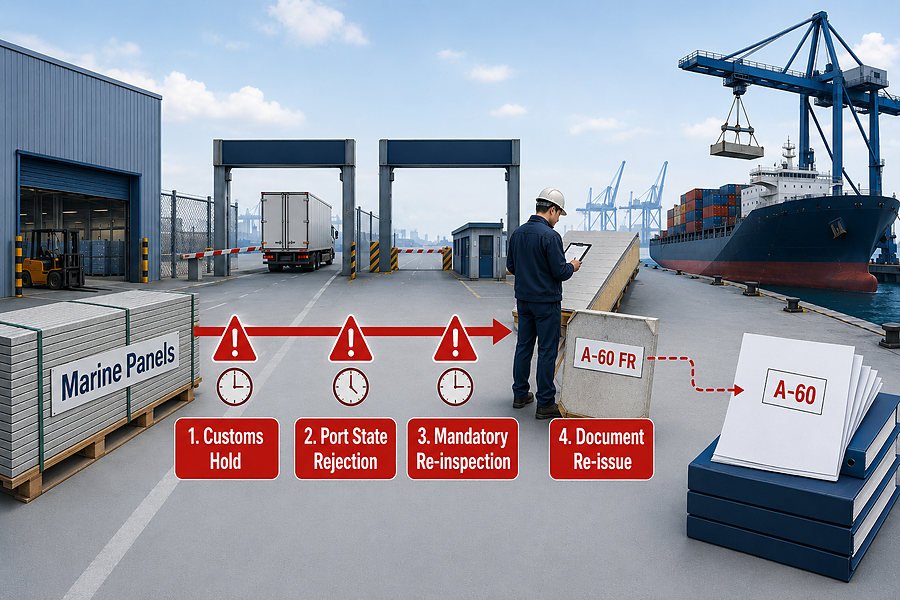
1. Triggering Customs Holds During Export Due to Marine Panel Document Errors
The first way mismatches cause trouble is by triggering customs holds during export9. If the HS code on your commercial invoice says "fireproof marine panel" but your packing list lacks the matching safety certificates, Customs might hold the container. I have seen containers sit in the port for 14 days just because the factory name on the export license did not match the name on the Type Approval Certificate. Port storage fees can easily cost you $100 per day10.
2. Facing Port State Control Rejections Upon Arrival
Second, you risk facing port state control rejections upon arrival. When the panels arrive in the US or Europe, the local Port State Control (PSC) will check the goods. If the physical panels do not have the MED Wheelmark sticker on the back, but the paperwork says they do, the PSC will reject the whole shipment. The panels cannot leave the port area, stopping your entire project.
3. Forcing Mandatory Re-Inspections by Classification Society Surveyors
Third, a mismatch forces mandatory re-inspections by classification society surveyors11 on site. If the local DNV surveyor sees that the panel core density is 80 kg/m³ but the certificate says 120 kg/m³, they will stop the installation. You will have to pay the surveyor's hourly rate, which is usually around $150 to $200 per hour, to come back after you fix the problem. This can delay the shipyard schedule by weeks.
4. Time-Consuming Re-Issuance of Factory Technical Documents
Finally, mismatches require the time-consuming re-issuance of factory technical documents to match physical labels. Sometimes the panels are perfectly fine, but the factory typed "50mm" instead of "30mm" on the Declaration of Conformity. Getting the supplier to admit the mistake, rewrite the paper, get the boss to sign it, and mail the original via DHL can take another 5 to 7 days.
| Delay Source | Point of Impact | Financial Consequence | Time Lost |
|---|---|---|---|
| Customs Export Hold | Origin Port | $100/day storage fees | 7 to 14 days |
| PSC Rejection | Destination Port | Panel replacement costs | 30 to 45 days |
| Surveyor Re-inspection | Shipyard | $150 to $200 per hour | 2 to 3 weeks |
| Document Re-issuance | Factory Office | DHL express fees | 5 to 7 days |
How Can Buyers Avoid Costly Marine Panel Recertification After Order?
You paid for the panels, but the surveyor rejected them. Now you have to pay for a new fire test. How can you stop this nightmare before it starts?
Buyers avoid costly recertification by demanding a pre-production document review with the local surveyor, writing certificate exactness into the purchase contract penalty clause, hiring third-party inspectors for pre-shipment label verification, and ensuring the supplier's quality management system remains valid through the entire production period.

1. Demanding a Pre-Production Document Review with the Local Surveyor
To avoid paying $15,000 for a new IMO fire test12, you must start early. Buyers avoid costly recertification by demanding a pre-production document review with the local surveyor13. Before you send the 30% deposit to the factory, take the supplier's certificates and email them to the DNV or ABS surveyor who will inspect the final ship. Ask the surveyor, "Will you accept these documents for this specific vessel?" If the surveyor says yes, save that email.
2. Writing Certificate Exactness into Purchase Contract Penalty Clauses
Second, you must write certificate exactness into the purchase contract penalty clause. Do not just write "Must provide certificates." You must write: "Supplier must supply panels identical to DNV Certificate No. XXXXX. Any deviation in core density, steel thickness, or adhesive brand14 will result in a 100% refund." When the factory sees this strict rule, they will not dare to swap the fireproof glue for a cheaper, uncertified one.
3. Hiring Third-Party Inspectors for Pre-Shipment Label Verification
Third, hire third-party inspectors for pre-shipment label verification. Pay a company like SGS or a local marine expert about $300 to visit the factory before loading. They must check that every single panel has the correct sticker showing the Type Approval number, the lot number, and the Wheelmark15. If the labels are missing, the inspector stops the loading right there.
4. Ensuring Supplier Quality Management Systems Remain Valid
Finally, ensure the supplier's quality management system remains valid through the entire production period. A factory's MED Module D certificate might expire during your 45-day production time. Check the expiry date before you order. If it expires next month, hold your order until they pass their new annual factory audit. Otherwise, your panels will be made during a time when the factory has no valid license.
| Avoidance Strategy | When to Do It | Cost to Implement | Risk Mitigated |
|---|---|---|---|
| Surveyor Pre-Review | Before 30% deposit | Free (just an email) | Final ship rejection |
| Contract Penalty Clause | During order placement | Free (contract term) | Material swapping by factory |
| Third-Party Inspection | Before container loading | ~$300 per visit | Missing physical labels |
| Module D Expiry Check | Before signing order | Free (check dates) | Invalid production dates |
Conclusion
Verifying marine panel compliance takes time, but it protects your shipyard clients. By asking the right questions, checking certificates early, and using tight contracts, you ensure smooth, profitable deliveries.
-
"How Does the IMO FTP Code Connect with Other Marine Fire Safety ...", https://magellanmarinetech.com/how-imo-ftp-code-connect-with-other-marine-fire-safety-frameworks/. The IMO 2010 FTP Code identifies Part 1 as the non-combustibility test and Part 3 as the test for “A,” “B,” and “F” class divisions, providing the regulatory context for marine panel fire-test reports. Evidence role: definition; source type: institution. Supports: The test report must match the IMO 2010 FTP Code Parts 1 and 3 for non-combustibility and fire resistance.. Scope note: This supports the relevant FTP Code test categories, not whether a particular supplier’s report complies with them. ↩
-
"Ship classification society - Wikipedia", https://en.wikipedia.org/wiki/Ship_classification_society. Classification-society type approval rules commonly specify a certificate validity period of up to five years from issuance, supporting the article’s statement about the usual TAC validity cycle. Evidence role: general_support; source type: institution. Supports: A marine Type Approval Certificate is normally valid for five years from its date of issue.. Scope note: Validity periods can vary by scheme, certificate type, renewal status, or issuing authority, so the source should be framed as common practice rather than a universal rule. ↩
-
"[PDF] RESOLUTION MSC.307(88) (adopted on 3 December 2010 ...", https://wwwcdn.imo.org/localresources/en/KnowledgeCentre/IndexofIMOResolutions/MSCResolutions/MSC.307(88).pdf. The IMO Fire Test Procedures Code ties approval of fire-resisting divisions to tested specimens and their construction details, supporting the claim that deviations such as reduced panel thickness may fall outside the tested approval basis. Evidence role: mechanism; source type: institution. Supports: A fire-rated marine panel generally must conform to the construction tested in the fire test report, and a thinner untested panel may not be covered by that approval.. Scope note: The source may establish the approval principle rather than state the exact phrase “cannot use a thinner panel”; applicability depends on the certificate conditions and the specific FTP Code test method. ↩
-
"Products covered by Mutual Recognition Agreements (MRAs). - eCFR", https://www.ecfr.gov/current/title-46/chapter-I/subchapter-Q/part-159/subpart-159.003/section-159.003-9. USCG guidance on the U.S.–EU Mutual Recognition Agreement explains that acceptance of MED Wheelmarked equipment is limited to product categories covered by the MRA, supporting the article’s point that coverage must be checked by category. Evidence role: historical_context; source type: government. Supports: For U.S. shipyard use, a European MED Wheelmark is acceptable only where the USCG–EU MRA includes the relevant product category.. Scope note: The source supports the category-based scope of the MRA; it does not determine whether any individual certificate, panel model, or shipment is acceptable without checking the current approval record. ↩
-
"Directive 96/98/EC - Wikipedia", https://en.wikipedia.org/wiki/Directive_96/98/EC. Directive 2014/90/EU establishes that marine equipment within the Directive’s scope and intended for EU ships must undergo conformity assessment and bear the wheel mark before being placed on board. Evidence role: general_support; source type: government. Supports: Suppliers of covered marine equipment for European/EU-flagged vessels need MED Wheelmark conformity.. Scope note: This supports the regulatory requirement for covered marine equipment on EU-flagged ships, not every product supplied to every European shipyard. ↩
-
"Conformity Assessment of Medical Devices: An Overview from a ...", https://pmc.ncbi.nlm.nih.gov/articles/PMC12821529/. Marine Equipment Directive conformity-assessment rules describe Module D as production-quality-assurance oversight by a notified body, including periodic surveillance of the manufacturer’s quality system. Evidence role: mechanism; source type: government. Supports: Module D concerns notified-body oversight of the manufacturer’s production quality system.. Scope note: The source may describe periodic surveillance rather than using the exact phrase “audited every year,” so the annual frequency should be verified in the applicable certificate or notified-body rules. ↩
-
"Directive 96/98/EC - Wikipedia", https://en.wikipedia.org/wiki/Directive_96/98/EC. The EU–US Mutual Recognition Agreement for marine equipment provides for reciprocal acceptance of specified conformity-assessment results for listed marine equipment, allowing some products to avoid duplicative testing while still requiring compliance with the receiving authority’s approval procedures. Evidence role: historical_context; source type: government. Supports: Some USCG approvals can rely on MED-related conformity assessment under the EU–US MRA rather than requiring wholly separate testing.. Scope note: The MRA applies only to equipment and standards covered by the agreement and does not automatically replace all USCG approval or marking requirements. ↩
-
"[PDF] RESOLUTION MSC.307(88) (adopted on 3 December 2010 ...", https://wwwcdn.imo.org/localresources/en/KnowledgeCentre/IndexofIMOResolutions/MSCResolutions/MSC.307(88).pdf. IMO Resolution MSC.307(88) adopted the 2010 FTP Code, which specifies international fire-test procedures used to demonstrate compliance with SOLAS fire-safety requirements for shipboard materials and components. Evidence role: definition; source type: institution. Supports: The IMO FTP Code 2010 is a key international baseline for fire-test reporting for marine panels and related materials.. Scope note: This supports the FTP Code as an international regulatory test framework, but separate classification societies may impose additional type-approval or installation requirements. ↩
-
"CROSS Ruling - U.S. Customs and Border Protection", https://rulings.cbp.gov/ruling/228794. Customs guidance and trade-compliance materials describe accurate classification, invoices, permits, and supporting documents as prerequisites for cargo release, supporting the proposition that document discrepancies can lead to examination, detention, or delayed clearance. Evidence role: general_support; source type: government. Supports: Mismatches between export documents, HS codes, certificates, and licenses can trigger customs holds or delayed release at the origin port.. Scope note: This would support the general customs-control mechanism rather than the specific example of marine panels or a 14-day hold. ↩
-
"[PDF] Port Authority Marine Terminal Tariff FMC Schedule No. PA 10 ...", https://www.panynj.gov/content/dam/port/doing-business-pdfs/Port%20Authority%20Marine%20Terminal%20Tariff%20FMC%20Schedule%20No.%20PA%2010%20(Effective%20February%2010,%202025).pdf. Published port tariff schedules commonly list daily storage, demurrage, or terminal charges for containers after free time expires, supporting the claim that a customs hold can generate daily port costs. Evidence role: statistic; source type: institution. Supports: Port storage or demurrage charges can reach roughly $100 per day when a container is held beyond free time.. Scope note: Tariffs vary substantially by port, container size, cargo type, and free-time allowance; a single tariff can only contextualize, not universally prove, the $100-per-day figure. ↩
-
"Resolution A.1120(30) Adopted on 6 December 2017 ...", https://wwwcdn.imo.org/localresources/en/KnowledgeCentre/IndexofIMOResolutions/AssemblyDocuments/A.1120(30).pdf. Classification-society rules and survey procedures require surveyors to verify that installed materials and equipment conform to approved certificates and specifications, supporting the need for corrective action and further survey when a material-property mismatch is found. Evidence role: mechanism; source type: institution. Supports: A mismatch between installed panel specifications and the certificate can require a classification society surveyor to stop acceptance and perform a follow-up inspection.. Scope note: The source would support the survey and conformity mechanism generally, not the specific density values or delay duration in the example. ↩
-
"How to choose the right marine wall panels for marine interior ...", https://magellanmarinetech.com/how-choose-right-marine-wall-panels-for-marine-interior-projects/. A source documenting current IMO FTP Code fire-test pricing or published laboratory fee schedules would support the claim that repeat marine fire testing can involve five-figure costs; such sources may vary by product, test method, laboratory, and region rather than proving a universal USD 15,000 price. Evidence role: statistic; source type: other. Supports: A new IMO fire test can cost around $15,000.. Scope note: The exact amount is likely market- and test-specific, so evidence may only substantiate an approximate cost range. ↩
-
"SURVEYS, VERIFICATIONS AND CERTIFICATION", https://www.imo.org/en/OurWork/IIIS/Pages/Survey-Verification-Certification.aspx. Classification-society guidance on surveys and type-approval documentation can support the contextual point that surveyors verify certificates and compliance documentation before accepting marine equipment for a vessel; it does not necessarily prescribe the buyer’s commercial timing or email workflow. Evidence role: general_support; source type: institution. Supports: A local classification or statutory surveyor’s document review can help determine whether supplier certificates will be accepted for a specific vessel.. Scope note: This would support the surveyor’s role in document acceptance, not prove that every surveyor will issue binding pre-production acceptance by email. ↩
-
"How Do Marine Panel Surface Finishes Affect Fire Safety ...", https://magellanmarinetech.com/how-marine-panel-surface-finishes-affect-fire-safety-compliance/. IMO FTP Code and marine type-approval documentation can support that fire-test approvals are tied to the tested product construction and conditions of approval; this supports concern about material substitutions, although it does not establish the article’s proposed refund clause as a regulatory requirement. Evidence role: mechanism; source type: government. Supports: Changing core density, steel thickness, or adhesive brand can affect whether panels remain identical to the approved fire-tested construction.. Scope note: The source would support the compliance risk of construction changes, not the specific contractual penalty language. ↩
-
"Directive 96/98/EC - Wikipedia", https://en.wikipedia.org/wiki/Directive_96/98/EC. EU Marine Equipment Directive materials explain that approved marine equipment placed on EU ships must carry the wheel mark and associated conformity information, supporting the need to verify physical markings; requirements for lot numbers or type-approval numbers may depend on the product certificate and notified-body documentation. Evidence role: definition; source type: government. Supports: Marine equipment labels may need to display conformity markings such as the Wheelmark and identifying approval information.. Scope note: The Wheelmark requirement is broadly supported by MED rules, while exact label fields can vary by equipment type and certification scheme. ↩