Buying marine panels without valid fire reports puts your whole project at risk. A failed port state control inspection costs thousands. I will show you how to spot fake documents.
Unreliable marine panel fire test reports often show expired dates, mismatching product densities, missing MED Wheelmark stamps, or come from unaccredited labs. A complete verification requires checking the lab's accreditation, matching the test specimen's exact specs to your order, and contacting the issuing body to confirm the certificate's validity.
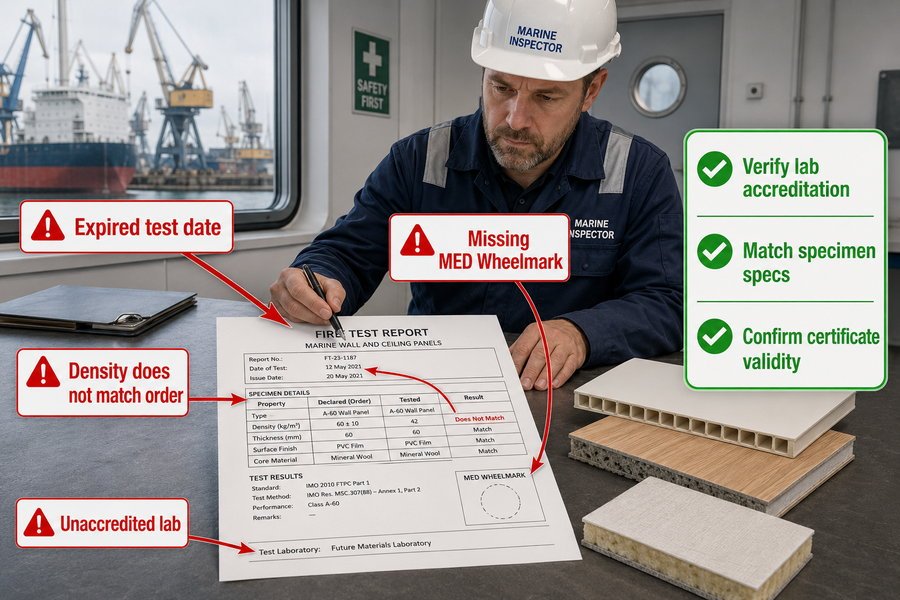
You can avoid these costly mistakes. Let us break down the exact steps to verify your supplier's fire test reports.
What Red Flags Reveal Fake Fire Test Reports for Marine Wall Panels?
Fake fire test reports look real at first glance. If you do not check closely, you will install non-compliant panels. Here are the warning signs you must look for.
Four red flags reveal fake fire test reports for marine wall panels: altered PDF fonts, test dates older than five years, missing unique tracking numbers, and product names that do not match the manufacturer. Always check these four elements to ensure full compliance with SOLAS regulations.
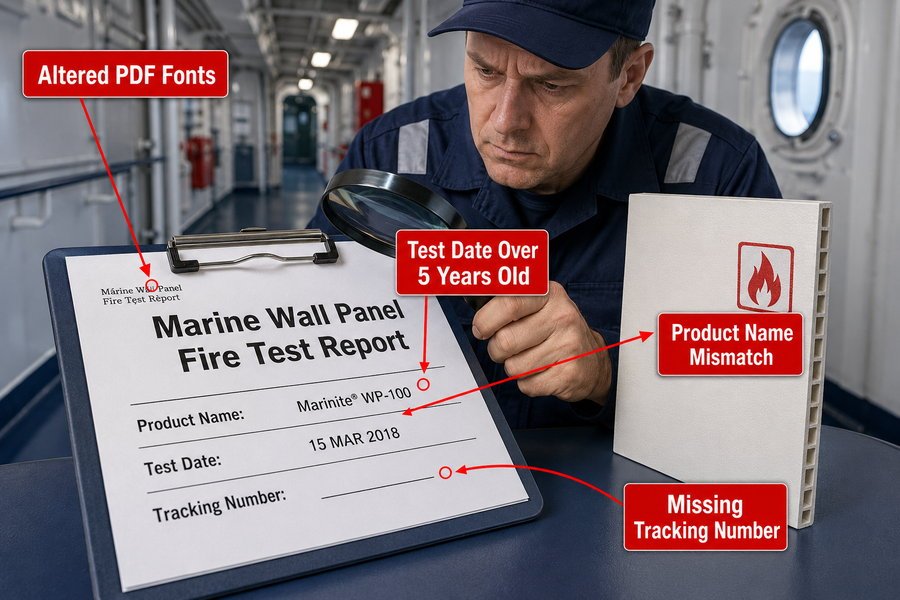
Finding these red flags is not hard if you know where to look. I will explain each red flag in detail so you can catch bad suppliers.
Altered PDF Fonts and Missing Tracking Numbers in Fire Reports
When I worked at the marine outfitting factory, I saw traders try to fake documents. The most obvious sign is altered PDF fonts1. Scammers often use a real report and change the company name. The font of the new text will look slightly different from the rest of the document. You can zoom in on the PDF to 400%. If the pixels around the company name look blurry compared to the test results, it is a fake.
Next, you must look for the unique tracking number. Every real IACS (International Association of Classification Societies) report has a specific certificate number2. For example, a DNV certificate will have a number like "MEDB00001A2". If the report is missing this number, or if the number looks like a simple date format, it is a huge red flag. You need this number to search the official lab database.
Expired Test Dates and Mismatched Product Names on Certificates
The third red flag involves the dates. According to the IMO FTP Code 2010, marine fire test certificates usually have a strict validity period. An EC Type Examination Certificate (Module B) is valid for exactly five years from the issue date. I always check the issue date and the expiration date. If the report is older than five years, it is useless for your shipyard project.
Finally, check the product name. The product name on the test report must exactly match3 the name of the manufacturer. Many small suppliers buy panels from a big factory and try to use the big factory's report. But if the brand name on the report is "Brand A" and your supplier is "Brand B", the shipyard will reject it. All four of these red flags mean you should stop the purchase immediately.
| Red Flag Element | What to Look For on the Report | Why It Matters for Compliance |
|---|---|---|
| PDF Fonts | Blurry text or mismatched text styles | Indicates the document was illegally modified |
| Tracking Numbers | Missing or weird certificate numbers | Prevents you from verifying the report online |
| Test Dates | Dates older than 5 years | Violates the IMO FTP Code 2010 rules |
| Product Names | Name does not match your supplier | Shipyards will reject unmatched brand names |
How to Confirm a Fire Test Report Matches the Marine Ceiling Panel Shipped?
You ordered a B-15 ceiling panel, but does the test report match the actual product in the container? Mismatches cause shipyard rejections. Let us fix this.
Confirm a fire test report matches the shipped marine ceiling panel by verifying three exact parameters: the core material density (typically 100-120 kg/m3 for rockwool), the panel thickness (like 25mm or 50mm), and the specific surface finish applied during the IMO FTP Code Part 3 fire test.
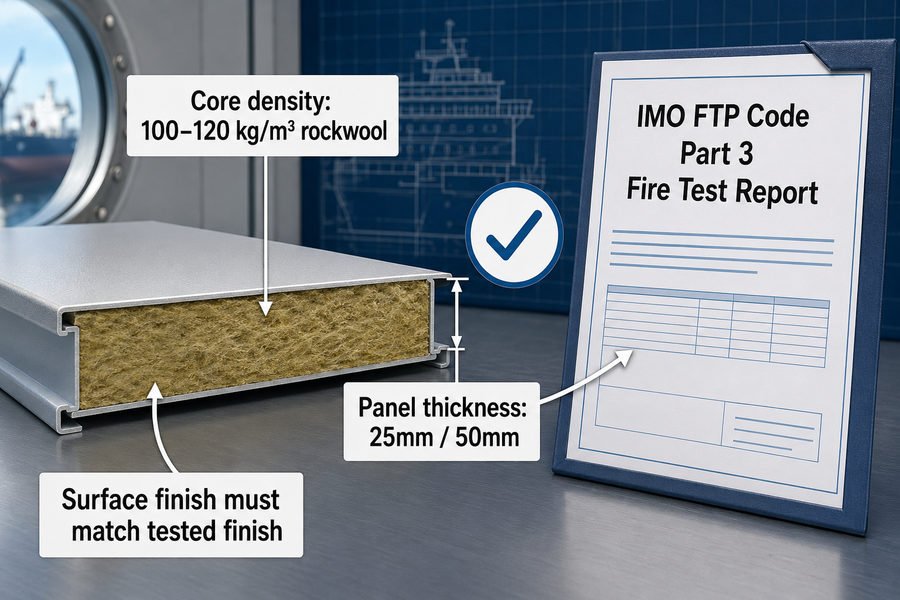
A report for a 50mm panel does not cover a 25mm panel. I will show you how to check the specific details on the packing list against the test report.
Verifying Core Material Density for Marine Ceiling Panels
A fire test report is only valid for the exact materials tested4. You must check the core material density. The IMO FTP Code Part 3 requires very strict density rules for insulation. For marine ceiling panels, the core is usually rockwool. The test report will state a specific density value. For a B-15 class ceiling panel, the required rockwool density is usually between 100 kg/m3 and 120 kg/m35.
You must ask your supplier to state the core density on the commercial invoice and the packing list. If the test report says 120 kg/m3, but the factory ships you panels with 80 kg/m3 rockwool to save money, the fire rating is completely invalid. The lighter panel will burn faster. I always demand photos of the raw rockwool packages at the factory before assembly. The label on the raw material must match the density on the fire test report.
Checking Panel Thickness and Surface Finish Specifications
The second parameter is the panel thickness. A B-15 ceiling panel usually has a thickness of 25mm. A B-0 wall panel might be 50mm. The fire test report will list the exact thickness tested. If you buy a 30mm panel, but the test report is for a 50mm panel, the report does not match6. You cannot use it. The shipyard surveyor will check this with a measuring tape.
The third parameter is the surface finish. Marine panels have PVC film or galvanized steel surfaces. The fire test report includes a low flame spread test for the surface material7. If the report tested a 150-micron PVC film, but your panels have a painted surface or a different plastic film, the report is invalid. You must verify that the surface finish mentioned in the report matches your order details perfectly.
| Parameter to Check | Expected Value Range | Where to Find This Information |
|---|---|---|
| Core Material Density | 100 kg/m3 to 120 kg/m3 (Rockwool) | Test report spec sheet vs Invoice |
| Panel Thickness | 25mm or 50mm | Test report drawing vs Physical panel |
| Surface Finish | 150-micron PVC or specific paint | Flame spread test section vs Order details |
Which Labs Are Trusted for Marine Wall Panel Fire Testing?
A fire test report is only as good as the lab that issued it. Using an unapproved lab wastes your money. Here is the list of trusted labs.
Trusted labs for marine wall panel fire testing include DNV (Norway), ABS (USA), Lloyd's Register (UK), Bureau Veritas (France), and RINA (Italy). These IACS member classification societies provide globally recognized testing and certification under the IMO FTP Code, ensuring acceptance by European and US shipyards.
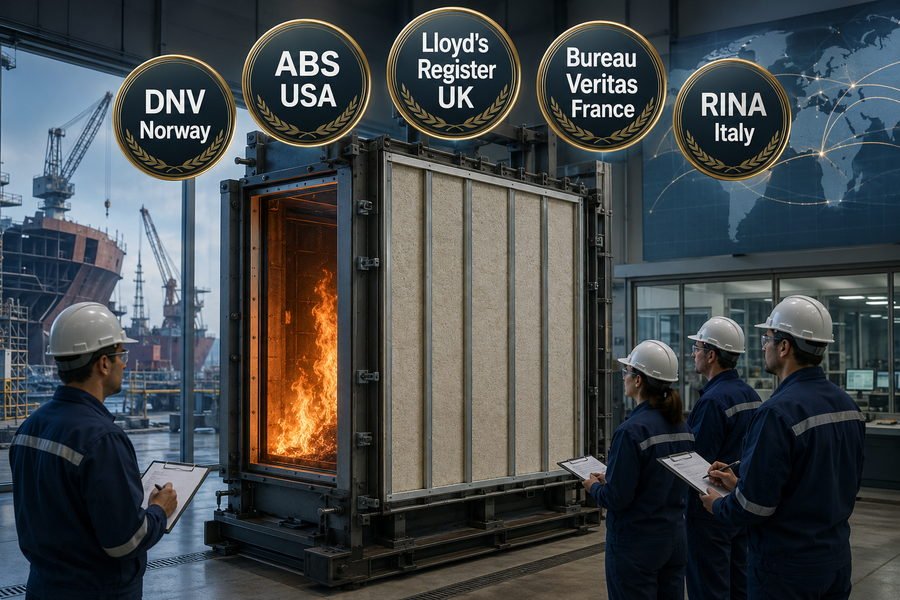
You must demand reports from these recognized organizations. Let us look at why IACS members are the only safe choice for your business.
The Role of DNV, ABS, and Lloyd's Register in Fire Testing
When you buy marine outfitting products for projects in Europe or the United States, you must use trusted labs. The most trusted labs belong to IACS.8 DNV (Det Norske Veritas) from Norway is the most common and highly respected lab in the world. Their certificates are accepted by almost every shipyard. ABS (American Bureau of Shipping) is very important if your ship is going to operate in US waters or if you are dealing with the US Coast Guard.9
Lloyd's Register (LR) from the UK is another top-tier lab. I always tell my clients that if they have a certificate from DNV, ABS, or LR, they will not have any problems during the inspection. These labs do not just test the fire resistance. They test the toxicity and smoke generation according to the IMO FTP Code.10 Their testing process is very strict, which is why their certificates hold so much power in the market.
Bureau Veritas and RINA Certifications for European Shipyards
Bureau Veritas (BV) from France and RINA from Italy are also excellent choices. If you are doing interior decoration for luxury cruise ships built in Italy or France, shipyards often prefer BV or RINA certificates. These five labs are the gold standard.
Sometimes, Chinese suppliers will give you a test report from a local Chinese city lab that is not a member of IACS. For example, a report from a local construction fire lab. This report is 100% useless for international marine projects. A marine wall panel must pass the IMO FTP Code Part 3 test, not a normal building fire test.11 You must strictly reject any test report that does not have the logo of an IACS member society.
| Trusted Testing Lab | Country of Origin | Best Application Area |
|---|---|---|
| DNV | Norway | Global, highly preferred in Europe |
| ABS | United States | US waters, US Coast Guard projects |
| Lloyd's Register (LR) | United Kingdom | Global commercial shipping |
| Bureau Veritas (BV) | France | European shipyards, passenger ships |
| RINA | Italy | Italian shipyards, luxury cruise ships |
What to Ask Before Accepting a Marine Ceiling Panel Fire Test Report?
Do not just accept a PDF file from a supplier. Asking the right questions upfront saves you from port state control problems later. Here is your checklist.
Before accepting a marine ceiling panel fire test report, ask three questions: Is this an EC Type Examination Certificate (Module B)? Do you have the corresponding Quality System Certificate (Module D)? And can you provide the lab's contact email to directly verify the report's authenticity?
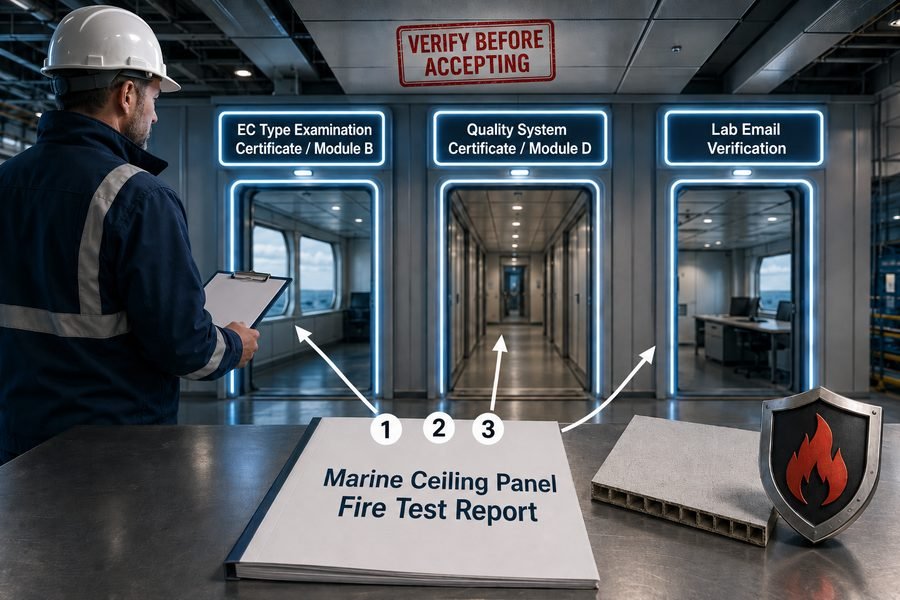
Knowing what to ask puts you in control. I will explain why these three questions expose dishonest suppliers immediately.
Requesting Module B and Module D Certificates for Ceiling Panels
The marine certification system in Europe uses the MED (Marine Equipment Directive) Wheelmark.12 To get the Wheelmark, a supplier needs two separate certificates. The first question you must ask is: "Can you send the Module B certificate?" The Module B is the EC Type Examination Certificate. This proves that the lab tested a sample of the panel and it passed the fire test.
But Module B is not enough. The second question you must ask is: "Do you have the Module D certificate?" The Module D is the Production Quality Assurance certificate.13 This proves that the factory's production line is audited every year to make sure they build the panels exactly like the sample they tested. Many bad suppliers pay for one Module B test, but they do not pay for the yearly Module D audit. If the supplier does not have both Module B and Module D, they cannot legally place the Wheelmark on the ceiling panel14.
Contacting the Testing Laboratory for Direct Verification
The third question you must ask is: "What is the contact email for the lab engineer who issued this report?" Honest suppliers will give you the contact information immediately. They want you to verify their good work. Fake suppliers will make excuses. They will say the lab is secret or they are not allowed to share the email.
When you get the contact information, you should send an email directly to the lab (like DNV or ABS). You attach the PDF report and ask, "Can you confirm this certificate number is valid and belongs to this manufacturer?" The labs are very helpful and will usually reply within 48 hours. This simple question stops scammers because they know you will catch them if they lie.
| Important Question to Ask | What the Certificate Proves | Result if Missing |
|---|---|---|
| Do you have Module B? | Proves the product design passes the fire test | Product is completely uncertified |
| Do you have Module D? | Proves the factory production quality is stable | Cannot apply the MED Wheelmark |
| What is the lab contact? | Proves the supplier is not hiding fake documents | High risk of document fraud |
Why Do Some Chinese Marine Wall Panel Suppliers Lack Valid Fire Test Evidence?
Many Asian suppliers offer low prices but fail to provide fire reports. This delays your project. Why does this happen? Here are the real reasons.
Some Chinese marine wall panel suppliers lack valid fire test evidence due to three main reasons: the high cost of IACS testing ($8,000 to $12,000 per test), their focus on domestic non-marine markets, or their status as trading companies rather than direct manufacturers with own certifications.
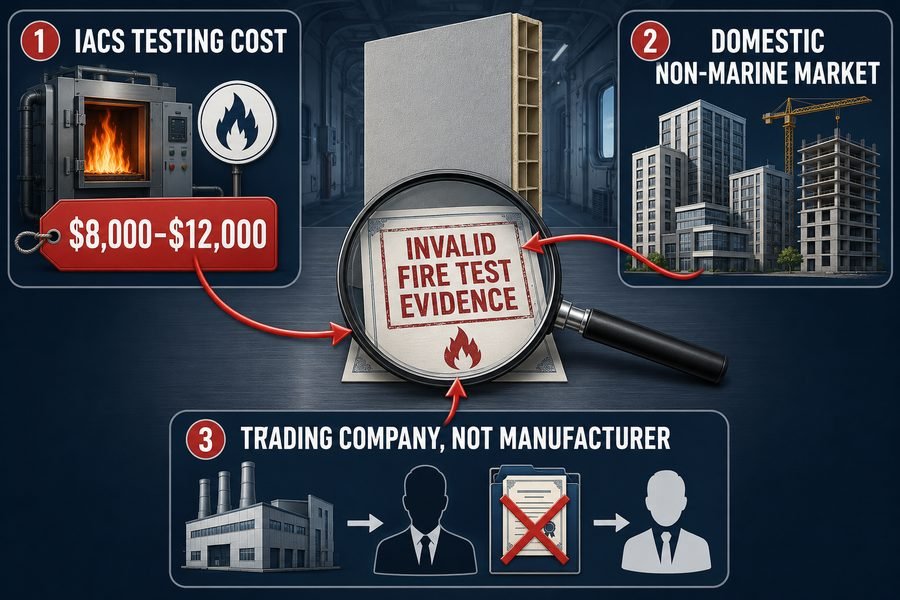
I worked in a factory here, so I know the hidden truth. Let me explain the cost and business models behind this issue.
The High Financial Cost of IACS Fire Testing for Suppliers
The biggest reason suppliers do not have valid fire test reports is the money. Marine testing is very expensive. To get an IMO FTP Code Part 3 fire test from a lab like DNV, the factory must pay between $8,000 and $12,000 just for one single test15. This is only for one type of panel (for example, a 50mm B-15 wall panel). If they want to sell 25mm ceiling panels, they must pay another $10,000.
Plus, they must pay around $3,000 to $5,000 every year for the Module D factory audit. Small factories cannot afford these costs. They try to save money by avoiding the tests. They lower their product price to attract buyers. But buying these cheap, untested panels is a trap. You will save $2,000 on the purchase, but you will lose $50,000 when the shipyard rejects the entire shipment.
Domestic Market Focus and Trading Company Limitations
The second reason is market focus. Many Chinese factories mainly produce sandwich panels for land-based cold rooms or temporary houses. These domestic construction projects do not require IMO marine fire tests.16 The factories are not marine specialists. They just try to sell their land panels to marine buyers to make extra money. They do not have marine test evidence because they do not know the marine rules.
The third reason involves trading companies. Many suppliers you find on Alibaba are not real factories. They are trading companies. A trading company does not own the fire certificates. The real factory owns them. The factory's name is on the DNV certificate. If the trading company tries to hide the factory's name from you, they will try to edit the PDF report to show their own trading name. This makes the report invalid. You must always buy from direct manufacturers who own their certificates, or ensure the trading company has a valid OEM agreement approved by the lab.
| Reason for Missing Reports | Financial or Structural Cause | Impact on Your Purchase |
|---|---|---|
| High Cost of Testing | $8,000 to $12,000 per panel type test | Supplier offers low prices but no compliance |
| Domestic Market Focus | Factory makes land-based buildings | Panels will fail marine moisture and fire standards |
| Trading Company Status | Trader does not own the factory certificate | Risk of forged PDFs and hidden factory names |
How to Audit a Supplier's Marine Panel Fire Test Documentation?
You received the documents. Now you must act like an inspector. Missing one detail can ruin your shipyard relationship. Here is how to audit them.
Audit a supplier's marine panel fire test documentation through a four-step process: check the IMO FTP Code 2010 reference, cross-reference the panel drawings with the tested specimen, verify the validity dates on the official issuing society's database, and ensure the Wheelmark logo is present and correct.
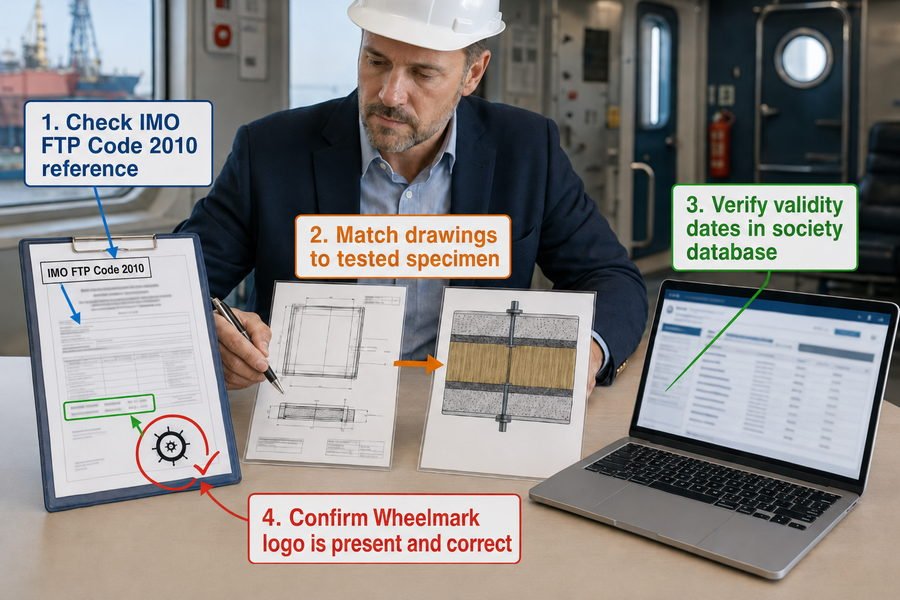
You do not need to be an engineer to do this audit. I will guide you through this strict four-step process so you can check documents quickly and accurately.
Checking IMO FTP Code 2010 References and Specimen Drawings
The first step in your audit is to look for the testing standard. The report must state clearly that the test was done according to the "IMO 2010 FTP Code17". If the report says "IMO Resolution A.754(18)18", this is the old standard from 1998. The old standard is expired and no longer accepted for new ships. You must reject reports using the old standard.
The second step is to cross-reference the panel drawings. Every good fire test report includes an engineering drawing of the test specimen at the end of the PDF. You must open this drawing and compare it to the drawing your supplier sent for your order. Look at the joint system. A marine wall panel connects using a specific tongue and groove joint or a spline joint. The joint design on your order must look exactly like the joint design on the lab's test drawing. If the joints are different, the fire rating is invalid.
Verifying Validity Dates and the Wheelmark Logo on Databases
The third step is verifying the validity dates. You cannot just read the PDF. You must go to the official database. If the report is from DNV, go to the DNV Approval Finder website. Type in the certificate number. The database will show if the certificate is "Valid", "Suspended", or "Withdrawn". This is the only way to know if the factory failed their yearly audit. The validity period is max 5 years.
The fourth and final step is checking the MED Wheelmark logo19. For European projects, the panel must have the Wheelmark. The certificate must show the logo of a ship's wheel. Next to the wheel, there must be a four-digit number. This number is the Notified Body number (for example, 0575 for DNV). Below the number, there is a year mark (like 2026). If the test report mentions a Wheelmark, but your physical panels arrive without these specific numbers stamped on them, the shipyard will fail your inspection.
| Audit Step | Action Required | What to Verify During the Audit |
|---|---|---|
| Step 1: Check Standard | Read the first page of report | Must state "IMO 2010 FTP Code", not older rules |
| Step 2: Match Drawings | Compare report to order specs | Joint designs and dimensions must match exactly |
| Step 3: Verify Dates | Use the IACS lab online database | Certificate status must show as currently "Valid" |
| Step 4: Check Wheelmark | Look at certificate and panel labels | Must include Notified Body number and year mark |
Conclusion
Verifying marine panel fire test reports protects your shipyard projects. By checking dates, matching technical specs, and using IACS databases, you ensure safe, high-quality, and compliant outfitting installations.
-
"[PDF] Digital Investigation Techniques: A NIST Scientific Foundation Review", https://nvlpubs.nist.gov/nistpubs/ir/2022/NIST.IR.8354.pdf. Research on digital document forensics describes font, layout, and rendering inconsistencies as indicators used to detect possible document tampering. Evidence role: mechanism; source type: paper. Supports: Mismatched or altered fonts in a PDF can indicate that a document has been modified.. Scope note: Such indicators are contextual red flags; they do not by themselves prove that a specific certificate is forged. ↩
-
"Ship classification society - Wikipedia", https://en.wikipedia.org/wiki/Ship_classification_society. Classification and certification bodies commonly assign certificate or approval numbers to marine equipment certificates so that the certificate can be identified and checked against issuing-body records. Evidence role: general_support; source type: institution. Supports: Authentic marine classification or approval documents normally include a traceable certificate number.. Scope note: The source may support certificate numbering and verification practices generally, rather than proving that every IACS-related report has the same numbering format. ↩
-
"[PDF] RESOLUTION MSC.307(88) (adopted on 3 December 2010 ...", https://wwwcdn.imo.org/localresources/en/KnowledgeCentre/IndexofIMOResolutions/MSCResolutions/MSC.307(88).pdf. The IMO 2010 FTP Code requires fire-test reports and approvals to identify the tested product and relevant manufacturer or product details, establishing that approval is tied to the tested item described in the report. Evidence role: definition; source type: institution. Supports: Marine fire-test documentation must identify the tested product, so mismatched product names can undermine acceptance of the certificate.. Scope note: The Code supports the need for clear product identification; the statement that names must match exactly may also depend on class-society, flag-state, or shipyard review procedures. ↩
-
"[PDF] RESOLUTION MSC.307(88) (adopted on 3 December 2010 ...", https://wwwcdn.imo.org/localresources/en/KnowledgeCentre/IndexofIMOResolutions/MSCResolutions/MSC.307(88).pdf. The IMO FTP Code Part 3 specifies fire-resistance testing for defined A-, B-, and F-class division specimens, supporting that a report’s classification is tied to the tested construction and material specification. Evidence role: expert_consensus; source type: institution. Supports: A fire test report is only valid for the exact materials and construction tested.. Scope note: This supports the general regulatory principle; the exact scope of acceptable substitutions may depend on the approval certificate and flag-state or classification-society interpretation. ↩
-
"How to choose the right fire class for marine wall panels?", https://magellanmarinetech.com/how-choose-right-marine-wall-panels-for-marine-interior-projects/. Published marine fire-division type-approval certificates commonly identify mineral-wool or rockwool core density as a specified parameter and provide examples of B-class ceiling or panel assemblies using densities in this range. Evidence role: general_support; source type: institution. Supports: B-15 marine ceiling panels commonly use rockwool core densities around 100–120 kg/m3.. Scope note: Such certificates can demonstrate common practice but do not establish a universal required density for every B-15 ceiling design. ↩
-
"Are Marine Fire Divisions the Same as Marine Panel Ratings?", https://magellanmarinetech.com/are-marine-fire-divisions-same-as-marine-panel-ratings/. IMO FTP Code Part 3 and associated type-approval practice base the fire-resistance classification on the tested division specimen, including construction dimensions, supporting the need for panel thickness to match the approved test configuration. Evidence role: mechanism; source type: institution. Supports: A fire test report for a 50 mm panel does not automatically cover a panel of a different thickness.. Scope note: The source may allow some extensions or variations only when explicitly covered by the approval or an accepted extended-application procedure. ↩
-
"What Is the Purpose and Scope of the IMO FTP Code? - Magellan ...", https://magellanmarinetech.com/what-purpose-scope-of-imo-ftp-code/. IMO FTP Code Part 5 sets test procedures for surface flammability and low flame-spread characteristics of bulkhead, ceiling, and deck finish materials, supporting that the tested surface finish is a relevant part of marine fire compliance. Evidence role: definition; source type: institution. Supports: Marine panel surface finishes are subject to low flame-spread testing, and the tested finish must be checked against the supplied product.. Scope note: This supports the relevance of surface-finish testing; whether a particular alternative finish invalidates an approval depends on the report, certificate scope, and approving authority. ↩
-
"RECOGNIZED ORGANIZATIONS", https://www.imo.org/en/OurWork/IIIS/Pages/Recognized-Organizations.aspx. IACS identifies its members as classification societies that establish and apply technical standards for ship safety and verification; this supports the institutional relevance of IACS membership but does not independently prove that only IACS members are trustworthy testing laboratories. Evidence role: general_support; source type: institution. Supports: The most trusted labs belong to IACS.. Scope note: The source would support IACS status and maritime safety role, not the subjective ranking of 'most trusted' or the exclusion of non-IACS laboratories. ↩
-
"46 USC 3316: Classification societies - OLRC Home", https://uscode.house.gov/view.xhtml?req=granuleid:USC-prelim-title46-section3316&num=0&edition=prelim. U.S. Coast Guard materials on recognized or authorized classification societies can document the regulatory relationship between ABS and U.S.-flag or U.S.-inspected maritime compliance; this supports the relevance of ABS in U.S. regulatory contexts, not a universal requirement for every vessel operating in U.S. waters. Evidence role: general_support; source type: government. Supports: ABS is important for ships operating in U.S. waters or projects involving the U.S. Coast Guard.. Scope note: The claim may vary by vessel flag, vessel type, inspection regime, and the specific approval being sought. ↩
-
"What Is the IMO FTP Code for Marine Interior Materials?", https://magellanmarinetech.com/what-imo-ftp-code-for-marine-interior-materials/. The IMO FTP Code includes procedures for smoke and toxicity testing of materials used on ships, supporting the statement that marine fire testing may address smoke generation and toxic gas production as well as fire performance. Evidence role: definition; source type: institution. Supports: The IMO FTP Code covers toxicity and smoke generation testing for marine materials.. Scope note: The source would establish the content of the IMO FTP Code; it would not verify that every listed society performs every test in-house for every product category. ↩
-
"[PDF] RESOLUTION MSC.307(88) (adopted on 3 December 2010 ...", https://wwwcdn.imo.org/localresources/en/KnowledgeCentre/IndexofIMOResolutions/MSCResolutions/MSC.307(88).pdf. The IMO FTP Code Part 3 sets fire test procedures for A-, B-, and F-class divisions used in ship construction, supporting the distinction between marine division testing and ordinary building fire tests; applicability depends on the panel’s intended installation and the governing flag-state or class approval route. Evidence role: definition; source type: institution. Supports: Marine wall panels used as ship divisions may need IMO FTP Code Part 3 testing rather than ordinary building fire testing.. Scope note: This supports the marine regulatory context for certain wall or bulkhead panels, but not every marine interior panel will necessarily require Part 3 testing in all applications. ↩
-
"Directive 96/98/EC - Wikipedia", https://en.wikipedia.org/wiki/Directive_96/98/EC. European Commission guidance on the Marine Equipment Directive explains that compliant marine equipment placed on the EU market bears the wheel mark as the directive’s conformity mark. Evidence role: definition; source type: government. Supports: The European marine equipment certification framework uses the MED Wheelmark as its conformity mark.. Scope note: This supports the role of the Wheelmark under the EU MED framework, but it does not address specific ceiling-panel approval procedures. ↩
-
"Conformity Assessment of Medical Devices: An Overview from a ...", https://pmc.ncbi.nlm.nih.gov/articles/PMC12821529/. EU conformity-assessment rules describe Module D as production quality assurance, requiring an approved quality system for production, final inspection, and testing under notified-body assessment and surveillance. Evidence role: definition; source type: government. Supports: Module D is the production quality assurance route and involves notified-body oversight of manufacturing quality controls.. Scope note: The general EU module description supports the production-quality function of Module D; it may describe surveillance as periodic rather than specifying the exact annual audit interval for every MED product category. ↩
-
"Marine Equipment Directive enters into force in the EEA - Efta.Int", https://www.efta.int/media-resources/news/marine-equipment-directive-enters-force-eea. The Marine Equipment Directive requires marine equipment to undergo the prescribed conformity-assessment procedure before the wheel mark is affixed, so equipment lacking the required certification route cannot lawfully bear that mark. Evidence role: general_support; source type: government. Supports: A supplier may not legally apply the MED Wheelmark unless the required conformity-assessment procedure has been completed.. Scope note: The source supports the legal requirement for conformity assessment before affixing the wheel mark; the exact certificate combination for ceiling panels depends on the applicable MED item and allowed module routes. ↩
-
"What Is the Purpose and Scope of the IMO FTP Code? - Magellan ...", https://magellanmarinetech.com/what-purpose-scope-of-imo-ftp-code/. A laboratory or notified-body fee schedule documents that marine fire-resistance testing is commonly priced as a multi-thousand-dollar service per test item, supporting the article’s cost rationale for suppliers. Evidence role: statistic; source type: institution. Supports: An IMO FTP Code Part 3 fire test for one panel type can cost roughly $8,000 to $12,000.. Scope note: Published fee schedules may vary by laboratory, country, specimen size, and scope, so they contextualize rather than universally prove the exact USD range. ↩
-
"How Does the IMO FTP Code Connect with Other Marine Fire Safety ...", https://magellanmarinetech.com/how-imo-ftp-code-connect-with-other-marine-fire-safety-frameworks/. IMO and SOLAS materials describe the FTP Code as a fire-test-procedure regime for materials and assemblies used on ships, indicating that its mandatory use is tied to maritime safety regulation rather than ordinary land-based construction. Evidence role: definition; source type: institution. Supports: Land-based cold-room or temporary-building projects are generally outside the IMO marine fire-testing regime.. Scope note: This establishes the marine scope of the FTP Code; local land-building codes may impose different fire tests, so it does not imply domestic projects have no fire-safety requirements. ↩
-
"[PDF] RESOLUTION MSC.307(88) (adopted on 3 December 2010 ...", https://wwwcdn.imo.org/localresources/en/KnowledgeCentre/IndexofIMOResolutions/MSCResolutions/MSC.307(88).pdf. The International Maritime Organization’s FTP Code, adopted by resolution MSC.307(88), sets out international procedures for fire testing materials and components used in ships. Evidence role: definition; source type: institution. Supports: The relevant testing standard for the audit is the IMO 2010 FTP Code.. ↩
-
"[PDF] RESOLUTION A.754(18) adopted on 4 November 1993 ...", https://wwwcdn.imo.org/localresources/en/KnowledgeCentre/IndexofIMOResolutions/AssemblyDocuments/A.754(18).pdf. IMO Resolution A.754(18), adopted in 1993, contained earlier fire-resistance test procedures, while the 2010 FTP Code was later adopted by MSC.307(88); this supports the distinction between the older resolution and the later code, but acceptance for a particular ship depends on the applicable flag-state and class approval regime. Evidence role: historical_context; source type: institution. Supports: IMO Resolution A.754(18) is an older fire-test standard relative to the IMO 2010 FTP Code.. Scope note: This source would establish chronology and standard identity, not by itself prove every current rejection rule for all vessels or jurisdictions. ↩
-
"Directive 96/98/EC - Wikipedia", https://en.wikipedia.org/wiki/Directive_96/98/EC. The European Commission describes the wheel mark as the conformity mark for equipment covered by the Marine Equipment Directive and requires it to be accompanied by the identification number of the notified body and the year in which the mark is affixed. Evidence role: definition; source type: government. Supports: For European marine equipment, the Wheelmark includes a notified-body identification number and a year mark.. ↩