Ship fires trap crews in dark, toxic mazes. If you buy the wrong panels, smoke kills faster than flames. Here is why low-smoke panels are critical for your ships.
Smoke toxicity and density matter because dense smoke drops visibility below the 0.5-meter safety limit, while toxic gases like carbon monoxide and hydrogen cyanide cause incapacitation within 3 minutes. High-quality marine panels must pass the IMO FTP Code Part 2 tests to ensure safe evacuation and crew survival.
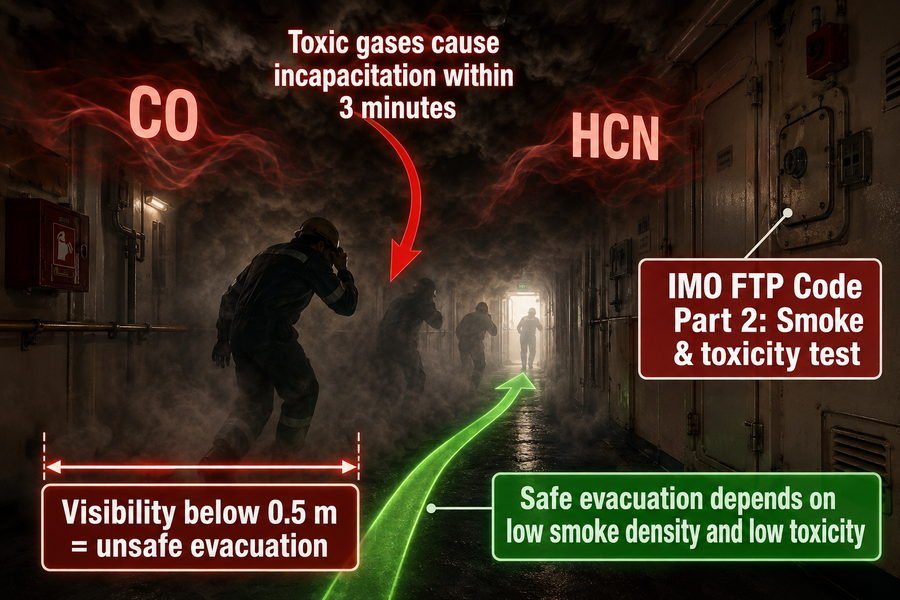
When I worked at the outfitting factory, I saw many buyers focus only on fire ratings. They completely ignored smoke generation. But let me tell you, ignoring smoke is a fatal mistake for your marine interior projects. If the passengers cannot see the exit or breathe the air, a high fire rating will not save them.
How Does Smoke Density Affect Cabin Evacuation Visibility?
Imagine running through a narrow ship corridor with zero visibility. Dense smoke causes panic and blocks escape routes. Understanding how smoke density cuts visibility can save lives during ship evacuations.
Smoke density affects cabin evacuation visibility by scattering and absorbing light, reducing the viewing distance to under 0.5 meters. This happens through three main factors: particulate concentration, corridor dimensions, and lighting power, completely blinding passengers and preventing them from finding the emergency exits in a fire.
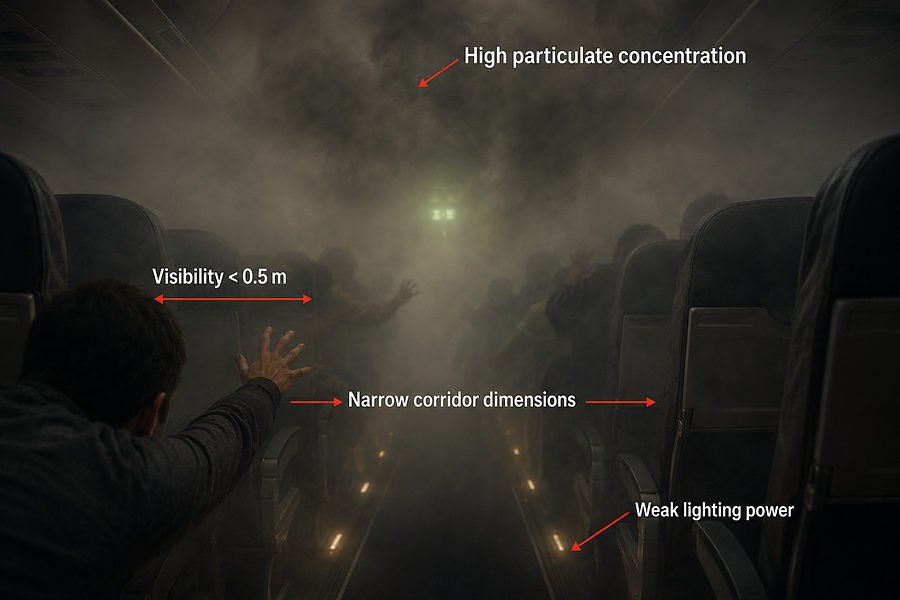
When I first started in the marine outfitting industry, I watched lab tests on burning wall panels. I learned that smoke density is an immediate threat to human life1. Smoke density affects cabin evacuation visibility through three main factors. The first factor is particulate concentration. The second factor is corridor dimensions. The third factor is lighting power. I will explain all three factors below.
The Impact of Particulate Concentration on Viewing Distance
Particulate concentration is the amount of solid soot in the air. When cheap marine panels burn, their surface films create heavy black soot. This soot physically blocks light. According to the ISO 5659-2 testing standard, we measure this using a metric called Specific Optical Density (Ds). If the maximum Specific Optical Density (Ds) reaches 200, the smoke absorbs almost all light. At a Ds level of 200, the viewing distance drops to less than 0.5 meters.2 Passengers cannot even see their own hands. They cannot find the emergency exit signs on the walls. This is why the IMO Fire Test Procedures (FTP) Code strictly limits the Ds value3 for marine interior materials. You must ensure your materials stay well below this density limit.
How Corridor Dimensions and Lighting Power Change Escape Routes
The physical space on a ship also changes how smoke acts. The second factor is corridor dimensions. Standard ship corridors are narrow, usually only 1.2 meters wide. Smoke fills this small space very fast. The smoke gets dense much quicker than it would in a large land-based room. The third factor is lighting power. Standard emergency exit lights on ships provide about 100 lumens of brightness. In clear air, 100 lumens is plenty. But in dense smoke, 100 lumens cannot penetrate the soot particles. According to fire safety engineering tests, when the optical density is high, the light simply scatters. It creates a solid white wall effect. This completely blinds the passengers and traps them.
| Factor Name | Specific Measurement or Standard | Direct Impact on Evacuation Visibility |
|---|---|---|
| Particulate Concentration | ISO 5659-2 (Specific Optical Density Ds) | Reduces safe viewing distance to under 0.5 meters. |
| Corridor Dimensions | Standard 1.2-meter ship corridor width | Causes smoke to fill the escape route rapidly. |
| Lighting Power | Standard 100-lumen emergency lights | Light scatters in smoke, causing total passenger blindness. |
What Toxic Gases Do Burning Marine Panels Release?
Invisible killers hide in burning cheap panels. Breathing these fumes causes instant lung damage. You must know exactly what toxic gases these marine panels release to protect your crew.
Burning marine panels release four primary toxic gases: carbon monoxide (CO) from incomplete combustion, hydrogen cyanide (HCN) from nitrogen-rich adhesives, hydrogen chloride (HCl) from PVC coatings, and sulfur dioxide (SO2). All four gases interact to shut down respiratory functions and damage lung tissue within minutes.
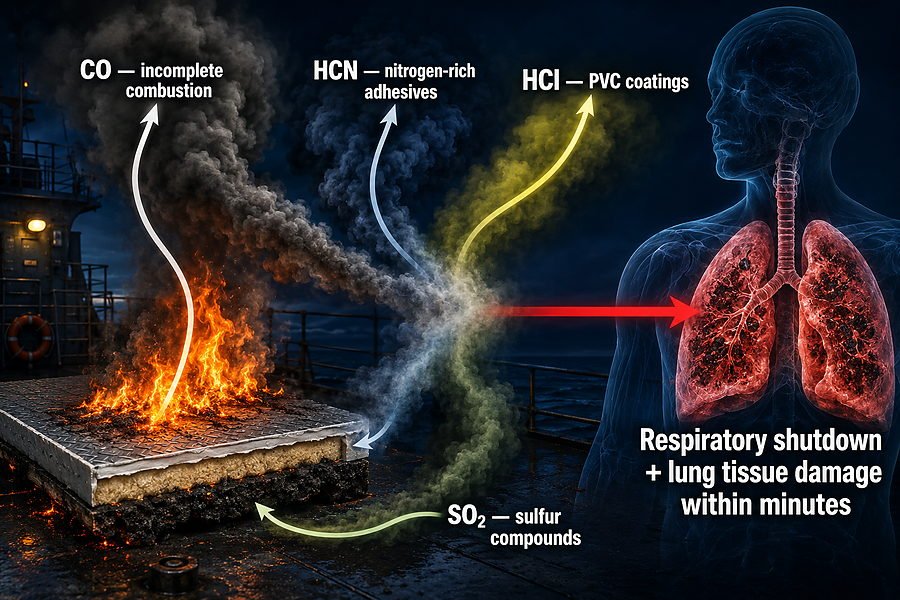
In my work at Magellan Marine, clients often ask me why standard commercial building panels cannot be used on ships. The answer is chemical composition. Burning marine panels release four primary toxic gases. The first is carbon monoxide (CO). The second is hydrogen cyanide (HCN). The third is hydrogen chloride (HCl). The fourth is sulfur dioxide (SO2). Each gas attacks the human body differently.
Release of Carbon Monoxide (CO) and Hydrogen Cyanide (HCN) from Panels
The first two gases stop the blood from carrying oxygen. The first gas is Carbon Monoxide (CO). CO comes from the incomplete combustion of the panel's core materials.4 According to the IMO FTP Code Part 2, the allowed limit for CO is 1450 ppm (parts per million). If the CO level goes over this, people pass out quickly. The second gas is Hydrogen Cyanide (HCN). HCN comes from the nitrogen-rich adhesives and glues used to press the panels together.5 The IMO limit for HCN is very strict at only 140 ppm. HCN is extremely dangerous because it stops human cells from using oxygen. If a person breathes HCN, their organs shut down in seconds.
Generation of Hydrogen Chloride (HCl) and Sulfur Dioxide (SO2) from Coatings
The next two gases destroy the lungs. The third gas is Hydrogen Chloride (HCl). HCl comes from burning PVC films and plastic surface coatings.6 The IMO limit for HCl is 600 ppm. When HCl touches the moisture in human lungs, it turns into hydrochloric acid. This acid literally burns the lung tissue from the inside. The fourth gas is Sulfur Dioxide (SO2). SO2 comes from the chemical flame retardants used in cheap panels. The IMO limit for SO2 is 120 ppm. SO2 causes massive throat swelling, which stops the person from breathing. You must buy panels that pass the IMO FTP Code Part 2 toxic gas limits7 to prevent these hazards.
| Toxic Gas Name | Chemical Source in Marine Panels | IMO FTP Code Part 2 Allowed Limit | Primary Effect on Human Body |
|---|---|---|---|
| Carbon Monoxide (CO) | Incomplete combustion of panel core | Maximum 1450 ppm | Stops blood from carrying oxygen. |
| Hydrogen Cyanide (HCN) | Nitrogen-rich panel adhesives | Maximum 140 ppm | Stops human cells from using oxygen. |
| Hydrogen Chloride (HCl) | PVC surface films and plastic coatings | Maximum 600 ppm | Burns lung tissue by forming acid. |
| Sulfur Dioxide (SO2) | Chemical flame retardants | Maximum 120 ppm | Causes severe throat swelling and choking. |
How Does Panel Smoke Toxicity Shorten Passenger Survival Time?
Trapped passengers have little time before losing consciousness. High toxicity cuts this window down to seconds. Let us look at how panel smoke toxicity drastically shortens passenger survival time.
Panel smoke toxicity shortens passenger survival time through three rapid physiological stages: eye irritation causing immediate blindness, respiratory tract inflammation blocking air flow, and systemic asphyxiation from blood oxygen depletion. Together, these three reactions reduce the typical 15-minute safe evacuation window to less than 3 minutes.
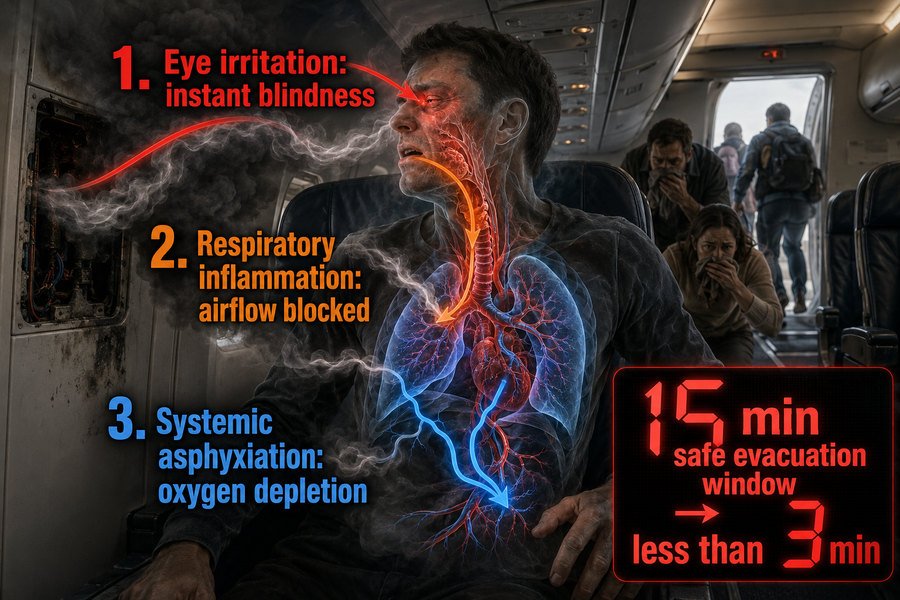
I once helped a shipyard review a fire accident report. The report showed that the fire did not kill the crew. The toxic smoke killed them before the fire even reached them. Panel smoke toxicity shortens passenger survival time through three rapid physiological stages. The first stage is eye irritation. The second stage is respiratory tract inflammation. The third stage is systemic asphyxiation. I will break down exactly how fast this happens.
Eye Irritation and Respiratory Tract Inflammation from Toxic Smoke
The first two stages stop a person from escaping. The first stage is eye irritation. When passengers encounter smoke with high Hydrogen Chloride (HCl) levels above 50 ppm8, their eyes react violently. Tears flood their eyes, and muscle spasms force their eyelids shut. This causes immediate functional blindness. Even if the smoke is not dense, they cannot open their eyes to find the exit. The second stage is respiratory tract inflammation. When passengers inhale Sulfur Dioxide (SO2) above 100 ppm9, their throat and airway swell. The windpipe closes to protect the lungs. This blocks air flow entirely. The passenger begins to choke on their own bodily reactions. They cannot run, and they drop to the floor.
Systemic Asphyxiation and the Reduction of the Safe Evacuation Window
The final stage causes death. The third stage is systemic asphyxiation. While the passenger is on the floor, they breathe in Carbon Monoxide (CO). CO binds to human hemoglobin 200 times faster than oxygen10. The blood stops delivering oxygen to the brain. According to marine fire safety engineering studies, a normal smoke-free evacuation gives passengers a 15-minute safe window. But when toxic gases trigger these three stages, that safe window drops to less than 3 minutes11. The passengers lose consciousness and die long before the rescue teams can reach them. This is the real danger of buying non-compliant interior materials.
| Physiological Stage | Triggering Factor from Smoke | Typical Time to Incapacitation | Result on Passenger Evacuation |
|---|---|---|---|
| Eye Irritation | HCl gas above 50 ppm | 30 to 60 seconds | Functional blindness; cannot find exits. |
| Respiratory Inflammation | SO2 gas above 100 ppm | 1 to 2 minutes | Windpipe closes; running becomes impossible. |
| Systemic Asphyxiation | CO gas binding to hemoglobin | Less than 3 minutes | Total loss of consciousness and death. |
Why Do Shipowners Reject High-Smoke Marine Panels?
Failed inspections cost shipyards millions in penalties. Non-compliant panels lead to rejected vessels. Shipowners reject high-smoke marine panels to avoid legal, financial, and severe operational disasters during ship delivery.
Shipowners reject high-smoke marine panels for four crucial reasons: failure to obtain Marine Equipment Directive (MED) Wheelmark certification, increased liability insurance premiums, higher risk of complete vessel loss, and failure to pass port state control (PSC) inspections. These four factors make high-smoke panels commercially unviable.
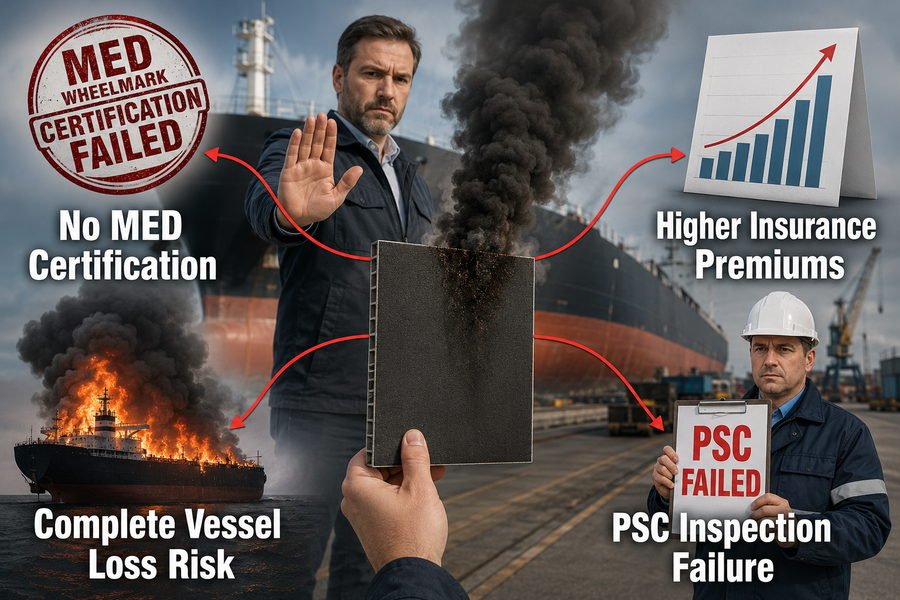
In my experience dealing with European and American shipyards, they are very strict about materials. You might think you can save money by buying cheaper, high-smoke panels. But the final buyer will not accept them. Shipowners reject high-smoke marine panels for four crucial reasons. First, they fail MED certification. Second, they fail PSC inspections. Third, they increase insurance premiums. Fourth, they cause complete vessel loss. Let me explain the commercial impact of these four reasons.
Failing MED Wheelmark Certification and Port State Control Inspections
The first two reasons are legal barriers. The first reason is the failure to obtain Marine Equipment Directive (MED) Wheelmark certification. For any ship sailing in European waters, all interior panels must carry the MED Wheelmark12. High-smoke panels cannot pass the IMO FTP Code Part 2 tests13, so they never get this mark. Without this mark, the ship is illegal. The second reason is the failure to pass Port State Control (PSC) inspections. When a ship arrives in a foreign port, PSC officers check the certificates of the interior materials14. If the materials are non-compliant, the officers will detain the ship. According to shipping industry averages, a detained ship costs the owner $20,000 to $30,000 per day15 in lost revenue and port fees.
The Burden of Increased Insurance Premiums and Vessel Loss Risks
The next two reasons are financial drains. The third reason is increased liability insurance premiums. Marine insurance companies send marine surveyors to inspect the ship. If the surveyor sees low-quality, high-smoke panels, they report a high fire hazard. The insurance company will then raise the vessel's annual premium by 15% to 20%. For a large commercial ship, this means hundreds of thousands of dollars extra every year. The fourth reason is the higher risk of complete vessel loss. In a real fire, high-smoke panels prevent the crew from putting out the fire quickly. The fire spreads, and the ship burns down completely. Shipowners know this, so they mandate low-smoke materials in all their shipbuilding contracts.
| Rejection Reason | Direct Consequence for the Shipowner | Estimated Financial Impact |
|---|---|---|
| MED Wheelmark Failure | Ship cannot be legally registered in Europe. | Complete rejection of the vessel delivery. |
| PSC Inspection Failure | Ship gets detained at the arrival port. | $20,000 to $30,000 per day in port penalties. |
| Increased Insurance | High hazard rating from marine surveyors. | 15% to 20% increase in annual premiums. |
| Complete Vessel Loss | Crew cannot fight the fire due to smoke. | Total loss of a multi-million dollar asset. |
Why Choose Low-Smoke Marine Panels Over Cheaper Ones?
Cheap panels seem great until your client refuses to pay. Low upfront costs often hide massive replacement bills later. Choosing low-smoke marine panels over cheaper ones guarantees your project success.
You must choose low-smoke marine panels over cheaper ones to secure three major advantages: guaranteed compliance with SOLAS regulations, avoidance of $50,000+ replacement rework costs, and faster approval from classification societies like DNV or ABS. These three benefits ensure your interior decoration projects remain profitable.
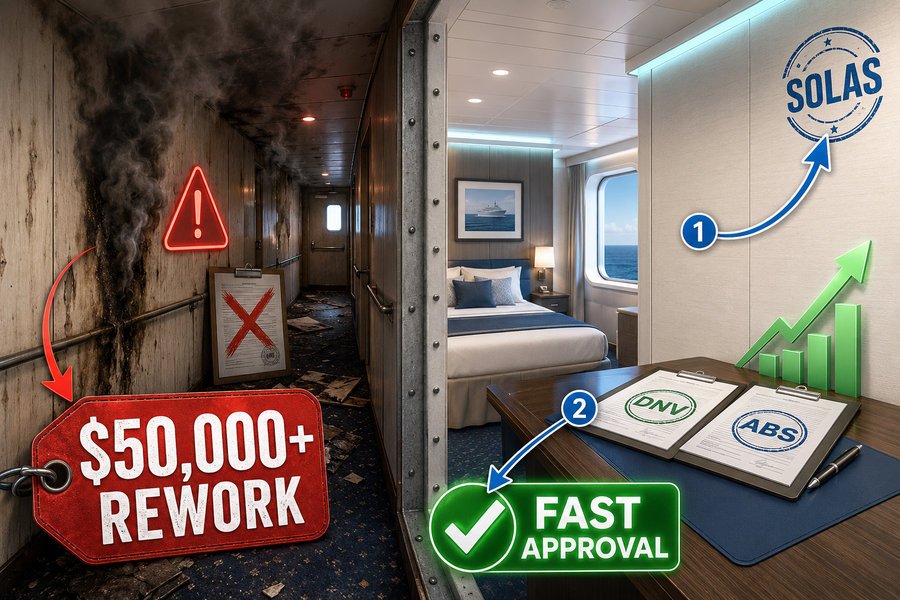
Procurement officers always look for the lowest price. I understand this because I deal with purchasing budgets every day at Magellan Marine. However, buying cheap panels is a trap. You must choose low-smoke marine panels over cheaper ones to secure three major advantages. The first advantage is guaranteed SOLAS compliance. The second is faster classification approval. The third is avoiding massive replacement rework costs. Here is the real math behind this choice.
Securing SOLAS Compliance and Faster Classification Society Approvals
The first two advantages keep your project on schedule. The first advantage is guaranteed compliance with SOLAS (Safety of Life at Sea) regulations. SOLAS Chapter II-2 strictly demands that interior finishes restrict the spread of toxic smoke.16 Low-smoke panels come with exact test reports proving this compliance.17 The second advantage is faster approval from classification societies like DNV, ABS, or Lloyd's Register. When the classification society surveyor walks onto the ship, they check your material certificates.18 If you use approved low-smoke panels, the surveyor stamps the approval in one day. If you use uncertified cheaper panels, the surveyor will halt the project and demand field tests. This delay can pause your interior decoration project for weeks.
Avoiding the Massive Financial Drain of Replacement Rework Costs
The third advantage protects your profit margin. The third advantage is the avoidance of massive replacement rework costs. Let me give you specific numbers. A cheap panel might cost $15 per square meter. A high-quality low-smoke panel costs around $25 per square meter. For a 2,000 square meter project, the cheap panel saves you $20,000 upfront. But when the shipyard rejects the cheap panels during final inspection, you have to tear them all down. Tearing down installed panels and installing new ones costs about $120 per square meter in labor and wasted materials.19 For that same 2,000 square meter project, your rework cost will be $240,000. You try to save $20,000, but you lose $240,000. This is why you must always buy the proper low-smoke panels.
| Financial Factor | Cheaper High-Smoke Marine Panels | Compliant Low-Smoke Marine Panels |
|---|---|---|
| Upfront Material Cost | $15 per square meter | $25 per square meter |
| Surveyor Approval Time | Weeks of delays and disputes | One day with proper certificates |
| Rework and Replacement | $120 per square meter (Labor + Materials) | $0 (No replacement needed) |
| Total Project Risk | Extremely High (Loss of profit) | Extremely Low (Guaranteed profit) |
How Do Ceiling Panel Fumes Hinder Crew Firefighting?
Firefighters need to see the flames to extinguish them. Toxic ceiling fumes blind crews and damage their gear. Ceiling panel fumes actively destroy your crew's ability to fight ship fires.
Ceiling panel fumes hinder crew firefighting by creating three massive obstacles: thermal imaging camera blockage from dense carbon soot, rapid clogging of Self-Contained Breathing Apparatus (SCBA) filters, and corrosive damage to firefighting hoses from acidic gases. These three obstacles completely paralyze the firefighting response efforts.
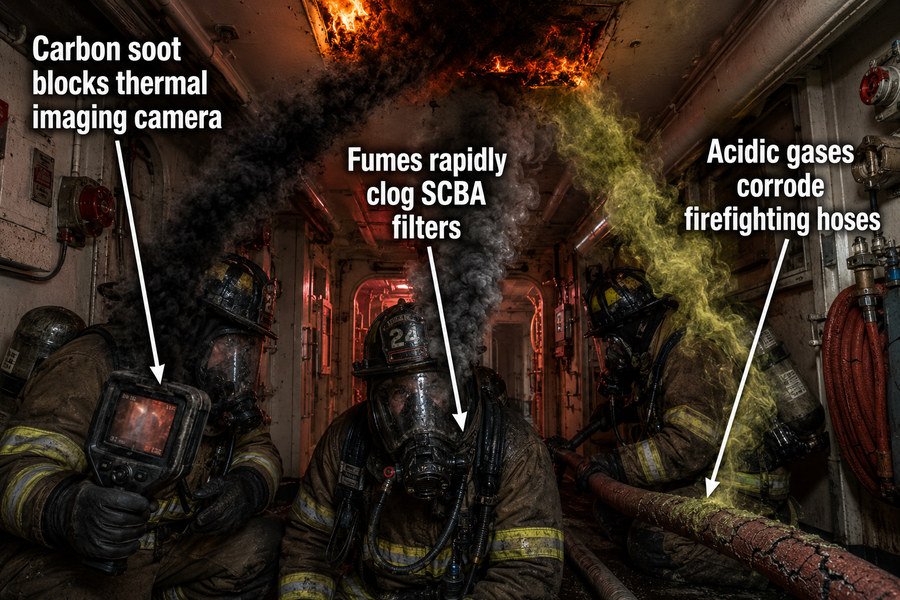
When a fire breaks out, the ship's crew becomes the fire department. They rely heavily on their emergency equipment. I have learned from safety drills that bad ceiling panels ruin this equipment. Ceiling panel fumes hinder crew firefighting by creating three massive obstacles. First, the fumes block thermal imaging cameras. Second, the fumes clog SCBA filters. Third, the fumes cause corrosive damage to the fire hoses.
Thermal Imaging Camera Blockage and SCBA Filter Clogging from Heavy Soot
The first two obstacles attack the firefighters' senses and air supply. The first obstacle is thermal imaging camera blockage. Firefighters use infrared cameras to find the hot spot of the fire through the smoke. These cameras read wavelengths between 8 and 14 micrometers20. However, the heavy carbon soot particles from cheap ceiling panels are large enough to block these infrared waves21. The camera screen just turns white, making it useless. The second obstacle is the rapid clogging of Self-Contained Breathing Apparatus (SCBA) filters. A standard SCBA tank and mask should give a crew member 45 minutes of safe breathing time. But the sticky, dense particulate matter from bad panels clogs the intake valves. This forces the crew member to breathe harder, draining the air tank in just 15 minutes.
Corrosive Damage to Firefighting Hoses from Acidic Fumes
The third obstacle attacks the water supply tools. The third obstacle is corrosive damage to firefighting hoses. As I mentioned earlier, burning cheap plastics release Hydrogen Chloride (HCl) gas22. When the firefighters spray water on the fire, the water mixes with the HCl gas in the air. This mixture creates liquid hydrochloric acid23. This acid drips onto the rubber and synthetic canvas of the firefighting hoses. It rapidly degrades the hose material. A standard fire hose operates at a pressure of 150 psi. When the acid weakens the rubber, the 150 psi pressure causes the hose to burst open. The crew loses their water pressure instantly. They cannot fight the fire, and they must retreat.
| Firefighting Equipment | Obstacle Created by Ceiling Fumes | Operational Consequence for the Crew |
|---|---|---|
| Thermal Imaging Cameras | Heavy carbon soot blocks infrared waves. | Crew cannot locate the source of the fire. |
| SCBA Breathing Masks | Sticky particulate matter clogs air valves. | Safe breathing time drops from 45 mins to 15 mins. |
| Firefighting Hoses | HCl gas mixes with water to form acid. | Acid weakens rubber, causing hoses to burst at 150 psi. |
Conclusion
Smoke toxicity and density determine life or death in ship fires. Choosing IMO-compliant, low-smoke marine panels protects your crew, ensures smooth vessel delivery, and secures your business profits.
-
"[PDF] A Legacy of Fire Safety - NIST Technical Series Publications", https://nvlpubs.nist.gov/nistpubs/SpecialPublications/NIST.SP.1325.pdf. Fire-safety literature identifies smoke as a principal life-safety hazard because it reduces visibility for escape and can expose occupants to toxic combustion products. Evidence role: expert_consensus; source type: government. Supports: Smoke density is an immediate threat to human life during fire evacuation.. Scope note: This supports the general hazard of smoke density but does not quantify risk for the specific marine cabin scenario described. ↩
-
"Smoke Obscuration Measurements in Reduced-Scale Fire ... - PMC", https://pmc.ncbi.nlm.nih.gov/articles/PMC6721433/. Research on visibility through fire smoke relates optical density or extinction coefficient to the distance at which objects and signs remain visible, providing context for estimating severe visibility loss at high smoke densities. Evidence role: mechanism; source type: paper. Supports: High smoke optical density can reduce viewing distance to very short ranges, such as under 0.5 meters.. Scope note: A chamber Ds value from ISO 5659-2 is not directly equivalent to corridor visibility without assumptions about path length, smoke distribution, target contrast, and illumination. ↩
-
"[PDF] RESOLUTION MSC.307(88) (adopted on 3 December 2010 ...", https://wwwcdn.imo.org/localresources/en/KnowledgeCentre/IndexofIMOResolutions/MSCResolutions/MSC.307(88).pdf. The IMO Fire Test Procedures Code includes smoke and toxicity testing requirements for materials used on ships and specifies acceptance criteria for smoke production. Evidence role: definition; source type: institution. Supports: The IMO FTP Code limits smoke-density values for marine interior materials.. Scope note: The exact Ds limits vary by material category and test condition, so the cited provision should be checked against the specific panel or surface material being discussed. ↩
-
"Carbon Monoxide Toxicity - StatPearls - NCBI Bookshelf", https://www.ncbi.nlm.nih.gov/books/NBK430740/. Authoritative fire-safety and public-health sources describe carbon monoxide as a product of incomplete combustion of carbon-containing materials and explain that it impairs oxygen transport by binding to hemoglobin. Evidence role: mechanism; source type: government. Supports: Carbon monoxide can be generated by incomplete combustion of panel core materials and can interfere with oxygen transport in the body.. Scope note: This evidence supports the general combustion chemistry and health mechanism; it does not prove the emission rate from any particular panel core formulation. ↩
-
"[PDF] Reduction of hydrogen cyanide concentrations and acute inhalation ...", https://nvlpubs.nist.gov/nistpubs/Legacy/IR/nistir4441.pdf. Fire-toxicity literature reports that hydrogen cyanide may be produced during combustion of nitrogen-containing organic materials, including some polymers, resins, foams, and adhesive systems. Evidence role: mechanism; source type: paper. Supports: Nitrogen-rich adhesives or related panel constituents can generate hydrogen cyanide during combustion.. Scope note: This provides contextual support for nitrogen-containing adhesives as a possible source of HCN; actual HCN production depends on the specific adhesive chemistry and fire conditions. ↩
-
"Toxicity of the Pyrolysis and Combustion Products of Poly(Vinyl ...", https://www.nist.gov/publications/toxicity-pyrolysis-and-combustion-products-polyvinyl-chlorides-literature-assessment. Combustion and thermal-decomposition studies of polyvinyl chloride identify hydrogen chloride as a major evolved gas from PVC and other chlorine-containing plastics. Evidence role: mechanism; source type: research. Supports: Burning PVC films or chlorine-containing plastic coatings can release hydrogen chloride gas.. Scope note: This supports PVC as a plausible HCl source; it does not establish that all plastic surface coatings used on panels contain PVC or chlorine. ↩
-
"[PDF] RESOLUTION MSC.61(67) (adopted on 5 December 1996 ...", https://wwwcdn.imo.org/localresources/en/KnowledgeCentre/IndexofIMOResolutions/MSCResolutions/MSC.61(67).pdf. The IMO Fire Test Procedures Code, Part 2, specifies smoke and toxicity test criteria for marine materials, including maximum concentrations for selected combustion gases such as CO, HCl, HCN, SO₂, NOx, HF, and HBr. Evidence role: definition; source type: institution. Supports: Marine panels should be assessed against IMO FTP Code Part 2 toxic gas limits rather than ordinary commercial building-panel requirements.. Scope note: This supports the existence and scope of the regulatory limits, not the toxicity of any specific Magellan Marine panel product. ↩
-
"Hydrogen chloride - NIOSH Pocket Guide to Chemical Hazards - CDC", https://www.cdc.gov/niosh/npg/npgd0332.html. A toxicology or occupational-health source should document that hydrogen chloride is a strong mucous-membrane irritant and that exposures in the tens of ppm can cause severe eye and respiratory irritation, supporting the plausibility of rapid visual impairment in smoke exposure. Evidence role: mechanism; source type: government. Supports: HCl levels above 50 ppm can cause severe eye irritation that may prevent passengers from seeing exits.. Scope note: The exact threshold for forced eyelid closure or functional blindness depends on exposure duration, individual sensitivity, and the full smoke mixture, so the source may support the mechanism more directly than the precise 50 ppm cutoff. ↩
-
"Sulfur dioxide - IDLH | NIOSH | CDC", https://www.cdc.gov/niosh/idlh/7446095.html. An occupational-health or toxicology source should show that sulfur dioxide is a potent respiratory irritant and that high-level exposure around 100 ppm is immediately dangerous, with bronchoconstriction and airway irritation that can impair breathing. Evidence role: mechanism; source type: government. Supports: SO2 exposure above 100 ppm can rapidly inflame or constrict the respiratory tract and impair escape.. Scope note: Such sources are likely to support respiratory irritation and bronchoconstriction, but may not directly support the absolute statement that the windpipe closes entirely in every exposed passenger. ↩
-
"Carboxyhemoglobin Toxicity - StatPearls - NCBI Bookshelf", https://www.ncbi.nlm.nih.gov/books/NBK557888/. A medical or biochemical reference should state that carbon monoxide has roughly 200–250 times greater affinity for hemoglobin than oxygen, forming carboxyhemoglobin and reducing oxygen delivery to tissues. Evidence role: mechanism; source type: paper. Supports: Carbon monoxide preferentially binds hemoglobin and interferes with oxygen transport to the brain and other tissues.. Scope note: Most sources describe relative binding affinity rather than binding speed, so the article’s wording may need adjustment from “faster” to “more strongly” or “with higher affinity.” ↩
-
"Summary of SOLAS chapter II-2 - International Maritime Organization", https://www.imo.org/en/ourwork/safety/pages/summaryofsolaschapterii-2-default.aspx. A fire-safety engineering source using available safe egress time or fractional effective dose models should show that toxic fire effluents such as CO, HCl, and irritant gases can reduce tenability and incapacitation times to only a few minutes under severe smoke conditions. Evidence role: expert_consensus; source type: research. Supports: Toxic smoke can sharply reduce the available safe evacuation time compared with smoke-free conditions.. Scope note: The exact reduction from a 15-minute smoke-free evacuation window to less than 3 minutes is scenario-dependent and may require a marine-specific fire model or case study rather than a general toxic-smoke reference. ↩
-
"RESOLUTION MSC.307(88) (adopted on 3 December ...", https://wwwcdn.imo.org/localresources/en/KnowledgeCentre/IndexofIMOResolutions/MSCResolutions/MSC.307(88).pdf. The EU Marine Equipment Directive establishes conformity-assessment and wheel-marking requirements for specified marine equipment placed on board EU-flagged ships, including fire-protection materials covered by implementing lists; this supports the regulatory basis for requiring approved interior materials. Evidence role: general_support; source type: government. Supports: For any ship sailing in European waters, all interior panels must carry the MED Wheelmark.. Scope note: The source may not state that every interior panel on every ship sailing in European waters requires the Wheelmark; applicability depends on flag state, vessel type, and whether the material falls within listed marine equipment categories. ↩
-
"[PDF] RESOLUTION MSC.307(88) (adopted on 3 December 2010 ...", https://wwwcdn.imo.org/localresources/en/KnowledgeCentre/IndexofIMOResolutions/MSCResolutions/MSC.307(88).pdf. The IMO FTP Code includes a smoke and toxicity test procedure for materials used on ships, providing the technical basis for assessing whether materials meet smoke-production requirements. Evidence role: definition; source type: institution. Supports: High-smoke panels cannot pass the IMO FTP Code Part 2 tests, so they never get this mark.. Scope note: This supports that smoke production is tested under the FTP Code; it does not by itself prove that every product described as a high-smoke panel will fail without product-specific test results. ↩
-
"Port State Control - International Maritime Organization", https://www.imo.org/en/ourwork/iiis/pages/port%20state%20control.aspx. Port State Control procedures under IMO and regional memoranda of understanding authorize inspectors to examine ship certificates and documentation, including statutory compliance records, as part of foreign-port inspections. Evidence role: mechanism; source type: institution. Supports: When a ship arrives in a foreign port, PSC officers check the certificates of the interior materials.. Scope note: This supports the inspection mechanism generally; it may not specifically list interior-panel certificates in every PSC inspection checklist or jurisdiction. ↩
-
"Port State Control - International Maritime Organization", https://www.imo.org/en/ourwork/iiis/pages/port%20state%20control.aspx. Industry and institutional studies of port-state-control detentions report that detention can impose substantial daily costs through lost charter revenue, port charges, and operational delays, providing context for the financial impact of detention. Evidence role: statistic; source type: research. Supports: According to shipping industry averages, a detained ship costs the owner $20,000 to $30,000 per day in lost revenue and port fees.. Scope note: The exact USD 20,000–30,000 daily figure may vary by vessel type, charter market, port, and delay duration; a source may support the order of magnitude rather than this precise range. ↩
-
"What Is the IMO FTP Code for Marine Interior Materials?", https://magellanmarinetech.com/what-imo-ftp-code-for-marine-interior-materials/. The source should document that SOLAS Chapter II-2 and the IMO Fire Test Procedures Code regulate fire safety characteristics of shipboard interior surface materials, including flame spread and smoke/toxicity testing for certain finishes. Evidence role: definition; source type: institution. Supports: SOLAS Chapter II-2 requires ship interior finishes to meet fire-safety standards related to flame spread and smoke/toxicity.. Scope note: The support is likely to describe regulatory requirements generally; it may not use the article’s stronger phrasing that SOLAS ‘strictly demands’ this for all interior finishes. ↩
-
"[PDF] RESOLUTION MSC.307(88) (adopted on 3 December 2010 ...", https://wwwcdn.imo.org/localresources/en/KnowledgeCentre/IndexofIMOResolutions/MSCResolutions/MSC.307(88).pdf. The source should explain that marine fire-protection materials are assessed through standardized fire-test procedures and that certificates or test reports are used to demonstrate conformity with applicable IMO/SOLAS requirements. Evidence role: mechanism; source type: institution. Supports: Compliant low-smoke marine panels are typically accompanied by standardized test documentation used to demonstrate regulatory conformity.. Scope note: The source can support the certification mechanism, but it will not prove that every low-smoke panel sold by a particular supplier has compliant test reports. ↩
-
"Ship classification society - Wikipedia", https://en.wikipedia.org/wiki/Ship_classification_society. The source should show that classification societies and flag-state survey processes rely on approved documentation, material certificates, or type-approval evidence when verifying shipboard materials against class and statutory requirements. Evidence role: general_support; source type: institution. Supports: Classification surveyors commonly review material certificates or approval documents as part of verifying compliance of installed marine materials.. Scope note: This would support the general inspection practice; it may not establish the exact actions of every surveyor on every project. ↩
-
"[PDF] “The State of U.S. Shipbuilding” - House Armed Services Committee", https://armedservices.house.gov/uploadedfiles/03.11.25_spf_state_of_shipbuilding_orourke_statement.pdf. The source should provide neutral evidence on the financial impact of construction or shipbuilding rework, such as documented labor, material, and schedule costs associated with removing and replacing nonconforming work. Evidence role: statistic; source type: paper. Supports: Replacement rework can create substantial labor and material costs after nonconforming panels have already been installed.. Scope note: A neutral source may support the general magnitude and cost drivers of rework rather than the article’s specific $120 per square meter figure, which may require project-specific cost data. ↩
-
"Broadband thermal imaging using meta-optics - Nature", http://labs.ece.uw.edu/amlab/Papers_Journals/Broadband_Thermal_Imaging.pdf. A technical source on firefighting thermal imagers or infrared thermography can substantiate that long-wave infrared cameras commonly operate in the 8–14 µm band. Evidence role: definition; source type: education. Supports: Firefighting thermal imaging cameras commonly read infrared radiation in the 8–14 micrometer range.. Scope note: This supports the sensor wavelength range, not the later claim that smoke will necessarily make the screen unusable. ↩
-
"The research on infrared radiation affected by smoke or fog in ... - PMC", https://pmc.ncbi.nlm.nih.gov/articles/PMC11193785/. Research on infrared imaging in fire environments can support that smoke and soot can attenuate or scatter infrared radiation and reduce thermal-image clarity. Evidence role: mechanism; source type: paper. Supports: Soot or smoke particulates can interfere with infrared thermal imaging used in fire conditions.. Scope note: Such sources may support degradation of image quality generally, but may not prove that ceiling-panel soot specifically makes a camera screen turn white in all cases. ↩
-
"Medical Management Guidelines for Vinyl Chloride - CDC", https://wwwn.cdc.gov/TSP/MMG/MMGDetails.aspx?mmgid=278&toxid=51. Fire chemistry and toxicology references can document that chlorine-containing plastics such as PVC can release hydrogen chloride gas during combustion or thermal decomposition. Evidence role: mechanism; source type: government. Supports: Some burning plastics can release hydrogen chloride gas, especially chlorine-containing materials such as PVC.. Scope note: This supports HCl release from chlorine-containing plastics specifically; it does not show that all inexpensive ceiling panels contain such plastics. ↩
-
"Hydrogen chloride - Wikipedia", https://en.wikipedia.org/wiki/Hydrogen_chloride. Chemical safety references can support that hydrogen chloride is highly soluble in water and forms hydrochloric acid when dissolved. Evidence role: mechanism; source type: government. Supports: Hydrogen chloride gas dissolves in water to form hydrochloric acid.. Scope note: This establishes the chemical mechanism, but not the concentration of acid that would form during a specific shipboard fire. ↩