Buying marine panels without checking the class certificate scope leads to rejected inspections and costly delays. Let me show you how to match certificate details to your exact order.
A marine panel class certificate scope must exactly match the order across six critical dimensions: thickness, fire rating, finish options, core material, vessel type, and manufacturing location. Mismatches in any of these areas will result in the Classification Society rejecting the panels during vessel installation.
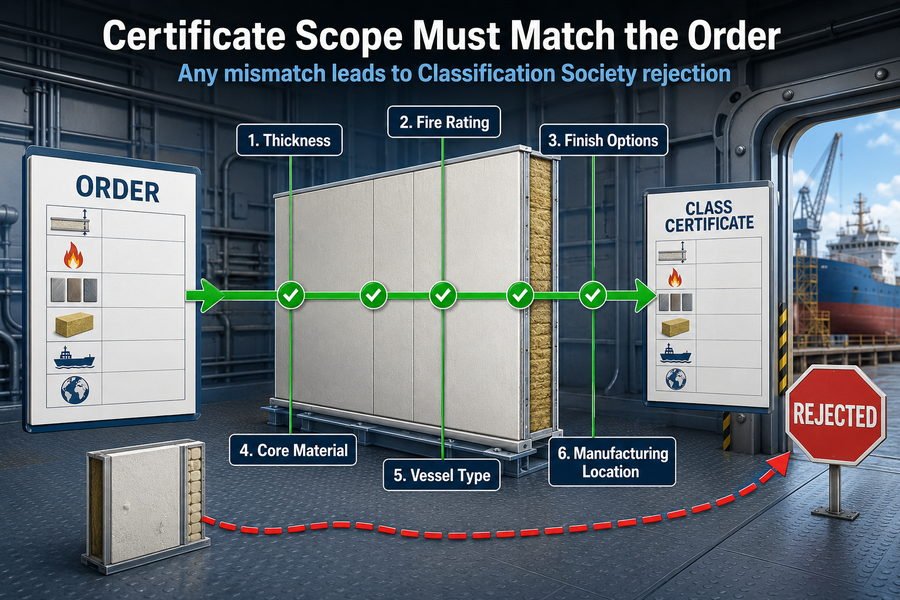
Let us break down exactly why each of these certificate parameters must align perfectly with your purchase order to keep your shipyard project on schedule.
Does a Marine Panel Class Certificate Cover All Thicknesses or Only the Tested One?
Ordering a 25mm panel with a certificate tested at 50mm can ruin your project. You need to know exactly what thickness ranges the marine class society actually approved.
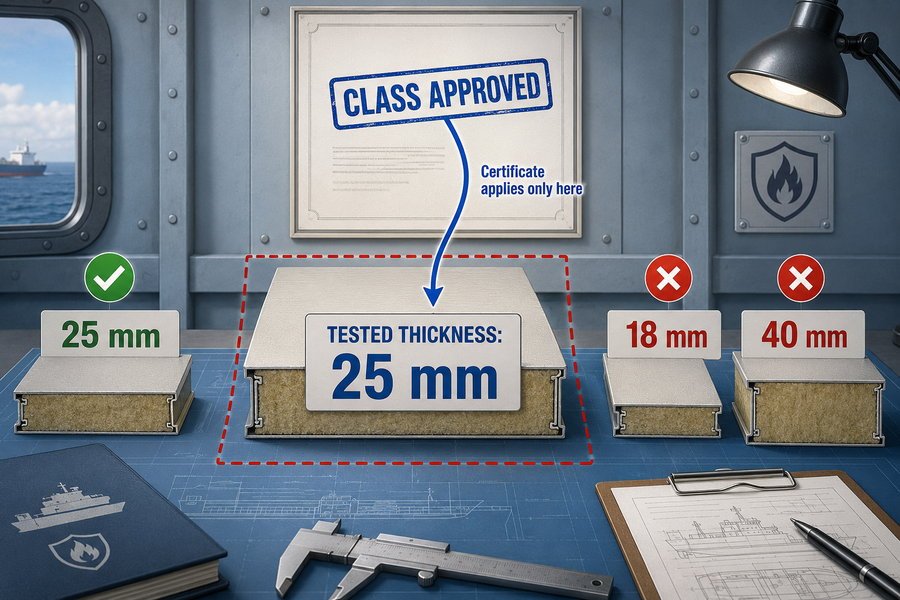
A marine panel class certificate only covers the specific thickness tested, or a strictly defined range if multiple thicknesses were tested. According to IMO FTP Code Annex 1 Part 3, any deviation from the certified thickness range completely invalidates the fire rating approval.
Impact of Panel Thickness on Fire Resistance Testing
Many buyers think that if a factory can make a 50mm panel pass a fire test, a 25mm panel of the same material is automatically safe. This is not true. The IMO FTP Code Annex 1 Part 3 requires panels to block heat transfer for a specific time.1 I have seen 50mm rock wool panels keep the unexposed side below a 140°C average temperature rise for 60 minutes. However, a 25mm panel with the exact same density will transfer heat much faster2 and fail the test in just 15 or 20 minutes. The thickness is the physical barrier. If you change the thickness, you change the physical barrier. This means the panel acts differently in a real fire. Therefore, class societies like DNV or ABS demand strict adherence to the tested thickness.
Defining Approved Thickness Ranges in Classification Certificates
A marine panel class certificate usually lists a strictly defined range rather than a single number. Factories want to sell many sizes, so they test the minimum and maximum thicknesses. For example, a factory might test a 25mm panel and a 50mm panel. If both pass the B-15 fire test, the classification society will issue a certificate covering the range from 25mm to 50mm. You can safely order a 30mm or 40mm panel using this certificate. You cannot order a 20mm panel or a 75mm panel. Testing marine panels is expensive. A standard fire test costs between $5,000 and $8,000 per panel type3 at a certified lab. Factories often skip testing sizes they rarely sell. You must check the exact numbers on the Type Approval certificate before you pay the deposit.
| Panel Ordered | Certificate Scope | Approval Status | Action Required |
|---|---|---|---|
| 50mm Rock Wool Panel | 50mm only | Approved | Proceed with order |
| 30mm Rock Wool Panel | 25mm to 50mm | Approved | Proceed with order |
| 20mm Rock Wool Panel | 25mm to 50mm | Rejected | Find new supplier or request new test |
| 75mm Rock Wool Panel | 50mm only | Rejected | Find new supplier or request new test |
Why Is a Marine Panel Class Certificate Valid for B-15 but Not A-60?
You bought a B-15 panel, but the surveyor demands A-60 for the engine room. Using the wrong rating puts the whole ship at risk and wastes your budget.
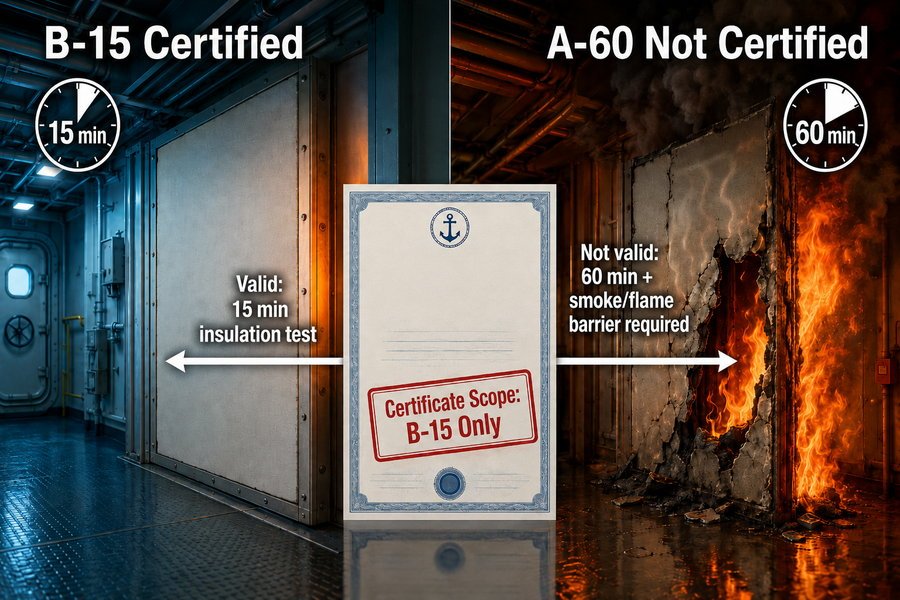
A marine panel certificate is valid for B-15 but not A-60 because they meet different IMO SOLAS fire testing criteria. A-60 panels must block smoke, flames, and limit temperature rise for 60 minutes, while B-15 panels only require 15 minutes of temperature resistance.
SOLAS Regulations for A-Class and B-Class Marine Panels
The International Convention for the Safety of Life at Sea (SOLAS) sets different rules for different parts of a ship. An A-60 panel and a B-15 panel serve completely different purposes. A-Class panels go into high-risk areas like engine rooms and stairwells. SOLAS requires an A-60 panel to stop smoke and flames for 60 full minutes4. It must also keep the average temperature rise on the safe side below 140°C for those 60 minutes. B-Class panels go into low-risk areas like cabin partitions. A B-15 panel only needs to stop smoke and flames for 30 minutes, and it only needs to limit the temperature rise for 15 minutes. A certificate for B-15 proves nothing about the panel's ability to survive a 60-minute fire.
Structural Differences Between A-60 and B-15 Certified Panels
Because the test rules are so different, the panels are built differently. You cannot use a B-15 certificate for an A-60 panel because the materials do not match. To pass the A-60 test, factories use heavy, high-density rock wool. The density usually ranges from 120 kg/m3 to 150 kg/m3, and the steel skins are thicker, often 0.6mm or more5. To pass the B-15 test, factories use lighter rock wool. I usually see B-15 panels with a rock wool density of 80 kg/m3 to 100 kg/m3 and 0.5mm steel skins. If you try to put a B-15 panel in an A-60 bulkhead, the core will fail long before 60 minutes.
| Fire Rating | Integrity Requirement (Smoke/Flame) | Insulation Requirement (Temp Rise) | Typical Core Density |
|---|---|---|---|
| A-60 | 60 Minutes | 60 Minutes | 120 - 150 kg/m3 |
| A-30 | 60 Minutes | 30 Minutes | 100 - 120 kg/m3 |
| A-0 | 60 Minutes | 0 Minutes | No insulation required |
| B-15 | 30 Minutes | 15 Minutes | 80 - 100 kg/m3 |
Are Marine Wall Panel Finish Options Included in the Class Certificate Scope?
Adding a beautiful PVC film to a certified bare panel might seem harmless. However, unapproved finishes burn fast and will fail the surveyor inspection.
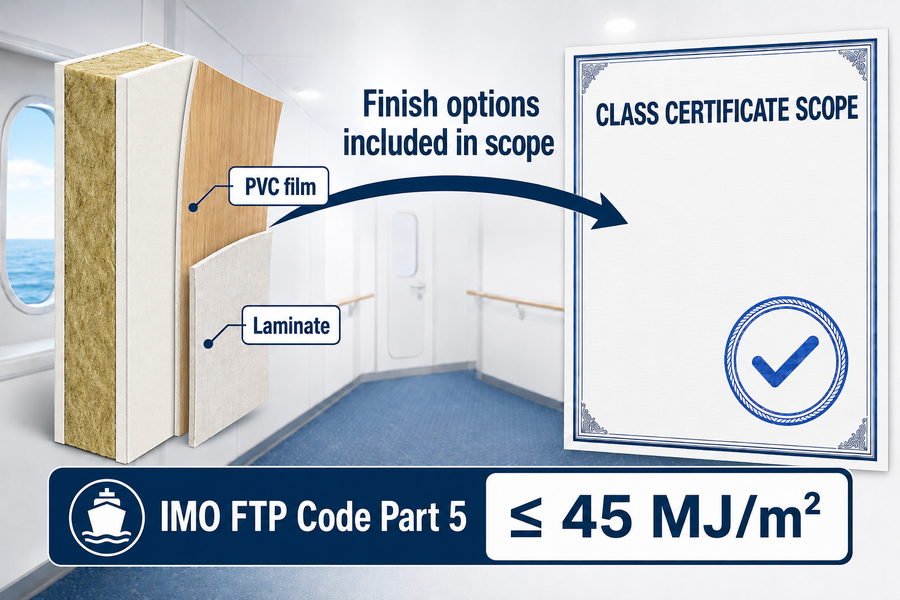
Marine wall panel finish options are strictly included in the class certificate scope. Any surface material, such as PVC films or laminates, must pass the IMO FTP Code Part 5 test for low flame spread and have a maximum calorific value of 45 MJ/m2.
IMO FTP Code Part 5 Requirements for Surface Finishes
The surface of a marine panel is the first thing a fire touches. The IMO FTP Code Part 5 requires all surface finishes to have low flame spread characteristics6. This means the fire must not travel quickly across the wall. The regulations also set a strict limit on the calorific value. According to SOLAS Chapter II-2, the combustible material on the panel surface cannot exceed a calorific value of 45 MJ/m27. PVC films, PET laminates, and paints all burn differently. A 0.15mm PVC film might pass the test easily. But a thicker 0.6mm PVC film might contain too much plastic and exceed the 45 MJ/m2 limit. I always warn my clients not to buy a certified bare panel and glue local PVC film on it. The classification society will reject it because the added film was never tested.
Verifying Finish Approvals on the Type Approval Certificate
You must read the certificate carefully to see which finishes are allowed. The Type Approval certificate will list the exact surface materials the factory used during the fire test. Sometimes, the certificate says "Approved for bare steel only." If you see this, you cannot order the panel with PVC film. If the certificate says "Approved with low flame spread PVC film, maximum thickness 0.2mm," then you are safe to order PVC finishes up to 0.2mm thick. Classification societies require the factory to provide separate lab reports for every type of finish they offer.
| Finish Type | Maximum Thickness limit | Calorific Value Limit | Testing Required |
|---|---|---|---|
| Bare Galvanized Steel | N/A | N/A | None (Non-combustible) |
| Standard PVC Film | Usually 0.15mm - 0.2mm | < 45 MJ/m2 | IMO FTP Code Part 5 |
| Marine Paint | Usually 50 - 100 microns | < 45 MJ/m2 | IMO FTP Code Part 5 |
| High-Pressure Laminate | Varies by manufacturer | < 45 MJ/m2 | IMO FTP Code Part 5 |
Why Does a Rock Wool Core Marine Panel Certificate Exclude Honeycomb Core Panels?
Switching from heavy rock wool to light aluminum honeycomb saves weight. But using the rock wool certificate for the honeycomb panel is completely illegal.
A rock wool core certificate excludes honeycomb panels because they have entirely different thermal insulation properties. Rock wool is a non-combustible material providing excellent temperature resistance, whereas aluminum honeycomb melts at approximately 660°C and fails standard IMO temperature rise requirements without additional insulation.
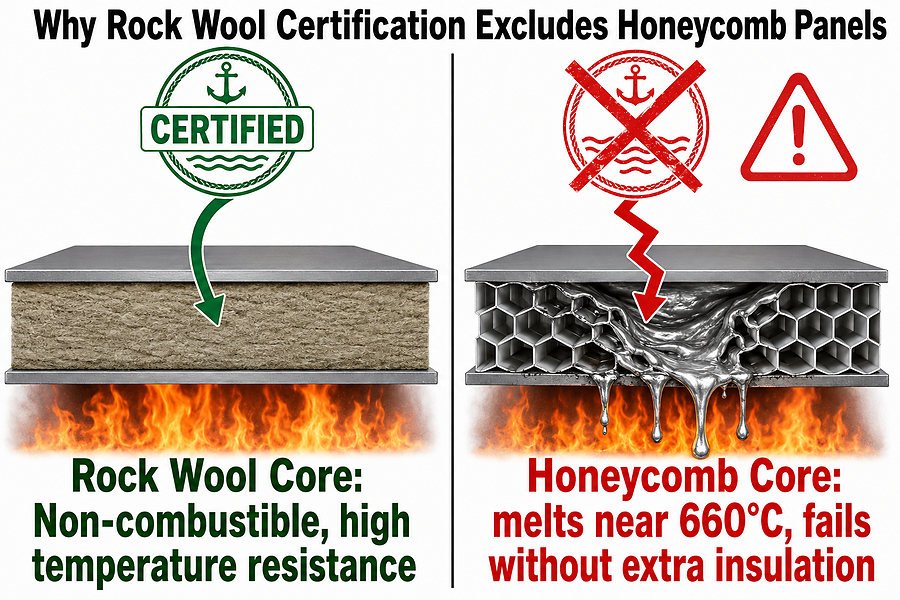
Thermal Conductivity Differences Between Rock Wool and Aluminum Honeycomb
The core material is the heart of a marine fire panel. You cannot swap the core without a new certificate.8 Rock wool provides excellent temperature resistance. It is made from spun volcanic rock and can withstand temperatures over 1000°C without melting9. It traps air inside its fibers, which blocks heat transfer. Aluminum honeycomb has completely different thermal insulation properties. Aluminum is a great conductor of heat.10 If a fire starts on one side of a honeycomb panel, the heat travels instantly through the aluminum cells to the other side. Furthermore, aluminum melts at approximately 660°C. Standard marine fires reach 800°C within the first 10 minutes.11 A bare aluminum honeycomb core will melt and collapse very quickly.
Certification Testing Failures for Uninsulated Honeycomb Cores
Because aluminum honeycomb melts at 660°C, it fails standard IMO temperature rise requirements very fast. A factory cannot take a rock wool B-15 certificate and apply it to an aluminum honeycomb panel. The honeycomb panel will fail the B-15 test unless the factory adds extra materials. To make a honeycomb panel pass a marine fire test, factories usually insert ceramic wool or specific intumescent materials inside the aluminum cells. This creates a completely new product structure. The classification society treats this new structure as a new invention. It requires a brand-new fire test and a brand-new certificate. Never accept a rock wool certificate for a honeycomb order.
| Core Material | Melting Point | Heat Transfer Rate | Typical Marine Application |
|---|---|---|---|
| Rock Wool (Mineral Wool) | > 1000°C | Very Low | Standard A-Class and B-Class bulkheads |
| Aluminum Honeycomb | ~ 660°C | High | Lightweight non-combustible partitions (C-Class) |
| Ceramic Wool | > 1200°C | Very Low | High-heat areas, honeycomb fire insulation |
| Polyurethane Foam | < 200°C | High (Burns rapidly) | Cold rooms (Not allowed for fire bulkheads) |
How Does a Shipyard Engineer Confirm a Marine Panel Certificate Covers the Target Vessel Type?
Buying panels for a commercial ship using a high-speed craft certificate can block your installation. Different vessels demand different regulatory approvals.
A shipyard engineer confirms vessel coverage by checking the certificate's regulatory standards and issuing society. They verify compliance with SOLAS for commercial vessels, HSC Code for high-speed craft, or USCG approval for vessels operating in United States waters, ensuring the society matches the ship's flag state.
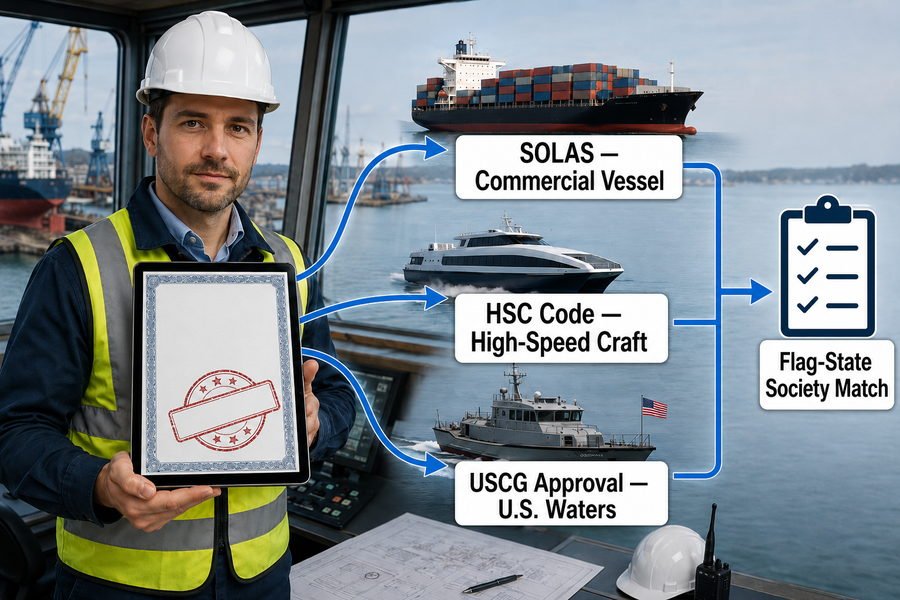
Verifying SOLAS, HSC, and USCG Regulatory Standards on Certificates
Shipyard engineers read the first page of the certificate very carefully. They look for specific regulatory standards. If the shipyard is building a standard cargo ship or passenger vessel, the engineer checks for SOLAS compliance. If they are building a fast ferry, they check for the HSC Code (High-Speed Craft Code). HSC regulations allow lighter materials but require different fire test profiles12. A SOLAS certificate does not automatically cover an HSC vessel13. Additionally, if the ship will sail in United States waters, the engineer must look for USCG (United States Coast Guard) approval. Many European certificates have a Mutual Recognition Agreement (MRA) with the USCG14. The engineer looks for the specific USCG approval number printed on the certificate document.
Matching the Classification Society to the Vessel's Flag State
Every ship sails under a flag state, like Panama, Liberia, or the Marshall Islands. The flag state gives authority to specific classification societies to inspect the ship15. An engineer must confirm the issuing society of the panel matches the ship's flag state rules. If a ship is being built under DNV classification, the shipyard engineer wants DNV certificates for the panels. If you buy panels with a CCS (China Classification Society) certificate, the DNV surveyor might reject them. Sometimes, surveyors accept certificates from other societies belonging to IACS (International Association of Classification Societies). However, the shipyard engineer must ask the surveyor for permission first.
| Vessel Type / Destination | Required Standard | Typical Weight Focus | Key Authority Checking |
|---|---|---|---|
| Standard Commercial Cargo | SOLAS | Heavy / Standard | IACS Members (DNV, LR, ABS, etc.) |
| High-Speed Ferry | HSC Code | Extremely Light | Flag State Authority |
| Vessels in US Waters | USCG Approval / MRA | Standard | United States Coast Guard |
| Inland River Vessels | Local River Rules | Moderate | Local Maritime Safety Administration |
Why Must the Factory Location on a Marine Panel Class Certificate Match the Production Site?
A supplier shows you a valid certificate but ships panels from a new, cheaper factory. The surveyor will reject these panels immediately upon arrival.
The factory location on a certificate must match the production site because Classification Societies audit specific facilities for quality control. An ISO 9001 audit and a factory production control (FPC) assessment are bound to one physical address to guarantee consistent manufacturing processes and material traceability.
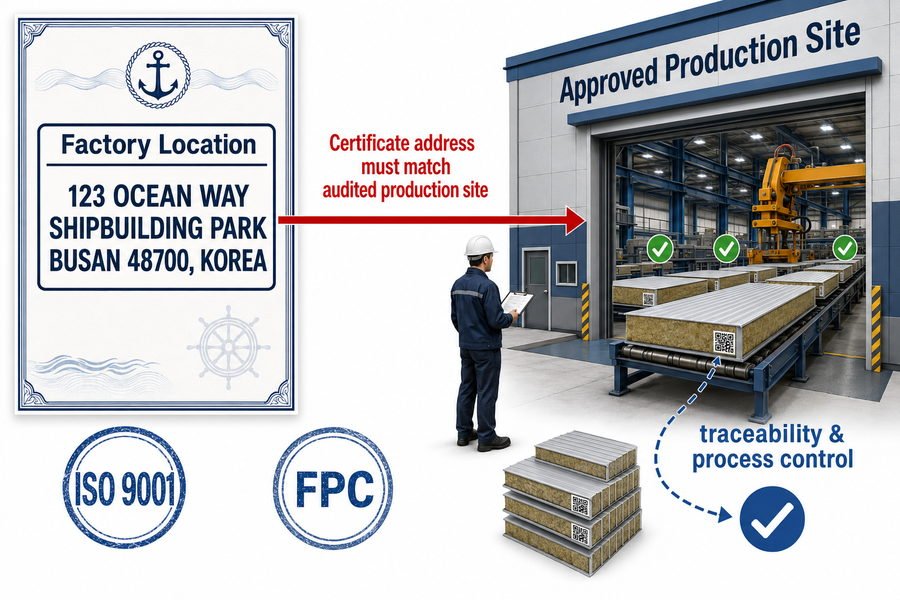
The Role of Factory Production Control (FPC) Assessments
A fire test only proves that one single panel passed the standard. It does not prove the factory can make 1,000 good panels. This is why classification societies conduct a factory production control (FPC) assessment. A surveyor visits the exact physical address of the factory. They inspect the glue machines, the steel presses, and the rock wool storage area. They verify the ISO 9001 quality management system is working at that specific location. If the supplier moves production to a different address, the surveyor has never seen the new machines or the new workers. The classification society immediately voids the certificate because the FPC assessment is no longer valid.
When panels are made in an unauthorized facility, you lose all material traceability. Marine Equipment Directive (MED) Module D rules require strict tracking of raw materials. The certified factory must record exactly which batch of rock wool went into which panel. A cheaper, un-audited factory will likely buy cheap, low-density rock wool to save money. The final panel might look identical on the outside, but it will fail in a fire. I always tell buyers to check the shipping documents. If the bill of lading shows the panels shipped from a different city than the address on the Type Approval certificate, the classification society surveyor at the shipyard will flag it and reject the cargo.
| Audit Type | Purpose | Bound to Physical Address? | Frequency of Renewal |
|---|---|---|---|
| Type Approval Fire Test | Proves the design works | No (Done in a Lab) | Usually every 5 years |
| Factory Production Control (FPC) | Proves consistent quality | Yes | Annually |
| ISO 9001 Certification | Proves management system | Yes | Every 3 years |
| MED Module D Audit | Proves material traceability | Yes | Annually |
Conclusion
Always verify the thickness, fire rating, finish, core material, vessel type, and factory location on marine panel certificates. Matching these details prevents costly surveyor rejections during your shipyard installations.
-
"What Is the Purpose and Scope of the IMO FTP Code? - Magellan ...", https://magellanmarinetech.com/what-purpose-scope-of-imo-ftp-code/. The IMO FTP Code, Annex 1, Part 3 specifies fire-resistance testing for A-, B-, and F-class divisions and uses insulation criteria based on limiting temperature rise on the unexposed face for defined time ratings. Evidence role: definition; source type: government. Supports: IMO FTP Code Annex 1 Part 3 requires panels to limit heat transfer for a specified duration during fire-resistance testing.. ↩
-
"[PDF] STEADY HEAT CONDUCTION", http://cecs.wright.edu/~sthomas/htchapter03.pdf. Standard heat-transfer theory treats conductive thermal resistance as proportional to material thickness, so reducing panel thickness lowers resistance and can increase heat flow under otherwise comparable conditions. Evidence role: mechanism; source type: education. Supports: A thinner panel of the same material and density can transfer heat faster because reduced thickness lowers the conductive thermal barrier.. Scope note: This supports the physical mechanism but does not prove the exact 15- or 20-minute failure time for any particular marine panel construction. ↩
-
"Fire testing laboratories - International Maritime Organization", https://www.imo.org/en/ourwork/safety/pages/firetestinglaboratories-default.aspx. Published fire-test laboratory fee schedules or institutional testing-price lists can document that full-scale fire-resistance testing commonly costs several thousand U.S. dollars per specimen or assembly. Evidence role: statistic; source type: institution. Supports: A standard fire test for a marine panel can cost approximately $5,000 to $8,000 per panel type at a certified lab.. Scope note: Testing prices vary by laboratory, jurisdiction, standard, specimen size, and reporting requirements, so a fee schedule would provide contextual support rather than a universal price. ↩
-
"What Is the Purpose and Scope of the IMO FTP Code? - Magellan ...", https://magellanmarinetech.com/what-purpose-scope-of-imo-ftp-code/. The IMO SOLAS/FTP Code definitions for Class A divisions state that they must prevent the passage of smoke and flame for a one-hour standard fire test, and the A-60 subclass must maintain the prescribed insulation temperature limits for 60 minutes. Evidence role: definition; source type: institution. Supports: SOLAS requires A-60 marine fire divisions to maintain integrity for 60 minutes and meet A-60 insulation criteria during that period.. Scope note: The source defines fire divisions and test classifications, not the performance of every commercial panel sold as A-60. ↩
-
"How to choose the right fire class for marine wall panels?", https://magellanmarinetech.com/how-choose-right-marine-wall-panels-for-marine-interior-projects/. Classification-society type-approval documentation or independent fire-test reports for tested A-60 marine bulkhead panels commonly list high-density mineral-wool cores and steel facings around this thickness, supporting the statement as an observed construction pattern rather than a SOLAS requirement. Evidence role: general_support; source type: institution. Supports: A-60 certified marine panels are commonly constructed with higher-density mineral wool and thicker steel skins, often around the stated density and thickness ranges.. Scope note: SOLAS is performance-based; density and skin thickness are not universal regulatory values and can vary by tested design and approval certificate. ↩
-
"[PDF] RESOLUTION MSC.307(88) (adopted on 3 December 2010 ...", https://wwwcdn.imo.org/localresources/en/KnowledgeCentre/IndexofIMOResolutions/MSCResolutions/MSC.307(88).pdf. The IMO FTP Code, Annex 1, Part 5 sets the test method and performance criteria for surface flammability of bulkhead, ceiling, and deck-finish materials, providing the regulatory basis for describing approved finishes as having low flame-spread characteristics. Evidence role: definition; source type: institution. Supports: The IMO FTP Code Part 5 requires surface finishes used on marine panels to demonstrate low flame-spread characteristics.. Scope note: This supports the regulatory meaning of the phrase, but the pass/fail status of any specific finish still depends on its individual test report or certificate. ↩
-
"When Does a Ship Refurbishment Trigger SOLAS Marine Panel ...", https://magellanmarinetech.com/when-ship-refurbishment-trigger-solas-marine-panel-compliance/. SOLAS Chapter II-2 includes a calorific-value restriction for combustible materials used on exposed interior surfaces, commonly cited as a maximum of 45 MJ/m² for such surface materials. Evidence role: statistic; source type: institution. Supports: SOLAS Chapter II-2 limits the calorific value of combustible material on the panel surface to 45 MJ/m².. Scope note: The citation should be checked against the applicable SOLAS edition and the exact ship-space category, because related provisions may vary by application and interpretation. ↩
-
"What Is the IMO FTP Code for Marine Interior Materials?", https://magellanmarinetech.com/what-imo-ftp-code-for-marine-interior-materials/. IMO fire-test procedures and type-approval practice assess a specified construction as tested, so a change in core material is a change to the approved assembly rather than a transferable property of the certificate. Evidence role: expert_consensus; source type: institution. Supports: A certified marine fire panel cannot simply change its core material and keep the same certificate.. Scope note: The source may state the requirement in terms of tested specimens, approved constructions, or type approval rather than using the exact phrase “swap the core.” ↩
-
"Mineral wool - Wikipedia", https://en.wikipedia.org/wiki/Mineral_wool. Technical references on mineral wool describe it as manufactured from molten rock or slag fibers and report service or melting temperatures around or above 1000°C, supporting its use as a high-temperature insulation material. Evidence role: general_support; source type: research. Supports: Rock wool can withstand temperatures over 1000°C without melting.. Scope note: Reported temperature limits vary by product composition and test method, so the source supports the general material property rather than every commercial rock-wool panel. ↩
-
"Thermal Conductivity - HyperPhysics", http://hyperphysics.phy-astr.gsu.edu/hbase/Tables/thrcn.html. Standard engineering references list aluminum’s thermal conductivity as far higher than that of mineral-wool insulation, supporting the claim that aluminum honeycomb cores provide conductive heat paths through panel cells. Evidence role: mechanism; source type: education. Supports: Aluminum has high thermal conductivity, so an aluminum honeycomb core can conduct heat more readily than a mineral-wool core.. Scope note: Bulk thermal-conductivity values do not by themselves prove the fire-test performance of a specific honeycomb panel, which also depends on geometry, skins, adhesives, air gaps, and added insulation. ↩
-
"[PDF] RESOLUTION MSC.307(88) (adopted on 3 December 2010 ...", https://wwwcdn.imo.org/localresources/en/KnowledgeCentre/IndexofIMOResolutions/MSCResolutions/MSC.307(88).pdf. The IMO FTP Code time–temperature curve for A- and B-class division fire tests specifies furnace temperatures as a function of time and is the relevant reference for evaluating claims about temperatures reached during standard marine fire testing. Evidence role: statistic; source type: institution. Supports: Standard marine fire-test temperatures are defined by an IMO time–temperature curve and should be cited when giving time-specific temperature values.. Scope note: The standard IMO cellulosic curve commonly cited for A/B divisions is closer to about 659°C at 10 minutes and about 821°C at 30 minutes, so a source may contextualize or challenge the article’s stated 800°C-in-10-minutes figure rather than directly confirm it. ↩
-
"[PDF] RESOLUTION MSC.97(73) (adopted on 5 December 2000 ...", https://wwwcdn.imo.org/localresources/en/KnowledgeCentre/IndexofIMOResolutions/MSCResolutions/MSC.97(73).pdf. The IMO High-Speed Craft Code sets construction and fire-safety requirements specifically for high-speed craft, reflecting design assumptions that differ from conventional SOLAS ships; this supports the need to verify HSC-specific fire testing and materials compliance. Evidence role: definition; source type: institution. Supports: HSC regulations allow lighter materials but require different fire test profiles.. Scope note: The source establishes the regulatory framework and general distinction, but it may not directly compare every permitted material or fire-test profile with SOLAS requirements. ↩
-
"High-speed craft - International Maritime Organization", https://www.imo.org/en/ourwork/safety/pages/hsc.aspx. IMO materials on the International Code of Safety for High-Speed Craft describe it as a code applying to high-speed craft in addition to the ordinary SOLAS framework, supporting the point that conventional SOLAS documentation alone is not necessarily sufficient for an HSC vessel. Evidence role: expert_consensus; source type: institution. Supports: A SOLAS certificate does not automatically cover an HSC vessel.. Scope note: The source supports the regulatory distinction; certificate acceptance still depends on the flag administration, class society, and the exact equipment or material approval involved. ↩
-
"[PDF] US-UK-Marine-Eq-MRA-signed.pdf - USTR", https://ustr.gov/sites/default/files/US-UK-Marine-Eq-MRA-signed.pdf. USCG guidance on mutual recognition of marine equipment approvals explains the basis on which certain European-approved marine equipment may receive U.S. Coast Guard acceptance under mutual recognition arrangements, supporting the need to verify the specific USCG approval basis on the certificate. Evidence role: historical_context; source type: government. Supports: Many European certificates have a Mutual Recognition Agreement (MRA) with the USCG.. Scope note: The support is contextual because eligibility depends on the equipment category, approval module, issuing body, and current USCG implementation rules; not every European certificate is covered. ↩
-
"RECOGNIZED ORGANIZATIONS", https://www.imo.org/en/OurWork/IIIS/Pages/Recognized-Organizations.aspx. IMO guidance on recognized organizations explains that flag administrations may delegate statutory survey and certification functions to classification societies or other recognized organizations, supporting the claim that the flag state controls which societies may act on its behalf. Evidence role: definition; source type: institution. Supports: The flag state gives authority to specific classification societies to inspect the ship.. Scope note: The source supports delegation of statutory functions generally; the exact list of authorized societies varies by flag administration and vessel type. ↩