You bought marine panels. The shipyard rejected them because the MED certificate was invalid. It hurts your profit and your schedule. I will show you how to avoid this big mistake.
Keeping the MED Wheel Mark valid requires passing an annual Module D factory audit, using only Module B approved materials like 120kg/m3 rock wool, keeping 10 years of quality records, and renewing certificates 3 months before the 5-year expiry date.
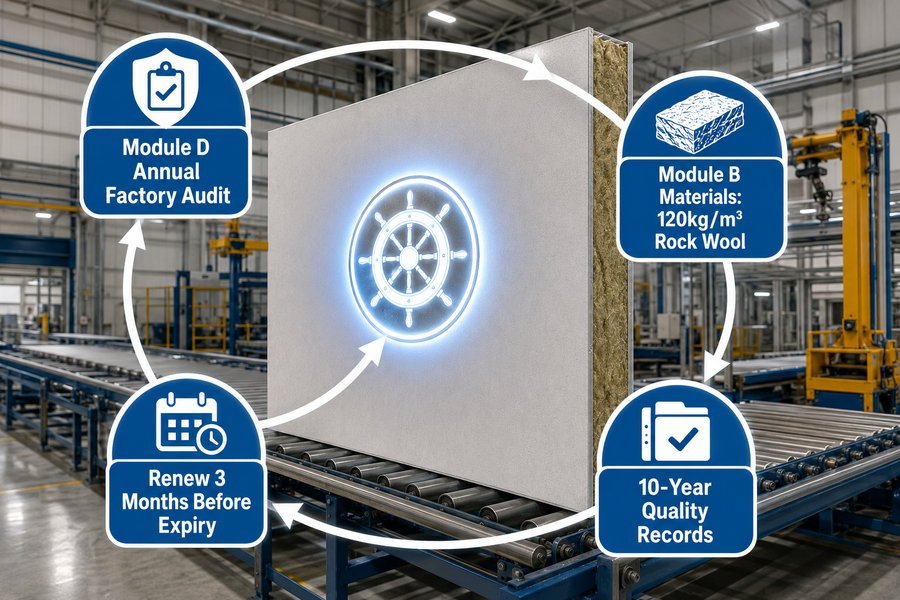
Let us look at the exact rules and steps to keep your panel production safe and your shipyards happy.
What Triggers MED Module D Factory Audits for Marine Accommodation Panels?
Factory audits can happen suddenly. This causes stress for production teams. A failed audit stops your shipments. Here are the clear reasons why an auditor visits your factory.
Four main events trigger a Module D audit: the initial certification application, annual routine surveillance, major production line changes, and high defect reports from port state control. You must prepare for all four to keep your marine panels compliant.
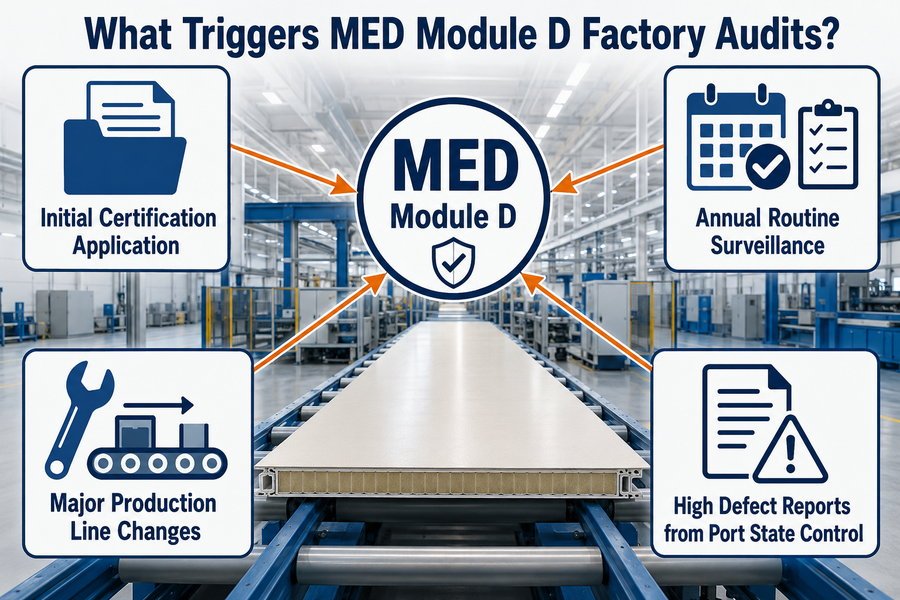
I have seen many factories fail because they did not know why an auditor was coming. You need to understand the four events that bring a Notified Body (NB) auditor to your door. According to the MED Directive 2014/90/EU, the auditor has the legal right to inspect your factory based on these triggers.1
Initial Certification and Annual Routine Surveillance for Marine Panel Facilities
The first event is the initial certification application. When a factory wants to start selling marine accommodation panels, they must pass this first big audit. The auditor from a Notified Body, such as DNV or Lloyd's Register, will spend two to three days at the factory. They check every part of the production line. This initial audit usually costs between $4,000 and $6,000.
The second event is the annual routine surveillance. Once you have the certificate, the auditor comes back every 12 months. This is a strict rule.2 They want to see if you still follow the exact same quality rules you had in the first year. This audit usually takes one to two days. The cost is around $1,500 to $2,500. I always tell my clients to prepare for this one month in advance. You must check your papers before the auditor arrives.
Managing Production Line Changes and High Defect Reports from Shipyards
The third event is a major production line change. If you buy a new laminating machine or move your factory to a new city, you must tell the Notified Body.3 The MED rules say you cannot just make big changes secretly. You must give them at least 30 days of notice. They will trigger a special audit to check the new setup. If you do not report the change, your certificate becomes invalid immediately.
The fourth event is high defect reports. This is the worst trigger. If a shipyard receives your marine accommodation panels and finds they fail fire safety checks, they will report you to Port State Control. Port State Control then informs the Notified Body. The Notified Body will trigger an emergency audit. They will come to your factory to find out why bad panels left your warehouse. This can lead to a direct cancellation of your MED Wheel Mark.4
| Audit Trigger Event | Notice Period to Notified Body | Auditor Time in Factory | Estimated Audit Cost |
|---|---|---|---|
| Initial Certification Application | N/A (Factory initiates) | 2 to 3 days | $4,000 - $6,000 |
| Annual Routine Surveillance | Scheduled by Notified Body | 1 to 2 days | $1,500 - $2,500 |
| Major Production Line Changes | 30 days before change | 1 day | $1,000 - $1,500 |
| High Defect Reports | Emergency (No notice) | 2 days | $2,000+ and fines |
How Often Are MED Surveillance Audits Required at Marine Accommodation Panel Factories?
Missing an audit deadline kills your certificate. Shipyards will not pay for uncertified goods. Knowing the exact timeline saves your business and protects your money.
MED surveillance audits happen in two ways: scheduled annual audits every 12 months, and unannounced random visits at least once every 3 to 4 years. Both are strictly required by the Notified Body to maintain the Module D quality certificate.
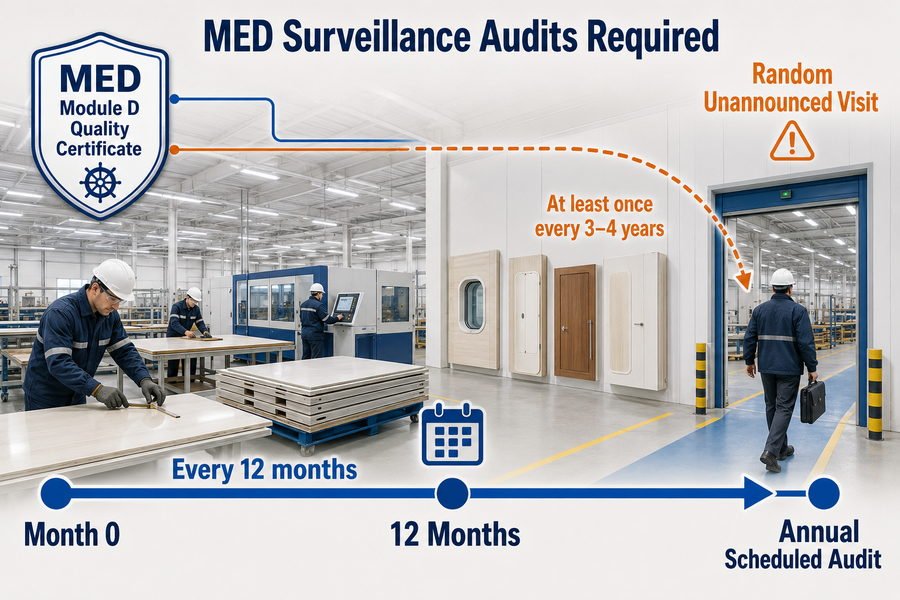
Time control is very important in marine outfitting. You cannot delay an auditor just because your factory is busy. The MED Directive sets clear timelines for factory inspections. You must follow these two frequency rules to keep your Module D certificate alive.
Managing the 12-Month Scheduled Annual Audits for Panel Production
The most common audit is the scheduled annual audit. The rule is very strict: the auditor must visit every 12 months5. There is usually a small time window, typically 30 days before or after the exact anniversary date of your certificate6. For example, if you got your certificate on May 15, the auditor will come between April 15 and June 15 next year.
In my experience working with marine panel suppliers in Asia, failing to book this annual audit is a big mistake. The Notified Body will not chase you. It is your job to contact them and pay the fee. The fee is usually $1,200 per day for the auditor, plus their flight and hotel costs. If you miss this 12-month window, the Notified Body will suspend your certificate. You cannot ship any panels with the Wheel Mark7 until the auditor finally comes.
Preparing for Unannounced Random Factory Visits by Notified Bodies
The second type of audit frequency is the unannounced random visit. Many factory owners do not know about this rule. The MED Directive 2014/90/EU gives the Notified Body the right to show up without any warning. Usually, this happens once every 3 to 4 years, depending on the risk level of your factory.
If your factory had problems in the past, the auditor will come more often. They will walk straight into your production line. They will check if you are testing the panels correctly on a normal Tuesday. You cannot hide anything. If your quality manager is on holiday, another person must know how to show the records. You must keep your factory ready every single day. This is the only way to survive an unannounced visit.
| Audit Frequency Type | Time Window | Factory Warning Time | Main Focus of Auditor |
|---|---|---|---|
| Scheduled Annual Audit | Every 12 months (± 30 days) | 30 to 60 days | Full review of quality system and records |
| Unannounced Random Visit | Every 3 to 4 years | 0 days (Surprise) | Real-time production checks and daily habits |
Does Changing Rock Wool Suppliers Invalidate MED Wheel Mark on Marine Accommodation Panels?
Finding a cheaper rock wool supplier saves money. But swapping materials blindly will ruin your certification. You must follow the material rules to stay safe.
Changing rock wool suppliers invalidates the MED mark unless you manage three scenarios: identical specs require Notified Body written approval, different specs require a new $5,000 Module B fire test, or keeping the current approved supplier keeps the mark valid.
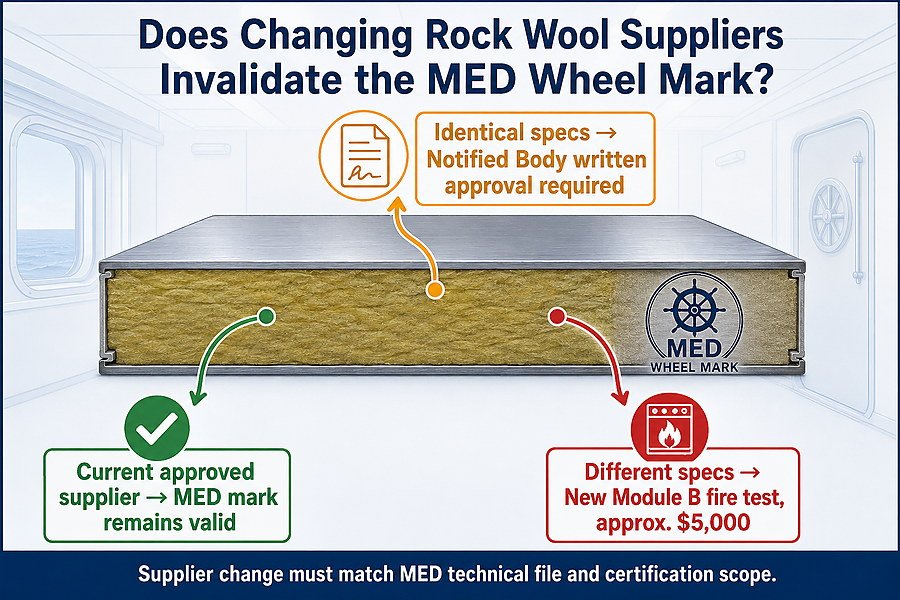
The core of a B-15 or A-60 marine accommodation panel is the rock wool. The Notified Body certified your panel based on the exact rock wool you used during the first fire test8. You cannot just change it. The IMO FTP Code 2010 Part 3 is very clear about material changes. We must look at the three exact scenarios.
Scenario 1 and 2: Identical Specs Approval and Different Specs Fire Testing
Scenario one is changing to a new supplier that has identical specifications. Suppose your current rock wool has a density of 120kg/m3 and a thickness of 50mm. You find a cheaper factory that makes the exact same 120kg/m3 rock wool. You cannot just buy it. You must send the new supplier's technical data to your Notified Body. The Notified Body must review it. They usually charge an administrative fee of $300 to $500. They will give you written approval within 14 to 21 days. Only then can you use the new rock wool.
Scenario two is changing to a new supplier with different specifications. Suppose you want to use a 100kg/m3 rock wool to save weight. This is a major change. Your old certificate is instantly invalid for this new design.9 You must perform a completely new Module B fire test. The fire test must reach temperatures up to 945°C10. This test costs between $5,000 and $8,000 at an approved laboratory. You also have to wait 30 to 60 days for a test slot.
Scenario 3: Keeping the Current Supplier to Maintain the Valid Mark
Scenario three is the safest choice: keeping your current approved supplier. If you do not change the supplier, your MED Wheel Mark stays valid. You do not need to pay for new fire tests or Notified Body reviews.
In my daily work, buyers often ask me to find cheaper panels. I always check if the factory changed their rock wool to cut costs illegally. If they changed the rock wool without telling the Notified Body, the panels are illegal. The shipyard will reject them. Sometimes, keeping the current supplier is cheaper than paying $8,000 for a new fire test and losing two months of production time. You must calculate the real costs before changing anything.
| Rock Wool Change Scenario | Required Action by Factory | Estimated Cost Impact | Time Impact |
|---|---|---|---|
| Scenario 1: Identical Specs | Get written NB approval | $300 - $500 | 14 to 21 days |
| Scenario 2: Different Specs | Perform new Module B fire test | $5,000 - $8,000 | 30 to 60 days |
| Scenario 3: No Change | Do nothing (Keep buying) | $0 | 0 days |
Which Production Records Are Required for MED Audits of Marine Accommodation Panels?
Auditors do not trust spoken words. They only trust paper. Missing records means an instant failure. Here is the exact list of papers you need.
You must maintain five core production records for MED audits: raw material Mill Test Certificates (MTC), daily quality control checklists, equipment calibration logs, non-conformance resolution reports, and final product traceability tags. MED rules require keeping these records for 10 years.
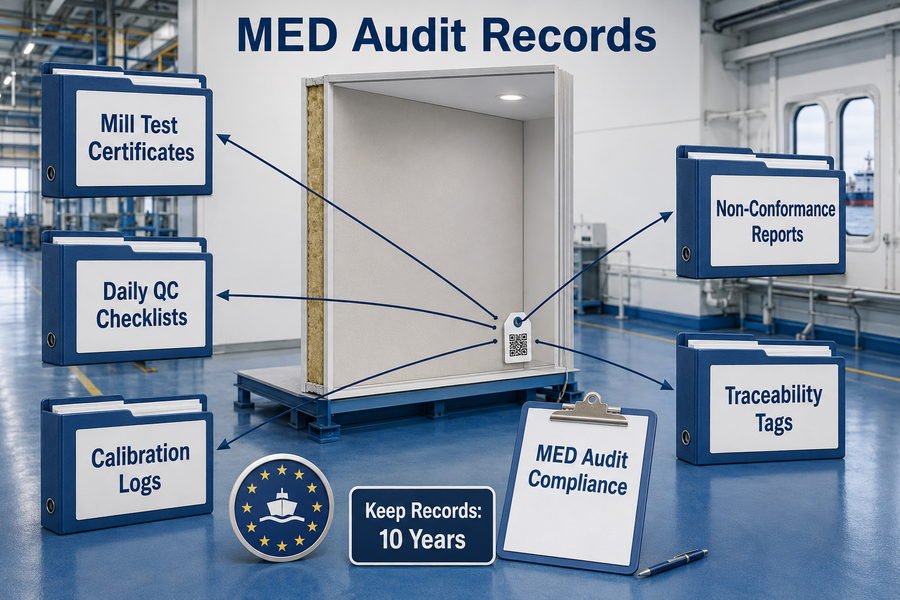
Good paperwork is the secret to a fast and easy audit. When the auditor sits in your meeting room, they want to see a clear history of your production. The MED Directive 2014/90/EU legally requires factories to keep records for 10 years after the last product was made. You must manage all five core records properly.
Handling Raw Material MTCs, Daily Checklists, and Calibration Logs for Audits
The first record is the raw material Mill Test Certificate (MTC). Every time you buy steel sheets, PVC films, or rock wool, the supplier must give you an MTC. The auditor will pick a random marine panel from your warehouse and ask to see the MTC for the steel used in that exact panel. You must show it immediately.
The second record is the daily quality control checklist. This paper proves your workers check the product every day. It includes checking the glue weight. For example, marine panel glue should be around 150g/m2. The worker must write this down. The auditor wants to see these daily numbers.
The third record is the equipment calibration log. Your factory uses weighing scales and temperature gauges on the pressing machine. These tools must be accurate. You must hire an outside company to test your tools every 12 months.11 The auditor will check the calibration stickers on your machines and the matching paper logs.
Managing Non-Conformance Reports and Product Traceability Tags
The fourth record is the non-conformance resolution report. Factories make mistakes. Panels get damaged. When a worker finds a bad panel, they must write a non-conformance report. This report explains what went wrong and how the factory fixed the problem. Auditors love to see these reports. It proves your quality system works and catches mistakes before they ship. If you show zero mistakes for a whole year, the auditor will think you are lying.
The fifth record is the final product traceability tag. Every marine accommodation panel must have a sticker or a laser mark. This mark shows the production date, the batch number, and the MED Wheel Mark.12 This tag connects the finished panel back to the raw material MTCs and the daily checklists. If a panel on a ship catches fire 5 years later, you use this tag to prove you built it correctly.
| Core Production Record | What It Proves to the Auditor | Update Frequency | Minimum Retention Period |
|---|---|---|---|
| Raw Material MTC | Materials meet Module B specs | Every material delivery | 10 Years |
| Daily QC Checklist | Workers follow daily standards | Every shift / daily | 10 Years |
| Equipment Calibration Log | Machines give accurate numbers | Every 12 months | 10 Years |
| Non-Conformance Report | Factory fixes its own mistakes | When a defect happens | 10 Years |
| Product Traceability Tag | Links panel to all factory data | Every finished panel | 10 Years |
How to Renew MED Certificates Before Expiry for Marine Accommodation Panel Lines?
Module B certificates expire every 5 years. Waiting until the last minute is dangerous. New tests take a long time to schedule.
Renewing MED certificates requires three strict steps: submitting the application 3 to 6 months before expiry, passing the Module B design re-evaluation, and completing the Module D factory renewal audit. Following this timeline prevents a gap in your certification.
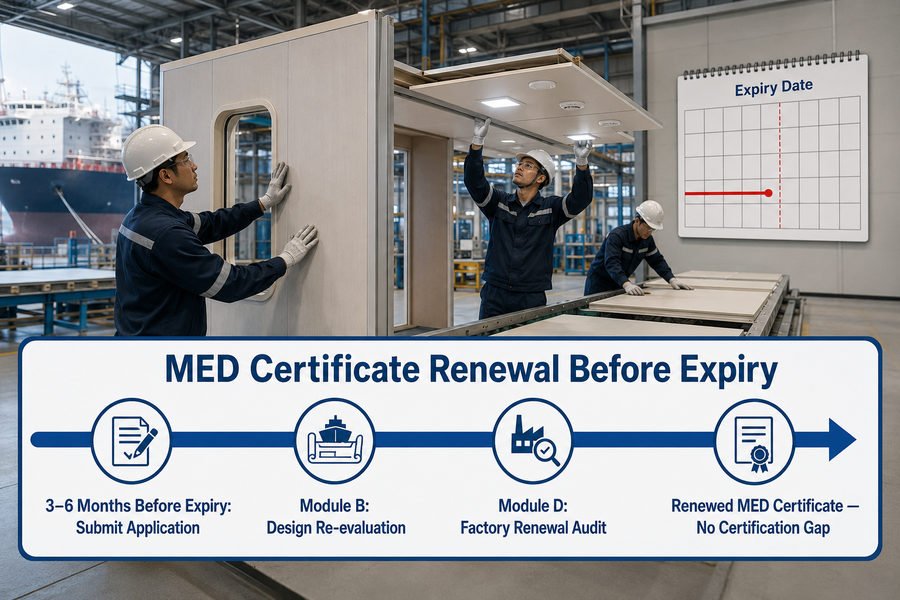
A valid MED certificate is your ticket to sell to shipyards in Europe and around the world. But certificates do not last forever. They have a hard expiration date, usually after 5 years13. You must manage the three renewal steps carefully. If you miss the date, you must stop selling immediately14.
Step 1: Submitting the Renewal Application 3 to 6 Months Early
The first step is submitting the renewal application early. You cannot apply one week before the certificate dies. The Notified Bodies are very busy. They need time to process your paper. I advise my factory clients to start the process 3 to 6 months (90 to 180 days) before the expiry date.
You must gather your old certificates, your current material lists, and your quality manual. You send this package to the Notified Body. They will review it to see if any IMO fire safety rules changed15 in the last 5 years. If the rules changed, they will tell you what you need to fix. This application step usually costs a small administrative fee, around $500 to $1,000.
Step 2 and 3: Module B Re-evaluation and Module D Renewal Audit
The second step is the Module B design re-evaluation. If the IMO rules did not change, the Notified Body might just renew your Module B design certificate based on your old fire tests. This saves you $5,000. However, if the rules changed, you might have to perform a new fire test. You must plan for this time. The re-evaluation fee from the Notified Body is usually around $2,000 to $3,000.
The third step is the Module D factory renewal audit. This is similar to your annual surveillance, but much deeper. The auditor comes to your factory and checks your records for the past 5 years. They check your 10-year storage system16. They interview your workers again. Once you pass this deep audit, the Notified Body will print your new certificate. Now you are safe to produce marine panels for another 5 years.
| Renewal Step | Ideal Action Timeline | Estimated Fees | Risk of Delay |
|---|---|---|---|
| Step 1: Submit Application | 90 to 180 days before expiry | $500 - $1,000 | Notified Body rejects late files |
| Step 2: Module B Re-evaluation | 60 to 90 days before expiry | $2,000 - $3,000 | New fire tests take 2 months |
| Step 3: Module D Renewal Audit | 30 days before expiry | $2,000 - $4,000 | Production line stops completely |
What Happens If Marine Accommodation Panels Ship Without MED Module D Marking?
Shipping uncertified panels seems like a quick fix for delays. It is actually a disaster. The penalties will destroy your project budget.
Shipping panels without the Module D mark causes three severe consequences: Port State Control detains the ship, the shipyard rejects the panels causing 60-day delays, and the panel supplier faces total replacement costs and fines reaching tens of thousands of dollars.
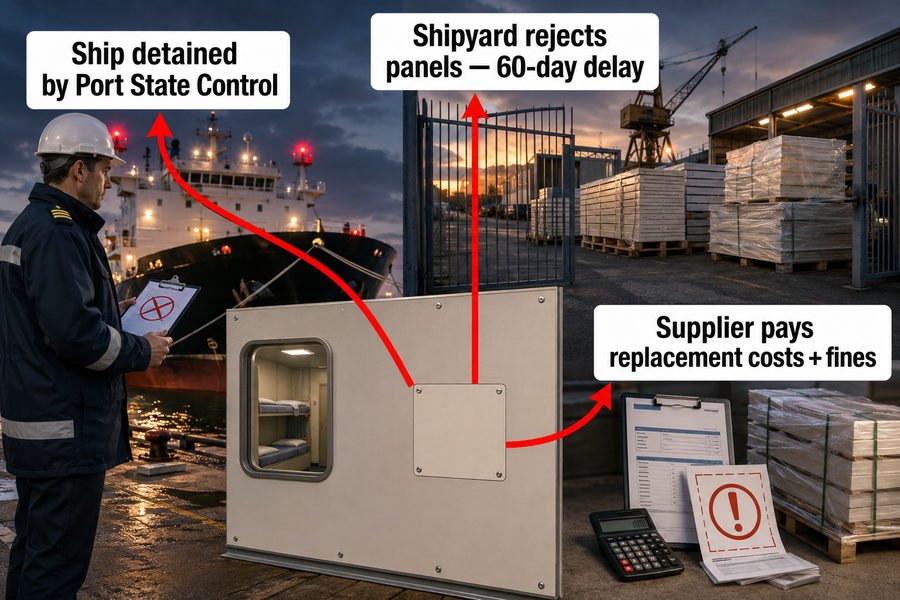
Sometimes a factory loses its certificate but still ships the panels to get the money. Or a buyer buys non-MED panels because they are cheap. This is a very bad idea. The marine industry is heavily regulated. The consequences of shipping without the Wheel Mark17 are huge. Let us look at the three direct results.
Consequence 1 and 2: Port State Control Detention and Shipyard Rejection
The first consequence is Port State Control detention18. When a ship is built, a surveyor checks it. If they see accommodation panels without the Wheel Mark, they will not give the ship a safety certificate. The ship cannot leave the port. Port fees are very high. A delayed ship can cost the owner $10,000 to $30,000 per day19. The ship owner will be very angry at the shipyard.
The second consequence is shipyard rejection. Shipyards know the rules. When your container arrives, their quality inspector checks the tags. If there is no Module D mark, they will reject the whole container. They will not even open the boxes. This causes a massive delay in their building schedule. It takes 30 to 60 days to order new panels, manufacture them, and ship them from Asia to Europe. The shipyard's interior decoration project completely stops.
Consequence 3: Total Replacement Costs and Supplier Financial Fines
The third consequence hits the pocket directly. Because the factory shipped illegal panels, they must pay for everything. They must pay to ship the bad panels back or destroy them. They must pay to remanufacture a completely new batch of panels with valid certificates. They must pay for express air shipping to try to save the shipyard's schedule.
Furthermore, the shipyard will charge the supplier financial fines for the delay. The contract usually has a penalty clause for late or wrong delivery. This fine can easily reach tens of thousands of dollars. In my career, I have seen suppliers go bankrupt because they tried to cheat the MED system just one time. It is never worth the risk.
| Severe Consequence | Who Discovers the Problem | Time Lost | Estimated Financial Loss |
|---|---|---|---|
| Port State Control Detention | Marine Surveyor | Weeks to Months | $10,000+ per day |
| Shipyard Rejection | Shipyard QC Inspector | 30 to 60 days | Project stops completely |
| Replacement Costs and Fines | Supplier Accounting Dept | N/A | $50,000+ total loss |
Conclusion
Keeping your MED Wheel Mark valid takes careful planning. Manage your audits on time, control your rock wool changes, and keep perfect records for 10 years to ensure lasting success.
-
"How Do EU Rules Differ From IMO Standards for Marine Panels ...", https://magellanmarinetech.com/how-eu-rules-differ-from-imo-standards-for-marine-panels/. Directive 2014/90/EU establishes the EU conformity-assessment framework for marine equipment and the role of notified bodies, including assessment and surveillance functions for certified equipment. Evidence role: general_support; source type: government. Supports: The Marine Equipment Directive provides the legal basis for notified-body audits or inspections of marine equipment manufacturers.. Scope note: The Directive may support notified-body authority generally without listing the article’s four triggers in the same operational wording. ↩
-
"How Do MED Modules B and D Affect Marine Accommodation Panel ...", https://magellanmarinetech.com/how-med-modules-b-d-affect-marine-accommodation-panel-procurement/. EU conformity-assessment rules for marine equipment require notified bodies to conduct periodic surveillance of approved quality systems after certification. Evidence role: mechanism; source type: government. Supports: After initial certification, manufacturers are subject to recurring surveillance audits by the Notified Body, potentially on an annual cycle.. Scope note: If the source states only “periodic” surveillance, it supports the continuing-audit obligation but not the exact twelve-month interval. ↩
-
"Directive 96/98/EC - Wikipedia", https://en.wikipedia.org/wiki/Directive_96/98/EC. EU conformity-assessment Module D requires manufacturers to keep the notified body informed of intended changes to an approved quality system, supporting the need to report substantial production or site changes. Evidence role: mechanism; source type: government. Supports: Major production-process or site changes must be reported to the Notified Body because they may affect the approved quality system.. Scope note: The legal text may not name examples such as a laminating machine or factory relocation; those examples are applications of the broader quality-system change rule. ↩
-
"How to Avoid EU Rejection of Marine Accommodation Panels for ...", https://magellanmarinetech.com/how-avoid-eu-rejection-marine-accommodation-panels-for-med-non-compliance/. Directive 2014/90/EU and the related conformity-assessment framework allow corrective action, restriction, suspension, or withdrawal of approvals or certificates when marine equipment is found non-compliant. Evidence role: mechanism; source type: government. Supports: Serious non-compliance or unresolved defects can result in loss, suspension, or withdrawal of MED Wheel Mark certification.. Scope note: The source supports cancellation or withdrawal as a possible regulatory consequence, not that it is automatic or direct in every defect case. ↩
-
"How Do MED Modules B and D Affect Marine Accommodation Panel ...", https://magellanmarinetech.com/how-med-modules-b-d-affect-marine-accommodation-panel-procurement/. Directive 2014/90/EU and its conformity-assessment module provisions state that notified bodies conduct periodic audits of approved production-quality systems, with the source used here supporting the annual surveillance requirement for Module D certification. Evidence role: general_support; source type: government. Supports: For MED Module D panel production, the scheduled surveillance audit is required every 12 months.. Scope note: The Directive or module text should be checked for the exact wording on audit frequency, because some timing details may be implemented through notified-body procedures rather than the Directive alone. ↩
-
"How Long Is MED Certification Valid for Marine Accommodation ...", https://magellanmarinetech.com/how-long-med-certification-valid-for-marine-accommodation-panels/. A notified-body or accreditation procedure describing MED Module D surveillance scheduling supports the use of a limited administrative window around the certificate anniversary for arranging annual audits. Evidence role: general_support; source type: institution. Supports: Scheduled annual MED Module D audits are commonly arranged within a limited window, such as 30 days before or after the certificate anniversary.. Scope note: A ±30-day window may be a notified-body or accreditation practice rather than a universal deadline stated directly in Directive 2014/90/EU. ↩
-
"How to Verify a Supplier's Wheel Mark Certification for Marine ...", https://magellanmarinetech.com/how-verify-suppliers-wheel-mark-certification-for-marine-accommodation-panels/. The MED framework links the Wheel Mark to valid conformity assessment and requires notified bodies to restrict, suspend, or withdraw certificates when conformity obligations are not maintained, supporting the consequence that products may not be placed on the market under a suspended certificate. Evidence role: general_support; source type: government. Supports: Missing the required surveillance audit can lead to certificate suspension, and products cannot be shipped with the Wheel Mark while the certificate is suspended.. Scope note: The source may establish the legal consequence of suspension and the conditions for using the Wheel Mark, but the exact timing of suspension after a missed audit can depend on the notified body’s procedure and contract terms. ↩
-
"RESOLUTION MSC.307(88) (adopted on 3 December ...", https://wwwcdn.imo.org/localresources/en/KnowledgeCentre/IndexofIMOResolutions/MSCResolutions/MSC.307(88).pdf. The 2010 FTP Code Part 3 and related type-approval documentation require the tested specimen’s construction, including insulation materials and dimensions, to be described as the basis for the fire-resistance result. Evidence role: general_support; source type: institution. Supports: The Notified Body’s certification is based on the rock wool used in the original fire test.. Scope note: This supports that certification is tied to the tested construction, but the exact level of material traceability may depend on the Notified Body’s certificate and technical file. ↩
-
"How Long Is MED Certification Valid for Marine Accommodation ...", https://magellanmarinetech.com/how-long-med-certification-valid-for-marine-accommodation-panels/. Marine Equipment Directive Module B rules provide that modifications to an approved type that may affect conformity or the validity of the certificate require notification to the Notified Body and, where necessary, additional approval. Evidence role: general_support; source type: government. Supports: Changing the rock wool specification, such as density, may place the new design outside the scope of the existing certificate unless approved by the Notified Body.. Scope note: The source would support that the existing certificate cannot automatically be applied to a materially different design, but it may not state that invalidity is instantaneous in all cases; the Notified Body normally assesses the effect of the change. ↩
-
"How Does the IMO FTP Code Connect with Other Marine Fire Safety ...", https://magellanmarinetech.com/how-imo-ftp-code-connect-with-other-marine-fire-safety-frameworks/. The standard time–temperature curve used for fire-resistance testing in IMO FTP Code Part 3 reaches approximately 945°C at 60 minutes, which explains the stated furnace temperature for A-class fire tests. Evidence role: statistic; source type: institution. Supports: The relevant marine fire test can expose specimens to temperatures up to about 945°C.. Scope note: This directly supports the temperature value for a 60-minute exposure, but the applicable exposure duration depends on the class rating being tested. ↩
-
"Complying with the resource requirements of ISO/IEC 17025:2017 in ...", https://pmc.ncbi.nlm.nih.gov/articles/PMC9579603/. Quality-management standards require monitoring and measuring equipment to be calibrated or verified at specified intervals against traceable standards; this supports the need for documented calibration control in production audits. Evidence role: mechanism; source type: institution. Supports: Measuring tools used for quality control must be calibrated or verified and documented at defined intervals.. Scope note: ISO-style requirements generally do not impose a universal 12-month interval or require an outside company in every case; those details may come from the manufacturer’s quality plan, risk assessment, customer requirements, or notified-body expectations. ↩
-
"What Is the Wheel Mark Certification Process for Marine ...", https://magellanmarinetech.com/what-wheel-mark-certification-process-for-marine-accommodation-panels/. Directive 2014/90/EU requires MED-compliant marine equipment to bear the wheel mark and sets identification obligations for manufacturers, including product traceability information such as type, batch, or serial number where applicable. Evidence role: definition; source type: government. Supports: MED-covered marine equipment must be marked for conformity and traceability, including the wheel mark and identifying information.. Scope note: The Directive supports wheel marking and traceability identification, but it may not prescribe the exact physical method of marking or require a production date for every product category. ↩
-
"How Long Is MED Certification Valid for Marine Accommodation ...", https://magellanmarinetech.com/how-long-med-certification-valid-for-marine-accommodation-panels/. The Marine Equipment Directive’s conformity-assessment provisions state that an EC type-examination certificate must include its period of validity and that this period may not exceed five years, supporting the article’s five-year renewal framing. Evidence role: definition; source type: government. Supports: MED certificates commonly require renewal on a five-year cycle.. Scope note: This directly supports the maximum validity of the Module B type-examination certificate, but individual certificate timing may depend on the certificate terms and applicable implementing acts. ↩
-
"How Long Is MED Certification Valid for Marine Accommodation ...", https://magellanmarinetech.com/how-long-med-certification-valid-for-marine-accommodation-panels/. EU Marine Equipment Directive rules require marine equipment placed on board EU ships to comply with applicable design, construction, performance, and testing requirements and to bear the wheel mark after conformity assessment, supporting the need to suspend sales when certification is no longer valid. Evidence role: general_support; source type: government. Supports: A manufacturer should stop selling MED-covered equipment if the relevant certificate has expired.. Scope note: The source supports the legal compliance requirement for placing equipment on the market or on board, but enforcement consequences may vary by jurisdiction and factual circumstances. ↩
-
"How Do EU Rules Differ From IMO Standards for Marine Panels?", https://magellanmarinetech.com/how-eu-rules-differ-from-imo-standards-for-marine-panels/. The Marine Equipment Directive links EU conformity requirements for marine equipment to applicable international instruments, including IMO conventions and testing standards, so changes to IMO fire-safety instruments can affect whether existing test evidence remains current. Evidence role: mechanism; source type: government. Supports: Notified Bodies review whether relevant IMO fire-safety requirements have changed since the prior certification.. Scope note: This provides the regulatory mechanism for reassessing against updated IMO-linked requirements; it does not prove that a specific product category’s rules changed in any given five-year period. ↩
-
"How to Verify a Supplier's Wheel Mark Certification for Marine ...", https://magellanmarinetech.com/how-verify-suppliers-wheel-mark-certification-for-marine-accommodation-panels/. The Marine Equipment Directive requires manufacturers to keep technical documentation and conformity-related records available for national authorities for at least ten years after the wheel mark is affixed, supporting the article’s reference to a ten-year record-retention system. Evidence role: definition; source type: government. Supports: Manufacturers need a ten-year documentation or record-storage system for MED compliance.. Scope note: This supports the ten-year documentation-retention obligation; the exact audit checklist used by a Notified Body may include additional quality-system records. ↩
-
"Directive 96/98/EC - Wikipedia", https://en.wikipedia.org/wiki/Directive_96/98/EC. An EU Marine Equipment Directive source would support that covered marine equipment placed on board EU ships must conform to the Directive and bear the wheel mark as evidence of conformity assessment. Evidence role: definition; source type: government. Supports: Covered marine equipment without the Wheel Mark may fail EU marine equipment conformity requirements.. Scope note: The source would verify the regulatory meaning of the wheel mark; it may need to be paired with product-specific MED listings to prove that a particular accommodation panel is covered. ↩
-
"[PDF] PROCEDURES FOR PORT STATE CONTROL, 2023", https://wwwcdn.imo.org/localresources/en/OurWork/IIIS/Documents/A%2033-Res.1185%20-%20PROCEDURES%20FOR%20PORT%20STATE%20CONTROL,%202023%20(Secretariat)%20(1).pdf. An IMO or Paris MoU source would support that port State control regimes inspect foreign ships for compliance with international safety requirements and may detain ships when deficiencies make them unsafe or non-compliant. Evidence role: definition; source type: institution. Supports: A ship with serious marine safety compliance deficiencies can be subject to Port State Control detention.. Scope note: Such sources establish the enforcement mechanism, but may not specifically address accommodation panels unless linked to an applicable safety or certification requirement. ↩
-
"Demurrage and detention: from operational challenges towards ...", https://pmc.ncbi.nlm.nih.gov/articles/PMC10026217/. A maritime economics, port operations, or insurance source would support that ship delays and detentions can generate substantial daily costs through lost hire, demurrage, port fees, and schedule disruption. Evidence role: statistic; source type: paper. Supports: A delayed ship can cost an owner approximately tens of thousands of dollars per day.. Scope note: Published figures often vary by vessel type, charter market, port, and contract terms, so the citation would provide contextual support rather than prove this exact daily range for every vessel. ↩