Using cheap land-based panels saves money upfront but risks lives at sea. If a fire breaks out, standard materials fail fast. Let's look at why only marine-grade panels work.
Non-marine-grade accommodation panels introduce four severe risks: immediate fire hazard due to rapid combustibility, structural failure from constant vessel vibration, severe moisture degradation leading to toxic mold, and immediate regulatory rejection resulting in vessel detention and voided insurance policies.
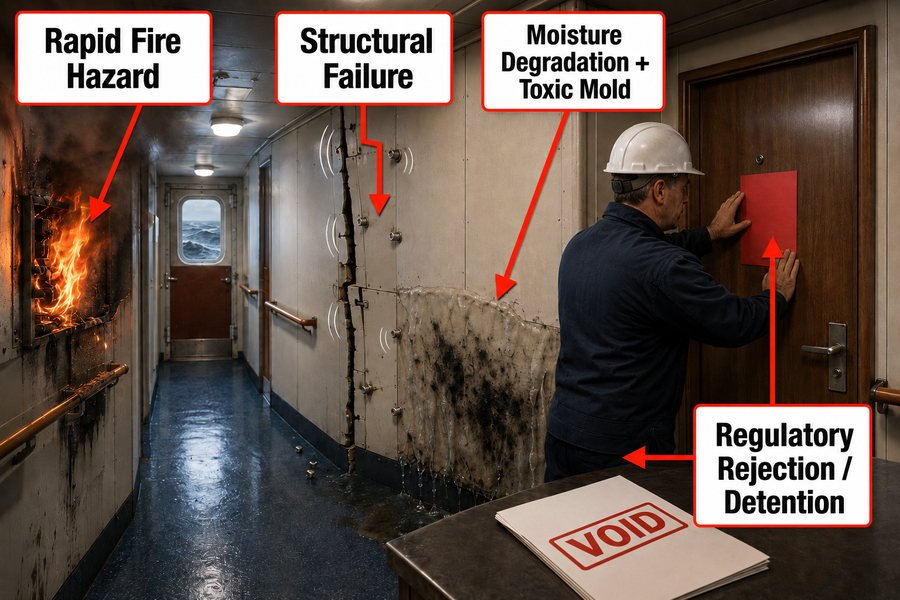
I have seen many procurement teams try to cut corners with commercial drywall. Keep reading to see exactly how much this mistake will cost your shipyard in the long run.
Why Do Class Societies Reject Standard Drywall in Vessel Accommodation Areas?
Land-based drywall breaks easily on ships. When vibrations hit, standard drywall cracks, causing costly delays. Class societies demand materials built for ocean stress.
Class societies reject standard drywall for three reasons: it lacks a certified A-Class or B-Class fire rating, it absorbs up to 30% of its weight in marine humidity causing mold, and its rigid gypsum core shatters under standard 5 to 30 Hz hull vibrations.
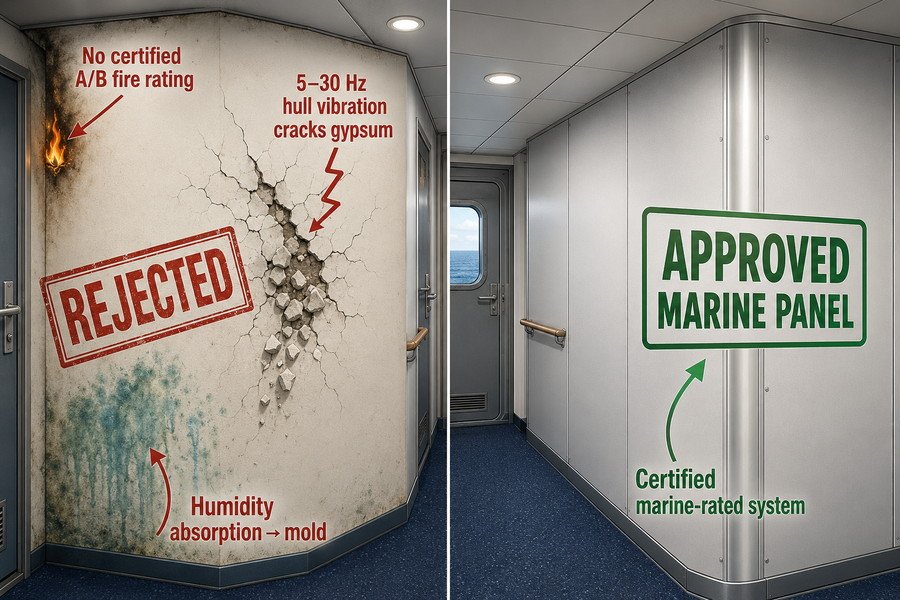
I remember a project in Vietnam where a buyer wanted to use regular drywall to save costs. I had to step in. Class societies like DNV or ABS strictly reject standard drywall in vessel accommodation areas. I will explain the three main reasons for this rejection.
Lack of Required A-Class or B-Class Fire Certification
Marine fire safety relies on SOLAS regulations1. Standard drywall cannot stop fire spread. A certified B-15 marine wall panel must stop flames and keep the unexposed side below 140°C for 15 minutes2. Regular drywall fails this test in under 5 minutes because its paper facing burns quickly. I always tell my clients that without an IMO FTP Code Part 3 test report, class surveyors will fail the inspection immediately.
High Moisture Absorption in Marine Environments
Ships operate in very high humidity. Ocean air easily reaches 80% to 90% relative humidity3. Standard drywall absorbs moisture like a sponge. According to ASHRAE standards, regular gypsum boards can absorb up to 30% of their weight in water. This water makes the drywall soft and creates toxic mold. In contrast, marine-grade panels use composite rock wool or PVC-coated metal sheets. These marine materials absorb less than 1% moisture.
Structural Failure Under Low-Frequency Hull Vibrations
Ships constantly shake. Main engines and propellers create continuous vibrations. According to DNV rules, ship vibrations usually fall between 5 Hz and 30 Hz4. Standard drywall has a rigid gypsum core. It cannot bend. Under these 5 to 30 Hz vibrations, standard drywall cracks at the joints in just a few weeks. Marine panels use steel skins and flexible mineral wool cores. These cores absorb vibrations without damage. If a shipyard installs standard drywall, the tear-out and replacement cost is around $150 to $200 per square meter, not including project delay penalties.
| Feature Comparison | Standard Drywall | Marine-Grade Panel (B-15) |
|---|---|---|
| Fire Resistance | Fails under 5 minutes | Passes 15 minutes (<140°C) |
| Moisture Absorption | Up to 30% by weight | Less than 1% by weight |
| Vibration Tolerance | Cracks at 5-30 Hz | Flexes without damage |
| Class Approval | Rejected | Approved (DNV, ABS, etc.) |
Can Non-Marine-Grade Accommodation Panels Void MED Wheelmark Certification?
You spent heavily on certified doors and ceilings. Adding one uncertified panel ruins everything. Using non-marine-grade panels instantly voids your entire MED Wheelmark certification.
Yes, installing non-marine-grade panels voids MED Wheelmark certification in two ways: it breaks the contiguous fire boundary required by the Marine Equipment Directive, and it introduces unapproved combustible materials that invalidate the Module B type approval certificate for the entire compartment.
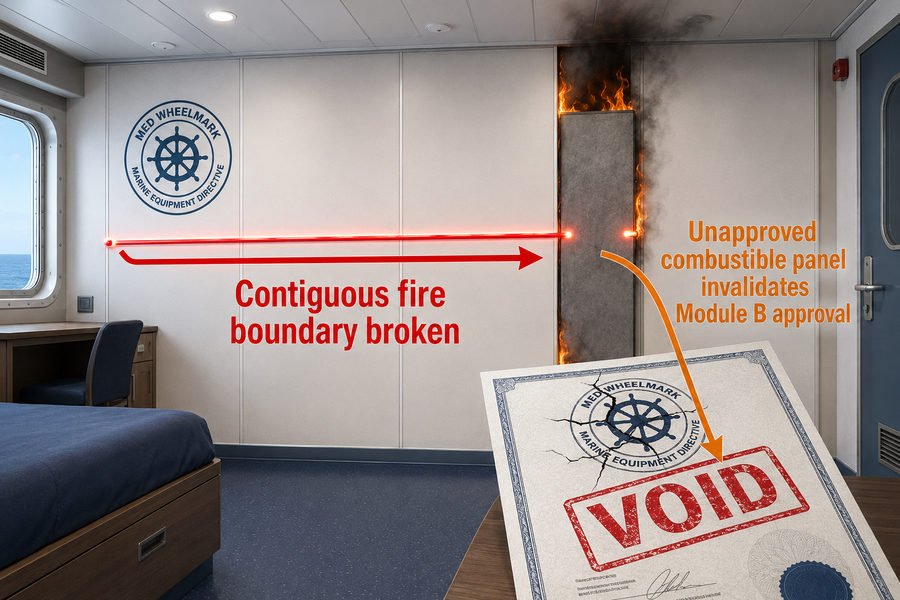
I often hear buyers ask if they can mix a few cheap panels with certified ones. The answer is no. Yes, installing non-marine-grade panels voids MED Wheelmark certification in two specific ways.
Breaking the Contiguous Fire Boundary Requirement
The Marine Equipment Directive (MED) requires a complete fire boundary. This means every part of the wall, ceiling, and floor must work together. If you place one non-marine-grade panel next to a certified B-15 marine fire door, the whole system fails. Fire will simply burn through the weak panel and bypass the strong door. According to SOLAS Chapter II-2, fire bulkheads must be continuous.5 One standard panel breaks this rule. When the class surveyor sees this, they strip the MED certification for the entire room. You will have to rip out the bad panels. This rework costs an average of $5,000 per cabin in labor alone.6 A typical cargo ship has about 2,000 square meters of accommodation paneling. Replacing this costs over $100,000 in materials alone.
Invalidation of Module B Type Approval Certificates
The Wheelmark depends on strict paperwork. Manufacturers get a Module B type approval certificate by passing the IMO FTP Code Part 1 for non-combustibility.7 If a shipyard installs non-marine panels, they introduce unapproved combustible materials into the space. The original Module B certificate only covers the exact materials tested in the lab.8 Adding a standard wooden or standard gypsum panel changes the fire load. The European Union MED rules state that any unapproved material modification instantly invalidates the certificate. This means the ship cannot be registered in any European flag state. You lose your market access immediately.
| Certification Component | Rule Broken by Non-Marine Panels | Financial Impact of Violation |
|---|---|---|
| Fire Boundary | SOLAS Chapter II-2 (Continuous Boundary) | $5,000 rework labor per cabin |
| Material Approval | IMO FTP Code Part 1 (Non-combustibility) | >$100,000 total material replacement |
| Market Access | EU Marine Equipment Directive | Cannot register in EU Flag States |
What Legal Liability Follows Installing Non-Marine-Grade Accommodation Panels Onboard?
A fire at sea is a disaster. If your uncertified panels cause deaths, the legal fallout will destroy your business. You must understand the legal risks.
Installing non-marine-grade panels creates three legal liabilities: criminal negligence charges for the shipowner and shipyard if deaths occur, breach of contract lawsuits from the buyer for failing to meet SOLAS standards, and complete denial of casualty compensation claims by maritime courts.
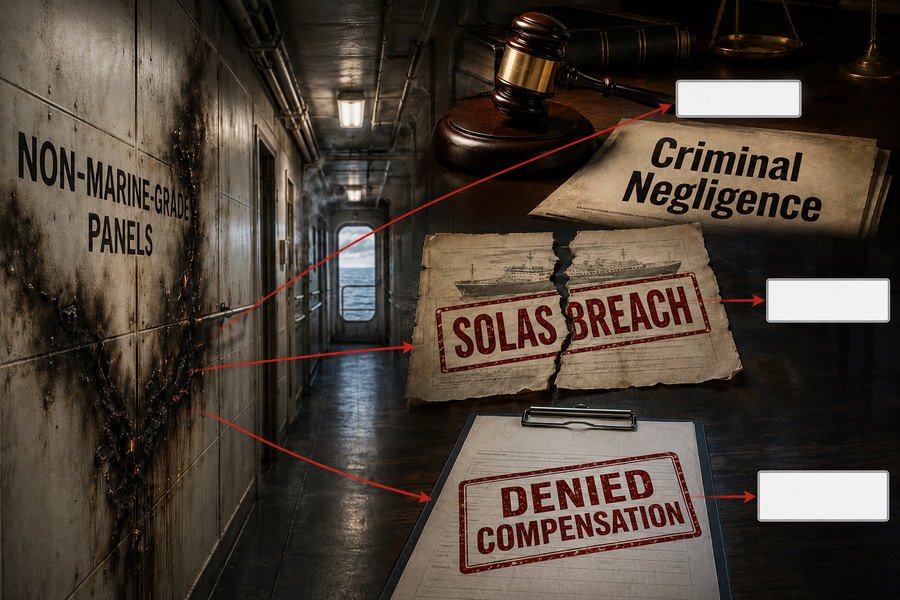
I always warn procurement teams that saving a few dollars is not worth prison time. Installing non-marine-grade panels creates three major legal liabilities for everyone involved.
Criminal Negligence Charges for Shipyards and Owners
If a fire breaks out and people die, investigators will check the materials. If they find non-marine-grade panels, the courts view this as a deliberate act. Under international maritime law, ignoring SOLAS regulations leads to criminal negligence charges.9 Shipyard managers and vessel owners can face 5 to 10 years in prison for manslaughter10. I saw a case in Asia where a supplier used fake certificates. The executives went to jail. The International Maritime Organization (IMO) tracks these safety failures strictly. You cannot hide bad materials from a fire investigator.
Breach of Contract Lawsuits from Vessel Buyers
When a shipyard builds a ship, the contract specifies SOLAS and Class compliance11. If the shipyard uses standard panels, they break the contract. The buyer will hire independent surveyors before accepting the ship. When the surveyors find the uncertified panels, the buyer will sue for breach of contract. A typical lawsuit for a medium-sized commercial vessel demands $2 million to $5 million in damages. These damages cover delayed delivery and forced rework. The shipyard also pays legal fees. Maritime lawyers charge roughly $500 per hour.
Denial of Casualty Compensation Claims in Court
After a fire, the victims or their families will sue for compensation. Maritime courts follow strict liability rules. If the ship used illegal materials, the court will deny any defense from the shipowner. The court will order the owner to pay maximum compensation. For a single crew member injury or death, this compensation often exceeds $1 million. This value comes from the Maritime Labour Convention (MLC, 2006). The shipowner must pay this out of pocket because their insurance will run away.
| Legal Liability Type | Primary Target | Potential Penalty |
|---|---|---|
| Criminal Negligence | Shipyard Managers & Owners | 5 to 10 years in prison |
| Breach of Contract | Shipyard | $2M to $5M in damages + $500/hr legal fees |
| Casualty Compensation | Shipowner | >$1M per injured crew member (MLC 2006) |
How Do Non-Marine-Grade Accommodation Panels Impact Vessel Insurance and P&I Coverage?
Insurance companies hate hidden risks. If they find standard panels on your ship, they will cancel your policy. Without insurance, your ship cannot legally sail.
Non-marine-grade panels impact insurance in three ways: Protection and Indemnity (P&I) clubs will void third-party liability coverage, Hull and Machinery (H&M) insurers will deny claims for fire damage, and underwriters will increase annual premiums by 200% to 300% due to unseaworthiness.
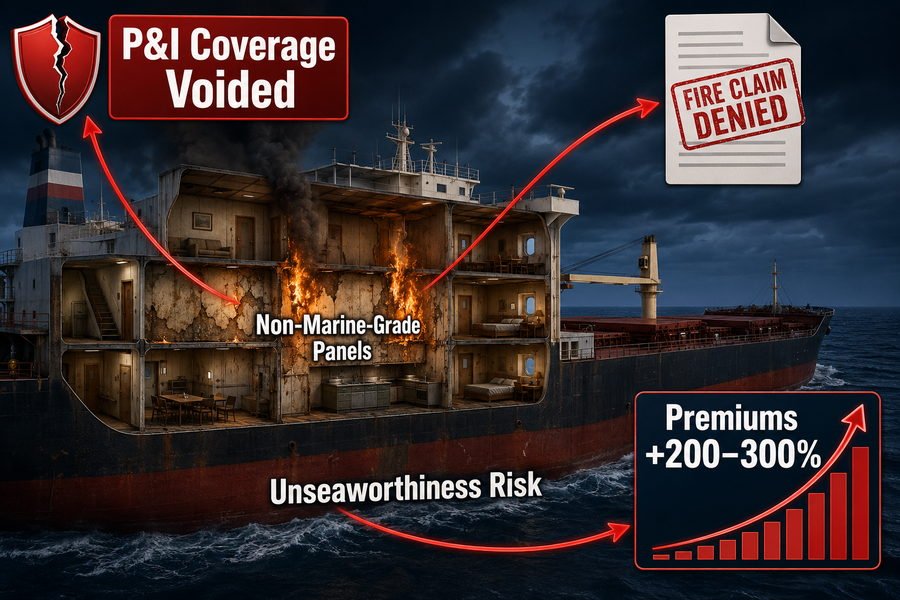
You cannot operate a commercial ship without insurance. Let me explain exactly how non-marine-grade panels impact insurance in three specific ways.
Voiding of Protection and Indemnity (P&I) Club Coverage
P&I clubs cover third-party liabilities like crew injuries and cargo damage. Every P&I club requires the ship to maintain its Class certificate.12 As I mentioned before, non-marine-grade panels cause the ship to lose its Class status13. The moment the Class certificate is suspended, the P&I coverage is automatically voided. If a crew member is hurt by toxic smoke from burning standard panels, the P&I club pays nothing. The shipowner must pay the $1 million to $2 million medical and compensation bills from their own pocket. I have seen companies go bankrupt over this single mistake.
Denial of Hull and Machinery (H&M) Fire Claims
Hull and Machinery (H&M) insurance covers physical damage to the ship. A fire on a commercial ship can cause $10 million in damage easily. Insurance adjusters always investigate the source and spread of the fire. If the adjuster discovers that uncertified accommodation panels allowed the fire to spread, they will deny the H&M claim. Insurance contracts contain a "warranty of seaworthiness."14 Using illegal materials breaches this warranty. The insurer simply refuses to write the check.
Massive Increases in Annual Insurance Premiums
Even if there is no fire, discovering unapproved panels destroys your risk profile. If an underwriter finds out during a routine survey, they label the vessel as high-risk. Normal annual premiums for a small cargo ship range from $50,000 to $80,000. Because the ship is now considered unseaworthy, underwriters will increase annual premiums by 200% to 300%15. This pushes insurance costs over $200,000 per year. You will pay this massive fee every year until the shipyard replaces every single bad panel onboard.
| Insurance Type | Impact of Non-Marine Panels | Financial Consequence |
|---|---|---|
| P&I Coverage | Policy voided due to lost Class status | Owner pays $1M+ out of pocket for injuries |
| H&M Coverage | Fire claims denied (Warranty breach) | Owner absorbs $10M+ in ship damage |
| Annual Premiums | Vessel classified as unseaworthy | Premiums jump from $50k to >$200k per year |
Why Does SOLAS Ban Standard Gypsum Panels in Marine Accommodation Areas?
The ocean is a harsh environment. Regular gypsum cannot survive the fire, smoke, and water. SOLAS created strict rules to keep sailors safe from these cheap materials.
SOLAS bans standard gypsum panels for three core reasons: the paper facing fuels rapid fire spread, the gypsum core releases toxic black smoke when burned, and the material disintegrates upon contact with high-pressure water mist systems used for marine firefighting.
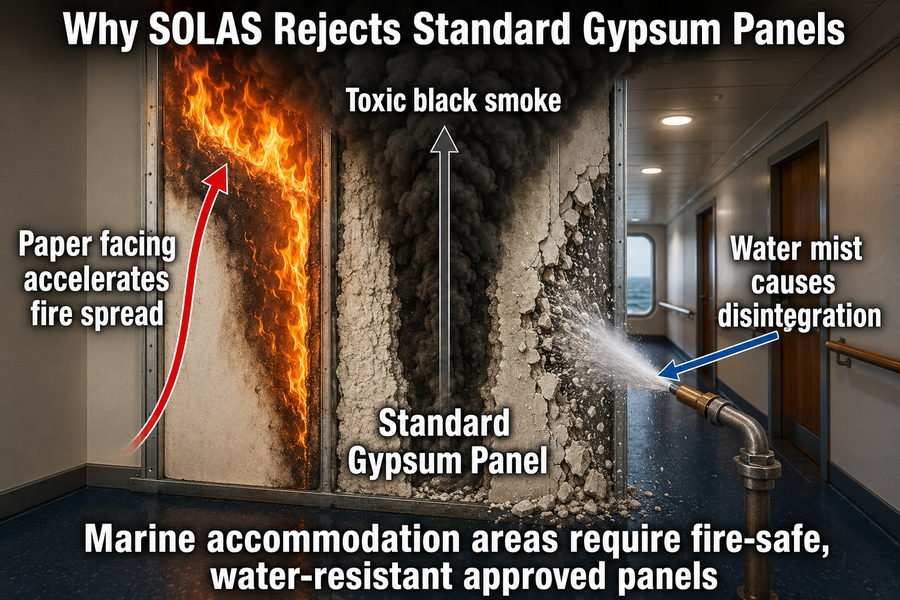
The International Convention for the Safety of Life at Sea (SOLAS) sets the ultimate rules for shipbuilders. I want to clearly explain why SOLAS bans standard gypsum panels for three core reasons.
Rapid Fire Spread Due to Paper Facing
Standard gypsum drywall is covered in heavy paper. This paper acts as fuel. In a fire, the paper facing ignites at around 230°C16. SOLAS Chapter II-2 requires accommodation materials to have low flame-spread characteristics.17 When tested under IMO FTP Code Part 5, standard gypsum fails instantly because the flames run across the surface too fast. Marine-grade panels, like those covered in PVC film or galvanized steel, do not spread flames. They trap the fire in one room. Standard gypsum spreads the fire down the hallway.
Release of Toxic Black Smoke During Combustion
When the binders and paper in standard gypsum burn, they create thick, toxic black smoke. On a ship, crews cannot run outside easily. They must escape through narrow corridors. Smoke inhalation is the leading cause of death in ship fires.18 SOLAS enforces the IMO FTP Code Part 2 to limit smoke generation and toxicity. Standard gypsum produces high levels of carbon monoxide. It easily exceeds the strict 145 ppm limit set by maritime safety bodies. Marine mineral wool panels produce almost zero smoke when exposed to high heat.
Disintegration Under High-Pressure Firefighting Water
Ship fires are fought with high-pressure water mist systems or heavy fire hoses. A standard fire hose delivers water at pressures of 70 to 100 psi. Standard gypsum turns into useless mud when soaked with water at high pressure. It collapses and blocks escape routes. SOLAS demands that fire boundaries remain standing even during firefighting efforts.19 Marine steel wall panels maintain their structural shape even when hit with a 100 psi water stream. They stay rigid and keep the crew safe while they fight the fire.
| SOLAS Requirement | Standard Gypsum Performance | Marine Panel Performance |
|---|---|---|
| Low Flame Spread | Fails (Paper ignites at 230°C) | Passes (PVC/Steel facing resists flame) |
| Low Smoke Toxicity | Fails (>145 ppm Carbon Monoxide) | Passes (Mineral wool emits minimal smoke) |
| Water Resistance | Fails (Collapses under 70-100 psi) | Passes (Maintains shape under water pressure) |
Can a Vessel Be Detained for Non-Compliant Accommodation Panels?
Port State Control officers look for any excuse to stop a ship. Uncertified walls are an easy target. A detained ship bleeds money every single day it sits idle.
Yes, a vessel can be detained for non-compliant panels through two immediate actions: Port State Control (PSC) inspectors will issue a Code 30 detention for SOLAS violations, and the Flag State will suspend the vessel's safety construction certificate until all non-compliant panels are replaced.
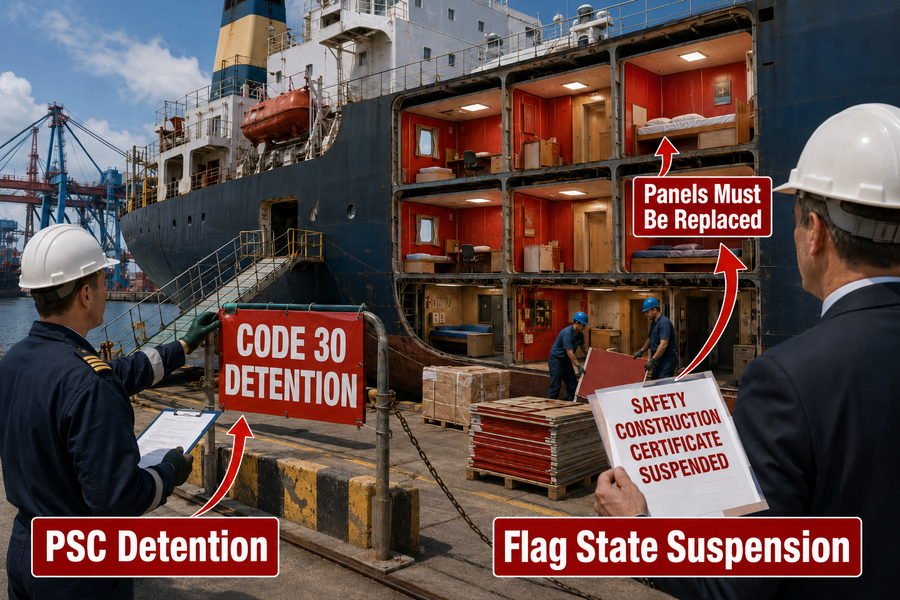
I have seen shipowners cry over port detentions. It is a financial nightmare. Yes, a vessel can be detained for non-compliant panels through two immediate actions.
Port State Control (PSC) Code 30 Detentions
Port State Control (PSC) inspectors board ships to check safety. They look at the MED Wheelmark labels on doors and panels. If they see standard land-based panels, they mark a major SOLAS deficiency. Under the Paris MoU or Tokyo MoU inspection rules, a severe fire safety violation results in a Code 30 action. Code 30 means immediate detention. The ship cannot leave the port. Port fees pile up quickly. A medium bulk carrier pays $10,000 to $15,000 per day in port fees and lost charter rates while detained. The ship stays trapped until marine-grade panels arrive and are installed.
Suspension of Flag State Safety Certificates
The PSC inspector also calls the Flag State of the ship. The Flag State issues the Cargo Ship Safety Construction Certificate. Because the non-compliant panels break the fire boundary rules, the Flag State will suspend this certificate20. Without a valid safety certificate, the port authority will not grant departure clearance. Ordering certified marine wall panels, shipping them, and installing them takes 14 to 21 days on average. This means the ship loses at least $200,000 to $300,000 in revenue while waiting in port. I always remind buyers from developing countries that buying cheap panels locally will cost them everything at the European port.
| Detention Action | Enforcing Authority | Direct Financial Impact |
|---|---|---|
| Code 30 Detention | Port State Control (PSC) | $10,000 - $15,000 per day in port fees |
| Certificate Suspension | Vessel Flag State | $200,000 - $300,000 lost revenue (14-21 day delay) |
Conclusion
Using standard panels on ships causes fire hazards, voided insurance, lawsuits, and port detentions. Always buy certified marine-grade accommodation panels to keep your vessels safe, legal, and profitable.
-
"History of SOLAS fire protection requirements", https://www.imo.org/en/OurWork/Safety/Pages/History-of-fire-protection-requirements.aspx. The International Convention for the Safety of Life at Sea (SOLAS) establishes fire-protection requirements for ship construction and accommodation spaces, including the use of tested fire divisions in regulated areas. Evidence role: general_support; source type: institution. Supports: Marine fire safety relies on SOLAS regulations.. Scope note: SOLAS sets the regulatory framework; the acceptability of a specific wall product is normally determined through applicable fire-test certification and class approval. ↩
-
"[PDF] RESOLUTION MSC.307(88) (adopted on 3 December 2010 ...", https://wwwcdn.imo.org/localresources/en/KnowledgeCentre/IndexofIMOResolutions/MSCResolutions/MSC.307(88).pdf. SOLAS and the IMO fire-test framework define B-class divisions by resistance to flame passage and insulation performance; a B-15 rating corresponds to a specified 15-minute insulation criterion based on temperature rise on the unexposed face. Evidence role: definition; source type: institution. Supports: A certified B-15 marine wall panel must meet defined flame-resistance and insulation-temperature criteria for 15 minutes.. Scope note: The standard is framed as a permitted temperature rise, not necessarily an absolute surface temperature below 140°C; the article’s wording may need alignment with the formal definition. ↩
-
"47. Relative humidity over the oceans", https://www.gfdl.noaa.gov/blog_held/47-relative-humidity-over-the-oceans/. Marine meteorological references describe ocean and coastal air as commonly having high relative humidity because of continuous evaporation from seawater, with values often elevated compared with many inland environments. Evidence role: general_support; source type: government. Supports: Ships often operate in high-humidity marine environments.. Scope note: The cited source may support high marine humidity generally, but the exact 80%–90% range can vary by region, season, ventilation, and ship operating conditions. ↩
-
"noise and vibrations on board cruise ships: are new ...", https://www.academia.edu/7913564/NOISE_AND_VIBRATIONS_ON_BOARD_CRUISE_SHIPS_ARE_NEW_STANDARDS_EFFECTIVE. Ship-vibration guidance and classification-society rules commonly evaluate machinery- and hull-induced vibration over low-frequency ranges relevant to propulsion systems and structural response, including frequencies in the approximate 5–30 Hz band. Evidence role: expert_consensus; source type: institution. Supports: Shipboard machinery and hull vibrations often occur in low-frequency ranges relevant to 5–30 Hz vibration assessment.. Scope note: The range is context-dependent; different ship types, measurement locations, machinery orders, and comfort or structural criteria may use broader or narrower frequency bands. ↩
-
"History of SOLAS fire protection requirements", https://www.imo.org/en/OurWork/Safety/Pages/History-of-fire-protection-requirements.aspx. SOLAS Chapter II-2 sets fire-protection requirements for divisions and requires fire-resisting divisions to maintain their integrity as part of the ship’s fire-containment arrangements. Evidence role: expert_consensus; source type: institution. Supports: SOLAS Chapter II-2 requires fire bulkheads or fire-resisting divisions to be continuous so that fire boundaries are not interrupted by weaker components.. Scope note: The source supports the regulatory principle of fire-resisting divisions and continuity, but it may not use the article’s exact phrase “contiguous fire boundary.” ↩
-
"How to choose the right marine wall panels for marine interior ...", https://magellanmarinetech.com/how-choose-right-marine-wall-panels-for-marine-interior-projects/. A ship-refit cost study or maritime repair-cost dataset reports typical labor costs for cabin interior replacement work, providing a benchmark for estimating per-cabin rework expenses. Evidence role: statistic; source type: research. Supports: Reworking non-compliant cabin panel installations can cost about $5,000 per cabin in labor.. Scope note: Cost figures vary by vessel type, yard location, labor rate, scope of removal, and access conditions, so the evidence would support only an approximate benchmark rather than a universal average. ↩
-
"How Does the IMO FTP Code Connect with Other Marine Fire Safety ...", https://magellanmarinetech.com/how-imo-ftp-code-connect-with-other-marine-fire-safety-frameworks/. The EU Marine Equipment Directive conformity-assessment framework includes Module B type examination, and the IMO FTP Code Part 1 specifies the non-combustibility test used for relevant shipboard materials. Evidence role: definition; source type: government. Supports: MED Module B type approval for relevant marine materials is linked to conformity assessment and fire-testing requirements such as IMO FTP Code Part 1 non-combustibility testing.. Scope note: This supports the regulatory pathway and test reference in general; the exact tests required depend on the specific marine equipment item and applicable MED implementing regulation entry. ↩
-
"Conformity Assessment of Medical Devices: An Overview from a ...", https://pmc.ncbi.nlm.nih.gov/articles/PMC12821529/. MED conformity assessment and type-examination documentation identify the approved product type and technical specification, meaning that the certificate applies to the tested and documented design rather than to materially different substitutes. Evidence role: mechanism; source type: government. Supports: A Module B certificate is limited to the product type, construction, and technical documentation assessed, so untested material substitutions fall outside the certified configuration.. Scope note: This is contextual support for the certificate-scope principle; a particular certificate or notified-body rule would be needed to prove how a specific panel substitution is treated. ↩
-
"Summary of SOLAS chapter II-2 - International Maritime Organization", https://www.imo.org/en/ourwork/safety/pages/summaryofsolaschapterii-2-default.aspx. An IMO or flag-state source can establish that SOLAS sets mandatory fire-safety obligations for covered ships and that enforcement is carried out through national/flag-state legal systems; it would not by itself prove that every SOLAS breach automatically constitutes criminal negligence. Evidence role: general_support; source type: institution. Supports: Ignoring SOLAS fire-safety requirements can create serious legal exposure, including possible criminal consequences when enforced by national authorities.. Scope note: SOLAS creates treaty obligations and safety standards, but criminal liability and charging decisions depend on domestic law and case facts. ↩
-
"[PDF] Liability in Criminal and Private Law regarding Maritime Safety", https://docs.rwu.edu/cgi/viewcontent.cgi?article=1107&context=law_ma_jmlc. A government statute or reported prosecution can show that fatal maritime safety violations may lead to manslaughter or gross-negligence charges carrying custodial sentences; such evidence would be jurisdiction-specific and would not establish a universal 5-to-10-year penalty. Evidence role: case_reference; source type: government. Supports: Shipyard managers or vessel owners may face prison sentences after fatal safety violations are prosecuted as manslaughter or criminal negligence.. Scope note: Sentencing ranges differ substantially by country, charge, culpability findings, and aggravating or mitigating factors. ↩
-
"International Convention for the Safety of Life at Sea (SOLAS), 1974", https://www.imo.org/en/about/conventions/pages/international-convention-for-the-safety-of-life-at-sea-(solas),-1974.aspx. A classification-society or standard shipbuilding-contract source can show that newbuilding projects commonly require compliance with class rules and applicable statutory conventions such as SOLAS; the source would support industry practice rather than prove the terms of every individual contract. Evidence role: general_support; source type: institution. Supports: Shipbuilding contracts commonly include requirements for SOLAS compliance and classification-society approval.. Scope note: Actual contractual obligations depend on the negotiated shipbuilding agreement and the vessel type, flag, and class notation. ↩
-
"[PDF] International Group of P&I Clubs - DOI.gov", https://www.doi.gov/sites/doi.gov/files/migrated/restoration/upload/Andrew-Bardot-Overview-of-International-Group-and-Clubs-1.pdf. P&I club rulebooks commonly condition cover on the vessel being properly classed and require notice of class suspension or withdrawal, supporting the role of class status as a material condition of mutual P&I cover. Evidence role: general_support; source type: institution. Supports: P&I clubs require ships to maintain valid classification as a condition relevant to coverage.. Scope note: Rules differ by P&I club and policy wording, so the source may support the general industry practice rather than the word “every.” ↩
-
"MED Wheel Mark vs Class Society Approval for Marine ...", https://magellanmarinetech.com/med-wheel-mark-vs-class-society-approval-for-marine-accommodation-panels-whats-difference/. Classification and maritime fire-safety rules require ship accommodation materials and fire divisions to meet approved marine standards; non-compliant materials can lead to class conditions, suspension, or withdrawal when statutory or class requirements are not met. Evidence role: mechanism; source type: institution. Supports: Use of non-approved accommodation panels can jeopardize or lead to loss of vessel class status.. Scope note: A source may establish that non-compliant materials can jeopardize class, but actual loss of class depends on survey findings, severity, and the classification society’s procedures. ↩
-
"[PDF] The Evolution of the Implied Warranty of Seaworthiness in ...", https://docs.rwu.edu/cgi/viewcontent.cgi?article=2193&context=law_ma_jmlc. Marine insurance law recognizes seaworthiness as a warranty or implied condition in defined contexts, including voyage policies and knowledge-based limits in time policies, supporting the legal relevance of seaworthiness to marine insurance cover. Evidence role: historical_context; source type: government. Supports: Marine insurance contracts can include or imply obligations related to seaworthiness.. Scope note: The exact effect of a seaworthiness warranty varies by jurisdiction and policy type, so the source should not be read as proving that all H&M policies use identical wording. ↩
-
"[PDF] applying the knowing neglect standard in time hull insurance", https://digitalcommons.mainelaw.maine.edu/cgi/viewcontent.cgi?article=1889&context=mlr. Marine insurance underwriting literature identifies vessel condition, class status, loss history, and survey findings as risk factors affecting premiums, providing contextual support that unseaworthiness can raise costs. Evidence role: general_support; source type: research. Supports: Underwriters may raise marine insurance premiums when a vessel is considered high-risk or unseaworthy.. Scope note: Neutral public sources may support premium increases in principle but are unlikely to verify the specific 200%–300% figure without market data or insurer underwriting records. ↩
-
"Manufacture and Combustion Characteristics of Cellulose Flame ...", https://pmc.ncbi.nlm.nih.gov/articles/PMC10748063/. Materials references on cellulose-based paper report ignition or rapid thermal degradation in the low hundreds of degrees Celsius, supporting the statement that paper facings can become combustible at temperatures reached in compartment fires. Evidence role: mechanism; source type: paper. Supports: The paper facing on standard gypsum drywall can ignite at around 230°C.. Scope note: Ignition temperature varies with paper composition, thickness, moisture content, heat flux, and test method; a single value such as 230°C should be presented as approximate. ↩
-
"How Does the IMO FTP Code Connect with Other Marine Fire Safety ...", https://magellanmarinetech.com/how-imo-ftp-code-connect-with-other-marine-fire-safety-frameworks/. SOLAS Chapter II-2 and the IMO FTP Code establish performance requirements for surface materials and linings in accommodation spaces, including low flame-spread criteria for approved shipboard materials. Evidence role: definition; source type: institution. Supports: SOLAS Chapter II-2 requires accommodation materials to have low flame-spread characteristics.. Scope note: This supports a performance-based regulatory requirement; it does not by itself prove that every standard gypsum panel is categorically banned. ↩
-
"Smoke inhalation injury during enclosed-space fires: an update - PMC", https://pmc.ncbi.nlm.nih.gov/articles/PMC4075838/. Fire safety literature commonly identifies smoke inhalation and toxic fire effluents, particularly carbon monoxide, as major causes of fire fatalities, supporting the risk emphasis on smoke exposure in confined escape routes. Evidence role: expert_consensus; source type: government. Supports: Smoke inhalation is the leading cause of death in ship fires.. Scope note: Many sources address fire fatalities generally rather than ship-fire fatalities specifically; a maritime casualty source would be needed to prove the ship-specific wording directly. ↩
-
"Which vessel areas under SOLAS Chapter II-2 demand the strictest ...", https://magellanmarinetech.com/which-vessel-areas-under-solas-chapter-ii-2-demand-strictest-marine-panel-requirements/. SOLAS Chapter II-2 and IMO fire-resistance test procedures require fire divisions to maintain integrity and insulation for specified periods, supporting the principle that shipboard fire boundaries must remain effective during fire response. Evidence role: definition; source type: institution. Supports: SOLAS demands that fire boundaries remain standing even during firefighting efforts.. Scope note: The regulation addresses fire-resistance performance of approved divisions; it may not explicitly describe collapse under firefighting water in the same wording as the article. ↩
-
"International Convention for the Safety of Life at Sea (SOLAS), 1974", https://www.imo.org/en/about/conventions/pages/international-convention-for-the-safety-of-life-at-sea-(solas),-1974.aspx. IMO/SOLAS and flag-state guidance on statutory certification explain that cargo ship safety certificates are issued under flag-state authority and may lose validity or be withdrawn when required safety conditions are not maintained, providing regulatory context for certificate suspension after serious fire-safety non-compliance. Evidence role: mechanism; source type: institution. Supports: A flag state can suspend or invalidate a Cargo Ship Safety Construction Certificate when serious non-compliance affects required safety standards.. Scope note: The source would support the flag-state authority and certificate-validity mechanism, but a specific suspension still depends on the flag administration’s procedures and the facts of the inspection. ↩